Showing posts with label Israeli war crimes. Show all posts

Tuesday, January 27, 2015

1712. Disillusioned by War, Israeli Soldiers Muted in 1967 Are Given Fuller Voice

By Jodi Rudoren, The New York Times, January 25, 2015


Tel Aviv--A young Israeli soldier, fresh from the front, bluntly recounts the orders from above. “They never said, ‘Leave no one alive,’ but they said, ‘Show no mercy,’ ” he explains. “The brigade commander said to kill as many as possible.”

Another recalls encountering Arabs on rooftops. “They’re civilians — should I kill them or not?” he asks himself. “I didn’t even think about it. Just kill! Kill everyone you see.” And a third makes it personal: “All of us — Avinoam, Zvika, Yitzhaki — we’re not murderers. In the war, we all became murderers.”

The wrenching, taped testimony is not from last summer’s bloody battle in the Gaza Strip but from the 1967 war, when Israel started out fighting Egypt, Jordan and Syria for its very survival and ended up seizing the West Bank, Gaza, the Sinai Peninsula and parts of the Golan Heights. As the International Criminal Court considers a war crimes investigation in the recent conflict, a new documentary film is showcasing previously unaired admissions of brutal behavior by an earlier generation.

The film,Censored Voices,” premiered at the Sundance Film Festival on Saturday, the latest in a series of movies by leftist Israeli filmmakers who have won awards abroad by presenting harsh looks at their own society. Based on interviews that the military heavily edited at the time, it includes accounts of Israelis summarily executing prisoners and evacuating Arab villages in a manner that one fighter likened to the Nazis’ treatment of European Jews.

The director, Mor Loushy, said in an interview that she was trying to revamp the prevailing Israeli narrative of triumph in 1967 in light of all that has happened since, and that the film “is very relevant for today.”

But with Israel increasingly in a defensive crouch on the international stage, the film raises concerns that, viewed without consideration for the existential threat Israel faced at the time, it could become catnip for contemporary critics.

“People abroad who don’t remember the way we do the circumstances of the Six-Day War will turn this into one more indictment of Israel,” said Yossi Klein Halevi, whose 2013 book, Like Dreamers, followed the lives of a group of 1967 veterans. “If there were isolated acts of abuse by our soldiers, that should not become the narrative about what the Six-Day War was about. Many of us here are, frankly, sick and tired of the blame-Israel-first narrative.”

Asked to respond to the film, Lt. Col. Peter Lerner of the Israel Defense Forces said it was “representative of Israel’s vibrant democracy, where everything can be and is openly discussed,” but not particularly pertinent to current debates over military conduct. While 1967 was a war between sovereign states, Colonel Lerner noted, today Israel faces “belligerent nonstate or semistate” actors with weapons “dispersed within the civilian arena.”

“Any attempt to draw similarities between the two,” he said in an email, “is weak and nonrepresentative of how warfare has developed, how the battlefield has evolved and how today terrorism takes precedence over traditional warfare.”

The 84-minute film had a budget under $1 million, financed mainly by Israeli and European broadcasters and the American documentary producer Impact Partners. Interspersing the 1967 interviews with archival footage from the war and ABC News’s coverage of it, it does make clear the imminent threat to Israel — and then the stunning turnabout that military historians have long considered a marvel.

Beyond the accounts of killing prisoners and civilians, perhaps the most striking element of the film is that within a week or two of the war’s end, these soldiers — from Israel’s socialist kibbutz movement — questioned its wisdom.

“I think that in the next round the Arabs’ hatred towards us will be much more serious and profound,” one says. Already ambivalent about the occupation of Palestinian territory, another worries, “Not only did this war not solve the state’s problems, but it complicated them in a way that’ll be very hard to solve.”

As Ms. Loushy put it, “This is the story of men who went out to war feeling like they had to defend their life, and they were right, of course, but they went out in one position and came back as conquerors.”
“If those voices had been published in 1967,” she said, “maybe our reality here would be different.”

Some of the voices were published at the time in “A Conversation With Warriors,” a collection edited by Avraham Shapira that sold a stunning 120,000 copies in Israel. (The English-language version is called “The Seventh Day.”) Mr. Halevi said its publication “was the moment when part of Israeli society started sobering up from the euphoria.”

When Ms. Loushy, 32, tripped across a copy doing research for a history paper, she was riveted by how different its tone was from the 1967 story she had learned in school. She cajoled Mr. Shapira, an aging kibbutznik and philosophy professor, to share the original audiotaped interviews that he had denied to legions of journalists and historians.

“If you listen — not hearing but listening — to the recordings, there is a symphony of sounds: There are screams, crying, real weeping,” Mr. Shapira said in an interview. “They anticipated what can happen if we’ll not work immediately for peace, practically to return back all the occupied territories. They express it as an inner feeling, no politics.”

He said current soldiers had told him that they found in these old interviews “a deep, personal expression of their own moral and human dilemmas.”

Ms. Loushy, whose previous film, “Israel Ltd.,” attempted to unmask Zionist propaganda tours, listened to 200 hours of tapes over eight months, much of which the censors had blocked from publication in the book. She was deep into the project before she discovered that the film, too, would be subject to censorship, she said.

Israel forbids the filmmakers to reveal how much they were forced to change, and the military censor’s office refused to discuss it.

“For us as a society to mend and to improve ourselves, we can’t censor,” Ms. Loushy said. “I think it’s important that we look the truth in the eyes.”

The film’s star is the original reel-to-reel tape recorder that Mr. Shapira bought in 1967. It replays the interviews as the soldiers — now graying, wrinkled men — sit alongside, sometimes closing their eyes or cringing a bit. Only in the final few minutes do some of them speak, briefly. One says he has become “less Zionist, less patriotic, less of a believer,” and another says, “I’m much more right wing than before.”

Pinchas Leviatan, 73, a retired horticulturalist and teacher, said in an interview that when Ms. Loushy had come to his home and played the tape, he had not recognized the voice, “but when I heard what I said, I was sure that it was me.” He had been telling the same stories to students for years.

In the film, Mr. Leviatan talks of being emotionally broken by seeing the humiliation of Egyptian soldiers after the fighting, when they “came with canteens filled with urine” and, upon being given water, “threw up on our feet and kissed us.” He is one of the Israeli soldiers whose views have changed with time.

“I was convinced that the peace is coming, and maybe after the Six-Day War I was hoping that it’s going to happen,” he said in the interview. “I was very naïve. I participated in another five wars as a commanding officer. The fact is that during the years, I lost my belief in the possibility of getting any solution in the area.”

Thursday, November 27, 2014

1660. Archbishop of Westminster Shocked by Effects of Gaza War

By Harriet Sherwood, The Guardian, November 23, 2014

Vincent Nichols, centre, the archbishop of Westminster, meets a priest at Der Latin church in Gaza City. Photograph: Mohammed Salem/Reuters.


The archbishop of Westminster said he was deeply shocked by his first visit to Gaza on Sunday, and that he had seen “a deeply depressing situation in a devastated region where people are trapped”.

Cardinal Vincent Nichols, the leader of the Roman Catholic church in England and Wales, toured neighbourhoods of Gaza that were virtually flattened during the 50-day war between Israel and Hamas in the summer. He visited a hospital and an industrial zone that were badly damaged by air strikes and shelling, and an orphanage caring for dozens of traumatised children, some of whom had been given up by parents unable to care for them.
“I was deeply shocked at the effects of war and endemic poverty,” he told the Guardian. “Pope Francis has said there must be an end to war, and when you see the effect in a place like Gaza it reinforces that.”

There was little sign of rubble being cleared, let alone reconstruction, he said. “It’s astonishing the number of people with the appearance of nothing to do – people just sitting on the streets. There is only the barest sense of order. This is not an economy that is going to be able to support its population.”

Nichols said he was concerned about “the innocent citizens of Gaza caught in a vice of conflicting ideologies – an almost impossible situation for them”.

The greatest fear was that the “rule of the extremists” was coming to the fore in the Middle East. “Political leaders must not be satisfied with a security or military response, but need to find a political solution,” he said.

Real political leadership was essential, he added, but “optimism is not the word that comes to mind, yet without it things will get worse.”

He had given an undertaking to the people he met in Gaza that he would try to widen public understanding of their situation, he said. Nichols has previously spoken in support of Palestinian Christians whose homes and livelihoods are threatened by a section of the vast concrete security barrier Israel is building near the West Bank town of Bethlehem.

During last summer’s war more than 2,000 Palestinians were killed in Gaza, while Israel puts its death toll at 66 soldiers and six civilians, including a Thai worker. About 17,000 homes in Gaza were destroyed and reconstruction costs have been estimated at £5bn.

Wednesday, November 5, 2014

1623. Families Under Rubbles: Israeli Attack on Inhabited Homes in Gaza Strip

By Amnesty International, 2014

Left, Palestinian men burying members of a family who were killed in an Israeli airstrike in Gaza this summer. Right, Israeli residents took cover from a rocket attack by Palestinian militants. A 50-day war was fought before a cease-fire was reached in August. Photos: Sergey Ponomarev for The New York Times; Gil Cohen Magen/Agence France-Presse — Getty Images


The following is the "Introduction" to the fifty page Amnesty International report on human right violations in the Israeli war against the Palestinian population in Gaza Strip. The full report can be found here.  This is the third war people of Gaza Strip have faced in 6 years. KN


*     *     *

Introduction
Israeli air strikes during Israel’s recent military operation in the Gaza Strip, Operation Protective Edge, targeted inhabited multistorey family homes. Whole families, including many women and children, were killed or injured by these targeted strikes and, in addition, there was extensive destruction of civilian property.

These attacks were carried out in the context of a 50-day conflict, from 8 July until 26 August, in which the scale of destruction, damage, death and injury to Palestinian civilians, homes and infrastructure was appalling. According to figures released by the United Nations, some 1,523 civilians, including 519 children, are among more than 2,192 Palestinians who died during the operation. By the time of the ceasefire on 26 August there were approximately 110,000 internally displaced persons living in emergency shelter and with host families. The UN estimated that about 18,000 housing units were destroyed or rendered uninhabitable, leaving approximately 108,000 people homeless. A further 37,650 housing units were damaged.

At the same time, Hamas and other Palestinian armed groups fired thousands of indiscriminate rockets and mortar rounds into civilian areas of Israel, killing six civilians, including one child.3 Dozens of other Israelis, including at least six children, were directly injured by rockets or shrapnel. A total of 66 soldiers were killed in the fighting.

Amnesty International has documented and is continuing to document serious violations of international humanitarian law, including unlawful killings and injuries to civilians and destruction of civilian property, both by Israel and by Hamas and Palestinian armed groups.
In this report Amnesty International examines targeted Israeli attacks carried out on inhabited civilian homes in the light of Israel’s obligations under international humanitarian law, specifically the rules on the conduct of hostilities. It does so by focusing on eight cases, in which targeted Israeli attacks resulted in the deaths of at least 111 people, of whom at least 104 were civilians, including entire families, and destroyed civilian homes. The cases were chosen for a variety of reasons, including the availability of witnesses, the clarity of the evidence and the number of civilians killed. They include two cases in which there were particularly high civilian casualties (at least 33 civilians killed in the bombing of the al-Dali building and 25 in the destruction of the Abu Jame’ family home).

In all the cases documented in this report, there was a failure to take necessary precautions to avoid excessive harm to civilians and civilian property, as required by international humanitarian law. In all cases, no prior warning was given to the civilian residents to allow them to escape.

In four of the cases (the attacks on the Abu Jame’ family home, the al-Dali building, the al- Bakri family home and the Abu Dahrouj family home), in which a total of at least 66 civilians were killed, Amnesty International has been able to identify a named individual who was an apparent member of an armed group. However, even if a fighter or a military objective was indeed present (or thought to have been present), the loss of civilian lives, injury to civilians

Israeli attacks on inhabited homes and damage to civilian objects appear disproportionate, that is, out of proportion to the likely military advantage of carrying out the attack, or otherwise indiscriminate. However, due to lack of information from the Israeli authorities, Amnesty International cannot be certain in any of these attacks what was being targeted. In cases where there is no military objective, an attack could violate the international humanitarian law prohibition of direct attacks on civilian objects and on civilians. Attacks directed at civilian objects or at civilians, or disproportionate and indiscriminate attacks that kill or injure civilians are war crimes. The fact that, in these eight cases which caused the deaths of at least 104 civilians, Israel has made no statement about who or what was being targeted, or even acknowledged that it carried out these particular attacks and the loss of civilian lives that they caused, is deeply worrying.

These attacks fit into a broader pattern. In addition to the cases detailed in this report, Amnesty International has documented more than 12 other targeted attacks that caused the deaths of civilians, including children, and destroyed all or part of inhabited home. Most appear to have been aerial attacks conducted by manned aircraft. Looking more widely at Israeli attacks of different kinds, including attacks during heavy fighting in areas such as al- Shuja’iyeh and Khuza’a, the Israeli human rights organization B’Tselem listed 72 homes destroyed in the Gaza Strip in whole or in part with families inside them up until 11 August 2014. This destruction killed 547 people, of whom 125 were women under the age of 60, 250 were minors, and 29 were people over the age of 60.

In all the cases described in this report and other similar ones during the conflict, the onus is on Israel to provide information concerning the attacks and their intended targets. Israel must also explain what precautions were taken to spare civilians in attacks that targeted military objectives but resulted in civilian deaths and injuries and destruction of civilian homes. The cases documented in this report, as well as other credible allegations of serious violations of international humanitarian law, must be promptly, independently and impartially investigated, in accordance with international law and standards and, wherever there is sufficient admissible evidence, alleged perpetrators, be they military or civilian officials, must be brought to justice in proceedings that fully respect international fair trial standards. Civilian victims and their families should receive full reparation. In addition, it is important that, following investigations, the Israeli military should learn the lessons of this and previous conflicts and change its military doctrine and tactics for fighting in densely populated areas such as Gaza so as to ensure strict compliance with international humanitarian law, in particular the principles of distinction, proportionality and precaution.

METHODOLOGY
Amnesty International has been unable to send a delegation of researchers to visit the Gaza Strip since the beginning of the conflict. The Israeli authorities have refused, up to the time of writing this report, to allow it and other international human rights monitors to enter the Gaza Strip through the Erez crossing with Israel, despite the organization’s repeated requests since the beginning of the conflict to do so. The Egyptian authorities have also not granted Amnesty International permission to enter the Gaza Strip through the Rafah crossing with Egypt, again despite the organization’s repeated requests to do so.

Amnesty International has consequently had to carry out research remotely, supported by two fieldworkers based in Gaza who were contracted to work with the organization for periods of several weeks. They travelled extensively within the Strip, visiting every site described in this briefing more than once, as soon as possible after the damage took place, interviewing victims and eyewitnesses of every case recorded and taking photos and videos of the sites. The organization consulted on the interpretation of photos and videos with military experts. It extensively reviewed relevant statements by the Israeli military and other official bodies, but they provide no indication as to whether any of the attacks in this report were directed at a particular military target. Amnesty International has therefore made considerable efforts to assess the military purpose, if any, of each attack. Amnesty International also studied relevant documentation produced by UN agencies, Palestinian, Israeli and other non- governmental organizations, local officials, media, and others who monitored the conflict, and consulted with them as needed.

Despite these efforts, the lack of access for Amnesty International’s researchers, as well as military and medical experts who would have accompanied them, has clearly hindered the work of Amnesty International, as it has hindered the work of other human rights organizations that have wished to document violations of international law in the Gaza Strip. 

Medical evidence and evidence of weapons used, both in damaged buildings and elsewhere, help monitors to assess how, with what and why something was targeted, but they disappear quickly. Suffering from a great shortage of living space, residents of the Gaza Strip started almost immediately after the conflict, as after other recent conflicts, to clear up the rubble and use what can be salvaged to rebuild their homes. Fragments of munitions which would have shown what weapons were used have been carried off from the rubble of destroyed homes by civil defence workers, souvenir hunters and others.

Governments who wish to hide their violations of human rights from the outside world have frequently banned Amnesty International from accessing the places in which they have been committed. Although Amnesty International researchers have consistently been able to access Israel and the occupied West Bank, they have not been allowed by the Israeli government to enter the Gaza Strip through the Erez crossing since June 2012. The UN Fact- Finding Mission on the Gaza Conflict, which was set up by the UN Human Rights Council and reported in 2009 on violations of international law by all sides during Israel’s Operation Cast Lead in the Gaza Strip criticized this policy stating: “The Mission is of the view that the presence of international human rights monitors would have been of great assistance in not only investigating and reporting but also in the publicizing of events on the ground.”6 It added: “The presence of international human rights monitors is likely to have a deterrent effect, dissuading parties to a conflict from engaging in violations of international law.”

Amnesty International sent its findings to the Israeli authorities on 8 October 2014, requesting any relevant information that could be provided on each of the cases in this report. It sent a memorandum to the three Israeli mechanisms investigating aspects of Operation Protective Edge – the State Comptroller, the army’s General Staff Mechanism for Fact-Finding Assessments, and the Knesset Foreign Affairs and Defense Committee – as well as to the army’s Chief of General Staff, the Prime Minister and the Ministers of Defense, Justice and Foreign Affairs. It asked for explanations of why each of these attacks was carried out; who or what was being targeted; what means of attack were selected; what precautions were taken to minimize the risk of harm to civilians and civilian objects; and whether any investigation had taken place or was ongoing. It had not received a response before this report was finalized, but any response received will be reflected in future publications.

Wednesday, August 27, 2014

1518. 40 Holocaust Survivors Condemn Gaza Assault and Call for Boycott of Israel

By David Harris-Gershon, Tikkun Daily, August 23, 2014
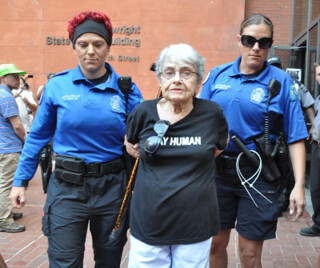
One of the signatories, the 90 year old Hedy Epstein who was recently arrested in St. Louis, Missouri demanding justice for black teenager Michael Brown killed by the police
In a letter published today in The New York Times as an advertisement, 40 survivors of Nazi genocide and hundreds of their children are publicly deploring “the massacre of Palestinians in Gaza,” Israel’s ongoing occupation, and the troubling rise of systemic racism.
The letter, a response to an advertisement posted recently by Eli Wiesel, in which Palestinians were portrayed as championing “child sacrifice,” is the first of its kind to be signed by so many Holocaust survivors, who are making waves by calling for a full boycott of Israel – roundly viewed as anathema by Jewish institutions in both the United States and Europe. Below is the full text of their letter:
As Jewish survivors and descendants of survivors and victims of the Nazi genocide we unequivocally condemn the massacre of Palestinians in Gaza and the ongoing occupation and colonization of historic Palestine. We further condemn the United States for providing Israel with the funding to carry out the attack, and Western states more generally for using their diplomatic muscle to protect Israel from condemnation. Genocide begins with the silence of the world.We are alarmed by the extreme, racist dehumanization of Palestinians in Israeli society, which has reached a fever-pitch. In Israel, politicians and pundits in The Times of Israel and The Jerusalem Post have called openly for genocide of Palestinians and right-wing Israelis are adopting Neo-Nazi insignia.Furthermore, we are disgusted and outraged by Elie Wiesel’s abuse of our history in these pages to justify the unjustifiable: Israel’s wholesale effort to destroy Gaza and the murder of more than 2,000 Palestinians, including many hundreds of children. Nothing can justify bombing UN shelters, homes, hospitals and universities. Nothing can justify depriving people of electricity and water.We must raise our voices and use our collective power to bring about an end to all forms of racism, including the ongoing genocide of Palestinian people. We call for an immediate end to the siege against and blockade of Gaza. We call for the full economic, cultural and academic boycott of Israel. “Never again” must mean NEVER AGAIN FOR ANYONE!

One of the signatories is Hedy Epstein, the 90-year-old human rights activist who was recently arrested in St. Louis before Governor Jay Nixon’s downtown office, protesting his actions and the actions of militarized police in Ferguson, Missouri. Epstein (left) has long been a prominent voice in various civil and human rights movements, including those fighting for the human rights of Palestinians in both the West Bank and Gaza. Her voice is now being joined by many others who survived the horrors of the Holocaust, by aligning with the BDS movement, in visible and controversial ways.
The letter’s appearance in the Times comes on the heels of an op-ed by Anthony Lerman which appeared in those pages on Friday. Entitled “The End of Liberal Zionism.” It echoed many of the same critiques as those found in the letter.
As the death toll in Gaza continues to rise – nearly 2,100 people have died, mostly civilians – a growing number of diaspora Jews, from prominent journalists to community members, are finding themselves pained by Israel’s actions and conflicted by their simultaneous support for and critiques of Israel.
These 40 survivors of one of the worst atrocities in human history have gone a step further, placing themselves in the post-Zionist camp due to what they see in Israel. Such voices have always been looked upon as a moral conscience within the Jewish community. Holocaust survivors speaking out in such an extreme way represents something profound taking place amidst the profoundly troubling history being created in the region.
As rockets continue to be fired into Israel and missiles continue to be dropped on Gaza, as innocents on both sides are terrorized, it’s far too easy for such violence to be justified, particularly by a people, my people, who have endured the wrath of history.

These 40 voices should give such justifications pause.

Saturday, August 16, 2014

1515. The Lancet: An Open Letter On the Behalf of the People of Gaza

By  Paola Manduca aIain Chalmers bDerek Summerfield cMads Gilbert dSwee Ang e, on behalf of 24 signatories, The Lancet, August 2, 2014

Al-Aqsa Martyrs hospital in Deir al-Balah in Gaza Strip was bombed by Israel killing four people.
We are doctors and scientists, who spend our lives developing means to care and protect health and lives. We are also informed people; we teach the ethics of our professions, together with the knowledge and practice of it. We all have worked in and known the situation of Gaza for years.

On the basis of our ethics and practice, we are denouncing what we witness in the aggression of Gaza by Israel.

We ask our colleagues, old and young professionals, to denounce this Israeli aggression. We challenge the perversity of a propaganda that justifies the creation of an emergency to masquerade a massacre, a so-called “defensive aggression”. In reality it is a ruthless assault of unlimited duration, extent, and intensity. We wish to report the facts as we see them and their implications on the lives of the people.

We are appalled by the military onslaught on civilians in Gaza under the guise of punishing terrorists. This is the third large scale military assault on Gaza since 2008. Each time the death toll is borne mainly by innocent people in Gaza, especially women and children under the unacceptable pretext of Israel eradicating political parties and resistance to the occupation and siege they impose.

This action also terrifies those who are not directly hit, and wounds the soul, mind, and resilience of the young generation. Our condemnation and disgust are further compounded by the denial and prohibition for Gaza to receive external help and supplies to alleviate the dire circumstances.

The blockade on Gaza has tightened further since last year and this has worsened the toll on Gaza's population. In Gaza, people suffer from hunger, thirst, pollution, shortage of medicines, electricity, and any means to get an income, not only by being bombed and shelled. Power crisis, gasoline shortage, water and food scarcity, sewage outflow and ever decreasing resources are disasters caused directly and indirectly by the siege.1
People in Gaza are resisting this aggression because they want a better and normal life and, even while crying in sorrow, pain, and terror, they reject a temporary truce that does not provide a real chance for a better future. A voice under the attacks in Gaza is that of Um Al Ramlawi who speaks for all in Gaza: “They are killing us all anyway—either a slow death by the siege, or a fast one by military attacks. We have nothing left to lose—we must fight for our rights, or die trying.”2

Gaza has been blockaded by sea and land since 2006. Any individual of Gaza, including fishermen venturing beyond 3 nautical miles of the coast of Gaza, face being shot by the Israeli Navy. No one from Gaza can leave from the only two checkpoints, Erez or Rafah, without special permission from the Israelis and the Egyptians, which is hard to come by for many, if not impossible. People in Gaza are unable to go abroad to study, work, visit families, or do business. Wounded and sick people cannot leave easily to get specialised treatment outside Gaza. Entries of food and medicines into Gaza have been restricted and many essential items for survival are prohibited.3 Before the present assault, medical stock items in Gaza were already at an all time low because of the blockade.3 They have run out now. Likewise, Gaza is unable to export its produce. Agriculture has been severely impaired by the imposition of a buffer zone, and agricultural products cannot be exported due to the blockade. 80% of Gaza's population is dependent on food rations from the UN.

Much of Gaza's buildings and infrastructure had been destroyed during Operation Cast Lead, 2008—09, and building materials have been blockaded so that schools, homes, and institutions cannot be properly rebuilt. Factories destroyed by bombardment have rarely been rebuilt adding unemployment to destitution.

Despite the difficult conditions, the people of Gaza and their political leaders have recently moved to resolve their conflicts “without arms and harm” through the process of reconciliation between factions, their leadership renouncing titles and positions, so that a unity government can be formed abolishing the divisive factional politics operating since 2007. This reconciliation, although accepted by many in the international community, was rejected by Israel. The present Israeli attacks stop this chance of political unity between Gaza and the West Bank and single out a part of the Palestinian society by destroying the lives of people of Gaza. Under the pretext of eliminating terrorism, Israel is trying to destroy the growing Palestinian unity. Among other lies, it is stated that civilians in Gaza are hostages of Hamas whereas the truth is that the Gaza Strip is sealed by the Israelis and Egyptians.

Gaza has been bombed continuously for the past 14 days followed now by invasion on land by tanks and thousands of Israeli troops. More than 60 000 civilians from Northern Gaza were ordered to leave their homes. These internally displaced people have nowhere to go since Central and Southern Gaza are also subjected to heavy artillery bombardment. The whole of Gaza is under attack. The only shelters in Gaza are the schools of the UN Relief and Works Agency for Palestine Refugees in the Near East (UNRWA), uncertain shelters already targeted during Cast Lead, killing many.
According to Gaza Ministry of Health and UN Office for the Coordination of Humanitarian Affairs (OCHA),1 as of July 21, 149 of the 558 killed in Gaza and 1100 of the 3504 wounded are children. Those buried under the rubble are not counted yet. As we write, the BBC reports of the bombing of another hospital, hitting the intensive care unit and operating theatres, with deaths of patients and staff. There are now fears for the main hospital Al Shifa. Moreover, most people are psychologically traumatised in Gaza. Anyone older than 6 years has already lived through their third military assault by Israel.

The massacre in Gaza spares no one, and includes the disabled and sick in hospitals, children playing on the beach or on the roof top, with a large majority of non-combatants. Hospitals, clinics, ambulances, mosques, schools, and press buildings have all been attacked, with thousands of private homes bombed, clearly directing fire to target whole families killing them within their homes, depriving families of their homes by chasing them out a few minutes before destruction. An entire area was destroyed on July 20, leaving thousands of displaced people homeless, beside wounding hundreds and killing at least 70—this is way beyond the purpose of finding tunnels. None of these are military objectives. These attacks aim to terrorise, wound the soul and the body of the people, and make their life impossible in the future, as well as also demolishing their homes and prohibiting the means to rebuild.

Weaponry known to cause long-term damages on health of the whole population are used; particularly non fragmentation weaponry and hard-head bombs.4, 5 We witnessed targeted weaponry used indiscriminately and on children and we constantly see that so-called intelligent weapons fail to be precise, unless they are deliberately used to destroy innocent lives.

We denounce the myth propagated by Israel that the aggression is done caring about saving civilian lives and children's wellbeing.
Israel's behaviour has insulted our humanity, intelligence, and dignity as well as our professional ethics and efforts. Even those of us who want to go and help are unable to reach Gaza due to the blockade.

This “defensive aggression” of unlimited duration, extent, and intensity must be stopped.

Additionally, should the use of gas be further confirmed, this is unequivocally a war crime for which, before anything else, high sanctions will have to be taken immediately on Israel with cessation of any trade and collaborative agreements with Europe.
As we write, other massacres and threats to the medical personnel in emergency services and denial of entry for international humanitarian convoys are reported.6 We as scientists and doctors cannot keep silent while this crime against humanity continues. We urge readers not to be silent too. Gaza trapped under siege, is being killed by one of the world's largest and most sophisticated modern military machines. The land is poisoned by weapon debris, with consequences for future generations. If those of us capable of speaking up fail to do so and take a stand against this war crime, we are also complicit in the destruction of the lives and homes of 1·8 million people in Gaza.
We register with dismay that only 5% of our Israeli academic colleagues signed an appeal to their government to stop the military operation against Gaza. We are tempted to conclude that with the exception of this 5%, the rest of the Israeli academics are complicit in the massacre and destruction of Gaza. We also see the complicity of our countries in Europe and North America in this massacre and the impotence once again of the international institutions and organisations to stop this massacre.

References
1 United Nations Office for the Coordination of Humanitarian Affairs (OCHA). Occupied Palestinian Territory: Gaza emergency situation report (as of 21 July 2014, 1500 hrs). http://www.ochaopt.org/documents/ocha_opt_sitrep_22_07_2014.pdf. (accessed July 22, 2014).
2 Webb-Pullman J. Dignity or death—we cannot give up now. http://gaza.scoop.ps/2014/07/dignity-or-death-we-cannot-give-up-now/. (accessed July 22, 2014).
3 Gilbert M. Brief report to UNRWA: The Gaza Health Sector as of June 2014. http://www.unrwa.org/sites/default/files/final_report_-_gaza_health_sector_june-july_2014_-_mads_gilbert_2.pdf. (accessed July 22, 2014).
4 Naim A, Al Dalies H, El Balawi M, et al. Birth defects in Gaza: prevalence, types, familiarity and correlation with environmental factors. Int J Environ Res Public Health 2012; 9: 1732-1747. PubMed
5 Manduca P, Naim A, Signoriello S. Specific association of teratogen and toxicant metals in hair of newborns with congenital birth defects or developmentally premature birth in a cohort of couples with documented parental exposure to military attacks: observational study at Al Shifa Hospital, Gaza, Palestine. Int J Environ Res Public Health 2014; 11: 5208-5223. PubMed

6 Ma'an News Agency. 4 killed, over 50 injured as Israel targets al-Aqsa hospital. http://www.maannews.net/eng/ViewDetails.aspx?ID=715087. (accessed July 22, 2014).

Supplementary Material
We declare no competing interests.

Supplementary appendix

PDF (63K)

Friday, August 15, 2014

1513. Statement from Palestine General Federation of Trade Unions--Gaza Strip

By Palestine General Federation of Trade Unions--Gaza Strip, July 31, 2014


Dear brothers and sisters in the labor movement, and all people who are working hard to build a better future for themselves and for their families in the United States of America, and those who believe in peace and justice.

As we write this message from Gaza, our families are facing a genocidal war waged by Israel. The State of Israel is using the most advanced killing machines made and exported from the United States of America. They are killing Palestinian children and eliminating entire families. They are denying the population of Gaza their right to live in peace and dignity.

The Gaza Strip is a small space, about 250 square miles, and is home to approximately 1.8 million people. Before the current massacre, the people of Gaza were already living in very difficult conditions. Israel imposed a siege and blockade, and has been controlling the air, sea, and land of Gaza for more than seven years. This blockade has also included control and closure of border crossings, and the restriction of movement, including of sick patients and students.

The trade market, import and export, has been restricted. As a result, we have witnessed and experienced the destruction of agriculture and the ongoing annihilation of workers, farmers and fishermen. The extreme levels of poverty and unemployment have been rising. The people of Gaza have seen a decline in their health and well-being, including the lack of educational services and sever shortages in access to healthy food. In addition, Israel controls the drinking water and electricity, and as a result, Gaza has had outages of water and electricity for up to 12 hours a day. As many scholars, journalists and human rights activists have noted, “Gaza is the world’s biggest prison.”

Under the pretext of the killing of three settlers in the West Bank, with no evidence pointing to any Palestinian group, Israel with its racist right-wing government, started its current offensive war, which has resulted in more than 1,600 Palestinians killed and more than 6,700 others injured, mostly serious and severe. Many of those killed were civilians, and more than one quarter of them were children and women.

In addition, more than 2,000 houses have been completely destroyed and nearly 3,000 houses have been partially destroyed – with more than half of them uninhabitable. This war has displaced more than 400,000 citizens from their homes. In addition, 95 mosques have been totally demolished, and 10 hospitals have been directly targeted, with one hospital totally destroyed.

Israel is targeting municipal workers, civil defense vehicles and ambulances – with more than six paramedics killed. During this war, we have experienced the attacks on more than 50 headquarters of the police and security services, 95 schools and educational facilities, and 7 media offices; many journalists and photographers have been killed. Also, 40 commercial fishing boats have been destroyed. Experts in the Interior Ministry estimate more than 15,000 tons of explosives have been dropped on the Gaza Strip. Economists estimate the Gaza Strip losses, as a result of the aggression, at more than US$3 billion thus far.

Dear friends, it’s your turn NOW to take an historic stand and take on the responsibility to stand by truth and justice and urge immediate action through the following:

1 – Pressure your government to stop the unjust aggression on our people and to stop spending money for weapons for occupation that kill us and kill our children.

2 – Work on a local and national level to urge your elected officials to stop dealing with the institutions that profit from the occupation and death of Palestinians.

3 – Educate and build awareness among the labor movements of the U.S. and urge them to condemn the Israeli aggression and to boycott Israel through various means, i.e., cultural, educational and commercial exchange with the occupation, while exposing the crimes of the occupation and its practices.

4 – Reach out and urge the international community through the United Nations to work by all means to enable the Palestinian people to attain and exercise their right to self-determination, through the embodiment of the Palestinian State, which is recognized by the General Assembly with an overwhelming majority, and to use the means of international law, including punitive means, to end the occupation of the Palestinian State, and to hold Israel accountable.

5 – Call upon the United Nations to provide protection for the Palestinians in the Occupied Territories, and to provide safeguards to prevent a repeat of aggression upon the Palestinian territories, particularly the Gaza Strip.

6 – Urge the United Nations to enforce the Geneva Conventions, and to ensure that Israel – as a member State that is a signatory of these agreements, including the human rights agreements – complies fully with these international conventions.

7 – Call on signatory States to the Geneva Conventions to fulfill their obligation to work to ensure the application, and to implement its jurisdiction to hold war crimes accountable, regardless of the nationality of the perpetrator and place of commission, to pave the way for rendering Israeli war criminals accountable, and end the impunity they have enjoyed for decades.

8 – Urge governments around the world and humanitarian organizations to declare the Gaza Strip a disaster area that is in need of major reconstruction and humanitarian aid for urgent relief to the displaced and affected people.


Finally, we are all confident and hope that you will stand with us to influence and put pressure on your government and the Israeli government alike, to stop the criminal aggression on our people. Your actions may help to save thousands of innocent children, women, youth and elders – as well as their dreams of living in security and peace.

Thursday, August 14, 2014

1510. Poetry: Running Order (Gaza Strip on My Mind)

By Lena Khalaf Tuffaha, khafila.org, August 2, 2014

Introduction: What happens before the Israeli military bombs your house? For many Gaza Strip residents, it’s a phone call. Sawsan Kawarea, a resident of Khan Younis, said she was in the house Tuesday when the phone rang. She answered, and on the other side was “David,” who claimed he was with the Israeli military.
“He asked for me by name. He said: ‘You have women and children in the house. Get out. You have five minutes before the rockets come,’ ” Kawarea said in an interview.
*     *     * 
LENA KHALAF TUFFAHA writes a poem in response. (Received via Magid Shihade)
They call us now.
Before they drop the bombs.
The phone rings
and someone who knows my first name
calls and says in perfect Arabic
“This is David.”
And in my stupor of sonic booms and glass shattering symphonies
still smashing around in my head
I think “Do I know any Davids in Gaza?”
They call us now to say
You have 58 seconds from the end of this message.
Your house is next.
They think of it as some kind of
war time courtesy.
It doesn’t matter that
there is nowhere to run to.
It means nothing that the borders are closed
and your papers are worthless
and mark you only for a life sentence
in this prison by the sea
and the alleyways are narrow
and there are more human lives
packed one against the other
more than any other place on earth
Just run.
We aren’t trying to kill you.
It doesn’t matter that
you can’t call us back to tell us
the people we claim to want aren’t in your house
that there’s no one here
except you and your children
who were cheering for Argentina
sharing the last loaf of bread for this week
counting candles left in case the power goes out.
It doesn’t matter that you have children.
You live in the wrong place
and now is your chance to run
to nowhere.
It doesn’t matter
that 58 seconds isn’t long enough
to find your wedding album
or your son’s favorite blanket
or your daughter’s almost completed college application
or your shoes
or to gather everyone in the house.
It doesn’t matter what you had planned.
It doesn’t matter who you are
Prove you’re human.
Prove you stand on two legs.