By Kamran Nayeri, February 27, 2016
 |
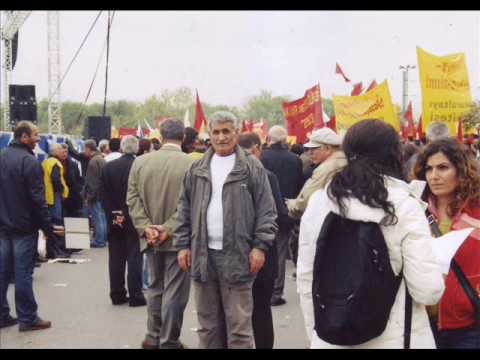
| Khosroshahi in center facing camera in a labor rally in London (date unknown) |
Yadullah Khosroshahi (pronounced Yædolah Xosroʃæhi; birth certificate surname is Khosravi (Xosrævi)) who was born in Shahr-e Kurd, Chaharmahal and Bakhtiari Province in Iran on October 28, 1942 and died in London, England, on February 4, 2010, was a central leader of the Iranian oil workers movement and a socialist leader of the Iranian labor movement.
In 1968, Khosroshahi was elected as a delegate of the Abadan refinery workers. After the Tehran oil refinery began production he was transferred there. In 1971, he helped lead the effort to create the Oil Workers Union of the North (of Iran). In 1973, he was arrested and severely tortured by the Shah's secret police SAVAK and given a 10-year prison term for his labor and socialist activities. However, he was freed after four and half years because of international campaign to free political prisoners and mounting mass movement of millions that led to the February 1979 revolution that overthrew the Pahlavi dynasty. After his release from prison, Khosroshahi joined efforts to create underground strike committees of the oil workers. These efforts led to the general strike in the oil industry that began on October 21, 1978 as the backbone of the general strike that was enforced in large workplaces and proved decisive in defeating General Gholam Reza Azhari’s martial law decree of November 6. On December 10 and 11 millions of Iranians took to the streets of Tehran and other large cities to demand “Down With the Shah.” On January 16, 1979, the Shah and his family left Iran for good (He died of cancer in Egypt on July 27, 1980). On February 11, 1979, in response to a military coup attempt by the high brass, a three-day armed insurrection overthrow the Pahlavi dynasty. Ayatollah Ruhollah Khomeini assumed power in the absence of any viable alternative and immediately set to work to establish the theocratic capitalist Islamic Republic.
After the triumph of the February revolution, oil workers and workers in other key industries and large enterprises, organized workers councils (shoras) on the basis of already existing strike committees to fill the void left by state and private management that had mostly fled the country. Khosoroshahi was elected to the National Shora (Council) of the Oil Industry. As the workers shoras spread across the country, together with the peasant shoras, soldiers shoras, student shoras, and shoras of the oppressed nationalities they held the promise of a government of the people, by the people and for the people. However, by 1983 the clerical capitalist Islamic Republic had systematically undermined and suppressed all grassroots movements in Iran except in Kurdistan. Workers shoras were destroyed, their leaders and activists were imprisoned, tortured and some executed. In 1982 as part of a massive round up of opponents of the Islamic Republic regime Khosroshahi was imprisoned and tortured. He was released in 1987. Upon his release, Khosroshahi tried to contact a group of oil workers who were under surveillance. When he learned that he was targeted for rearrest he escaped to Pakistan. However, life for Iranian refugees in Pakistan was harsh and dangerous. On August 24, 1987, Khosroshahi managed to land in London and seek political asylum. After a period of settlement in London, he resumed his tireless campaign for the cause of Iranian workers until death of stroke on February 4, 2010.
Social background
Khosroshahi was born into a poor working class family with several children in Shahr-e Kurd, Chaharmahal and Bakhtiari Province on October 28, 1942. He was almost a year old when his father died. His mother moved the family to Ahmad Abad neighborhood of Abadan in Khuzestan Province. Abadan was run by the British who controlled the exploration and production of oil and occupied the southern half of Iran during World War II. Later Khosroshahi wrote about social and labor history of Abadan characterizing life under the British rule as a form of Apartheid: "Foreigners and office employees lived in separate neighborhoods of the town. They had their separate buses, offices, bathrooms, clubs, cinemas, and restaurants. Workers were barred from going to their neighborhoods. Violators were arrested and jailed. The best things belonged to the foreigners and the worse to workers. For example, in the summer heat of Khuzestan drinking water was provided for everyone. But foreigners had water cooler in their offices, office workers had pitchers of iced water and workers were given bucks of water kept in shaded locations outdoors.” (Khosroshahi, no date; Ashori, 2002)
Because of his family's poverty, Khosroshahi was forced to seek employment after completing his elementary school education (sixth grade). At age 14 he was accepted as an unpaid apprentice in the maintenance department of the Abadan refinery. In 1958, after two years of apprenticeship he was hired as a maintenance worker at the National Iranian Oil Company (NIOC). Khosroshahi continued his education while working and received a high school diploma.
Leader of oil workers
While oil workers had a history of militancy, Khosroshahi characterized the conditions at the Abadan refinery as "similar to a military base.” (ibid.) Still, workers were able to press for reforms and Khosroshahi was elected as workers' delegate in 1968. (Ibid.; Safavi,2010)
In 1968, the newly built Tehran oil refinery began operations and over the next two years groups of 30-40 experienced workers were transferred from Abadan refinery to help with its operations. Aginst his expressed wishes, Khosroshahi was transferred to Tehran.
In 1970, he was elected as a delegate of Tehran refinery workers and in 1971 they were able to establish the Oil Workers Union of the North (of Iran) and he was elected as its first Secretary. (Arzhang, et. al., 2010; Safavi, 2010) In 1973, he helped lead a two-week strike during a major repair of the refinery. The workers won most of their demands including the reduction of work week from 48 hours to 40 hours and a 25% increase in hourly wages for overtime work. After an industrial "accident" killed a worker, Khosroshahi organized a protest strike that led to his arrest by the SAVAK. However, because of his popularity among his coworkers he was soon released. When he was taken in again by the SAVAK, workers campaigned for his release and printed a flyer in his defense using the refinery’s printshop. Although Khosroshahi was quickly released, the SAVAK soon realized that a number of banned socialist books were also printed on the same press. This led to the arrest of Khosroshahi for the third time. Khosroshahi recalls that "for two years we were printing banned socialist books using the refinery press by a printshop worker who also had a friend in a bookstore that provided the original work and sold the banned books. I did not even know the bookstore contact." (Khosroshahi, ibid) (For a somewhat different account of this episode, see, Heshmat Reisi, 2010).
The SAVAK severely tortured Khosroshahi including by beating him with a cable, using electric shock, and by burning his fingers and toes with a smelting torch. The head of the Labor Section of the SAVAK personally burned candles on his back. At the same time, they tried to bribe him to work for the SAVAK. When he refused his initial sentence of two years was extended to a ten-year.
Leader of the National Council of the Oil Industry
However, Khosroshahi was freed after four and half years because of international campaign to free political prisoners and mounting mass movement of millions that led to the February 1979 revolution that overthrew the Pahlavi dynasty.
Upon his release Khosroshahi who was blacklisted from returning to his job at Tehran refinery worked with oil workers to organize underground strike committees in the oil industry. The underground strike committees helped prepare for the October 21, 1978, oil workers general strike that served as the backbone of the national general strike that paralyzed the Shah's regime and paving the road to the February 1979 revolution. Because of the Shah's industrialization program there were 2.5 million industrial workers on the eve of the 1979 revolution twice as many as in 1965. (Curtis and Hooglund, 2008, p. 106) and oil workers had an outsized economic weight as oil revenue was the main source of government income as it had been since the 1950s. (ibid., p. 145). Khosroshahi recalls how significant the general strike was: "We stopped oil exports. We denied oil to the army and the police during Marshall Law. The government tried to break our general strike but couldn't." (Khosroshahi, ibid.) Meanwhile, neighborhood committees that sprang up everywhere served as distribution networks leaving no Iranian household without fuel in cold winter months during the strike.
As pro-monarchist managers fled their jobs and sometimes the country after the February revolution workers councils spread across Iran in major industries and large workplaces to keep them running. In the oil industry, workers councils were formed everywhere and the National (Shora) Council of the Oil Industry was organized and Khosroshahi was elected to it. This council tried to improve health and safety at workplace and workers medical care, transportation, workers cafeterias, home mortgages without interest, college scholarship for workers with high school diploma and oil workers' children, increased vacation time, subsidies for travel, annual bonuses, establishing credit cooperatives, etc. But like other national workers councils in major industries it also had to take on national and international questions.
The Islamic Republic that assumed power after the Shah’s downfall came into conflict with grassroots movements in general and workers councils in particular. The Islamic Republic organized Islamic Associations in workplaces to undermine and destroy workers council by pitting Muslim workers who supported Ayatollah Khomeini against other workers. In the Tehran refinery where Khosroshahi worked and elsewhere in the oil industry Islamic Associations aided the government to harass, intimidate and arrest labor and socialist activists.
The critical blow to the workers council movement in the oil industry came when the Saddam Hussein army invaded Iran in September 22, 1980 (see, Iran-Iraq war). The Iraqi forces destroyed or seriously damaged oil industry instillations in Khuzestan. A large section of oil workers were forced out of their jobs almost overnight. Those who did not lose their life fighting Iraqi invaders were scattered around the country by the Islamic Republic and when they were able to take a job it was in other economic sector. Khomeini who had called the Iraqi invasion a "gift from God" supported repressive policies in workplaces in the name of increasing production to support the war effort. Independent workers organizations were forced to suspend activity and many were dissolved.
After the leadership of the leadership of the People's Mujahedin of Iran decided on armed confrontation with the Islamic Republic regime in response to protracted government harassment and repression in the summer of 1981, the regime began a vicious and widespread campaign of repression, mass arrest, torture and executions that was extended to political groups that openly opposed Khomeini. By 1983, this wave of repression was extended to all independent organizations including leftist political groups that politically supported the Islamic Republic. All grassroots movement were destroyed. (The Kurdish region remained an exception for a short time but it was also subdued eventually).
Khosroshahi was arrested in the summer of 1982 and tortured. He spent four years and three months in jail. Soon after his release from prison in 1987, he was targeted for arrest again because he contacted a group of oil workers who were under surveillance. He had to flee to Pakistan.
Campaigning from exile for independent workers organizations in Iran
However, life for Iranian refugees in Pakistan was harsh and dangerous. On August 24, 1987, Khosroshahi managed to arrive in London and was arrested in the airport. After a 48-hour investigation he was freed upon filing an application for political asylum. Two months later his application was approved. In an interview he granted about that time, while expressing gratitude for the more humane treatment he was offered by the British authorities compared to those in Iran Khosroshahi complained of new hurdles: "language problem, lack of funds, and non-existence of necessary and sufficient aid to the asylees." (Khosroshahi, ibid.)
Khosroshahi used his time in exile to broaden his horizon and to reflect on the experiences of the labor movement in the aftermath of the defeat of the 1979 revolution. A central conclusion was the need for independent organizations of the working class: "The independence of the working class in the current situation from all non-working class organs, from governments to management, to political parties of the left, or right, or center, is among the most important issues for consideration by the labor activists." (cited in Mohammad Safavi, 2010) Thus, Khosroshahi and a group of other exiled Iranian labor activists organized the "Association of Exiled and Immigrant Workers" that rallied around the slogan of "Long live independent workers organizations" and published a paper called "Exiled Worker" (Kargar-e Tæbeidi).
In 1999, Khosroshahi helped organize the Conference of Communist Activists of the Labor Movement in London that established the Labor Foundation (Bonyad-e Kar). The Labor Foundation worked to collect and publish "oral histories" of leaders and activists of the Iranian labor movement and organize solidarity with the independent labor movement that was taking shape in Iran. However, the Labor Foundation operated in Farsi and remained largely isolated from the labor movement in Europe and North America where its members lived.
Khosroshahi was interested in learning about and participating in labor struggles in Britian and elsewhere and spoke fondly of the miners strike that he joined early on his arrival from Iran. In 2001, he travelled to Cuba as part of U.S.-Cuba Labor Exchange to observe the Congress of Central de Trabajadores de Cuba (CTC) in Havana, April 28-30, and to learn about the Cuban revolution. He participated in the May Day rally and march of approximately one million organized by the CTC. (Nayeri, 2010)
Upon returning from Cuba, Khosroshahi coedited an English language newsletter Labor Links to help organize solidarity with the Iranian labor movement in Western Europe and North America (Nayeri, ibid.). However, the Labor Foundation proved unable to organize labor solidarity among non-Iranians and Labor Link ceased publication after fiver issues. The Labor Foundation dissolved in 2007.
The last major organized activity Khosroshahi played a leading role in was the International Alliance in Support of Workers in Iran (IASWI). IASWI was founded in in Canada in 1999 and began work in 2000 with the explicit aim of increasing awareness about labor conditions in Iran and solidarity it in the Canadian labor movement. The founders reached out to the Iranian labor activists and Khosroshahi was soon working closely with them helping to organize its branch in England. This period coincided with the formation of independent unions among Tehran transit workers in Tehran and among Haft Tapeh sugar cane workers. Thus, Khosroshahi’s wish to see organization of independent unions in Iran was granted (Safavi, 2010)
However, he died when these organizations were under severe attack especially after the crushing of the mass protest movement of 2009. His life was celebrated by labor activists inside and outside Iran and many Iranian socialist organizations as well as some large European and Canadian unions (see, "Tributes and Articles About Yadullah Khosroshahi”).
Khosroshahi contributed to a number of labor publications including Pazhohesh Kargari (Labor Research), Kar Mozd (Wages), and Andishe Jamehe (Social Thought). He left behind articles about labor policy and labor and social history as well as many interviews.
References:
Arzhang, Majid, Nosrat Teimour Zadeh, and Ghlamreza Partovi. "An Honrable Man Who Joined History," Arash, no. 104, pp. 278-79, March 2010.
Ashori, Mohammad Reza.“Let Me Speak!: A Conversation with Yadullah Khosravi
(Khosroshahi) Former Secretary of the Oil Workers Union of Tehran Refinery,”
Andish-e Jamehe (Social Thought), no. 23, pp. 36-43, 2002.
Curtis, Glenn E. and Eric Hooglund. Iran: Country Study, Fifth edition, Library of Congress, 2008.
publication name or date (but appears to have been conducted soon after Khosroshahi’s arrival in London)
Reisi, Heshmat. "Forty Years with Comrade Yadullah". Arash, no. 104, pp. 294–96.