By Cintia Frencia and Daniel Gaido, Jacobin, March 8, 2017
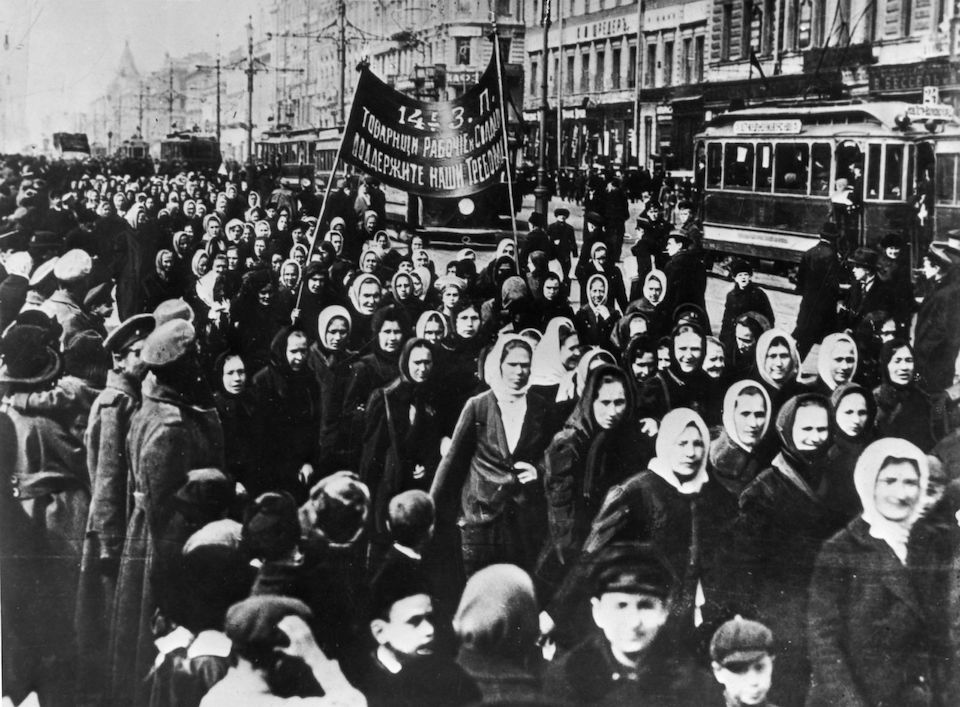 |
| Workers strike on March 8, 1917, led to the February revolution in Russia |
The first International Women’s Day was celebrated not on March 8 but on March 19, 1911. The date was chosen to commemorate the 1848 Revolution in Berlin — the day before, March 18, was dedicated every year to “the fallen heroes of March.”
In Germany, two and a half million copies of a flyer urging participation in Women’s Day were printed and distributed. Die Gleichheit put out its own call: “Comrades! Working Women and Girls! March 19 is your day. It is your right. Behind your demand stands Social Democracy, organized labor. The Socialist women of all countries are in solidarity with you. March 19 should be your day of glory!”
Trumpeting the battle cry “Forward to female suffrage,” more than a million women — mostly, but not exclusively, women organized in the SPD and the unions — took to the streets in Germany demanding social and political equality. They organized “popular public political assemblies” — forty-two in Berlin alone — where they discussed the issues affecting their lives.
Around the world, working women set aside a day for themselves. In 1911, women workers in United States, Switzerland, Denmark, and Austria chose March 8 as Women’s Day. Counterparts in France, Holland, Sweden, Bohemia, and (crucially) Russia soon added themselves to the list of celebrants.
Celebrating International Women’s Day on March 8 took hold as a worldwide practice in 1914. A famous sign emblazoned with the words “Women’s Day / March 8, 1914 – Forward with Female Suffrage,” in which a woman dressed in black waves the red flag, marked the occasion. In Germany — overcome with hysteria in the lead-up to World War I — police prohibited the poster from being hung or distributed publicly. The fourth International Women’s Day turned into a mass action against the imperialist war that would erupt three months later.
Three years later, March 8 would acquire a new significance when the February Revolution convulsed Russia (February 23 in the Julian calendar is March 8 in the Gregorian calendar). Russian working women played a leading role in the upheaval. Despite the opposition of every party, including the Bolsheviks, they turned the International Women’s Day demonstration into a mass strike that carried away the whole working class of Petrograd and gave birth to the Russian Revolution.
What War Wrought
War broke out in August 1914, inaugurating a new era in the development of the International Socialist Women’s Movement.
The entire Second International — and therefore the International Socialist Women’s Movement as well — split along national lines, succumbing to chauvinism. In Germany, the SPD (and its affiliate, the General Commission of Trade Unions) adopted a “social peace” policy, making critical demonstrations verboten. Those who flouted the proscription and publicly celebrated International Women’s Day suffered repression at the hands of the government and the police.
In early November 1914, Clara Zetkin issued an appeal “To the Socialist Women of All Countries,” where she spoke out strongly against the war and in favor of mass actions for peace. As part of this opposition to imperialism, Zetkin convoked the third and final Socialist Women’s Conference in April 1915. (Lenin accompanied the Bolshevik delegation, which included his wife Krupskaya and Lilina Zinoviev.)
As imperialist war waged around them, the conference issued the internationalist battle cry “War on war.” But principled opposition to militarism was in short supply. Upon returning to Germany, Zetkin was arrested for distributing the manifesto as an illegal leaflet.
An Annual Reminder
After the collapse of the second German Empire and the formation of councils (Räte) of workers and soldiers all over Germany in November 1918, the bourgeoisie effected a kind of democratic counter-revolution: they granted women the right to vote, but counterpoised parliament and the constituent assembly assembled in Weimar to the soviets of workers’ delegates.
Doing the bourgeoisie’s bidding was Social Democratic leader Friedrich Ebert, the first president of the Weimar Republic (and “the Stalin of Social Democracy,” in the words of historian Carl Schorske). In his hands — and those of the union bureaucracy — the demand for universal female suffrage, adopted by the revolutionary labor movement as a transitional demand, was turned into a barrier to socialist revolution.
Since International Women’s Day had originated in the left wing of the proletarian women’s movement, the SPD leadership also stopped celebrating March 8. They argued that, following the extension of female suffrage, the holiday’s objectives had been achieved.
To their credit, the Communist Party continued to celebrate International Women’s Day under the slogan “All Power to the Councils! All Power to Socialism!” And in June 1921, Clara Zetkin helped make it official. The Second International Conference of Communist Women, chaired by Zetkin and held in Moscow, proclaimed that in the future, International Women’s Day would be celebrated around the world on March 8.
Ever since, International Women’s Day celebrations have been held on March 8 in countries across the globe — serving as an annual reminder of the revolutionary potential of working women.


