Showing posts with label Hunter-gatherers. Show all posts

Thursday, June 11, 2026

3690. Human Nature and Socialism: Part 4. Socialism as the Process of De-alienation

By Kamran Nayeri, June 11, 2026


For readers familiar with my thinking, it would be reasonable to expect me to conclude this multipart essay with a review of the concept of human nature among the world's indigenous peoples. However, indigenous cultures, for the most part, lacked a notion of human nature because they viewed humanity as part of nature rather than separate from it.  The very concept of human nature presumes a certain separation between humanity and nature, which at least warrants explanation.

Indeed, there has been such a separation between humanity and the rest of nature in all civilizations. Thus, the philosophers and social and natural scientists I sampled in this essay have all noticed this separation and attempted to bridge it, at least through an understanding of “human nature.”

The problem of alienation

According to David Leopold (2022), the term “alienation” emerged in modern Europe. In English, the term had emerged by the early fifteenth century, already possessing an interesting cluster of associations. It was to refer to an individual’s estrangement from God and to mental derangement by psychiatric doctors. G.W.F. Hegel (1770–1831) introduced the term in German, which included the sense of property transfer.  Leopold suggests that the first philosophical discussion of alienation was in French, in Jean-Jacques Rousseau's (1712–1778) Second Discourse.  The concept of alienation is central to Karl Marx’s theory of socialism from the Economic and Philosophical Manuscripts of 1844 to his later work, including Das Kapital. Thus, in Marx’s theory, alienation is implied in human nature as an assemblage of social relations created by the dominant mode of production. The central task of socialism is to do away with capitalist alienation centered in the capitalist mode of production.

Thus, it is no surprise that indigenous peoples lack a concept of “human nature,” as they have considered themselves part of nature rather than estranged (alienated) from it. As I have explained elsewhere (Nayeri, 2013), alienation from nature arose with the emergence of the first agrarian cultures some 12,000 years ago because farmers needed to domesticate plants and animals to develop farms, the first artificial ecosystems, and to protect them from wild nature.  The transition implied an estrangement from nature, thereby conferring moral superiority on the farmer (humans). Social alienation arose when the early farmers produced an ongoing economic surplus, leading to social differentiation, domination, and exploitation. Thus, to rid society of social and ecological alienation requires a transition from ecocentrism to anthropocentrism at the same time as a socialist revolution, hence Ecocentric Socialism.  

The indigenous peoples often have not yet made the transition from hunter-gatherers to farmers and civilization, or are in the process of doing so, and hence still carry with them essential aspects of their ancestors’ ecocentrism. 

Let me outline how some indigenous peoples view themselves and their relationship to the rest of nature.

Robin Wall Kimmerer

Braiding Sweetgrass: Indigenous Wisdom, Scientific Knowledge, and the Teachings of Plants is a 2015 book by Potawatomi professor of botany Robin Wall Kimmerer that explores the role of Indigenous knowledge as an alternative or complementary approach to mainstream Western scientific methodologies.

The book consists of interconnected essays rather than a single linear argument. Kimmerer uses Sweetgrass, an aromatic herb, as a symbol of reciprocity and cultural renewal. The "Three Sisters" (corn, beans, and squash) serve as a model of cooperation in nature. Maple syrup harvesting exemplifies the ethical use of natural gifts. She emphasized the importance of language in shaping relationships with the natural world.

Kimmerer underscores the core of the Indigenous culture as follows:

1. Nature is a community of relations. She argues that plants, animals, rivers, and landscapes are not merely resources but part of a larger ecological community. Drawing on Potawatomi traditions, she emphasizes reciprocity rather than domination. A recurring idea is that the world is full of gifts—sunlight, water, food, fertile soil—and that receiving these gifts entails responsibilities.

2. Indigenous knowledge and Western science. As a trained botanist and a Potawatomi woman, Kimmerer explores how scientific knowledge and Indigenous knowledge can complement one another. She argues that science often tells us how ecological systems work, while Indigenous traditions can help answer questions about how humans ought to live within them.

3. The Honorable Harvest. One of the book's most influential concepts is the "Honorable Harvest," an ethical code for taking from nature: Take only what you need. Never take the first or the last. Use what you take. Give thanks. Give something back. Kimmerer presents this as a practical ecological ethic that promotes sustainability and respect.

4. Gratitude as an ecological practice.  The book contrasts a culture of consumption with a culture of gratitude. Kimmerer suggests that gratitude changes our relationship with the world, making exploitation less likely and stewardship more natural.

5. Critique of capitalism and resource extraction. Without developing a systematic political theory, Kimmerer criticizes economic systems that treat land and living beings as commodities. She argues that ecological crises stem partly from relationships based on ownership, extraction, and profit rather than reciprocity and care.

Kimmerer's central message is that ecological sustainability requires more than scientific knowledge or technological solutions. It requires transforming our relationships with the living world.  She put it this way: “The ecosystem is not a machine, but a community of beings, subjects rather than objects. What if those beings were the drivers?” (Kimmerer, 2023, p. 331). Humans flourish when they see themselves as members of an ecological community bound by reciprocity, gratitude, and responsibility. Kimmerer presents a worldview in which agency is not confined to humans alone; plants, animals, and ecosystems participate in shaping life, while humans are called to enter respectful relationships with them rather than stand outside nature as its rulers.

Vine Deloria Jr.

Vine Deloria Jr. (1933–2005) was a Standing Rock Sioux scholar, author, theologian, and activist whose writings transformed the study of Native American history, religion, and law. Through his scholarship and leadership, he became one of the 20th century’s most influential Indigenous intellectuals, advocating for tribal sovereignty and reexamining Western conceptions of science and spirituality. In his book, God Is Red (1973), he explores Native American religious traditions and critiques the dominance of Western Christianity in shaping U.S. society. The book is regarded as a foundational text in Native American studies and Indigenous theology. Deloria expresses the same themes as Kimmerer.

Arturo Escobar

Arturo Escobar, a Colombian anthropologist and activist-scholar, has been recognized for pioneering post-development and political ecology thought. His work challenges Western notions of progress, focusing on ecological design, territorial autonomy, and “pluriversal” worldviews that embrace multiple ways of living and knowing.

Escobar’s Encountering Development (2011) framed the concept of post-development, arguing that traditional development models perpetuate colonial power structures. He advocates for locally grounded alternatives rooted in environmental care, cultural pluralism, and autonomy rather than economic growth alone.

Escobar’s later books—Designs for the Pluriverse (2018), Pluriversal Politics (2020), and La relacionalidad (2024)—extend his ideas toward “ontological design” and eco-social transitions. He was elected to the American Academy of Arts and Sciences in 2021, in recognition of his influence on global debates about sustainability and decolonial futures.

Eduardo Viveiros de Castro

Viveiros de Castro is perhaps the most influential interpreter of Amazonian thought. He was born in Brazil in 1951 and trained as an anthropologist. He is a professor at the National Museum of the Federal University of Rio de Janeiro. His theory of "Amerindian perspectivism" proposes that many beings are people, that morality is not an exclusive property of humanity, and that different species inhabit different perspectives on the same world. His work is theoretical rather than political, but it offers powerful conceptual resources for animistic materialism to which I subscribe. Viveiros de Castro has written a number of books, including Cosmological Perspectivism in Amazonia and Elsewhere, Hau Masterclass Series (vol. 1) (2012). In this book, he develops the concept of “perspectivism which is one of the most influential ideas in contemporary anthropology. It emerged from his study of Amazonian Indigenous.

Perspectivism is the philosophical position that one's access to the world through perception, experience, and reason is possible only through one's own perspective and interpretation. It rejects both the idea of a perspective-free or an interpretation-free objective reality.

Western thought generally assumes: One nature (the same physical world for everyone)

Many cultures (different human interpretations of that world). Viveiros de Castro argues that many Amazonian peoples hold something close to the reverse: One culture (all beings share personhood, intentionality, social life); many natures (different bodies generate different worlds). He calls this multi-naturalism, contrasting it with Western multiculturalism. In Amazonian perspectivism, animals, spirits, and other beings are not regarded as mere objects. Many are considered people.

Concluding remarks

Let me summarize the contributions I considered on human nature and the human mind from different intellectual traditions—historical materialism, dialectical biology, cybernetics and systems theory, neuroscience, and Indigenous cosmologies—that all challenge the liberal image of the autonomous individual.

Karl Marx viewed humans as a social, productive, self-creating species. He recognized that humans are part of nature, transforming nature through collective and historical praxis. Human nature develops historically as an assemblage of social relations.

There are two fundamental weaknesses in Marx’s theory. He intentionally leaves out nature in his consideration of human nature, society, and history, although he admits humans are embedded in nature, and his anthropocentric theory is limited to the history of class societies, which constitute a mere 5,000 years out of 300,000 years of the existence of Homo Sapiens and 2.5 million years of our ancestors in the Homo genus. Throughout this “prehistory,” our ancestors were hunter-gatherers, a way of human existence that precedes the emergence of modes of production, central to Marx’s theories.

Richard Levins and Richard Lewontin view the organism and environment as co-creating each other in a |dialectical interaction. They reject genetic and environmental determinism. The weakness in their view is that they do not clearly admit the primacy of nature over culture, as is clearly admitted in the theory of evolution to which they subscribe. Consequently, they remain within the bounds of Marx’s nineteenth-century socialism.

Gregory Bateson, relying on cybernetics and systems theory, views the human mind as part of a larger ecological mind. He correctly insists that the human mind exists in networks and relationships that operate according to the laws of systems and not according to individuals or groups of individuals. While Bateson was not interested in the theory of socialism, his theory of ecology of mind is indispensable to thinking about socialism and how to transition to it.

For Robert Sapolsky, human behavior emerges from biology, natural and social history. Humans are biological organisms embedded in their environment. He offers a multi-level analysis that supports questioning of free will. Notably, while Sapolsky offers biological evidence for human behavior, he is not a genetic determinist, as he places equal emphasis on biology, culture, and society; in fact, he argues that the nature/culture debate is obsolete. Indeed, his argument against the existence of free will, for greater consideration in judging fellow human beings, and for the importance of building institutions that support the development of virtues and inhibit vices must become the cornerstone of a democratic and libertarian socialism that has been missing in the history of socialism so far.

For Robin Wall Kimmerer, humans are members of a community of living beings. She calls for reciprocity with plants, animals, and ecosystems. For Vine Deloria Jr. humans belong to sacred places and relationships.  Nature is alive and communicative. He offers a critique Western anthropocentrism. Arturo Escobar believed humans live in relational and in radical interdependence with nonhuman worlds. He calls for a collective ecological and relational ontology. For Eduardo Viveiros de Castro, humanity is a condition of personhood, not species | Humans and nonhumans are all persons from their own perspective. He advocates Amerindian perspectivism and multinaturalism.

A note on ontology

It is necessary to conclude with a note on ontology. Nineteenth-century materialism was a philosophical and cultural shift that rejected religious and spiritual explanations, asserting instead that matter is the fundamental reality of the universe. Driven by rapid scientific advancements and the Industrial Revolution, it fundamentally transformed how humans understood nature, society, and themselves. Marx shared this ontology. In historical materialism, Marx and Engels developed a framework to critique capitalism and explain societal conflicts through class struggles and the means of production.

In modern times, Materialism has been refined to include the idea that all of reality is composed of physical objects, including both material objects and energy. Thus, nineteenth-century materialism has been redefined to explain quantum physics and the uncertainty principle.  The uncertainty principle, also known as Heisenberg's indeterminacy principle, is a fundamental concept in quantum mechanics. It states that there is a limit to the precision with which certain pairs of physical properties, such as position and momentum, can be simultaneously known. In other words, the more accurately one property is measured, the less accurately the other property can be known.

This poses fundamental Limitations on philosophical materialism about what can be known about particles, challenging the materialist view of complete knowledge of the physical world. First, there is the observer effect: It highlights the role of the observer in measurement, complicating the materialist perspective that reality exists independently of observation. Second, it introduced non-determinism: The principle introduces non-deterministic elements in quantum mechanics, conflicting with materialism's often deterministic framework. Third, it raises questions about the nature of reality itself, suggesting that at a fundamental level, reality may not be as straightforwardly material as philosophical materialism posits. The limitations on knowledge imply that materialism may not fully account for the complexities of existence and consciousness. Quantum entanglement is the phenomenon in which the quantum state of each particle in a group cannot be described independently of the state of the others, even when the particles are separated by a large distance. The topic of quantum entanglement is at the heart of the disparity between classical physics and quantum physics: entanglement is a primary feature of quantum mechanics not present in classical mechanics. These challenge the materialist view of objects' separateness and individuality, suggesting interconnectedness that materialism struggles to explain.

These have been reintroduced in panpsychism, the view that mind or conscious experience, of some type or other, is a fundamental and ubiquitous feature of reality, including for all physical reality.  Panpsychism is also described as a theory that the mind is a fundamental feature that exists throughout the universe. It is one of the oldest theories in the philosophy of mind, possibly overlapping in some interpretations with animism, the spiritual or religious worldview of many indigenous societies, though panpsychism is usually regarded as a philosophical (metaphysical) stance. Physicists and cosmologists increasingly believe that the universe itself must be viewed in a relational sense.

The idea that existence is fundamentally relational – that nothing exists in complete isolation – is not new to philosophy. But today, the sciences are independently arriving at the same conclusion through their own rigorous methods. Across disciplines as different as physics and meteorology, the emerging picture is consistent: the universe’s deep structure is one of interconnection, mutual influence, and dynamic interdependence. To understand this, we need to look carefully at three major scientific frameworks: the theory of relativity, quantum field theory, and chaos theory (Philosophy Institute, no date).”

It must be evident that the nineteenth-century materialism of Marx, just like his theories of human nature, society, and history as embedded in historical materialism, must be revised in light of what we know and the problems we face in the twenty-first century. I trust this multipart essay lends additional support to my theory of Ecocentric Socialism, founded on ecological animistic materialism Nayeri, 2023, Chapter 19; Nayeri, 2021). 


References:

Escobar, Arturo. Designs for the Pluriverse: Radical Interdependence, Autonomy, and the Making of Worlds. 2018.

Leopold, David.Alienation.” Stanford Encyclopedia of Philosophy. 2022.

Kimmerer, Robin Wall. Braiding Sweetgrass: Indigenous Wisdom, Scientific Knowledge and the Teachings of Plants. 2015.

Kopenawa, Davi. The Falling Sky. 2013.

Viveiros de Castro, Eduardo.  Cosmological Perspectivism in Amazonia and Elsewhere. 1998

Nayeri, Kamran.Economics, Socialism and Ecology: A Critical Outline, Part 2,” Our Place in the World: A Journal of Ecosocialism. October 29, 2013.

_____________." The Case for Ecocentric Socialism.” Our Place in the World: A Journal of Ecosocialism. July 4, 2021.

_____________." Whose Planet? Essays on Ecocentric Socialism. 2023. 

Philosophy Institute. Unveiling the Fabric of the Universe: Insight from Contemporary Science.No date. 

Saturday, November 10, 2018

3072. A Summary of Recent Anthropological Research on Contemporary Hunter-Gatherer Societies

By Carol E. Ember, Explaining Human Culture, 2014
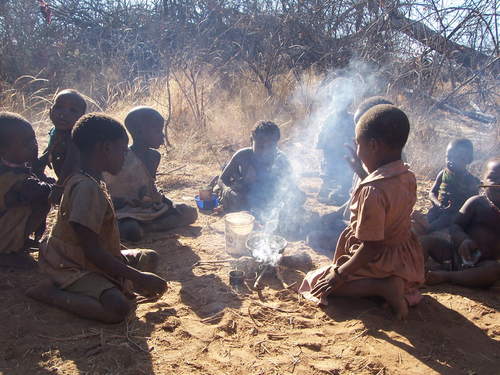
On average Hadza children gather and hunt half their food.  Here they are cooking their meal. 

In the quest to explain human culture, anthropologists have paid a great deal of attention to recent hunter-gatherer, or forager, societies. A major reason for this focus has been the widely held belief that knowledge of hunter-gatherer societies could open a window into understanding early human cultures. After all, it is argued, for the vast stretch of human history, people lived by foraging for wild plants and animals. Indeed, not until about 10 thousand years ago did societies in Southwest Asia (the famous Fertile Crescent) begin to cultivate and domesticate plants and animals. Food production took over to such an extent that, in the past few hundred years, only an estimated 5 million people have subsisted by foraging.

What can we infer about our distant ancestors by looking at a few well-known hunter-gatherer societies of recent times? To draw reliable inferences, we would need to believe that pockets of human society could exist unchanged over tens of thousands of years—that hunter-gatherers did not learn from experience, innovate, or adapt to changes in their natural and social environments. Even a cursory look at the ethnographic record, however, reveals that many foraging cultures have changed substantially over time. Moreover, recent hunter-gatherer cultures share some traits but are also quite different from one another.
Explaining Human Culture 2
  
Hunter-Gatherers
How can we draw better inferences about the past? Cross-cultural researchers ask how and why hunter-gatherer societies vary. By understanding what conditions predict variation and also using the paleoanthropological record to make educated guesses about past conditions in a particular place, anthropologists may have a better chance of inferring what hunter-gatherers of the past were like (Hitchcock and Beisele 2000, 5; C. R. Ember 1978; Marlowe 2005).

Because cultures change through time, we cannot simply project ethnographic data from the present to the past.
Below we summarize the cross-cultural literature in the last half century on hunter-gatherers. We generally restrict the discussion to statistically supported hypotheses based on samples of 10 or more cultures. We also discuss what is not yet known and pose questions that invite further research.

What We Have Learned
We know about hunter-gatherers of recent times from anthropologists who have lived and worked with hunting and gathering groups. Some of the best recently known cases are the Mbuti of the Ituri Forest (central Africa), the San of the Kalahari Desert (southern Africa) and the Copper Inuit of the Arctic (North America). These hunter-gatherers live in environments that are not conducive to agriculture.
What are hunter-gatherers of recent times generally like?

Based on the ethnographic data and cross-cultural comparisons, it is widely accepted that recent hunter-gatherer society:

• are fully or semi-nomadic.
• live in small communities.
• have low population densities.
• do not have specialized political officials.
• have little wealth differentiation.
• are economically specialized only by age and gender.
• usually divide labor by gender, with women gathering wild plants and men
fishing and almost always doing the hunting. Some cross-cultural findings are less widely discussed:
• Compared to food producers, hunter-gatherers are less likely to stress obedience and responsibility in child training. On the other hand, hunter-gatherer cultures that emphasize hunting are more likely to stress achievement in children (Barry, Child, and Bacon 1959; Hendrix 1985).
• Compared to food producers, hunter-gatherers show more warmth and affection toward their children (Rohner 1975, 97–105).
• The songs of hunter-gatherers are less wordy and characterized by more nonwords, repetition, and relaxed enunciation (Lomax 1968, 117–28).
• In contrast to food producers, hunter-gatherers are less prone to resource
unpredictability, famines, and food shortages (Textor 1967; C. R. Ember and Ember 1997, 10).

Are hunter-gatherers more peaceful than food producers?
Some cross-cultural findings contradict each other, inviting further investigation.

It is widely agreed that, compared to food producers, hunter-gatherers fight less (C. R. Ember and Ember 1997). But are hunter-gatherers typically peaceful? Different researchers have arrived at different answers to this question. For example, C. R. Ember (1978) reported that most hunter-gatherers engaged in warfare at least every two years. Another study found that warfare was rare or absent among most hunter-gatherers (Lenski & Lenski, 1978; reported in Nolan2003).

Hunter-gatherer cultures differ from food-producing cultures in child-rearing practices and vocalization. Food-producing cultures are more vulnerable to famines and food shortages.

How we define terms will affect the sample and determine the outcome of a cross-cultural study. When asking if hunter-gatherers are typically peaceful, for example, researchers will get different results depending upon what they mean by peaceful, how they define hunter-gatherers, and whether they have excluded societies forced to stop fighting by colonial powers or national governments.

Most researchers contrast war and peace. If the researcher views peace as the absence of war, then the answer to whether hunter-gatherers are more peaceful than food producers depends on the definition of war. Anthropologists agree that war in smaller-scale societies needs to be defined differently from war in nation-states that have armed forces and large numbers of casualties. Also, within-community or purely individual acts of violence are nearly always distinguished from warfare. However, there is controversy about what to call different types of socially organized violence between communities. For example, Fry (2006, 88, 172–74) does not consider feuding between communities warfare.

How and why do hunter-gatherers vary?
Hunter-gatherers vary in many ways, but cross-cultural research has focused on variations in types of food-getting, contributions to the diet by gender, the degree of nomadism, the frequency of external and internal warfare, and marital residence.

• The closer to the equator, the higher the effective temperature, or the more plant biomass, the more hunter-gatherers depend upon gathering rather than hunting or fishing. (Lee and DeVore 1968, 42–43; R. L. Kelly 1995, 70; Binford 1990, 132)
• The lower the effective temperature, the more hunter-gatherers rely on fishing (Binford 1990, 134).
• Males contribute more to the diet the lower the effective temperature or the higher the latitude (R. L. Kelly 1995, 262; Marlowe 2005, 56).
• In higher quality environments (with more plant growth), men are more likely to share gathering with women. Greater division of labor by gender occurs in lower quality environments (Marlowe 2007).
• Fully nomadic lifestyles are more likely as the growing season lengthens (Binford 1990, 131).
• Among hunter-gatherers, in contrast to other kinds of societies, the division of labor predicts marital residence. The more a foraging society depends upon gathering, the more likely the society is to be matrilocal. The more dependence upon fishing, the more likely a society is to be patrilocal. The degree of dependence on hunting does not predict marital residence (C. R. Ember 1975).
• Patrilocal hunter-gatherers do not have more warfare than those that are matrilocal. Among foragers, as in other societies, patrilocal residence is predicted by internal (within society) warfare or a high male contribution to subsistence; matrilocality is predicted by a combination of purely external warfare and a high female contribution to subsistence (C. R. Ember 1975).
• Bilocal residence, rather than unilocal residence, is predicted by community size under 50, high rainfall variability, and recent drastic population loss
(C. R. Ember 1975).
• Hunter-gatherers with higher population densities have more warfare than
those with low population densities. Similarly, more complex hunter-gatherer societies have more warfare than simpler hunter-gatherers (Nolan 2003, 26; R. C. Kelly 2000, 51–52; Fry 2006, 106).
• Hunter-gatherers with a high dependence on fishing are more likely to have internal warfare than external warfare (C. R. Ember 1975).
• In New Guinea, foragers with a high dependence on fishing tend to have higher population density and large settlements. Some of the foragers in New Guinea with a high dependence on fishing have densities of 40 or more people/square km and settlements of over 1000 people (Roscoe 2006).

What We Do Not Know
• Why do some foraging societies share more than others? Is meat consistently shared more than plants? Does sharing differ by gender?
• Why should division of labor predict residence amongst hunter-gatherers, but not among food-producing cultures (See C. R. Ember 1975)?
• Do foragers with a high dependence on fishing tend to have a higher population density and large settlements, as is the case in New Guinea (See Roscoe 2006)?
• How different are foragers with a little agriculture from those who lack agriculture?
• Are foragers with horses more like pastoralists than foragers lacking horses?
• Recently, discussion of the differences between complex and simple hunter-gatherers has increased (See Fitzhugh 2003; Sassaman 2004.) Complex
hunter-gatherers generally have considerable inequality and more political hierarchy.
– What other differences are there between complex and simple hunter-gatherers?
– What implications do such differences have for the emergence of complex foragers?
Explaining Human Culture 8
  

Glossary
Bilocal residence A pattern in which married couples live with or near the wife’s or the husband’s parents with about equal frequency
Ethnographic What we know from descriptions written by observers, usually anthropologists, who have lived with and worked with people in the present and recent past
Matrilocal residence A pattern of marital residence where couples typically live with or near the wife’s parents
Multilocal residence Includes both bilocal residence and unilocal residence with a frequent alternative.
Patrilocal residence A pattern of marital residence where couples typically live with or near the husband’s parents
Unilocal residence A pattern in which married couples live with or near one specified set of relatives (patrilocal, matrilocal, or avunculocal)
Explaining Human Culture 10

Additional Cross-Cultural Studies of Hunter-Gatherers
Halperin, Rhonda H. 1980. “Ecology and mode of production: Seasonal vari- ation and the division of labor by sex among hunter-gatherers.” Journal of Anthropological Research, 36, 379-399.
Korotayev, Andrey V. & Alexander A. Kazankov. 2003. “Factors of sexual freedom among foragers in cross-cultural perspective.” Cross-Cultural Research, 37, 29-61.
Lozoff, Betsy and Gary Brittenham. 1979. “Infant care: Cache or carry.” The Journal of Pediatrics, 95, 478-483.
Marlowe, Frank W. 2003. “The mating system of foragers in the standard cross-cultural sample.” Cross-Cultural Research, 37, 282-306.
References
Barry, Herbert, III, Irvin L. Child, and Margaret K. Bacon. 1959. “Relation of Child Training to Subsistence Economy.” American Anthropologist 61 (1): 51–63. https://doi.org/10.1525/aa.1959.61.1.02a00080.
Binford, Lewis R. 1990. “Mobility, Housing, and Environment: A Comparative Study.” Journal of Anthropological Research 46 (2): 119–52. https://doi.org/10. 1086/jar.46.2.3630069.
Ember, Carol R. 1975. “Residential Variation Among Hunter-Gatherers.” Behavior Science Research 10 (3): 199–277. https://doi.org/10.1177/ 106939717501000302.
———. 1978. “Myths About Hunter-Gatherers.” Ethnology 17 (4): 439–48. https://doi.org/10.2307/3773193.
Ember, Carol R., and Melvin Ember. 1997. “Violence in the Ethnographic Record: Results of Cross-Cultural Research on War and Aggression.” In Troubled
Times: Violence and Warfare in the Past, 1–20. New York, NY: Routledge.
Fitzhugh, Ben. 2003. The Evolution of Complex Hunter-Gatherers: Interdisciplinary Contributions to Archaeology. New York, NY: Kluwer Academic/Plenun Publishers.
Fry, Douglas. 2006. The Human Potential for Peace: An Anthropological Challenge to Assumptions About War and Violence. New York, NY: Oxford
University Press.
Hendrix, Lewellyn. 1985. “Economy and Child Training Reexamined.” Ethos 13
(3): 246–61. https://doi.org/10.1525/eth.1985.13.3.02a00030.
Hitchcock, Robert K., and Megan Beisele. 2000. “Introduction.” In Hunters and Gatherers in the Modern World: Conflict, Resistance, and Self-Determinations, 1–10. New York, NY: Berghahn Books.
Kelly, Raymond C. 2000. Warless Societies and the Origin of War. Ann Arbor, MI.: The University of Michigan Press.
Kelly, Robert L. 1995. The Foraging Spectrum. Washington, DC: Smithsonian Institution Press.
Lee, Richard B., and Irven DeVore. 1968. Man the Hunter. New York, NY: Aldine Publishing Company.
Lomax, Alan. 1968. Folk Song Style and Culture. Edited by Edwin E. Erick- son. Publication (American Association for the Advancement of Science) 88. Washington, DC: American Association for the Advancement of Science.
Marlowe, Frank W. 2005. “Hunter-Gatherers and Human Evolution.” Evo- lutionary Anthropology: Issues, News, and Reviews 14 (2): 56–67. https: //doi.org/10.1002/evan.20046.
———. 2007. “Hunting and Gathering: The Human Sexual Division of Foraging Labor.” Cross-Cultural Research 41 (2): 170–95.
Nolan, Patrick. 2003. “Toward an Ecological-Evolutionary Theory of the Incidence of Warfare in Preindustrial Societies.” Sociological Theory 21 (1): 18–30. https://doi.org/10.1111/1467-9558.00172.
Rohner, Ronald. 1975. They Love Me, They Love Me Not: A Worldwide Study of the Effects of Parental Acceptance and Rejection. New Haven, CT: HRAF Press.
Roscoe, Paul. 2006. “Fish, Game, and the Foundations of Complexity in Forager Society: The Evidence from New Guinea.” Cross-Cultural Research 4 (1): 29–46. https://doi.org/10.1177/1069397105282432.
Sassaman, Kenneth E. 2004. “Complex Hunter-Gatherers in Evolution and History: A North American Perspective.” Journal of Anthropological Research 12 (3): 227–80. https://doi.org/10.1023/B:JARE.0000040231.67149.a8.
Textor, Robert B. 1967. A Cross-Cultural Summary. New Haven, CT: HRAF Press.

Thursday, December 28, 2017

2784. Crushed by Civilization: The Process of Extinction of the Taushiro Hunter-Gatherer Tribe in Amazon


By Nicholas Casey, The New York Times, December 26, 2017
Amadeo at the Tigre River is the last surviving member of the Taushiro hunter-gatherer tribe in the Amazon. His five children are dotted across the Americas. CreditBen C. Solomon/The New York Times
INTUTO, Peru — Amadeo García García rushed upriver in his canoe, slipping into the hidden, booby-trapped camp where his brother Juan lay dying.
Juan writhed in pain and shook uncontrollably as his fever rose, battling malaria. As Amadeo consoled him, the sick man muttered back in words that no one else on Earth still understood.
Je’intavea’, he said that sweltering day in 1999. I am so ill.
The words were Taushiro. A mystery to linguists and anthropologists alike, the language was spoken by a tribe that vanished into the jungles of the Amazon basin in Peru generations ago, hoping to save itself from the invaders whose weapons and diseases had brought it to the brink of extinction.
A bend on the “wild river,” as they called it, sheltered the two brothers and the other 15 remaining members of their tribe. The clan protected its tiny settlement with a ring of deep pits, expertly hidden by a thin cover of leaves and sticks. They kept packs of attack dogs to stop outsiders from coming near. Even by the end of the 20th century, few outsiders had ever seen the Taushiro or heard their language beyond the occasional hunter, a few Christian missionaries and the armed rubber tappers who came at least twice to enslave the small tribe.
But in the end it was no use. Without rifles or medicine, they were dying off.
A jaguar killed one of the children as he slept. Two more siblings, bitten by snakes, perished without antivenom. One child drowned in a stream. A young man bled to death while hunting in the forest.
Then came the diseases. First measles, which took Juan and Amadeo’s mother. Finally, a fatal form of malaria killed their father, the patriarch of the tribe. His body was buried in the floor of his home before the structure was torched to the ground, following Taushiro tradition.
So by the time Amadeo wrestled his dying brother into the canoe that day, they were the only ones who remained, the last of a culture that once numbered in the thousands. Amadeo sped to a distant town, Intuto, that was home to a clinic. A crowd gathered on the small river dock to see who the dying stranger was, dressed only in a loincloth made of palm leaves.
Juan’s shaking soon gave way to stiffness. He drifted in and out of consciousness, finally looking up at Amadeo.
Ta va’a ui, he said at last. I am dying.
The church bell rang that afternoon, letting villagers know that the unusual visitor had died.
“The strange thing was how quiet Amadeo was,” said Tomás Villalobos, a Christian missionary who was with him when Juan died. “I asked him, ‘How do you feel?’ And he said to me: ‘It’s over now for us.’”
Amadeo said it haltingly, in broken Spanish, the only way he would be able to communicate with the world from that moment on. No one else spoke his language anymore. The survival of his culture had suddenly come down to a sole, complicated man.

An Unexpected Burden

Human history can be traced through the spread of languages. The Phoenicians spanned the ancient Mediterranean trade routes, bringing the alphabet to the Greeks and literacy to Europeans. English, once a small language spoken in southern Britain, is now the mother tongue of hundreds of millions across the world. The Chinese dialects are more than a billion strong.
But the entire fate of the Taushiro people now lies with its last speaker, a person who never expected such a burden and has spent much of his life overwhelmed by it.
“That’s Amadeo there: Almost no one understands him when he’s speaking his language,” said William Manihuari, watching Amadeo fish alone from a canoe on a recent day.
“And when he dies, no one is left,” added José Sandi, a 12-year-old boy who watched as well.
The waters of the Peruvian Amazon were once a vast linguistic repository, a place where every turn of the river could yield another dialect, often completely unintelligible to people living just a few miles away. But in the last century, at least 37 languages have disappeared in Peru alone, lost in the steady clash and churn of national expansion, migration, urbanization and the pursuit of natural resources. Forty-seven languages remain here in Peru, scholars estimate, and nearly half are at risk of disappearing.
I came to the river outpost of Intuto, 10 hours by speedboat from the nearest city, to figure out how the Taushiro, like so many other cultures, had been brought to this kind of end. The journey began in forgotten linguistic papers and historical sketches. It even led me to storm-ravaged Puerto Rico, where a retired Christian missionary rummaged through the last existing pictures of the Taushiro, nearly coming to tears as she looked through them for the first time in years.
And it brought me here, to the banks of a silty brown river, where the cumulative experience of the Taushiro people swung alone in a hammock: A man around 70 whose memory was fading and whose grasp of the language was slipping away because he had no one to speak it with.
“At any moment I might disappear, my life will end, we don’t know how soon,” Amadeo said stoically. “The Taushiro don’t think about death. We just move on.”
He knows that’s not true, that there is no moving on for the Taushiro anymore. It leaves him exasperated, at times wondering how much of the blame is his, or whether the extinction of his people really matters at all.
“Sometimes I don’t care anymore,” he said.
The Taushiro were among the world’s last hunter-gathers, living as refugees in their own country, wandering the swamps of the Amazon basin with blow guns called pucuna and fishing from small boats called tenete. To count in their language, they had words only for the numbers onetwothree and many. And by the time Amadeo was born, their population had shrunk so drastically that they had no names in a traditional sense: Amadeo’s father was simply iya, or father, his mother iño, or mother, his sister and brother ukuka and ukuñuka.


COLOMBIA
ECUADOR
Intuto
Tigre River
Amazon River
BRAZIL
Pucallpa
Aucayacu
PERU
Lima
BOLIVIA
Pacific Ocean
200 MILES

Languages are typically passed down through families, but Amadeo broke his apart decades before he realized what the consequences would be for his culture and its place in history. He still has five children, dotted across the Americas. But after his wife left him in the 1980s, he put them into an orphanage when they were still young, thinking it was safer than a life in which children were abducted by traffickers or lost to war. None of them lived with him after that. They never learned his language.
“For those languages that are in this critical situation, many times it seems their fate is already sealed — that’s to say, it’s hard to ever recover a language at this stage,” said Agustín Panizo, a government linguist trying to document Taushiro. “Amadeo García, he wants Taushiro to come back. He wants it, he dreams of it, he longs for it, and he suffers to know that he’s the last speaker.”
Now Amadeo lives alone in a clapboard house behind the town’s water tower, spending many of his final days drinking. Desperate to speak and hear whatever Taushiro he can, he sits alone on his porch in the morning, reciting the only literature ever written in the language — verses of the Bible translated into Taushiro by missionaries who sought to convert the tribe years ago.
Ine aconahive ite chi yi tua tieya ana na’que I’yo lo’, he read aloud one morning. It was the story of Lot from the Book of Genesis. Lot and his family become the sole survivors of their city when God destroys Sodom and Gomorrah. Lot loses his wife when she looks back at the destruction, against the instructions of God.
Amadeo lives alongside the people of Intuto, but not with them, often passing them in a quiet stupor. Mario Tapuy, 74, who met Amadeo as a child when he lived in the forest, said he had tried many times to draw Amadeo out of the bar to teach others the language.
Mr. Tapuy, who speaks his own indigenous language, Kichwa, said he had realized years ago that the future of Taushiro would come to down to Amadeo, regardless of whether he wanted the responsibility.
“I told him many times,” Mr. Tapuy said. “He listens, but it doesn’t record in his brain.”
I had arrived in Intuto with a linguist named Juanita Pérez Ríos, who had known Amadeo for years and introduced me to him that day. In the evening, Amadeo wanted to speak to his son Daniel, who lives in Lima, the capital, and Ms. Pérez lent him her phone. It had been many months since the father and son had spoken.
“I fell on my knees in the jungle,” said Amadeo. “I’m limping a little.”
“You need to be careful,” said Daniel.
The two spoke in Spanish, which was sometimes difficult for Amadeo.
“My brothers told me you’ve been getting a little drunk,” Daniel chided him. “You need to stop that now.”
Then a pause.
“I love you a lot, understand?” said Daniel. The phone clicked.
Amadeo sat in his home for a few minutes, looking into the night as the sounds of the forest grew louder. Families could be heard in the distance, cooking dinner.
“They say they love me, but they never come,” he said.
Continue reading the main story


Photo

Amadeo fishing near Intuto. The Peruvian Amazon was once a vast linguistic repository, but in the last century at least 37 languages have disappeared in Peru alone.CreditBen C. Solomon/The New York Times

An Age of Rubber, and Slavery

The problems began with rubber.
The Taushiro and other indigenous groups had long harvested a sticky white substance that leaked from certain trees and coated their clothes, making them waterproof. But by the 19th century, Europeans had discovered the utility of rubber as well, setting off a boom.
European and American companies descended into the jungles, forcing indigenous populations into slavery to tap the rubber while building huge palaces on the lands left behind. The deadly Age of Rubber had begun in the Amazon.
In many areas, as much as 90 percent of the indigenous population died from disease and forced labor, researchers say. Thousands moved into newly settled cities. But the Taushiro, along with many other tribes, took another route: They decided to disappear.
Amadeo’s early memories from the hidden Taushiro settlement of Aucayacu remain in the haze of a place where writing was unknown and no records were kept, not even of his birth, which he thinks was sometime in the 1940s. His first memory was walking naked through the forest in a storm, the rain trickling down his body.
Contact with the outside world was rare, and often violent.
First came a rubber tapper in search of slaves. Wielding machetes and rifles, he found Aucayacu with four of his men and ordered the tribe to work. Amadeo and his family spent grueling days draining rubber from tree trunks and sculpting it into blocks to be sold by the trader downriver.
The tapper forced Amadeo’s married sister into a sexual relationship, then nearly beat her to death with a piece of wood. Her husband threw a spear through the tapper, who was never seen there again.
Before long, another rubber tapper came in his place. Perhaps learning from the fate of his predecessor, the new tapper decided to give his rifle in exchange for work, rather than turn it against the Taushiro.
He also gave them something else. Unable to distinguish among his workers, he lined them up and gave them Spanish names: Margarita, Andrés, Magdalena, César, Antonio. The youngest boy was called Amadeo. With no surnames, the Taushiro were each given two: García García.

Taking On Christianity

One day the ground began to tremble and the world took another step toward Amadeo.
It wasn’t an earthquake, but the seismic testing equipment of the Occidental Petroleum Corporation, an American company that had come to Peru. Rubber had long declined in the Amazon. Now the foreigners were after oil.
Word spread among the drillers that an indigenous group was hiding on one of the tributaries of the Tigre River. Occidental soon sent a plane and a lookout with binoculars to locate the tribe.
It was the first time Amadeo had seen anyone fly. It was 1971.
“They were so close to the ground you could see their faces looking at us,” Amadeo said.
With the coordinates of the Taushiro in hand, contact was inevitable. But rather than sending one of its own, the oil company turned to a group of Christian evangelists with an unusual mission.
The Summer Institute of Linguistics had been founded four decades earlier by an evangelical minister who wanted to translate the Bible into every language still spoken. By the 1970s, the group had become a fixture in forests of Latin America, often under government contracts for literacy programs.
Contact — followed by conversion — was the ultimate goal of the Christian linguists. The mission sometimes proved deadly.
In 1956, after dropping gifts to the uncontacted Waorani people, five missionaries were speared to death by the tribe on a riverbank in Ecuador. Undeterred, the institute sent a sister of one of the dead missionaries to try once more with the Waorani, who let the outsider and her family live among them. The tribe converted.
In 1971, Daniel Velie approached the edges of the Taushiro settlement, making his way past the booby traps and barking dogs. From the back of a canoe, he hauled out a heavy device to make the first recordings of their language.
But the Taushiro were in no state to speak.
An illness had swept through the village. When Mr. Velie arrived, seven Taushiro were near death. He pulled out a first-aid kit and gave them penicillin, the first antibiotics the Taushiro had taken. When they recovered, he took down the first 200 words of a Taushiro glossary.
Using hand gestures, the group conveyed their appreciation to the missionary. But Mr. Velie wanted something in return. He eventually asked for Amadeo, who was thought to be in his 20s at the time, to return with him and start teaching the language to others.
“They said yes, Amadeo could go; they were so thankful to have been saved,” said Nectali Alicea, the linguist soon put in charge of the Taushiro project by the language institute. “It was medicine that was the key.”
Ms. Alicea was a young Puerto Rican social sciences graduate. She had already embarked on missions to Mexico as part of her training with the institute, which taught her the structures of languages at its annual summer boot camp in Oklahoma.
For Ms. Alicea, as with many of the missionaries, the languages were a bridge to Christianity.
“You cannot evangelize in Spanish,” she said.
One of her pictures from 1972 shows Amadeo stepping aboard a plane for the first time, en route to the institute’s compound outside the Peruvian city of Pucallpa. A new world of firsts was opening up: of roads and sidewalks, of chicken, which he had never eaten before. He slept on the floor, unaccustomed to a bed. For days on end, Ms. Alicea took dictations of his language to prepare to meet the Taushiro in the forest.
She arrived at their secret camp that June with a missionary doctor from Georgia, his wife and their son for a two-week visit. The Taushiro clan welcomed the strangers and the recording technology they brought, along with medicine, machetes and food.
“The father would embrace me and not let me go,” Ms. Alicea wrote in her diary of one of the Taushiro men. “I would forget my land and stay here, he said.”
She began to follow some of their conversations, learning enough Taushiro to ask one man in the clan why he never swam. Despite living off the river, the Taushiro avoided even wading in it, washing themselves from the safety of a canoe. The man explained that under the water lurked a horde of boa constrictors, waiting to strike.
Ms. Alicea and the missionaries with her stripped down to their underwear and jumped into the river, laughing and splashing.
“When they saw us in the water, something changed,” Ms. Alicea said, adding that the event had caused the Taushiro to question their long-held beliefs. “They asked us how we did it. And we said: ‘Because we have a Spirit that is stronger than the boa.’”
Ms. Alicea produced a Bible.
Years before, the Taushiro had taken Christian names. Now they were taking on Christianity itself.
Continue reading the main story


Photo

Amadeo outside the clapboard home where he lives alone. CreditBen C. Solomon/The New York Times

A Life of Isolation

When Amadeo, the youngest of the Taushiro, arrived with a girl named Margarita Machoa, declaring that she would be his wife, there was a sigh of relief in Aucayacu. The Taushiro line was continuing.
“She fell in love with me,” said Amadeo, recalling how he and Margarita had played with her toy dolls after meeting.
Amadeo was a grown man. Margarita was 12 years old.
Amadeo soon wound up in jail, arrested at the request of the girl’s father. He said Margarita was too young to give Amadeo her consent.
In the end, it was Ms. Alicea, the linguist, who brokered Amadeo’s release, arguing that Peruvian law allowed indigenous men to marry according to their customs. Converting the clan to Christianity was possible, Ms. Alicea felt, but the changes could go only so far.
“It was typical among natives; I had seen this with Candoshi, with the Sharpras people,” Ms. Alicea said. “They had such small girls with the oldest men. At least this was better.”
Within months, Margarita was pregnant with Amadeo’s first child, a girl they named Margarita. The baby was the first of five.
Amadeo and Ms. Alicea continued their work recording the Taushiro language, fighting pressure from the missionaries to move onto other groups. Amadeo had given Ms. Alicea a Taushiro name, ukuka, or sister, and she called him ukuañuka, or younger brother, in return.
During the birth of his last son, also named Amadeo, Ms. Alicea cut the umbilical cord by the side of the river. The two were becoming inseparable, working long hours to document Taushiro words.
“She would ask, ‘What is this called?’” Amadeo recalled. “‘How do you say nail? How do you say toe?’”
Amadeo taught his children the ways of the clan, particularly David, Daniel and Jonathan, who were becoming quick with blow guns and spears. On early mornings, he took them to gather the palm leaves they had left near termites’ nests the day before. The leaves were covered in insects — bait for fishing, a technique the Taushiro had used for generations.
Yet the dangers of the forest were always present.
“My father would say before we went to sleep, ‘Remember, a tiger can come for you,’” Jonathan said, using a common word for jaguars.
Taushiro culture, especially its language, proved isolating for Amadeo’s wife, Margarita, who came from a different tribe and was unable to communicate with anyone in Taushiro. She couldn’t even speak with her own husband, except in broken Spanish. She spent long days alone with her children, sometimes screaming at them or giving them beatings in frustration.
“Since she was married young, she wasn’t grown up,” said her daughter, also named Margarita, who remembers being thrown out of a canoe by her mother when the girl could barely swim. “It’s not the same to play with a doll as it was to play with flesh and bones.”
In 1984, after their fifth child was born, Amadeo took the family to a village where he worked construction for several months. Neighbors said the couple argued frequently. They could hear Margarita’s screams when Amadeo beat her.
Margarita, her daughter said, had gotten into a relationship with a man her own age. When Amadeo learned of it, he attacked her again.
It was the last beating she took from him.
“She left that night and said nothing,” the daughter said.

Leaving the Forest

Their mother’s sudden departure devastated the family. Without her, Amadeo became the sole caretaker of five children. The division of labor between the genders had been strict among the Taushiro, with men spending the day hunting for food and women raising the children.
“I knew nothing about how to care for them,” Amadeo said.
With his relatives in Aucayacu dwindling from old age and disease, Amadeo decided to leave the camp for the missionary compound near Pucallpa, several hundred miles away. His children, he didn’t realize at the time, were leaving the forest for good.
In the city, Amadeo sank into despair — and into alcoholism. In town, liquor was suddenly available.
“He got drunk, he insulted people,” said Mario Tapuy Paredes, a friend at the time.
Still, Amadeo held onto the project that had anchored most of his adult life, documenting Taushiro with the missionaries. He and Ms. Alicea had moved beyond a basic dictionary and grammar books into the first translations of the Bible, including parts of Genesis and sections of New Testament books like the Gospels.
But for the language to survive beyond books, it needed to be taken on by Amadeo’s children. And it was becoming unclear whether he could keep them safe, let alone teach them Taushiro.
One day when Amadeo was out of the house, Margarita, then 9, was approached by a woman offering her food. She followed the woman to a taxi, which sped away with her. Ms. Alicea called the police, who rescued the girl from a boat launch where her abductor had planned to put her into a child trafficking ring.
The abduction shook Amadeo. Feeling overwhelmed, he eventually decided to put the children into an orphanage.
It was a lonely and troubling time for them. But in 1989, a social worker came to Ms. Alicea with a request. With 40 children, the orphanage was overextended, and Peru’s Maoist rebels, the Shining Path, were staging massacres in nearby cities.
Could Ms. Alicea, the orphanage asked, adopt the Taushiro children herself? Ms. Alicea, then in her 50s, would now become the mother of the world’s last five Taushiro children.
There was an obstacle, however. Her own mother, in her 70s, was growing ill in Puerto Rico. Ms. Alicea wanted to return to care for her.
This confronted the linguist with the most difficult choice of her career: to save the Taushiro language and culture, or to save the children she had known since their birth and grown to love.
The contradictions were lost on no one.
First Amadeo, one of the last of his people, who had spent his adult life trying to ensure that his language endured, had given up his own children, virtually guaranteeing that they would never pass it along.
Then Ms. Alicea, who had devoted herself for nearly two decades to documenting and preserving the Taushiro way of life, was taking its few remaining descendants to a distant country, to be raised in an entirely different culture that would effectively erase their own.
“I was Christian first,” she said, explaining that her principal duty was to the welfare of the children.
Ms. Alicea’s decision to move the children to Puerto Rico remains a shock to linguists who know of Taushiro, arguing that her choice all but guaranteed its extinction.
“I have never heard of an equivalent story elsewhere; in any academic circle, that would have been considered an unethical event,” said Zachary O’Hagan, a Ph.D. student in linguistics at the University of California, Berkeley who has done research with Amadeo in Peru.
“When a language like this disappears, you have lost a key data point in studying what universal properties exist in all languages,” Mr. O’Hagan said.
But Ms. Alicea said it was unlikely that Amadeo would have ever taught his children Taushiro under the circumstances. And she said that, at the time, she did not envision a future in which Amadeo would become the last of his tribe.
In 1990, she adopted the children and changed their last names to her own. The family moved across the hemisphere.
“I love the language,” Ms. Alicea said. “But I love the people more than the language. With the blessing of God, those children had a future.”
Continue reading the main story


Photo

An early morning in Intuto. CreditBen C. Solomon/The New York Times

Culture Shock

The change was staggering for the children.
They had been born in an isolated tribe in the Amazon and abandoned in an orphanage. Suddenly, they were transported to a commonwealth of the United States, with busy streets that came to a halt at rush hour and high rises in San Juan.
The thump of nightclub music stretched into the night. They saw the Caribbean for the first time. Ms. Alicea became their guide to the new world, taking them on vacations to New York. Her photos from the early 1990s show the Taushiro children playing in the snow.
The adjustment differed for each of the children as they settled into San Lorenzo, Ms. Alicea’s home in the center of the island. Margarita, the most extroverted of the children, made new friends quickly. Amadeo Jr., the youngest at 6, picked up a Puerto Rican accent. But his indigenous features were a curiosity to his classmates. Rather than say he was Taushiro, he told his friends his father was Japanese.
David was the first one to run into trouble.
As the years passed, he became angry. By seventh grade, his teachers feared his outbursts. Ms. Alicea began to notice money missing from her wallet.
One night, Ms. Alicea confronted him in the living room. It led to an altercation that ended with her calling the police.
“I want you to decide if you want to stay here, if you want to be American or Peruvian,” she recalled telling him. “I love him and still do.”
Two of the brothers, Jonathan and Daniel, decided to return to their father.
The years alone had been difficult for Amadeo. Increasingly drawn to alcohol, which was available only in towns, Amadeo settled in Intuto and lived as a recluse, still sleeping on the ground as he had in Aucayacu. He now hunted with a rifle instead of a blowgun, heading into the forest most days in search of game to sell.
“When we were out, he camped alone,” recalled Jorge Choclón, who sometimes hunted with Amadeo. “That was his way. And he didn’t like society.”
But waiting on the dock in 1994 for the arrival of Jonathan and Daniel, Amadeo was filled with hope again. The father and sons, reunited, embraced.
While they could not speak the language, Amadeo was eager to bring his sons back into the traditions of their people. He and Jonathan woke at 5 a.m. for the hunt, returning after sundown. He took the boys to what remained of the Taushiro settlement in Aucayacu, where only his father and a few relatives still survived.
Jonathan felt apart from it, unable to communicate with anyone there.
“My grandfather could only say my name,” he recalled. “I had gotten used to Puerto Rico. Now I felt more from there. I cried all night.”
The opportunity to learn Taushiro seemed lost. The boys were teenagers, past the age when children usually pick up language quickly from their parents. Spanish was still the language they heard at school most of the day, and a stigma lingered in Intuto when it came to indigenous languages.
“I could barely say a few words — mother, father, that was it,” Jonathan said.
The arrival of David, the oldest brother, in 1996 brought new challenges. Mr. Villalobos, the Christian missionary who directed the school in Intuto, said David’s anger had followed him to Peru. The boy rarely did his schoolwork and was known for carrying a knife around town, once threatening to stab one of his classmates, Mr. Villalobos said.
And Amadeo’s drinking continued.
One day, José Álvarez, a missionary, went to visit Amadeo at his home on the edge of town. In Spanish, Amadeo told him he was sick, but after a moment Mr. Álvarez said he realized Amadeo was trying to say he was depressed, unable to find the correct word. Amadeo began to cry, the first time Mr. Álvarez had ever seen him express emotion.
“He spoke in tears of his children, that they didn’t want to come see him, that they didn’t want to know hardly anything of him, or their Taushiro origins, not the language, not the culture,” Mr. Álvarez wrote in a letter from that time.
Mr. Álvarez added: “I felt in these moments the deep pain that probably that man felt, the last Taushiro, that the saga of his people would definitively end with him.”
The Taushiro language had been reduced to its last five speakers: Amadeo, and four family members who desperately held onto life in their encampment in Aucayacu. And even that meager number was about to collapse.
The first to die was a brother of Amadeo’s who had long been unable to walk, paralyzed years ago after a snake bite. Then Amadeo’s aunt woke up one day with a sore throat, a fever and blotchy rashes across her body, the first signs of measles. The missionaries had left the encampment years ago, and she died without treatment.
Then came malaria. In the late 1990s, a deadly strain began to work its way up the rivers of northern Peru. Amadeo’s father fell ill and died. Now only Juan, Amadeo’s last brother, remained, living alone in the ruins of the settlement where he had grown up, with only dogs for company.
In 1999, Amadeo hauled his dying brother from the canoe, and the two spoke in Taushiro for the last time.
“They said, ‘Don’t cry, your brother is with the Lord,’” recalled Amadeo.
Continue reading the main story


Photo

A Race Against Time

Nearly 20 years later, Amadeo walked through an overgrown cemetery, the place he had buried his brother. The wooden cross had fallen over. Juan García’s name was barely visible where it had been etched onto one of the beams.
“When I’m gone, I’ll be here as well,” Amadeo said later that day. “I am old and will disappear at any time.”
Yet even in the twilight of Amadeo’s life, a few hold out hope that some part of the Taushiro language will persist after him.
This year, Peru’s Ministry of Culture decided to take up the work that Ms. Alicea began. Working with Amadeo, government linguists have created a database of 1,500 Taushiro words, 27 stories and three songs, with plans to make recordings of Amadeo available to academics and others interested in the language.
It is a race against time — and against Amadeo’s own memory, which sometimes fails him after so many years of having no one to speak with in Taushiro.
But linguists involved in the work say that even if Taushiro dies with Amadeo, a record of it will be kept, at least.
“It’s the first time that Peru has made this kind of gesture,” said Mr. Panizo, the linguist leading the project.
Last February, the government flew Amadeo to Lima to give him a medal for his contribution to Peruvian culture. The sudden attention was a shock to Amadeo, along with the packed streets of Lima and the interviews with the local news media.
Still, he beamed as a crowd gathered for a ceremony that honored several other indigenous activists who spoke their languages. Government officials gave impassioned speeches on the importance of preserving the 47 indigenous languages that remain in the country. Amadeo spoke words in Taushiro.
While Amadeo knew that he had not passed his language to his five children, he took comfort in the fact that they were safe. They had not suffered the fate of their relatives, who had all perished in the forest. One of them, Daniel, was even in the audience that day to see him.
After the ceremony, the two men embraced. Daniel introduced Amadeo to his 6-year-old daughter, the first time Amadeo had met his grandchild.
“I just want to be proud of my father, of the tribe that we were, that I was born into, that we lived,” said Daniel, who works as a construction worker in Lima.
One evening this summer, Amadeo sat alone and began to speak his language, saying one sentence in Taushiro, then translating it into Spanish, before repeating the process. It was growing late, the crickets and frogs were getting louder, and Amadeo raised his voice above them.
“I am Taushiro,” he said. “I have something that no one else in the world has. One day when I am gone from the world, I hope the world remembers.”