Showing posts with label History of capitalism. Show all posts

Saturday, October 22, 2016

2479. Book Review: Fossil Capital

By Irma Allen, Ecologist, April 27, 2016
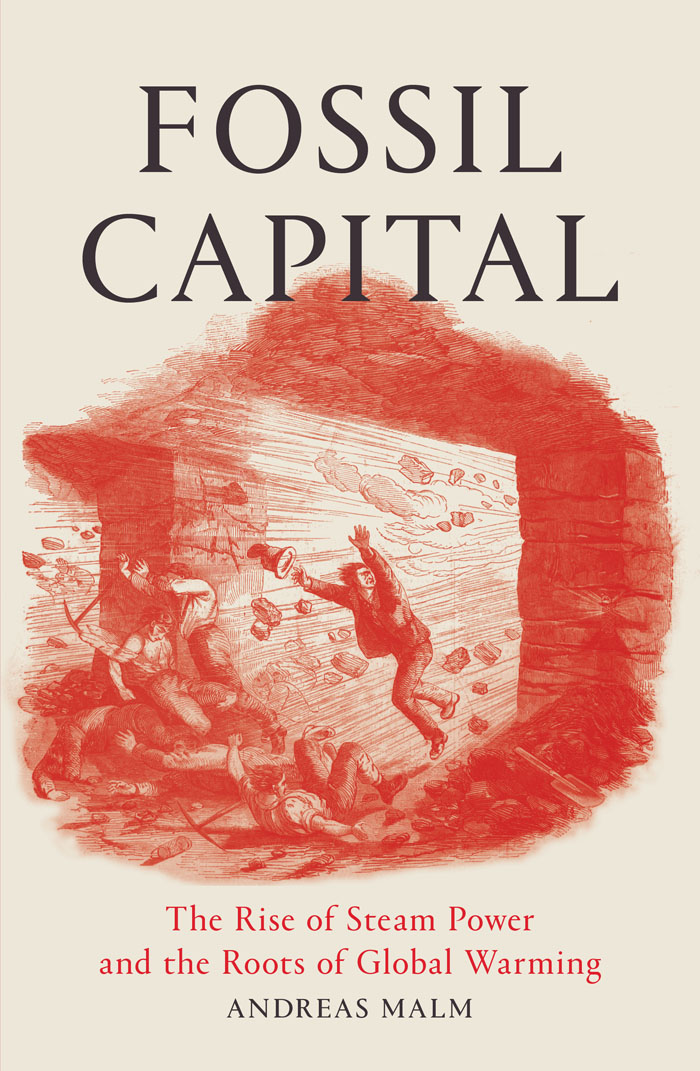

We all know that coal and steam vanquished over water power in Britain's - and the world's - industrial revolution, writes Irma Allen. But as Andreas Malm sets out in his fascinating new book, the deciding factors in that victory were the unconstrained mastery over people and nature that coal provided mill owners. And so the model was set for the fossil age that may only now be coming to an end.

Coal-fired steam was divisible, privately operable and amenable to concentration. It did not rely on the vagaries of natural cycles, such as weather. It was a prime mover that could be 'whipped up by its master' taming both nature and bodies.

If global warming is the "unintended by-product par excellence", as the opening of Andreas Malm's potent new book states, what is it a by-product of?

The obvious answer is the burning of fossil fuels. But, why do we burn them at all and how did reliance on these substances come about?

Understanding the emergence of the 'fossil economy' - one in which economic expansion and fossil fuel consumption are united, resulting in an accelerating quantity of atmospheric CO2 - demands a return to history 'eyes wide open'. As the book asks, "how did we get caught up in this mess?”

According to his thesis, British industry's switch from waterwheels to coal-fired steam engines in the 19th century is the fundamental turning point upon which the climate crisis hinges. Understanding why this occurred goes to the "roots of global warming" as it reveals the vested interests of 'business-as-usual' today.

The canary in the coal mine warns of unseen danger - Malm's warning is that a false understanding of climate change history is leading to flawed diagnosis, so failed remedies. Echoing her approach, it is no wonder Naomi Klein endorses the book as "essential reading”.

Dismantling of two main theories
Malm builds his argument gradually in quasi-detective fashion, applying Marxist critique to received wisdom. In doing so, he persuasively dismantles two theories, or 'storylines' as he tellingly calls them, which currently dominate on-going political and public reckoning of fossil economics.

The first is the 'Ricardo-Malthusian paradigm'. According to this story, steam arose as a response to scarcity of good watering holes at which to quench the thirst of continued industrial expansion of Britain's cotton mills. Rational actors, so this line of thinking goes, saw the logic and economic competitiveness of the steam engine straight away and set about installing the new technology to the benefit of society.

An intrinsic human pyromania - a love affair with fire - perhaps further spurred our fossil addiction. Malm, however, finds that the transition from water to steam actually "took the form of a protracted contest" without a clear winner over a number of decades. Contrary to wide-held belief, James Watt's patenting of the steam engine in 1784 was not the inevitable start of the industrial revolution.

Early trials with steam engines in manufacturing ended badly, and most mill owners were uninterested years after its invention. This was because water was free and abundant, coal was expensive, while steam engines had frequent technical malfunctions and could even explode. Furthermore, water power was often more efficient than steam.

All this flies in the face of classical economic thinking. What, then, forced the leap?
In answering this, Malm critiques a second, increasingly dominating, storyline - that of the 'anthropocene narrative'. This holds that humankind as a unified category has become a geological agent of environmental change, ushering in a new geologic epoch we must simply now manage, adapt to, or even make the most of, as some 'eco-modernists' insist.

The anthropocene camp blames the human species as a whole for global warming. Yet Malm shows that inequality and differentiated responsibility are central to its history, and it is time to confront that.

Industrial capitalism and the revolution
The early 1820s saw the first structural crisis of industrial capitalism. This was repeated in 1837 and again in the hyper-depression of 1841-2, creating waves of social unrest. In 1824 the Combination Laws, which made strikes and unionization illegal, were repealed.

The "mighty energies of the masses" were awakened. Large-scale protests over poor pay and working conditions were the result over the following two decades, just as industrial capital was struggling. The Chartist movement, seeking rights and a voice for workers, emerged in 1836. Britain was brought to the brink of "all-out revolution", in Malms's words. Industry was petrified. It was during this struggle between workers and capitalists that steam power was adopted.

Colonialism as a backdrop is not touched upon, although its machinations on distant shores would have fed into these tensions and vice versa. Malm's theory, however, is that steam arose out of very specific social relations in Britain "as a form of power exercised by some people against others." It offered a way to subordinate and control unruly labour that was refusing to cooperate.

In the cotton industry, striking spinners could bring factories to a standstill. In Preston, for example, all thirty factories came to a grinding halt when 650 spinners walked out in November 1836. Weavers, although home-based, also contributed to the malaise. Under conditions of worsening pay, due to rising urbanization and the low-skilled nature of the work, weavers were resorting to embezzlement - retaining a portion of the stock to sell on the black market.

Whereas in the industrial heyday this was an annoyance, under crisis conditions this was intolerable for capital. The solution to both was to install Iron Men (self-acting machines) and Power Looms in the factories - run on steam. This was further resisted by workers who feared knock-on implications for employment leading to a general strike in 1842 and 'Plug Riots' that literally 'pulled the plug' on steam engines.

Proletarian "steam demonology" battled the "steam fetishism" that increasingly preoccupied bourgeois fantasies. Yet by 1850 both steam - and capitalists - had won. Chartism had collapsed, and capitalism entered a period of "sustained renaissance". Natural and social power became fused.

The lure of coal
Still the choice of coal, rather than water, as a source of fuel was not inevitable. At one point, large-scale engineering projects to construct artificial waterpower through levees and reservoirs were proposed. But this required coordination and inter-reliance between mill owners - something competitive industrialists were not keen on.

Coal-fired steam was divisible, privately operable and amenable to concentration. It suited capitalist desires well. A number of additional aspects contributed to coal's pull. It offered spatial and temporal benefits over water. Freed from location by rivers, factories could be sited more centrally in cities, where urbanizing population growth offered cheap workers "trained to industrious habits”.

Steam powered by coal did not need to rely on the vagaries of natural cycles, such as weather, either. It was a prime mover that could be "whipped up by its master" taming both nature and bodies. The invention of high-pressure steam was the last nail in the coffin for waterpower - the steady expansion of coal-fired steam the result.

All these were accumulating "moment(s) in the emergence of the fossil economy". Whilst it would have been useful to have a greater analysis of how these aspects intersected, each chapter provides a compelling overview of these eye-opening trends.

The quest for wealth caused climate change
The fossil economy was never a 'species-wide project' nor a democratic endeavor. The root of climate change is shown to lie with the power of some to put the private accumulation of wealth above all else. In particular, Malm argues that historical blame for climate change points at Britain.

More accurately, and more in line with a differentiated class analysis, he ought to say blame lies with Britain's capitalists (and their supporters). Even more specifically - a handful of white British men appear to have pulled the levers. So, is climate change a man? as an article in this paper once asked, or a white British capitalist male? Malm does not speculate, but the implication is there.

In 1850, the year which marked the near complete shift from hand looms to power looms and thus the birth of the fossil economy, Britain "emitted nearly twice as much carbon dioxide as the US, France, Germany, Belgium combined. It emitted a thousand times more than Russia and two thousand times more than Canada.”

Sweden's footprint was on a par with the latter. Today, the US and China, which gets its own later chapter, are of course competing for the title of total contributions to global warming, but Britain still ranks fifth in the world.

There is a sense of future reckoning ominously looming when he states that "the more coming generations are forced to upgrade the significance of matters of carbon, the more sharply will the British exception stand out and its history attract interest." He reveals his own cards perhaps too much when he says that Britain should be smeared "in the soot it has bequeathed to humanity.”

Yet if environmental justice is to be taken seriously - and climate negotiations have been careful to avoid just that - he has a loaded point. His tract serves to blow open the myth that the human species are but one equal category. In the early twenty-first century, the poorest 45% of humanity generated 7% of current CO2 emissions, while the richest 7% produced 50%.

How can we declare the 'anthropocene' a neutral concept in light of this? Its politics of distributing equal blame are both laid bare and dismantled. In this human climate-change farm we are all equal, we are led to believe. But Malm shows that some are more responsible than others. How to resolve this is something he does not venture to tackle.

Future steps
What next? The book's lessons for how we consider current discourse around the diffusion of renewable energy technologies today is striking. As is pointed out, we often hear that renewables are not competitive enough - that the market must decide. Yet if the fossil capital theory is correct, this is not how technological change occurs.

Technology serves social ends. To force the transition, we must challenge the power structures preventing this shift from happening. Malm rounds off the book with a look at how a renewable economy will only occur if it is planned and implemented against private interests whose investments are sunk in fossil capital.

Equally, to meet emissions reductions targets we'd need a "planned economic recession" tantamount to a "war on capital". This is not about waiting for socialism, but a pragmatic, though uncomfortable, proposal to solve our present day mess.
Reworking a familiar refrain, Malm concedes "it has become easier to imagine large-scale intervention in the climate system" - by which he refers to business-as-usual attempts at geo-engineering - "than in capitalism”.

Resolving this paradox would be the work of a miracle, he says - but humans are the only ones capable of conjuring it up. With our eyes now wide open, we better get on with it.

Wednesday, July 13, 2016

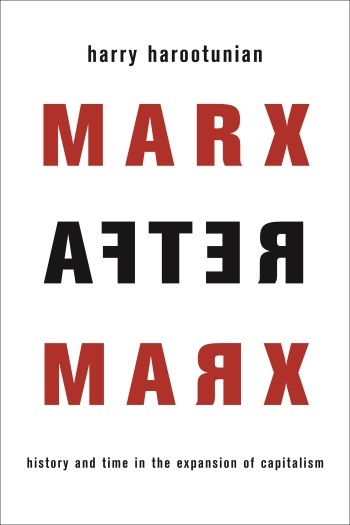
2375. Marx after Marx — An Interview with Harry Harootunian

By Harry Hartootunian, Columbia University Press, November 30, 2015 


Question: How does Marxism look different once it is taken out of the Western framework? What does it mean to “Deprovincialize Marx”?

Harry Harootunian: The question of how Marxism looked different once it was taken out of the Western framework, once it was deprovincialized and resituated in a context constituted of a different lived historico-cultural experience is, in many ways, the central problem of my book.

At one level it was obvious that the migration of Marxism acquired a different appearance when it landed in regions outside of Western Europe. In fact, its migration showed the multiple routes to the development of capitalism. Uno Kozo, the great Japanese political economist notedthat the development of capitalism in Japan was a local inflection of a global process similar to other late developing societies since it followed the same economic laws despite the mediating contaminations exercised by specific historical and cultural circumstances. However, it should be pointed out that this observation was made by a number of previous thinkers in Eastern Europe, Rosa Luxemburg, Leon Trotsky and even Georg Lukacs, the putative founder of ‘Western Marxism.”

All of these thinkers recognized that the penetration of capital in Eastern Europe dramatically contrasted with economic practices derived from previous modes of production and in some cases were metabolized to serve capital’s quest for surplus value. Marx put it simply in Grundrisse when he remarked that capital takes what it finds useful at hand from prior forms of economic activity and subordinates it to capitalism’s production process. Lukacs sought to show how the visible disparity between co-existing different forms of practice, the then and the now, could be overcome through the agency of ideology. The bourgeois mind was made to see in these residual appropriations not practices derived from pre-capitalist presuppositions but rather from capital’s own presuppositions. With thinkers from the margins of industrial capital and the colonies, the determining factor was the moment of encounter, time and circumstances in which capital appeared in a society. What I’m suggesting is that the reason why capital looked different derived from the convergence of two different forms of historical intervention: the conditions accounting for the timing of capital’s entry and the reasons prompting its adoption and the subsequent collision with a received, lived history and cultural experience.

The movement of Marxism could only result in a deprovincialization that took on the appearance of local historical and cultural color. When Marx announced in his famous Preface of the first edition of Capital I that “the country that is more developed industrially shows, to the less developed, the image of its own future,” he was not proposing that it would look like England or even France. What he was offering was the promise of development, knowing, at the same time, that the operation of formal subsumption, as the rule and logic of capitalist development, would inevitably involve a process of appropriation of what was at hand. Imitation of a “classic” example would have been simply impossible to maintain under the rule of formal subsumption. So I propose that in terms of theory, Marxism and its general laws, will always be mediated by local historical and cultural circumstances.

Q: Building upon that how does the history of Marxism and Marxist movements look different when you begin to look beyond the Euro-American context?

This question might be answered by suggesting that much of the concerns of Marxism outside of Europe-America, beginning with Lenin, was an effort to return to some of the more fundamental considerations of the founders, namely wage labor and the production process. In Western Marxism, The Frankfurt school was preoccupied with the role played by culture, consumption and the culture industry in the domination of everyday life. This program reflected the privilege accorded to the commodity form and ultimately value was released from its relationship to labor, whose importance was diminished. In a sense, this move to the structuring force of the commodity—value theory—exemplified thinkers like H-G Backhaus and Antonio Negri and to some extent Moishe Postone. The trouble with this orientation is that it was premised on the presumption that value had invaded every pore of the social formation. In this regard, the efforts of thinkers to return to some of the principal perspectives of the founders were an attempt to return to history and politics rather than philosophy. The move to philosophy signified a withdrawal from historical considerations related to labor and production, as suchand its importance for forms of contemporary political intervention. The preoccupation with philosophy separated lived culture from politics and history by subsuming their identities instead of reuniting value and history. In this regard, one should recall Marx’s own repudiation of philosophy and rejection of the “concept” for the sensuousness of the concrete commodity. If value trumped history, culture and consumption replaced history to signal in the West capital’s completion, that is, the accomplishment of real subsumption.

In contrast, the world beyond Europe remains at an earlier stage, still dominated by the bricolage of formal subsumption, incomplete, undeveloped, a history in the making aimed at “catching up.” Hence, the stage theory of an earlier Marxism was stretched to distinguish the West from the world beyond it, even though they shared the same contemporary moment. What I’m suggesting is that the presumed stagist movement from formal to real subsumption (absolute surplus value to relative surplus value) was another way of representing the difference between the advanced West and the backwardness of underdevelopment, maintaining the trajectory of an earlier and vulgate version of Marxism evolved from the Second and Third Internationals that would explain where societies were located in the historical route to socialism. Yet, on closer examination, it is possible to discern in this evolutionary scheme how the underdeveloped society is cast into another temporal register to reveal the distance it must travel to reach the true contemporaneity of modern capitalism. It is precisely this stagism that mandates the reproduction or replication of a singular model of development that excludes other, plural possibilities.

Q: What were some of the alternate routes that capitalism took outside of the West that challenge how Marxism has been understood in the Western tradition, or as interpreted through the English experience as articulated in Capital?

HH: Japan constitutes a particular dramatic alternative to the English model, inasmuch as the country experienced a local feudal system that collapsed in 1868 and was replaced by a new kind political regime dedicated to adopting capitalist development from England. Its own feudalism failed to develop capitalism from its own internal contradictions and as people like Uno observed, Japan had no need to go through the long and catastrophic phase of so called primitive accumulation because it took place 300 years earlier and the nature of English industrial capitalism had considerably changed. In other words, Japan had no need to release large numbers of peasant cultivators from the land and their principal means subsistence until a later time. Gramsci provides yet another alternative that aimed to enlist a coalition of northern industrial workers aligned with semi-feudal peasants as does Mariategui and his conceptualization of contemporary non-contemporaneity consisting of Inca communalism (Marx’s valorization of the archaic in the contemporary present) capitalism.

Q: In one chapter you examine a group of Chinese and Japanese theorists. How did capitalism’s relatively late arrival in those countries shape their understanding of Marx and Marxist theory as it applied to their local conditions?

HH: Building on some of my earlier responses, it is interesting to notice that the experience of development in China and Japan and the relatively late arrival of capitalism inevitably stimulated the acceleration of capitalist development to “catch up.” But this experience, whether in China or Japan, or indeed elsewhere, must inevitably take into account the role played by the Soviet Union in funneling Marxian theory into new regions beyond Europe as the basis of forming new national communist parties.

This combination of implanting a critical strategy with universalist aspirations in societies that were either colonized or, like Japan, starting out late to develop a capitalist based economy forced them to confront the contradictory demands between the external constraints exerted by the Soviet comintern and the actualities of local reality it often overlooked or ignored and misunderstood. More often than not, local communist groups followed the changing ideological strategies of the comintern and tactics they authorized. In the case of both Chinese and Japanese communists, a disciplined adherence to the Soviet line offered the hope of accelerated development among groups dedicated to what was called National Marxism. In China there was an almost obsessive preoccupation with questions of periodization and fitting China’s long complex imperial history into a framework dominated by the role played by the feudal stage and the category of transition leading to the capitalist mode production. Even in the reflections of Wang Yanan, we can see the residue of this concern with periodization derived from an earlier debate and the attempt to locate the feudal experience in a remote, archaic time that elastically stretched into the 19th century to produce a frozen semi-colonial, semi-feudal mode of production, part foreign capital, part Chinese compradors.

With Japan, the tortuous efforts to fit Japan’s shorter feudal history into the readymade framework resulted in (1) recognizing feudal carry-overs, remnants from a prior mode of production, that functioned to stall and even block the further development of capitalism in Japan to produce the political effect of “refeudalization” that resembles “semi-feudalism” or “semi-colonialism.;” (2) a profoundly influential historical controversy that tried to determine whether the Meiji Restoration of 1868s was a genuine bourgeois revolution or an abortive one that, along the way, yielded a vast historiographical archive that still dominates Japanese historical practice. One of its most interesting purposes was the attempt to identify the conditions that would have shown how Japan’s own feudalism would have led to the development of the capitalist mode of production had the country not been opened by foreigners. (3) With thinkers like Uno, who acknowledged the operation of formal subsumption without naming it as such, the very remnants obstructing the further development of capitalism in Japan were recognized as instances of how capital works, by taking what is at hand that is useful to its production process. But Uno went further in perceiving the enormous time gap between England’s inaugural capitalism and Japan’s much later development as the reason explaining why Japan didn’t have to replicate the English experience of “so-called primitive accumulation” because it was in process of adopting a more form of industrial capital from England.

There is also the problem of the Asiatic mode of production, which the Japanese quickly abandoned but Chinese remained attached to, in one form or another. I couldn’t help thinking that its revival in the PRC during the 1980s constitutes a background to China’s meteoric development of capitalism, which resembled a continuation of the large scale public works projects (canals, irrigation networks etc.) characteristic of the conduct of the AMP in China’s earlier history.

Q: What role does or should Marxist theory play in the way we understand contemporary capitalism?

HH: I think that post-coloniality provided an invaluable contribution to Marxism by emphasizing its specific cultural and geographic formation, especially the kind of Marxism that filtered into colonies like India. But in the campaign to “provincialize Europe” and “unthink Eurocentrism,” I think it went too far when it wrote off Marxism as merely another Western historicist metanarrative imposed from the outside to smother “native sensibilities and imagination.” If Marxism was vulnerable to charges of an inaugural Eurocentrism, postcoloniality was answerable for its collaboration with imperialism in its most contemporary avatar of globalization. This apparent complicity with forms of neocolonialism derived from its prior relationship with the Cold War and its enthusiastic embracing of post-structural philosophy, with its own ideological defense of Cold War polarities that encouraged dismissal of Marxism or simply ignoring it out of neglect.

In many ways, post-coloniality appropriated and embodied the “desire” Fredric Jameson once attributed to cultural studies but equally shared by post-coloniality, which was the yearning to succeed Marxism in American academic life and replace it. Beyond its capture of academic institutions, there was the politics of a reigning textualism in the literary fields and the insinuation of history and political into disciplines traditionally unreceptive to what they had to offer. But the problem posed by post-colonialty and its caricature of Marxism is mirrored in a frozen Marxism that still clings to a vulgate version of stage theory figured under the circumstances of a distant past to meet its specific social, economic and political conditions. What I’ve tried to propose is a Marx who was able to expand his own angle of vision from the 1860s on and widen his perspective to envisage a global arena marked by the formation of the world market. We can perceive in this epochal shift that Marx had moved toward envisioning the multiple possibilities for radical transformation among the world’s societies that no longer depended on their capacity to replicate a singular model offered by a European nation-state or bypass the colonial experience, and which, as his views on Russia showed, could utilize the residues of a prior modes of production to create either a new register of formal subsumption or bypass capital altogether.

The role Marxism plays today is the same critical vocation and practice Marx imagined at the start. It is still the best critical strategy we have available to understanding timeliness and its changes and grasping what must be done.

Sunday, May 1, 2016

2303. A Political Marxist: Ellen Meiksins Wood, 1942-2016

By Ken Hircschkop, Radical Philosophy, May-June 2016

I have a vivid memory – too vivid to be an accident – of the first time I read something written by Ellen Meiksins Wood. It was an article in New Left Review on the separation of the economic from the political; it was, of course, polemical. I didn’t know the context of the polemic or understand the significance of Ellen’s robust defence of ‘political Marxism’. But I knew this was something distinctive: a sophisticated argument, laid out in language that was lucid and direct and in a tone to which the term ‘uncompromising’ does faint justice. It was a vibrant but careful, ambitious yet historically nuanced kind of Marxism. 

When, a few years later, I met the author behind the fierce words I was, like many others, surprised and delighted. Could the extraordinarily charming, warm and chatty woman across from me on the Chesterfield-to-London train be reconciled with the take-no-prisoners author of such fierce polemic? This was the paradox of Ellen Meiksins Wood, or, rather, her achievement: a loving person who flourished in concert with others, and could do so even as she articulated, in person or in print, the sharpest of arguments. It was a blend that won her the loyal, adoring friendship of many people over a long and successful life. In her final years she boasted of the political double act she took on the road, in which she argued the cause of Marxism head-to-head against a leading social democrat: her loving and beloved husband Ed Broadbent.

Ellen was born in New York City in 1942. Her parents were Latvian Jews and active Bundists, who had left their home in dramatic circumstances in the late 1930s. After her parents’ divorce and the end of the war, she went to Germany with her mother, who, on assignment from the Jewish Labor Committee in New York, was working with displaced persons. Her earliest experiences were thus coloured by both the leftist commitments of her family and the Left’s response to the tragedies wrought by fascism and the war. 

The young Ellen Meiksins then became, of all things, a Californian teenager. When her mother’s work was completed, they moved to Los Angeles, where Ellen attended Beverley Hills High School, returning occasionally to New York to visit her father and stepbrothers, Peter and Robert. Her first degree, in Slavic languages and literature, was taken at Berkeley and it was followed by postgraduate work in political theory at UCLA, where she met her first husband, Neal Wood. Her doctoral dissertation, ‘The Epistemological Foundations of Individualism’, was published in revised form as a book in 1972. 

In 1967 Ellen and Neal moved to Toronto to take up posts at York University, a relatively new institution, which, like its Robbins-inspired kin in the UK, was self-consciously modern in its structure and its commitments. It would be Ellen’s institutional home for her entire career, becoming, in her own words, ‘the most Marxist department in North America’. Her commitment to what she would later call ‘the social history of political thought’ would find an ideal home in the graduate program in Social and Political Thought that she and Neal helped found in 1973. There she would educate and inspire a generation of political theorists and critics. 

What being ‘a Marxist’ meant in this period was, however, a matter of intense dispute: the breakdown of Stalinism, the rise of Eurocommunism, the re-emergence of Trotskyist and Maoist parties and the gradual strengthening of the new social movements led to intense debate within Marxism over both core principles and political strategy. In this climate, Ellen seemed to feel the greatest affinity with the generation for whom the war and the struggle with fascism were political crucibles, the ‘Old New Left’, as it was latter dubbed, which had broken with Stalinism but still regarded the working class as the irreplaceable agent of revolutionary change. They had first organized around the New Reasoner – now they wrote for the Socialist Register, to which Ellen became a steady contributor.

The prominence of historians within this group (Edward Thompson and John Saville among others) was probably decisive. Ellen’s version of historical materialism would consistently tilt against those who interpreted Marxism as either a theoretical science (the Althusserians, with their talk of levels and structures) or Kulturphilosophie. For her it was first and foremost a historical account of the emergence and working of capitalism, articulating not immutable laws of historical development but the particular and in some sense contingent circumstances and processes that brought capitalism into being. In a revealing aside, she once claimed that there was no explicit theoretical account of her kind of Marxism available, but that ‘something like it is implicit in the works of certain Marxist historians’. These affinities and the personal friendships they fostered would eventually draw her into the orbit of the British New Left. In 1983 she joined the editorial board of New Left Review, on which she would serve until 1993, and in the 1980s she and Neal began spending roughly half their time in London, eventually settling in Primrose Hill a few doors down from their friends Ralph Miliband and Marion Kozak. 

While dividing her time between Canada and England, Ellen waged an intellectual campaign on two fronts. The first, which took shape in articles for The Socialist Register and New Left Review, and in a series of increasingly ambitious and influential books, was an argument for the centrality of Marxism in general and for her understanding of it in particular, polemically aimed at those who wanted to dissolve its analysis in the warm bath of post-Marxism and the new social movements. In books like The Retreat from Class (which won her an international following and the Isaac Deutscher Prize) and Democracy Against Capitalism Ellen insisted that the analysis of capitalism remained the central task of socialist intellectuals and that this analysis had to attend, above all, to the political struggles around property and the control of production that were central to the labour movement. Marxism lost its way when it split the political off from the economic, for then the economy became a system with an internal logic (which might, or might not, lead to crises) and political action assumed a culturalist and voluntarist character. The labour movement was the key to the revolutionary enterprise – if it couldn’t make the running, no one could. 

Compared to most of the left political theory of the time, this looked fairly orthodox. But Ellen had done more than make a fresh case for an established position. By insisting that political relationships, embodied in forms of property, were the central fact of capitalism, she illuminated the interdependence between the capitalist state and the market relations it had to enforce. More importantly, Ellen’s work broke the spell that captivated so much of the Left: the association of capitalism with ‘modernity’, with cities, with their bourgeois denizens and with industry. Capitalism was not originally the creature of cities, of expanding trade, or even wage-labour, she argued. It had depended first and foremost on the destruction of customary practices in peasant life, on the conversion of agricultural land into wholly private property, and on the forceful establishment of market dependency throughout the countryside of England. England, not France. And England in the sixteenth and seventeenth centuries, not the England of the satanic mills. 

The second front of Ellen’s work was an ambitious ‘social history’ of European political thought, on which she worked at first with Neal and then continued solo after his death. With Neal she published A Trumpet of Sedition, which examined political theory in Britain in those two decisive centuries; later Citizens to Lords and Liberty and Property would cover, in one grand sweep, political thought from Greek antiquity to the Enlightenment. The narrative sweep was meant to highlight the moments of decisive transformation, when ‘parcellized sovereignty’ was replaced by the total, coercive power of the modern state and the web of feudal obligation was twisted into the tight, focused bond of private property. It was no accident that John Locke was the key figure for Ellen or that she thought of early modern political theory as her intellectual centre. For it was there that the decisive relationship between state power and capitalist property had been forged.

When the socialist Left lost sight of this relationship, or even abandoned it, the result was an unwitting naturalization of capitalism, which appeared as the simple, perhaps inevitable, outgrowth of modern urban life, or the expansion of trade, or technological advance. It was, Ellen insisted, none of these things. Focusing on that exceptional moment in the history of English society – the moment of peasant dispossession, enclosure and agricultural ‘improvement’ – would ensure we understood capitalism as the product of particular historical circumstances, a configuration of land, people and power that had violently remade England, and would violently remake other lands, European and colonial, in the centuries that followed. Its violent, catastrophic origins, summarized in her 2002 book The Origin of Capitalism, would be echoed in the political violence of world war and fascism in the twentieth century. At both moments, political Marxism stressed the historical specificity of capitalism and thus the possibility of its overcoming.

This illuminating vision and the lucid, engaging style in which it was articulated made Ellen an important figure internationally. Although her sympathies with, and similarities to, other intellectuals of the Left – Robert Brenner, Paul Sweezy and Harry Magdoff in America; Edward Thompson and Ralph Miliband in England – were marked and important, in many ways she always seemed a one-off, a unique voice. That she was a woman in this male-dominated world was obviously a major factor. After Neal’s death in 2003 she continued to write. Her book Empire of Capital set contemporary imperialism in the kind of comparative historical context that had done so much to sharpen her account of political theory and capitalism’s origins. 

Six years before her death Ellen became close to Ed Broadbent, an iconic figure of the Canadian Left and the leader of the New Democratic Party in the 1970s and 1980s. They married in 2014. In January of this year Ellen succumbed to the cancer which she had fought against, with impressive calm, many years before. The Left has lost one of its most distinctive voices. Distinctive not just in what Ellen had to say, but in its impassioned calm, a seriousness that lacked all pretention and any trace of meanness.

Saturday, January 23, 2016

2170. A Tribute to Ellen Meiskins Wood (1942-2016)

By  Vivek Chibber, versobooks.com, January 15, 2015
Ellen Meiskins Wood
Ellen Meiskins Wood passed away on January 14, 2016, after a long struggle with cancer.  Wood was a thinker of extraordinary range, writing with authority on Ancient Greece, early modern political thought, contemporary political theory, Marxism, and the structure and evolution of modern capitalism.  But even more importantly, she was one of those enchanted few from the New Left who never relented in their commitment to socialist politics.  In fact, it was with her book The Retreat from Class in 1986 that she burst onto the stage as a major presence on the intellectual Left.  That book was one of the early, and certainly most compelling, criticisms of the emerging post-Marxist milieu taking shape in the erstwhile New Left. Intellectually, it offered a bracing defense of historical materialism against post-marxist critiques; politically, it announced Woods censure of a generation that, after a brief dalliance with socialist politics, was turning against it with ferocious intensity.  
Woods defense of class analysis was always combined with an insistence that it be disciplined by empirical research.  And on those grounds she never hesitated to engage even those historians and theorists who were closest to her.  In Peasant-Citizen and Slave, she took issue with G.E.M de ste. Croix, perhaps one of the greatest historians of antiquity and certainly its most illustrious Marxist analyst, who argued in his The Class Struggle in the Ancient Greek World that the main source of surplus in both Greece and Rome was the labor of slaves.  Wood argued that while de ste. Croix was certainly correct in noting the importance of slave labor in antiquity, he greatly exaggerated its centrality for surplus production. She built her case with a careful examination of primary sources, through which she not only countered de ste Coix, but also constructed one of the compelling materialist analyses of the structure of Greek democracy.  Slightly more than a decade later, Wood took on Robert Brenner, her lifelong friend and political comrade, on the origins of modern capitalism.  While Wood was deeply influenced by Brenner’s argument about the origins of capitalism in England, she insisted that his analysis of capitalism’s rise in the Low Countries was both empirically questionable and analytically flawed. Again, her argument was characterized by a careful examination of the facts with razor-sharp analytical precision.  Her criticism remains perhaps the of the most important critiques of Brenner’s highly influential work. 
Wood is perhaps best known for her role in the development of “Political Marxism”.  This is the name given to an argument about the structure and origins of capitalism, based most centrally on the work of historian Robert Brenner.  Brenner and his colleagues have argued that what defines capitalism is a particular set of social property relations, which are unique to the modern era, and which force all economic actors to a dependence on the market.  Whereas in all previous eras, production was subsistence oriented, capitalism is the first economic system that forces producers to sell on the market, and hence to have to compete in order to survive.  Wood argued that this had two very important implications.  First, that capitalism is the first economic system in which the market plays a central role.  Whereas markets have existed for millennia, ours is the first era in which they actually regulate production and exchange, and hence generate the social division of labor. This did not come about naturally. There is no in-built tendency for markets to grow to the point where they displace pre-capitalist forms of production.  They had to be created by forcibly stripping peasants of their land. 
Second, it means that profit-maximization is something that is forced onto the producers as a means of survival.  Firms don’t make profits because they are greedy – they do it because if they don’t, they will be driven out of the market.   The market, therefore, is not an institution built upon the happy exercise of an entrepreneurial spirit, but a highly coercive institution that not only dominates workers, but also capitalists.  This has a clear political implication – that so long as production is based on market competition, the antagonism between workers and employers cannot be erased.  For as long as employers have to survive by winning the competitive battle, that have to focus ruthlessly on minimizing their costs.  And this means that they have to constantly press down on workers’ wages and benefits as part of their survival strategy.  The market pits capitalists against their own workers.  Woods conclusion?  That as long as capitalist property relations are in place, class struggle will remain a central axis of contention. In the years following the publication of The Retreat from Class, Wood published dozens of essays deepening this argument and showing how political theory ignores the septicity of capitalism only at its peril.
In her last years, Wood had embarked on an extraordinarily ambitious analysis of the development of political thought, from Antiquity to the modern era.  Wood sought to locate the central thinkers of each era in their social, particularly class, context, showing how the major themes and arguments were linked to the central political dynamics of the time, and hence embedding the political ideologies of each era to the underlying class structure.  She had completed two volumes in the series, extending from the Greeks to the Enlightenment.  A third volume, bringing he story to the current century, was in preparation, but will not now be completed. 
I only met Ellen on a couple of occasions, but like so many others on the Left, I feel I owe her a tremendous debt.  She was not only a fantastically gifted theorist  perhaps the most brilliant of her generation  but she also held her ground morally and politically through what is undoubtedly the most difficult period for the Left since its inception.  Ellen showed so many of us what it means to be a committed intellectual  that it is possible to be intensely moral and relentlessly analytical; to be passionate but still work with a cool attention to detail; to be profoundly rooted in a movement but maintain one’s independent judgement.  She carried all this off with an effortlessness that one can only try to emulate.  Her demise is a loss that we will all feel deeply for some time to come.  And sadly, it is a loss that the Left does not yet have the resources to absorb. 

More in #EllenMeiksinsWood