Showing posts with label Food policy. Show all posts

Monday, May 18, 2020

3368. Creating Abundance By Occupying Your Plate

By Kamal Prasad, People Powered Peace, No date
Occupy Your Plate
The Occupy Movement came about partly because we realized that we had given away too much power to government and industry that do not always have the best interest of the people in mind in their actions. Once power is given away, it can be very difficult to get back.  That is why we have yet to see the one percent pay their fair share. There is one power, however, which we all have that hasn’t been taken away from us and that is what we put on our plates to nourish our bodies every day. Here is why it matters.
The largest receiver of farm subsidies in the U.S. is the corn industry. However, according to the USDA, over 95% of the corn grown is fed to cows, pigs and chickens. In fact, majority of the edible grains grown are fed to livestock, which if they were fed to people directly would feed over 800 million people. Taking these factors into account, the livestock industry is the largest receiver of government farm subsidies.
We are told that we need GMOs because they can be made pesticide and drought resistant to produce larger yields to feed a growing population. If we weren’t using the food we grow now to feed animals who return only a fraction of that food back with even lower nutritional value, we would have enough food to feed everyone without the need for GMOs.
Instead of subsidizing raising foods that promote heart disease, diabetes and cancer, why don’t we support those same farmers to grow vitamin, phytonutrient, and antioxidant producing foods that enhance life, fight diseases and increase longevity?
Animal agriculture is also responsible for a large portion of world’s environmental problems, emitting more greenhouse gases than all modes of transportation combined. As can be deduced from the food grown to feed animals, animal agriculture is a huge consumer of fossil fuels. The livestock industry is also responsible for the largest use of farm land and water as well being the largest polluter of these resources.
If one were to take a poll, almost everyone would condemn cruelty to animals, including farm animals. Yet, by US Dept of Agriculture’s own account, over 95% of all animal products that we consume daily come from factory farms; where sentient beings are intensively confined, suffer both physical and mental abuse before meeting a horrible death. Even so-called humanely raised animals are typically sent to the same inhumane slaughterhouses that also process factory-farmed animals.
There isn’t one good reason to give up eating animals, there are several. The details of each of the things listed above could fit volumes. I encourage you to do your own research, to empower yourself against the industries and the government beholden to them, that use our tax-dollars to exploit our land, water and living creatures capable of loving and feeling. Perhaps you will come to the same conclusion I came to 4 years ago.
Giving up eating animals is not about deprivation; it is about creating abundance, an abundance of resources, an abundance of food to feed the hungry, an abundance of health, for people and the planet, and an abundance of compassion. And when there is abundance, there is sharing, and sharing makes it a better world to live in, for us, them, our children and generations yet to come.
One of the easiest way to be a part of the Occupy Movement is by occupying your plate. You still have this power, so be powerful.

Resources

Friday, February 27, 2015

1750. Food Waste Is Becoming Serious Economic and Environmental Issue, Report Says

By Ron Nixon, The New York Times, February 25, 2015


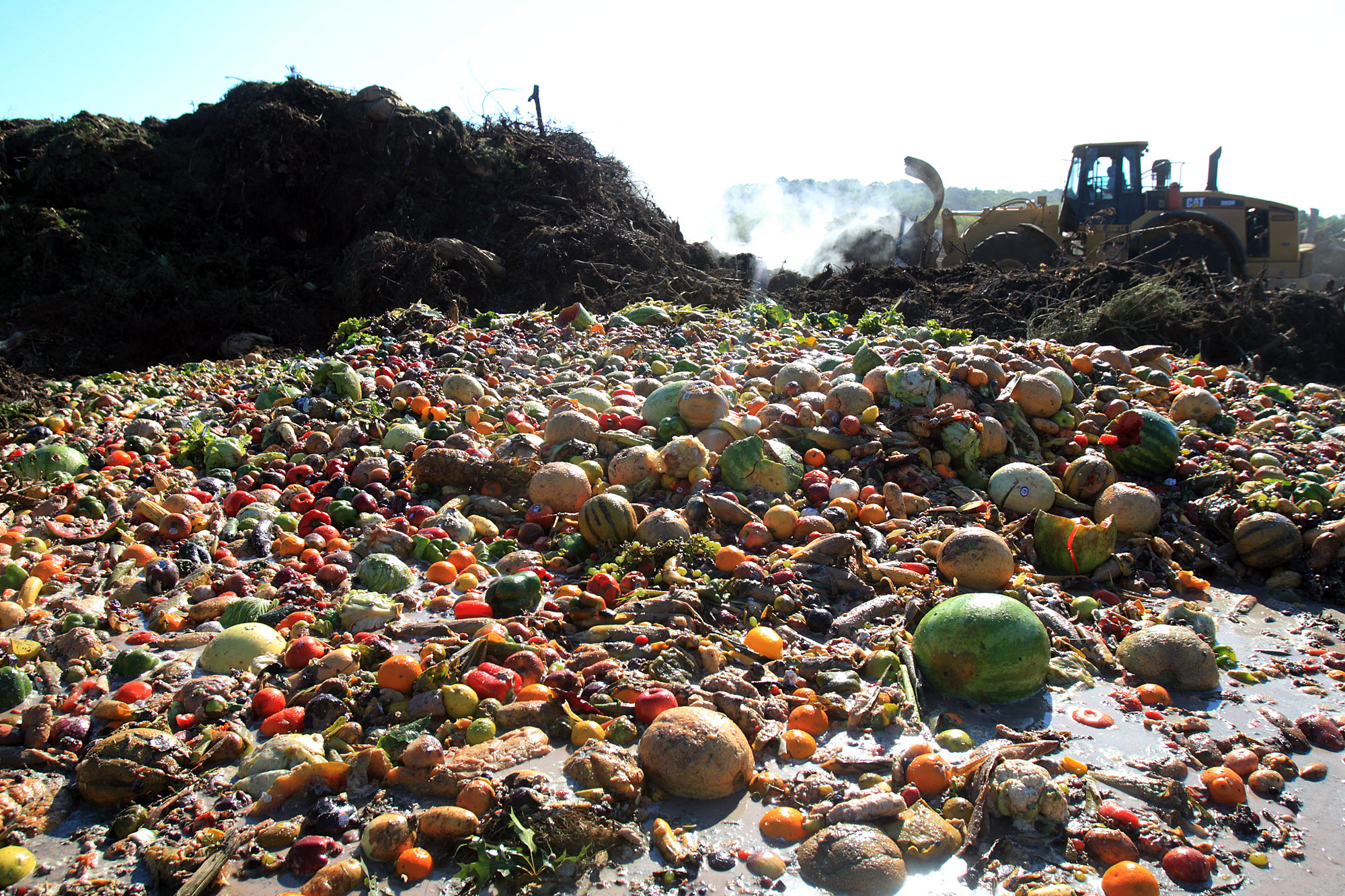
WASHINGTON — With millions of households across the country struggling to have enough to eat, and millions of tons of food being tossed in the garbage, food waste is increasingly being seen as a serious environmental and economic issue.

A report released Wednesday shows that about 60 million metric tons of food is wasted a year in the United States, with an estimated value of $162 billion. About 32 million metric tons of it end up in municipal landfills, at a cost of about $1.5 billion a year to local governments.

The problem is not limited to the United States.

The report estimates that a third of all the food produced in the world is never consumed, and the total cost of that food waste could be as high as $400 billion a year. Reducing food waste from 20 to 50 percent globally could save $120 billion to $300 billion a year by 2030, the report found.

“Food waste is a global issue, and tackling it is a priority,” said Richard Swannell, director of sustainable food systems at the Waste and Resources Action Program, or Wrap, an antiwaste organization in Britain that compiled the new report. “The difficulty is often in knowing where to start and how to make the biggest economic and environmental savings.”

The food discarded by retailers and consumers in the most developed countries would be more than enough to feed all of the world’s 870 million hungry people, according to the Food and Agriculture Organization of the United Nations.

But it is not just those countries that have problems with food waste. The report showed that it is also an issue in African countries like South Africa.

The problem is expected to grow worse as the world’s population increases, the report found. By 2030, when the global middle class expands, consumer food waste will cost $600 billion a year, unless actions are taken to reduce the waste, according to the report.

Food waste is not only a social cost, but it contributes to growing environmental problems like climate change, experts say, with the production of food consuming vast quantities of water, fertilizer and land. The fuel that is burned to process, refrigerate and transport it also adds to the environmental cost.

Most food waste is thrown away in landfills, where it decomposes and emits methane, a potent greenhouse gas. Globally, it creates 3.3 billion metric tons of greenhouse gases annually, about 7 percent of the total emissions, according to the report.
The United Nations agency points out that methane gas from the world’s landfills are surpassed in emissions by only China and the United States.

“Seven percent is not the largest contributor of greenhouse gasses, but it’s not an insignificant amount,” said Helen Mountford, the director of economics at the World Resources Institute. “But this is one area — reducing food waste — where we can make a difference.”

Over the last several years, some cities and counties in the United States, including New York City, have started programs to tackle the issue. Hennepin County, Minn., the state’s most populous county, provides grants from $10,000 to $50,000 to local business and nonprofits to help recycle food products or turn them into compost.

“There is still a lot in the waste stream,” said Paul Kroening, supervising environmentalist at Hennepin County Environmental Services. “We are just scratching the surface.”

A coalition of food industry trade groups, the Food Waste Reduction Alliance, has also increased effort to combat food waste. Meghan Stasz, the director of sustainability for the Grocery Manufacturers Association, a member of the alliance, said the group was working with supermarket chains to reduce waste by clarifying expiration dates and selling smaller portions of food.

Ms. Stasz said the group was also getting its members to donate more food and make changes in manufacturing processes to reduce the amount of wasted food. One member, the giant food company ConAgra, changed the way it placed dough in shell for its pot pies and saved 235 tons of dough in a year.

Mr. Swannell, of the antiwaste group Wrap, applauded those efforts, but said more still needed to be done.


“Awareness of food waste has risen, but we need to do more to tie that awareness to actions on the ground,” he said. “We need to find better ways to deal with food waste, but we need to prevent it in the first place.”