Showing posts with label Farm animals. Show all posts

Wednesday, December 28, 2022

3614. Growing Up on a Farm Butchering Farm Animals

By Sarah Smarsh, The New York Times, December 21, 2022


Cold days are better for killing animals. Warmer months demand time in the wheat fields. Plus, 

heat and sun quickly turn meat rancid.

On my family’s farm in rural Kansas, we did our butchering in the fall and winter, when the work drew no flies.

On gray afternoons, I would get home from school — after an hourlong bus ride on muddy roads — to see a large, pink carcass hanging near the cinder block farmhouse where I lived with my grandparents.

Grandpa would have already shot a bullet through the heifer’s brain, drained her blood, cut off her feet with a handsaw and begun to peel away her skin. Then, having hooked two of her legs with a steel spreader connected to the long arm of our tractor, he would have used hydraulic controls to lift the heavy creature — who, not two hours prior, grazed in the pasture and huddled against the north wind with her family — and sliced her underbelly from anus to neck.


We would spend the evening in the butchering shed — a small barn next to the house with a garage door, a bloodstained concrete floor and a rosebush growing up its south wall. Grandpa did the carving. Grandma stood at the grinder making hamburger. My job was to weigh the meat on a metal scale, wrap it in butcher paper and label it with a marker. More often than not, friends and family pitched in and left with steaks for their deep freezers. Grandpa saved the heart and liver, which he pickled in a jar in our icebox.

This was an average day for me, growing up. During those formative years, witnessing death did not desensitize me to the plight of our fellow animals. Rather, life on the farm in general strengthened my reverence for the more-than-human world, which so plainly dictated our lives. While we opened and closed the gates that trapped farm animals, we were often at their mercy.

On winter mornings when we would have preferred a warm bed, we crouched in the snow and pulled a breech calf into the world before sunrise. We were aware each day, when we entered the pasture to check the water in the stock tank, that even the smallest of the Charolais cattle could beat us in a fight. We had friends who had been trampled or gored by bulls, and Grandpa told the story of an area farmer who, years before, slipped on a patch of ice while inside one of his pens, hit his head and was eaten by hogs.

On Sundays at the little Catholic church down the dirt road from our house, we stared up at Jesus’ bleeding, hanging body and listened to the sermons about man’s dominion over the earth. But in our bones we knew it was the other way around.

Our humility was not just the result of doing hard, undervalued work. It was also the result of being undervalued people.


Even as a child, I understood that families like mine, poor rural farmers, were low in the pecking order. Television shows and movies portrayed us as buffoons and hicks, always the butt of the joke. Our presumed incivility, and even monstrousness, was suggested in conversations, often to laughter, by humming the banjo tune from the 1972 film “Deliverance,” present in many VHS collections during my 1980s childhood. “Squeal like a pig,” some jokers continued — a reference to that film’s infamous rape scene.

We didn’t need those cues to know that society held us in low esteem, though. All we had to do was look at our bank accounts.

We worked the land and killed animals so that others would eat, so that we would afford propane for the winter, and so that the rich, rigged industry we supplied grain to would become a little richer.

The profound humility instilled in me by my upbringing left no room in my worldview for exceptionalism of any sort. It also left me troubled by the ways that most humans calculate the value of things — animals, plants, land, water, resources, even other people — according to hierarchies that suit their own interests.

More than once, while wrapping meat, I sliced my finger on the sharp edge of the butcher paper. There was nothing special about my blood. It was red just like the pigs’ and the cows’. It was clear to me that there was nothing special about me or my family, either, doing that most essential work of feeding others. Nothing special but also nothing lesser.

From there, near the bottom of the proverbial social ladder — where women drove tractors and people of all races lived in single-wide trailers — I began to see through the many false narratives of supremacy that govern our society. That men are better than women. That white people are better than everyone else. That the rich are better than the poor. Even, yes, that human beings are better than animals.


The experiences of my early life left me forever in mind of the animals that society consumes and the workers who spend their lives among them. It also left me rageful toward industries that devalue both. In some ways, my professional mission to champion the exploited and expose the powerful — as a journalist, an author and an advocate for social justice — can be traced back to lessons I learned on the farm.


Unfortunately, farms like ours — and the ancient, intimate tradition of husbandry into which I was born — have been disappearing for decades, forced out of business by policies that favor large industrial operations.

Today an estimated 99 percent of the meat in the United States comes from factory farms, barbaric places that leverage the selfish, amoral paradigm of human supremacy for immense capitalist gain. Industrialized agriculture has made meat, eggs, milk, leather, cheese, wool and other animal goods readily, cheaply available to the modern consumer but at a terrible cost — both to the animals, who endure savage cruelty, and to the low-wage laborers, many of whom are immigrants of color, who suffer injuries to body and spirit.

This likely isn’t news to you. The details of this dark business, while partly obscured by ag-gag laws, are widely documented, yet they remain underdiscussed. The torturous treatment of animals at the hands of multibillion-dollar monopolies is among the greatest horrors being committed on this planet.

In comparison, our small farm was as humane as any enterprise raising animals for slaughter might be. And while we lived in poverty, according to many definitions, it was a fortune and privilege to grow up with a big garden, with cows and pigs and chickens.

Subsistence through modest land ownership historically has been refused to people of color, stolen from Indigenous peoples and made economically unfeasible for poor folks of all stripes, who set off for cities in order to survive.

Whereas most Americans today have no direct contact with the animals they eat, I carried their manure on my boots. Thus, long before I learned about the industry that delivers chicken tenders and bacon strips to the masses, I had an aversion to factory-farmed products. The beef was too gray. The chicken smelled wrong. The egg yolks were too pale.


Ironically, our culture associates eco-consciousness with higher socioeconomic status, as though greater wealth denotes greater character. But in my experience, environmental impacts are most keenly felt and understood by the poor and unheard.

In fact, as I have climbed out of poverty and into a class of highly educated, financially comfortable liberals, I have found that for all their supposed interest in justice and claims of being on the right side of history, most of my peers give little thought to animal suffering in their eating decisions.

Of course, wealth and class play a role in what food and products you can afford. Socioeconomic barriers to values-based eating choices undeniably exist, particularly in urban areas cut off from healthy food options. But one doesn’t have to afford expensive grass-finished beef or frozen patties engineered from pea protein to make effective food decisions, and white male chief executives didn’t invent plant-based living. Bougie restaurants serving charcuterie boards sure as hell didn’t invent local venison salami, which we made from the deer we hunted.

To be certain, many middle-class and affluent consumers far removed from agricultural work have learned about the problems of factory farming, including its contribution to climate change, and altered their habits. I applaud their important efforts. For some people, though, working near the bottom of the class ladder provides not just knowledge but a knowing, and that knowing deserves respect.

As a young adult, I lived in poverty and faced food insecurity. These conditions limited my choices, but they did not negate my affection for the earth. I grew up driving a farm truck with wheat kernels on the floor of the cab and an “Eat beef” license plate on the front bumper. I knew people maimed by farm machinery and disabled by agricultural chemicals. Regarding the conditions of farm animals and farmworkers, I had no option but to understand.

For me, there is no taste of meat without bodily memory — the heat of a newborn calf in my cold arms, the smell of the mother’s cascading excrement, the danger of her heavy hooves. I could see the cows on our farm from my upstairs bedroom window and the pigs and chickens from our front door.

My early proximity to animals did not cause my empathy for them, I suspect, so much as it starkly revealed it. To be sure, similar experiences did not make animal rights activists out of most of the people in my farming community. But in general, I observed more environmentally conscious behaviors among the rural working poor than in other socioeconomic spaces I’ve inhabited.


Maybe it was because minimizing waste and reusing and repairing old things were economic necessities. Or perhaps it was because carbon-spewing air travel was an unaffordable luxury. Or maybe it was because they had no choice but to look into a cow’s eyes before they killed her.

I do not wish to valorize the working class or demonize those who are better off. Both groups vote in droves for politicians who cater to massive agricultural corporations, the fossil fuel lobby and other powerful entities that destroy our planet.

But guilt for crimes committed against other species and against the earth is not equally shared. Wealthy corporations and the governments beholden to them, choosing profit over sustainability and moral decency, created and fortified the food systems with which the average individual has little choice but to engage.

Navigating those systems today, while living again in rural Kansas after years in cities, I now eat eggs from my neighbor’s hens and, about once a month, chicken, beef or bison raised and slaughtered down the road. At other times, living without access to such food or means to afford it, I went without eating animal products for years at a time. I haven’t consumed dairy in more than a decade, but for those who do, the particular devastation of family dairies makes local milk and cheese much harder to come by.

Still, I am part of the problem. I ate fast-food hamburgers well into my 20s, and my home almost certainly contains products that were tested on animals. My cat eats canned meat from factory farm byproducts, and I’m wearing mass-produced leather sneakers as I type this.

I am sympathetic to the argument that any consumption of animal products is unethical and unnecessary. Realistically, however, the urgent problem for our time is not whether they will be consumed but how.

While it is important that consumers from all socioeconomic backgrounds care about the earth and its creatures, ultimately only policy has the power to restrain the agriculture industry’s worst abuses. I am heartened by long-term legal efforts to extend personhood to other animal species and, more immediately, by the New Jersey senator and famous vegan Cory Booker’s new legislation to make slaughterhouse practices more humane. In a more perfect world, future farm bills would somehow rebuild the nearly four million small farms lost to urbanization and industrialization since the 1930s, allowing future generations the closeness to animals that engenders awareness.


My family, squeezed out like so many others, had to sell our fifth-generation farm more than 20 years ago. I was a first-generation college student by then, working toward a more comfortable life.

No education, however, would surpass the one I received in the butchering shed, where I held a bleeding muscle with my bare hands and placed it on the scale. Today, when I look at that scale — now an antique on display in my kitchen — I give thanks for those who worked and those who died so that I may eat.

Sunday, August 2, 2015

1960. A Haven From the Animal Holocaust

By Chris Hedges, truthdig, August 2, 2015 


WATKINS GLEN, N.Y.—There are mornings when Susie Coston, walking up to the gate of this bucolic farm in her rubber boots, finds crates of pigs, sheep, chickens, goats, geese or turkeys on the dirt road. Sometimes there are notes with the crates letting her know that the animals are sick or injured. The animals, often barely able to stand when taken from the crates, have been rescued from huge industrial or factory farms by activists.

The crates are delivered anonymously under the cover of darkness. This is because those who liberate animals from factory farms are considered terrorists under U.S. law. If caught, they can get a 10-year prison term and a $250,000 fine under the Animal Enterprise Terrorism Act. That is the punishment faced by two activists who were arrested in Oakland, Calif., last month and charged with freeing more than 5,700 minks in 2013, destroying breeding records and vandalizing other property of the fur industry.

Only in the insanity of corporate America can nonviolent animal rights activists be charged as terrorists while a white supremacist who gunned down African-Americans in a South Carolina church is charged on criminal counts. Only in the insanity of America can Wall Street financers implode the global economy through massive acts of fraud, causing widespread suffering, and be rewarded with trillions of dollars in government bailouts. Only in the insanity of America can government leaders wage wars that are defined as criminal acts of aggression under international law and then remain, unchallenged, in positions of power and influence. All this makes no sense in an open society. But it makes perfect sense in our species of corporate totalitarianism, in which life, especially the life of the vulnerable, is expendable and corporate profit alone is protected and sanctified as the highest good.

The animal agriculture industry causes suffering, death and environmental degradation—to humans as well as animals—on a scale equaled only by the arms industry and the fossil fuel industry. And by eating meat and dairy products we aid and abet a system that is perhaps the primary cause of global warming and is pumping toxins and poisons into our bodies and the rest of the ecosystem.

Animal agriculture sends more greenhouse gas emissions into the atmosphere than worldwide transportation. The waste and flatulence from livestock are responsible for creating at least 32,000 million tons of carbon dioxide per year, or 51 percent of all worldwide greenhouse gas emissions. Livestock causes 65 percent of all emissions of anthropogenic nitrous oxide, a greenhouse gas 296 times more destructive than carbon dioxide. Crops raised to feed livestock consume 56 percent of the water used in the United States. Seventy percent of the crops we grow in the U.S. are fed to animals. 

Eighty percent of the world’s soy crop is fed to animals. It is a flagrant waste of precious and diminishing resources. It takes 1,000 gallons of water to produce one gallon of milk.
Farm Sanctuary in Watkins Glen—which the government briefly listed as an “extremist” animal rights group in the early 1990s—is probably the world’s most lavish retirement home for farm animals. Gene Baur and Lorri Houston founded it. They raised money to create Farm Sanctuary, and to pass out literature about the abuse of animals at the hands of factory farm operators, by selling vegan hot dogs from a Volkswagen van at Grateful Dead concerts. In all, they drove their van to the parking lots outside nearly 100 concerts across the country. The first animal they rescued was a sheep, later named Hilda, found lying in a pile of dead animals behind a stockyard.

“Farm Sanctuary begins with the idea that there’s this horrible system and most people are unwittingly supporting it by buying animal-based foods,” Baur said when I reached him by phone at his home in Arlington, Va.

“We can only rescue a small handful compared to the billions who deserve to be rescued,” he said. “So we try to model and encourage a new kind of relationship with animals. Rescuing individuals also helped us cope with the horrors of factory farming. Going into these places we would see atrocious abuse. We would witness thousands of animals confined in horrible conditions, held in crates where they couldn’t even turn around. This takes a toll on you emotionally. Being able to rescue a few individuals out of that system helped heal us. Farm Sanctuary is a place of hope. It is a place of transformation. Animals who had been terribly mistreated, and seen only as production units, as commodities, have their lives transformed. They become our friends, instead of our food. You can’t rescue them all, but you do what you can. Farm animal rescue is an immediate concrete response to an untenable chronic problem.”

Farm Sanctuary, which operates through donations, has a budget of $10 million a year and runs two farms in California besides the one in New York state.

There are 1,000 animals at the organization’s three farms—cows, sheep, goats, turkeys, pigs, geese, donkeys, chickens and ducks. The animals, which receive state-of-the-art medical care and are fed vegan food, roam the pastures unmolested. Cows are not impregnated in order to keep them producing milk. Eggs are not taken from chickens for human use. And all the creatures live out their natural lives liberated from the animal holocaust that defines the animal agriculture industry.

“It is very easy to love dogs and cats,” Coston, the sanctuary’s shelter director, said as we stood amid a flock of turkeys one rainy morning. “They are everywhere. They are in our world. But it is not easy to love turkeys because very few people get to meet turkeys. But look, they just followed us in,” she said as we stepped into a barn. “They love being around people. They love attention. They are no different from pets. They also like to be petted.”

Every animal [at the farm] has a different personality, every animal has a name, all have health records,” she went on as we walked to a barn that held rescued pigs. “We are saying they are as important as any other individual.”

The relationships between the animals, including two blind cows that are inseparable, and between the animals and the men and women who work at the sanctuary were evident, and often moving. Pigs, chickens, turkeys and cows often responded to those working in the barns the way pets respond to their human companions. The animals gathered around barn workers to be scratched or stroked. Coston often suspended our conversation to address a pig or a cow by name and explain the intricacies of their histories and personalities—some shy, some gregarious, some rebellious, some jealous of others in the herd or flock, some moody and some attached to a particular worker at the farm.   

Coston said the farm keeps the numbers small to maintain the relationships. “I won’t overcrowd,” she said. “I could go out now and save 5,000 spent layers [chickens]. But I would not see them, and many of them would die. They would no longer be individuals.”
Farm Sanctuary has been behind ballot initiatives to end the worst abuses in factory farming and has rescued pigs trapped by flooding in Iowa and more than 700 chickens at a Mississippi broiler factory struck by a tornado. Coston said that after storms hit factory farms—some of which can house more than a million chickens—the animals often are bulldozed alive into pits.

Yet the sanctuary movement is not without its critics within the animal rights community.

“Farm Sanctuary is a strong supporter of what I call ‘happy exploitation,’ or the idea that we can exploit nonhuman animals in a ‘compassionate’ way through welfare reforms that supposedly make animal exploitation more ‘humane,’ ” said the animal rights philosopher and author Gary Francione, whom I spoke with in New York City. “This sort of approach sends a most problematic normative signal and encourages people to be comfortable about their continued participation in the institutionalized exploitation of animals. For example—one of many—Farm Sanctuary joined with Peter Singer and others in publicly expressing ‘appreciation and support’ for the supposedly ‘pioneering’ effort of Whole Foods that has evolved into the Animal Welfare Rating program, which gives Whole Foods customers a choice of what level of animal torture they will purchase—and all with the stamp of approval of ‘animal advocates’ such as Farm Sanctuary. To the extent that Farm Sanctuary promotes veganism, it does so as a means to reduce suffering, along with ‘enriched’ caged eggs, crate-free pork and other supposedly more ‘humane’ foods, and not as a moral imperative required by fundamental justice. Indeed, Farm Sanctuary denigrates principled, consistent veganism as a moral imperative, characterizing it [instead] as involving ‘personal purity.’ ”

Farm Sanctuary’s Baur said he is more willing than strict abolitionists such as Francione to “meet people where they are.” He sees his organization’s farms as educational tools, a way for visitors to begin to recognize that food-stock animals are worthy of life.

“We are a vegan organization. We encourage people to eat plants, instead of animals, but we also understand that sometimes change happens incrementally,” Baur said.

Proposition 2 in California was an initiative that was on the ballot in 2008 to ban the use of veal crates, gestation crates and battery cages in the state of California,” Baur said. “It was approved by voters. Gary sees this as a ‘welfare reform’ that only enables and further codifies this notion that animals are consumables and commodities. My belief is that it gets people thinking and talking about farm animals as living creatures who suffer. It begins a process and a discussion. If these are living, feeling creatures, don’t they deserve to be treated with compassion and respect? When you start thinking through those issues, the logical conclusion is that you don’t eat animals.”

Baur, like Francione, dismisses what he calls industry “marketing tools” that present cattle or chicken as free-range, grass-fed or naturally raised. “[These animals] basically still live on a factory farm,” Baur said. “And at the end of the day, there’s the fundamental question of whether or not we should be killing and eating animals. If we can live well without killing and causing unnecessary harm, why wouldn’t we? The words ‘humane’ and ‘slaughter’ don’t fit well together.”

“Our food system is a mess,” Baur said. “The vegan movement and the animal rights movement have focused largely on what happens to the nonhuman animals who are exploited. But the human beings in the system are also treated very badly,” he said in speaking of workers in the slaughterhouses and factory farms. “They too are treated as expendable commodities. To me, being vegan is about trying to live as kindly as possible. That includes how we relate to nonhuman animals, as well as to human animals, as well as to the planet. It’s about creating mutually beneficial relationships, instead of abusive and exploitive relationships.”

Related posts:  "How Veganism Can Help Save the World"

Thursday, February 6, 2014

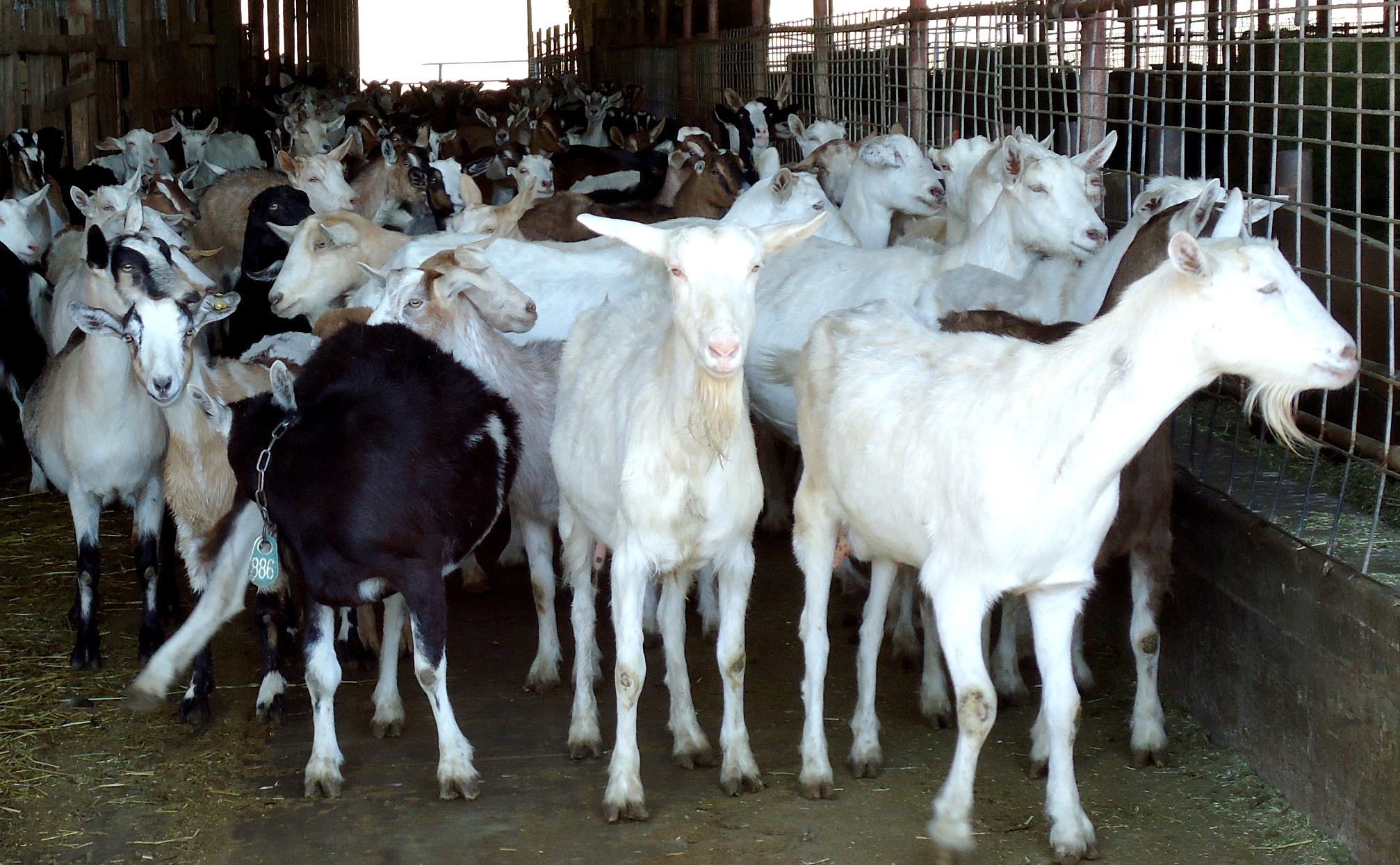
1307. Life of Factory Farm Sheep and Goat

By Farm Sanctuary, February 5, 2014
Lamb shang
In the U.S., sheep and goats are raised for meat, for milk, and for fibers used in textiles. In all three industries, these playful, intelligent animals routinely suffer inhumane treatment throughout their lives and are ultimately slaughtered for human consumption. In the U.S., an estimated 2.2 million sheep and lambs and 1.5 million goats are slaughtered for meat every year.
Sheep used for meat in the U.S. are typically slaughtered when they are very young, because consumers prefer lamb. A lamb is typically slaughtered when he six to eight months old, a tiny fraction of his natural lifespan.

Most sheep and lambs are “tail-docked” within a few weeks of birth. This involves either cutting off the tail or fastening a tight rubber ring around the appendage until it rots and falls off. Lambs exhibit sings of pain when subjected to either method. Tail docking can also lead to chronic pain and an increase in the occurrence of rectal prolapse.
A sheep’s wool production naturally declines with age. In the wool industry, sheep with decreased wool production are sent to slaughter. In Australia, the source of most of the world’s wool, these sheep are typically exported to Middle Eastern countries by sea, enduring grueling journeys of up to three weeks. The death by throat-slashing that awaits these sheep at their destination often occurs while they are fully conscious.

Goat meat and milk are the most widely consumed animal products in the world. Goats are slaughtered very young, at just a fraction of their natural lifespan. A kid is typically slaughtered when he is just three to five months old.

Like dairy cows, goats used for dairy are kept continually impregnated through artificial insemination so that they keep producing milk. Kids are taken away at birth, so that their mother’s milk can be used for human consumption. Male kids, considered useless in the dairy industry, are immediately killed.