Showing posts with label Ecological collapse. Show all posts

Thursday, January 21, 2021

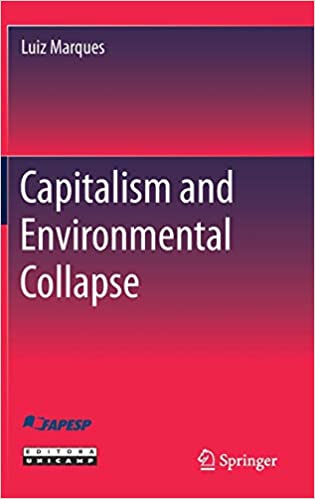
3470. Book Review: Capitalism and Environmental Collapse

By Frank Kaminski, Mud City Press, January 19, 2021


Capitalism and Environmental Collapse is an exhaustive summary of today’s plethora of existential ecological threats, followed by an equally comprehensive discussion of what author Luiz Marques deems to be the core fallacies at their root. Part one meticulously surveys the states of the world’s forests, water, soil, and biodiversity; the extent of human-made waste, industrial intoxication, and fossil fuel exploitation; and the increasingly clear signs of severe, abrupt climate change. Part two makes a detailed case for adopting “a new social contract founded on a natural contract,” one aimed at conferring substantive rights to the nonhuman world. Marques shows through innumerable concrete examples that the time for considering such a proposal is long overdue. Still, even the most belated journey is best undertaken with the aid of an assiduously researched and cogent reference such as Marques supplies here.

As its title suggests, the book argues, in part, that capitalism is inherently incapable of attaining sustainability. The basic tenets of this indictment are hardly new, acknowledges Marques. Numerous others have pointed out that, because the survival of capitalistic economies requires ceaseless expansion, the term “sustainable capitalism” is an oxymoron. Additionally, plenty have argued that the blame for our planet’s ever-accelerating progression toward biological impoverishment can be wholly laid at the proverbial feet of capitalism. And it’s well understood at this point that, quite apart from any attempts at reform on the part of human societies, the rules of the capitalist game are inexorably changing due to the increasingly heavy economic burden of its deleterious externalities. What Marques succeeds in doing is adding further ammunition to these and other well-founded charges against capitalism.

Part one abounds with examples of the runaway nature of our predicament. Not many years ago, recounts Marques, experts believed that events such as a global warming of 2°C above pre-industrial levels or beyond, the vanishing of several tropical forests and the Arctic Ocean’s first iceless September were likely to occur by the end of this century. By 2018 (the year in which this book’s previous, Portuguese edition was released), the middle of the century had come to seem more probable. Now the timeline has been compressed to the second quarter of this century—in other words, as soon as a few years from now. Thus, the author seems justified in stating that “[a]cceleration is maybe the most defining feature of our time.”

It’s difficult to pick a most disturbing case among the countless horrors of modern-day capitalism encapsulated by Marques. Still, some top contenders would have to be the water scarcity affecting two-thirds of humanity, the orders-of-magnitude increase in plastic pollution projected to occur by 2025, the more than 44% jump in new cancer cases seen worldwide between 2012 and 2018, the collapse in both terrestrial and aquatic biodiversity and the Amazon’s ongoing transformation from rainforest to open grassland. Consider also the facts that air pollution in many cities has grown severe enough that breathing is as harmful as smoking, that complete male infertility across the developed world could occur within the next half century due to industrial fertilizer and pesticide exposure, and that neurodevelopmental disabilities could become so much the norm that humans might lack the intelligence to undo the chemical pollution responsible for stunting their brains.

These and many other dire modern-day realities provide compelling support to one of the author’s chief arguments, which is that the age-old, seemingly commonsense equation “more surplus = more security” no longer holds true. It did for millennia, which is why it became so ingrained in our collective mindset. In the present era, however, the equation has been inverted, so that now more surplus equals less security, whether in the form of a disrupted climate system, a ravaged biosphere or a human race poisoning itself out of existence. The greater the surpluses, the greater the accompanying impacts on the planetary life support system. Marques deems the inability of most people to grasp this new equation to be “the main cognitive obstacle to widespread awareness of the environmental deadlock that threatens us.”

Marques explains how our society’s continued belief in the old equation leads to the writing off of grim ecological wake-up calls as mere collateral effects of an ultimately beneficent industrial system. Even those who appear to take such threats seriously tend to relegate them to the status of “problems” to be solved through ever-greater applications of the very surpluses that caused them, courtesy of technological innovation, efficiency gains and other improvements that have traditionally accompanied continuous growth economics. It’s common to imagine that various yet-to-be-invented geoengineering “solutions” hold the key to ensuring humanity’s future security. But Marques, ever the exemplar of precautionary thinking, counters this tenuous faith with the unassailable observation that “the only geoengineering that is known, effective, and safe is to try to drastically reduce anthropic interference on ecosystems.”

With respect to the future availability of petroleum—the main fuel that has enabled the industrial era’s surpluses—Marques assumes an agnostic position. “To my knowledge,” he writes, “it is not possible to foresee the future of oil supply.” Marques goes on to weigh two potential scenarios: one in which oil grows scarce within the foreseeable future, and another in which it remains abundant for perhaps another 50 years. He rightly concludes that the second scenario would be far more damaging than the first, as it would cause a collapse of the global environment rather than merely that of the global economy. While his argument is well-reasoned overall, it doesn’t seem to take into account one factor that would tend to favor a near future of energy scarcity: the extreme financial woes that U.S. tight oil producers have incurred as a result of bringing online this staggeringly costly, hitherto unconventional source of oil.

The author allows that a sustained decrease in fossil fuel burning—whether by choice or from scarcity—could, in theory, permit us to avert an upheaval of the Earth’s climate. He points to a study suggesting that if CO2 emissions were to drop below current levels by 2030 and then continue decreasing, we could potentially limit the rise in global temperatures to less than 2° C, a target widely seen as necessary to avoid the worst impacts of climate change. However, he sensibly rules out a voluntary ratcheting down of fossil fuel consumption, given our society’s weak political resistance to corporations vested in fossil fuel production, as well as the growing power and influence exerted by these same corporations. Thus, he informs us that, barring an imminent decline in the geological availability of fossil fuels, numerous projections have us breaching the 2° C threshold as soon as 2035 to 2045.

He reports that if the current rate of increase in atmospheric CO2 concentrations is maintained, we’re headed for a global average temperature rise of 3° C to 4° C by the mid-2060s, an increase thought to be incompatible with civilization as we know it. In laying out the possible consequences of hitting such an alarming milestone, Marques presents a number of worst-case scenarios that the Intergovernmental Panel on Climate Change (IPCC) doesn’t consider in its analyses. The IPCC’s blind spot, according to Marques, is that it doesn’t think in terms of systems. It fails to take full account of positive climate feedbacks and tipping points, since these are difficult to capture in models. These worst-case scenarios include, among other things, an exponential sea level rise and the possibility of a runaway greenhouse effect that would cause Earth to revert to a “hothouse” state last seen millions of years ago.

This review has so far covered two of the three “concentric illusions” that Marques sees as driving us toward socio-environmental collapse: the belief that capitalism can be sustainable and the assumption that more surplus equates to more security. The third concentric illusion noted by Marques is the anthropocentric delusion that “the biosphere is a means to an end and that the right to reduce it to an energy apparatus for human benefit is rooted in the singularity of our species or in a radical discontinuity between us and the web of life.” In his takedown of this idea, Marques cites a wealth of pointed examples showing how badly it has backfired on us as a result of our being an inextricable part of the natural world we’ve been so heedlessly subjugating.

Marques maintains that the only way for human societies to avoid socio-environmental collapse is for them to free themselves of their current rule by corporate interests. In order to do this, he argues, they must adopt radical new forms of democratic government and allow public policy and practice to be guided by scientific consensus. Addressing humanity’s ecological crisis is outside the capacity of the entity that currently governs human affairs—a merging of the national state and the corporation that Marques refers to as the “state-corporation”—since to this entity, all considerations other than maximizing profit are secondary.

Though a detailed policy proposal is beyond the scope of Marques’ book, the final chapter manages to cover a great deal of fruitful ground in its 15 pages, from the need to decentralize economic activity and strengthen shared global governance, to the failings of nationalism and absolute national sovereignty, to the notion of a natural contract. And there’s certainly no arguing with his parting observation that while a wholesale abandonment of global capitalism and an acceptance of ecological limits might seem like fantasy, human societies have no alternative if they are to survive beyond the next few decades. 

Thursday, August 23, 2018

3002. Humans Are Blind to Imminent Environmental Collapse

By William E. Reese, The Tyee, November 16, 2017

Curious thing about H. sapiens is that we are clever enough to document — in exquisite detail — various trends that portend the collapse of modern civilization, yet not nearly smart enough to extricate ourselves from our self-induced predicament.
This was underscored once again in October when scientists reported that flying insect populations in Germany have declined by an alarming 75 percent in the past three decades accompanied, in the past dozen years, by a 15 percent drop in bird populations. Trends are similar in other parts of Europe where data are available. Even in Canada, everything from casual windshield “surveys” to formal scientific assessments show a drop in insect numbers. Meanwhile, domestic populations of many insect-eating birds are in freefall. Ontario has lost half its whip-poor-wills in the past 20 years; across the nation, such species as nighthawks, swallows, martins, and fly-catchers are down by up to 75 percent; Greater Vancouver’s barn and bank swallows have plummeted by 98 percent since 1970. Heard much about these things in the mainstream news?
Too bad. Biodiversity loss may turn out to be the sleeper issue of the century. It is caused by many individual but interacting factors — habitat loss, climate change, intensive pesticide use and various forms of industrial pollution, for example, suppress both insect and bird populations. But the overall driver is what an ecologist might call the “competitive displacement” of non-human life by the inexorable growth of the human enterprise.
On a finite planet where millions of species share the same space and depend on the same finite products of photosynthesis, the continuous expansion of one species necessarily drives the contraction and extinction of others. (Politicians take note — there is always a conflict between human population/economic expansion and “protection of the environment.”)
Remember the 40 to 60 million bison that used to roam the great plains of North America? They — along with the millions of deer, pronghorns, wolves and lesser beasts that once animated prairie ecosystems — have been “competitively displaced,” their habitats taken over by a much greater biomass of humans, cattle, pigs and sheep. And not just North Americans — Great Plains sunshine also supports millions of other people-with-livestock around the world who depend, in part on North American grain, oil-seed, pulse and meat exports.
Competitive displacement has been going on for a long time. Scientists estimate that at the dawn of agriculture 10,000 years ago, H. sapiens comprised less than one per cent of the total weight of mammals on the planet. (There were probably only two to four million people on Earth at the time.) Since then, humans have grown to represent 35 percent of a much larger total biomass; toss in domestic pets and livestock, and human domination of the world’s mammalian biomass rises to 98.5 percent!
One needs to look no further to explain why wildlife populations globally have plunged by nearly 60 per cent in the past half-century. Wild tigers have been driven from 93 per cent of their historic range and are down to fewer than 4,000 individuals globally; the population of African elephants has imploded by as much as 95 per cent to only 500,000 today; poaching drove black rhino numbers from an already much reduced 70,000 in 1960 to only 2,500 individuals in the early 1990s. (With intense conservation effort, they have since rebounded to about 5,000). And those who still think Canada is still a mostly pristine and under-populated wilderness should think again — half the wildlife species regularly monitored in this country are in decline, with an average population drop of 83 percent since 1970. Did I mention that B.C.’s southern resident killer whale population is down to only 76 animals? That’s in part because human fishers have displaced the orcas from their favoured food, Chinook salmon, even as we simultaneously displace the salmon from their spawning streams through hydro dams, pollution, and urbanization.
The story is similar for familiar species everywhere and likely worse for non-charismatic fauna. Scientists estimate that the “modern” species extinction rate is 1,000 to as much as 10,000 times the natural background rate. The global economy is busily converting living nature into human bodies and domestic livestock largely unnoticed by our increasingly urban populations. Urbanization distances people psychologically as well as spatially from the ecosystems that support them.
The human band-wagon may really have started rolling 10 millennia ago but the past two centuries of exponential growth greatly have accelerated the pace of change. It took all of human history — let’s say 200,000 years — for our population to reach one billion in the early 1800s, but only 200 years, 1/1000th as much time, to hit today’s 7.6 billion! Meanwhile, material demand on the planet has ballooned even more — global GDP has increased by over 100-fold since 1800; average per capita incomes by a factor of 13. (rising to 25-fold in the richest countries). Consumption has exploded accordingly — half the fossil fuels and many other resources ever used by humans have been consumed in just the past 40 years. (See graphs in: Steffen, W et al. 2015. The trajectory of the Anthropocene: The Great Acceleration. The Anthropocene Review, Volume: 2 Issue: 1, page(s): 81-98.)
Why does any of this matter, even to those who don’t really give a damn about nature per se? Apart from the moral stain associated with extinguishing thousands of other life-forms, there are purely selfish reasons to be concerned. For example, depending on climate zone, 78 percent to 94 percent of flowering plants, including many human food species, are pollinated by insects, birds and even bats. (Bats — also in trouble in many places — are the major or exclusive pollinators of 500 species in at least 67 families of plants.) As much as 35 percent of the world’s crop production is more or less dependent on animal pollination, which ensures or increases the production of 87 leading food crops worldwide.
But there is a deeper reason to fear the depletion and depopulation of nature. Absent life, planet earth is just an inconsequential wet rock with a poisonous atmosphere revolving pointlessly around an ordinary star on the outer fringes of an undistinguished galaxy. It is life itself, beginning with countless species of microbes, that gradually created the “environment” suitable for life on Earth as we know it. Biological processes are responsible for the life-friendly chemical balance of the oceans; photosynthetic bacteria and green plants have stocked and maintain Earth’s atmosphere with the oxygen necessary for the evolution of animals; the same photosynthesis gradually extracted billions of tonnes of carbon from the atmosphere, storing it in chalk, limestone and fossil fuel deposits, so that Earth’s average temperature (currently about 15 C) has remained for geological ages in the narrow range that makes water-based life possible, even as the sun has been warming (i.e. stable climate is partially a biological phenomenon.); countless species of bacteria, fungi and a veritable menagerie of micro-fauna continuously regenerate the soils that grow our food. (Unfortunately, depletion-by-agriculture is even faster — by some accounts we have only just over a half-century’s worth of arable soils left).
In short, H. sapiens depends utterly on a rich diversity of life-forms to provide various life-support functions essential to the existence and continued survival of human civilization. With an unprecedented human-induced great global die-off well underway, what are the chances the functional integrity of the ecosphere will survive the next doubling of material consumption that everyone expects before mid-century?
Here’s the thing: climate change is not the only shadow darkening humanity’s doorstep. While you wouldn’t know it from the mainstream media, biodiversity loss arguably poses an equivalent existential threat to civilized existence. While we’re at it, let’s toss soil/landscape degradation, potential food or energy shortages and other resource limits into the mix. And if you think we’ll probably be able to “handle” four out of five such environmental problems, it doesn’t matter. The relevant version of Liebig’s Law states that any complex system dependent on several essential inputs can be taken down by that single factor in least supply (and we haven’t yet touched upon the additional risks posed by the geopolitical turmoil that would inevitably follow ecological destabilization).

Which raises questions of more than mere academic interest. Why are we not collectively terrified or at least alarmed? If our best science suggests we are en route to systems collapse, why are collapse — and collapse avoidance — not the primary subjects of international political discourse? Why is the world community not engaged in vigorous debate of available initiatives and trans-national institutional mechanisms that could help restore equilibrium to the relationship between humans and the rest of nature?
There are many policy options, from simple full-cost pricing and consumption taxes; through population initiatives and comprehensive planning for a steady-state economy; to general education for voluntary (and beneficial) lifestyle changes, all of which would enhance global society’s prospects for long-term survival. Unique human qualities, from high intelligence (e.g., reasoning from the evidence), through the capacity to plan ahead to moral consciousness, may well be equal to the task but lie dormant — there is little hint of political willingness to acknowledge the problem let alone elaborate genuine solutions (which the Paris climate accord is not).
Bottom line? The world seems in denial of looming disaster; the “C” word remains unvoiced. Governments everywhere dismissed the 1992 scientists’ Warning to Humanity that “…a great change in our stewardship of the Earth and the life on it is required, if vast human misery is to be avoided” and will similarly ignore the scientists’ “second notice.” (Published on Nov. 13, this warning states that most negative trends identified 25 years earlier “are getting far worse.”) Despite cascading evidence and detailed analysis to the contrary, the world community trumpets “growth-is-us” as its contemporary holy grail. Even the United Nations’ Sustainable Development Goals are fixed on economic expansion as the only hammer for every problematic nail. Meanwhile, greenhouse gases reach to at an all-time high, marine dead-zones proliferate, tropical forests fall and extinctions accelerate.
Just what is going on here? The full explanation of this potentially fatal human enigma is no doubt complicated, but Herman Melville summed it up well enough in Moby Dick: “There is no folly of the beasts of the earth which is not infinitely outdone by the madness of men.”; margin-bottom: 14px; padding: 0px;"> William Rees, FRSC is a professor at the University of British Columbia and former director of the School of Community and Regional Planning (SCARP) at UBC.

Tuesday, November 21, 2017

2753. Climate Crisis and Managed Deindustrialization: Debating Alternatives to Ecological Collapse

By Richard Smith, Common Dreams, November 21, 2017


On Monday November 13th, climate scientists from the Tyndal center for Climate Change Research at the University of East Anglia presented their carbon emissions research to the UN climate negotiators at Bonn Germany. The data were shocking: After three years in which human-caused emissions appeared to be leveling off, global CO2 emissions are now rising again to record levels in 2017. Global emissions are on course rise this year by 2%. China’s emissions are projected to rise by 3.5%. These may sound like small numbers but to climate scientists these are huge because if we’re to keep global temperatures from rising by more than 2 degrees Centigrade, those emissions need to be falling sharply, not just leveling off, let alone rising. Colorado State University climate scientist Scott Denning said “We’ve got to cut emissions by half in the next decade, and by half again in the next two decades, as well. The fact that it’s going up is like a red flag flashing light on the dashboard.”

This time the scientists wrote in part: "Since 1992, with the exception of stabilizing the stratospheric ozone layer, humanity has failed to make sufficient progress in generally solving these foreseen environmental challenges, and alarmingly, most of them are getting far worse." If we don’t take immediate steps, “soon it will be too late to shift course away from our failing trajectory, and time is running out. " The goal of the letter, said William Ripple, distinguished professor in the college of Forestry at Oregon State University, and lead author of the new warning, is to "ignite a wide-spread public debate about the global environment and climate."


The same day, the journal BioScience published a letter by more than 15,000 scientists from around the world that looks back at the human response to climate change and other environmental challenges in the 25 years since another large group of scientists published the 1992 “World Scientists Warning to Humanity.”  

Ripple is right. We need a conversation, a global public debate about the global environment and how to save the planet, and we need to begin it right now.

As if on cue, in yesterday’s New York Times, Professor Benjamin Fong launched a broadside placing the blame squarely where it needs to be. The problem isn’t public ignorance, it isn’t bad politicians, it isn’t even bad companies: 
The real culprit of the climate crisis is not any particular form of consumption, production or regulation but rather the very way in which we globally produce, which is for profit rather than for sustainability. So long as this order is in place, the crisis will continue and, given its progressive nature, worsen. This is a hard fact to confront. But averting our eyes from a seemingly intractable problem does not make it any less a problem. It should be stated plainly: It’s capitalism that is at fault.
Changing the conversation
For far too long, polite conversation, public debate and consideration of policy initiatives have been subordinated to the imperatives of capitalist reproduction, above all profit maximization. Profit maximization and job creation go hand in hand and crucially depend upon economic growth. All “reasonable” solutions to the crisis of global warming take that as their starting point, a fundamental principle that cannot be challenged. This is the unspoken premise of carbon taxes: Carbon taxes do not threaten growth. They’re simply another cost of doing business, another tax which moreover can be passed along to consumers. This is why ExxonMobil, Shell, BP and most big fossil fuel companies support carbon taxes as the lesser evil (cap and trade is the greater evil precisely because a cap would threaten growth, which is why cap and trade are not acceptable to business and why such schemes have all been either rejected outright as in the United States or so watered down as to be useless charades as in Europe, British Columbia and elsewhere). The oil companies are not looking to put themselves out of business. Industry and IEA studies project that global demand for fossil fuels will rise by 40% over the next few decades and the oil companies intend to cash in on this growth. To do so they need to deflect criticism by being good citizens, paying their carbon taxes, contributing to the “solution” or at least appearing to do so.

The problem is, we live in an economy built on perpetual growth but we on a finite planet with limited resources and sinks. To date, all efforts to “green” capitalism have foundered on this fundamental contradiction: maximizing profit and saving the planet are inherently in conflict and cannot be systematically aligned even if, here and there, they might coincide for a moment. That’s because under capitalism, CEOs and corporate boards are not responsible to society, they’re responsible to private shareholders. CEOs can embrace environmentalism when it boosts profits, as with energy efficiency, recycling, and new “green” products and the like. But saving the world requires that the pursuit of profits be systematically subordinated to ecological concerns—and this they cannot do. No corporate board can sacrifice earnings, let alone put itself out of business, just to save the humans because to do so would be to risk shareholder flight or worse. Profit-maximization is an iron rule of capitalism, a rule that trumps all else, and this sets the limits to ecological reform within capitalism—and not the other way around as the promoters of “green capitalism” imagined. 

To save the humans we know we have to drastically cut fossil fuel consumption. But “Keep It in the Ground” is not just an abstraction and not just about future supplies. If we’re going to radically suppress fossil fuel consumption in the here and now as we must, then this has to translate into drastic retrenchments and closures of industrial plants across the economy—and not just of coal mines, oil and gas companies but all the fossil fuel dependent industries: autos, trucking, petrochemical industries, airlines, shipping, construction and more.

What’s more, the global ecological crisis we face is far bigger than just fossil fuels. We’re not just overconsuming fossil fuels. We’re overconsuming every resource on the planet, driving ourselves and countless other species to extinction. Ultimately, if we really want to save the planet, we’re going to have to shut down or at least drastically retrench all kinds of resource-hogging, polluting, unnecessary, unsustainable industries and companies from fossil fuels to bottled water, from disposable products to agrichemicals, plastic junk to military weapons of destruction.

Needless to say, retrenching and closing down such industries would mean job losses, millions of job losses from here to China (pdf).  Yet if we don’t shut down those unsustainable industries we’re doomed. What to do? There’s no point in chanting “Keep It in the Ground” if we don’t have a jobs program for all those workers whose jobs need to be excessed to save those workers’ children and ours. This is our dilemma.Take just one: Cruise ships are the fastest growing sector of mass tourism on the planet. But they are by far the most polluting tourist indulgence ever invented: Large ships can burn more than 150 tons of the filthiest diesel bunker fuel per day, spewing out more fumes—and far more toxic fumes—than 5 million cars, polluting entire regions, the whole of southern Europe – and all this to ferry a few thousand boozy passengers about bashing coral reefs. There is just no way this industry can be made sustainable. The cost of the ticket for that party boat cruise is our children. The same can be said for dozens if not hundreds of industries, thousands of companies around the world. We can save these industries, save capitalism, or we can save the planet. We can’t save both.   

Planned, managed deindustrialization or unplanned, chaotic ecological collapse
Capitalism cannot solve this problem because no company can promising new jobs to unemployed coal miners, oil-drillers, automakers, airline pilots, chemists, plastic junk makers, and others whose jobs would be lost because their industries would have to be retrenched—and unemployed workers don’t pay taxes. So CEOs, workers, and governments find that they all “need” to maximize growth, overconsumption, even pollution, to destroy their children’s tomorrows to hang onto their jobs today. Thus we’re all onboard the high-speed train of ravenous and ever-growing plunder and pollution.

We can’t shop our way to sustainability because the problems we face cannot be solved by individual choices in the marketplace. They require collective democratic control over the economy to prioritize the needs of society and the environment. And they require local, national, regional and international economic planning to re-organize our economies, to provide new jobs to replace those jobs we need to abolish, and to rationally and fairly redeploy resources to those ends. In a paper I wrote for The Next System Project last year—"Six Theses on Saving the Planet"—I laid out my argument for ecosocialism as the only alternative to market-driven ecological collapse in the form of six theses:And as our locomotive races toward the cliff of ecological collapse, the only thoughts on the minds of our CEOS, capitalist economists, politicians and labor leaders is how to stoke the locomotive to get us there faster. Professor Fong is right: Corporations aren’t necessarily evil. They just can’t help themselves. They’re doing what they’re supposed to do for the benefit of their owners. But this means that so long as the global economy is based on capitalist private/corporate property and competitive production for market, we’re doomed to collective social suicide and no amount of tinkering with the market can brake the drive to global ecological collapse.
  1. Capitalism, not population is the main driver of planetary ecological collapse and it cannot be reformed enough to save the humans.
  2. Green capitalism can’t save us because companies can’t commit economic suicide to save the humans. There’s just no solution to our crisis within the framework of any conceivable capitalism.
  3. The only alternative to market-driven ecological collapse is to transition to some sort of mostly planned, mostly publicly owned economy based on a global ‘contraction and convergence’ around a sustainable level of resource consumption that can provide a dignified living standard for all the world’s peoples while leaving enough for future generations and other species.
  4. Rational planning requires bottom-up democracy.
  5. Democracy requires rough socioeconomic equality – which requires that we abolish extreme differences in incomes and wealth and enforce those rights already in theory guaranteed to us in the Universal Declaration of Rights (1949) including the right to work at fair compensation, the right to equal employment, the right to adequate food, housing, medical care, education, social services, and a comfortable retirement.
  6. Far from “austerity,” an ecosocialist future offers us liberation from the treadmill of consumerism, from the fetishism of commodities. Freeing ourselves from the toil of producing unnecessary and /or harmful products and services would free us to shorten the work day, to enjoy the leisure promised but never delivered by capitalism, to redefine the meaning of the standard of living to connote a way of life that is actually richer, while consuming less, to realize the fullest potential of every human being. This is the emancipatory promise of ecosocialism.
For some readers, my arguments may raise as many questions as they answer. Fine. But if we don’t change the conversation, if we don’t deal with the systemic problems of capitalism and come up with a viable alternative, our goose is cooked.  So if not ecosocialism, then what? This is the public debate we need to be having right now. What are your thoughts? 

Thursday, January 21, 2016

2167. Sustainability and Place: How Emerging Mega-Trends of the 21st Century Will Affect Humans and Nature at the Landscape Level


By John W. Daya,, Matthew Moerschbaechera, David Pimentelb, Charles Hall, Alejandro Yánez-Arancibiad, Ecological Engineering, 2013


Abstract:  We discuss the sustainability of natural and human systems in the United States in relation to 21st century threats associated with energy scarcity, climate change, the loss of ecosystem services, the limitations of neoclassical economics, and human settlement patterns. Increasing scarcity and the decreasing return on investment for existing conventional energy reserves are expected to significantly reduce the amount of affordable energy for societal needs and demands. This will also make dealing with the predicted impacts of climate change more difficult and expensive. Climate change will threaten the present sustainability of natural environments, agriculture, and urban areas but these impacts will manifest themselves differen- tially across the landscape. The impacts of projected climate change will make living in arid regions of the southern Great Plains, the Southwest, and the southern half of California increasingly difficult. Acceler- ated sea-level rise and increased frequency of strong hurricanes will increase the vulnerability of natural and human systems along the Gulf and Atlantic coasts while making them less sustainable. Ecosystem services provided by natural environments form the basis for the human economy everywhere and are also at risk from climate change impacts and overuse. Decreasing energy availability, climate change, and continued degradation of ecosystem services are likely to make continued economic growth difficult if not impossible. The capacity of neoclassical economics to effectively deal with these growing threats is limited. The areas of the country most compromised by these 21st century trends are likely to be the southern Great Plains, Southwest, southern California, the Atlantic and Gulf coasts, and densely populated areas everywhere, but especially in the northeast, Midwest, and southern California. 

For a PDF version of the article click here.