By Leonard Susskind, What Is the Universe? February 2026
Showing posts with label Cosmology. Show all posts
Showing posts with label Cosmology. Show all posts
Wednesday, April 22, 2026


Saturday, June 5, 2021
3509. Book Review: All Things Great and Small: The origins and fates of atoms and galaxies are closely intertwined
By Priyamvada Natarajan, The New York Review off Books, July 1, 2021
If, in some cataclysm, all of scientific knowledge were to be destroyed, and only one sentence passed on to the next generations of creatures, what statement would contain the most information in the fewest words? I believe it is the atomic hypothesis (or the atomic fact, or whatever you wish to call it) that all things are made of atoms.
The profound insight that the entire material world can be described succinctly as composed of fundamental building blocks is at the foundation of all theories about the nature of matter, from ancient inquiries into its properties, to medieval and early modern attempts to transmute base metals into precious gold, to modern efforts to understand atomic structure, harness the power of the atom with fission and fusion, and create artificial materials in laboratories.
Three new books examine our current understanding of matter’s origin and qualities, and chronicle our continuing quest to probe beyond atoms. Neutron Stars: The Quest to Understand the Zombies of the Cosmos by Katia Moskvitch, a science writer, explores recent research into the super-dense remains of stars ten times more massive than our Sun, whose precise material composition has eluded us. The astrophysicist Katie Mack’s The End of Everything (Astrophysically Speaking) shows how the contents of our universe—matter and energy—determine its destiny and, ultimately, its demise. In Fundamentals: Ten Keys to Reality, the physicist Frank Wilczek, who was awarded the Nobel Prize in Physics in 2004, addresses new discoveries that are leading to a reassessment of the atomic hypothesis. He explains how notions of matter have changed over the past decades from “all things are made of atoms” to “all things are made of elementary particles”—the expanding list of which includes quarks, gluons, muons, and the recently discovered Higgs boson.
Atomism in the West is first attributed to the fifth-century-BCE Greek philosophers Leucippus and his pupil Democritus. (The word “atom” derives from the Greek atomos, meaning “without parts.”) While none of their original writings have survived in complete form, fragments and quotations attributed to Democritus give us an idea of his atomic theories. The most famous text influenced by Democritus is De rerum natura (On the Nature of Things), the didactic poem in six books by Titus Lucretius Carus (99 BCE–55 BCE), a poet of the late Roman Republic and a follower of the Greek philosopher Epicurus, who had taken up Democritus’s atomic theory. Lucretius—who did not use the term “atom,” opting instead for “first things” and “the seeds of things”—declared that the fundamental units of matter were infinite, immutable, and invisible; constantly in motion; and subject to an occasional and unpredictable small “swerve,” endlessly combining or splitting apart and reconstituting themselves to take on new forms. According to Lucretius, while objects in the universe, ranging from the distant stars to life forms crawling on the Earth, are transient, their constituents—the fundamental seeds that make them up—are eternal.
In the first two books of De rerum natura, which focus on the material world, Lucretius compares these fundamental particles to letters in an alphabet, a finite set that can form an infinite variety of sentences. Just as there are letter combinations that are not permitted in a language, not all seeds can combine with all others; moreover, Lucretius asserted, there is a code that governs the permitted combinations. His account of matter, which sounds strikingly like a description from a modern-day physics or chemistry textbook, was utterly radical. Though Lucretius didn’t claim that he knew the code dictating how these seeds could arrange and rearrange themselves, he did suggest that it was knowable through investigation. This is, of course, the goal of modern science—to uncover, via observation and investigation, the laws of nature that govern the regularities and patterns in phenomena.
The concept of atoms was not confined to esoteric discussions in natural philosophy but garnered broad acceptance and percolated into the larger culture, cropping up in unlikely places, for instance in Shakespeare’s description of the fairy prankster Queen Mab in Romeo and Juliet:
She is the fairies’ midwife, and she comes
In shape no bigger than an agatestone
On the forefinger of an alderman,
Drawn with a team of little atomies
Athwart men’s noses as they lie asleep.
With his use of the phrase “little atomies,” Shakespeare reveals that by the 1590s, his world was well acquainted with the atomistic view of matter.
Atomic theories appear in other philosophical traditions too. The notion that all matter is composed of small, indivisible particles is found in the teachings of the ancient Indian analytic Vaisesika philosophical school, which dates back to the third century BCE. According to Vaisesika atomism, the four elements (earth, water, air, and fire) each come in two variations: atomic—that is, invisible, indivisible, and indestructible; and composite—that is, visible and perceptible. A Vaisesika text called The Manual of Reason argued that if there were no fundamental unit of matter, a mountain and a mustard seed would be the same size, since they would each contain an infinite number of parts.
With the development of quantum physics in the early twentieth century, scientists established that the atoms that make up all visible matter—which physicists call baryons—are composed of subatomic units: protons and neutrons, which form the atom’s nucleus, and electrons. It was soon discovered that the properties of atoms determined which elements could bond together to make new molecules, and that in certain conditions atoms could be transformed into others through fusion and fission, nuclear processes that release enormous amounts of energy.
More recently, cosmology has provided us with an inventory of the material content of the universe, and what a bizarre one it is. Every one of the ninety-four elements found naturally on Earth was created elsewhere in space, and all but three—hydrogen, helium, and lithium, which were synthesized within the first three minutes of the birth of the universe at the Big Bang—were formed in the cores of distant stars, where extreme conditions cause nuclei to collide and fuse, creating elements of greater atomic mass.
At the end of their life cycles, stars explode, dispersing carbon, silicon, sulfur, magnesium, calcium, and iron into space, enriching the hydrogen clouds from which the next generation of stars eventually forms. These elements may have arrived on Earth via meteors, or possibly were present in the matter that coagulated into our solar system 4.5 billion years ago. The calcium that our bones are made of and the iron that permeates every red blood cell in our bodies come from stars. Clichés aside, we are literally made of stardust.
In 1930 the Indian astrophysicist Subrahmanyan Chandrasekhar calculated that the birth mass of a star determines its ultimate fate: depending on its initial size, it will become either a white dwarf, a neutron star, or a black hole. A star the size of our Sun has an interior with a temperature of about 15 million degrees centigrade—so hot that atomic nuclei are stripped of their encircling electrons. These subatomic particles—electrons and nuclei—constantly collide with one another, generating pressure inside the core of the star. This internal pressure prevents gravity from causing the star’s collapse.
Pressure is also generated when hydrogen nuclei, which each have one proton, fuse with other hydrogen nuclei to form helium, which has two protons. Once all the available hydrogen in the core is exhausted, gravity starts to prevail. This causes the core of the star to contract and heat up, leading to the formation by fusion of heavier elements, such as carbon, oxygen, and silicon. Our Sun will run out of hydrogen in another five billion years or so. As its core contracts, its outer layers will expand, passing into what is referred to as the red giant phase. At this point, its radius will have grown so large that it engulfs the orbit of Mercury. It will continue to collapse, ultimately leading to the formation of a dim remnant, a white dwarf, with fusion no longer supplying energy in the core.
In 1933 the Swiss astronomer Fritz Zwicky proposed that stars more massive than our Sun would die by imploding—that is, by collapsing in on themselves due to gravity—and that this process would cause protons, which carry a positive electric charge, to capture negatively charged electrons, leading to the production of neutrons. The energy released in this process would power dramatic supernova explosions, leaving behind the neutron-rich, super-dense core—a neutron star. Moskvitch dedicates her book to Zwicky, does justice to his ideas, and gives him credit for predicting and detecting supernovae—cosmic beacons that have been important in shaping our view of the cosmos. Supernovae serve as standard rulers for measuring distances and were instrumental in the 1998 discovery of dark energy, which is believed to power the accelerating expansion of the universe.
Zwicky was also the first to propose the existence of dark matter, in order to explain why some galaxies appear to move faster than expected. Dark matter, believed to be crucial for the formation of galaxies, is composed of an as yet undetected particle that likely formed in the infant universe. Like every other kind of matter, it exerts and responds to gravity, but it does not interact with light, rendering it invisible and therefore extremely challenging to detect. Cosmologists estimate that dark matter makes up about 24 percent of all the stuff in the universe. By comparison, the ordinary atoms that we are made of account for a mere 4 percent. To add to the mystery, the dominant constituent of our universe is yet another invisible and immaterial entity, dark energy, comprising about 70 percent of the overall cosmic inventory. We know how both dark energy and dark matter manifest in our universe—but not quite what they are.
Neutron stars are the densest form of matter currently known, with about 1.4 times the mass of the Sun packed into a radius of just six miles. A teaspoon of neutron star material would weigh 10 million tons. Like their more enigmatic cousins, black holes, neutron stars are stellar corpses, but they come in many types: there are pulsars, which spin at extremely rapid rates, close to a thousand times per second; and magnetars, which are the strongest magnets known in nature. Unlike black holes, neutron stars possess surfaces, suffer starquakes that we can detect, and are also thought to be the source of gamma-ray bursts, the most energetic explosions in the universe.
Moskvitch offers riveting explanations of what astronomers have learned so far using radio telescopes, starting with Jocelyn Bell’s discovery in 1967 of the first pulsar, and what puzzles remain in the tantrums as well as quiet murmur of neutron stars. She opens with a wonderful account of the first-ever observation, in August 2017, of the collision of two neutron stars, by researchers working with the gravitational wave detectors LIGO in the US and Virgo in Italy. Unlike the dark collisions of two black holes and the resulting tremors in space-time—gravitational waves—that LIGO first recorded in 2016, the neutron-star collision was accompanied by visible fireworks: a bright flash of gamma radiation arrived seconds after the gravitational waves, reaching Earth after a 130-million-year journey. Researchers used this alert signal to observe the crash in other ways, using radio, optical, near infrared, X-ray, and gamma ray telescopes—opening up the new field of multi-messenger astronomy.
These multiple sets of eyes, spanning different wavelengths of light, captured the collision’s debris cloud in vivid, unprecedented detail and recorded the production of heavy elements—including an estimated 236 sextillion tons, or forty times the Earth’s mass, of pure gold. This was the first time we witnessed this process unfold. The conditions inside a neutron star are not powerful enough to create elements heavier than iron; only the collision of two neutron stars can do so. All the gold we know of, including the gold wedding ring on your finger or the chain adorning your neck, was created by collisions of two neutron stars in the distant universe.
Moskvitch closes with a description of the current frontier—recently detected fast radio bursts (FRBs) that most believe to be emitted by neutron stars, though we don’t yet have a conclusive theory to explain them. The ultimate mystery, though, pertains to the equation that describes the state of matter packed into neutron stars. As Moskvitch observes, this fundamental question is one that brings together fields in physics that developed largely in parallel—nuclear physics, condensed-matter physics, and astrophysics. In this incredibly compact state, matter and its behavior hold many more secrets. For example, the density at the center of a neutron star is thought to be so high that neutrons themselves are crushed out of existence, freeing the three quarks inside each of them. The core would then consist of a liquid of quarks, called quark matter. Quark matter might have even more peculiar properties: it is expected to be similar to the state of electrons in a metal, and perhaps even exhibit a type of superconductivity.
Contrary to Lucretius, our material world is not really indestructible or eternal. So how will it all end? In The End of Everything (Astrophysically Speaking), Katie Mack explains the possible fates, each terrible in its own way, that await our universe. The equations derived from Einstein’s theory of general relativity connect the contents, shape, and destiny of the universe. The past, present, and future are therefore determined by its evolving material and immaterial constituents. What may seem surprising, she writes, is that “much as modern cosmology informs our understanding of the very, very small, particle theories and experiments can give us insight into the workings of the universe on the largest scales.” The complex interplay of the microscopic and macroscopic determines cosmic eschatology.
As Mack points out, only one thing is certain: the universe will end. It simply cannot persist unchanged forever. The universe has been expanding since its birth about 13.8 billion years ago. As its composition has changed from being dominated by radiation for the first 30,000 years of its existence to being dominated by matter and then by dark energy (for the past 4 billion years), the expansion rate has also changed. Further transitions will determine the universe’s ultimate fate. This is a challenging question that several large teams of cosmologists are probing with observational surveys and experiments.
The five possible cosmic catastrophes that Mack discusses are the Big Crunch, in which our current cosmic expansion reverses and the universe condenses into a black hole—a singularity; the Heat Death, in which the universe expands forever, getting darker and more desolate; the Big Rip, a dark-energy driven, violent fate in which gravity is overpowered and eventually everything, including atoms, are ripped apart; Vacuum Decay, the least likely scenario, in which a rogue bubble of “true vacuum” would run amok and essentially cancel the universe; and the bounce—the most speculative of these possibilities—a cyclic cosmology where birth and death alternate repeatedly.
Though I am drawn by temperament to a cyclic universe that has no beginning and no end, the possibility that fires my imagination is the Big Crunch. The sequence would start with a slowdown of the current accelerating rate of expansion before reversal. Having flipped course, a contracting universe would become an extreme place—heating up to incredibly high temperatures and densities, beyond anything we can produce in the laboratory. None of our current theories, quantum mechanics and general relativity included, offer any guidance to the behavior of matter at such high densities. Mack writes that what “you’d encounter when the entire observable universe is collapsing into a subatomic dot are all kinds of incalculable.” Nothing material that we know of would survive; eventually it all would hurtle rapidly into a singularity. There is a strange symmetry to this fate, in which everything may end up as it was before the Big Bang—in ashes, as it were.
A book that outlines the grim fates that await our universe might seem pessimistic, but we humans are unlikely to bear witness to any of these catastrophic outcomes, as they will not manifest for billions of years. Even as Mack manages to simplify, with a disarmingly colloquial style, many complex and abstract physical concepts while explicating cosmic doom, she leads us to dream of the end without agonizing about it.
By classifying matter into “particles of construction, particles of change, and bonus particles” in Fundamentals, Frank Wilczek offers an authoritative update to Democritus’s atomic hypothesis. He shares ten profound ideas that he believes describe all of physical reality and our experience of it. As with his previous books, Wilczek deftly blends contemplative elements with a clear exposition of basic physics, adding cautious speculation about future experiments likely to reveal deeper facets of reality. Fundamentals is divided into two main sections, titled “What There Is” and “Beginnings and Ends,” with alluring chapter titles in the former section that include “There’s Plenty of Space,” “There’s Plenty of Time,” “There Are Very Few Ingredients,” “There Are Very Few Laws,” and “There’s Plenty of Matter and Energy.”
Wilczek explains the three primary properties of elementary particles from which all others can be derived—mass, charge, and spin—noting “that they are things you can define and measure precisely.” Yet although they can be measured, “the connection of the primary properties—the deep structure of reality—to the everyday appearance of things is quite remote.” While the mass and charge of the building blocks of matter are easy to understand, spin is a challenging concept for the nonphysicist. Wilczek elegantly explains how elementary particles are essentially like tiny spinning tops or gyroscopes. He summarizes “four (deceptively) easy principles” that govern how the world works, as far as we know—the basic laws of physics describe change, are universal, local, and precise.
Wilczek then outlines three big questions pertinent to our understanding of the physical world and beyond. What caused the Big Bang? Are there even more meaningful patterns hidden in the sprawling landscape of fundamental particles and forces that we have not uncovered so far? And what is the nature of consciousness—did mind emerge from matter, and if so, how? While his philosophical speculations on the nature of consciousness and the emergence of complexity meander, he is especially crisp about the mysteries that remain to be solved in physics.
In particular, he introduces axions—hypothetical subatomic particles whose name he coined—as the link that may help unlock two mysteries that appear unrelated: the unknown nature of dark matter and the near-exact temporal symmetry of known physical laws. Physical laws appear to almost retain their form independent of the direction of the flow of time—this is a real puzzle as we live in a universe in which time moves in only one direction. Physicists suspect that this signals the existence of a new kind of particle—the axion—that formed in the early universe and has the right properties to be dark matter. Wilczek is enthusiastic about the many experimental efforts currently underway to detect the axion. With so much known and understood about the nature of ordinary atoms, we still eagerly await the discovery of new classes of subatomic particles that might hold the key to many vexing theoretical problems.
The profound insight that the entire material world can be described succinctly as composed of fundamental building blocks is at the foundation of all theories about the nature of matter, from ancient inquiries into its properties, to medieval and early modern attempts to transmute base metals into precious gold, to modern efforts to understand atomic structure, harness the power of the atom with fission and fusion, and create artificial materials in laboratories.
Three new books examine our current understanding of matter’s origin and qualities, and chronicle our continuing quest to probe beyond atoms. Neutron Stars: The Quest to Understand the Zombies of the Cosmos by Katia Moskvitch, a science writer, explores recent research into the super-dense remains of stars ten times more massive than our Sun, whose precise material composition has eluded us. The astrophysicist Katie Mack’s The End of Everything (Astrophysically Speaking) shows how the contents of our universe—matter and energy—determine its destiny and, ultimately, its demise. In Fundamentals: Ten Keys to Reality, the physicist Frank Wilczek, who was awarded the Nobel Prize in Physics in 2004, addresses new discoveries that are leading to a reassessment of the atomic hypothesis. He explains how notions of matter have changed over the past decades from “all things are made of atoms” to “all things are made of elementary particles”—the expanding list of which includes quarks, gluons, muons, and the recently discovered Higgs boson.
Atomism in the West is first attributed to the fifth-century-BCE Greek philosophers Leucippus and his pupil Democritus. (The word “atom” derives from the Greek atomos, meaning “without parts.”) While none of their original writings have survived in complete form, fragments and quotations attributed to Democritus give us an idea of his atomic theories. The most famous text influenced by Democritus is De rerum natura (On the Nature of Things), the didactic poem in six books by Titus Lucretius Carus (99 BCE–55 BCE), a poet of the late Roman Republic and a follower of the Greek philosopher Epicurus, who had taken up Democritus’s atomic theory. Lucretius—who did not use the term “atom,” opting instead for “first things” and “the seeds of things”—declared that the fundamental units of matter were infinite, immutable, and invisible; constantly in motion; and subject to an occasional and unpredictable small “swerve,” endlessly combining or splitting apart and reconstituting themselves to take on new forms. According to Lucretius, while objects in the universe, ranging from the distant stars to life forms crawling on the Earth, are transient, their constituents—the fundamental seeds that make them up—are eternal.
In the first two books of De rerum natura, which focus on the material world, Lucretius compares these fundamental particles to letters in an alphabet, a finite set that can form an infinite variety of sentences. Just as there are letter combinations that are not permitted in a language, not all seeds can combine with all others; moreover, Lucretius asserted, there is a code that governs the permitted combinations. His account of matter, which sounds strikingly like a description from a modern-day physics or chemistry textbook, was utterly radical. Though Lucretius didn’t claim that he knew the code dictating how these seeds could arrange and rearrange themselves, he did suggest that it was knowable through investigation. This is, of course, the goal of modern science—to uncover, via observation and investigation, the laws of nature that govern the regularities and patterns in phenomena.
The concept of atoms was not confined to esoteric discussions in natural philosophy but garnered broad acceptance and percolated into the larger culture, cropping up in unlikely places, for instance in Shakespeare’s description of the fairy prankster Queen Mab in Romeo and Juliet:
She is the fairies’ midwife, and she comes
In shape no bigger than an agatestone
On the forefinger of an alderman,
Drawn with a team of little atomies
Athwart men’s noses as they lie asleep.
With his use of the phrase “little atomies,” Shakespeare reveals that by the 1590s, his world was well acquainted with the atomistic view of matter.
Atomic theories appear in other philosophical traditions too. The notion that all matter is composed of small, indivisible particles is found in the teachings of the ancient Indian analytic Vaisesika philosophical school, which dates back to the third century BCE. According to Vaisesika atomism, the four elements (earth, water, air, and fire) each come in two variations: atomic—that is, invisible, indivisible, and indestructible; and composite—that is, visible and perceptible. A Vaisesika text called The Manual of Reason argued that if there were no fundamental unit of matter, a mountain and a mustard seed would be the same size, since they would each contain an infinite number of parts.
With the development of quantum physics in the early twentieth century, scientists established that the atoms that make up all visible matter—which physicists call baryons—are composed of subatomic units: protons and neutrons, which form the atom’s nucleus, and electrons. It was soon discovered that the properties of atoms determined which elements could bond together to make new molecules, and that in certain conditions atoms could be transformed into others through fusion and fission, nuclear processes that release enormous amounts of energy.
More recently, cosmology has provided us with an inventory of the material content of the universe, and what a bizarre one it is. Every one of the ninety-four elements found naturally on Earth was created elsewhere in space, and all but three—hydrogen, helium, and lithium, which were synthesized within the first three minutes of the birth of the universe at the Big Bang—were formed in the cores of distant stars, where extreme conditions cause nuclei to collide and fuse, creating elements of greater atomic mass.
At the end of their life cycles, stars explode, dispersing carbon, silicon, sulfur, magnesium, calcium, and iron into space, enriching the hydrogen clouds from which the next generation of stars eventually forms. These elements may have arrived on Earth via meteors, or possibly were present in the matter that coagulated into our solar system 4.5 billion years ago. The calcium that our bones are made of and the iron that permeates every red blood cell in our bodies come from stars. Clichés aside, we are literally made of stardust.
In 1930 the Indian astrophysicist Subrahmanyan Chandrasekhar calculated that the birth mass of a star determines its ultimate fate: depending on its initial size, it will become either a white dwarf, a neutron star, or a black hole. A star the size of our Sun has an interior with a temperature of about 15 million degrees centigrade—so hot that atomic nuclei are stripped of their encircling electrons. These subatomic particles—electrons and nuclei—constantly collide with one another, generating pressure inside the core of the star. This internal pressure prevents gravity from causing the star’s collapse.
Pressure is also generated when hydrogen nuclei, which each have one proton, fuse with other hydrogen nuclei to form helium, which has two protons. Once all the available hydrogen in the core is exhausted, gravity starts to prevail. This causes the core of the star to contract and heat up, leading to the formation by fusion of heavier elements, such as carbon, oxygen, and silicon. Our Sun will run out of hydrogen in another five billion years or so. As its core contracts, its outer layers will expand, passing into what is referred to as the red giant phase. At this point, its radius will have grown so large that it engulfs the orbit of Mercury. It will continue to collapse, ultimately leading to the formation of a dim remnant, a white dwarf, with fusion no longer supplying energy in the core.
In 1933 the Swiss astronomer Fritz Zwicky proposed that stars more massive than our Sun would die by imploding—that is, by collapsing in on themselves due to gravity—and that this process would cause protons, which carry a positive electric charge, to capture negatively charged electrons, leading to the production of neutrons. The energy released in this process would power dramatic supernova explosions, leaving behind the neutron-rich, super-dense core—a neutron star. Moskvitch dedicates her book to Zwicky, does justice to his ideas, and gives him credit for predicting and detecting supernovae—cosmic beacons that have been important in shaping our view of the cosmos. Supernovae serve as standard rulers for measuring distances and were instrumental in the 1998 discovery of dark energy, which is believed to power the accelerating expansion of the universe.
Zwicky was also the first to propose the existence of dark matter, in order to explain why some galaxies appear to move faster than expected. Dark matter, believed to be crucial for the formation of galaxies, is composed of an as yet undetected particle that likely formed in the infant universe. Like every other kind of matter, it exerts and responds to gravity, but it does not interact with light, rendering it invisible and therefore extremely challenging to detect. Cosmologists estimate that dark matter makes up about 24 percent of all the stuff in the universe. By comparison, the ordinary atoms that we are made of account for a mere 4 percent. To add to the mystery, the dominant constituent of our universe is yet another invisible and immaterial entity, dark energy, comprising about 70 percent of the overall cosmic inventory. We know how both dark energy and dark matter manifest in our universe—but not quite what they are.
Neutron stars are the densest form of matter currently known, with about 1.4 times the mass of the Sun packed into a radius of just six miles. A teaspoon of neutron star material would weigh 10 million tons. Like their more enigmatic cousins, black holes, neutron stars are stellar corpses, but they come in many types: there are pulsars, which spin at extremely rapid rates, close to a thousand times per second; and magnetars, which are the strongest magnets known in nature. Unlike black holes, neutron stars possess surfaces, suffer starquakes that we can detect, and are also thought to be the source of gamma-ray bursts, the most energetic explosions in the universe.
Moskvitch offers riveting explanations of what astronomers have learned so far using radio telescopes, starting with Jocelyn Bell’s discovery in 1967 of the first pulsar, and what puzzles remain in the tantrums as well as quiet murmur of neutron stars. She opens with a wonderful account of the first-ever observation, in August 2017, of the collision of two neutron stars, by researchers working with the gravitational wave detectors LIGO in the US and Virgo in Italy. Unlike the dark collisions of two black holes and the resulting tremors in space-time—gravitational waves—that LIGO first recorded in 2016, the neutron-star collision was accompanied by visible fireworks: a bright flash of gamma radiation arrived seconds after the gravitational waves, reaching Earth after a 130-million-year journey. Researchers used this alert signal to observe the crash in other ways, using radio, optical, near infrared, X-ray, and gamma ray telescopes—opening up the new field of multi-messenger astronomy.
These multiple sets of eyes, spanning different wavelengths of light, captured the collision’s debris cloud in vivid, unprecedented detail and recorded the production of heavy elements—including an estimated 236 sextillion tons, or forty times the Earth’s mass, of pure gold. This was the first time we witnessed this process unfold. The conditions inside a neutron star are not powerful enough to create elements heavier than iron; only the collision of two neutron stars can do so. All the gold we know of, including the gold wedding ring on your finger or the chain adorning your neck, was created by collisions of two neutron stars in the distant universe.
Moskvitch closes with a description of the current frontier—recently detected fast radio bursts (FRBs) that most believe to be emitted by neutron stars, though we don’t yet have a conclusive theory to explain them. The ultimate mystery, though, pertains to the equation that describes the state of matter packed into neutron stars. As Moskvitch observes, this fundamental question is one that brings together fields in physics that developed largely in parallel—nuclear physics, condensed-matter physics, and astrophysics. In this incredibly compact state, matter and its behavior hold many more secrets. For example, the density at the center of a neutron star is thought to be so high that neutrons themselves are crushed out of existence, freeing the three quarks inside each of them. The core would then consist of a liquid of quarks, called quark matter. Quark matter might have even more peculiar properties: it is expected to be similar to the state of electrons in a metal, and perhaps even exhibit a type of superconductivity.
Contrary to Lucretius, our material world is not really indestructible or eternal. So how will it all end? In The End of Everything (Astrophysically Speaking), Katie Mack explains the possible fates, each terrible in its own way, that await our universe. The equations derived from Einstein’s theory of general relativity connect the contents, shape, and destiny of the universe. The past, present, and future are therefore determined by its evolving material and immaterial constituents. What may seem surprising, she writes, is that “much as modern cosmology informs our understanding of the very, very small, particle theories and experiments can give us insight into the workings of the universe on the largest scales.” The complex interplay of the microscopic and macroscopic determines cosmic eschatology.
As Mack points out, only one thing is certain: the universe will end. It simply cannot persist unchanged forever. The universe has been expanding since its birth about 13.8 billion years ago. As its composition has changed from being dominated by radiation for the first 30,000 years of its existence to being dominated by matter and then by dark energy (for the past 4 billion years), the expansion rate has also changed. Further transitions will determine the universe’s ultimate fate. This is a challenging question that several large teams of cosmologists are probing with observational surveys and experiments.
The five possible cosmic catastrophes that Mack discusses are the Big Crunch, in which our current cosmic expansion reverses and the universe condenses into a black hole—a singularity; the Heat Death, in which the universe expands forever, getting darker and more desolate; the Big Rip, a dark-energy driven, violent fate in which gravity is overpowered and eventually everything, including atoms, are ripped apart; Vacuum Decay, the least likely scenario, in which a rogue bubble of “true vacuum” would run amok and essentially cancel the universe; and the bounce—the most speculative of these possibilities—a cyclic cosmology where birth and death alternate repeatedly.
Though I am drawn by temperament to a cyclic universe that has no beginning and no end, the possibility that fires my imagination is the Big Crunch. The sequence would start with a slowdown of the current accelerating rate of expansion before reversal. Having flipped course, a contracting universe would become an extreme place—heating up to incredibly high temperatures and densities, beyond anything we can produce in the laboratory. None of our current theories, quantum mechanics and general relativity included, offer any guidance to the behavior of matter at such high densities. Mack writes that what “you’d encounter when the entire observable universe is collapsing into a subatomic dot are all kinds of incalculable.” Nothing material that we know of would survive; eventually it all would hurtle rapidly into a singularity. There is a strange symmetry to this fate, in which everything may end up as it was before the Big Bang—in ashes, as it were.
A book that outlines the grim fates that await our universe might seem pessimistic, but we humans are unlikely to bear witness to any of these catastrophic outcomes, as they will not manifest for billions of years. Even as Mack manages to simplify, with a disarmingly colloquial style, many complex and abstract physical concepts while explicating cosmic doom, she leads us to dream of the end without agonizing about it.
By classifying matter into “particles of construction, particles of change, and bonus particles” in Fundamentals, Frank Wilczek offers an authoritative update to Democritus’s atomic hypothesis. He shares ten profound ideas that he believes describe all of physical reality and our experience of it. As with his previous books, Wilczek deftly blends contemplative elements with a clear exposition of basic physics, adding cautious speculation about future experiments likely to reveal deeper facets of reality. Fundamentals is divided into two main sections, titled “What There Is” and “Beginnings and Ends,” with alluring chapter titles in the former section that include “There’s Plenty of Space,” “There’s Plenty of Time,” “There Are Very Few Ingredients,” “There Are Very Few Laws,” and “There’s Plenty of Matter and Energy.”
Wilczek explains the three primary properties of elementary particles from which all others can be derived—mass, charge, and spin—noting “that they are things you can define and measure precisely.” Yet although they can be measured, “the connection of the primary properties—the deep structure of reality—to the everyday appearance of things is quite remote.” While the mass and charge of the building blocks of matter are easy to understand, spin is a challenging concept for the nonphysicist. Wilczek elegantly explains how elementary particles are essentially like tiny spinning tops or gyroscopes. He summarizes “four (deceptively) easy principles” that govern how the world works, as far as we know—the basic laws of physics describe change, are universal, local, and precise.
Wilczek then outlines three big questions pertinent to our understanding of the physical world and beyond. What caused the Big Bang? Are there even more meaningful patterns hidden in the sprawling landscape of fundamental particles and forces that we have not uncovered so far? And what is the nature of consciousness—did mind emerge from matter, and if so, how? While his philosophical speculations on the nature of consciousness and the emergence of complexity meander, he is especially crisp about the mysteries that remain to be solved in physics.
In particular, he introduces axions—hypothetical subatomic particles whose name he coined—as the link that may help unlock two mysteries that appear unrelated: the unknown nature of dark matter and the near-exact temporal symmetry of known physical laws. Physical laws appear to almost retain their form independent of the direction of the flow of time—this is a real puzzle as we live in a universe in which time moves in only one direction. Physicists suspect that this signals the existence of a new kind of particle—the axion—that formed in the early universe and has the right properties to be dark matter. Wilczek is enthusiastic about the many experimental efforts currently underway to detect the axion. With so much known and understood about the nature of ordinary atoms, we still eagerly await the discovery of new classes of subatomic particles that might hold the key to many vexing theoretical problems.
I write this soon after the announcement from the Fermi National Accelerator Laboratory in mid-April of a tantalizing development in the subatomic realm: a mismatch between theoretical computations and experimental measurement of the wobble of a subatomic particle—the muon, a heavier cousin of the electron—in a magnetic field. If this holds up, it portends the existence of a fifth fundamental force in nature—along with gravity, electromagnetism, and the strong and weak forces—as well as the existence of new subatomic particles. This would completely shake up our understanding of matter. The remarkable thing about the era we live in, which Wilczek aptly characterizes as a time when “technology has already given us superpowers, and there is no end in sight,” is that radical, transformative discoveries like this one, which could dramatically alter our concept of the universe, might be just around the corner.
Monday, November 2, 2020
3437. New Research of Oldest Light Confirms Age of the Universe
By Science Daily, July 20, 2020
 |
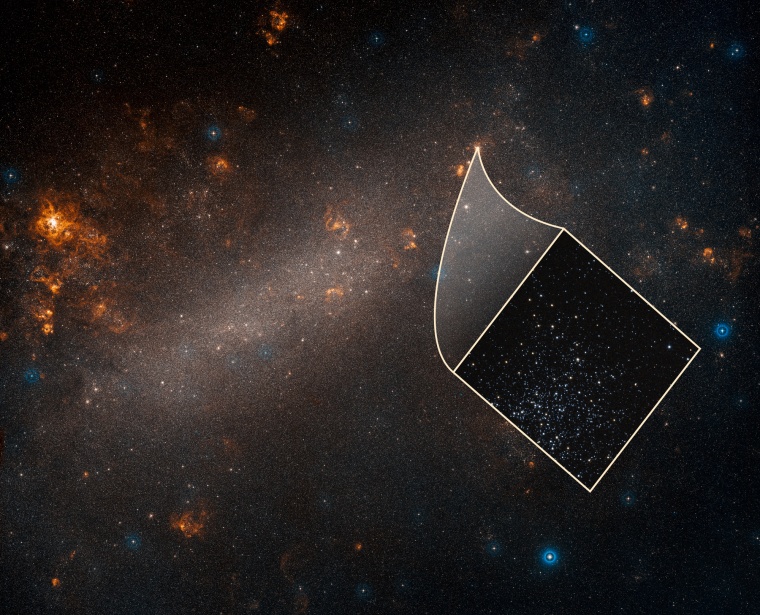
| A view of part of the universe |
Just how old is the universe? Astrophysicists have been debating this question for decades. In recent years, new scientific measurements have suggested the universe may be hundreds of millions of years younger than its previously estimated age of approximately 13.8 billions of years.
Now new research published in a series of papers by an international team of astrophysicists, including Neelima Sehgal, PhD, from Stony Brook University, suggest the universe is about 13.8 billion years old. By using observations from the Atacama Cosmology Telescope (ACT) in Chile, their findings match the measurements of the Planck satellite data of the same ancient light.
The ACT research team is an international collaboration of scientists from 41 institutions in seven countries. The Stony Brook team from the Department of Physics and Astronomy in the College of Arts and Sciences, led by Professor Sehgal, plays an essential role in analyzing the cosmic microwave background (CMB) -- the afterglow light from the Big Bang.
"In Stony Brook-led work we are restoring the 'baby photo' of the universe to its original condition, eliminating the wear and tear of time and space that distorted the image," explains Professor Sehgal, a co-author on the papers. "Only by seeing this sharper baby photo or image of the universe, can we more fully understand how our universe was born."
Obtaining the best image of the infant universe, explains Professor Sehgal, helps scientists better understand the origins of the universe, how we got to where we are on Earth, the galaxies, where we are going, how the universe may end, and when that ending may occur.
The ACT team estimates the age of the universe by measuring its oldest light. Other scientific groups take measurements of galaxies to make universe age estimates.
The new ACT estimate on the age of the universe matches the one provided by the standard model of the universe and measurements of the same light made by the Planck satellite. This adds a fresh twist to an ongoing debate in the astrophysics community, says Simone Aiola, first author of one of the new papers on the findings posted to arXiv.org.
"Now we've come up with an answer where Planck and ACT agree," says Aiola, a researcher at the Flatiron Institute's Center for Computational Astrophysics in New York City. "It speaks to the fact that these difficult measurements are reliable."
In 2019, a research team measuring the movements of galaxies calculated that the universe is hundreds of millions of years younger than the Planck team predicted. That discrepancy suggested that a new model for the universe might be needed and sparked concerns that one of the sets of measurements might be incorrect.
The age of the universe also reveals how fast the cosmos is expanding, a number quantified by the Hubble constant. The ACT measurements suggest a Hubble constant of 67.6 kilometers per second per megaparsec. That means an object 1 megaparsec (around 3.26 million light-years) from Earth is moving away from us at 67.6 kilometers per second due to the expansion of the universe. This result agrees almost exactly with the previous estimate of 67.4 kilometers per second per megaparsec by the Planck satellite team, but it's slower than the 74 kilometers per second per megaparsec inferred from the measurements of galaxies.
"I didn't have a particular preference for any specific value -- it was going to be interesting one way or another," says Steve Choi of Cornell University, first author of another paper posted to arXiv.org. "We find an expansion rate that is right on the estimate by the Planck satellite team. This gives us more confidence in measurements of the universe's oldest light."
As ACT continues making observations, astronomers will have an even clearer picture of the CMB and a more exact idea of how long ago the cosmos began. The ACT team will also scour those observations for signs of physics that doesn't fit the standard cosmological model. Such strange physics could resolve the disagreement between the predictions of the age and expansion rate of the universe arising from the measurements of the CMB and the motions of galaxies.
The ACT research is funded by the National Science Foundation (NSF), and the NSF also funds the work of Professor Sehgal and colleagues at Stony Brook.
Editor's Note: The papers from the Atacama Cosmology Telescope researchers are available online at: https://act.princeton.edu/publications
Friday, May 24, 2019
3253. New Research Suggests that the Big Bang Occurred 12.5 Billion Years Ago
By Corey S. Powell, NBC News, May 18, 2019
 |
The lost time is especially vexing because, in a universe full of mysteries,
its age has been viewed as one of the few near-certainties. By 2013,
the European Planck space telescope's detailed measurements of cosmic
radiation seemed to have yielded the final answer: 13.8 billion years
old. All that was left to do was to verify that number using independent
observations of bright stars in other galaxies.
Then came an unexpected turn of events.
A
few teams, including one led by Nobel laureate Adam Riess of the Space
Telescope Science Institute in Baltimore, set out to make those
observations. Instead of confirming Planck's measurements, they started
getting a distinctly different result.
"It was getting to
the point where we say, 'Wait a second, we're not passing this test —
we're failing the test!'" says Riess, co-author of a new paper about the research to be published in Astrophysical Journal.
He estimates that his results, taken at face value, indicate a universe that is only 12.5 billion to 13 billion years old.
At
first, the common assumption was that Riess and the other
galaxy-watchers had made a mistake. But as their observations continued
to come in, the results didn't budge.
Reanalysis of the Planck data didn't show any problems, either.
Reanalysis of the Planck data didn't show any problems, either.
If all the numbers are
correct, then the problem must run deeper. It must lie in our
interpretation of those numbers — that is, in our fundamental models of
how the universe works. "The discrepancy suggests that there's something
in the cosmological model that we're not understanding right," Riess
says. What that something could be, nobody knows.
Discovery of the dawn of time
The
current discrepancy traces its origin way back to 1929, when astronomer
Edwin Hubble discovered that galaxies are fleeing from Earth in all
directions. More shocking, Hubble found that the farther away the
galaxies are, the faster they're moving apart.
That pattern means they're all fleeing from each other as well. "The
only way all of this can be true is if space is expanding," Riess says.
If the idea of an expanding universe seems bizarre to you, welcome to the club.
"It's
still bizarre to me, too," Riess says. "But that's what all of the data
show, and that's what our theory predicts." Even Hubble never fully
accepted the implications of his own work.
An expanding
universe implies that the universe has a definite age, because you can
retrace the action back to a time when everything in the cosmos was
crammed together in an extremely dense, hot state: what we call the Big Bang.
"This
is another hard concept for people to get their heads around,"
University of Chicago cosmologist Wendy Freedman said, adding that the
Big Bang didn't go off like a kind of bomb. "The Big Bang is an
explosion of space, not into space," she said.
In other
words, galaxies are not flying away from each other through space. Space
itself is stretching between them, and it has been ever since the Big
Bang. So it's meaningless to ask where the Big Bang occurred. It
occurred everywhere. As Freedman puts it, "There is no center or edge to
the explosion."
But in the expanding universe, there is a
beginning of time — at least, time as we know it.
By measuring the rate at which galaxies are moving apart, astronomers realized, they could figure out the moment when the cosmos blinked into existence. All they had to do is figure out how to get their galactic measurements exactly right.
By measuring the rate at which galaxies are moving apart, astronomers realized, they could figure out the moment when the cosmos blinked into existence. All they had to do is figure out how to get their galactic measurements exactly right.
Clocking the cosmos
Freedman
has been working on that problem for more than three decades, far
longer than she ever expected. "This is an incredible challenge," she
says. "Imagine making measurements out to hundreds of millions of light
years to 1-percent accuracy!"
Hubble himself flubbed the
test. His original calculations implied a universe younger than Earth,
because he had drastically underestimated the distances to other
galaxies.
The difficulty of making direct observations of other
galaxies is one of the reasons why scientists created the Planck space
telescope. It was designed to detect radiation left over from the Big Bang.
The pattern of that radiation indicates the exact physical state of the
early universe, if you know how to decode it. In principle, then, the
Planck readings should tell us everything we want to know about what the
universe is made of, and how old it is.
Planck has been a
resounding success, pinning hard numbers onto the soft riddles of the
cosmos. It indicated that 26 percent of the universe consists of dark matter,
invisible material that helps hold galaxies together. It also confirmed
the surprise discovery that the universe is dominated by dark energy,
an unknown force that permeates all of empty space. (The detection of dark energy is what earned Riess a shared 2011 Nobel Prize.)
The
likely implication of these findings is that the universe will keep
expanding forever, faster and faster, into an ever-deeper darkness. It's
an uncomfortable thought, one that Riess would rather not dwell on:
"The scale of time is so beyond that of humanity, I don't think of it in
human terms."
Most satisfying, perhaps, Planck finally
completed the job that Hubble began, determining how quickly the
universe is expanding and how long it has been around. Or so it seemed.
Something big is missing
Fortunately,
Freedman and Riess and their colleagues didn't give up on their
alternate approach to determining the age of the universe. They kept
improving their observations, and are now getting close to that
ambitious target of 1 percent accuracy. Which brings us to the current
dispute — what the scientists politely refer to as "the tension."
The latest galaxy studies indicate an expansion rate about 9 percent faster than the answer from Planck. That might not sound like much of a disagreement, but over cosmic history it adds up to that full billion years of lost time.
Given
the stakes, everyone involved is checking and rechecking their results
for possible sources of error. Increasingly, though, it looks like the
problem lies not with the observations but with the theories of
cosmology that underpin them. If those theories are wrong or incomplete,
the interpretation of the Planck readings will be flawed, too.
"There's
currently no consistent story that works for all our cosmological
data," says Princeton University astrophysicist Jo Dunkley, who has
extensively analyzed the Planck results. "That means there is
fascinating work to be done, to see if there is something out there that
can explain all of it."
The "tension" reminds scientists of just how much they still don't understand about the underlying laws of nature. Dunkley points to the ghostly particles known as neutrinos, which are extremely abundant throughout space. "We measure neutrinos in the lab and put them in our cosmological model assuming that they are behaving just as we expect them to, but we simply don't know if that's true," she says. "I wouldn't find it surprising if dark matter turned out to be more complicated than we think, too."
Then
there's the enigma of dark energy. "We have no good ideas for what it
is. Perhaps there are also elements completely missing from the model
side, still to be discovered," Freedman says. Theorists have no shortage
of ideas: new types of dark energy, new fields, new particles.
Figuring
out which explanation is correct — if any — will require another vast
improvement in how we measure what the universe is actually doing.
Freedman isn't coy about the magnitude of our ignorance: "The question
is, what do we have yet to learn? I'd love to come back in a hundred or a
thousand years and find out!"
Sunday, March 18, 2018
2850. The Mind that Roamed the Cosmos: Stephen Hawking Dies at 76
By Dennis Overbye, The New York Times, March 14, 2018
 |
| Dr. Hawking in his office at the University of Cambridge in December 2011. |
Stephen W. Hawking, the Cambridge University physicist and best-selling author who roamed the cosmos from a wheelchair, pondering the nature of gravity and the origin of the universe and becoming an emblem of human determination and curiosity, died early Wednesday at his home in Cambridge, England. He was 76.
A university spokesman confirmed the death.
“Not since Albert Einstein has a scientist so captured the public imagination and endeared himself to tens of millions of people around the world,” Michio Kaku, a professor of theoretical physics at the City University of New York, said in an interview.
Dr. Hawking did that largely through his book “A Brief History of Time: From the Big Bang to Black Holes,” published in 1988. It has sold more than 10 million copies and inspired a documentary film by Errol Morris. His own story was the basis of an award-winning 2014 feature film, “The Theory of Everything.” (Eddie Redmayne played Dr. Hawking and won an Academy Award.)
Scientifically, Dr. Hawking will be best remembered for a discovery so strange that it might be expressed in the form of a Zen koan: When is a black hole not black? When it explodes.
What is equally amazing is that he had a career at all. As a graduate student in 1963, he learned he had amyotrophic lateral sclerosis, a neuromuscular wasting disease also known as Lou Gehrig’s disease. He was given only a few years to live.
The disease reduced his bodily control to the flexing of a finger and voluntary eye movements but left his mental faculties untouched.
He went on to become his generation’s leader in exploring gravity and the properties of black holes, the bottomless gravitational pits so deep and dense that not even light can escape them.
That work led to a turning point in modern physics, playing itself out in the closing months of 1973 on the walls of his brain when Dr. Hawking set out to apply quantum theory, the weird laws that govern subatomic reality, to black holes. In a long and daunting calculation, Dr. Hawking discovered to his befuddlement that black holes — those mythological avatars of cosmic doom — were not really black at all. In fact, he found, they would eventually fizzle, leaking radiation and particles, and finally explode and disappear over the eons.Nobody, including Dr. Hawking, believed it at first — that particles could be coming out of a black hole. “I wasn’t looking for them at all,” he recalled in 1978. “I merely tripped over them. I was rather annoyed.”
That calculation, in a thesis published in 1974 in the journal Nature under the title “Black Hole Explosions?,” is hailed by scientists as the first great landmark in the struggle to find a single theory of nature — to connect gravity and quantum mechanics, those warring descriptions of the large and the small, to explain a universe that seems stranger than anybody had thought.
The discovery of Hawking radiation, as it is known, turned black holes upside down. It transformed them from destroyers to creators — or at least to recyclers — and wrenched the dream of a final theory in a strange, new direction.
“You can ask what will happen to someone who jumps into a black hole,” Dr. Hawking said in 1978. “I certainly don’t think he will survive it.
“On the other hand,” he added, “if we send someone off to jump into a black hole, neither he nor his constituent atoms will come back, but his mass energy will come back. Maybe that applies to the whole universe.”
Dennis W. Sciama, a cosmologist and Dr. Hawking’s thesis adviser at Cambridge, called Hawking’s thesis in Nature “the most beautiful paper in the history of physics.”
Edward Witten, a theorist at the Institute for Advanced Study in Princeton, said: “Trying to understand Hawking’s discovery better has been a source of much fresh thinking for almost 40 years now, and we are probably still far from fully coming to grips with it. It still feels new.”
In 2002, Dr. Hawking said he wanted the formula for Hawking radiation to be engraved on his tombstone.
He was a man who pushed the limits — in his intellectual life, to be sure, but also in his professional and personal lives. He traveled the globe to scientific meetings, visiting every continent, including Antarctica; wrote best-selling books about his work; married twice; fathered three children; and was not above appearing on “The Simpsons,” “Star Trek: The Next Generation” or “The Big Bang Theory.”
He celebrated his 60th birthday by going up in a hot-air balloon. The same week, he also crashed his electric-powered wheelchair while speeding around a corner in Cambridge, breaking his leg.
In April 2007, a few months after his 65th birthday, he took part in a zero-gravity flight aboard a specially equipped Boeing 727, a padded aircraft that flies a roller-coaster trajectory to produce fleeting periods of weightlessness. It was a prelude to a hoped-for trip to space with Richard Branson’s Virgin Galactic company aboard SpaceShipTwo.
Asked why he took such risks, Dr. Hawking said, “I want to show that people need not be limited by physical handicaps as long as they are not disabled in spirit.”His own spirit left many in awe.
“What a triumph his life has been,” said Martin Rees, a Cambridge University cosmologist, the astronomer royal of England and Dr. Hawking’s longtime colleague. “His name will live in the annals of science; millions have had their cosmic horizons widened by his best-selling books; and even more, around the world, have been inspired by a unique example of achievement against all the odds — a manifestation of amazing willpower and determination.”
Studies Came Easy
Stephen William Hawking was born in Oxford, England, on Jan. 8, 1942 — 300 years to the day, he liked to point out, after the death of Galileo, who had begun the study of gravity. His mother, the former Isobel Walker, had gone to Oxford to avoid the bombs that fell nightly during the Blitz of London. His father, Frank Hawking, was a prominent research biologist.
The oldest of four children, Stephen was a mediocre student at St. Albans School in London, though his innate brilliance was recognized by some classmates and teachers.
Later, at University College, Oxford, he found his studies in mathematics and physics so easy that he rarely consulted a book or took notes. He got by with a thousand hours of work in three years, or one hour a day, he estimated. “Nothing seemed worth making an effort for,” he said.
The only subject he found exciting was cosmology because, he said, it dealt with “the big question: Where did the universe come from?”
He moved to Cambridge upon his graduation from Oxford. Before he could begin his research, however, he was stricken by what his research adviser, Dr. Sciama, came to call “that terrible thing.”
The young Hawking had been experiencing occasional weakness and falling spells for several years. Shortly after his 21st birthday, in 1963, doctors told him that he had amyotrophic lateral sclerosis. They gave him less than three years to live.
His first response was severe depression. He dreamed he was going to be executed, he said. Then, against all odds, the disease appeared to stabilize. Though he was slowly losing control of his muscles, he was still able to walk short distances and perform simple tasks, though laboriously, like dressing and undressing. He felt a new sense of purpose.
“When you are faced with the possibility of an early death,” he recalled, “it makes you realize that life is worth living and that there are a lot of things you want to do.”
In 1965, he married Jane Wilde, a student of linguistics. Now, by his own account, he not only had “something to live for”; he also had to find a job, which gave him an incentive to work seriously toward his doctorate.
His illness, however, had robbed him of the ability to write down the long chains of equations that are the tools of the cosmologist’s trade. Characteristically, he turned this handicap into a strength, gathering his energies for daring leaps of thought, which, in his later years, he often left for others to codify in proper mathematical language.
“People have the mistaken impression that mathematics is just equations,” Dr. Hawking said. “In fact, equations are just the boring part of mathematics.”
By necessity, he concentrated on problems that could be attacked through “pictures and diagrams,” adopting geometric techniques that had been devised in the early 1960s by the mathematician Roger Penrose and a fellow Cambridge colleague, Brandon Carter, to study general relativity, Einstein’s theory of gravity.
Black holes are a natural prediction of that theory, which explains how mass and energy “curve” space, the way a sleeping person causes a mattress to sag. Light rays will bend as they traverse a gravitational field, just as a marble rolling on the sagging mattress will follow an arc around the sleeper.
Too much mass or energy in one spot could cause space to sag without end; an object that was dense enough, like a massive collapsing star, could wrap space around itself like a magician’s cloak and disappear, shrinking inside to a point of infinite density called a singularity, a cosmic dead end, where the known laws of physics would break down: a black hole.
Einstein himself thought this was absurd when the possibility was pointed out to him.Using the Hubble Space Telescope and other sophisticated tools of observation and analysis, however, astronomers have identified hundreds of objects that are too massive and dark to be anything but black holes, including a supermassive one at the center of the Milky Way. According to current theory, the universe should contain billions more.
As part of his Ph.D. thesis in 1966, Dr. Hawking showed that when you ran the film of the expanding universe backward, you would find that such a singularity had to have existed sometime in cosmic history; space and time, that is, must have had a beginning. He, Dr. Penrose and a rotating cast of colleagues published a series of theorems about the behavior of black holes and the dire fate of anything caught in them.
A Calculation in His Head
Dr. Hawking’s signature breakthrough resulted from a feud with the Israeli theoretical physicist Jacob Bekenstein, then a Princeton graduate student, about whether black holes could be said to have entropy, a thermodynamic measure of disorder. Dr. Bekenstein said they could, pointing out a close analogy between the laws that Dr. Hawking and his colleagues had derived for black holes and the laws of thermodynamics.
Dr. Hawking said no. To have entropy, a black hole would have to have a temperature. But warm objects, from a forehead to a star, radiate a mixture of electromagnetic radiation, depending on their exact temperatures. Nothing could escape a black hole, and so its temperature had to be zero. “I was very down on Bekenstein,” Dr. Hawking recalled.
Santi Visalli/Getty Images
To settle the question, Dr. Hawking decided to investigate the properties of atom-size black holes. This, however, required adding quantum mechanics, the paradoxical rules of the atomic and subatomic world, to gravity, a feat that had never been accomplished. Friends turned the pages of quantum theory textbooks as Dr. Hawking sat motionless staring at them for months. They wondered if he was finally in over his head.
When he eventually succeeded in doing the calculation in his head, it indicated to his surprise that particles and radiation were spewing out of black holes. Dr. Hawking became convinced that his calculation was correct when he realized that the outgoing radiation would have a thermal spectrum characteristic of the heat radiated by any warm body, from a star to a fevered forehead. Dr. Bekenstein had been right.
Dr. Hawking even figured out a way to explain how particles might escape a black hole. According to quantum principles, the space near a black hole would be teeming with “virtual” particles that would flash into existence in matched particle-and-antiparticle pairs — like electrons and their evil twin opposites, positrons — out of energy borrowed from the hole’s intense gravitational field.
They would then meet and annihilate each other in a flash of energy, repaying the debt for their brief existence. But if one of the pair fell into the black hole, the other one would be free to wander away and become real. It would appear to be coming from the black hole and taking energy away from it.
But those, he cautioned, were just words. The truth was in the math.
“The most important thing about Hawking radiation is that it shows that the black hole is not cut off from the rest of the universe,” Dr. Hawking said.
It also meant that black holes had a temperature and had entropy. In thermodynamics, entropy is a measure of wasted heat. But it is also a measure of the amount of information — the number of bits — needed to describe what is in a black hole. Curiously, the number of bits is proportional to the black hole’s surface area, not its volume, meaning that the amount of information you could stuff into a black hole is limited by its area, not, as one might think, its volume.
That result has become a litmus test for string theory and other pretenders to a theory of quantum gravity. It has also led to speculations that we live in a holographic universe, in which three-dimensional space is some kind of illusion.
Andrew Strominger, a Harvard string theorist, said of the holographic theory, “If it’s really true, it’s a deep and beautiful property of our universe — but not an obvious one.”
To ‘Know the Mind of God’
The discovery of black hole radiation also led to a 30-year controversy over the fate of things that had fallen into a black hole.
Dr. Hawking initially said that detailed information about whatever had fallen in would be lost forever because the particles coming out would be completely random, erasing whatever patterns had been present when they first fell in. Paraphrasing Einstein’s complaint about the randomness inherent in quantum mechanics, Dr. Hawking said, “God not only plays dice with the universe, but sometimes throws them where they can’t be seen.”
Many particle physicists protested that this violated a tenet of quantum physics, which says that knowledge is always preserved and can be retrieved. Leonard Susskind, a Stanford physicist who carried on the argument for decades, said, “Stephen correctly understood that if this was true, it would lead to the downfall of much of 20th-century physics.”
On another occasion, he characterized Dr. Hawking to his face as “one of the most obstinate people in the world; no, he is the most infuriating person in the universe.” Dr. Hawking grinned.
Dr. Hawking admitted defeat in 2004. Whatever information goes into a black hole will come back out when it explodes. One consequence, he noted sadly, was that one could not use black holes to escape to another universe. “I’m sorry to disappoint science fiction fans,” he said.
Despite his concession, however, the information paradox, as it is known, has become one of the hottest topics in theoretical physics. Physicists say they still do not know how information gets in or out of black holes.
Raphael Bousso of the University of California, Berkeley, and a former student of Dr. Hawking’s, said the present debate had raised “by another few notches” his estimation of the “stupendous magnitude” of Dr. Hawking’s original discovery.
In 1974, Dr. Hawking was elected a Fellow of the Royal Society, the world’s oldest scientific organization; in 1979, he was appointed to the Lucasian chair of mathematics at Cambridge, a post once held by Isaac Newton. “They say it’s Newton’s chair, but obviously it’s been changed,” he liked to quip.
Dr. Hawking also made yearly visits to the California Institute of Technology in Pasadena, which became like a second home. In 2008, he joined the Perimeter Institute for Theoretical Physics in Waterloo, Ontario, as a visiting researcher.
Having conquered black holes, Dr. Hawking set his sights on the origin of the universe and on eliminating that pesky singularity at the beginning of time from models of cosmology. If the laws of physics could break down there, they could break down everywhere.
In a meeting at the Vatican in 1982, he suggested that in the final theory there should be no place or time when the laws broke down, even at the beginning. He called the notion the “no boundary” proposal.
With James Hartle of the Institute for Theoretical Physics in Santa Barbara, Calif., Dr. Hawking envisioned the history of the universe as a sphere like the Earth. Cosmic time corresponds to latitude, starting with zero at the North Pole and progressing southward.
Although time started there, the North Pole was nothing special; the same laws applied there as everywhere else. Asking what happened before the Big Bang, Dr. Hawking said, was like asking what was a mile north of the North Pole — it was not any place, or any time.
By then, string theory, which claimed finally to explain both gravity and the other forces and particles of nature as tiny microscopically vibrating strings, like notes on a violin, was the leading candidate for a “theory of everything.”
In “A Brief History of Time,” Dr. Hawking concluded that “if we do discover a complete theory” of the universe, “it should in time be understandable in broad principle by everyone, not just a few scientists.”
He added, “Then we shall all, philosophers, scientists and just ordinary people, be able to take part in the discussion of why it is that we and the universe exist.”
“If we find the answer to that,” he continued, “it would be the ultimate triumph of
Until 1974, Dr. Hawking was still able to feed himself and to get in and out of bed. At Jane’s insistence, he would drag himself, hand over hand, up the stairs to the bedroom in his Cambridge home every night, in an effort to preserve his remaining muscle tone. After 1980, care was supplemented by nurses.
Dr. Hawking retained some control over his speech up to 1985. But on a trip to Switzerland, he came down with pneumonia. The doctors asked Jane if she wanted his life support turned off, but she said no. To save his life, doctors inserted a breathing tube. He survived, but his voice was permanently silenced.
Speaking With the Eyes
It appeared for a time that he would be able to communicate only by pointing at letters on an alphabet board. But when a computer expert, Walter Woltosz, heard about Dr. Hawking’s condition, he offered him a program he had written called Equalizer. By clicking a switch with his still-functioning fingers, Dr. Hawking was able to browse through menus that contained all the letters and more than 2,500 words.
Word by word — and when necessary, letter by letter — he could build up sentences on the computer screen and send them to a speech synthesizer that vocalized for him. The entire apparatus was fitted to his motorized wheelchair.
Even when too weak to move a finger, he communicated through the computer by way of an infrared beam, which he activated by twitching his right cheek or blinking his eye. The system was expanded to allow him to open and close the doors in his office and to use the telephone and internet without aid.
Although he averaged fewer than 15 words per minute, Dr. Hawking found he could speak through the computer better than he had before losing his voice. His only complaint, he confided, was that the speech synthesizer, manufactured in California, gave him a new vocal inflection.
“Please pardon my American accent,” he used to say.
His decision to write “A Brief History of Time” was prompted, he said, by a desire to share his excitement about “the discoveries that have been made about the universe” with “the public that paid for the research.” He wanted to make the ideas so accessible that the book would be sold in airports.
He also hoped to earn enough to pay for his children’s education. He did. The book’s extraordinary success made him wealthy, a hero to disabled people everywhere and even more famous.
The news media followed his movements and activities over the years, from visiting the White House to meeting the Dallas Cowboys cheerleaders, and reported his opinions on everything from national health care (socialized medicine in England had kept him alive) to communicating with extraterrestrials (maybe not a good idea, he said), as if he were a rolling Delphic Oracle.
Asked by New Scientist magazine what he thought about most, Dr. Hawking answered: “Women. They are a complete mystery.”
In 1990, Dr. Hawking and his wife separated after 25 years of marriage; Jane Hawking wrote about their years together in two books, “Music to Move the Stars: A Life With Stephen Hawking” and “Traveling to Infinity: My Life With Stephen.” The latter became the basis of the movie “The Theory of Everything.”
In 1995, he married Elaine Mason, a nurse who had cared for him since his bout of pneumonia. She had been married to David Mason, the engineer who had attached Dr. Hawking’s speech synthesizer to his wheelchair.
In 2004, British newspapers reported that the Cambridge police were investigating allegations that Elaine had abused Dr. Hawking, but no charges were filed, and Dr. Hawking denied the accusations. They later divorced.
His survivors include his children, Robert, Lucy and Tim, and three grandchildren.
‘There Is No Heaven’
Among his many honors, Dr. Hawking was named a commander of the British Empire in 1982. In the summer of 2012, he had a star role in the opening of the Paralympics Games in London. The only thing lacking was the Nobel Prize, and his explanation for this was characteristically pithy: “The Nobel is given only for theoretical work that has been confirmed by observation. It is very, very difficult to observe the things I have worked on.”
Dr. Hawking was a strong advocate of space exploration, saying it was essential to the long-term survival of the human race. “Life on Earth is at the ever-increasing risk of being wiped out by a disaster, such as sudden global nuclear war, a genetically engineered virus or other dangers we have not yet thought of,” he told an audience in Hong Kong in 2007.
Nothing raised as much furor, however, as his increasingly scathing remarks about religion. One attraction of the no-boundary proposal for Dr. Hawking was that there was no need to appeal to anything outside the universe, like God, to explain how it began.
In “A Brief History of Time,” he had referred to the “mind of God,” but in “The Grand Design,” a 2011 book he wrote with Leonard Mlodinow, he was more bleak about religion. “It is not necessary to invoke God to light the blue touch paper,” he wrote, referring to the British term for a firecracker fuse, “and set the universe going.”
He went further that year, telling The Guardian: “I regard the brain as a computer which will stop working when its components fail. There is no heaven or afterlife for broken-down computers; that is a fairy story for people afraid of the dark.”
Having spent the best part of his life grappling with black holes and cosmic doom, Dr. Hawking had no fear of the dark.
“They’re named black holes because they are related to human fears of being destroyed or gobbled up,” he once told an interviewer. “I don’t have fears of being thrown into them. I understand them. I feel in a sense that I am their master.”
Subscribe to:
Posts (Atom)