Showing posts with label Communist Party of Cuba. Show all posts

Wednesday, April 27, 2016

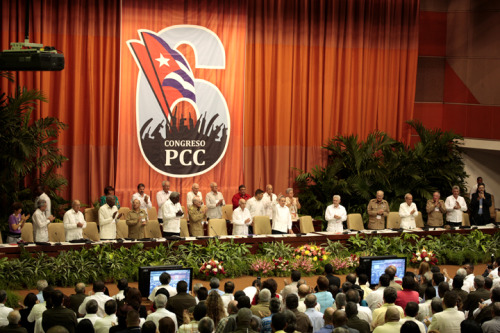
2294. Cuba’s Ongoing 7th Party Congress

By Elio Delgado Legon, Havana Times, April 27, 2016
The 7th Congress of the Communist Party of Cuba was held in Havana, April 16-19
The plenary session and commission meetings of the 7th Congress of the Cuban Communist Party (PCC) was held in Havana from April 16 to 19, but the closing ceremony on the 19th did not put an end to the Congress. The work of the representatives will continue in the months to come.

Many in Cuba and abroad consider this a historical congress, first of all because it is the last to be presided by the historical leaders of the revolution and, second, because it has laid the foundations for the conceptualization of the economic model to follow and the development of the economy until 2030.

The two aims could not be met in the brief time the Congress lasted. They require the involvement of all Party members and the analysis and opinions of workers and the whole of society, through grassroots organizations.

The main report, read by First Secretary Raul Castro, diagnoses Cuba’s social reality and demonstrates the Party’s capacity to interpret the sentiments of the masses, tracing economic, scientific and social development aims for the country.

One of the paragraphs of the report explains that “we have planned to have both documents, the conceptualization and the bases for the National Development Plan, that is, be subjected to democratic debate following their analysis during the Congress, by members of the Party and the Young Communists League, representatives of grassroots organizations and broad sectors of society, so that these may be enriched and perfected.”

The participation of society in the preparation of the final drafts will have a positive impact on the close relationship that ought to exist between the Party and the masses.
The central report will have to be thoroughly reviewed by all Party members and by all workers and society in general, for it constitutes the guide for all future work to be undertaken by revolutionaries.

Counterrevolutionaries at home and abroad have vociferated that the report does not say what many expected it to. Were they expecting Cuba to adopt a multi-party system or for it to return to the neoliberal capitalism that was eradicated many years ago?
They should bear in mind that Cuban revolutionaries have never given up and, if, once in our history, because of a lack of unity and understanding, the Zanjon Pact was signed with the Spanish Crown to bring about peace without independence, the Baragua Protest saved the honor of Cubans. Those who support the Zanjon Pact today should not deceive themselves, as Cuban revolutionaries today, who know their history, will make Cuba an eternal Baragua.

Faced with the reality of the world today and the onslaught of Latin America’s right against progressive and left-wing parties (with guidance and aid from abroad), the Cuban revolution isn’t going to fall into the trap. Those who followed the siren songs of neoliberalism in Argentina are today regretting the country’s retreat to the times of Carlos Menem, when the country was neck-deep in neoliberal muck and was only able to pull itself out of this pit thanks to the progressive governments of Nestor Kirchner and Cristina Fernandez.

In other countries, such as Honduras, Paraguay and, more recently, Brazil, parliamentary coups or economic warfare (as exemplified by Venezuela) are being used to set up new forms of neoliberalism.

We will never again return to the days of politicking and the shame of seeing unscrupulous politicians descend like vultures on the spoils of the homeland, mired in chaos and misery. What the revolution has achieved to date, which is far from insignificant, will continue to consolidate itself and grow until we have reached a prosperous and sustainable form of socialism, as was reaffirmed at the recently-concluded 7th Congress, which shall go on for as long as is needed.

Thursday, April 21, 2016

2286. Fidel Castro: The Cuban People Will Overcome

By Fidel Castro Ruz, Granma, April 20, 2016 
Fidel and Raúl Castro at the 7th Congress of the Communist Party of Cuba.
It constitutes a superhuman effort to lead any people in times of crisis. Without them, the changes would be impossible. In a meeting such as this, which brings together more than a thousand representatives chosen by the revolutionary people themselves, who delegated their authority to them, for all it represents the greatest honor they have received in their lives, to which is added the privilege of being a revolutionary which is the product of our own consciousness.

Why did I become a socialist, or more plainly, why did I become a communist? That word that expresses the most distorted and maligned concept in history by those who have the privilege of exploiting the poor, dispossessed ever since they were deprived of all the material wealth that work, talent and human energy provide. Since when does man live in this dilemma, throughout time without limit. I know you do not need this explanation but perhaps some listeners do.

I speak simply so it is better understood that I am not ignorant, extremist, or blind, nor did I acquire my ideology of my own accord studying economics.

I did not have a tutor when I was a law and political sciences student, subjects in which they have a great influence. Of course then I was around 20 years old and was fond of sports and mountain climbing. Without a tutor to help me in the study of Marxism-Leninism; I was no more than a theorist and, of course, had total confidence in the Soviet Union. Lenin's work violated after 70 years of Revolution. What a history lesson! It can be affirmed that it should not take another 70 years before another event like the Russian Revolution occurs, in order that humanity have another example of a magnificent social revolution that marked a huge step in the struggle against colonialism and its inseparable companion, imperialism.

Perhaps, however, the greatest danger hanging over the earth today derives from the destructive power of modern weaponry which could undermine the peace of the planet and make human life on earth’s surface impossible.

The species would disappear like the dinosaurs disappeared, perhaps there will be time for new forms of intelligent life or maybe the sun’s heat will grow until it melts all the planets of the solar system and its satellites, as a large number of scientists recognize. If the theories of several of them are true, which we laypeople are not unaware of, the practical man must learn more and adapt to reality. If the species survives a much longer space of time the future generations will know much more than we do, but first they will have to solve a huge problem. How to feed the billions of human beings whose realities are inevitably at odds with the limited drinking water and natural resources they need?

Some or perhaps many of you are wondering where are the politics in this speech. Believe me I am sad to say it, but the politics are here in these moderate words. If only numerous human beings would concern ourselves with these realities and not continue as in the times of Adam and Eve eating forbidden apples. Who will feed the thirsty people of Africa with no technology at their disposal, no rain, no reservoirs, no more underground aquifers than those covered by sands? We will see what the governments, which almost all signed the climate commitments, say.

We must constantly hammer away at these issues and I do not want to elaborate beyond the essentials.

I shall soon turn 90, such an idea would never have occurred to me and it was never the result of an effort, it was sheer chance. I will soon be like everyone else. We all reach our turn, but the ideas of the Cuban communists will remain as proof that on this planet, working with fervor and dignity, can produce the material and cultural wealth that humans need, and we must fight relentlessly to obtain these. To our brothers in Latin America and the world we must convey that the Cuban people will overcome.

This may be one of the last times that I speak in this room. I voted for all the candidates submitted for election by Congress and I appreciate the invitation and the honor of your listening to me. I congratulate you all, and firstly, compañero Raúl Castro for his magnificent effort.

We will set forth on the march forward and we will perfect what we should perfect, with the utmost loyalty and united force, just as Martí, Maceo and Gómez, in an unstoppable march.

Sunday, April 17, 2016

2280. Raúl Castro: Economic Development, Struggle for Peace and Ideological Resolve Are Party’s Principal Tasks

By Granma, April 17, 2016
Raúl Castro addressing the openning session of the 7th Congress of PCC. 
The development of the national economy, along with the struggle for peace and ideological resolve, constitute the principal missions of the Communist Party of Cuba, First Secretary Raúl Castro said, during the inaugural session of the 7th Party Congress.
PCC First Secretary Raúl Castro Ruz, presented the Central Report to the 7th Congress, after evoking the 55th anniversary of the proclamation of the socialist character of the Cuban Revolution, on April 16, 1961, on the eve of the mercenary invasion at Playa Girón, which was defeated in less than 72 hours, with Comandante en Jefe Fidel Castro Ruz on the front lines, and noted that participating in the event were 1,000 delegates and some 280 invitees, representing the Party’s 600,000 members, organized in 54,000 grassroots units.
The first Secretary noted that the Congress would include the presentation of four principal draft documents, work on several of which began after the previous Congress: the conceptualization of Cuba’s socio-economic model; the development plan through 2030; a report on the implementation of the guidelines over the last five years and their updating for the period 2016-2020; and an analysis of Party objectives approved at the First National Party Conference.
These documents, he insisted, must not be considered finished works, or an ideological prism, but will be enriched during the commissions’ debates, and subsequently submitted to periodic review, maintaining a dynamic vision of their content.
On this occasion, he clarified, a major process of public debate and consultation on these documents was not held, because they are considered a continuation of the lines agreed upon five years ago, to update the country’s socio-economic model.
Additionally, he said, these documents reflect the collective work of many different professionals, and were analyzed during two Central Committee Plenums, a process which led to the submission of 900 opinions and suggestions, included in the latest version.
Raúl noted that this is the first time a Party Congress has considered the conceptualization of the country’s socio-economic model, one which outlines the essential foundations of the society to which we aspire, to be reached via the process of updating underway.
The conceptualization and the basis of the National Economic and Social Development Plan through 2030, following their analysis during the Congress, will not be approved at this event, but rather will go on to be debated by Party and Young Communist League members, representatives of mass organizations and different sectors of society, with the aim of enriching and perfecting said plan, Raúl noted.
The Army General requested that the 7th Congress authorize the Central Committee to introduce the modifications resulting from this consultation process and the final approval by the National Assembly of People’s Power.
Regarding progress in the implementation of the Guidelines, Raúl noted that since they were approved it was made clear that “the process of implementation will not be an easy path, free of obstacles and contradictions,” and that the fundamental transformations in the updating of the economic model would take over five years to implement, which in practice has been demonstrated.
Regarding the main obstacles encountered during this process, he mentioned out-dated mindsets and resistant attitudes.
Efforts to implement the Guidelines have been systematic, he stated, adding that 21% of the 313 approved guidelines have been implemented, while 77% are in the process and 2% have yet to be initiated.
However, he admitted, the slow implementation of legal regulations and their assimilation, has delayed approved policies in practice.
The principle that no one will be left uncared for, determines the updating of the Cuban economic model, undeniably impacted by the global economic crisis and the effects of the U.S. blockade, he added.
Economic decisions can not mean a break with the ideals of social justice of the nation or undermine the unity of the majority of the people around the Party, nor as a result of these measures should instability and uncertainty be generated in the population, he noted.
FOCUS ON THE ECONOMY
Referring to the dual currency system in the country, one of the main economic obstacles, Raúl stressed that work in this area has not ceased, and the solution will not be put off indefinitely.
Rectifying this situation, along with other structural distortions of the Cuban economy, will be key to driving forward progress in terms of growth and further development, he noted.
The change to the monetary system will facilitate creating conditions to overcome the adverse effects of egalitarianism and at the same time make the socialist principle of “from each according to his ability, to each according to his work” a reality.
Among the broader legal norms approved between the Sixth Congress of the PCC and this edition, the new Foreign Investment Law is an important engine of the economy. In this regard, Raúl stressed that in addition to the advantages that Law No.118 offers investors, this guarantees national sovereignty at all times.
The creation of the Mariel Special Development Zone, as a major means of attracting national and foreign investors, is also one of the noteworthy steps in this process, given its ability to generate employment and long-term financing.
Raúl emphasized that, without underestimating in the least the obstacle of the U.S. blockade and its extraterritorial application, archaic prejudices must be left behind, in approaching the new stage in the thawing of relations between the two countries.
Broadly speaking, in terms of foreign investment, the President noted that the focus of investments has changed substantially. For example, while five years ago, levels of investment in the productive sphere and infrastructure reached 45%, in 2015, these areas accumulated 70% of total foreign investment.
He also highlighted that the recognition of the market is not at all at odds with the socialist economy, nor does this mean that the Party, the government and mass organizations will cease to act in situations that negatively affect the population. On the contrary, they should help prevent these from manifesting.
Amid these circumstances, Raúl noted that in general, “salaries and pensions are still insufficient to meet the needs of the Cuban family,” despite having seen growth in the period from 2010 to 2015.
However, he acknowledged that it has not been possible to extend the budgeted wage increases to the majority of the activities outlined in the approved policy.

Saturday, June 20, 2015

1889. Who Should Lead the Communist Party of Cuba

By Pedro Campos, Havana Times, July 12, 2013

During a recent meeting of the Communist Party Central Committee President Raul Castro stated that “Party leaders must be capable of recognizing the country’s problems and looking towards the future”, an article published in Granma, Cuba’s major official newspaper, reported on July 3. I will limit myself to commenting on this particular remark.
It should be the other way around, Mr. President: those who are capable of identifying today’s problems, those who look for and find solutions to these problems and are able to look towards the future, should be the ones selected to head the Party. But no: you continue to appoint those who are loyal to you, even if they’re incapable of seeing, solving or identifying anything.
The way Party leaders are appointed – on the basis of intelligence gathered or produced by various State Security organs –, a mechanism imposed on the Party by the “founding leadership” of the Cuban revolution, in violation of bottom-up democratic election principles, is what robs Cuba of leaders able to identify and solve problems.
The solution is simple: do not appoint any more leaders, do not make any more proposals for new Central Committee members, provincial or municipal officials and do not even let these different Party institutions impose the “instructors” at the grassroots level of the Party.  Let the members make these proposals and elect who they see fit.
The problem faced by the Communist Party is the same problem Cuba’s entire economy and society faces: excessive centralization, top-down decision-making processes, and a general lack of democracy. Democratic centralism has two main components, but you have neglected the second one, as you have neglected all of the proposals advanced by the socialist and democratic left you have worked to silence.
As I have expounded on elsewhere, until you acknowledge the failure of the political, economic and social conceptions that could be grouped under the “Marxist-Leninist” school of thought, or, rather, the dogmatic, Soviet-Stalinist version of Marx’s and Lenin’s main ideas, a true rectification of the mistakes made thus far, and a true renewal of socialism, will not be possible.
In the meantime, we will have more of the same, disguised with new words and impelled by old and exhausted schemes, structures, methods, slogans and the word “socialism”, ever more divested of meaning and besmirched by failure, in short: more malaise, isolation and contempt.
Those of us who try and rescue the concept of socialism will continue to climb up a slippery slope, full of promontories and, of course, plagued with dangers.
The veiled persecution of democratic socialists continues in Cuba. After the Party, Armed Forces and Ministry of the Interior were “purged” of “perestroikists and left-wingers”, in a clean-up operation which began with the trials of General Ochoa and Minister of the Interior Abrantes, our comrades continue to be “visited” and denigrating articles and comments about us continue to appear in online publications and blogs.
In recent days, I attempted to leave several comments on Cubadebate, an online publication of the PCC. Though these were written in a respectful tone and showed the utmost moderation, they were all immediately rejected.
So be it. This is the time it was our lot to live in and it is better to live with dignity, to take up the struggle, than to live on our knees before the Empire and the new masters.
We continue to struggle for true socialism, for life.