Showing posts with label Climate change tipping points. Show all posts

Friday, February 16, 2024

3636. Climate Chaos: The Planet's Tipping Points

 By David Gelles and Manuela Anderoni, The New York Times,  Debruary 15, 2024

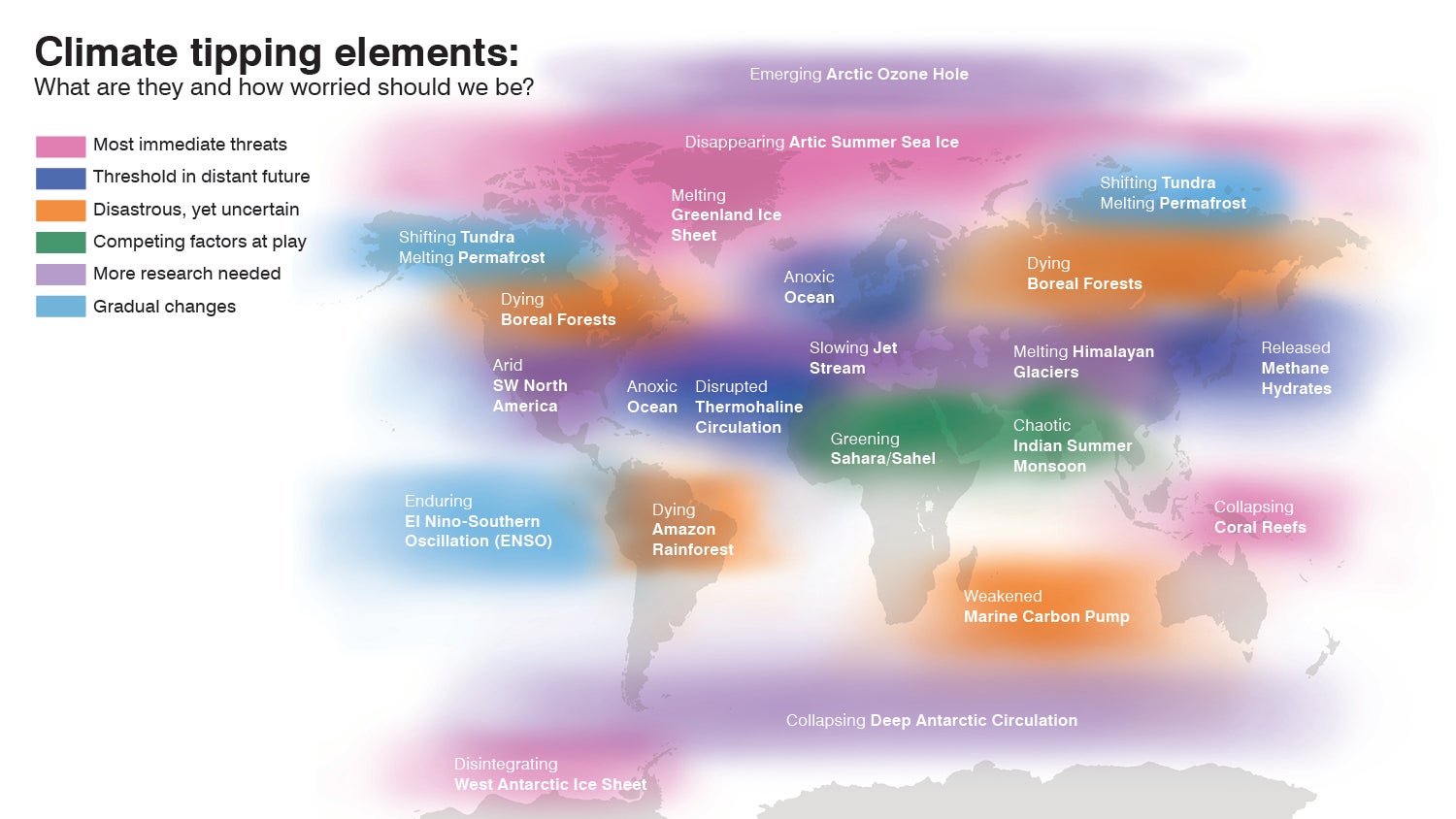
Possible tipping points


Editor's note: This article ends with a "good tipping points" section which notes how solar power has become competitive in prices with fossil fuels in the United States. It pushes the old argument that somehow "market forces" will result in outcomes that will stop catastrophic climate change. That is pure nonsense for a number of reasons. While it is true that lowering of prices of solar panels add economic incentives to install them at homes, anyone who has installed them, including this writer, knows that there are many obstacles to instaltion of solar system. In my own case, for example, the roof of my house was not a good candidate to install solar panels because of shading from nearby trees. The roof also lacked rafters which are used to secure heavey solar panels on the roof. So, I had to build a separate structure at the cost of $35,000 to install a solar system for $25,000. How many U.S. households can sped $60,000 to transition to solar power? Furthermore, solar systems will require the use of the electrial grid at night and during cloudy or rainy days the solar system does not produce electricity. A solution is to buy backup batteries. But they are VERY expensive. My house will require two Tesla batteries that have been outside of my budget to purchase. One bid was for $36,000. The lowest bid was for $21,000 but they also wanted to charge me $6000 for digging a trench and $6,000 for installing a new electircal panel. 

So far only less than ONE PERCENT of the U.S. homes have solar systems! Why the Times and the capitalist politicians and media continue to promote "market forces" to stop climate change? For the same reason that NO government yet has honored its commitment to the UN sponosered Paris agreement to stop climate change. Let us recall that climate change is a world scale problem and the solution must come from a unified world response which will require unified government respose! The movement to stop climate change has died out precisely because of its reliance on the capitalist politicians. In the same article, the authors write about the cutting down of the Amazon rainforest as a stipping point while calling climate change "human caused!" But "humans" are not cutting down the Amazon forest, capitalist corporations are in search of profits!  

Fossil fuels are built into the fabric of anthrpocentric industrial capitalist economies the world over. That is why to get rid of them we need an ECOCENTRIC SOCIALIST REVOLUTION. This maybe an unreachable goal during the little time we have given the planet's time limits imposed by the tipping points. But at least we are not following the capitalist corporations, their politicians and media, to extinction.  It is better to fight for survival of most of life on the planet. I have discussed these issues in detail in my book Whose Planet? Essays on Ecocentric Socialism 2023. 

*.    *.    *

A drumbeat of recent reports has driven home the fact that our planet’s complex environmental systems are undergoing profound upheavals as a result of human activity.

Glaciers around the world, from Greenland to Switzerland to Antarctica, are melting faster than expected as atmospheric and ocean heat hit new highs.

New research suggests that up to half of the Amazon rainforest could rapidly transform into grasslands or weakened ecosystems in the coming decades as a result of deforestation, climate change and drought. Those stresses could eventually drive the entire forest ecosystem, home to a tenth of the planet’s land species, past a tipping point that would trigger a forest-wide collapse.

And a new study suggests that a crucial network of ocean currents that carries warm water into the North Atlantic is showing early signs of collapse because of an influx of fresh water from melting glaciers.


All of these developments appear worrisome on the surface. But, most concerning of all, they raise the specter that the planet may be approaching some of the so-called tipping points that could trigger severe and irreversible changes.

Tim Lenton, a professor who studies climate and Earth systems at the University of Exeter, said tipping points were characterized by “amplifying feedback within a system that’s getting strong enough that it can cause a self-propelling change.”

What that means in layman’s terms: Once the key threshold is crossed, the change accelerates, and a profound transformation becomes inevitable. Change begets more change in a self-reinforcing loop.

There is no consensus that any large-scale tipping points have been reached, though there is debate about whether some, on the Greenland ice sheet and in many of the world’s coral reefs, are close or have already tipped.

“Things that we actually observe happening in the climate look a whole lot like tipping point changes, or serious harbingers of those changes,” Lenton said.


The phrase “tipping point” has a complicated and controversial history. Scientists started talking regularly about climate tipping points in the early 2000s. They quickly concluded that some of those tipping points were fast approaching, or might have already passed.

The self-propelling mechanism of tipping points are typically made up of various feedback loops. Here are examples of how some of them work.

  • Some of the most worrisome concern the world’s vast ice sheets. If the Greenland ice sheet collapses, for example, global sea levels could rise by seven meters, or 23 feet, over the next centuries. Feedback loops: As the ice melts, its surface declines in altitude, which means the air on top of it is warmer, leading to more melting. And, disappearing ice means fewer white surfaces to reflect sunlight back into space, which warms the atmosphere even more.

  • Thawing of permafrost could release gigatons of planet-warming methane into the atmosphere. Feedback loop: Methane causes the atmosphere to warm further, melting more permafrost, and so on.

  • Earth’s ecosystems — such as forests, coral reefs and lakes — are in danger, too, with far-reaching consequences. For example, the collapse of boreal forests, which burned at an unprecedented rate last year, could send enormous amounts of carbon into the atmosphere. Feedback loop: Fires create water stress, reducing the ability of trees to resist insect infestation, which makes them more vulnerable to fires.

  • Currents and monsoons that regulate the oceans and the atmosphere can slow down, warm up and shift in all sorts of ways. If the currents that bring warm water to the North Atlantic collapse, for example, average temperatures in Western Europe could plummet in a matter of decades. Feedback loop: These currents move saltier water from one part of the ocean to another. If they become weaker, less salt is transported, the surface water becomes less salty, which makes it less dense and less likely to sink, weakening currents further.

Since researchers started identifying tipping points, the list of systems that are close to the edge has grown steadily to the current two dozen; some closer, some farther from collapse. You can check them all out in a report about global tipping points that Lenton and his colleagues published a few months ago.

It’s not only the planet that can experience tipping points. There are industrial, technological and economic tipping points, too. And some of them might help curb global warming.

Take the rapid decline in costs for renewable energy. Last year, we reported on a study that argued solar power had already passed a tipping point because market forces alone, with no help from policymakers, could make it the cheapest source of electricity by 2027. Similar dynamics could benefit wind power, batteries and other parts of the clean energy transition.

The new economics of green energy is leading to an influx of spending in the sector. Last year, for the first time, total global investments in solar were greater than investments in oilSolar panels, wind turbines and batteries are all experiencing startling gains in efficiency, too. And, the adoption of electric vehicles and heat pumps continues to rise as they become more affordable.


Lenton, who is writing a book about tipping points, noted that social norms could rapidly change, as well, practically overnight. (The phrase “tipping point” was used in social science to describe a sudden rush of white families moving out of a given neighborhood as Black families moved in.)

Some people believe that we may see the animal farming industry we have today as unacceptable in the future. Could eating meat every day be frowned upon in the future? Will burning fossil fuels ever become unthinkable?

“Sometimes change really is self-propelling, and something huge happens out of nowhere,” Lenton said. “It could be really bad, if it’s bad. But it can also be very good, if it’s good.”

Tuesday, March 1, 2022

3570. How Close Are We to Climate Tipping Points?

By Renee Cho, State of Planet, November 11, 2021


As world leaders gather at the United Nations Climate Change Conference (COP26) in Glasgow, Scotland, to take bolder action against climate change, human activity has already warmed the planet 1.1°C above pre-industrial levels.

The Intergovernmental Panel on Climate Change (IPCC) has warned that exceeding 2°C of warming could have catastrophic consequences and that we need to keep global warming to 1.5°C. The world is currently on track to surpass both of those limits. Under the most optimistic scenario, if all 140 countries that have announced net zero targets or are considering them actually reach these goals, as well as their more ambitious 2030 commitments under the Paris Agreement, warming could be limited to 1.8°C by 2100. But will overshooting 1.5°C push us over climate tipping points, triggering irreversible and abrupt changes? The IPCC’s latest report warned of that possibility, and UN Secretary-General Antonio Guterres recently said, “…time is running out. Irreversible climate tipping points lie alarmingly close.”

What are the tipping points? And how close are they?

A tipping point is the point at which small changes become significant enough to cause a larger, more critical change that can be abrupt, irreversible, and lead to cascading effects. The concept of tipping points was introduced by the IPCC 20 years ago, but then it was thought they would only occur if global warming reached 5°C. Recent IPCC assessments, however, suggested that tipping points could be reached between 1°C and 2°C of warming.

Here are the major climate tipping points.

Greenland ice sheet

The Greenland ice sheet contains enough water to raise global sea levels by over 20 feet and its melting is accelerating. From 1992 to 2018, it lost close to four trillion tons of ice. While its disintegration is not likely to be abrupt, there could come a point beyond which its eventual collapse is irreversible for millennia.

A new study found that ice-sheet height and melting rates in the Jakobshavn basin, one of the fastest melting basins in Greenland, are destabilizing the ice sheet. Most of the melting occurs on the ice surface because of warming temperatures, but as the height of the ice sheet is reduced, the surface is exposed to warmer air at lower altitudes, which further speeds melting.

In addition, less snowfall leaves the ice surface darker so it absorbs more of the sun’s heat and warms faster. Scientists are not sure if a tipping point has been passed but the study found that there would likely be more melting in the near future. In other research, scientists speculated that the critical temperature range at which the Greenland ice sheet would go into irreversible disintegration is between 0.8°C and 3.2°C of warming above pre-industrial levels.

The West Antarctic Ice Sheet (WAIS)

The WAIS is vulnerable to collapse because it sits on bedrock below sea level and is affected by the ocean’s warming. A 2018 study found that the WAIS went from ice loss of almost 58.5 billion tons a year between 1992 and 1997 to 175 billion tons from 2012 to 2017. The Thwaites Glacier on West Antarctica’s Amundsen Sea has lost a trillion tons of ice since the early 2000s, and some scientists believe it could be headed for an irreversible collapse, which could threaten a large part of the WAIS and raise global sea levels by two feet or more.

The Pine Island glacier, also on the Amundsen Sea, is thinning rapidly as well. A new study found that current policies, heading for almost 3°C of warming, would result in an abrupt hastening of Antarctic ice loss after 2060, while other research suggests that the tipping point for the WAIS lies between 1.5°C and 2.0°C of warming.

Another new study found that if the WAIS melted, it could raise sea levels three feet more than previous projections of 10.5 feet; Antarctica as a whole contains enough ice to raise global sea levels by over 200 feet.

Atlantic Meridional Overturning Circulation (AMOC)

The AMOC is one of the main global ocean currents and is critical to regulating climate. Cold salty water, which is dense and heavy, sinks deep into the ocean in the North Atlantic and moves along the bottom until it rises to the surface near the equator, usually in the Pacific and Indian Oceans. Heat from the sun then warms the water, and evaporation leaves the water saltier. The warm salty water travels up the coast via the Gulf Stream, warming the U.S. East Coast and Western Europe. Once the water releases its heat and reaches the North Atlantic, it becomes cold and dense again, and the cycle, which can take water 1,000 years to complete, continues. But as glaciers and ice sheets melt, they add fresh, less dense water to the North Atlantic, which prevents the water from sinking and impedes circulation. This may be why AMOC has slowed 15 percent since the 1950s. A recent study found that the AMOC is in its weakest state in 1,000 years. Moreover, the latest climate models project that continued global warming could weaken the AMOC by 34 to 45 percent by 2100.

The AMOC drives global ocean currents. Photo: Felton Davis

If the AMOC shuts down, it would cause significant cooling along the east coast of the U.S. and Western Europe. This, in turn, would alter rainfall patterns, make sea levels rise, cause more drying, and reduce agriculture in the U.K. It could also potentially set off other tipping points. And even if global warming is reversed, once shut down, the AMOC would not switch back on for a long time. Scientists believe this occurred during the last ice age when a glacial lake burst and poured freshwater into the Atlantic. As the AMOC shut down, the Northern Hemisphere entered a cold spell that lasted 1,000 years.

While there are still many uncertainties, some studies suggest that the AMOC’s tipping point could be reached between 3°C and 5.5°C of warming.

Amazon rainforest

The Amazon rainforest, the world’s largest tropical rainforest, stores 200 billion tons of carbon—equal to about five years of global carbon emissions from the burning of fossil fuels—and is home to millions of species of plants and wildlife. The moisture from the Amazon’s rainfall returns to the atmosphere from the soil through evaporation and from plants through transpiration. This self-sustaining process creates clouds and more rainfall.

Amazon deforestation. Photo: Astro_Alex

Because of logging, ranching, mining, agriculture, and fires, the Amazon has lost about 17 percent of its tree cover and at the current rate of deforestation, could reach a loss of 27 percent by 2030. The policies of Brazil’s pro-development president, Jair Bolsonaro, have led to widespread clear-cutting and the rate of deforestation in Brazil is the highest since 2008.

If 20-25 percent of the Amazon were deforested, its tipping point could be crossed, according to one study. Fewer trees would mean less evapotranspiration, and without enough rainfall to sustain itself, the Amazon could start to die back. In other words, parts of the rainforest could transition into a savannah, a drier ecosystem characterized by grasslands and few trees. In the process, it would potentially release 90 gigatons of CO2, exacerbating climate change. Crossing this tipping point would also result in the loss of biodiversity and ecosystem services, affect global weather patterns, and threaten the lives of 30 million people, many Indigenous, who depend on the rainforest to survive. One study found that dieback would occur if we reach 3°C of warming.

The Amazon is already feeling the effects of climate change, as over the last century, temperatures in the region have increased 1°C to 1.5°C.  The Amazon is experiencing longer and hotter dry seasons that make it more vulnerable to wildfires, reduced evapotranspiration in response to higher levels of CO2, and there are now more drought-tolerant tree species.

Scientists are unsure whether the Amazon has a single overall tipping point, or when exactly it might be reached, and the ecosystem has some ability to adapt to changing conditions. But fires and drought could cause local changes that spread drying conditions to other regions because of an overall reduction of moisture. Twenty-eight percent of the eastern part of the Amazon is already losing more carbon than it is absorbing due to deforestation. And some climate models predict that by 2035, the Amazon will be a permanent source of carbon.

Thawing permafrost

Permafrost is ground that remains frozen for two or more consecutive years and is composed of rock, soil, sediments, and ice. Some permafrost has been frozen for tens or hundreds of thousands of years. It is found in northern hemisphere lands without glaciers, including parts of Siberia, Alaska, northern Canada and Tibet. In the Southern Hemisphere, there is permafrost in parts of Patagonia, Antarctica and the Southern Alps of New Zealand.

Thawing permafrost on Herschel Island in the Beaufort Sea. Photo: Boris Radosavljevic

Fourteen hundred billion tons of carbon are thought to be frozen in the Arctic’s permafrost, which is twice as much carbon as is currently in the atmosphere. But the Arctic is warming two times faster than the rest of the planet—it has already warmed 2°C above pre-industrial levels. As it warms and thaws the permafrost, microbes come out of hibernation and break down the organic carbon in the soil, releasing CO2 and methane, which then trigger even more warming and melting. The 2019 Arctic Report Card from NOAA found that the Arctic’s thawing permafrost could be releasing 300 to 600 million tons of carbon per year into the atmosphere.

Methane stored in ice-like formations called hydrates are also found in permafrost in ocean sediments. This methane may be released as hydrates are thawed by warming seawater. Scientists recently discovered methane leaking from a giant ancient reservoir of methane below the permafrost of the Laptev Sea in the East Siberian Arctic Ocean.

Scientists don’t know exactly how much carbon could ultimately be released by thawing permafrost or when. According to one report, 2°C of warming could mean the loss of 40 percent of the world’s permafrost.

ENSO

El Niño and La Niña are the warm and cool, naturally occurring weather patterns across the tropical Pacific—the El Niño-Southern Oscillation, or ENSO. Every two to seven years, the pattern alternates, bringing disruptions in temperature and precipitation. El Niño causes impacts around the world, such as more drought in India, Indonesia and Brazil, and flooding in Peru. As the ocean warms, it could push ENSO past a tipping point, which would make El Niño events more severe and frequent and could increase drought in the Amazon.

Tipping point interactions

The Greenland ice sheet is melting. Photo: UN Photo

A recent study of the WAIS, the Greenland ice sheet, the AMOC, ENSO, and the Amazon rainforest tipping points found that they could interact with one another before temperatures reach 2°C. This interaction would enable tipping to occur at lower thresholds than previously expected. The risk analysis found that a cascade could potentially begin with the melting of the ice sheets because their critical thresholds are lower. For example, as the Greenland ice sheet releases fresh water into the North Atlantic, the AMOC could slow. This would result in less heat being transported towards the north. As the North got colder, it could potentially help stabilize the Greenland ice sheet. However, it would also result in warmer water in the Southern Ocean and this could lead to more drought in some parts of the Amazon while others get more rainfall. Changes in the AMOC could also trigger changes in ENSO, leading to a more permanent El Niño state, whose impacts could lower the critical threshold for Amazon dieback.

The scientists say that these changes would occur over long time scales, and that the limits of computing power make it impossible to represent each climate system’s tipping point or their interactions exactly.

Can we avoid the climate tipping points?

Seventy-three percent of people in G20 countries think Earth is close to climate tipping points, according to a Global Commons Alliance poll. And much research indicates that if we do not curb our carbon emissions immediately to keep global warming below 2°C, we are headed for irreversible and catastrophic conditions. But some experts are more sanguine.

Robin Bell, a polar scientist at Columbia University’s Lamont-Doherty Earth Observatory, who specializes in ice sheet dynamics, doesn’t believe the ice sheets are at a tipping point yet.

“The most recent science is suggesting that maybe some of the runaway mechanisms we were worried about, might not occur,” she said. “For example, in terms of the WAIS, pressure on the giant river of ice could keep it from flowing. It means either we just need to keep icebergs in the way, or maybe it’s something we can think about engineering. It’s not that we have to hold the whole thing back, we just have to put a little pressure on it, and it will possibly not collapse—the ice sheet may not be as bad as we thought and maybe we have some time to get our act together.”

Bell worries more about the social tipping points than the physical ones. Will they occur fast enough to forestall climate tipping points? Social tipping points are the points where many members of society quickly and dramatically change their behavior or thinking. A 2020 study proposed six social tipping points that could help stabilize Earth’s climate: removing fossil-fuel subsidies and incentivizing decentralized energy generation, building carbon-neutral cities, divesting from assets linked to fossil fuels, clarifying the moral implications of fossil fuels, expanding climate education and engagement, and making greenhouse gas emissions transparent.

”The real question is: Is there the social will to act?” Bell said. “And it appears that the social will is emerging. We really are starting to have serious conversations. People from the individual scale to the government scale are taking action, and that’s what needs to happen.”

Steve Cohen, senior vice dean of Columbia University’s School of Professional Studies and a professor in the Practice of Public Affairs at Columbia’s School of International and Public Affairs, places his hope in technology. “The most important driver of change in the modern world has been technology,” he said. “And it’s a pretty simple equation: technological change leads to economic change, leads to social and cultural change, which leads to political change.”

Technological change can be difficult to predict but can sometimes lead to rapid changes, said Cohen, citing the ubiquitous and indispensable smart phone as a prime example. “The phone is the most important thing you take when you leave the house because it’s a portable computer that you bring around with you. Would anybody have predicted that 25 years ago?”

He also puts great hope in young people. “If you look at polling data, young people by a huge margin understand the climate issue. And it cuts across ideology, cuts across everything. It you’re under 30, you know, there’s a climate crisis.”

The pledges countries make in Glasgow at COP26 and the policies they implement afterwards will ultimately determine how close the world will come to climate tipping points.

Greta Thunberg, the 18-year-old Swedish climate activist with millions of young followers, went to Glasgow to join a climate strike and put pressure on politicians to get them to make real commitments to curb climate change.

“We know that change is possible because we can look back in history and see that there have been massive changes in society that have been unprecedented,” Thunberg said. “If we felt like there wasn’t any hope, we wouldn’t be activists.”