Showing posts with label Capitalist austerity. Show all posts

Saturday, December 29, 2018

3133. Yellow Vests Protesters: “We are not tired”

By Richard Greeman, December 29, 2018
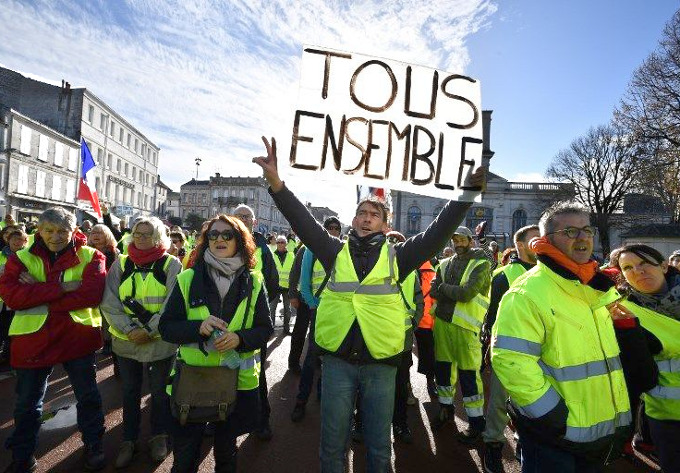

Is the Yellow Vest rebellion, now in its seventh week, “petering out?” Such was the near-unanimous pronouncement of the mainstream media, when I returned home to Montpellier, France, eager to participate and to observe first-hand this popular insurrection which I had been afraid of missing.

I needn’t have worried. By nine o’clock last Saturday morning (Dec. 22), hundreds of Yellow Vest demonstrators were gathering for a peaceful march to the Préfecture (local seat of government) chanting “We’re not tired” and carrying placards reading “We are not casseurs (vandals) or pyromaniacs. Peaceful” (see video[2]) The mood was bon enfant (“jolly”) with demonstrators en famille including the children and old folks in wheelchairs. Marching ten abreast, they filled the rue de la Loge, but when they arrived at the Préfecture, the police, apparently taunted by some radicals in the crowd, let loose with teargas, injuring children (see video[3]). Then all hell broke loose and continued all day, with marches, countermarches and gas in the air. 

This indiscriminate use of gas was typical of the government’s tactic of preventing mass peaceful demonstrations by provoking violence and spreading fear. For example, “black block” casseurs and rock throwers have been identified as under-cover policemen by eyewitness and on videos. This was apparently the case last Saturday at the Montpellier Préfecture. (See video[4])

Meanwhile, my wife and I were out with the Yellow Vests at the main roundabout into Montpellier, where two thirds of the passing drivers were displaying yellow vests, giving the high-sign, or honking their approval. So much for the Yellow Vests decline in popularity. The sign we were handed shows the word “Republic” crossed out and replaced by “Direct Democracy. The Divorce is Consummated.”  Then: “Inform yourselves by Internet. 99% media owned by billionaires.” (see attached photo). At the same time, we were getting regular cellphone reports from downtown of tear-gassing continuing all day, capped by the triumphal arrival of more than 80 Yellow Vest motorcyclists who took over the main square as evening fell[R1] .

Similar actions, on a larger scale, were taking place in Paris, where, in a successful ruse, the Yellow Vest Facebook page convinced the police that they were going to attack the royal chateau out at Versailles, where hundreds CRS riot police were moved. In fact, the Yellow Vests organized a last-minuet, fast-moving wildcat march that began in Montmartre, snaked through the capital ahead of the police, and was only stopped at Macron’s Elysée Palace, heavily invested by the “forces of order.” At the very same time, the National Assembly in Paris was hastily approving a “Yellow Vest Law” designed to recognize their protesters’ grievances and embarrass President Macron, a number of whose party members voted with the majority. A measure of the President’s popularity.

Smaller Numbers                

To be sure, the Yellow Vest demonstrations in Paris and the provinces yesterday and last Saturday (Dec. 15) were smaller than the previous four Saturdays. The reasons for this decline are obvious: 1. Massive police violence  2. The concessions already won from President Macron (who had vowed never to make any), 3.The shocking Dec. 11 terrorist killings in Strasbourg,  4. The pro-government bias of the media, and 5. Winter vacation (sacred in France). So I’m not sure this decline in numbers means the movement is “petering out” – as the talking heads in mainstream media keep proclaiming with undisguised relief.

In any case, one thing is certain. The French establishment, non-plussed by an incomprehensible leaderless movement which refuses to be coopted back into the system, has reacted crudely with an onslaught of violence and lies. Although partly successful, these repressive tactics have also backfired in a serious way, depriving the French political class, already weak and divided, of its legitimacy and threatening its hegemony. Let’s take a closer look at this campaign of state repression and establishment propaganda.

Violence

The unprecedented violence unleashed by the “forces of order” over the previous five Saturday gatherings, invisible in the mainstream media, has been taking its toll on activists, as videos of police brutality and hideous injuries circulate on YouTube, on alternative new sites like Médiapart,and through the Yellow Vest Facebook pages.

These new tactics, officially named PROJECT FEAR, were explicitly designed to intimidate. So are the harsh sentences imposed on Yellow Vest demonstrators arrested as casseurs (vandals) for as little as possessing bike helmets, gas masks, and ski goggles considered “evidence” of “conspiracy” and “intention to attack the forces of order.” These items are now so common, that the local Bricorama (“Home Depot”) strategically displays ski goggles right next to yellow emergency vests, yet such demonstrators are routinely herded straight from the street into Room 24, a 24-hour emergency courtroom where they are sent to jail after summary trials.

From the very beginning of the movement on Nov. 27, Yellow Vests have been systematically repressed by the government through massive use of tear gas, flash bombs, pepper spray, water canons and police truncheons. In a report published on Friday, Human Rights Watch said that France’s “crowd-control methods maim people,” pointing to cases where protesters were wounded by rubber projectiles and tear gas grenades. At the same time, the mainstream media systematically played up vandalism against property (windows broken, cars burned) during demonstrations – while failing to expose indiscriminate police brutality and the many serious injuries including the murder of an 80 year old Arab woman hit in the head with a flashball while attempting to shutter her balcony windows. Here are some gruesome videos which you may not want to look at showing what happens when police are licensed to deliberately aim their flashball and gas grenades at people’s faces.[5]

Given the demographics of the more than 3,000 people arrested thus far, few fit the stereotype of young, black-clad casseurs (vandals) and fascists, whom the government and media blame for the violence. Many of them, provincials, had in fact come out to protest (and gone to Paris) for the first time in their lives. The Yellow Vests I have seen here in Montpellier appeared mostly middle-aged. They, and their Parisian counterparts, don’t look a bit like the typical black block “anarchists” who are visible on countless videos and who somehow never seem to get arrested – although some have been filmed climbing aboard police vehicles.

This contradiction might be one explanation for why, despite all attempts to castigate them as “perpetrators of unacceptable violence,” the government’s and media’s ongoing rhetoric about security has been quite ineffective.[6] Indeed, it has mainly succeeded in de-legitimizing their authors.[7] The contrast between official reports and those of eyewitnesses and videos on Facebook is too glaring. The narrative is always about demonstrators violently “attacking police,” however not a single injured policeman has been seen on T.V.

Having seen French CRS riot squad Robocops from close up, it seems to me demonstrators fighting with them (like we did with their ill-equipped predecessor in ’68) would be like ragged peasants with clubs going up against knights in full armor.
Macron’s militarized state over-reaction to a mass political demonstration breaks with a long tradition of tolerance for muscled demonstrations by rowdy angry farmers and militant labor unions. A tolerance Macron, in speeches, has blamed for the failure of previous governments to pass needed pro-business counter-reforms.

Lies: the Monarch Addresses his People

On Monday evening Dec. 10, after a month of silence in the face of massive rejection of his neo-liberal policies and arrogant, condescending personality, Macron finally went on TV with a lame pre-recorded speech combining threats and concessions. The “Jupiterian” President began by blaming all the violence on the protesters (“we have all seen them attacking the police”) and threatening them with severe punishment (“no indulgence”) if they persist. For the Yellow Vests, this was throwing gasoline on the fire, as everyone who had participated in the protests or had seen the horrendous videos of the systematic police mayhem deliberately unleashed by Macron knew he was lying.

“The President of the rich” then went on to admit that the protesters may have had a legitimate point. “We” (the royal “we”?) “may have forgotten the single mother struggling to make ends meet” and the other little people. Macron then condescended to propose “a national conversation, which I will coordinate,” including even local mayors, about the social/economic crisis. He also made few economic concessions.

These included rescinding his new taxes on social security retirement for some retirees with very low incomes, elimination of taxes on paid overtime, a call on businesses to voluntarily give a year-end bonus to their employees, and a year-end 100€ ( $115) raise in the minimum wage.

On closer examination by the Yellow Vests, this “raise” turned out to be “smoke and mirrors.” First, it applied to only some low-wage workers. Second, it was not really a raise in the hourly wage, but in fact a government bonus to encourage “active” workers, which did not include benefits and was to be paid for out of the workers’ taxes, essential moving money from one pocket to another. “Don’t give us words, give us figures” one Yellow Vest told me, infuriated at being taken for a fool (con).

In his address, the monarchical President pointedly refused to pronounce the words “Yellow Vests” and “ecology” or to re-establish the Tax on Great Fortunes to pay for these concessions. Macron’s offer of crumbs from the table of the rich was immediately rejected as “too little, too late’ by the Yellow Vests, who continued calling for Macron’s resignation and a bottom-up reorganization of French democracy.


The Strasbourg Killings

Concerning Macron’s speech to the nation, Susan Ram suggests that “two elements merit particular concern. Firstly, his inclusion of the phrase “laïcité bousculée” (‘secularism buffeted or overturned’) in his analysis of the ills of current French society. Secondly, his reference to the ‘profound identity’ of the nation and the need, in this context, to ‘tackle’ the question of immigration. Both comments seem suggestive of an effort to inject racist and xenophobic themes into the Yellow Vest movement, the better to divide it while simultaneously making it appear that the state is listening to right-wing grievances. Indeed, from the beginning the Yellow Vests,  given their origins in la France Profonde  (middle France) have been smeared by the media (and rejected by much of the Left) as right-wing and racist, despite videos showing them forcefully ejecting members of LePen’s National Front from their march.

Events in Strasbourg just a day after Macron’s opened up further opportunities for divisive propaganda. As Ram continues: “The killing of four people, and injuring of a dozen or so others, by a lone radicalized Islamist gunman at the city’s popular Christmas market predictably became grist to state efforts to undermine and divide the Yellow Vest uprising. A sequence of senior government ministers and regional officials called on protestors to call a halt, optimistically invoking the ‘exhaustion’ of the security forces as an argument likely to melt the hearts of Yellow Vestssubjected to baton charges, tear gas, rubber bullets and more. The education minister, Jean-Michel Blanquer, expressed his horror at “vile” social media posts suggesting the government had exaggerated (or worse) the Strasbourg attack in order to deflect attention away from the protest movement. On cue, the mainstream media plunged into a smear-the-protestors feeding frenzy.”[8]

The Winter Holidays

Workaholic U.S. readers may have difficulty taking in the seriousness of holidays in this country, which mandates five full weeks of vacation per year, where family ties remain strong enough so that children are routinely sent to their grandparents for the Winter holiday, where train reservations are all booked up months in advance and where no place is farther than four hours from Paris.

The first paid vacations were won by the French workers at the end of the 1936 national wave of sit-in strikes, and newsreels of the departures that August of Parisian worker families who had never seen the sea are part of the national narrative.[9] Impending summer vacations were also partly responsible for the eventual collapse of the inspiring May-June 1968 student-worker rebellion. The French police have taken advantage of this factor forcibly remove the makeshift shelters and barbeques that had been a convivial feature of the Yellow Vest presence at roundabouts and toll-booths. Yet there were still a few Yellow Vests at the main roundabout here in Montpellier on Christmas eve, and a downtown rally announced for this Saturday, Dec. 29, came off peacefully, although there was gas elsewhere.[10] Meanwhile, Yellow Vests descended onto the tracks at the Montpellier railroad station and blocked trains. (See video.[11])

Why France’s ‘Silent Majority’ Is Mad as Hell

Like all the spontaneous mass uprisings that dot French history going back to Feudal times, the Yellow Vest revolt was initially provoked by unfair taxes. Spurning all established political parties, and unions, the Yellow Vests got organized on social media and acted locally. The broadcast media, although highly critical, spread the news nationally, and the movement spread across France, blocking intersections, filtering motorists, allowing free passage at highway tollbooths, and gathering to demonstrate, more and more numerous and militant, on successive Saturdays.

Why Saturdays? “I can’t go on strike,” explains one woman.  “I’m raising three kids alone. My job, that’s all I have left. Coming on Saturdays is the only way for me to show my anger.” Women – receptionists, hostesses, nurses-aids, teachers – are present in unusually large numbers in these crowds, and they are angry about a lot more than the tax on Diesel. Like Trump, Macron has showered corporations and millionaires with huge tax cuts, creating a hole in the budget which he has compensated by cuts in public services (hospitals, schools, transit, police) and by tax increases for ordinary people (up to 40% of their income), large numbers of whom are struggling hard to make ends meet and going into debt. 

This anger has been building since last Spring, the 50thanniversary of the 1968 worker-student uprising, but was frustrated when Macron won the stand-off with labor over his neo-liberal, pro-business counter-reforms. This labor defeat was facilitated by the leadership of the CGT and other unions, who played the same negative role in the 1968 sell-out to de Gaulle.[12] Although workers have been active in the Although workers have been active in the Yellow Vest movement, which fights for traditional labor goals like higher minimum wage, public services, etc. the French labor leaders have shunned them as petty-bourgeois potential fascists. These union bureaucrats see the Yellow Vests, accurately, as competitors and a threat to their own hegemonic status as official representatives of the workers, especially after Macron’s “concessions.”

On Dec. 6, in direct response to an appeal for calm from Macron, the leaders of the CGT and all the other labor federations except for Solidaritésigned a Déclaration of solidarity – not with the injured and arrested demonstrators, but with the Macron government as the representative of the peaceful republican order![13] In return for what many have described as a “betrayal,” these professional negotiators accepted Macron’s invitation to “resume the social dialogue” – that is to sit at the table with him and negotiate more “give backs” of workers’ rights.  The next day, contradicting themselves, the CGT’s Martinez and the other union leaders called for a national labor demonstration on Fri. Dec 14 covering the same basic economic demands as the Yellow Vests but not on the same day, Saturday Dec 15.

Needless to say, only a few stalwarts came out for Martinez’ much touted demonstration. Yet clearly, only with the active participation of France’s organized workers can this broad popular movement succeed – for example through a general strike – in bringing the capitalist class to its knees and founding a new social order.

What Next?

So apparently the Yellow Vest movement is not exactly “petering out.” After six weeks of daily roadblocks and disruptions in every corner of France, and after six (now seven) successive mass demonstrations of hundreds of thousands in Paris and the provinces, violently repressed, this spontaneous, self-organized rebellion, coordinated via social media, is still seriously challenging the political and economic order in France.

Not only has this rebellion persisted despite unprecedented police brutality, media misrepresentation, and rejection by labor union officials, it has retained its grass-roots popularity  and deepened its goals – from an initial rejection of a tax increase on Diesel fuel to explicit rejection of the established political/economic system and to near-unanimous call for the resignation of Macron and the creation of a new kind of democracy via referendum or constitutional convention.

Moreover, the French students have joined the uprising, protesting Macron’s introduction of anti-democratic selection in college admissions,
with 170 high schools disrupted in answer to the “Black Tuesday” appeal by their union. There has also been a revival of strikes and protests among civil servants, nurses and educators, all inspired by the Yellow Vests’ success in wringing concessions from Macron, whose onslaught of pro-business, neo-liberal counter-reforms organized labor, hamstrung by its collaborationist leaders, failed to stop last Spring. The apparent rift with the ecological movement has been breached as demonstrations from the two movements combined in action under the slogan “End of the Month/End of the World: Same Cause/Same Enemy.” Likewise, marchers from the feminist “End Violence Against Women” have been honored and welcome by the Yellow Vests.

Meanwhile, the epidemic of Yellow Vest inspired revolts has spread to Belgium, Great Britain, Portugal, Holland, Hungary, Iraq, Lebanon, Egypt and beyond,[14] recalling the Internet-propagated contagion  of the 2011 Arab Spring and “Occupy” movements and even provoking the Egyptian military government to ban the sale of yellow emergency vests. But the numbers are smaller. See video of German Amazon workers wearing yellow vests during their annual Christmas attempt to strike and disrupt the company’s profits during the busiest time of the year in an international effort that includes Polish Amazon workers.[15]  

Clearly, to achieve ultimate success this spontaneous, self-organized, uprising of the 99% against the 1%  will have to unite internationally as well as to  continue to deepen itself, to grow and to mutate – like similar popular movements in the history of France from the Jacqueries of the Middle Age through the Sans-culottes of 1789, the social-republicans of 1848, the Communards of 1871. Armed with social media on which to coordinate mass actions and to debate goals and methods from the local to the national and international levels, there is no technical reason why this self-organized insurrection cannot surpass the uncoordinated movements of 2011 and take root everywhere. So far, as far as France is concerned, the missing political elements are the full participation of the industrial working class and of the North African and African immigrant population, which have not yet showed up en masse.

Only the future will tell how far this movement will go, but already its achievements are impressive and permanent. 1. The Yellow Vests have succeeded in unmasking and discrediting Macron, the neo-liberal wunderkind who was supposed to Thatcherize France and is now so hated that the remaining years of his mandate are in question.
2. The Yellow Vests have also unmasked and discredited the mass media, particularly television networks, which had supposedly hypnotized the ignorant masses who now see them as corrupt, overpaid propagandists for the billionaire class. 3. The Yellow Vests have also succeeded – wonder of wonders! – in unmasking and discrediting the hegemonic myth of representative “democracy” with its unrepresentative “political class” of professional politicians of right left and center. These genies can never again be put back in the bottle.

Amazing achievements for a movement that is only seven weeks old and still growing. The hegemony of the French ruling classes is hanging by slender threads of increasingly counter-productive violence and lies. The French popular masses, already famous for their anger and cynicism, are furious at being taken for fools by their betters and joyful at feeling their own strength and solidarity. No one knows where all this will end.


[1] Richard Greeman was an activist in Paris in the late ‘fifties and a member of the legendary revolutionary group Socialisme ou Barbarie, with Castoriadis and Lyotard. He is based in Montpellier and is best known for his translations of the Franco-Russian novelist and revolutionary, Victor Serge.
[7] This unacknowledged “invisible” violence reminds me of the Nixon’s “secret bombing” of Cambodia, which was of course no secret to the Cambodians, and when finally revealed, provoked the nation-wide student strike of 1971 After U.S. troops killed protesters on the campuses of Kent State and Jackson State universities..
[9] Unfortunately, while the workers were at the beach that memorable Summer, the Popular Front government took away many of the advantages they had won, acquiesed in Franco’s right-wing coup in Spain and Stalin’s blood-purge of Lenin’s closest comrades. As Victor Serge, disparing at any possibility of policial action, lamented at the time: “Vacation is sacred.”
[10] https://www.facebook.com/lagazettedemontpellier/videos/2314803012073979/ There was no teargas. On the other hand, two Saturdays ago in Toulouse, where the Yellow Vest movement is small, the CRS riot police invaded the main square, where the annual Christmas Market was being held and most Yellow Vests were sitting outside at cafés when a few hundred peaceful marches with signs. The cops, under orders, innundated the whole square with tear gas, thus spoiling the businesses of the restaurants and the Christmas Markets on one of the must lucrative days of the year – all so as to blame it on the Yellow Vests.That kind of bullshit doesn’t fly in France, where people resent being taken for fools (cons). What will happen in Montpellier on the last Saturday of the Christmas Market?
[12] Please see my « French Labor’s Historical Defeat » https://www.laprogressive.com/teacher-strikes/

Wednesday, May 27, 2015

1857. Spanish Elections: Understanding Podemos

By Pablo Iglesias, New Left Review, May-June 2015


Introduction: As emergency policies have hardened into a new political order, Europe’s two-party system has come under increasing strain. The discredited centre lefts of the Socialist International have been deserted by their core electorates, who have shifted both to the right and to the left. For the most part, popular anger has found expression through existing anti-establishment parties: UKIP and the Front National in England and France, the SNP and Sinn Féin in Scotland and Ireland, Syriza in Greece. In Italy and Spain, however, anti-austerity parties have been set up from scratch—the first mass-based left parties to be founded anywhere since the Brazilian PT in 1982. In Greece, Troika management has forced the Syriza government to confront the German-led Eurozone regime head-on; for Spain’s Podemos and Italy’s Five Star Movement, the principal target is still the national system and its ruling order, which both call ‘the Caste’. Unlike the Five Stars, however, Podemos has a mass protest movement behind it: the May 2011 indignado occupations and the two years of direct action against evictions and cuts that followed. In generation and formation, too, the leaderships are quite distinct. The core group of Complutense University lecturers who founded Podemos in 2014 are thirty years younger than M5S’s directors. Intellectuals and publicists, they were radicalized in the nineties, amid swirling currents of Negrian political theory and alter-globalism; their presentational skills were first honed on community TV. The hands-on confidence gained working with radical governments in Bolivia, Ecuador or Venezuela helps explain the audacity of their bid to mobilize the discontent of the indignados in a national political project. Pablo Iglesias, Podemos general secretary, was born into a leftist madrileño family in 1978, and cut his teeth as a schoolboy activist in the PCE. Iglesias read law, then politics and film studies; moving from post-autonomism—his doctoral dissertation was Multitude and Collective Post-National Action—to Gramscian cultural criticism: Machiavelli before the Big Screen (2013) offers readings of A Few Good Men, Dogville, Katyn´, Ispansi, Amores Perros and Kubrick’s Lolita through the lenses of Gramsci, Said, Agamben, Wallerstein, Brecht, Harvey, Butler. Disputar la Democracia (2014) was a tightly written manifesto excoriating the corruption of Spain’s political order as consubstantial with a development model based on real-estate speculation. On the eve of the May 2015 Spanish regional elections, Iglesias sets out the strategic thinking behind Podemos and, below, responds to NLR’s questions about the project.

*     *     *

The explosion of the 2008 financial crisis has produced a series of unforeseen political consequences, in Europe in particular. How can the forces of the radical left best respond to this unprecedented challenge? The aim here is to explain the analysis that has informed Podemos’s political strategy in Spain: who we are, where we’re coming from and where we want to go—the fullest reflection on these questions that I’ve been able to set down since being elected leader of Podemos last November. It’s also an opportunity to speak in my own voice, outside the format of mainstream media interviews. Of my combined roles as party General Secretary and political scientist and theorist, the first would not have been possible without the second. This is one of the defining characteristics of Podemos.


Faced with the unprecedented political situation created by the Eurozone crisis, our starting-point was a recognition of the twentieth-century left’s defeat, already registered by NLR. [1] Hobsbawm’s ‘short century’, from the Bolshevik Revolution to the fall of the Berlin Wall, saw the horrors of fascism, war and colonial violence, but was also an age of hope and social progress. After 1945, social programmes in the advanced-capitalist countries brought a limited redistribution of wealth and higher living standards for major sectors of the working class, especially where trade unions were strong. The Russian and Chinese revolutions proved incapable of combining economic redistribution with democracy, but produced undeniable advances in modernization and industrialization; Soviet military strength, primarily responsible for the defeat of Nazism, was also proof of economic development. In the post-war period, the USSR represented a real counter-weight to US interventionism. If the Cold War generated Eastern-bloc satellite states devoid of any real sovereignty, it also opened up space for anti-colonial movements to defy US hegemony, and helped to buttress welfare states and the extension of social rights in the West.

From the 1970s, Washington and the other Western powers wagered on a new set of policies to address the gathering problems of their economies: beating back trade unions, empowering financial sectors, privatizing public assets and accelerating the relocation of production to low-wage zones, along with the establishment of the fiat-dollar system. The fall of the Soviet bloc was an enormous boost for the Washington Consensus, but also for the preponderance of finance capital within the European Union. This took constitutional form in the Maastricht Treaty, whereby member states agreed to surrender monetary sovereignty to an ‘independent’ European Central Bank. The convergence criteria and Stability Pact hedging the new single currency signalled the growing hegemony of a united Germany within the European project; national macro-economic policies were restricted to reducing public spending, imposing wage restraint and promoting privatization—or emigration. Many of the struggles of the past decades in Europe can be seen as defensive stands against the ongoing attrition of national sovereignty. In this context of defeat for the existing lefts, critical thought was largely separated from political praxis—in stark contrast to the organic links between theoretical production and revolutionary strategy that characterized the early twentieth century. It became the work of professionalized university teachers, rather than radical political leaders. Indeed the themes of contemporary critical thinking are intimately related to historical defeat.

Nevertheless, despite the narrowing of political possibilities due to the hollowing of state sovereignty, the past fifteen years have seen the emergence of new adversaries for neoliberalism, not just in the form of social movements but also at state level. In Latin America, in conditions of severe economic and political crisis, popular and progressive formations won electoral victories which they transformed into projects for the recuperation of sovereignty, both in national and regional terms. While the context that produced these processes differed in numerous respects—economic, social and cultural structures, strength of the state, geopolitical situation—from that of Europe, let alone the US, there was one similarity. Latin America too had seen the historic defeat of the old left in the disastrous years of the seventies and eighties. The emergence of these new forces was a reminder that politics, as a stage for struggles in constantly shifting conditions, never comes to a halt, however hard the conditions in which it operates.

Even without the threat of the old spectre, the world order has entered into a period of geopolitical transition over the past fifteen years, an expression in part of the displacement of the industrial balance between the North Atlantic and East Asia. Washington’s unilateral predominance has been qualified, at least, by the emergence of great powers, old and new, whose interests may not easily be subsumed into those of the US. Deng Xiaoping’s reforms demonstrated the viability of a state-planned ultra-capitalism, converting the land of the Cultural Revolution into the world’s foremost productive zone and a powerful international actor. In the ‘pivot region’ of Eurasia, Putin’s semi-democratic Russia continues to demonstrate that Moscow is back on the world stage.

Faultlines
The 2008 crisis has now produced unexpected new political openings, in southern Europe in particular, in forms that few could have predicted. State bailouts for bankrupt financial institutions led to ballooning national debts and soaring interest-rate spreads. The emergency policies to ‘save the euro’ imposed—and soon normalized—by the German-led bloc have had disastrous effects in Portugal, Ireland, Italy, Greece and Spain, where millions have lost their jobs, tens of thousands have been evicted from their homes and the dismantling and privatization of public-health and education systems has sharply accelerated, as the debt burden was shifted from banks to citizens. The EU has been split along north–south lines, a division of labour that mandates a low-wage workforce and cheap goods and services for the Mediterranean countries, while the young and better-trained are forced to migrate. The 2014–20 EU budget represents a victory for this line.
Not so long ago, Spain was being hailed as an EU economic success story thanks to a development model based on real-estate bubbles and corrupt urban projects, overseen since the post-Franco Transition by the Partido Socialista Obrero Espãnol (PSOE) and Partido Popular (PP). Now, along with the other PIIGS, it is being forced to surrender historic social rights through austerity policies that Germany and its northern allies would never impose at home. But the crisis itself has helped to forge new political forces, most notably Syriza in Greece—which finally has a sovereign government, defending a social Europe—as well as Podemos in Spain, opening up the possibility of real political change and the recuperation of social rights. Clearly in present conditions this has nothing to do with revolution, or a transition to socialism, in the historic sense of those terms. But it does become feasible to aim at sovereign processes that would limit the power of finance, spur the transformation of production, ensure a wider redistribution of wealth and push for a more democratic configuration of European institutions.

Regime crisis?
But what type of crisis is roiling Spain? In Gramsci’s classic definition, hegemony is the power of the leading elites to convince subaltern groups that they share the same interests, including them within a general consensus, albeit in a subordinate role. Loss of that hegemony creates an organic crisis, which can manifest itself in the failure of the ruling institutions—including the mainstream political parties—to preserve and renew their legitimacy. In Spain, as in other Eurozone countries, the economic meltdown and the measures imposed to ‘save the single currency’ raised the spectre of an organic crisis, which led in political terms to what we call a regime crisis: that is, the exhaustion of the political and social system that emerged from the post-Franco transition. The principal social expression of this regime crisis was the 15-M movement, the vast indignado mobilization which, starting on 15 May 2011, occupied city squares across Spain for weeks on end. Its principal political expression has been Podemos.

Spain’s post-1975 transition transformed Francoism into a liberal-democratic system, comparable to that of most Western countries. Crucially, it left the Francoist economic elites untouched and helped to recycle a good part of the political and administrative leadership, who retained their positions within the state apparatus even after the landslide election victory of the PSOE in 1982. A ‘spirit of consensus’ governed not only the Francoist reformers, led by Adolfo Suárez, but also the democratic opposition—the Spanish Communist Party (PCE), mainstay of underground resistance to the dictatorship, and PSOE, initially much smaller. With unstinting support from the mainstream media, above all the Prisa group’s influential new daily El País, this consensus was embodied in the 1977 Moncloa Pacts, tying the unions to wage restraint in exchange for social benefits. It was translated into juridical norms by the 1978 Constitution, affirmed by referendum, which gave its name to the ‘78 Regime’. Little by little, despite the resistance of well-established Catalan and Basque nationalist parties and certain sectors of the left, this consensus gained the support of a majority of the Spanish population. Enshrined in a ‘constitutional monarchy’ under Franco’s handpicked successor, Juan Carlos I, the new arrangements guaranteed Spain’s accession to NATO and the European Community, at little cost to the economic elite.

The PCE’s poor results in the 1978 election did not alter their possibilist tactics, following the same ‘pragmatic’ Euro-communist line, with the same conservative style, as the French and Italian parties. At the height of the debate on Euro-communism, its meagre electoral returns and the dismantling of the social movement, Manuel Sacristán—perhaps Spanish Marxism’s best mind—referred to the historic defeat of the workers’ movement and the left within a new socioeconomic context dominated by consumerism, the growing influence of the mass media and an international situation that imposed strict limits on any meaningful transformation in Southern Europe. [2] The lesson drawn was not only the impossibility of socialism and revolution—seen from the present, it is quite moving that there were political leaders in Spain who believed in the viability of these projects—but the impossibility of quite moderate schemes of social amelioration, deemed electorally unworkable in the context of rising neoliberal hegemony. ‘In the meantime’, what had to be done, according to Sacristán, was to undertake micro-level political action, outside the state, in the environmental, peace and feminist movements, building alternative forms of daily life. For electoral purposes, the PCE formed a broader alliance in 1986, Izquierda Unida. For the Spanish left, it seemed, there were no better options.

After 2011
Today, as a result of the Eurozone débâcle, we are no longer living ‘in the meantime’ but in a full-blown regime crisis—a situation in which it may be possible to alter the parameters of Spanish politics in a way that hasn’t happened since the post-Franco Transition. It should be stressed that this is not a state crisis, a collapse of the administrative apparatus, as was beginning to unfold in Bolivia and Ecuador before Morales and Correa were swept into office in 2006. State institutions in Spain, however impoverished and sapped by corruption, still fulfil their functions—which go far beyond the monopoly of force—providing the regulatory mechanisms for social existence, as well as generating loyalty and security for the ruling order. Yet the indisputable failure of austerity policies in Spain has helped trigger a regime crisis, which has opened—for how long, we don’t know—an unprecedented set of political opportunities. The frustration of expectations among important sectors of the middle classes and the salariat, as a result of the ‘structural reforms’, is one of the most decisive factors for understanding the political possibilities of the present.

The 15-M movement served as a safety valve for these frustrations. The fact that it found no electoral expression demonstrated that the hegemonic crisis brought to the fore by this upsurge, which surprised the world, was also a crisis of the existing Spanish left. The 15-M held up a mirror to the left, revealing its deficiencies. It also put on the table the main component of a new common sense: rejection of the dominant political and economic elites, systematically signalled as corrupt. The 15-M also crystallized a new culture of contestation that could not be grasped by the categories of left and right—something that the leaders of the existing left refused to acknowledge from the start. The logic of the 15-M movement led to its exhaustion; it didn’t achieve the effects desired by its committed activists, who hoped that the social could substitute for the institutional. Aiming to reduce politics to the mere expression of countervailing social powers, built through mobilization and patient activism, was one of the major blunders of the movementist intelligentsia in Spain, which failed to realize that the ‘in the meantime’ was precisely that: a way of working up until the arrival of the moment for audacity, which would require quite different political techniques.

The defeats suffered by PSOE in the 2011 regional and national elections that followed 15-M were of a historic severity; it lost nearly 40 per cent of its 2008 vote. The immediate result was that the PP swept into a series of regional governments and won an absolute majority in the Cortes. But from that moment on, one could feel the shifts taking place within the party system. It was clear from the polls that both the governing PP and PSOE were losing electoral support, while Izquierda Unida and the small liberal parties—Ciudadanos, founded in Catalonia in 2006, and Unión Progreso y Democracia (UPyD), set up in 2007—were doing better. In this new conjuncture, IU had the opportunity to draw up a more audacious—or at least, less timid—strategy than the one it was pursuing. It would have been enough to follow the example of the Left Alternative in Galicia (AGE), an alliance of IU, Anova—a left-nationalist Galician party—ecologists and others. A move of this sort at a national level could have allowed IU to give electoral representation to the seething social discontent, but it didn’t seize the chance.

In Catalonia, meanwhile, it was obvious that Convergència i Unió, the hegemonic conservative-nationalist party, was losing ground to its mildly social-democratic counterpart, Esquerra Republicana de Catalunya, which was aiming to become the main party within the pro-independence process—clearly the backbone of social discontent at the time. In the Basque Country and Navarra, the return of the abertzale left to the electoral arena was threatening the hegemony of the Basque Nationalist Party in Euskadi and even that of the conservative Unión del Pueblo Navarro.

If we add to these trends the irruption of Podemos, its results in the May 2014 European elections and subsequent trajectory in the polls, the Spanish two-party model would seem to be in trouble. The unceasing offensive against Podemos, conducted with a virulence unprecedented for Spain, reveals the extent to which we are seen as a real threat to the dynastic parties’ system. It’s obvious that the game has only just begun. In the months ahead we’ll face tough challenges, starting with the 24 May regional elections. But it also seems clear that, beyond the immediate outcomes at the ballot box, there are signs of irreversibility in this regime crisis. Spanish politics will not return to how things were before Podemos.

The Podemos hypothesis
Assuming that, under determinant conditions, it is possible to generate discursively a popular identity that can be politicized along electoral lines, then in Spain, in the context of the incipient regime crisis produced by the Eurozone disaster, those conditions seemed to be met. The task, then, was to aggregate the new demands generated by the crisis around a mediatic leadership, capable of dichotomizing the political space. Given these factors, our hypothesis is not difficult to understand. In Spain, the spectre of an organic crisis was generating the conditions for the articulation of a dichotomizing discourse, capable of building the 15-M’s new ideological constructs into a popular subject, in opposition to the elites.

For the founders of Podemos, this was not a novel hypothesis; we had begun to sketch it out in our initial reflections on the 15-M movement. Our thinking drew on a particular set of political experiences—Latin America’s ‘gained decade’—and a specific model for political communication: our television programme, La Tuerka [The Screw]. Analysis of the developments in Latin America offered us new theoretical tools for interpreting the reality of the Spanish crisis, within the context of the Eurozone periphery; from 2011, we began to talk about the ‘latinamericanization’ of Southern Europe as opening a new structure of political opportunity. This populist possibility was theorized most specifically by Íñigo Errejón, drawing on the work of Ernesto Laclau.

The second key to this hypothesis was La Tuerka. From the start, within our modest means, we understood La Tuerka as a ‘party’. People no longer engage politically through parties, we thought, but through the media. La Tuerka and our second programme, Fort Apache, were the ‘parties’ through which we would wage our political struggle on the most fundamental terrain of ideological production: television. La Tuerka became our preparatory school, teaching us how to intervene most effectively on mainstream television talk shows. It also trained us for the consultancy work in political communication that we developed, which in turn gave us experience in planning electoral campaigns and advising spokespeople and political leaders. Thanks to La Tuerka and the training it gave us, we learned how to produce television ‘slots’—and how to think politically within the medium of TV.
Our goals at that stage were modest; we never thought we’d get this far. But accomplishing those limited objectives—writing papers, promoting small-scale initiatives, producing and presenting TV programmes, studying audiovisual communication, advising political leaders on media strategy—ensured that we were well prepared for the indispensable ingredient of the Podemos hypothesis: a leadership figure with a high recognition factor in Spain. There was no inevitability about our TV presence, and no guarantee that it would prove effective and enduring. From May 2013, however, I was constantly in the mass media. That summer, we started thinking about the possibility of using my media presence for a national political intervention. At that stage, my view was that such a project could only be carried out in collaboration with the existing left. The proposal we made to the left parties for joint open primaries signalled this orientation. We thought that opening the choice of candidates to the citizens would help to tilt the balance of forces on the political board in our favour: the left would look more like the people.

We saw ourselves as a force for renewal; what we didn’t anticipate was that the coldness, not to say open hostility, with which our proposals were received would enable us to go much farther. The stubborn conservatism of the IU leaders, incapable of taking on other styles or perspectives, and the disdain of some of the activist groups, forced us to start putting our hypothesis into practice in virtual solitude; but that also meant that we were under no obligation to make concessions to the left’s conservatism, or to the paralysing styles of some of the social movements. Paradoxes of history: the enabling conditions of the Podemos phenomenon included the reservations it generated among those theoretically most likely to share our project—thanks to which we could fly higher and more freely.

For the configuration of the political field into a left–right division created a setting in which change, in a progressive direction, was no longer possible in Spain. On the symbolic terrain of left and right, those of us who advocate a post-neoliberal transformation through the state—defending human rights, sovereignty and the link between democracy and redistributive policies—have not the slightest chance of electoral victory. When our adversaries dub us the ‘radical left’ and try, incessantly, to identify us with its symbols, they push us onto terrain where their victory is easier. Our most important political-discursive task was to contest the symbolic structure of positions, to fight for the ‘terms of the conversation’. In politics, those who decide the terms of the contest determine much of its outcome. This has nothing to do with ‘abandoning principles’ or ‘moderation’, but with the assumption that unless we ourselves define the terrain of ideological struggle, it will limit the discursive repertoire at our disposal.

This is only possible in exceptional situations, such as the one we are now in. It demands a specific strategy to identify the frameworks that could define this new setting, as well as the discourse to project it in the mediasphere. When we insist on talking about evictions, corruption and inequality, for example, and resist getting dragged into debates on the form of the state (monarchy or republic), historical memory or prison policy, it doesn’t mean that we don’t have a stance on those issues or that we’ve ‘moderated’ our position. Rather, we assume that, without the machinery of institutional power, it makes no sense at this point to focus on zones of struggle that would alienate us from the majority, who are not ‘on the left’. And without being a majority, it is not possible to get access to the administrative machinery that would allow us to fight these discursive battles in other conditions, while intervening with public policies.

TV Nation
For decades, television has been the central ideological apparatus in our societies. In recent years social networks have opened up new sites of ideological contestation, democratizing access to the public sphere, despite their unequal penetration of different strata. Even if they are still far from competing with TV, they played a key role in our campaign for the European elections and remain one of Podemos’s distinctive features. Television, however, conditions and even helps to manufacture the frameworks through which people think—the mental structures and their associated values—at a much higher level of intensity than the traditional sites of ideological production: family, school, religion. As far as political attitudes and opinions are concerned, in Spain TV talk shows are probably the major producers of arguments explicitly for popular use. Most of the arguments heard in bars or workplaces are generated by ‘opinion-makers’ who appear on TV and radio. Social imaginaries are clearly shaped by apparently non-ideological and apolitical formats, presented as ‘merely’ entertainment—the most important ideological operations are those that give the appearance of being non-ideological to notions that are perceived as common sense. In the context of the crisis, however, as far as specifically political debates are concerned, TV studios have become the real parliaments. Indeed one of the most important manifestations of the crisis was the opening of a new space within television debates, which we could occupy; someone had to represent the ‘victims’ of the crisis. What we said allowed these victims—subaltern layers, above all the impoverished middle classes—to identify themselves as such and to visualize, through the form of a new ‘us’, the ‘them’ of their adversaries: the old elites.

The TV phenomenon of ‘the pony-tailed professor’ might be defined as the most effective occupation of that space, previously attempted by others on the left, either through luck or through practice. In fact this televisual discourse was the result of intense preparation for each intervention. Step by step, an unconventional left-wing talk-show guest became a reference-point for the socio-political discontent caused by the crisis. Converting this reference-point into a candidate was a high-risk strategy; our Euro-election campaign succeeded because we managed to maintain that media presence which, until the last two weeks of the campaign, was basically that of an unusual talk-show guest rather than a candidate or political leader. The main goal of the campaign was to explain that ‘the guy with the pony-tail’ on TV was taking part in the elections. That’s why we opted for something that had never been done before in Spain: using the candidate’s face on the ballot. The ‘People of the Television’—el pueblo de la televisión, or the TV nation, so to speak—didn’t know about a new political party called Podemos, but they knew about the guy with the pony-tail.
This populace, politically socialized through television, was not ‘representable’ within the traditional left–right categories of the political space. In the context of high dissatisfaction with the elites, our objective of identifying a new ‘we’ that included the TV nation initially came together around the signifier ‘Pablo Iglesias’. Before and during the campaign, our work on TV talk shows aimed to introduce new concepts and arguments that would help to define the political battlefield to our advantage. The way in which the notion of ‘the Caste’ was brought to bear—denoting Spain’s political and economic establishment—is perhaps the best example. This new media space, susceptible to politicization, had been in the making for some time, as programme analysis has revealed. The overwhelming popularity of the weekly current-affairs show Salvados and its presenter Jordi Évole can’t be explained solely by the social sensitivity of its topics or by Évole’s progressive stance. The key to its success was its ability to focus on the central issues of social dissatisfaction, creating—whether consciously or not—a new discourse that crossed political boundaries; in Laclau’s terms, it was transversal.

Towards a party
From our launch in January 2014 until the Euro-elections that May, the political leadership of Podemos was constituted by a group of a few dozen cadres, who took on all the usual tasks of a campaign team. Along with a group of lecturers and researchers at the Complutense University of Madrid, this drew on a new generation of militants from Juventud sin Futuro (Youth without a Future), student associations, La Tuerka and other political and social organizations, as well as alternative cultural projects and 15-M. This group formed the initial nucleus of Podemos and ran its initial campaign, focusing on communication—social networks, TV shows, public events, propaganda. A few weeks after the launch, we put out a call for the creation of Podemos Circles, local and sectoral groups which began to flower, establishing our presence throughout the country. But in spite of this extended teamwork, we were far from being a political organization. Podemos was still a citizens’ movement that had sparked tremendous enthusiasm, expressed in the establishment of the Circles, the growing participation at our events, the activity of thousands in the social networks and the possibility that this hope could be translated into votes on 25 May. But we were not yet a political organization.

After the Euro-elections Podemos had five MEPs, although it still lacked a formal political leadership and an organized territorial and sectoral structure across regions, as well as formal mechanisms for decision-making. From the start we wagered on processes that would allow popular participation in the most important decisions; this was how the technical team that organized our founding congress, the November 2014 Citizens’ Assembly, was chosen. At the Assembly, which represented a historic milestone in terms of participation, Podemos converted itself from a citizens’ movement with an electoral project into a political organization with leading bodies, internal systems of control, political and tactical guidelines and a clear goal of organizational efficiency. From that point we started our local and regional construction processes, which have just been completed. In the course of the Assembly we agreed our basic electoral strategy, supporting popular unity candidates in the municipal elections, for which Podemos would not stand independently, while running in the regional elections under our own ‘brand’.

Our Constituent Assembly, and the regional and local processes that followed, established the skeletal structure of a political party, on track for the November 2015 general election. But Podemos’s muscle-tissue, so to speak, reaches well beyond the organization itself, for it has the capacity to link the most advanced sectors of civil society into a broader project of political change, working to include popular movements in a process that cannot be undertaken alone. To be a governing party, Podemos needs the best cadres of civil society; winning elections will require us to safeguard those decision-making links with the broader society through open voting. If anything has made us strong, it is that we haven’t allowed militant nuclei to isolate us from the wishes of society, to hijack an organization that is—over and above the identities of its political leaders, cadres and militants—an instrument for political change in Spain.

Podemos’s March for Change on 31 January this year was not just a historic event in terms of the scale of participation—between 100,000 and 300,000 people—but also in its unconventional character. It was not a protest, nor was it intended to raise a particular set of social demands. The history of the twentieth-century workers’ movement showed that not all strikes needed to be justified by specific labour demands; rather, in decisive moments, a strike can be converted into a political instrument, without representative interfaces or mediations. The March for Change was a specifically political event, linked to the public representation of a social will that takes Podemos as a fundamental instrument for change. Its importance lay not just in the fact that no other political force in Spain had the capacity for a mobilization on this scale. Much more importantly, the March for Change signalled a determination to end the disassociation between mass mobilizations and electoral politics. The old political parties in Spain appear to the citizens as little more than machines for getting access to the state administration by electoral means. In fact the elections that followed the 15-M movement had the feeling of an optical illusion: politicians and parties that were utterly discredited, perceived as the main problem by the citizens, were apparently inescapable, still dominating the realm of formal democracy. The March for Change brought politics back to the streets. If it was not as vast as the March for Dignity of March 2014, which brought together the trade unions and social movements under the slogan ‘Bread, Work, Housing’, it nevertheless demonstrated both the strength of our organizational abilities and the massive support of Spain’s citizens. The sneering response of the old elites to the 15-M movement—telling the demonstrators in the squares that they should run for election—is unlikely to be repeated any time soon. The January 2015 mobilization signalled the start of a new cycle, opening a decisive year for Spain.

Shifting ground
Since the Euro-elections, but particularly since the start of 2015, the establishment attacks on Podemos have been unceasing, far surpassing what’s meted out to the other political forces. This was entirely predictable, proof of how much we alarm the historic power-holders in Spain. The dizzying upsurge of an organization like Podemos in the polls has caused jitters among our opponents. In the first months of 2015, the arguments thrown at us by the propagandists of the PP and the PSOE usually had a boomerang effect, increasing our support and allowing our spokespeople to hit back with notable effect in the mass media. Over the last few months, the techniques and character of these attacks have sharpened, and have slowly become more damaging. We need to assume that our media battles will no longer be conducted in the same advantageous conditions as before and that the attacks will continue, at least until we achieve an institutional footing in the regional and local elections. The latest campaigns against us have shown that we could lose our offensive capacity for putting topics on the political agenda.

The most important challenge facing us is the November general election. It is difficult to predict where we’ll come, but what we need to work towards is a plebiscite that will simplify the political options into a choice between the conservative PP and Podemos. But though it may be possible for us to overtake the PSOE, it is still far from ‘Pasokization’—the complete collapse undergone by the centre-left PASOK, once the most powerful party in Greece but reduced to irrelevance after its pro-austerity coalition with New Democracy. The PSOE still has significant electoral support. It was given a political oxygen cylinder by the Andalusian regional elections in March, even if its result there was largely due to local conditions. Podemos tripled its vote since the Euro-elections, winning 15 seats in Andalusia and 15 per cent of the vote—a good result, but it doesn’t prefigure our overtaking the traditional parties, PP and PSOE. This is why the regional elections on 24 May—above all in Madrid, Valencia and Asturias—and the Catalonian election in September are so important for us.

Our vital goal this year is to overtake PSOE—an essential pre-condition for political change in Spain, even if we don’t manage to outstrip the PP. The hypothesis of the Socialists undertaking a 180-degree turn and rejecting austerity policies, so that we could reach an understanding with them, will only come into play if we effectively outdo them. At that stage, PSOE will either accept the leadership of Podemos or commit political suicide by submitting to that of the PP. The PSOE leadership and the different factions within the party are well aware of this and have been working flat out to minimize our lead. Holding the Andalusian election two months early was a clear attempt by the regional PSOE baroness, Susana Díaz, to make sure that the first test in this decisive electoral year would be held where the Socialists had suffered the least attrition—and they pulled it off.

Another crucial question to be determined in 2015 will be our responsibilities in the post-electoral scene, where Podemos may face the possibility of governing with the support of other parties, or supporting others so they can take office. We may yet see a series of regional-level ‘grand coalitions’ between the PP and PSOE, which would strengthen Podemos’s role as the main opposition, though they would be disastrous for Spain. But for the Socialists this would imply Pasokization and their leaders are likely to explore other options. PSOE will be locked into the contradiction between the logic of the state and its interests as a party, and it is not clear how this will be resolved. The same dilemma awaits Ciudadanos, the white-label party of the elites, promoted as the ‘right-wing Podemos’: it is bound to discuss potential agreements with the PP but knows what a negative impact this would have on its electoral growth.

For Podemos, it will be important to play a part in regional governments after the regional elections and to keep the PP out of office. But most critical of all is to enter the general election in the strongest possible position. Institutional empowerment will offer us safeguards and give us vital experience, but it could also mean we lose our ‘outsider’ advantage. We may face contradictions that could undermine our fundamental objective: going into the general election with the best hope of redefining the political force-field in Spain.

Translated by Fruela Fernández

Notes: 
[1] ‘The only starting-point for a realistic left today is a lucid registration of historical defeat’: Perry Anderson, Renewals, NLR 1, Jan–Feb 2000. Anderson called for a stance of uncompromising realism, refusing any accommodation with the ruling system and rejecting any consoling understatement of its power: pp. 16, 13–14. [This and subsequent footnotes: NLR]

[2] For an alternative view, arguing that a determined alliance between the PCE and PSOE could have extracted a significantly more democratic settlement from the Francoists, especially given the high levels of worker militancy at the time, see the two articles by Patrick Camiller: ‘Spanish Socialism in the Atlantic Order, NLRI/156, March–April 1986, and The Eclipse of Spanish Communism, NLRI/147, Sept–Oct 1984.