Showing posts with label Canada. Show all posts

Sunday, May 8, 2016

2311. The Fires in Canada Look a Lot Like Climate Change--and That Should Scare You

By John D. Sutter, CNN, May 7, 2016
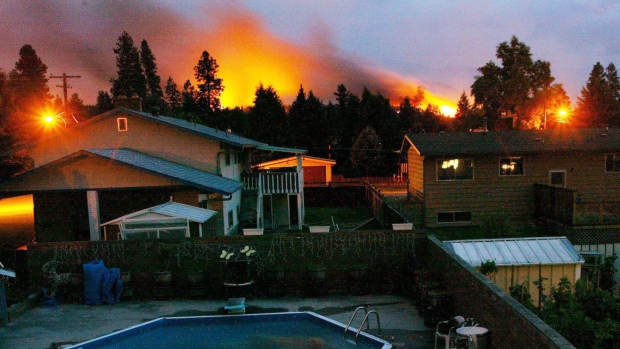
Wildfires in Fort McMurray, Alberta, Canada.


The fire raging in Fort McMurray, Canada sounds like something from the apocalypse.
"It was like driving through hell," Michel Chamberland told CNN of his escape from the area. "Those flames, they were bright, they were big ... It's unreal. It's almost like a dream or something.”

The fire, which has burned at least 325 square miles, forcing the evacuation of some 88,000 people, is so hot and so intense that's it's formed its own weather. The thundercloud produced by the blaze actually is creating its own lightning, and consequently spreading the fire's rage, setting more trees alight.
True, there have been fires in Canada's boreal forest for ages. But scientists and researchers say this fire looks a whole lot like climate change. And that should be alarming for all of us.

"This is an example of what we expect -- and consistent with what we expect for climate change," said Mike Flannigan, a professor of wildland fire at the University of Alberta who's been studying climate change and wildfire for decades. "This fire is unprecedented," he said, referring to its local impact.

It's impossible for scientists to say global warming caused this specific fire, of course, but polluting the atmosphere is creating conditions that make such disasters more likely, bigger and costlier.

"In Canada, our area burned (by wildfire) has more than doubled since thLe early 70s," Flannigan said. "And we've published work that states that this is because of human-caused climate change.

"We also find -- and other researchers in the United States find -- that as the temperature increases we see more fire.”

Hot, dry conditions helped created the perfect conditions for the fire near Fort McMurray. The remote town, which is the gateway to Canada's oil sands region, a hotbed of fossil fuel extraction, saw a high temperature of 91 Fahrenheit on Tuesday. The previous record of 82 degrees was set in 1945, according to government climate data.

Rachel Cleetus, lead economist and climate policy manager for the Union of Concerned Scientists, said climate change is "a significant contributing risk factor" in the Canada wildfires. There are other risk factors, like El Nino and our development patterns. But we can clearly see the climate risk factor because of where [the fire is] playing out geographically.

"We know the northern latitudes are warming faster than anywhere else.”

"You definitely see the fingerprints of climate change," she said.

A ridge in the jet stream, associated with rapid warming in the Arctic, also has helped lock in a high pressure zone over northwest Canada. That likely contributed to the fire conditions, experts said.

Fires only are expected to get bigger and costlier as humans keep pumping heat-trapping gases into the atmosphere, primarily by burning fossil fuels for heat, electricity and transportation. A 2011 report from the U.S. National Academy of Sciences, for example, says certain parts of the American West could see up to a 650% increase in the median area burned by wildfires each year if temperatures rise another 1 degree Celsius. Humans already have warmed the climate about 1 degree Celsius compared with temperatures before the industrial revolution.

To avoid 2 degrees of warming, which world leaders say is the danger zone for climate change, society basically needs to ditch fossil fuels between 2050 and 2100 -- a monumental task but one researchers say is achievable.

Meanwhile, wildfire seasons already are getting longer. In Alberta, the province where Fort McMurray is located, the fire season now officially starts in April, Flannigan said. It used to start in May. "In recent years we've actually had forest fires in December, which doesn't have any historical analog," he told me.

In parts of the western United States, there no longer is a "fire season." The entire year is now fair game.

"Climate change has led to fire seasons that are now on average 78 days longer than in 1970," the U.S. Forest Service said in an August 2015 report. "The U.S. burns twice as many acres as three decades ago and Forest Service scientists believe the acreage burned may double again by mid-century.”

Lightning -- which starts many fires -- also increases with higher atmospheric temperatures.

These consequences are serious and they are increasingly expensive.
We need to grasp where we come into the picture on fires like the one in Canada and plan accordingly. That means better fire management -- including discouraging the growth of towns in fire-prone areas and creating emergency funds to help cash-strapped agencies fight these bigger, badder fires.

It also, crucially, means working to eliminate fossil fuel use as quickly as possible. Climate activists around the world this week are trying to temporarily shut down several coal mines and fossil fuel export terminals. The message of this "Break Free" movement is apt and well-timed: Burning any fossil fuels is dangerous -- these resources must be left in the ground. Our governments should listen. They should adopt carbon taxes as well as invest in public transit and clean energy.

Doing so won't prevent all wildfires, of course. Nature always has had a cruel streak.

But by cleaning up pollution we can make fires like the one in Canada less likely.

"Sometimes it takes a few bloody noses for human behavior to change," said Flannigan, the professor at the University of Alberta. "I was hoping maybe Hurricane Sandy would be a springboard for change. In part, this fire may be a springboard for change -- at least for Canadians.

"As a global citizen who has any concern for their children or their grandchildren we need to take action," he said. "We can't continue on this business as usual [path] without severe repercussions.”

Ones that look a lot like the hellish fire in Canada.

Monday, March 21, 2016

2248. First Nation Rejects a Billion Dollars Offer for a Pipeline Challenging Trudeau's Climate Plan

By Martin Luckas, The Guardian, March 20, 2016
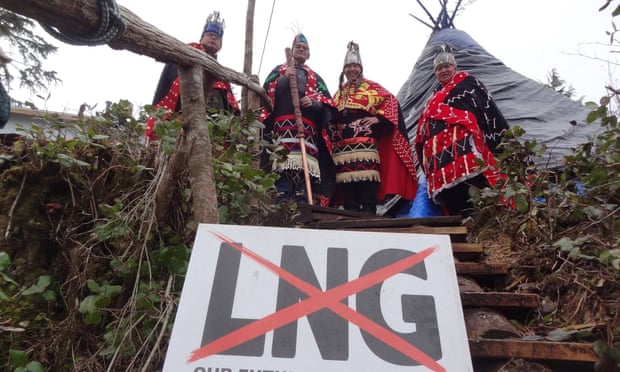
Indigenous leaders gather on Lelu island where the Lax Kw’alaams First Nation has set up camp to protest the construction of the Petronas LNG terminal. Photo: SkeenaWatershed Coalition.
Everything has a price. Everyone can be bought. We assume this principle is endemic to modern life — and that accepting it is most obvious to the impoverished. Except all over the world, people are defying it for a greater cause. That courage may be even more contagious.

It has been in full supply in north-west Canada, where an oil giant is aiming to construct one of country’s biggest fossil fuel developments: a pipeline to ship liquified natural gas (LNG) out of British Colombia. To export it overseas via tankers, Malaysian-owned Petronas must first win approval for a multi-billion dollar terminal on the coast.

That happens to be at the mouth of Canada’s second-largest salmon river, on the traditional territory of the Lax Kw’alaams First Nation. One of the world’s longest un-dammed rivers, the Skeena abounds in the fish relied on by surrounding wildlife — and by First Nations and an entire regional economy.

Last year, following our modern principle, Petronas offered the First Nation an offer they imagined couldn’t be refused: in exchange for their support, a whopping $1.15 billion in cash. But put to a vote, the Lax Kw’alaams resoundingly said “no” — every single community member.

When Petronas made the offer, Lax Kw’alaams hereditary chief Yahaan says he believed the community — poor and with few employment prospects — might vote yes.

“Opportunities like that don’t come to your door every day,” he says. “But I give my people credit for taking that bold step. They showed their love and their passion for the land and water. No amount of money can compare to the richness of the river and what it gives us.”

They knew something even a billion dollars couldn’t persuade them to ignore: that you couldn’t pick a worse place to transform into an industrial landscape. The proposed site for the LNG plant is smack in the middle of a unique estuary, a coastal Mecca for fish: where every year hundreds of millions of young salmon, having travelled down the river after birth, feed and nurture as part of their journey to adulthood.

When the British Columbia government gave Petronas a green-light anyway — ignoring the unanimous ‘no’ vote and the legal duty to consult all impacted First Nations — Yahaan and community members sprung into action. In the summer of 2015 they set up camp on Lelu island, right in the path of Petronas at the mouth of the river. Monitoring the area on boats, they peacefully turned away workers from sensitive sites.

The camp, still up today, is a defence not just of wild salmon and aboriginal rights. Like many such outposts manned by Indigenous peoples across Canada, it is a defence of an entire worldview. On one side stands a government — wedded to an extractivist mentality — that is bent on carving up the province with tens of thousands of fracking wells. It promises an extravagant illusion of 100,000 jobs, which in truth amount to just a few thousand that will vanish as this resource boom, like all others, goes bust. And as Indigenous peoples’ rights have become more powerful, the government and its corporate partners have responded the way they know how: hiking the sums by which to buy them off.

On the other side, the salmon protectors, feeding tens of thousands and supporting a commercial and recreational economy crucial to British Columbians. Promoting an abundance of life instead of threatening to extinguish it. Taking care with the land so that it can take care of people. Getting by on what the earth can continually restore rather than depleting forever what lies beneath.

This is an Indigenous outlook, but one ever more people share. It is in sync with the knowledge that our energy sources must work not against natural cycles but with them — harnessing the power of the sun, water and wind. This can provide jobs in far greater numbers than fossil fuels. And this is the kind of economy we need more of: regenerating naturally, creating enduring local benefits, existing in balance with the natural world. It is, in other words, everything a dirty energy economy is not.

The most dangerous imbalance of all that would be generated by this industrial project, Yahaan says, has only deepened the community’s opposition: its contribution to climate change. Far from clean, emissions from an LNG industry would shatter the provincial government’s emission targets. The Petronas plant and its associated fracking alone could become the country’s largest carbon polluter.

All this means that the courageous resistance of this First Nation has put Prime Minister Justin Trudeau’s climate plan on trial. The new Liberal government — which will have final say on the project — has raised enormous expectations. And raised those of First Nations: as Trudeau has said repeatedly, “governments grant permits, but only communities grant permission.” But as he has mouthed these words, he has pledged to build pipelines and fulfill ex-Prime Minister Stephen Harper’s dream of getting fossil fuels to overseas markets. Trudeau can build LNG up, or bring down emissions: he cannot do both. Will it be on the shores of this beautiful, irreplaceable corner of the world that Trudeau’s contradiction flounders?

The signs so far are mixed. The federal government has said they’ll give the same tax breaks to the LNG industry that Harper was prepared to. On Friday they approved a smaller but controversial LNG project in southern British Columbia. And yet the federal government is clearly feeling the heat of opposition: after tens of thousands of public comments criticizing the Petronas project, a decision that was to come down March 22 has been delayed for three months.

The British Columbia government’s response to date has been worse. “I’m not sure what science the forces of no bring together up there except that it’s not really about the science,” Premier Christy Clark declared. “It’s not really about the fish. It’s just about trying to say no. It’s about fear of change. It’s about a fear of the future.”

It must have been a complete fluke for the “forces of no” that the results of a study assessing the project were published in Science, one of the world’s premier academic journals. Its conclusion? The LNG plant could lead to the collapse of BC’s wild salmon run.

It must be another coincidence that the government’s own scientific studies showed, already 40 years ago, that any development in this region could “completely destroy” the river’s complex ecosystem.

And still yet another coincidence that the government’s current studies continue to point out the problems with an LNG industry: its emissions, in a worse case scenario, “would be comparable to those from Alberta’s oilsands.”

The provincial government’s denigration has a different purpose: laying the grounds to marginalize and criminalize its Indigenous opposition. Yahaan says the RCMP who escorted Petronas workers regularly threatened community members patrolling in boats. “They said they were watching us from land, air, and water. A police sergeant told me, ‘we could have ripped anyone out of those boats, but we didn’t want to make it seem like we were protecting the corporations.’”

In the face of this, support for the Lax Kw’alaams has only been growing. In January, several neighbouring Indigenous nations, locals non-native groups and opposition politicians signed onto the Lelu Declaration, a powerful call from the First Nation to protect the area from industrial development and hold it in trust for generations to come.

Their stance is a challenge not just to Trudeau. It is a challenge to all those who choose to side with the extractive economy that offers security in the short-run but guarantees peril in the long-term. Last year, I sat in a meeting where activists from around the country debated how to propel us to the next economy. After a labour unionist pleaded for caution when it came to risking the jobs of the oil industry, an Indigenous leader named Arthur Manuel stood up. “Look at the example of Lax Kw’alaams,” he said. “We, the poorest communities in Canada, turn down money all the time.” If this First Nation can find the courage to risk another way, what excuse do the rest of us have?

These Indigenous “forces of no,” derided by Christy Clark, ignored by Justin Trudeau, have taken to calling themselves by another name: the Forces of Know. They hold a few things certain, but one could not be more fundamental. It is that their approach, anchored in ancient knowledge and arched toward a habitable future, is how the world can be saved: by loving the natural world and living economies more than mere money and profit.

Friday, November 27, 2015

2098. Canada’s New Leadership Reverses Course on Climate Change

By Ian Austen, The New York Times, November 26, 2015
Prime Minister Justin Trudeau with high school students in Ottawa after an information session on climate change. Photo: Adrian Wyld/The Canadian Press, via Associated Press. 

OTTAWA — In less than a month, Canada has executed a complete about-face on global climate change.

With the defeat of the Conservatives in the October general election, out went nearly a decade of Canada making itself something of a global outcast on the issue. The record of the former prime minister, Stephen Harper, on climate change was marked by retreat, foot-dragging, and hand-wringing over the economic consequences of moving too quickly.

The new prime minister, Justin Trudeau, and his Liberals are now trying to make up for lost time. And along with the left-leaning New Democrats, who wrested power from the Conservatives in the oil-rich province of Alberta last spring, they have now moved climate-change policy to the top of the country’s political agenda.

The swift about-face put Ed Whittingham, one of the country’s most prominent environmentalists, briefly at a loss for words in a recent interview. “What adjective can I use?” Mr. Whittingham, the executive director of the Pembina Institute, asked after a moment. “Marked? Dramatic? Significant? They all apply.”

Mr. Harper skipped last year’s United Nations climate summit meeting in New York. But Mr. Trudeau will attend this year’s meeting in Paris next week, and not only that: He has invited his political opponents and all 10 of the country’s provincial premiers to join the delegation. He gathered the premiers in Ottawa on Monday for a meeting largely devoted to developing a national strategy.

“We’ll demonstrate that we are serious about climate change,” Mr. Trudeau said after a four-hour dinner with the premiers. “This means making decisions based on science; it means reducing carbon emissions, including through carbon pricing towards a climate-resilient economy.” Several of the provincial leaders voiced similar sentiments.

Mr. Harper would never have said that. Though he acknowledged a need for some action during his decade in power, he withdrew Canada from the Kyoto accord on climate change and warned about the economic consequences of moving faster than the United States.

Canada has made a bit of progress on reducing greenhouse-gas emissions, but most of it has come from the provinces: Ontario has stopped burning coal to produce electricity, for instance, and Quebec, British Columbia and Alberta have introduced carbon taxes of varying effectiveness. At the federal level, though, Mr. Harper lowered emission-reduction targets that had been set by an earlier Liberal government, calling them unrealistic, and then failed to meet even the lowered targets.

Overall emissions have been rising in Canada in recent years, after dipping during the 2008 recession. The latest available figures show the country emitting 726 million metric tons of carbon in 2013 — and given that, Mr. Harper’s critics argued that his government’s policies could not possibly get them down to the goal of 611 million by 2020.

So far, Mr. Trudeau has been careful not to attach specifics numbers to his promises, saying only that the goals will be more ambitious and that they must be developed in cooperation with the provinces. The federal government can regulate emissions from factories and vehicles, but the provinces have control over natural resources and many areas of business regulation, making their participation vital to any national plan’s success.

With Alberta now in the hands of the New Democrats, it should be much easier for Mr. Trudeau to reach an agreement. Alberta did have a carbon tax before the election, but it was widely viewed as inadequate, and the former governing party, the Progressive Conservatives, who ran the province for four decades, seemed unwilling to press the oil and gas industry on the issue; energy royalties are a major source of provincial revenue.

Last Sunday, the new provincial premier, Rachel Notley, unveiled a sweeping new climate change plan for Alberta, including a more robust carbon tax that will eventually reach $30 a metric ton and a cap on greenhouse gas emissions from the province’s oil sands, which are seen by environmental activists as a particularly dirty source of petroleum. Somewhat surprisingly, Ms. Notley was joined at her presentation not only by environmentalists but also by executives from four of the largest oil sands companies.
“The Alberta announcement takes away the biggest barrier Canada has had on climate action,” said Dale Marshall, national program manager at Environmental Defence, an environmental group based in Toronto.

Several premiers, including Ms. Notley, have accepted Mr. Trudeau’s invitation to Paris. This week Kathleen Wynne, the Liberal premier of Ontario, Canada’s most populous province, sketched out her plans to join Quebec’s cap-and-trade system for pricing carbon.

The new government’s efforts on climate change are something of a vindication for Stéphane Dion, Mr. Trudeau’s foreign affairs minister and a key adviser on climate issues. When Mr. Dion led the Liberals in the 2008 election, he based his unsuccessful campaign against Mr. Harper around an environmental platform that included carbon taxes.

Without time to develop a detailed plan, Mr. Trudeau and his colleagues will not be able to present much more than their good intentions in Paris. Mr. Trudeau has given himself and the provincial premiers 90 days after the conference to work out specifics.
Mr. Marshall expects Mr. Trudeau to offer the provinces incentives to set and meet emission reduction targets — for example, extra money for transit projects.
Mr. Trudeau has told the provinces they will be free to reach their emissions targets by whatever means they prefer. That will preserve the current situation, with some provinces using carbon taxes and others a cap-and-trade system to hold emissions down.
Mr. Marshall said he hoped that the province-by-province approach will eventually evolve toward a single national system.

Working out the specifics will not be easy. “In some ways, the task is quite daunting,” Mr. Marshall said.

And it is unlikely that the final system will please everyone. Clayton Thomas-Muller, a campaigner for 350.org Canada, an affiliate of the American advocacy group, said that his organization wanted the new policy to end all expansion of the oil sands. Mr. Trudeau is unlikely to propose any such measure, but slumping oil prices and Ms. Notley’s cap on emissions in Alberta may spare him the trouble by making expansion of the oil sands uneconomical.

Mr. Thomas-Muller said that while his group was not entirely in sync with Mr. Trudeau on the issue, the new prime minister had certainly changed the conversation in Canada on climate change.

“This government has certainly taken positive, hopeful actions in its first few weeks of government,” he said by telephone from Winnipeg, Manitoba. “There is some kind of a renaissance happening.”

Monday, November 16, 2015

2088. The Fruit of Unpaid Labor

By Natalie Childs, Guts, November 10, 2015

When I decided that I wanted to be a farmer, organic farms were the obvious place to look for work. Conventional farming aspires to produce the cheapest possible food for a globalized system, which I believe severely undermines the health of the soil, the health of farmers and eaters, and the resilience of communities. I felt that small-scale organic farms were working towards a more just and sustainable food system, undoing (or challenging) the conventional farm system. Overall, I still believe this to be true, and I’m proud to be a part of the steady rise in young organic farmers in Canada.
In one crucial respect, however, the organic movement is failing its commitment to creating a more resilient food system: its regressive approach to labour. The instances of unwaged labour on small organic farms are much higher than on conventional farms: one study found that, in Ontario, 65 percent of workers on small-to-medium scale ecological farms* are non-waged (making less than minimum wage), while the provincial average for the entire agriculture sector is 4 percent. That means that if you’re buying organic in Ontario (and the rest of the country), it’s a safe assumption that some of the people who grew your food were not paid for their work.
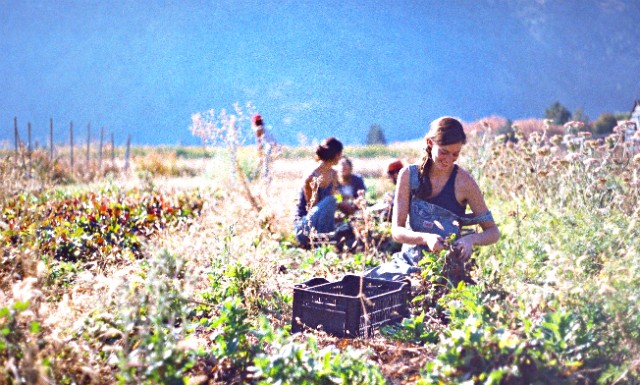
Like almost every other young farm worker I know, I entered the field through an unwaged internship. The specific details of these internships vary, but in most cases, people spend five to six months working forty to sixty hours a week on a farm for room, board, and a minimal stipend, as well as the educational experience they’re expected to gain. In my own experience, I struggled with what felt at times like an unjust arrangement—working at repetitive, mindless tasks that didn’t teach me much for a dollar or two an hour—but it wasn’t until I had been working in farming for a few years that I realized just how systemic the unpaid internship is. I interviewed a number of people* who had recently completed farm internships, and heard remarkably similar stories. The imbalances I felt in my own farm internship were not the result of bad management, but the impact of an industry-wide eagerness to rely on unpaid “interns” or “apprentices” year after year.
But aren’t there labour laws that prevent this sort of thing? Alas, no. In most of the country, labour carried out by farm workers is exempt from regular employment standards. There’s nothing requiring a farmer to pay an apprentice anything for their challenging and physically strenuous work. As a result, many internships* look like that of Kate, who recently completed a season on a Salt Spring Island farm:
In theory we worked from 6:00 am until 6:00 pm, with an hour lunch, but there were many nights where we worked until eight or nine. I even remember several nights where we worked into the dark, fixing irrigation with flashlights, working in the barn, calling it a day around ten thirty and going straight to bed. At best we worked for under two dollars per hour and at worst under a dollar.
All across the country, there are thousands of people who are committed to a more conscious and just ecological agriculture, working for a few dollars a day in order to feed Canadians. Why do we accept this situation as normal?
Sarah is one of these committed farm workers. When she began her first internship on an organic vegetable farm in Southern Ontario in April of 2011, she romanticized farming: “I still had stars in my eyes about the whole thing. It felt good to start on a new trajectory and fulfill one of my dreams by doing something completely different with my life.” She worked ten to twelve hours a day, six days a week for housing, farm food, and a $50-per-week stipend to cover groceries that weren’t grown on the small farm. She appreciated the community created on the farm and the new skills she was learning. Fairly quickly, however, a repetitive strain injury forced her to leave her position:
Within one month at the farm [carpal tunnel] symptoms began to affect everything I did—I couldn’t even hold a spoon or toothbrush without my hands going numb, and I was starting to show signs of real nerve damage, especially in my dominant hand.
Sarah saw a local doctor, a physiotherapist, and an occupational therapist—a huge expense on her $50 weekly budget.
Every one of them recommended rest in order to start healing, but when my ability to work fifty to sixty hours per week was threatened, I felt a strong push by the farmers to leave as soon as possible so they could replace me. With no money, no job, and no longer being able to work to support myself, I had to move back in with my mother after being on my own for more than ten years.
The situation was frightening. Sarah had intended to begin her new career in farming by learning from experienced farmers and had accepted that hard work and challenging conditions would be the price she paid for a valuable educational experience. Despite these expectations, however, and despite the fact that she genuinely enjoyed her time on the farm, the realities of an unpaid internship were hard to ignore:
It quickly became evident that I was only as valuable as my labour, and it was scary to know that my housing and food and (very limited) income were all directly bound up with my ability to work, and being an unpaid intern meant I had no savings and no WSIB or EI protection in the event of such an injury.
Sarah is far from alone in this experience, and the internship system that is the entry point for most new farmers in Canada is rife with exploitative labour practices. So much so that some interns are turning to the legal system. A farm on Vancouver Island was forced in mediation to compensate apprentices they had hired for their work. The lawyers consulted by the farmers were clear on the fact that although unwaged internships are common, legally, there isn’t much justification for them: nobody can sign away their rights to minimum wage. There was no uncertainty for the courts, as defendant farmer Evelyn Pereira explained, “Employment Standards is pretty black and white about what an employee is; if they are coming to your farm to do the work that an employee would do, then they are an employee.”
One might think this ruling would have been a wake-up call for the industry, but, thus far, little has changed. Part of this recalcitrance comes from the fact that labour regulations vary from province to province, and British Columbia, where the lawsuit took place, has a mandatory minimum wage law that applies to farmers. ManitobaQuebec Yukon, and Newfoundland and Labrador also have an absolute minimum wage, but laws in the rest of Canada expressly exempt farm workers from minimum wage requirements. These exceptions do more than impoverish workers, they also strip them of crucial workplace rights, since the same laws that determine minimum wage also regulate overtime rates, partial hours, on-call work, employees waiting for work on the work premises, piecework, deductions for board, lodging, meals, and uniforms, and workplace injury compensation. In Alberta, to take one of the most egregious examples, farmers get to choose whether or not their workers are covered under the workers’ compensation program. If you get injured on an Alberta farm and your employer didn’t voluntarily pay into the program, you’re on your own! The NDP government has signaled that they intend to change this situation, but as of August 2015 only seven percent of Alberta farm workers have workers’ compensation. It’s a scary place to be a farm worker.
Heather
There is no good reason why farmers in 2015 should be exempt from basic labour requirements, and there’s certainly no good reason why small-scale and organic farms should embrace this system. If anything, small scale agriculture should be striving to move away from the conventional food system, a system whose history of racism and exploitation continue to this day. Canada’s industrial food production system relies heavily on the poorly compensated migrant labour of the Temporary Foreign Worker program. Most of the food produced in this country is planted, harvested, and sometimes processed by workers from Mexico and the Caribbean, who work seasonally in Canada and then return home for the rest of the year. These workers, between 25,000 and 35,000 of them a year, are expected to come to Canada and grow our food, but they are not granted the same rights as citizens, or even a pathway to citizenship. Although temporary foreign workers (TFWs) are technically entitled to the minimum wage, there is no limit to the number of hours they can be required to work and they aren’t entitled to overtime pay or holidays. They are precariously dependent on the good will of their employers, and they have little legal recourse in the case of illness or abuse.
Even more egregiously, TFWs are required to make CPP and EI payments, despite receiving virtually no benefit from these programs. A study released last March by the United Food and Commercial Workers (UFCW) union, estimates workers participating in the federal Seasonal Agricultural Worker Program (SAWP) paid $8.996 million in EI premiums in 2012. Because of the Harper Government’s reform to EI regulations, however, workers will not be able to claim EI benefits unless they are “authorized to remain in Canada,” a stipulation that invalidates temporary foreign workers from filing claims.
To be clear: the demographics of temporary workers on conventional farms and interns on small organic farms are very different. Organic farm interns are mostly Canadians, overwhelmingly white, mostly female, and fairly likely to hold a college or university degree. These workers are in a considerably less precarious position than the immigrant workforce that fuels the conventional farm industry, and the labour issues faced by temporary foreign workers and organic interns are not the same ones. Any fight for intern rights, though, needs to consider the bigger picture of food production in Canada. In more ways than we realize, all Canadians are deeply indebted to the labourers who grow and harvest our food, and we need to consider ways to ameliorate the conditions for those who do that work.
If we want to improve conditions on small-scale organic farms, there are two fairly simple solutions: pay workers for their work, or set up a formal apprenticeship program that offers an explicit, formalized education and a recognized certification upon completion. Provincial governments offer the latter opportunity in many skilled trades, and there’s no reason farming apprenticeships couldn’t be regulated in the same way. The problem with the current system is that, although these positions are typically termed “apprenticeships” or “internships,” small farms rarely adhere to the legal provincial or federal standards of an apprenticeship. Apprenticeship standards vary by province and across industries, but in all cases they require that an apprentice receive a government certified accreditation at the completion of their training. As the Ontario government puts it: “Apprentices become skilled workers once they have acquired the knowledge and skills in a trade or occupation and are certified by a provincial or territorial authority.” Farm interns receive no certification, and there are no standards around what an intern can be expected to know at the end of a season.
Article pic spinach
Bernard just completed his second season of a farm internship in Nova Scotia, and he appreciated his mentors and the experiences he had. The compensation and the education he received, however, didn’t always feel equal to the labour he contributed to the farm. He and other interns were technically paid minimum wage, but had to return $800 a week for their rooms and an “educational fee.” As Bernard says,
There’s something very vulnerable and friable [about] setting up an agreement to be taught by someone who isn’t a trained teacher; even more, to be paying an “educational fee.” None of the farms I worked on have strict curricula of what interns can expect to learn; the conditions are that interns will be involved in all aspects of the farm and can learn more just by asking questions.
On a farm in New Brunswick, Hannah and Heather were effectively left to teach themselves how to farm, alongside their fellow apprentices. As Heather says, “My apprenticeship left with me with a lot of ideas of how I don’t want to farm, while this is valuable knowledge, it is definitely not the desired outcome of a farming apprenticeship.”
Educational plans for interns vary widely, and there are surely farm internships that are rigorous, formalized, and extensive. However, the system described above, in which interns are expected to do the majority of their learning simply by absorbing the farm environment and asking the right questions, is all too common. In practice, this means that many interns get a great education in some aspects of the farming business—weeding, planting and, harvesting—without getting a well rounded sense of what goes into running a farm. Lucia Stephen, food activist and program coordinator for the Atlantic Canadian Organic Regional Network (ACORN)’s Grow A Farmer Initiative points to two equally important parts of a farmer’s education:
Production skills and business skills. In order to establish a sustainable profitable farm, one set can’t go without the other, unless you are dividing responsibility among different partners involved with the farm enterprise—even still, having a general sense of both components is integral.
Many apprenticeships focus on the repetitive aspects of the production skills, without any of the business skills to go with them. Interns can finish a season without knowing anything about soil amendments, crop planning, budgeting, marketing, or selling, all crucial elements of running a small farm.
Of course, there is a huge amount of romanticism and idealism that goes into the choice to begin work on an organic farm, and one could blame young naïve workers for their choice to follow a “back to the land” dream into a situation that is more challenging than they expect. There is a “do what you love” mentality around the choice to pursue farming that masks the fact that Canadians desperately need farmers. It is true that many interns on small ecological farms in Canada are the privileged children of middle-class parents who have been raised with the idea that they should “follow their passions.” As Miya Tokumitsu points out in her analysis of the “do what you love” ideology, “according to this way of thinking, labor is not something one does for compensation, but an act of self-love. If profit doesn’t happen to follow, it is because the worker’s passion and determination were insufficient.” Farm interns who dare to speak up to their employers about hazardous work conditions, overtime hours, or insufficient pay are often rebutted with the idea that “this is just farming—you have to love it.” The idea that “nobody makes money farming” is also frequently brought up as an excuse not to pay workers. This rhetoric of organic farming treats farm labour like non-profit work, or volunteering, rather than a business.
Buckwheat mow
After Sarah was forced to leave her first internship because of injuries, she took another one the following year, in Western Quebec. She describes a tense working situation which fluctuated between supportive and volatile, depending on the mood of the employer:
We shared hugs every morning before starting the workday. It didn’t take long, however, for the veneer to wear off. If someone did something wrong—and always by accident—the farmer would sometimes explode at them, reacting in ways that were entirely disproportionate to the situation. The morning hugs began to feel like a show rather than an act of caring; they felt manipulative, and some days I really did not want to hug him but didn’t feel safe to say so.
The concept of farm work as a “labour of love” that is its own reward belies the incredible toll it can take on the worker’s body, and the simple fact that work merits pay. The current internship system is certainly one of the reasons that most young Canadians don’t view farming as a valid career path, leaving gaping generational holes in the farm labour market.
As Lucia Stephen explained to me:
80 percent of Canadian farmers will face retirement within the next ten years and we are facing a looming void in agricultural production and fertile farmland in need of succession. We need to train and mentor a strong and resilient generation of new farmers NOW to ensure both the preservation and revitalization of our rural farming communities, while deepening the roots of our diversified regional food systems.
This enormous gap in the labour market needs to be filled by someone in order for Canada’s food supply to remain stable. Food Secure Canada (FSC) is one organization that is closely monitoring this issue, through collaboration with a pan-Canadian alliance of organizations and individuals working together to advance food security and food sovereignty. As one of the organization’s many projects, FSC has worked with FarmStart and the National Farmers Union Youth Caucus in creating the New Farmer Initiative (NFI)to explore challenges and opportunities facing new farmers in Canada. The NFI’s New Farmer Policy Round Up, published in March 2015, reports on consultations with new farmer stakeholders done in 2014. The report provides overarching recommendations on how to support new farmers in Canada.
NFI’s recommendations bring the looming threat of the generation gap into focus. Without a strong strategy to retain farm land and to create a new generation of agricultural workers in Canada, the number of farmers “will decline faster and faster over the next 15-20 years. This will significantly weaken Canada’s ability to sustain food production and to depend on farmland for environmental goods and services in the face of climate change.” A future of reduced fossil-fuel consumption will mean that Canada needs more local farms and farmers, not less, and we’ll need farmers and farm workers to be able to make a living growing food for Canadians. At the moment, it is difficult for struggling farmers to adequately pay their workers, particularly when they can barely pay themselves.
Peppers
NFI policy recommendations emphasize a new approach to education:
The current scattered approach to teaching new farmers requires a re-think. Agricultural colleges focus largely on research and underfunded non-profits try to bridge the gap, but no clear career path exists for “first generation” farmers – those who did not grow up on a farm.
The report’s authors propose “on-farm employment/internships on accredited farms. This program would help incentivize farmers to pay a living wage and provide a rung in the learn-to-farm ladder with reliable employment.” Other NFI recommendations include “standards for training farmers of different backgrounds and sectors” and “subsidizing training programs for farmers.” These supports would go a long way towards allowing young people to consider farming as a career without automatically putting their financial and physical security in jeopardy.
Internships could be a valuable part of this career path. If internship programs had a more standardized training and educational curriculum and an accreditation system, unpaid stints of farm work in exchange for learning could be appropriate. But if you aren’t learning, you should be paid.
These educational supports would be enormously helpful in building a better food system in Canada. More broadly, what would a just food system look like for workers? It would mean support from government and consumers. It would mean ending agricultural labour exceptionalism—paying at least minimum wage to both Canadian and migrant workers, and not excluding them from the securities and benefits that other workers enjoy. Importantly, it would also require that eaters start to ask questions about who works to grow their food, no matter where they buy it. Folks who buy organic and local food because they value the health of the planet, their communities and their families also need to consider the health of those who grow their food. When buying conventionally produced food, we all need to consider how its relative cheapness is artificial—it comes largely on the backs of the workers who produce food.
No one goes into organic farming to get rich, and that won’t change any time soon. But despite their challenging apprenticeship experiences, many of the people I interviewed still intend to become farmers, and they continue working towards it. Raising the capital to actually start a business on a farm worker’s wages is yet another hurdle for first-generation farmers, but many of us will keep trying: Hannah is the manager of an urban farm in Toronto, Kate is signed on to her third season as the greenhouse manager at a Hudson Valley farm, Sarah has started her own farming venture in Ottawa. There are people who want to do this important work, and if you eat, you need them to! We need help, though: apprentices, workers, and farmers all need support from consumers and from government. Let’s set up a better food system, starting by teaching people how to farm in an effective, ecological, and profitable way.
Acknowledgements: Thanks to Caleb Glasser for research help, and to everyone who thoughtfully and generously responded to interview questions.
Natalie Childs is a farm worker in Western Quebec and an editor of GUTS. She just got Twitter and you can get in touch @nat_childs.
Images by Natalie Childs