Showing posts with label Brazil. Show all posts

Thursday, June 8, 2017

2625. Passive Revolution: The Transnational Capitalist Class Unravels Latin America's Pink Tide

By William I. Robinson, Truthout, June 6, 2017
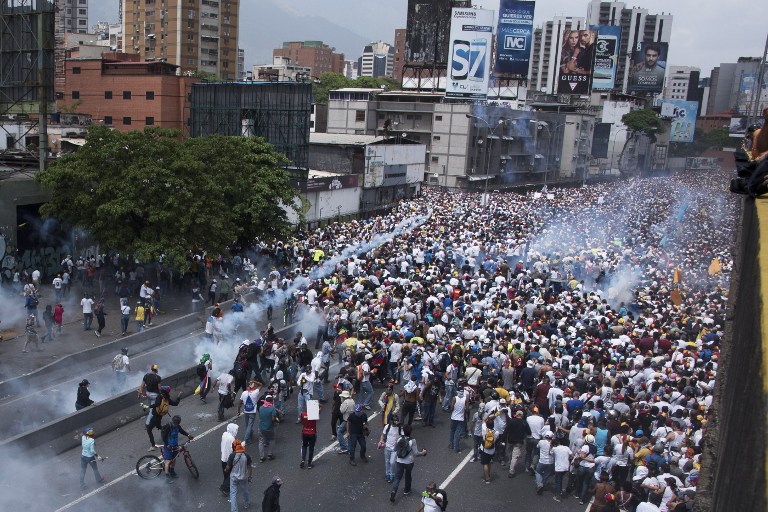
Demonstrators clashed with the riot police during a march against President Nicolas Maduro in Caracas in April.  Photo: Carlos Bacerra/AFP. 

The day after the Organization of American States (OAS) met in Washington, DC, on May 31 at the behest of the US and right-wing Latin American governments to debate the crisis in Venezuela, judge Nelson Moncada was gunned down at an opposition protest in Caracas, in a crime that some claimed was an act of revenge for his involvement in the sentencing of a prominent opposition politician. The OAS, however, remained silent on the crime, as well as on the deepening crisis and escalating state repression against mass protests sweeping Brazil and Colombia. Bolivian President Evo Morales accused the OAS of seeking to "politically eliminate the anti-imperialist presidents and governments" in Latin America in line with the historic pattern of US intervention in the region to prop up right-wing dictatorships and crush revolutionary and progressive movements.

The leftist governments in Latin America that swept to power in the early 21st century, known collectively as the Pink Tide, transformed the political landscape in the Americas and inspired popular and revolutionary struggles around the world. The Pink Tide governments came to power on the heels of mass popular resistance to the late 20th century juggernaut of neoliberalism and capitalist globalization in the region. Yet nearly two decades after the turn to the left, the right has resumed power with a vengeance in Brazil, Argentina, Paraguay and Honduras, while the Venezuelan revolution is in deep crisis and the leftist projects in Bolivia, Ecuador, Uruguay, Nicaragua and El Salvador have been emptied of much of their socialist pretensions. If this ebbing of the Pink Tide demonstrates the limits of parliamentary changes in the era of global capitalism, it also points to the renewed hegemony of the transnational capitalist class over the region.

The social model pursued by the Pink Tide governments involved the capture and redistribution of surpluses generated by the export of raw materials to global markets. Notwithstanding the leftist rhetoric, these governments oversaw a massive expansion of raw material production in partnership with foreign and local contingents of the transnational capitalist class, that is, the transnationally integrated ruling capitalist groups that emerged in countries around the world through globalization and that exercise collective control over the new globalized system of production and finance. As a result, the Pink Tide countries became ever more integrated into emergent transnational circuits of global capitalism and dependent on global commodity and capital markets.

There was no attempt to break with this extractivist model, even in the more radical experiments in Venezuela, Bolivia and Ecuador, where energy and other natural resources were nationalized. All three countries deepened their dependence on the export of hydrocarbons and industrial and precious minerals. Venezuela is even more dependent on oil exports in 2017 than it was at the turn of the century. Soy production in Argentina, Brazil, Paraguay, Uruguay and Bolivia experienced an explosive expansion as transnational corporate agribusiness displaced millions of smallholders and converted the countryside into a vast sea of industrial-scale soy plantations.

With the exception of Venezuela during the height of the Bolivarian revolution, what stood out were the absence of any shift in basic property and class relations despite changes in political blocs, a discourse in favor of the popular classes, and an expansion of social welfare programs. In effect, these governments carried out what Italian Marxist theorist and politician Antonio Gramsci referred to as passive revolution, whereby dominant groups undertake reform from above that defuses mobilization from below for more far-reaching transformation. The Pink Tide governments were "progressive" insofar as they introduced limited redistribution and restored a role for the state, less in regulating accumulation than in administering its expansion in more inclusionary ways. When we cut through the rhetoric, many of the Pink Tide states were able to push forward a new wave of capitalist globalization with greater credibility than their orthodox and politically bankrupt neoliberal predecessors.

The commodities boom financed the expansion of social programs that reduced poverty and raised the standard of living of the working and popular classes. Yet because there were no more substantial structural transformations that could address the root causes of poverty and inequality, these social programs were subject to the vagaries of global markets over which the Pink Tide states exercised no control. Once the 2008 world financial crisis hit, they came up against the limits of redistributive reform within the logic of global capitalism. The extreme dependence on raw materials exports threw these countries into economic turmoil when global commodities markets collapsed, undermining governments' abilities to sustain social programs and generating political tensions that helped fuel popular protest and open up space for a right-wing resurgence.

Brazil was most indicative of the mild reformist thrust of many Pink Tide governments, and the most tragic for the popular classes. President Luiz InĂ¡cio Lula da Silva won the 2002 election only after his wing of the Workers' Party moved sharply toward the political center and promised not to default on the country's foreign debt. In Brazil, as elsewhere, the Pink Tide state remained a part of the larger institutional networks of the global financial system and beholden to transnational finance capital. The Workers' Party government demobilized the mass social movements that brought it to power and then imposed austerity after the collapse. Only in this light can we understand the brazen return of the far right.

US intervention, of course, is a critical part of the story of the unraveling of the Pink Tide. As in other historical moments of counterrevolution, such as in Chile under Salvador Allende in the early 1970s and Nicaragua in the 1980s, US strategists have been deft at exploiting mistakes and limitations of the Pink Tide governments and manipulating legitimate grievances among the popular sectors in these countries for the purposes of destabilization. This is especially the case with the Bolivarian project in Venezuela -- by far the most radical and socialist-oriented experiment among the Pink Tide -- that has faced an all-out strategy of US counter-revolution since its inception.

There are other factors to consider as well, such as the particular dynamics of class and social struggles in each country that shaped the trajectory of Pink Tide experiences and the attempts at building an alternative regional economic bloc around the Bolivarian Alliance for the Peoples of Our America (ALBA).

Yet these dimensions played out to the drumbeat of the expansion of capitalist globalization in the region followed by crisis. The transnational capitalist class used its structural power in the global political economy to defuse the Pink Tide challenge to its rule. In this way the transnational capitalist class demonstrated its capacity to subordinate leftist projects at the national and regional levels to its logic of global accumulation. The lesson seems to be that a viable project from below requires a more significant rupture with that logic than the Pink Tide was able or willing to undertake.

William I. Robinson is professor of sociology, global studies and Latin American studies at the University of California at Santa Barbara. His most recent book is Global Capitalism and the Crisis of Humanity.

Tuesday, February 2, 2016

2184. Hydropower Dams Threaten One-Third of the World’s Freshwater Fish

By Eisabeth Grossman, Earth Island Journal, January 7, 2016 
Accordimg to the forthcoming Science article the Belo Monte Belo dam may set a record for biodiversity loss because
of the site that is homes to an exceptional number of endemic species. 

Three of the world’s most important tropical river basins — the Amazon, the Congo and the Mekong — are experiencing an unprecedented boom in the construction of hydropower dams. According to a paper by more than three dozen scientists from universities, research institutions and conservation organizations around the world, which will be pubished tomorrow in Science magazine, these projects pose a major threat to biodiversity, including to one-third of all the world’s freshwater fish species. The authors say long-term impacts of tropical hydropower projects are rarely assessed adequately and call for better — and more transparent — planning that more accurately evaluates the full costs of these dams. Without this, the authors write, these projects will lead to species extinctions, as well as significant declines in fisheries and other “ecosystem services” on the world’s “mega-diverse” tropical rivers.

While most of the 838 existing dams on these river systems are relatively small, more than 450 new dams are currently planned for the Amazon, Congo and Mekong Rivers — about 75 percent of these in the Amazon. The paper’s authors contend that those planning the dams “have generally failed to assess the true benefits and costs of large hydropower projects,” leading both to financial cost overruns and underestimation of environmental and social costs. Those costs can be high — the dams take a toll on biodiversity, and damage to fish populations can threaten food security in local communities that depend on the fisheries.

As the paper’s lead author, Kirk Winemiller, Regents Professor in Texas A&M University’s Department of Wildlife and Fisheries Sciences & Program in Ecology and Evolutionary Biology, explained via email, these three tropical river basins “contain a disproportionate amount of the world’s freshwater biodiversity, including about one third of all freshwater fish species.” Further, said Winemiller, many of these rivers' “sub-basins and tributaries contain unique species found nowhere else.”

For example, the Xingu River in Brazil, which is a major tributary of the Amazon, includes a complex of rapids that Winemiller says “provides habitat for about four dozen fish species found nowhere else on earth.” The paper notes that altogether, there are nearly 1,500 endemic species found in the Amazon Basin. 

According to the paper, Brazil’s massive Belo Monte dam, which is due to be completed this year, “may set a record for biodiversity loss” owing to its siting at a location with an exceptional number of endemic species. “This controversial project is nearing completion and will radically change the river, its ecology, and the lives of local people, especially indigenous communities that have depended on the river’s ecosystem services,” said Winemiller. At least 334 new Amazon dams have been proposed in addition to those already operating and under construction.ozens of other endemic fish species.

In the Mekong River Basin, which is already heavily dammed with some 370 dams, there are plans for almost 100 more, including nearly a dozen dams on the river’s main stem. The Lower Mekong River currently supports important inland fisheries, recently estimated to be worth about $17 billion a year. The dam building planned for the Mekong will disrupt the movement of the river’s migratory fish — blocking their ability to move between their wet and dry season, and spawning and nursery, habitats. The dams will also disrupt livelihoods. More than 3 million people living in Cambodia, Laos, Thailand and Vietnam are directly involved in these fisheries, said Winemiller. Many more of the 60 million people who live in the Mekong River Basin depend on the river in other ways as well.

It is well known that dams block fish passage and disrupt river hydrology, which in turn upsets rivers’ ecological balance and the ability of fish and other aquatic species to access floodplain and nursery habitats. But the full measure of these impacts throughout a river basin are usually poorly accounted for by those building dams, say the paper’s authors.

“We have a lot of evidence on specific projects but there have been few global assessments or large scale assessments like this article on three large river basins,” International Rivers interim executive director Peter Bosshard told Earth Island Journal.

As Bosshard explained, “There isn’t a lot of money for scientific research on these issues,” and such research — including environmental assessments — needs to be done before full dam construction begins, but that often doesn’t happen. In many cases, he said, “millions, sometimes scores of millions of dollars have been spent” and a “river may already have been diverted,” before an assessment is completed. “By that time it’s almost impossible to stop a project.” He also pointed out that on many of these projects, assessments are not done by an independent third-party but by companies hired by those building the dams.

The World Bank, which helps finance many dam building projects worldwide, was not able to comment on the not-yet-published paper but offered a summary of a 2014 World Bank report on hydropower. It says that “Hydropower production is the least-cost method of providing electricity in many developing countries” that in some places may alleviate local poverty and improve food security. However, it says, hydropower “can also carry significant risks” — challenges that have become more pressing in the last decade. 

The Science paper authors think that assessment of those risks is often lacking when it comes to project approval and financing. “Institutions that permit and finance hydropower development should require basin-scale analyses that account for cumulative impacts,” including climate change, they write. Such evaluations and subsequent changes to dam siting are “imperative,” they say. Without this, there will be significant species loss and, they note, “We are skeptical, that rural communities in the Amazon, Congo, and Mekong basins will experience benefits of energy supply and job creation that exceed costs of lost fisheries, agriculture, and property.”

Saturday, January 2, 2016

2143. Story of a Disaster Foretold

By Ian Steinman, Jacobin, January 2, 2016
The devastation in Minas Gerais, Brazil.

In November 5, a dam used as a waste dump owned by the mining company Samarco broke, causing a flood of toxic mud and water which killed twelve, injured many more, and completely destroyed the nearby town of Bento Rodriguez in Brazil. The waste from the spill has gone on to poison the Rio Doce, a major river linking the interior of Brazil’s Minas Gerais State to the eastern coast of Espirito Santo.

60 million cubic meters of waste water has choked off life in and around the river. More than a quarter of a million people have been left without usable water. Entire communities, towns, and cities spread along the Rio Doce and in the waters nearby find their livelihoods and futures threatened.

The exact causes of the breach are still under investigation, however recently released information points towards a construction project that was meant to connect the dam with another nearby dam, quintupling the size of the facility. Samarco has maintained that the waters have not been contaminated with toxic material and that it represents no threat to people or the environment. The government has largely supported those claims.

Nevertheless a recent test showed levels of arsenic and mercury over ten times the legal limit. The United Nation’s Office of the High Commissioner for Human Rights has also criticized the reports by Samarco and has declared the company’s and the federal government´s responses so far to be inadequate.

While the true scale of the disaster is still unknown, the devastating effects will be felt for years to come. Responsibility for this disaster lies not only with Samarco but also the destructive economic trends of the last few decades, the privatization of Samarco’s co-owner Vale, and widespread collusion between the ruling political class and mining corporations.

A Global Trend Towards Disaster
The disaster comes in the middle of a major economic crisis in Brazil which acutely affected the mining industry. The global drop in the value of raw resources like iron has contributed to Brazil’s economic downturn.

Mining companies have responded to the crisis by laying off workers and focusing on cost-cutting measures. 2,097 workers in the mining industry of the state of Minas Gerais were fired in the first semester of 2015. In Espirito Santo, one of the states through which the Rio Doce passes on the way to the coast, Samarco’s parent company Vale fired more than four thousand workers.

While Samarco maintains that the dams passed a government inspection in July and were considered safe, the method they are using to deposit waste in dammed local waters is a cheap — and risky — solution. In Chile, where earthquakes are a consistent threat, many mining companies rely on dry storage techniques which cost ten times as much.

The construction of water-based storage areas from scratch on virgin land would also be safer but cost twice as much. This is nothing compared to the death, displacement, and devastation visiting the environment and communities along the river. Yet for a capitalist business, especially under recessionary pressures, the cheapest method possible will always prevail.

This kind of disaster is not exclusive to Brazil and the developing world. It is in fact part of a global trend in the mining industry towards more and more catastrophic failures of water-based waste storage techniques. A report by Lindsay Bowker and David Chambers shows a growing trend towards more “serious” and “very serious” failures starting in the sixties and increasing up to the present.

When companies refuse to opt for costly overhauls, safer storage techniques, and repairs they turn towards makeshift solutions which often expand the storage dumps far beyond their originally intended and designed limits. Targeting the industry’s financial markets and investment trends, the report concludes that there is “a clear and irrefutable relationship between the mega trends that squeeze cash flows for all miners at all locations, and this indisputably clear trend toward failures of ever greater environmental consequence.”

The crisis of waste dump failures looks much like the general crisis of capitalist investment in production. It is not profitable to invest in major overhauls, safe storage techniques, or new, more technically advanced mines.

Facing the crisis of over-production triggered by the fall in global ore prices, private companies are attempting to cut costs, raise productivity, and extract as much as possible from existing mining facilities. Yet pushing extraction to the breaking point has dire consequences for entire communities, regions, and ecosystems.

The costs of cleanup and long-term economic and environmental damage are never fully borne by the company — often itself a subsidiary used by larger corporations to evade liability — but instead are passed on to local and national governments.

In Brazil this is exacerbated as the costs of adopting safety measures or even operating legally often far outweigh the token fines imposed on companies which violate the law. Fees imposed on Samarco are so far some of the largest but still fall far short of the overwhelming economic, environmental, and human cost of this man-made disaster.
Vale was once a national mining company and seen as central to the development of the Brazilian economy and national independence. But the state company was privatized in 1997 under the neoliberal administration of Fernando Henrique Cardoso in a sale widely considered to have substantially undervalued the company.

Its $3.14 billion price tag glaringly omitted the value of its patents, mineral rights, reserves, and stock in other companies. Though it accounted for infrastructure, many mines were still missing from the assessment. On the day the sale was finalized thousands of protesters clashed with police in front of the headquarters in Rio de Janeiro with similar protests across Brazil.

Today the company has an estimated value of over $53 billion and has established itself as a global multinational with a reputation to match. Behind the illusion of South-South solidarity the international operations of the company are just as bad as and often even worse than the practices of European and American multinationals.

Samarco, the company formally responsible for the disaster, is itself is a joint venture owned by Vale and the Anglo-Australian multinational BHP Bilton.

The PT’s Complicity
While Vale may have been privatized under the neoliberal leadership of Cardoso and the right-wing PSDB the new owners of the company quickly found willing partners in the Workers Party of former President Lula da Silva and current President Dilma Rousseff. Legal efforts to challenge the privatization over irregularities in the sale received no support from the PT, who instead embraced Vale, the mining industry, and the banks that own and finance much of industry.

In 2014 alone Vale invested r$8.25 million in the electoral campaigns of the PT and r$23.55 million to the PMDB — a PT ally which controls the Ministry of Mines and Energy as well as the National Department of Mineral Production. Dilma Rousseff’s reelection campaign counted on r$14 million in donations from Vale – far outstripping the r$2.7 million that went to right-wing opposition candidate Aecio Neves — as well as another r$14 million from a variety of other mining companies.

One of the largest stockholders in the privatized Vale is Bradesco Bank. Joaquim Levy, Rousseff’s main economic minister and architect of recently implemented austerity programs, formerly worked as a director for Bradesco. Bradesco recorded record profits of r$4.47 billion in the second trimester of 2015, an 18 percent growth compared to the previous year. The banking sector as a whole has seen unprecedented growth and rates of profit under the PT’s administration and has been a willing partner of the government.

In Minas Gerais, the disaster’s epicenter, the PT’s Fernando Pimental is serving as governor. Far from using the crisis as an opportunity to impose tougher regulations, he and the PT legislatures have instead rushed a bill once championed by the PSDB’s Aecio Neves that speeds up environmental licensing for mining companies. What emerges at the state and national level is a web of complicity and support in which the PT has often been Vale’s party of choice to ensure its economic interests are defended.

Additionally, under pressure from the economic crisis and deeply affected by the corruption scandals, there is now a major proposal to privatize huge sections of Petrobras, the Brazilian state oil company. Petrobras has been moving forward with a plan to sell $15 billion in assets by the end of this year with more sales to come in 2016 and beyond. The estimated cost of the Lava Jato corruption scandal has been as much as $6 billion and along with the fall in oil prices has left the company heavily indebted and facing a serious crisis.

Workers at Petrobras have attempted to resist this trend towards privatization. Petrobras workers recently ended one of the largest strikes in recent history in which workers in many locals occupied platforms and workplaces as well as defied the union bureaucracy’s attempts to end the strike early. Opposition to the privatization plan was a major demand of the strike and a source of rank-and-file disillusionment with the PT government.

However, the main trade union responsible for representing Petrobras workers is deeply linked to the PT and Petrobas management. The discontent expressed in the strike was substantial but still far short of the kind of mass workers movement which would be needed to block the proposed assets sale.

The threat of both ongoing and future privatization represents not only a major issue for Petrobras workers but potentially poses a substantial environmental threat. If privatized sectors of the oil and gas industry follow the same path as Vale the likely consequence will be even more environmental disasters.

Fighting Back
The disaster shows the irreparable damage which capitalist businesses wreck upon the environment and the growing trends across the mining industry towards ever more risky and damaging techniques. Corporate models in environmentally risky industries like mining socialize the dire risks of extraction while privatizing the financial benefits.
Yet while defending state ownership is important, it is far from enough. The crisis of Petrobras and its growing trend towards privatization has itself been driven by the looting of its assets by the governing PT party and its allies. The ability of the ruling and allied parties to steal from Petrobras in league with private business and company management is a weakness of its state-owned and state-controlled character.
The right opposition has until now been able to use the corruption scandals to push for further privatization. Rousseff and the PT have themselves advanced the partial privatization of Petrobras by asset sales as a solution to the immense costs of corruption and the deepening economic crisis.

In the aftermath of the disaster there is a political opportunity to strike a blow against the whole project of privatization. The only alternative which the ruling parties have to offer Brazil is more privatization at a slower or faster rate with more environmental disasters sure to follow.

Against both state and corporate corruption, the Left must retake the old slogan of nationalization under workers’ control — not just as a labor demand but also an environmental necessity. With a crisis at Petrobras and growing popular hatred of Vale, workers’ management represents the only real alternative to a future of private profit and socialized devastation.