By Matthew Lau, Jacobin, May 20, 2017
The day after Stephen Jay Gould died, his obituary appeared on the front page of the New York Times, testifying to his position as the most famous scientist in the United States. His talent for synthesizing ideas and arguments, his work ethic, and — as he would have been the first to note — luck made him famous.
He had not planned to write his monthly column, “This View of Life,” for Natural History for twenty-five years, but, like his childhood hero Joe DiMaggio, Gould became known for this literary streak, which breathed new life into the half-forgotten art of the popular scientific essay, a tradition that dates back to Galileo.
Like Galileo, Gould did more than interpret science for laypeople. He was also a path-breaking evolutionary theorist and a canny political organizer for leftist causes.
Along with his colleague Niles Eldredge, Gould changed the way biologists view the fossil record. His concept of punctuated equilibrium argued that new species emerge relatively rapidly and then remain mostly stable for millions of years. To his more parochial colleagues’ chagrin, Gould partly credited the inspiration for “punc eq” to the fact that he had “learned his Marxism, literally at his daddy’s knee.”
Though he was redbaited for this comment, Gould and Eldredge were speaking as pluralists and historicists not dogmatists. “We make a simple plea for pluralism in guiding philosophies . . . for the basic recognition that such philosophies . . . constrain all our thought.”
Historical context also acts as a constraint on new ideas. Darwin acknowledged the influence of the classical political economy of Smith and Malthus on his theory of evolution. Gould noted that his leftist upbringing and participation in the revolution of the Civil Rights Movement enabled him to recognize the importance of “punc eq’s” patterns of sudden and discontinuous evolutionary change.
Gould also revitalized the study of evolutionary development with his influential historical survey of the subject, Ontogeny and Phylogeny, and made his mark on anthropology by insisting that human evolution looked more like a branching bush with multiple overlapping lineages than a ladder of predictable stages.
Raised in a leftist household in Queens, Gould led his local NAACP’s youth chapter. He displayed his writerly talents early on, when he introduced the Little Rock Nine on their victory tour of New York. “They are tormented by racists down South and autograph seekers here,” he noted drolly. He worried his brave fellow teenagers would not get to enjoy New York City and thanked them for enhancing his high school’s curriculum with the day’s most pressing issues. “No event in my memory ever aroused such interest in the Queens teenager,” Gould told the audience. “No event has ever aroused in him such hatred for segregation and all it stands for.”
While studying at Antioch College, he participated in desegregation efforts in and around Yellow Springs, Ohio. In 1964, a lone barbershop that had resisted desegregation for four years in nearby Xenia briefly became the Civil Rights Movement’s national focal point. Even while studying abroad at Leeds University, Gould fought for progressive causes, working to desegregate dance halls and joining the campaign for nuclear disarmament.
These two facets of Gould’s life regularly intersected. In 1982, he served as an expert witness against “creation science” in McLean v. Arkansas. A year earlier, he had published his most famous political intervention, his prize-winning critique of biological determinism, The Mismeasure of Man.
At its core, Mismeasure argues that the twentieth century’s IQ tests share a desire to justify race and class hierarchies with the nineteenth century’s more primitive measures of cranial features and theories of criminal physiognomy. In both eras, researchers rationalized the status quo with the premise of immutable, hereditary intelligence and the fallacy of reification, which held that intelligence can be reduced to a single number and those numbers used to rank people on a linear scale.
Mismeasure also addresses the issue of confirmation bias — especially racial bias — in the sciences. In the book and an article in Science that preceded it, Gould analyzed nineteenth-century race scientist Samuel Morton’s two sets of skull measurements, one from 1839 and the second from 1849, to demonstrate that Morton unconsciously manipulated his data to prove that Caucasians had greater cranial volumes than other racial groups.
Gould also reminded his readers that eugenics and other consequences of biological determinism remain with us. The United States, nation of immigrants, misused IQ tests to establish quotas on southern and eastern Europeans Jews in 1924 and kept them in effect as millions tried to flee Nazi Germany. The state of Virginia thought it wise to sterilize “idiots” and “morons” until as recently as 1972.
Mismeasure came out just as academia was accepting more women and people of color into its ranks. Thanks to Gould’s polemical style and activist stance, the book almost immediately became canonical in undergraduate curriculum.
Refutation and Vindication
Or rather, it was — until Gould returned to the Times’s headlines in June 2011. “Study Debunks Stephen Jay Gould’s Claim of Racism on Morton’s Skulls,” the article proclaimed. A team of physical anthropologists, led by Jason E. Lewis, had remeasured roughly half of Morton’s skulls and reanalyzed both his and Gould’s findings. They concluded, “[i]ronically, Gould’s own analysis of Morton is likely the stronger example of bias influencing results,” citing important instances where Morton’s work was more accurate than Gould’s. In the most glaring error, Gould inflated the average cranial capacity of Native American skulls by “arbitrarily” leaving out several smaller crania in his reanalysis.
People quickly reacted to the revelation of Gould’s purported bias toward “political correctness.” Writing on his influential blog, anthropologist John Hawks described Gould’s work as perfidious and claimed it “cast doubt on the validity of the scientific enterprise.” Ralph Holloway, a member of the team that reanalyzed Morton and Gould, explained that he “just didn’t trust Gould.” “I had the feeling that [Gould’s] ideological stance was supreme . . . [and] just felt he was a charlatan.”
Far-right “race realists” unsurprisingly trumpeted the news that Gould’s findings had been “refuted.” Even among more measured critics and defenders, a narrative began to take hold: Gould had proved his point, but “it just wasn’t the example he intended.” Morton started to appear more “sinned against than sinning.”
At the end of their article, Lewis et al. wrote, “were Gould still alive, we expect he would have mounted a defense of his analysis of Morton.” This is a virtual certainty: Gould openly acknowledged his errors throughout his career and called “factual correction . . . the most sublime event in intellectual life.” Gould cannot defend himself, but, since Lewis et al. can, it’s curious that they have not responded to more recent peer-reviewed studies that refute key aspects of their work.
Though the Times has yet to report it, more recent evidence suggests that the reanalysis of Morton’s skulls makes computational mistakes that favor Caucasians. And as several studies now show, the scientists did not ultimately challenge Gould’s main claim that the inconsistencies between Morton’s measurements in 1839 and 1849 indicate unconscious racial bias. Moreover, the differences between mean values for all races when corrected were, as Gould originally argued, so small as to be statistically insignificant.
Why hasn’t the Times reported these more recent findings? The answer also helps explain why they and other outlets so enthusiastically reported the criticism against Gould in the first place. As he would have recognized, it’s politics.
Historical interpretation as science
Though no one knew it in 2011, Nicholas Wade, the reporter covering the story for the Times, would publish a widely condemned “race science” book in 2014 called A Troubling Inheritance: Genes, Race, and Human History. A purported summary of recent research in population genetics that explains cultural differences between white, East Asian, and African civilizations, Wade’s book inspired an open letter of condemnation, which virtually every expert in the field of population genetics signed.
Beyond Wade’s pathetic resuscitation of “scientific racism,” the Gould-Morton controversy has a deeper political dimension. The absence of mainstream reporting on The Mismeasure of Man’s vindication shows how the popular press privileges “hard” science over the “soft” sciences of historical interpretation. Gould himself fought long and hard against this bias, which caricatured paleontologists like him as “stamp collectors.”
Gould wrote his 1989 book, Wonderful Life: The Burgess Shale and the Nature of History, in large part to counteract the bias toward experimental science. The Burgess Shale in British Columbia includes the greatest repository of fossils from the Cambrian explosion, the dawn of multicellular life. As Gould’s book notes, scientists working with these fossils radically changed paleontology’s core concepts. Contrary to earlier studies, many of the shale’s fossils do not have known ancestors. This means that life was, in crucial ways, more diverse at the outset of the multicellular period than since. Current species evolved from only a few “lucky” surviving lineages.
Because the work involved “mere” description and no experimental work, the new interpretations did not make headlines. Gould contrasts this with the other great paleontological development of the late twentieth century, the “Alvarez hypothesis,” which holds that dinosaur extinction resulted from extraterrestrial impact.
Both discoveries told the same compelling story; both “illustrat[ed] . . . the extreme chanciness and contingency of life’s history,” yet only the “Alvarez hypothesis” made the cover of Time magazine.
The same privileging of “hard” science explains why media outlets picked up the attack on Gould’s analysis but not his subsequent vindication. These reports all emphasized that Lewis et al. had literally remeasured hundreds of skulls in the Morton collection (presumably while wearing white lab coats). As one more recent critique noted, however, “from the standpoint of evaluating Gould’s published claims, the re-measurement was completely pointless.”
“Gould never claimed that Morton’s [later] shot-based measurements, which is what Lewis et al. compared their new measurements to, were unreliable.” Confirming their bias toward experimental methods, “Lewis et al. are . . . falsifying (their word) a claim Gould never made.” Such a glaring conceptual problem should prompt us, as it would have prompted Gould, to inquire into this supposed controversy’s historical context.
The return of far-right, racist politics was a depressingly predictable consequence of the election of the first black American president. The Obama administration didn’t help matters, as its failure to respond justly to the 2008 financial crisis only further radicalized some segments of the American population. Rebranded as the “alt-right” and “race realists,” this resurgence culminated in Trump’s election and his appointment of white nationalists to top posts.
Only in this climate can Lewis et al. claim without irony that Samuel Morton was a disinterested, objective researcher. This same Morton measured Native American skulls “to ascertain,” as his supporter George Combe put it, if they “perished” because of “a difference in brain between the native American race, and their conquering invaders.” This same Morton sought to prove the polygenist thesis, which holds that the human races arose separately. This same Morton was eulogized in the leading Southern medical journal of his day “for aiding most materially in giving to the negro his true position as an inferior race.”
Gould’s ideas remain vital because today’s reactionary racism isn’t an entirely new development. Rather, it extends the one Gould struggled against throughout his career.
In 1996, he reissued Mismeasure to include new material that debunked The Bell Curve, the biological-determinist bestseller of the early 1990s. In this second edition, Gould situated The Bell Curve in its historical context, arguing that novelty could not explain its popularity. After all, its central arguments had already been discredited on numerous grounds. Instead, Gould argued,
He would have been saddened, though maybe not surprised, to see this historical moment evolve into full-blown reaction. Mismeasure’s careful recording of how everything from pseudoscientific intelligence testing to programs of forced sterilization were used to maintain racial and class hierarchies gives readers a good idea of what it means to make America great again.
It’s no small task to summarize the diversity of Gould’s three hundred essays for Natural History. From the panda’s thumb to the flamingo’s smile; from the hyena’s genitals to the human male’s nipples; from the little known contingencies of Darwin’s life to the virtual impossibility of intelligent life ever evolving at all, Gould’s essays are as instructive as they are surprising and entertaining.
Tough Hope
But according to Gould, basic themes supported all this and diversity. He was interested in “the meaning of pattern in life’s history[,] . . . the nature of history[,] . . . and what it means to say that life is the product of a contingent past not the inevitable result of simple, timeless laws of nature.” Critics find this emphasis on unpredictability depressing. Does it amount to anything more than saying “stuff happens”?
Gould of course saw it differently. The luck of being here at all should make us more aware of our existence’s fragility and force us to recognize that we have no one to look to for guidance but ourselves.
In Wonderful Life, Gould argued that the evolution of intelligent life represents such a unique and improbable outcome, that, if you started life over at the beginning of the Cambrian explosion, different early organisms would have survived the period’s decimation, and we would never have existed at all:
Gould’s sense of moral responsibility figures in his column’s other main project — what Marxists would recognize as his critique of ideology and what he called “the social implications of the scientific assault upon pervasive biases of Western thought.”
Gould listed four such biases: “progress, determinism, gradualism, and adaptationism.” They persist because they serve as a great comfort to many. Determinism and adaptationism tell us that we are meant to be here and are well suited for survival; gradualism and progress tell us that change occurs in predictable ways. In short, these biases teach us that everything happens for a reason.
As Gould pointed out, even progressive causes like the environmental movement fall prey to these biases’ hubris. Green activists too often assume that the earth is so delicate that we can destroy it and that, therefore, we shoulder the responsibility of saving it. With a New Yorker’s sarcasm, Gould responded, “We should be so powerful!”
He insisted that humans — not the earth — are the ones in danger. But this view does not make climate change any less of a crisis. As he put it:
With his leftist organizing experience and his awareness of the consequences of human development on our own survival, you might expect that Gould would have devoted numerous columns to the ecological crisis. But he waited, he explained, until he could contribute something more than a repetition of “the shibboleths of the movement.”
In his essay on the extinction of the land snail Partula on the island of Moorea in French Polynesia, Gould argued that we should grieve for the scientist Henry Crampton whose lifetime of dedication to studying Partula on a remote island under adverse circumstances was erased by the unintended consequences of introducing predatory creatures into the environment. Though Gould was also an expert on land snails, as he explains it, the point is that we need a humanistic ecology too, “both for the practical reason that people will always touch people more than snails do or can, and for the moral reason that humans are legitimately the measure of all ethical questions — for these are our issues not nature’s.”
So what would Gould say today, as environmental decimation intensifies and the Trump administration begins to roll back the mostly inadequate steps taken to deal with climate change? A clue resides in Gould’s commentaries following the 9/11 terrorist attacks.
He lived in SoHo at the time, and he and his family volunteered tirelessly to support first responders and clean-up crews. Amid so much suffering, we might expect Gould’s writings to turn despondent and pessimistic. But he remained optimistic instead. Why?
Gould staked many of his arguments on the concept of relative frequency, which maintains that, the more something occurs, the more it matters. This idea made punctuate equilibrium significant, because stasis among lineages in the fossil record had high relative frequency but had “previously been ignored as nonevidence of nonevolution.” Gould noticed the high relative frequency of basic human decency in the weeks following 9/11.
After years of misguided wars and an expanded police state, it’s easy to forget that the event’s interpretation was an open question in those days near the end of Gould’s life. “Ground Zero,” he noted, “is a focal point for a vast web of bustling goodness, channeling uncountable deeds of kindness from an entire planet.” The people of Halifax, where he stayed when his plane was diverted during the attacks, had welcomed him and thousands of other stranded travelers.
Gould devoted his final column in Natural History to his grandfather, Papa Joe, who arrived in the United States, by a strange coincidence, on September 11, 1901. Like so many Jewish immigrants at the turn of the twentieth century, his grandfather found work in the garment district of Manhattan, struggled with poverty, but still managed to find his way. “He and my grandmother raised four children,” Gould writes, “all imbued with the ordinary values that ennoble our species and nation: fairness, kindness, the need to rise by one’s own efforts.” Gould argued that the countless ordinary stories like Papa Joe’s “will outshine, in the brightness of hope and goodness, the mad act of spectacular destruction that poisoned his life’s centennial.”
It is tempting to label these remarks as Pollyannaish, but Gould was not naïve. The philosopher in him spoke of the “Great Asymmetry”: one destructive act can undo years of careful effort, but decent people still vastly outnumber their counterparts. At the same time, the veteran political organizer in Gould knew it would take concerted action. His essay on Papa Joe closes:
The call for “permanent vigilance and action” under the rubric of “tough hope” in response to the work of reactionary extremists who reject modernity was Gould’s final theme as a public intellectual. With the Left returning to its duty to organize and remembering its roots in the projects of the Enlightenment and modernity, we must commit ourselves to Gould’s legacy of “tough hope.”
 |
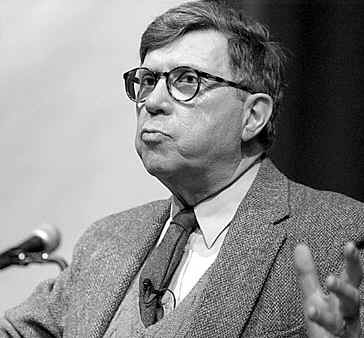
| Stephen Jay Gould. Wikimedia Commons. |
The day after Stephen Jay Gould died, his obituary appeared on the front page of the New York Times, testifying to his position as the most famous scientist in the United States. His talent for synthesizing ideas and arguments, his work ethic, and — as he would have been the first to note — luck made him famous.
He had not planned to write his monthly column, “This View of Life,” for Natural History for twenty-five years, but, like his childhood hero Joe DiMaggio, Gould became known for this literary streak, which breathed new life into the half-forgotten art of the popular scientific essay, a tradition that dates back to Galileo.
Like Galileo, Gould did more than interpret science for laypeople. He was also a path-breaking evolutionary theorist and a canny political organizer for leftist causes.
Along with his colleague Niles Eldredge, Gould changed the way biologists view the fossil record. His concept of punctuated equilibrium argued that new species emerge relatively rapidly and then remain mostly stable for millions of years. To his more parochial colleagues’ chagrin, Gould partly credited the inspiration for “punc eq” to the fact that he had “learned his Marxism, literally at his daddy’s knee.”
Though he was redbaited for this comment, Gould and Eldredge were speaking as pluralists and historicists not dogmatists. “We make a simple plea for pluralism in guiding philosophies . . . for the basic recognition that such philosophies . . . constrain all our thought.”
Historical context also acts as a constraint on new ideas. Darwin acknowledged the influence of the classical political economy of Smith and Malthus on his theory of evolution. Gould noted that his leftist upbringing and participation in the revolution of the Civil Rights Movement enabled him to recognize the importance of “punc eq’s” patterns of sudden and discontinuous evolutionary change.
Gould also revitalized the study of evolutionary development with his influential historical survey of the subject, Ontogeny and Phylogeny, and made his mark on anthropology by insisting that human evolution looked more like a branching bush with multiple overlapping lineages than a ladder of predictable stages.
Raised in a leftist household in Queens, Gould led his local NAACP’s youth chapter. He displayed his writerly talents early on, when he introduced the Little Rock Nine on their victory tour of New York. “They are tormented by racists down South and autograph seekers here,” he noted drolly. He worried his brave fellow teenagers would not get to enjoy New York City and thanked them for enhancing his high school’s curriculum with the day’s most pressing issues. “No event in my memory ever aroused such interest in the Queens teenager,” Gould told the audience. “No event has ever aroused in him such hatred for segregation and all it stands for.”
While studying at Antioch College, he participated in desegregation efforts in and around Yellow Springs, Ohio. In 1964, a lone barbershop that had resisted desegregation for four years in nearby Xenia briefly became the Civil Rights Movement’s national focal point. Even while studying abroad at Leeds University, Gould fought for progressive causes, working to desegregate dance halls and joining the campaign for nuclear disarmament.
These two facets of Gould’s life regularly intersected. In 1982, he served as an expert witness against “creation science” in McLean v. Arkansas. A year earlier, he had published his most famous political intervention, his prize-winning critique of biological determinism, The Mismeasure of Man.
At its core, Mismeasure argues that the twentieth century’s IQ tests share a desire to justify race and class hierarchies with the nineteenth century’s more primitive measures of cranial features and theories of criminal physiognomy. In both eras, researchers rationalized the status quo with the premise of immutable, hereditary intelligence and the fallacy of reification, which held that intelligence can be reduced to a single number and those numbers used to rank people on a linear scale.
Mismeasure also addresses the issue of confirmation bias — especially racial bias — in the sciences. In the book and an article in Science that preceded it, Gould analyzed nineteenth-century race scientist Samuel Morton’s two sets of skull measurements, one from 1839 and the second from 1849, to demonstrate that Morton unconsciously manipulated his data to prove that Caucasians had greater cranial volumes than other racial groups.
Gould also reminded his readers that eugenics and other consequences of biological determinism remain with us. The United States, nation of immigrants, misused IQ tests to establish quotas on southern and eastern Europeans Jews in 1924 and kept them in effect as millions tried to flee Nazi Germany. The state of Virginia thought it wise to sterilize “idiots” and “morons” until as recently as 1972.
Mismeasure came out just as academia was accepting more women and people of color into its ranks. Thanks to Gould’s polemical style and activist stance, the book almost immediately became canonical in undergraduate curriculum.
Refutation and Vindication
Or rather, it was — until Gould returned to the Times’s headlines in June 2011. “Study Debunks Stephen Jay Gould’s Claim of Racism on Morton’s Skulls,” the article proclaimed. A team of physical anthropologists, led by Jason E. Lewis, had remeasured roughly half of Morton’s skulls and reanalyzed both his and Gould’s findings. They concluded, “[i]ronically, Gould’s own analysis of Morton is likely the stronger example of bias influencing results,” citing important instances where Morton’s work was more accurate than Gould’s. In the most glaring error, Gould inflated the average cranial capacity of Native American skulls by “arbitrarily” leaving out several smaller crania in his reanalysis.
People quickly reacted to the revelation of Gould’s purported bias toward “political correctness.” Writing on his influential blog, anthropologist John Hawks described Gould’s work as perfidious and claimed it “cast doubt on the validity of the scientific enterprise.” Ralph Holloway, a member of the team that reanalyzed Morton and Gould, explained that he “just didn’t trust Gould.” “I had the feeling that [Gould’s] ideological stance was supreme . . . [and] just felt he was a charlatan.”
Far-right “race realists” unsurprisingly trumpeted the news that Gould’s findings had been “refuted.” Even among more measured critics and defenders, a narrative began to take hold: Gould had proved his point, but “it just wasn’t the example he intended.” Morton started to appear more “sinned against than sinning.”
At the end of their article, Lewis et al. wrote, “were Gould still alive, we expect he would have mounted a defense of his analysis of Morton.” This is a virtual certainty: Gould openly acknowledged his errors throughout his career and called “factual correction . . . the most sublime event in intellectual life.” Gould cannot defend himself, but, since Lewis et al. can, it’s curious that they have not responded to more recent peer-reviewed studies that refute key aspects of their work.
Though the Times has yet to report it, more recent evidence suggests that the reanalysis of Morton’s skulls makes computational mistakes that favor Caucasians. And as several studies now show, the scientists did not ultimately challenge Gould’s main claim that the inconsistencies between Morton’s measurements in 1839 and 1849 indicate unconscious racial bias. Moreover, the differences between mean values for all races when corrected were, as Gould originally argued, so small as to be statistically insignificant.
Why hasn’t the Times reported these more recent findings? The answer also helps explain why they and other outlets so enthusiastically reported the criticism against Gould in the first place. As he would have recognized, it’s politics.
Historical interpretation as science
Though no one knew it in 2011, Nicholas Wade, the reporter covering the story for the Times, would publish a widely condemned “race science” book in 2014 called A Troubling Inheritance: Genes, Race, and Human History. A purported summary of recent research in population genetics that explains cultural differences between white, East Asian, and African civilizations, Wade’s book inspired an open letter of condemnation, which virtually every expert in the field of population genetics signed.
Beyond Wade’s pathetic resuscitation of “scientific racism,” the Gould-Morton controversy has a deeper political dimension. The absence of mainstream reporting on The Mismeasure of Man’s vindication shows how the popular press privileges “hard” science over the “soft” sciences of historical interpretation. Gould himself fought long and hard against this bias, which caricatured paleontologists like him as “stamp collectors.”
Gould wrote his 1989 book, Wonderful Life: The Burgess Shale and the Nature of History, in large part to counteract the bias toward experimental science. The Burgess Shale in British Columbia includes the greatest repository of fossils from the Cambrian explosion, the dawn of multicellular life. As Gould’s book notes, scientists working with these fossils radically changed paleontology’s core concepts. Contrary to earlier studies, many of the shale’s fossils do not have known ancestors. This means that life was, in crucial ways, more diverse at the outset of the multicellular period than since. Current species evolved from only a few “lucky” surviving lineages.
Because the work involved “mere” description and no experimental work, the new interpretations did not make headlines. Gould contrasts this with the other great paleontological development of the late twentieth century, the “Alvarez hypothesis,” which holds that dinosaur extinction resulted from extraterrestrial impact.
The impact theory has everything for public acclaim — white coats, numbers, [Alvarez’s] Nobel renown and location at the top of the ladder of status. The Burgess redescriptions, on the other hand, struck many observers as one funny thing after another — just descriptions of some previously unappreciated, odd animals from early in life’s history.
Both discoveries told the same compelling story; both “illustrat[ed] . . . the extreme chanciness and contingency of life’s history,” yet only the “Alvarez hypothesis” made the cover of Time magazine.
The same privileging of “hard” science explains why media outlets picked up the attack on Gould’s analysis but not his subsequent vindication. These reports all emphasized that Lewis et al. had literally remeasured hundreds of skulls in the Morton collection (presumably while wearing white lab coats). As one more recent critique noted, however, “from the standpoint of evaluating Gould’s published claims, the re-measurement was completely pointless.”
“Gould never claimed that Morton’s [later] shot-based measurements, which is what Lewis et al. compared their new measurements to, were unreliable.” Confirming their bias toward experimental methods, “Lewis et al. are . . . falsifying (their word) a claim Gould never made.” Such a glaring conceptual problem should prompt us, as it would have prompted Gould, to inquire into this supposed controversy’s historical context.
The return of far-right, racist politics was a depressingly predictable consequence of the election of the first black American president. The Obama administration didn’t help matters, as its failure to respond justly to the 2008 financial crisis only further radicalized some segments of the American population. Rebranded as the “alt-right” and “race realists,” this resurgence culminated in Trump’s election and his appointment of white nationalists to top posts.
Only in this climate can Lewis et al. claim without irony that Samuel Morton was a disinterested, objective researcher. This same Morton measured Native American skulls “to ascertain,” as his supporter George Combe put it, if they “perished” because of “a difference in brain between the native American race, and their conquering invaders.” This same Morton sought to prove the polygenist thesis, which holds that the human races arose separately. This same Morton was eulogized in the leading Southern medical journal of his day “for aiding most materially in giving to the negro his true position as an inferior race.”
Gould’s ideas remain vital because today’s reactionary racism isn’t an entirely new development. Rather, it extends the one Gould struggled against throughout his career.
In 1996, he reissued Mismeasure to include new material that debunked The Bell Curve, the biological-determinist bestseller of the early 1990s. In this second edition, Gould situated The Bell Curve in its historical context, arguing that novelty could not explain its popularity. After all, its central arguments had already been discredited on numerous grounds. Instead, Gould argued,
Its initial success must reflect the depressing temper of our time — a historical moment of unprecedented ungenerosity, when a mood for slashing social programs can be so abetted by an argument that beneficiaries cannot be aided due to inborn cognitive limits expressed as low IQ scores.
He would have been saddened, though maybe not surprised, to see this historical moment evolve into full-blown reaction. Mismeasure’s careful recording of how everything from pseudoscientific intelligence testing to programs of forced sterilization were used to maintain racial and class hierarchies gives readers a good idea of what it means to make America great again.
It’s no small task to summarize the diversity of Gould’s three hundred essays for Natural History. From the panda’s thumb to the flamingo’s smile; from the hyena’s genitals to the human male’s nipples; from the little known contingencies of Darwin’s life to the virtual impossibility of intelligent life ever evolving at all, Gould’s essays are as instructive as they are surprising and entertaining.
Tough Hope
But according to Gould, basic themes supported all this and diversity. He was interested in “the meaning of pattern in life’s history[,] . . . the nature of history[,] . . . and what it means to say that life is the product of a contingent past not the inevitable result of simple, timeless laws of nature.” Critics find this emphasis on unpredictability depressing. Does it amount to anything more than saying “stuff happens”?
Gould of course saw it differently. The luck of being here at all should make us more aware of our existence’s fragility and force us to recognize that we have no one to look to for guidance but ourselves.
In Wonderful Life, Gould argued that the evolution of intelligent life represents such a unique and improbable outcome, that, if you started life over at the beginning of the Cambrian explosion, different early organisms would have survived the period’s decimation, and we would never have existed at all:
Homo sapiens, I fear, is a “thing so small” in a vast universe, a wildly improbable evolutionary event well within the realm of contingency. Make of such a conclusion what you will. Some find it depressing; I have always regarded it as exhilarating, and a source of both freedom and consequent moral responsibility.
Gould’s sense of moral responsibility figures in his column’s other main project — what Marxists would recognize as his critique of ideology and what he called “the social implications of the scientific assault upon pervasive biases of Western thought.”
Gould listed four such biases: “progress, determinism, gradualism, and adaptationism.” They persist because they serve as a great comfort to many. Determinism and adaptationism tell us that we are meant to be here and are well suited for survival; gradualism and progress tell us that change occurs in predictable ways. In short, these biases teach us that everything happens for a reason.
As Gould pointed out, even progressive causes like the environmental movement fall prey to these biases’ hubris. Green activists too often assume that the earth is so delicate that we can destroy it and that, therefore, we shoulder the responsibility of saving it. With a New Yorker’s sarcasm, Gould responded, “We should be so powerful!”
He insisted that humans — not the earth — are the ones in danger. But this view does not make climate change any less of a crisis. As he put it:
Our planet is not fragile at its own time scale, and we, pitiful latecomers in the last microsecond of the planetary year are stewards of nothing in the long run. Yet no political movement is more vital and timely than modern environmentalism — because we must save ourselves (and our neighbor species) from our own immediate folly.
With his leftist organizing experience and his awareness of the consequences of human development on our own survival, you might expect that Gould would have devoted numerous columns to the ecological crisis. But he waited, he explained, until he could contribute something more than a repetition of “the shibboleths of the movement.”
In his essay on the extinction of the land snail Partula on the island of Moorea in French Polynesia, Gould argued that we should grieve for the scientist Henry Crampton whose lifetime of dedication to studying Partula on a remote island under adverse circumstances was erased by the unintended consequences of introducing predatory creatures into the environment. Though Gould was also an expert on land snails, as he explains it, the point is that we need a humanistic ecology too, “both for the practical reason that people will always touch people more than snails do or can, and for the moral reason that humans are legitimately the measure of all ethical questions — for these are our issues not nature’s.”
So what would Gould say today, as environmental decimation intensifies and the Trump administration begins to roll back the mostly inadequate steps taken to deal with climate change? A clue resides in Gould’s commentaries following the 9/11 terrorist attacks.
He lived in SoHo at the time, and he and his family volunteered tirelessly to support first responders and clean-up crews. Amid so much suffering, we might expect Gould’s writings to turn despondent and pessimistic. But he remained optimistic instead. Why?
Gould staked many of his arguments on the concept of relative frequency, which maintains that, the more something occurs, the more it matters. This idea made punctuate equilibrium significant, because stasis among lineages in the fossil record had high relative frequency but had “previously been ignored as nonevidence of nonevolution.” Gould noticed the high relative frequency of basic human decency in the weeks following 9/11.
After years of misguided wars and an expanded police state, it’s easy to forget that the event’s interpretation was an open question in those days near the end of Gould’s life. “Ground Zero,” he noted, “is a focal point for a vast web of bustling goodness, channeling uncountable deeds of kindness from an entire planet.” The people of Halifax, where he stayed when his plane was diverted during the attacks, had welcomed him and thousands of other stranded travelers.
Gould devoted his final column in Natural History to his grandfather, Papa Joe, who arrived in the United States, by a strange coincidence, on September 11, 1901. Like so many Jewish immigrants at the turn of the twentieth century, his grandfather found work in the garment district of Manhattan, struggled with poverty, but still managed to find his way. “He and my grandmother raised four children,” Gould writes, “all imbued with the ordinary values that ennoble our species and nation: fairness, kindness, the need to rise by one’s own efforts.” Gould argued that the countless ordinary stories like Papa Joe’s “will outshine, in the brightness of hope and goodness, the mad act of spectacular destruction that poisoned his life’s centennial.”
It is tempting to label these remarks as Pollyannaish, but Gould was not naïve. The philosopher in him spoke of the “Great Asymmetry”: one destructive act can undo years of careful effort, but decent people still vastly outnumber their counterparts. At the same time, the veteran political organizer in Gould knew it would take concerted action. His essay on Papa Joe closes:
We will win now because ordinary humanity holds a triumphant edge in millions of good people over each evil psychopath. But we will only prevail if we can mobilize this latent goodness into permanent vigilance and action.
The call for “permanent vigilance and action” under the rubric of “tough hope” in response to the work of reactionary extremists who reject modernity was Gould’s final theme as a public intellectual. With the Left returning to its duty to organize and remembering its roots in the projects of the Enlightenment and modernity, we must commit ourselves to Gould’s legacy of “tough hope.”