Showing posts with label Antartica melting. Show all posts

Saturday, May 27, 2017

2617. Antarctica Is Beginning toTurn Green Due to Global Warming

By Chris Mooney, The Washington Post, May 18, 2017

Researchers in Antarctica have discovered rapidly growing banks of mosses on the ice continent’s northern peninsula, providing striking evidence of climate change in the coldest and most remote parts of the planet.

Amid the warming of the last 50 years, the scientists found two different species of mosses undergoing the equivalent of growth spurts, with mosses that once grew less than a millimeter per year now growing over 3 millimeters per year on average.

“People will think of Antarctica quite rightly as a very icy place, but our work shows that parts of it are green, and are likely to be getting greener,” said Matthew Amesbury, a researcher with the University of Exeter in the United Kingdom and lead author of the new study. “Even these relatively remote ecosystems, that people might think are relatively untouched by humankind, are showing the effects of human-induced climate change.”

The study was published Thursday in Current Biology, by Amesbury and colleagues with the University of Cambridge, the British Antarctic Survey and the University of Durham.

Less than 1 percent of present-day Antarctica features plant life. But in parts of the Peninsula, Antarctic mosses grow on frozen ground that partly thaws in the summer — when only about the first foot of soil ever thaws.

The surface mosses build up a thin layer in the summer, then freeze over in winter. As layer builds on top of layer, older mosses subside below the frozen ground, where they are remarkably well preserved due to the temperatures.

Amesbury said that made them “a record of changes over time.”

Soil samples from a 400-mile area along the northern part of the Antarctic Peninsula found dramatic changes in growth patterns going back 150 years.

The Antarctic peninsula has been a site of rapid warming, with more days a year where temperatures rise above freezing. The consequence, the study found, was a four- to five-fold increase in the amount of moss growth in the most recent part of the record.

“This is another indicator that Antarctica is moving backward in geologic time — which makes sense, considering atmospheric CO2 levels have already risen to levels that the planet hasn’t seen since the Pliocene, 3 million years ago, when the Antarctic ice sheet was smaller, and sea levels were higher,” said Rob DeConto, a glaciologist at the University of Massachusetts, Amherst, who was not involved in the study but reviewed it for The Washington Post.

“If greenhouse gas emissions continue unchecked, Antarctica will head even further back in geologic time…perhaps the peninsula will even become forested again someday like it was during the greenhouse climates of the Cretaceous and Eocene, when the continent was ice free,” DeConto continued by email.

The authors agree the currently observed changes are probably just the beginning. “These changes, combined with increased ice-free land areas from glacier retreat, will drive large-scale alteration to the biological functioning, appearance, and landscape of the [Antarctic peninsula] over the rest of the 21st century and beyond,” they wrote.

The moss growth is still modest compared to what’s happening in the Arctic, where a large-scale greening trend has even been captured by satellite. In the Arctic, there’s now so much plant growth that some scientists are hoping it will at least partially offset the loss of carbon from thawing permafrost beneath those plants.

Those days are probably very far off for the Antarctic, but it’s clear the continent used to be a very different landscape.

“We’re starting back on a journey towards that sort of environment,” said Amesbury. “Certainly, Antarctica has not always been the ice place it has been now on very long timescales.”

Wednesday, February 24, 2016

2225. Antarctica Could Be headed for Major Meltdown

By  Science Daily, February 23, 2016

Map showing the locations of Antarctica's ice shelves, including Larsen C (in yellow on the top left), the largest ice shelf in the Antarctic Peninsula. (Credit: Ted Scambos, NSIDC).
In the early Miocene Epoch, temperatures were 10 degrees warmer and ocean levels were 50 feet higher -- well above the ground level of modern-day New York, Tokyo and Berlin.

It was more than 16 million years ago, so times were different. But there was one important similarity with the world we live in today: The air contained about the same amount of carbon dioxide. That parallel raises serious concerns about the stability of ice sheets in Antarctica, according to a study published in the Proceedings of the National Academy of Sciences.

All told, Antarctica's glaciers are the size of the United States and Mexico combined, and they contain enough water to raise the world's sea level by 180 feet. And although no humans live permanently in Antarctica, what happens there impacts everyone, said Aradhna Tripati, a geochemist at UCLA's Institute of the Environment and Sustainability who collaborated on the research.

"The ice sheets serve as huge stores of water," Tripati said. "As the ice melts, it gets dumped in the ocean and the sea level rises.”

The study is the latest revelation of ANDRILL, a $20 million research project focused on the South Pole. The effort, now 12 years old, has involved 100 researchers from seven countries. ANDRILL researchers were the first to bore holes through Antarctic ice shelves and sea ice to sample the ocean floor below.

Previous research showed that ice shelves -- the parts of the ice sheets that extend over water -- are vulnerable to even small increases in greenhouse gases. But the new study, which was written by Richard Levy of GNS Science, a New Zealand research organization, was the first to demonstrate that the huge, land-based glaciers are also vulnerable.

David Harwood, a University of Nebraska paleontologist who led the study, said the project's goal was to see what prehistoric environments could tell us about the modern era of climate change.

"We're drilling back into the past to understand the future and how dynamic our planet can be," he said.

To do that, researchers set 90 tons worth of drilling equipment on a floating sea ice in McMurdo Sound, where conditions can be particularly harsh: The average August temperature is minus 23 degrees Fahrenheit, and savage windstorms can occur at a moment's notice. Using a diamond-tipped tubular drill, researchers bored through 24 feet of ice, 1,200 feet of water and 3,300 feet of ocean floor. The rock samples they collected preserve a chronological record of environmental conditions dating back 20 million years.

The samples were sent to Tripati for analysis. As she looked at the sedimentary layers, a story began to emerge. Samples that were formed during warmer times, when the ice shelf was gone or unstable, were tan-colored and rich with fossils. But samples drawn from years when the sea was covered with ice, were mostly rock with fossils from only a few deep sea organisms.

Looking even closer, Tripati examined individual molecules from the samples to determine air and water temperatures at different times in history. Warmer times correlated with higher levels of carbon dioxide in the atmosphere, melting ice shelves and the loss of parts of the East Antarctic ice sheet.

According to Tripati, scientists are seeing early signs of the same conditions today.
"If carbon dioxide is sustained at current levels, we run the risk of Antarctic ice shelf disappearance," she said.

The ice shelves are critical because they act like a cork in a Champagne bottle, holding back the huge, land-based flows of glacial ice on the Antarctic continent, Tripati said. But they are particularly sensitive to temperature changes. Just a few degrees of increased warmth can make them disappear because they are warmed by both the air and the sea.

And disappearing ice shelves lead to even more warming because of something called the albedo effect: Light-colored ice reflects the sun's radiation away from Earth. After it melts, the darker-colored seas absorb more radiation and more heat.

That process could take hundreds of years, but signs of rapid change are already here. In 2002, the Larsen B ice shelf -- which was made up of more than 1,250 square miles of 720-foot-thick ice -- disintegrated into the ocean over the course of a month, shocking scientists and observers. Over the past several decades, seven out of 12 ice shelves on the Antarctic Peninsula have collapsed.

"They've just been going like dominoes," Tripati said.

Still, researchers say the PNAS findings offer a glimmer of hope. Policymakers rely on computer models to predict future climate change, and the models now can be refined based on the new information about changes that occurred millions of years ago, Tripati said.

The big question that remains is how fast melting will occur. Harwood said the ANDRILL findings emphasize the fragility of ice shelves and the urgency of taking action on a global scale.

"The models simulate thresholds, points of no return," he said. "It's good for policymakers to know how fast we have to get off this train or turn it in a new direction."


Journal Reference:

1 Richard Levy, David Harwood, Fabio Florindo, Francesca Sangiorgi, Robert Tripati, Hilmar von Eynatten, Edward Gasson, Gerhard Kuhn, Aradhna Tripati, Robert DeConto, Christopher Fielding, Brad Field, Nicholas Golledge, Robert McKay, Timothy Naish, Matthew Olney, David Pollard, Stefan Schouten, Franco Talarico, Sophie Warny, Veronica Willmott, Gary Acton, Kurt Panter, Timothy Paulsen, Marco Taviani. Antarctic ice sheet sensitivity to atmospheric CO2variations in the early to mid-Miocene. Proceedings of the National Academy of Sciences, 2016; 201516030 DOI: 10.1073/pnas.1516030113

Monday, November 9, 2015

2082. Melting Ice in West Antarctica Could Raise Seas by Three Meters, Warns Study

By Agence France-Presse, The Guardian, November 2, 2015
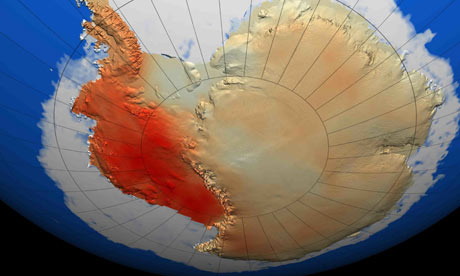
The red area is west Antartica that is melting
A key area of ice in west Antarctica may already be unstable enough to cause global sea levels to rise by three metres of ocean rise, scientists said on Monday.

The study follows research published last year, led by Nasa glaciologist Eric Rignot, warning that ice in the Antarctic had gone into a state of irreversible retreat, that the melting was considered “unstoppable” and could raise sea level by 1.2 metres.

This time, researchers at Germany’s Potsdam Institute for Climate Impact Research pointed to the long-term impacts of the crucial Amundsen Sea sector of west Antarctica, which they said “has most likely been destabilized”.

While previous studies “examined the short-term future evolution of this region, here we take the next step and simulate the long-term evolution of the whole west Antarctic ice sheet,” the authors said in the Proceedings of the National Academy of Sciences.
They used computer models to project the effects of 60 more years of melting at the current rate.

This “would drive the west Antarctic ice sheet past a critical threshold beyond which a complete, long-term disintegration would occur.”

In other words, “the entire marine ice sheet will discharge into the ocean, causing a global sea level rise of about three meters,” the authors wrote.

“If the destabilisation has begun, a three-meter increase in sea level over the next several centuries to millennia may be unavoidable.”

Even just a few decades of ocean warming can unleash a melting spree that lasts for hundreds to thousands of years.

“Once the ice masses get perturbed, which is what is happening today, they respond in a non-linear way: there is a relatively sudden breakdown of stability after a long period during which little change can be found,” said lead author Johannes Feldman.

The authors noted that Antarctica’s situation presents the largest uncertainty in sea level projections for the coming centuries, and that studying the vast region poses many challenges.

And indeed, just days before the PNAS study was released, another scientific paper used Nasa satellite data form 2003 to 2008 to show that Antarctic ice had gained mass, and had packed on enough to exceed the amount lost in other areas.

“We’re essentially in agreement with other studies that show an increase in ice discharge in the Antarctic peninsula and the Thwaites and Pine Island region of west Antarctica,” said a statement by Jay Zwally, a glaciologist with Nasa Goddard Space Flight centre whose study was published on 30 October in the Journal of Glaciology.

“Our main disagreement is for east Antarctica and the interior of west Antarctica – there, we see an ice gain that exceeds the losses in the other areas.”

According to climatologist Michael Mann, who was not involved in either study, the use of older satellite data could be the cause for the disconnect.

“It sounds to me as if the key issue here is that the claims are based on seven-year-old data, and so cannot address the finding that Antarctic ice loss has accelerated in more recent years,” he told AFP.