Showing posts with label American politics. Show all posts

Wednesday, February 19, 2020

3319. On Trump's Political Base: Audacity of Hate

By Thomas B. Edsall, The New York Times, February 19, 2020
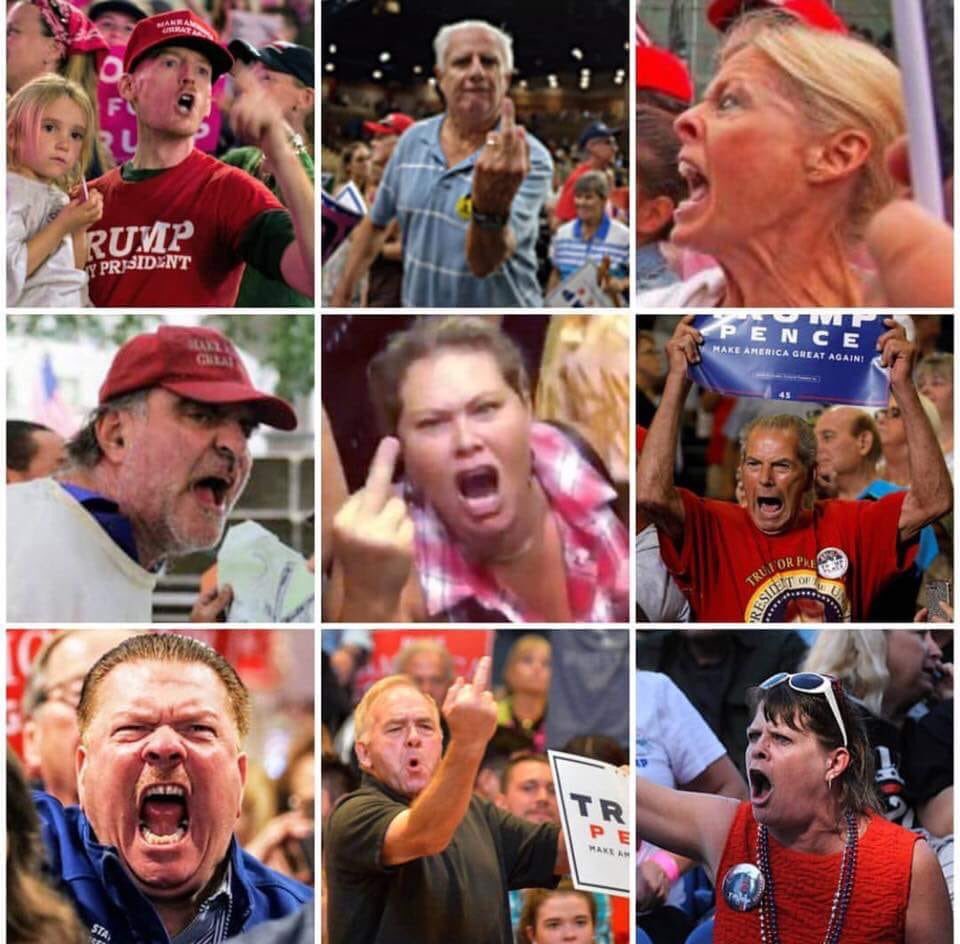
Trump's political base is empowered by fear and hate

Karl Rove had a novel idea for how to organize President George W. Bush’s 2004 re-election campaign.

He and the chief campaign strategist, Matthew Dowd, decided on a “base strategy.” 

They reallocated the bulk of the campaign’s media budget to focus on social conservatives instead of on moderates — a decision predicated on the fact that the swing or persuadable, share of the electorate had shrunk from one in five voters to less than one in 10. The most effective use of campaign funds, the thinking ran, was to invest in turning out more of the millions of white right-wing voters who needed to be motivated to show up at the polls.

The result was a shift that year from a traditional centrist strategy to an emphasis on anger and fear, a shift that turned out to have profound long-term consequences.

Campaigns in the past had relied on activating resentment and hostility, of course, but the re-election drive for Bush in 2004 was the first to make this the centerpiece of a mainstream presidential effort.

American politics were irrevocably transformed, polarization strategies became institutionalized and the stage was set for the explicit racial and anti-immigrant themes dominating Donald Trump’s campaigns for election and re-election.

Three major events over the next 10 years bridged the gap between the White House campaign of George W. Bush and the White House campaign of Donald J. Trump.
The economic meltdown of 2007-9 devastated faith in the American economic system and in the nation’s elected leaders — especially the Republican establishment.

In the midst of stock market losses of $2 trillion — a 40 percent plunge in the value of the Dow Jones — the country was hit by a catastrophic mortgage crisis, with nearly 10 million Americans losing their homes to foreclosure sales, according to Marketplace.org:

"The effects of the subprime mortgage crisis are not only still being felt today, they have indelibly changed the way Americans view homeownership and the way we live."

In 2008, the country, reeling from economic chaos, elected Barack Obama — the brainy president of the Harvard Law Review and a professor of constitutional law at the University of Chicago — as America’s first black president.

A second response to intensifying fears, however, was the emergence of the Tea Party, which mobilized racially and financially apprehensive whites who felt abandoned by the Republican leadership.

Hostility to Wall Street, costly bailouts of banks, brokerages and the auto industry, played a role. But as the financial crisis played out, immigration and struggles over school integration compounded this unease.

Theda Skocpol, a professor of government and sociology at Harvard and a co-author of “The Tea Party and the Remaking of Republican Conservatism,” told Mother Jones:

"This was definitely a movement of people who are anxious about racial changes in the country, anxious about immigration, and were, in some cases, also Christian conservatives who felt very passionately about homosexuality and abortion and having laws against those."

Skocpol, who spent many hours talking with Tea Party members, added that veterans of the Tea Party movement “are the core of the most adamant of Trump’s supporters.”

The Tea Party changed what it was permissible to debate openly in contemporary politics. Within a few years, it enabled Trump to further erode the norms of political combat and more openly instigate partisan conflict based on racial and ethnic antagonism.

Under Trump, coded rhetoric like Reagan’s “welfare queen” and Nixon’s “silent majority,” was — and is — no longer coded.

Trump’s sudden emergence as a political player began in 2011 with his championing of the birther movement, promoting the false allegation that President Obama was born in Kenya.

In March 2011, as he contemplated a run for the presidencyTrump began to claim in television interviews that Obama

"doesn’t have a birth certificate, or if he does, there’s something on that certificate that is very bad for him. Now, somebody told me — and I have no idea if this is bad for him or not, but perhaps it would be — that where it says “religion,” it might have 'Muslim.' And if you’re a Muslim, you don’t change your religion, by the way."

Trump directly challenged the political calculations of Republican leaders who argued after Mitt Romney’s defeat in 2012 that the party needed to make inroads among Latino, Asian and African-American voters.

Sean Trende, an election analyst at RealClearPolitics, Vox reported, “offered a different diagnosis: Romney’s real problem was ‘missing’ white voters who didn’t show up to vote,” and Trende was proved right: As the 2016 primary battle progressed, “those voters” were “no longer missing.” Trump had found them.

Trump didn’t just find the missing white voters. He found the voters who most strongly objected to immigration, responding positively to such survey questions as:

“Immigrants today are a burden on our country because they take our jobs, housing and health care” and “It bothers me when I come into contact with immigrants who speak little or no English.”

More than any of his competitors for the nomination, Trump understood the underbelly of the white Republican electorate. Not only did he understand it, he was ready and willing to go where no other presidential candidate would venture.

More than anything, Trump intuitively understood how polarization, and with it, the intense hatred among legions of Republican voters of liberal elites and of the so-called meritocracy could be a powerful tool to win elections.

Thomas Mann, a senior fellow at Brookings and the author, with Norman Ornstein, a resident scholar at the American Enterprise Institute, of the book “It’s Even Worse Than It Looks: How the American Constitutional System Collided With the New Politics of Extremism,” was blunt in his assessment of the broad contemporary political environment.

"Partisan polarization has become hard-wired in the American political system and is likely to be with us for the foreseeable future. Our constitutional system is not well matched with our current party system. Partisan asymmetry makes it even worse. The GOP has radicalized into an anti-system party that does not accept the legitimacy of its opposition and enables a slide toward autocracy. Very dangerous times for American democracy."
It is an environment in which negative campaigning, on TV and on social media, has become the instrument of choice, not a tool, but the beating heart of political partisanship.

Two political scientists, Gaurav Sood and Shanto Iyengar, describe this shift to antagonistic campaigning in “Coming to Dislike Your Opponents: The Polarizing Impact of Political Campaigns

"Negative ads are especially effective in increasing partisan affect. A strong negativity bias influences information processing, making people more likely to attend to negative rather than positive appeals."
The rise in hostile views of the opposition candidate, the two authors argue, “is not primarily due to learning about real ideological positions of the candidates and the parties.” Instead, they write, the more likely explanation is that the effectiveness of these campaigns is in reminding “partisans about the negative traits of the out-party candidate, and positive traits of her own party.”

Sood and Iyengar see the use of divisive campaign tactics increasing in the future:

"It is likely that as a consequence of the data revolution, and burgeoning social scientific research, campaigns will learn to target individuals better, and will be able to deliver more “potent” messages to them."

In this climate, penalties for intraparty dissent are quick and brutal. Take a look at what happened to Justin Amash, of Michigan, once a Republican in good standing, one of the founders of the conservative Freedom Caucus, who was sent to political purgatory (and eventually exile from the party) after he suggested that Trump had committed impeachable offenses as president.

“I don’t think we’ve seen the worst of it,” Douglas Ahler, a political scientist at Florida State University, emailed in response to my inquiry, adding:

"When you take today’s urban-rural divide, couple it with the most engaged citizens’ tendency to live in echo chambers, and add accelerants in the forms of identity politics and misinformation campaigns, you have a house waiting to go up in flames.
“We identify three possible negative outcomes for democracy,” the political scientists Jennifer McCoy and Tahmina Rahman of Georgia State and Murat Somer of KoƧ University Istanbul, wrote in their 2018 paper, “Polarization and the Global Crisis of Democracy.”

The three negative outcomes, according to the authors, are gridlock; democratic erosion or collapse under new elites and dominant groups; and democratic erosion or collapse under old elites and dominant groups.

With few exceptions, political scientists are pessimistic about both the short- and long-term prospects for the amelioration of hostile partisan division. It is probably best not to take comfort in experiments that reveal that, under certain circumstances, it is possible to lessen polarization.

Ethan Porter, a professor of media and public affairs at George Washington University, for example, wrote me that his work with Thomas J. Wood, a political scientist at Ohio State, shows that

when factual misinformation is corrected, people tend, on average, to be made more accurate. People are hardly invulnerable to factual corrections; on the contrary, whether Republicans or Democrats are exposed to corrections of their partisan leaders, they generally respond by becoming more accurate.

In practice, however, the rise of newspaper fact-checking would appear to at least partially achieve the goal of correcting misinformation, even as the rise of mutual hatred between Democrats and Republicans has accelerated.

Similarly, Joshua Kalla and David Broockman, political scientists at Yale and Berkeley, argued in their January 2020 paper “Reducing exclusionary attitudes through interpersonal conversation,” that “exclusionary attitudes — prejudice toward outgroups and opposition to policies that promote their well-being — are presenting challenges to democratic societies worldwide,” but, what they describe as “non-judgmentally exchanging narratives in interpersonal conversations can facilitate durable reductions in exclusionary attitudes.”

But, it is difficult, if not impossible, to conceive of circumstances under which Chuck Schumer and Mitch McConnell, or Nancy Pelosi and Donald Trump, would “non-judgmentally” exchange “narratives in interpersonal conversations.”

Nate Persily, a professor of law and political science at Stanford, wrote me that the most significant damage resulting from negative partisanship and polarization is 

"that the normal methods of accountability in a democratic society cease to apply. It used to be that people, regardless of party, believed government statistics about the employment rate and other metrics of progress and national well-being. Now, our interpretation of the basic facts of whether we are going in the right or wrong direction is dominated by whether expressing such an opinion is consistent with that which would advantage our tribe."

This extends to the legitimacy of elections, Persily continued, adding that

"trust in the electoral process is now contingent on who wins. That is, losers will cry ‘fraud’ and consider the president illegitimate, even if the election is well-run. This is the kind of dynamic we see in the developing world and unstable democracies. It is a recipe for disaster."

Alex Theodoridis, a political scientist at the University of California-Merced, argued that instead of being an aberration, polarization may now be the norm, the default political environment:

"Many look back fondly on the middle part of the last century when a political party, ideology, and a host of social categories were not strongly aligned the way they are today and, thus, partisan polarization was far less pronounced."

But, he continued,

it is more likely that that bygone era was the aberration and today’s hyperpolarization is what we should expect in equilibrium. In other words, we probably ought to accept the current state of affairs as the new normal. The mutual dislike and distrust between Democrats and Republicans is likely to persist without a dramatic party realignment.

In fact, nothing would make Trump happier than to have Theodoridis’s belief that polarization is the new normal or to see Persily’s warnings of lost legitimacy proven true. Trump thrives when the climate is chaotic and disruptive and he is the prime example of lost legitimacy in American politics.

Thursday, September 19, 2019

3282. American Electoral Politics: The Changing Shape of the Parties Is Changing Where They Get Their Money


By Thomas B. Edsall, The New York Times, September 18, 2019


Money is the mother’s milk of politics, as the old saying goes, and the slow-motion realignment of our two major political parties has changed who raises more money from the rich and who raises more from small donors.

A pair of major developments give us a hint about how future trends will develop on the partisan battleground.

First: Heading into the 2020 election, President Trump is on track to far surpass President Barack Obama’s record in collecting small-donor contributions — those under $200 — lending weight to his claim of populist legitimacy.

Second: Democratic candidates and their party committees are making inroads in gathering contributions from the wealthiest of the wealthy, the Forbes 400, a once-solid Republican constituency. Democrats are also pulling ahead in contributions from highly educated professionals — doctors, lawyers, tech executives, software engineers, architects, scientists, teachers and so on.

These knowledge class donors, deeply hostile to Trump, propelled the fund-raising success of Democratic House candidates in 2018 — $1 billion to the Republicans’ $661 million.
While there are advantages for Democrats in gaining support from previously Republican-leaning donors, this success carries costs. In winning over the high-tech industry, the party has acquired a constituency at odds with competing Democratic interest groups, especially organized labor and consumer protection proponents. Picking up rich backers also reinforces the image of a party dominated by elites.

In their paper, “Increasing Inequality in Wealth and the Political Expenditures of Billionaires,” Adam Bonica and Howard Rosenthal, political scientists at Stanford and N.Y.U., track the partisan contribution patterns of the Forbes 400 from the 1981-82 election cycle through the 2011-12 cycle.

For that three-decade period, the level of giving to Republicans and Republican Party committees by members of the Forbes 400 followed a steady downward trajectory, falling from 68 percent to 59 percent.

This downward trajectory coincided with the steady transformation of the sources of wealth for those on the Forbes list. In 1982, when the list was first published, solidly Republican manufacturers and energy producers dominated — 89 of the 400 richest Americans having made their fortunes in oil.

By 2018, 59 of the Forbes 400 had made their fortunes in technology, including six of the top ten: Jeff Bezos, No. 1; Bill Gates No. 2; Mark Zuckerberg, No. 4; Larry Ellison, No. 5; Larry Page, number 6; and Sergey Brin number 9. Eighty-eight more made their money in the financial sector. In contrast to the 1982 Forbes list, only 14 on the 2018 list made their money in manufacturing and 24 in energy.

“The 400 have trended steadily to the left,” conclude Bonica and Rosenthal.

The two authors write that from 1989 to 2017, members of the Forbes 400 have fared much better under Democratic presidents than Republican presidents: The 400 “did very well under the two Democrats, Clinton and Obama. They did not do well under either Bush.”

Bonica and Rosenthal’s analysis may prove troubling for those seeking to slow or reverse increasing wealth and income inequality. As the Forbes 400 moves toward the Democratic Party, they write, “Inequality in campaign contributions in the American plutocracy has grown hand in hand with the growth in economic inequality.”
They go on to raise another basic question: Does increased support for Democrats among the affluent and the rich undermine efforts to stem the growth of inequality?

The historic rise in inequality in recent decades has not ushered in an era of Republican fund-raising dominance. On the contrary, Democrats have made substantial gains against Republicans in recent decades while inequality was on the rise.

In a separate essay, published on the Scholars’ Strategy Network, which discusses the implications of their work, Bonica and Rosenthal wrote:

The superrich control resources that parties and politicians require and, as a result, are courted. Politicians have incentives to pay attention to the policy concerns that animate wealthy donors on left and right alike — and this dynamic influences public discussion and policymaking.

The continued concentration of money at the top, they write, translates into more political power:

"The ideas, values, and preferences of wealthy donors distort the focus of U.S. democracy more than individuals’ desires to grow their already vast fortunes. Rather than worry about individual corruption, citizens and leaders should worry about the many ways money in politics can amplify the voices of the privileged few over those of the majority. As wealth concentration grows, so will uneven political influence."

Bonica has turned tracking campaign contributions by wealth and occupation into a specialty.

He provided The Times with data extending from 1980 to 2016 covering the contribution patterns of donors who gave the largest amount of money in each election cycle. (Roughly a quarter of Bonica’s list overlaps with the Forbes 400 list.)

In the 1979-80 presidential election cycle, 71 percent of the top 400 donors gave to Republicans and to right-of-center political action committees, while 29 percent gave to Democrats and left-of-center PACS, a 42-point difference. In the 2015-16 presidential cycle, 54 percent gave to Republicans and right-leaning PACs, and 46 percent gave to Democrats, an 8-point difference.

In the case of contribution patterns of those in different occupations, Bonica emailed in response to my inquiry:

"The medical profession has perhaps experienced the largest generational realignment. Physicians who graduated medical school before the 1990s tend to favor Republicans, but younger cohorts have trended sharply to the left.
Bonica’s data shows that doctors who graduated in the 30 years from 1960 to 1990 consistently gave more to Republicans than to Democrats, generally in the 54-55 percent range."

Starting with those graduating in 1990, however, the share of contributions going to Republicans began to decline, dropping below 50 percent for those graduating in 1996 and falling to the low 30s for the youngest cohort.

As further evidence of this trend, Bonica cited a 2017 survey of 1,660 medical students published in the journal Academic Medicine. The survey reported that 89.1 percent said they supported Obamacare. In the survey, 77.7 identified themselves as liberal, 12.2 percent moderate and 7.2 percent conservative.

Bonica’s study of lawyers, conducted with Maya Sen, a political scientist at Harvard, also demonstrates a strong pro-Democratic trend in campaign contributions, although attorneys have leaned Democratic for decades.

On an ideological scale — with plus numbers indicating right-of-center and minus numbers indicating left-of-center — Bonica found that lawyers who graduated from nonelite schools shifted from roughly evenly split between left and right in the 1950s to minus .6, or liberal, by 2012. Lawyers from elite schools (Harvard, Stanford, Yale, etc.) were liberal-leaning in the 1950s (minus .25) and became rock-solid liberals by the current decade (minus .9).

Three different scholars — David E. Broockman and Neil Malhotra, professors at Stanford’s Graduate School of Business, and Gregory Ferenstein, an independent journalist who writes about Silicon Valley — have a different take. Their paper, “Predispositions and the Political Behavior of American Economic Elites: Evidence from Technology Entrepreneurs,” explores some of the political consequences of the ascendance of high-tech.

Technology entrepreneurs, despite their Democratic leanings, are ambivalent on key elements of the Democratic agenda, according to Broockman and his co-authors. They are reliably orthodox liberals on some issues, not so reliable on others.

On matters of globalization, trade, and immigration, this Silicon Valley constituency is firmly pro-globalization. Eighty-seven percent support free trade agreements and 56 percent are “in favor of increasing levels of immigration,” which is “15 points higher than Democratic” rank and file, the paper says.

On social issues, the authors found that “technology entrepreneurs are again very liberal,” including near-universal (96 percent) support of same-sex marriage, 82 percent support of gun control and 67 percent opposition to the death penalty.

Perhaps most significant and most surprising, surveys of high tech executives conducted by Broockman and colleagues show that tech entrepreneurs “strongly support redistribution and taxation.” For example, Broockman et al. continue, “nearly all technology entrepreneurs support increasing taxes on those making over $250,000 or $1,000,000 per year (with 76 and 83 percent expressing some support for each, respectively).” Seventy-five percent support programs specifically targeted toward the poor, including 59 percent in support of increased spending for the poor. Some 82 percent indicated “support for universal health care even if it means raising taxes.”

While high tech executives share the views of liberal elites generally on the issues described above, there are significant areas of conflict.

“Technology entrepreneurs do not share conventional Democratic views on the regulation of product and labor markets,” the authors write. “Technology entrepreneurs are indeed more conservative even than Republican citizens and most similar to Republican donors.”

On specific issues, almost all (82 percent) tech executives believe that it is too difficult to fire workers and that the government should make it easier to do so. However, majorities of Democratic donors and citizens believe the government should make it harder to fire workers (a 50 percentage point difference from technology entrepreneurs).

In the case of organized labor, three quarters (74 percent) of tech executives “say they would like to see labor unions’ influence decrease, versus only 18 percent of Democratic donors and 33 percent of Democratic citizens.”

In their conclusion, the three authors address how the growing influence of the tech industry in Democratic politics will affect the party’s approach to social spending and the reduction of inequality.

On one hand, they write, “technology entrepreneurs seem poised to support Democratic candidates — and therefore redistributive policies that should reduce inequality — financially.”

On the other, they point out that these entrepreneurs generally stand opposed to many government interventions in markets — such as government support for labor unions, worker protections, and consumer protections — that have long been central to the Democratic Party’s ideological answer to inequality and supported by traditional Democratic constituencies.

The result, they suggest, is that as Democratic elected officials receive increasing financial support from technology entrepreneurs and attempt to court further support from them” intraparty conflicts over “regulating product and labor markets may take center stage.

Altogether, the developments at the high-end of campaign finance are a mixed bag for the Democratic Party, expanding the sources of political money while simultaneously risking internal divisions.

More worrisome for the Democratic Party and its candidates is Donald Trump’s exceptional success in raising campaign money in small dollar amounts, which suggests that his racial and anti-immigrant rhetoric continues to motivate supporters.

Federal Election Commission data on Barack Obama’s 2012 campaign and Hillary Clinton’s 2016 bid, along with an analysis of Trump’s fund-raising in the 2020 campaign by the Center for Responsive Politics, shows the following.

By the end of his re-election campaign, Obama raised a total of $549.4 million, of which $234.4 million, or 42.7 percent, came in contributions of less than $200.

By the end of her 2016 campaign, Clinton raised a total of $405.7 million, of which $105.6 million, or 26.0 percent, came in low dollar amount,

By the end of June 2019, at a much earlier stage in his campaign, Trump had raised a total of $124.8 million, of which $87.3 million, or 70.0 percent, is made up of donations under $200.

Brian Schaffner, a political scientist at Tufts, wrote in an email that “Trump’s appeal is more to ideologues and emotional Republican contributors rather than to strategic and traditional Republican large-dollar donors.”

He argues that the fact that Trump raises such a large share from small-dollar donors is due less to Trump’s improvement among small donors than it is to the difficulty he has raising money from large donors. This is really a story about how the traditional large donors in the Republican Party didn’t want to give to Trump in 2016 and even so far in 2020 they continue to be reluctant to contribute to him.

Raymond J. La Raja, a political scientist at the University of Massachusetts-Amherst, also emailed me:

"It is not too surprising that Trump has outpaced others, even Obama, in raising money from small donors." 

Individual donors — big and small — tend to be much more polarized compared to the rest of the electorate. They give because of strong ideological preferences and passions. People like Trump ignite those passions.

Bonica notes that “there is a strong association between ideological extremity and total funds raised from small donors at the presidential level.” Bonica’s calculations of the ideological positioning of the candidates shows that Trump is “the most extreme conservative,” while Bernie Sanders, who “raised 58 percent of his campaign dollars from small donors” in 2016, stands out as the most liberal candidate, “which might mirror what we see in Trump from the left.”

Trump’s success in raising small-dollar contributions is not necessarily a harbinger of his prospects in November 2020. It does, however, raise a question about the contemporary role of the two major political parties.

Traditionally, one of the core strengths of the Democratic Party has been that voters trust it more than the Republican Party to protect and advance the interests of the middle class. In recent years, however, that advantage has been eroding.

The NBC/WSJ poll has repeatedly asked voters “which party do you think would do a better job looking out for the middle class?”

In the 1990s, an average of eight polls showed the Democrats with a 22.25 point advantage, 43.0 to 21.75. The question was dropped only to be resumed in December 2011. From 2011 to September 2014, the Democratic advantage fell to 19.5 points, 44.0 to 24.5.

Since then, in six surveys conducted from June 2015 to October 2018 — the Trump era — the Democratic advantage continued to erode to 13.1 points, 41.3 to 28.2. In the two most recent surveys, the Democratic advantage fell to 10 points, 41 to 31, less than half of what it was in the 1990s.

The Democrats may or may not regain the presidency in 2020, but they could well lose their invaluable credential as the party of the middle class.

Sunday, December 11, 2016

2506. Professors Watchlist: Attacking Academic Freedom and Free Speech


By Kamran Nayeri, December 11, 2016 

 On November 21, a group called Turning Point USA, self-described as a "student movement for free markets and limited government," launched the website Professors Watchlist. In a November 28 New York Times article, Matt Lam, an organizer of the website, claims: “We aim to post professors who have records of targeting students for their viewpoints, forcing students to adopt a certain perspective, and/or abuse or harm students in any way for standing up for their beliefs.”  But a review of the list shows that those included have no record of "targeting," "abusing," or "harming" students. Instead, they are included because of their academic and scholarly work that the website organizers find contrary to their conservative outlook.  For example, Richard Wolfe, Emeritus Professor of Economics, of the University of Massachusettes, Amherst, is included simply for publishing scholarly books in Marxian economics.  Moreover, the list is inaccurate; Professor Wolfe retired seven years ago! 

Professors Watchlist is an attack on academic freedom and freedom of speech guaranteed by the First Amendment of the Constitution.  With the election of Donald Trump on November 8, rightist groups have become emboldened.  A Southern Poverty Law Center survey of more than 10,000 K12 teachers, counselors, and administrators after the elections found that 90% believed the school atmosphere was negatively affected and 80% reported heightened anxiety and concern among students.  Turning Point USA and their Professor Watchlist is an attempt to extend such fears to the colleges.  

But there is already resistance.  On December 8, more than one hundred professors from the University of Notre Dame published a letter in the students' paper The Observer to ask their names should also be included in the Professors Watchlist. They wrote: 
We make this request because we note that you currently list on your site several of our colleagues, such as Professor Gary Gutting, whose work is distinguished by its commitment to reasoned, fact-based civil discourse examining questions of tolerance, equality, and justice. We further note that nearly all faculty colleagues at other institutions listed on your site, the philosophers, historians, theologians, ethicists, feminists, rhetoricians, and others, have similarly devoted their professional lives to the unyielding pursuit of truth, to the critical examination of assumptions that underlie social and political policy, and to honoring this country’s commitments to the premise that all people are created equal and deserving of respect. 

This is the sort of company we wish to keep.

We surmise that the purpose of your list is to shame and silence faculty who espouse ideas you reject. But your list has had a different effect upon us. We are coming forward to stand with the professors you have called “dangerous,” reaffirming our values and recommitting ourselves to the work of teaching students to think clearly, independently, and fearlessly.
 John Bellamy Foster, a world-renown Marxist sociologist, professor of sociology at the University of Oregon and editor of the socialist journal Monthly Review, is also included in the Professors Watchlist.  Here are his remarks to the  Political Economy of the World-System, Marxist Sociology, and Environment and Technology Sections of the American Sociological Association:  
Dear Colleagues,
This is no game. We are in a different period. I have not yet seen the environmental sociology discussion on this, but I am a PEWS [Politial Economy of the World-System], Environmental and Technology, and Marxist Sociology Section member (a former chair of the Marxist section) and I am on the list. I believe I am the only one on the list in Oregon. In my case I am on it because of the Horowitz Dangerous Professors list of a decade ago, where I was listed. The Professor Watchlist has taken over the statements by Horowitz there word for word, I believe, but now it is more serious. There is a University of Oregon Chapter of the Professor Watchlist established over the last week and I am the principal target. This week an NPR affiliated local radio station will be interviewing the head of the Chapter in a call-in show, where that individual will no doubt pinpoint me as the local rotten apple and use that as a weapon for threatening other professors. One of my sins is to be editor of Monthly Review. I have been asked to do a separate, “adjacent” interview on the same station, in which I will be able to respond. 
Here we have to learn from history. The key to developing a coherent response is the Einstein First Amendment Strategy from 1953 developed in the midst of the McCarthy Era (the initial attempt to use the First in the case of the Hollywood Ten failed) in which Einstein declared that there should be determined non-cooperation and that the goal should be to use the First to attack the inquisition itself. His letter appeared in the NYT on June 12, 1953 and opened the way for writers Leo Huberman and Harvey O’Connor, and then Corliss Lamont, Lillian Hellman, and Paul Sweezy, all of whom were closely connected and linked to Einstein and MR, to put this strategy into practice in a succession of attempts to break McCarthyism. Sweezy was the most successful because he refused to turn over his lecture notes and to name names and they hit him with contempt of court and consigned him to county jail and he fought it all the way to the U.S. Supreme Court. Things are obviously not at that critical state yet (we are not talking about subpoenas and prosecutions with possible imprisonment at the moment), though there are calls to reestablish the House on Un-American Activities Committee. But I think that the Einstein strategy is what we need to adopt from the start. If such a stance is taken from the beginning we may be able to head off further disasters. There should be no arguing of specifics of charges, rather freedom of speech and academic freedom and challenging the goon squads should be everything. You might want to familiarize yourself with the U.S. Supreme Court Decision Sweezy v. New Hampshire of 1957. You can find it online under its case number (354 U.S. 234). Welcome to Gleichschaltung. 
Yours,
                    John Bellamy Foster 


A local radio station, interviewed a student representing the Professors Watchlist as well Professor Foster.  You can listen to them here.