Showing posts with label Agricultural revolution. Show all posts

Monday, August 29, 2016

2427. Gender Equality in Hunter-Gatherer Bands

By Hannah Delvin, The Guardian, May 14, 2015
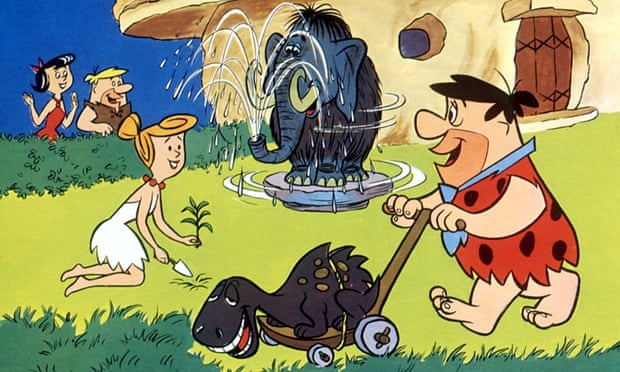
The authors of the study argue that sexual equality may have proved an evolutionary advantage for early human societies, as it would have fostered wider-ranging social network (probably not including gardening). Photograph: Everett Collection / Rex Features.
Our prehistoric forebears are often portrayed as spear-wielding savages, but the earliest human societies are likely to have been founded on enlightened egalitarian principles, according to scientists.
A study has shown that in contemporary hunter-gatherer tribes, men and women tend to have equal influence on where their group lives and who they live with. The findings challenge the idea that sexual equality is a recent invention, suggesting that it has been the norm for humans for most of our evolutionary history.
Mark Dyble, an anthropologist who led the study at University College London, said: “There is still this wider perception that hunter-gatherers are more macho or male-dominated. We’d argue it was only with the emergence of agriculture, when people could start to accumulate resources, that inequality emerged.”
Dyble says the latest findings suggest that equality between the sexes may have been a survival advantage and played an important role in shaping human society and evolution. “Sexual equality is one of a important suite of changes to social organisation, including things like pair-bonding, our big, social brains, and language, that distinguishes humans,” he said. “It’s an important one that hasn’t really been highlighted before.”


The study, published in the journal Science, set out to investigate the apparent paradox that while people in hunter-gatherer societies show strong preferences for living with family members, in practice the groups they live in tend to comprise few closely related individuals. 
The scientists collected genealogical data from two hunter-gatherer populations, one in the Congo and one in the Philippines, including kinship relations, movement between camps and residence patterns, through hundreds of interviews. In both cases, people tend to live in groups of around 20, moving roughly every 10 days and subsisting on hunted game, fish and gathered fruit, vegetables and honey.
The scientists constructed a computer model to simulate the process of camp assortment, based on the assumption that people would chose to populate an empty camp with their close kin: siblings, parents and children.
When only one sex had influence over the process, as is typically the case in male-dominated pastoral or horticultural societies, tight hubs of related individuals emerged. However, the average number of related individuals is predicted to be much lower when men and women have an equal influence – closely matching what was seen in the populations that were studied.
“When only men have influence over who they are living with, the core of any community is a dense network of closely related men with the spouses on the periphery,” said Dyble. “If men and women decide, you don’t get groups of four or five brothers living together.”


The authors argue that sexual equality may have proved an evolutionary advantage for early human societies, as it would have fostered wider-ranging social networks and closer cooperation between unrelated individuals. “It gives you a far more expansive social network with a wider choice of mates, so inbreeding would be less of an issue,” said Dyble. “And you come into contact with more people and you can share innovations, which is something that humans do par excellence.”
Dr Tamas David-Barrett, a behavioural scientist at the University of Oxford, agreed: “This is a very neat result,” he said. “If you’re able to track your kin further away, you’d be able to have a much broader network. All you’d need to do is get together every now and then for some kind of feast.”
Advertisement
The study suggests that it was only with the dawn of agriculture, when people were able to accumulate resources for the first time, that an imbalance emerged. “Men can start to have several wives and they can have more children than women,” said Dyble. “It pays more for men to start accumulating resources and becomes favourable to form alliances with male kin.”
Dyble said that egalitarianism may even have been one of the important factors that distinguished our ancestors from our primate cousins. “Chimpanzees live in quite aggressive, male-dominated societies with clear hierarchies,” he said. “As a result, they just don’t see enough adults in their lifetime for technologies to be sustained.”
The findings appear to be supported by qualitative observations of the hunter-gatherer groups in the study. In the Philippines population, women are involved in hunting and honey collecting and while there is still a division of labour, overall men and women contribute a similar number of calories to the camp. In both groups, monogamy is the norm and men are active in childcare.
Andrea Migliano, of University College London and the paper’s senior author, said: “Sex equality suggests a scenario where unique human traits, such as cooperation with unrelated individuals, could have emerged in our evolutionary past.” 

Tuesday, August 9, 2016

2403. The Agrarian Revolution and Monogomy

By Stephanie Buch, Timeline, August 4, 2016
The Garden of Earthly Delight, Hieronymus Bosch circa 1500. (Wikimedia Commons)

Even if you haven’t so much as clipped a basil plant, you are the descendant of someone who tilled a field. And that person most likely participated in one of humankind’s earliest monogamous relationships. That’s because monogamy likely wasn’t commonplace until the invention of private property.

Before about 8,000 B.C.E. gathering food and resources was constant, and there was rarely extra. So, for the survival of all and the need to procreate, our prehistoric ancestors lived in nomadic clans — sharing everything from meals to childcare to sexual partners. These tribes had little hierarchical structure. Everyone played a crucial role in community survival. Everyone contributed to a shared group identity.

In such social structures, omnigamy thrived, posited 19th Century American anthropologist Lewis H. Morgan. Omnigamy was group partnerships among all genders in a large group, a step beyond polygamy, depending on your definition. Under such egalitarian circumstances, casual sex with multiple partners was the norm, according to the authors of Sex at Dawn. There was no shame or taboo about it. It follows, that everyone cared for everyone else’s children, too.

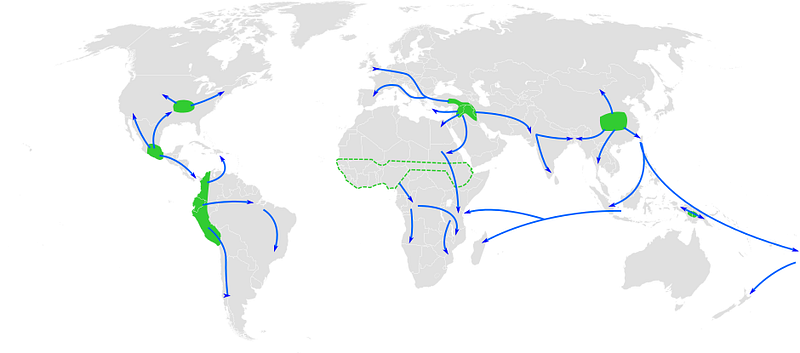
Map of the world showing approximate centers of origin of agriculture and its spread in prehistory (Wikimedia Commons)
However, between 12,000 and 4,000 B.C.E., in a period known as the Neolithic Revolution, humans learned to cultivate most of agriculture’s fundamental crops in the world’s major regions. Rice and soybean farming originated in China, pigs were domesticated in what is now modern Turkey, maize crops came from North America, etc.

Land settlement generally lead to a more sedentary lifestyle around urban centers — no more moving to follow food supply. Just grow some more. In many places, such as Western Europe, food surplus led to profit potential; private property became precious. And land wasn’t the only thing to own.

Women’s roles as community leaders shrunk. They were isolated in a new patriarchy, their bodies and babies mere chips in the agricultural economy.

From there, fierce competition for wealth divided communities into smaller units and eventually into nuclear families. Monogamy ruled, and still does.

But some argue our earlier ancestors had it right. Polyamory isn’t just an experimental phase for Tinder users; it’s coming out of the shadows as a legitimate alternative to coupledom.

Added to the Oxford English Dictionary in 2006, polyamory is the practice of forging intimate relationships with multiple people at a given time. Unlike hookup culture participants, poly people seek genuine emotional connection with two or more partners. Polyamory may exist in closed relationships of triads or quads (three people or two couples, respectively), or more. Group marriages or “tribes” of many people consider themselves one cohesive relationship unit, not unlike those nomadic tribes.

Though research is still minimal, experts suggest roughly 4 to 5 percent of the U.S. population seeks romantic relationships outside monogamy, with their partner’s permission.

Not surprisingly, today’s poly practitioners differ from our ancestors. For one, we have different laws and governing bodies, social taboos, economics, and gender roles. Our ideas of consent are different. Also known as “consensual non-monogamy,” polyamory today emphasizes constant, open communication and respect among participants, perhaps a set of rules (“no sleeping with someone else in our shared bed at home,” for instance).

It can get complicated, of course, especially because we can’t shatter the ingrained norms of monogamy overnight. “A heterosexual, normative relationship is much easier to be in because the rules are there — that’s considered cheating, that’s not,” a woman named Maria tells Vice. “[In polyamory] you’re constantly talking about what the rules are.”

Not to mention that coming out as polyamorous to one’s family, even if they were Baby Boomers of the sexual revolution, is likely fraught with anxiety. The majority of estate and insurance laws also refuse to acknowledge triad relationships. Having children may complicate things even further on that front.

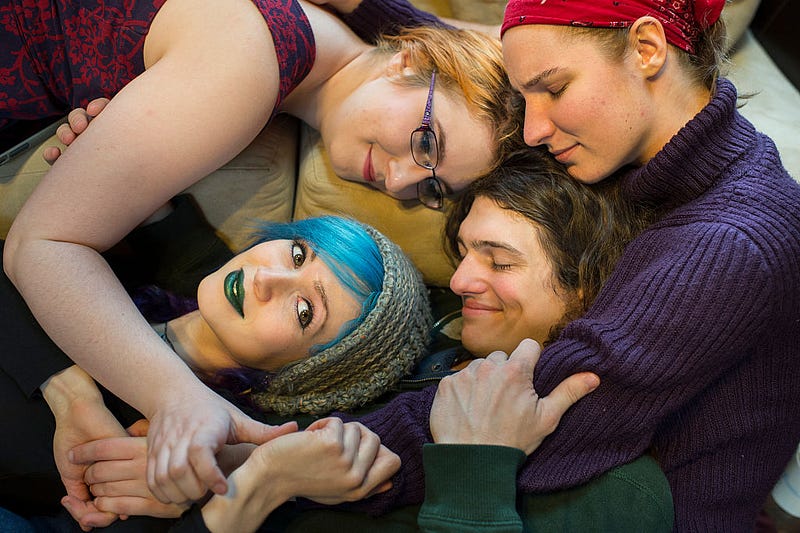
From top left clockwise, Rachel Ruvinsky, 22; Sam Brehm, 21; Bennett Marschner, 26; and Hannah Schott, 22; pose for a photograph in Derwood, Maryland, on Wednesday, January 20, 2016. The group of friends carry on multiple relationships simultaneously. (Photo by Nikki Kahn/The Washington Post via Getty Images)

Poly people have many different reasons to choose this lifestyle, but a big one is “yearning for community,” the innate need to connect rather than isolate. We’re not here to debate whether polyamory is the “natural” human state, but sharing love widely worked for a long time. The poly community calls it “compersion,” the feeling of pleasure one gets when their partner is fulfilled by another person’s love — the opposite of jealousy.

If this idea sounds distant and utopian, fine. But neither was monogamy a natural “fix” for human sexuality, if such a thing exists. It was merely one consequence in a world increasingly driven by commerce, a means of property ownership in the new agricultural economy.

Who knows, maybe technology will be to monogamy what agriculture was to polyamory: one phases the other out. Maybe Tinder is the new soybean.