Friday, November 18, 2016

2493. U.S. Companies to Trump: Don’t Abandon Global Climate Deal

By Hirako Tabuchi, The New York Times, November 16, 2016


Hundreds of American companies, including Mars, Nike, Levi Strauss and Starbucks, have urged President-elect Donald J. Trump not to abandon the Paris climate deal, saying a failure by the United States to build a clean economy endangers American prosperity.

In a plea addressed to Mr. Trump — as well as President Obama and members of Congress — 365 companies and major investors emphasized their “deep commitment to addressing climate change,” and demanded that he leave in place low-emissions policies in the United States.

“Failure to build a low-carbon economy puts American prosperity at risk,” the companies said in a joint letter announced on Wednesday in Marrakesh, Morocco, where global leaders are determining the next steps for the Paris deal. “But the right action now will create jobs and boost U.S. competitiveness.”

The companies also said that they would push ahead with their own targets to reduce their carbon footprints regardless of steps taken by Mr. Trump once he is in office. During his campaign, Mr. Trump, who has called climate change a hoax, pledged to leave the Paris accord, dismantle the Environmental Protection Agency and undo Mr. Obama’s climate change policies.

“This doesn’t change our commitments,” said Kevin Rabinovitch, global sustainability director at Mars, which has pledged to eliminate 100 percent of its greenhouse gas emissions from its factories and offices by 2040. “We’re doing this because we see a real business risk. We see a real business problem.”

Businesses large and small have scrambled in the days since Mr. Trump’s victory to chart their next moves in an uncertain regulatory situation. Mr. Trump’s campaign pledges and musings have been driven by the belief that the economy will grow faster if businesses are freed from cumbersome federal regulations, especially those that limit carbon emissions.

The president-elect has heightened environmentalists’ fears that his administration will take on an anti-climate, anti-environment bent by appointing the climate contrarian Myron Ebell to lead the E.P.A. transition. Climate change activists have denounced Mr. Ebell, whose Competitive Enterprise Institute has received funding from oil and gas interest groups.

Some corporations, like the country’s largest automakers, have already seized on a potential upside to the president-elect’s leanings, urging a rethinking of stringent federal auto emissions standards. An easing of federal standards for passenger cars, which together with the rest of the transportation sector emit more carbon dioxide than any other part of the American economy, could have immense implications for overall emissions.

Others, like solar and wind power companies, have raced to find common ground with Mr. Trump, pressing for reassurances that his administration will not slash investment in renewable energy or alter federal tax credits on renewable energy projects.
“Mr. Trump talks about infrastructure, he talks about jobs,” said Michael Skelly, founder and president of Clean Line Energy Partners, a company based in Houston that builds transmission lines for renewable energy.

“What we’re creating are welding jobs, steel manufacturing jobs, in Kansas, Oklahoma, Iowa,” he said. “These are projects that create income for landowners, create jobs in the middle of the country.”

The stakes are high. Damage from climate change — especially from extreme weather events like hurricanes, flooding and drought — could shave as much as 5 percent off annual global gross domestic product by 2100, according to a study commissioned by the British government that is considered one of the most comprehensive.

Environmental groups have been left with the daunting prospect that, with a climate skeptic in the White House, they will need to look directly to corporations to assume the mantle of leading the country’s response to climate change. But without strict regulatory standards or oversight, companies will be left freer to pick and choose which climate-friendly policies to pursue, and which they will choose to ignore or abandon.

Still, some American corporations have already made significant efforts to reduce their environmental footprints. So reversing them now would be disruptive not just for the environment, but for their bottom line. And even with a move away from climate-friendly policies back home, American corporations face tightening regulations overseas.

“Now more than ever, Levi Strauss believes it is important to reaffirm our commitment to address climate change by supporting the Paris Climate Agreement,” said Michael Kobori, the company’s vice president for sustainability.

“Building an energy-efficient economy in the U.S. will ensure our nation’s competitiveness,” he said, “and position U.S. companies as leaders in the global market — all while doing the right thing for our planet.

2492. The Coal Industry Isn't Coming Back

By Michael E. Webber, The New York Times, November 15, 2016


Austin, Tex. — Donald J. Trump made many important campaign promises on his way to victory. But saving coal is one promise he won’t be able to keep.

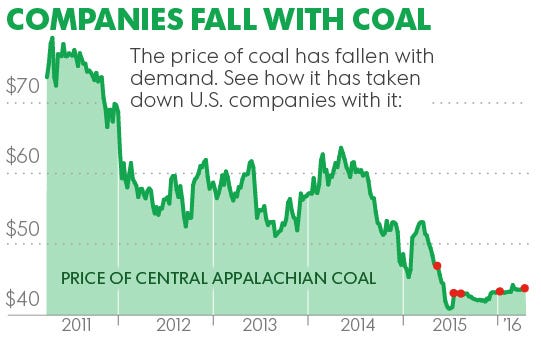
Many in Appalachia and other coal-mining regions believe that President Obama’s supposed war on coal caused a steep decline in the industry’s fortunes. But coal’s struggles to compete are caused by cheap natural gas, cheap renewables, air-quality regulations that got their start in the George W. Bush administration and weaker-than-expected demand for coal in Asia.

Nationwide, coal employment peaked in the 1920s. The more recent decline in Appalachian coal employment started in the 1980s during the administration of Ronald Reagan because of the role that automation and mechanization played in replacing miners with machines, especially in mountaintop removal mining. Job losses in Appalachia were compounded by deregulation of the railroads. Freight prices for trains dropped as a result, which meant that Western coal — which is much cleaner and cheaper than Eastern coal — could be sold to markets far away, cutting into the market share of Appalachian mines. These market forces recently drove six publicly traded coal producers into bankruptcy in the span of a year.

Mr. Trump cannot reverse these trends.

For Mr. Trump to improve coal’s fate would require enormous market intervention like direct mandates to consume coal or significant tax breaks to coal’s benefit. These are the exact types of interventions that conflict with decades of Republican orthodoxy supporting competitive markets. Another approach, which appears to be gaining popularity, is to open up more federal lands and waters to oil, gas and coal production.

Doing so would only exacerbate coal’s challenges, as it would add to the oversupply of energy, lowering the price of coal, which makes it even harder for coal companies to stay profitable. Those same policy actions would also lead to more gas production, depressing natural gas prices further, which would outcompete coal. Instead of being a virtuous cycle for coal, it looks more like a death spiral. And this is all without environmental regulations related to reducing carbon dioxide emissions, which aren’t even scheduled to kick in for several years.

Even if the president-elect tried to make these moves, surprising opponents might step in his way. Natural gas companies are the primary beneficiaries of, and now defenders of, clean air and low carbon regulations. They include Exxon Mobil, the world’s largest publicly traded international oil and gas company, which operates in a lot of countries that care about reducing carbon emissions. The company issued a public statement in support of the Paris climate agreement on Nov. 4, the day it took effect. Shutting down coal in favor of natural gas, which is cleaner and emits much less carbon, is a big business opportunity for companies like Exxon Mobil.

In the battle between coal companies and major oil and gas producers, I expect the latter will be victorious.

The rapid uptake of cheap renewables is also a contributor to coal’s demise. Mr. Trump made campaign comments suggesting the end of support for renewable energy technologies. But his recent statements call for supporting all energy forms, including renewables, suggesting he won’t target them after all.

Even if he did, what are his options? Their tax subsidies are already scheduled to expire or shrink. Plus, wind and solar farms are usually installed in rural Republican districts, which explains why they get so much Republican support in the first place. All those rural districts in America’s wind corridor might not be thrilled if their preferred candidate seeks to undermine one of their most important sources of economic growth.

The saving grace for coal production in the United States may be exports to Europe or China. But Europe’s demand for coal is waning. And Mr. Trump seems to be marching us toward a trade war with China. Doing so means the Chinese could retaliate by not buying our coal. And even if a trade war is avoided, cheap coal is readily available from nearby Australia.

What does this mean for the average American? More of the same when it comes to energy, which is a good thing. Energy prices will stay low and our air quality will keep improving. And both will help the economy grow.

Any way you slice it, coal’s struggles are real and hard to mitigate. No matter how much Mr. Trump tries to protect coal from market competition, doing so will be hard to execute and will get him crosswise with important Republican stakeholders and long-held Republican policy priorities.


Michael E. Webber is the deputy director of the Energy Institute at the University of Texas, Austin, and author of “Thirst for Power: Energy, Water and Human Survival.”

Wednesday, November 16, 2016

2491. A Noxious Smog Decends on Tehran

By Thomas Erdbrink, The New York Times, November 16, 2016
Tehran: What Is Wrong With This Picture?

TEHRAN — This week, as a yellow blanket of smog settled in for what is typically a winter-long stay, Reza Shajiee, a prominent hipster socialite, posted a picture of himself on Instagram wearing a gas mask under his motorcycle helmet. The text reads, “My city is better than yours, its air is better than yours,” and is accompanied by an emoticon wearing a gas mask.

One of his followers, @j.barzegar, responded, “Tehran gas chamber, slow death.”

Mr. Shajiee said he posted the picture in protest, but he didn’t know against whom. “No one can solve this, and it’s only getting worse,” he said.

Schools were closed for a second day in Tehran on Tuesday, and many citizens stayed home as the capital was covered in an unusually noxious cloud for a fifth day.

Like many other metropolises in developing countries, including New Delhi and Beijing, Tehran and other Iranian cities regularly disappear under a thick blanket of smog. Every year in the autumn, the pollution gets trapped by the Alborz Mountains that hug the city like an overbearing mother. It happens so often that it is hardly news anymore.

For most Iranians, the pollution is the new normal, a problem so large and complex that it is better just to pretend that it is not there.

Of course, the consequences are undeniable. On Tuesday, a City Council member said that 412 people had died because of the pollution in recent days. Iranian officials estimate that the pollution causes the premature deaths of about 45,000 people nationwide each year.

Hospital wards are filled with coughing patients. Children are told to cover their mouths when they go outside. With the increase in air pollution over the past decade, cases of bone marrow and lung cancer related to high levels of lead in the air have exploded, health experts say.

Iranian officials are at loss. A Health Ministry official told the Asr-e Iran news site that people can shield themselves from the cancerous pollution by staying indoors and drinking lots of milk and eating fresh vegetables. “This will strengthen the body,” said the official, Khosrow Sadeghniyat.

The office of Iran’s supreme leader, Ayatollah Ali Khamenei, issued a religious edict on Monday that said using cars during times of pollution without a good reason was religiously forbidden. A member of Parliament, Elias Hazrati, apologized to the nation on Tuesday, saying the conditions were “shameful.”

Mr. Shajiee, the socialite, said, “There are too many cars, too many people, the only solution is to stop everyone from going out, and everybody knows that will never happen.”

“I hate this city,” he added. “I’ll move out at the first opportunity.”

But he kept driving around on his chocolate-colored Vespa, churning out smoke. “What else to do?” he asked.

Under the city’s yellow blanket, most Tehranis go about their business as if the skies were blue and the air was clean. The traffic jams that define much of Tehran life are as insane as ever, despite emergency regulations aimed at keeping cars out of the center. Cafes and restaurants are full, and people even continue exercising in the city’s many parks.

“I can’t just sit at home,” said Pani Aghavan, 24, a musician. “I need to work and make money.” She wears a mask for protection, one of the few Tehranis to do so. “Most people simply don’t care; they prefer not to think of the pollution and the poison it is,” she said.

There has been pollution in Tehran for quite a while, but it picked up after the Iranian government was forced by sanctions to refine its own gasoline — a poisonous, high-octane brew. The sanctions were lifted after the nuclear agreement with world powers in January, but Iran continues to produce gasoline locally instead of sending its oil abroad for refining.

Many Iranians say that ignoring the problem is their only option. In a country where participation in politics is mostly limited to voting in elections, citizens simply learn to endure whatever comes their way.

“I work two jobs, have no money even to have a child and really don’t see how I can stop this pollution,” said Morteza Hosseinzadeh, who has a master’s degree in theater studies but sells fruit to survive. “Without hardship and taking risks I won’t get anywhere, so I can’t focus on solving such big problems.”

President Hassan Rouhani on Sunday called on citizens to help solve “national problems,” including pollution, an extreme water shortage and unemployment. Warning that there were several crises in the country, especially concerning the environment, Mr. Rouhani somewhat unhelpfully lauded the nuclear agreement for bringing “a breath of fresh air” to the country.

In response, the conservative Javan newspaper posted a picture of Tehran covered in smog with the headline: “Fresh air; Gradual death of citizens.” Other newspapers pointed out that the government’s obsession with car manufacturing was taking a toll. Over the past year, Iranian state-owned car manufacturers have closed deals with the French automakers Renault and Peugeot, aiming to increase the production of cars to two million a year.

“Even one additional car is too many,” said Mojgan Faraji, a journalist who is normally supportive of the government. Auto policies should change, she said. “As long as our gasoline is substandard, every new car worsens the situation.”

Children, elderly people and those with weak lungs are most affected by the pollution, but the effects of the smog go beyond the lungs, health experts say.

“It makes people agitated, depressed and even aggressive,” said Parisa Pakdel, a psychoanalyst in Tehran. “Youths lose their ability to concentrate, become hyperactive and develop sleep disorders. It’s not a pretty picture.”

2490. Americans Go to Cuba for Lung Cancer Treatment

By Sally H. Jacobs, The New York Times, November 14, 2016
Zuby Malik, in a family-supplied photograph, in front of La Pradera hospital in Havana. Ms. Malik, 78, has lung cancer.
Zuby Malik is an unlikely candidate to violate international law. A 78-year-old mother of four with a crown of silver hair, she is a retired obstetrician-gynecologist with a penchant for order.

But Ms. Malik is fighting for her life. After receiving a Stage 4 non-small-cell lung cancer diagnosis a year ago, she exhausted many of the treatments available to her and grappled with torturous side effects that left her itching and gasping for breath. During the summer, she decided to go to Cuba and bring back a cancer vaccine that is not approved in the United States. That she comes from a family steeped in medical training made the decision all the more difficult.

“At first, I was a little nervous,” said Ms. Malik, sitting in her Northern California living room flanked by an oxygen tank and a table of medicines. “But American treatments were not helping me, and I decided I should go to Cuba. What other choice did I have?”

Soon after she began the medication, she said, her breathing became easier and her energy returned. In her refrigerator was a box of blue- and orange-capped vials of the vaccine.

Other cancer patients are following the same unlikely trail. Since beginning to normalize relations with the United States in 2014, Cuba has become a hot tourist draw with its unspoiled beaches and vibrant night life. But the country also has a robust biotechnology industry that has generated an innovative vaccine called Cimavax. It is part of a new chapter of cancer treatment known as immunotherapy, which prompts the body’s immune system to attack the disease.

Cimavax is a therapeutic vaccine developed not to prevent cancer, but to halt its growth and keep it from recurring in patients with non-small-cell lung cancer. Developed in Cuba and available to patients there since 2011, it works by targeting a protein called epidermal growth factor, or E.G.F., that enables lung cancer cells to grow. The vaccine stimulates the body’s immune system to make antibodies that bind to E.G.F., preventing it from fueling the cancer’s growth. It is also available in Peru, Paraguay, Colombia and Bosnia and Herzegovina.

Last month, Gov. Andrew M. Cuomo of New York announced that the Roswell Park Cancer Institute, a nonprofit cancer center designated by the National Cancer Institute in Buffalo, had received authorization from the Food and Drug Administration to conduct a clinical trial of Cimavax. It marks the first time since the Cuban revolution that Cuban and American institutions have been permitted to engage in such a joint venture, said Roswell Park’s chief executive, Candace S. Johnson.

The trial could take years, but American cancer patients are not waiting. Over the past couple of years, dozens have slipped into Havana and smuggled vials of the vaccine in refrigerated lunchboxes back to the United States, sometimes not even telling their doctors. Talk about Cimavax on cancer patient networks online has been escalating steadily as relations between the two countries have warmed and more patients are making preparations to go.

“There’s no doubt that without this medicine, I would be dead,” said Mick Phillips, 69, of Appleton, Wis., who first went to Cuba in 2012 and has been returning annually ever since. “When we were children, we were taught that Cubans didn’t know what they were doing. Turns out they do.”

Despite experiences like Mr. Phillips’s, trials in Cuba have shown only a modest benefit over all. In the most recent trial, patients receiving the vaccine after chemotherapy lived about three to five months longer than patients who did not receive it. The study, published earlier this year in the peer-reviewed journal Clinical Cancer Research, also found that vaccinated patients with high concentrations of E.G.F. in their blood lived even longer.

The United States’ embargo against Cuba prohibits the importation of most goods from Cuba, including medication, without a license. American citizens are now permitted to travel to Cuba if their purpose falls into one of a dozen categories approved by the Treasury Department, but seeking medical care is not one of them.

Most patients going to Cuba fly through a third country such as Canada or travel under a general education category called “people to people.” None have declared with customs officials the dozens of vials of Cimavax they bring back tucked in their backpacks or suitcases. Stephen Sapp, a public affairs officer for United States Customs and Border Protection, says there is no record of Cimavax being intercepted at the United States’ border. If it were, it is unclear what might happen.

Under the F.D.A.’s “personal importation policy, some unapproved medications may be brought into the country if there is not an adequate alternative available in the United States, or if treatment began in a foreign country and the amount is limited to a three-month supply. In addition, the Treasury Department recently established a new general license enabling American citizens to import Cuban pharmaceuticals under certain circumstances. But in the case of Cimavax, the regulation has apparently never been put to the test.

Ms. Malik’s son, Nauman, carried 80 vials of the vaccine and a set of syringes in his backpack when he and his mother flew into Los Angeles from Cuba in June. Patients generally receive an initial round of four injections at La Pradera, an international health center that caters mostly to foreign medical tourists in Havana — two to the arms and two to the buttocks — and then continue to give themselves periodic injections at home for up to several months. At the airport, Mr. Malik wrote on his declaration form that he was carrying medication, but he said that authorities did not ask what it was.
“I was ready for the discussion, but it just never happened,” he said.

Cuban researchers began working on Cimavax in the 1990s, prompted in part by the high rate of lung cancer in the country. A noncontrolled study in 1995 produced the earliest published evidence of the feasibility of inducing an immune response against epidermal growth factor in patients with advanced tumors, according to a 2010 article published in Medicc Review, an international journal of Cuban medicine.

Dr. Kelvin Lee, the chairman of immunology at Roswell Park, has been collaborating with scientists at Cuba’s Center of Molecular Immunology since 2011. He said he hoped the vaccine could be used on other head and neck cancers and ultimately “to prevent cancer.”

Patients in Cuba began receiving the vaccine free in 2011, and it has been administered to more than 4,000 patients worldwide, according to Roswell Park. Lung cancer and immunotherapy researchers are intrigued by Roswell Park’s proposed trial, which would combine the vaccine with a form of immunotherapy called a checkpoint inhibitor that keeps the cancer from turning off a patient’s immune system. The Roswell trial intends to use the drug Opdivo, one of four checkpoint inhibitors approved by the F.D.A.

But the scientists are also reserved in their appraisal of Cimavax, in part because the Cuban trials were done on a relatively small number of patients. There is concern that the vaccine has received disproportionate attention in the flush of warming relations between the two countries.

“The data is intriguing, but we need to do more definitive studies to evaluate the benefits,” said Justin F. Gainor, a thoracic oncologist at Massachusetts General Hospital who works on the design of clinical trials for novel therapeutics. “Right now, the body of evidence does not support using it outside the clinical trial process.”

The Cuban health care system has long been recognized for providing high-quality health care. A 2015 report on the Cuban health system by the World Health Organization noted, “In Cuba, products were developed to solve pressing health problems, unlike in other countries, where commercial interests prevailed.”

With Cimavax migrating into the United States, those commercial interests are already coming into play. In Cuba, a four-shot dose of Cimavax costs up to $100 to manufacture, Dr. Lee said. Mr. Phillips, of Appleton, Wis., estimates that he pays about $9,000 for his annual supply of Cimavax, or about $1,500 a dose, which a visiting nurse administers every two months. Although some patients say the price recently dropped to about $850 a dose, the total cost of the trip can easily run more than $15,000, including airfare, lodging at La Pradera for several nights, and several months worth of the vaccine.
Mr. Phillips, a lifelong smoker who was given a lung cancer diagnosis in 2009, said it was worth every penny. After chemotherapy and radiation, his cancer returned in 2010.
“Since I have been taking Cimavax, it hasn’t come back,” said Mr. Phillips, who travels to Cuba via Toronto.

How other patients are doing on Cimavax is difficult to gauge. Ms. Malik’s oncologist declined to be interviewed, saying he did not know enough about the medication. Several patients said they had not told their doctors for fear that they would refuse to treat them further.

“I’m afraid he won’t treat me if I am being treated by a Cuban doctor,” said a 57-year-old woman named Lily who started Cimavax in Cuba in June and asked not to be identified because she is afraid of consequences for not declaring it. “I think he’ll be afraid of liability or malpractice issues if he treated me while I was taking something that’s not F.D,A.-approved.”

In the five months since Ms. Malik began taking Cimavax, her experience has been mixed. Initially, the fluid in her lungs diminished significantly, giving her renewed energy and allowing her to get around without her walker. But recently, fluid has begun to build up in her right lung, and she has grown weak and short of breath. Her son says she is likely to switch to a new medication soon and stop taking Cimavax. a
“It’s not panning out as we’d hoped,” he said. “It’s really like the Wild West trying to know what is best to do.”

Stories of patients returning from Cuba are met with keen interest on the online health care social network Inspire, which supports a lung cancer group of about 53,000 members. They share information about how to travel under the radar and which size of refrigerated lunchbox is best.

“We got a lot of inquiries,” said Judy Gallant, an owner of P&G Travel, which has offices in Ontario and Havana, and is planning trips to Cuba for half a dozen American patients. “We make it clear we are not medical people. We just help them connect with people who are.”

Some American patients have a new worry: that when Donald J. Trump, the president-elect, takes office, he might crack down on Cuba and make it more difficult for patients to travel there. But Mick Phillips does not seem worried.

“I think we’re going to be O.K.,” he said. “Trump may do a lot of things, but I don’t think he’s into preventing people from being able to live.”

2489. Paris Climate Agreement Is Too Weak to Meet Stated Goals, Report Finds

By John Schwartz, The New York Times, November 16, 2016
Himallian springs are drying up as glaciers melt
Morocco to hammer out details of the landmark global climate change accord reached in Paris almost a year ago, the independent International Energy Agency warned that the nearly 200-nation deal was too weak to meet its avowed temperature target.

The I.E.A.’s annual World Energy Outlook stated that reaching the Paris targets to reduce greenhouse gas emissions was possible, and that meeting those targets would slow climate change. Yet the I.E.A.’s estimates also showed that the result of those reductions was not likely to keep the temperature increase beyond preindustrial levels “well below” 2 degrees Celsius, as hoped. Instead, the report’s authors estimated, meeting the national commitments to reduce carbon dioxide emissions would still allow temperatures to rise 2.7 degrees Celsius by 2100.

Meeting the most ambitious temperature goal discussed at the conference would be next to impossible, the report stated: “The transformation required for a reasonable chance of remaining within the temperature goal of 1.5 degrees Celsius is stark.”

A shifting mix of energy sources that favors renewable energy and more efficient energy use are putting those targets within reach.

The annual report of the I.E.A., which is based in Paris, noted that renewable energy was booming, with more capacity added in 2015 than for coal, oil and nuclear power combined. Still, fossil fuels will have a substantial role to play in the global energy mix for many years to come — especially natural gas, which is rapidly displacing coal.

“The era of fossil fuels is far from being over, even if the Paris pledges are fully implemented,” said Fatih Birol, executive director of the I.E.A. Today, he said, the share of fossil fuels in the global energy mix is about 81 percent; if Paris goals are met, the share will drop only to 74 percent by 2040. This is in part because even though renewable energy sources are finding their way into electricity generation, oil is still an important source of power for transportation and petrochemical production.

Still, there are winners and losers within fossil fuels, Dr. Birol said. The biggest winner worldwide in the group’s projections is natural gas, and the biggest loser is coal. China, the world’s largest coal producer and user, has been pulling back and appears to have reached the peak of its coal use in 2013.

Dr. Birol declined to discuss the effect on the group’s projections of the election of Donald J. Trump, who has called climate change a hoax, and pledged to abandon the Paris deal and to promote a revival of coal.

“We are a technical organization,” Dr. Birol said. “Governments come and go around the world, and this is a perfectly normal thing.” He said the group would be watching the actual policies and actions that emerge from the Trump administration, since “these changes may have global implications.” Once the policies do emerge, “we will include them” in future reports, Dr. Birol said.

The report predicted that by 2040, 80 percent of the new energy generated to meet global demand will come from natural gas and renewable sources like solar and wind power.
A push to use energy more efficiently is expected to help in the fight against climate change, Dr. Birol said, citing predictions that world energy use is expected to rise more slowly than in the past, even in the face of continued economic growth.

Tim Buckley, an analyst with the Institute for Energy Economics and Financial Analysis, a progressive research organization based in Cleveland, said that the decline of coal and the explosion in low-cost renewable energy provided a simple lesson: “Those who exit fossil fuels and embrace solar and wind will reap financial rewards and avoid stranded assets.”

“Stranded assets” is a term applied to fossil fuel reserves such as oil, coal and natural gas that are still in the ground; in many scenarios of addressing climate change, companies would not be able to exploit their reserves. Oil companies like Exxon Mobil have disputed the issue. The new report states that unless governments work hard to address the issue for a smooth and orderly transition away from fossil fuels, “there is a risk that major losses will be incurred.”