Showing posts with label Coal. Show all posts

Sunday, November 25, 2018

3097. Climate Crisis and the Addiction to Coal

By Somini Sengupta, The New York Times, November 24, 2018
A miner in Telegana State, India, which, until recently, suffered chronic power failures. Photo: Rebecca Conway, The New York Times. 

HANOI, Vietnam — Coal, the fuel that powered the industrial age, has led the planet to the brink of catastrophic climate change.

Scientists have repeatedly warned of its looming dangers, most recently on Friday, when a major scientific report issued by 13 United States government agencies warned that the damage from climate change could knock as much as 10 percent off the size of the American economy by century’s end if significant steps aren’t taken to rein in warming.

An October report from the United Nations’ scientific panel on global warming found that avoiding the worst devastation would require a radical transformation of the world economy in just a few years.
Central to that transformation: Getting out of coal, and fast.

And yet, three years after the Paris agreement, when world leaders promised action, coal shows no sign of disappearing. While coal use looks certain to eventually wane worldwide, according to the latest assessment by the International Energy Agency, it is not on track to happen anywhere fast enough to avert the worst effects of climate change. Last year, in fact, global production and consumption increased after two years of decline.

Cheap, plentiful and the most polluting of fossil fuels, coal remains the single largest source of energy to generate electricity worldwide. This, even as renewables like solar and wind power are rapidly becoming more affordable. Soon, coal could make no financial sense for its backers.

So, why is coal so hard to quit?

Because coal is a powerful incumbent. It’s there by the millions of tons under the ground. Powerful companies, backed by powerful governments, often in the form of subsidies, are in a rush to grow their markets before it is too late. Banks still profit from it. Big national electricity grids were designed for it. Coal plants can be a surefire way for politicians to deliver cheap electricity — and retain their own power. In some countries, it has been a glistening source of graft.

And even while renewables are spreading fast, they still have limits: Wind and solar power flow when the breeze blows and the sun shines, and that requires traditional electricity grids to be retooled.

“The main reason why coal sticks around are, we built it already,” said Rohit Chandra, who earned a doctoral degree in energy policy at Harvard, specializing in coal in India.

Home to half the world’s population, Asia accounts for three-fourths of global coal consumption today. More important, it accounts for more than three-fourths of coal plants that are either under construction or in the planning stages — a whopping 1,200 of them, according to Urgewald, a German advocacy group that tracks coal development. Heffa Schücking, who heads Urgewald, called those plants “an assault on the Paris goals.”

Indonesia is digging more coal. Vietnam is clearing ground for new coal-fired power plants. Japan, reeling from 2011 nuclear plant disaster, has resurrected coal.

The world’s juggernaut, though, is China. The country consumes half the world’s coal. More than 4.3 million Chinese are employed in the country’s coal mines. China has added 40 percent of the world’s coal capacity since 2002, a huge increase for just 16 years. “I had to do the calculation three times,” said Carlos Fernández Alvarez, a senior energy analyst at the International Energy Agency. “I thought it was wrong. It’s crazy.”

Spurred by public outcry over air pollution, China is now also the world leader in solar and wind power installation, and its central government has tried to slow down coal plant construction. But an analysis by Coal Swarm, a U.S.-based team of researchers that advocates for coal alternatives, concluded that new plants continue to be built, and other proposed projects have simply been delayed rather than stopped. Chinese coal consumption grew in 2017, though at a far slower pace than before, and is on track to grow again in 2018, after declining in previous years.

China’s coal industry is now scrambling to find new markets, from Kenya to Pakistan. Chinese companies are building coal plants in 17 countries, according to Urgewald. Its regional rival, Japan, is in the game too: nearly 60 percent of planned coal projects developed by Japanese companies are outside the country, mostly financed by Japanese banks.

That contest is particularly stark in Southeast Asia, one of the world’s last frontiers of coal expansion.

Nguy Thi Khanh has seen the contest close-up in Vietnam. Born in 1976, a year after the end of the war, she remembers doing homework by the light of a kerosene lamp. In her northern village, the electricity failed several hours a day. When it rained, there was no power at all. When it came, it came from a coal plant not far away. When her mother hung laundry to dry, ash settled on the clothes.

Today, pretty much every household in Vietnam, population 95 million, has electricity. Hanoi, the capital, where Ms. Nguy now lives, is in a frenzy of new construction, with soaring demand for cement and steel — both energy guzzlers. The economy is galloping. And, up and down the coast, 1,600 kilometers in length, foreign companies, mainly from Japan and China, are building coal plants.

One such project is in Nghi Son, a onetime fishing village south of Hanoi and now home to a sprawling industrial zone. The first power plant opened here in 2013. Japan’s overseas aid organization, the Japan International Cooperation Agency, paid for it. The Japanese trading house Marubeni developed it.

A second coal-fired power plant, far bigger, is under construction next door. Marubeni is building that too, along with a Korean company. The Japan Bank for International Cooperation, an export credit agency meant to lower financial risk for private lenders, is helping to fund it.

In the shadow of the smokestack, Nguyen Thi Thu Thien was drying shrimp on the side of the road and complaining bitterly. She had moved out of her house after the power plant built an ash pond right in front. “The coal dust has blackened my house,” she said. “Even the trees are dying. We can’t live there.”

She and the others drying shrimp on the road were doubly angry that the new plant would need a new port, and that would displace their husbands, who tie up their fishing boats there.

Trucks rumbled by, throwing up dust, as the women emptied their baskets of shrimp. They kept every bit of themselves covered: wide-brimmed hats, face masks, gloves.

Coal accounts for 36 percent of the country’s power generation capacity now; it is projected to grow to 42 percent by 2030, according to the government. To feed those plants, Vietnam will need to import 90 million tons of coal by 2030.

But coal projects are also sparking community opposition rare in a country that squelches dissent. Villagers blocked a highway in 2015 to protest a Chinese project in the southeast. The provincial authorities quashed another proposed plant in the Mekong Delta.

Most plants in Vietnam use old, polluting technologies that many investors, including Marubeni, have recently promised not to back in future projects. A company spokesman said by email that it would continue with the Nghi Son project “to contribute to a stable power supply and to economic growth.”

Vietnam says it is on track to meet its emissions reductions targets under the Paris accord. So, too, China and India, with far bigger carbon footprints. But those targets were set by the countries themselves, and they will not be enough to keep global temperatures from rising to calamitous levels. The United States has said it will exit the Paris climate pact.

Those sobering facts loom over the next round of international climate negotiations, starting Dec. 3 in the heart of Poland’s coal country. The American delegation plans to promote coal at the event, just as it did at last year’s talks in Bonn, Germany.

In the public imagination, the coal miner has long been a symbol of industrial virility, a throwback to an era when hard labor — particularly men’s labor, rather than robots — fueled economic growth.

That idea has been central to politics. German coal miners have lifted the fortunes of that country’s far-right party. Poland’s right-wing government has promised to open new coal minesAustralia’s prime minister, Scott Morrison, rose to power as a champion of coal.

President Trump has promised, unsuccessfully so far, to revive coal mining jobs and instructed his Environmental Protection Agency to roll back rules to reduce emissions from coal-fired power plants.

That message might be welcome in American coal country, but the industry’s future in the United States is not promising. There are cheaper fuels, including natural gas; gas now accounts for around 31 percent of total power generation in the United States, the same share as coal. China has imposed tariffs on coal imports from the United States, in the tit-for-tat trade dispute. More than 200 coal plants have closed since 2010, and coal consumption has continued to decline, contrary to Mr. Trump’s false claims. Coal mining jobs have plummeted over the last decade, despite a modest increase of about 4 percent in the first 18 months of the Trump presidency.
‘We have coal. We are producing more every year.’

The economics, and the political calculus are very different in the world’s biggest democracy: India, population 1.3 billion.

Ajay Mishra, the career civil servant in charge of energy in the central Indian state of Telangana, knows firsthand.

Five years ago, he said, daily power cuts cursed his state. Ceiling fans cut out on stifling summer afternoons. Factories ran on diesel-guzzling generators. The people of Telangana were furious.

State officials had to do something to fix the electricity problem. They harnessed the sun, briefly making Telangana a leading solar power producer in India. They also turned to what government officials have relied on for over a century: the vast vein of coal that sat underground, stretching across the hills and forests of central India.

Telangana now has round-the-clock electricity. Its farmers get it free to pump water. It sweetens the re-election bid of Telangana’s top elected official, K. Chandrashekar Rao, in state polls later this year.

“We have coal,” Mr. Mishra said. “We are producing more every year. For the next 100 years we have it.”

On a warm Tuesday in October, about a four-hour drive from Hyderabad, the capital of Telangana, an army of men in indigo shorts went underground to dig it out.

A simple pulley drew them in, a bit like a ski lift, except here, it took them deeper and deeper down a shaft. The creak of the pulley was all you could hear, and water, drip-dripping inside the earth. Here and there, off to the side, stood miners, their forms barely visible in the darkness, except for the belted flashlights that snaked across their bodies.

At about 900 feet below the surface, where the air was black and cool and the coal under our feet was squishy, a burst of explosives broke down a wall of coal. Small, sooty chunks were piled into tubs and wheeled out, then loaded onto coal trucks that hurtled down the country roads, sprinkling a layer of ash everywhere.

So deeply is India invested in coal, this, like other mines, is state-owned. So are most power plants. Coal subsidies the country’s vast rail network.

That person at the top of that system, India’s prime minister, Narendra Modi, has sought to cast himself as a champion of clean energy.

But Mr. Modi has been inaugurating new coal mines, too. His government has made it faster for the industry, including mining, to get environmental clearances, rankling environmentalists. India’s state-owned companies are building new coal-fired plants across the country, almost all of them financed by public sector banks.

In an interview in the capital, New Delhi, India’s energy secretary, Ajay Bhalla, said some 50 gigawatts of additional coal capacity was under construction. That’s a fraction of what was under development even a decade ago when India’s energy demand was projected to soar. Many of those plants are meant to replace older, more polluting ones. But coal would not sunset anytime soon, he predicted, not until there’s a cheap and efficient way to store energy from solar and wind energy.

Analysts say India must retool its electricity grid for the post-coal era. Battery technology is fast advancing. Microgrids can replace traditional electricity systems. Many existing coal plants are now running below capacity, several are idle, and new energy efficiency standards could slow down demand to the point where there may be a glut of costly coal-fired plants. Left holding this bundle of stranded assets: The public sector banks that financed them.

For now, though, coal accounts for 58 percent of India’s energy mix.

“It’s not that I’m using the coal very willingly,” Mr. Bhalla said. “But I have to.”

Friday, November 18, 2016

2492. The Coal Industry Isn't Coming Back

By Michael E. Webber, The New York Times, November 15, 2016


Austin, Tex. — Donald J. Trump made many important campaign promises on his way to victory. But saving coal is one promise he won’t be able to keep.

Many in Appalachia and other coal-mining regions believe that President Obama’s supposed war on coal caused a steep decline in the industry’s fortunes. But coal’s struggles to compete are caused by cheap natural gas, cheap renewables, air-quality regulations that got their start in the George W. Bush administration and weaker-than-expected demand for coal in Asia.

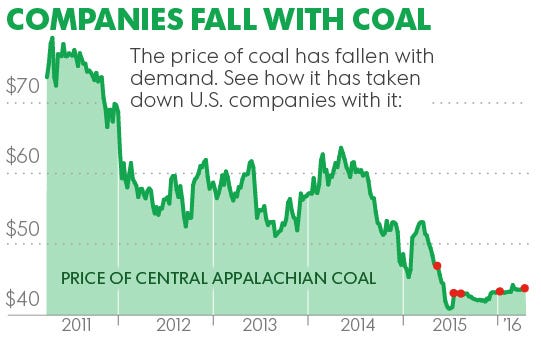
Nationwide, coal employment peaked in the 1920s. The more recent decline in Appalachian coal employment started in the 1980s during the administration of Ronald Reagan because of the role that automation and mechanization played in replacing miners with machines, especially in mountaintop removal mining. Job losses in Appalachia were compounded by deregulation of the railroads. Freight prices for trains dropped as a result, which meant that Western coal — which is much cleaner and cheaper than Eastern coal — could be sold to markets far away, cutting into the market share of Appalachian mines. These market forces recently drove six publicly traded coal producers into bankruptcy in the span of a year.

Mr. Trump cannot reverse these trends.

For Mr. Trump to improve coal’s fate would require enormous market intervention like direct mandates to consume coal or significant tax breaks to coal’s benefit. These are the exact types of interventions that conflict with decades of Republican orthodoxy supporting competitive markets. Another approach, which appears to be gaining popularity, is to open up more federal lands and waters to oil, gas and coal production.

Doing so would only exacerbate coal’s challenges, as it would add to the oversupply of energy, lowering the price of coal, which makes it even harder for coal companies to stay profitable. Those same policy actions would also lead to more gas production, depressing natural gas prices further, which would outcompete coal. Instead of being a virtuous cycle for coal, it looks more like a death spiral. And this is all without environmental regulations related to reducing carbon dioxide emissions, which aren’t even scheduled to kick in for several years.

Even if the president-elect tried to make these moves, surprising opponents might step in his way. Natural gas companies are the primary beneficiaries of, and now defenders of, clean air and low carbon regulations. They include Exxon Mobil, the world’s largest publicly traded international oil and gas company, which operates in a lot of countries that care about reducing carbon emissions. The company issued a public statement in support of the Paris climate agreement on Nov. 4, the day it took effect. Shutting down coal in favor of natural gas, which is cleaner and emits much less carbon, is a big business opportunity for companies like Exxon Mobil.

In the battle between coal companies and major oil and gas producers, I expect the latter will be victorious.

The rapid uptake of cheap renewables is also a contributor to coal’s demise. Mr. Trump made campaign comments suggesting the end of support for renewable energy technologies. But his recent statements call for supporting all energy forms, including renewables, suggesting he won’t target them after all.

Even if he did, what are his options? Their tax subsidies are already scheduled to expire or shrink. Plus, wind and solar farms are usually installed in rural Republican districts, which explains why they get so much Republican support in the first place. All those rural districts in America’s wind corridor might not be thrilled if their preferred candidate seeks to undermine one of their most important sources of economic growth.

The saving grace for coal production in the United States may be exports to Europe or China. But Europe’s demand for coal is waning. And Mr. Trump seems to be marching us toward a trade war with China. Doing so means the Chinese could retaliate by not buying our coal. And even if a trade war is avoided, cheap coal is readily available from nearby Australia.

What does this mean for the average American? More of the same when it comes to energy, which is a good thing. Energy prices will stay low and our air quality will keep improving. And both will help the economy grow.

Any way you slice it, coal’s struggles are real and hard to mitigate. No matter how much Mr. Trump tries to protect coal from market competition, doing so will be hard to execute and will get him crosswise with important Republican stakeholders and long-held Republican policy priorities.


Michael E. Webber is the deputy director of the Energy Institute at the University of Texas, Austin, and author of “Thirst for Power: Energy, Water and Human Survival.”

Wednesday, July 6, 2016

2364. The Failed Promise of "Clean Coal"

By Ian Urbina, The New York Times, July 5, 2016

A “first-of-its-kind” technologically speaking and the most expensive coal plant of all time, Mississippi Power’s Kemper Plant has put ratepayers at risk in pursuit of unproven and far-off returns. 

DE KALB, Miss. — The fortress of steel and concrete towering above the pine forest here is a first-of-its-kind power plant that was supposed to prove that “clean coal” was not an oxymoron — that it was possible to produce electricity from coal in a way that emits far less pollution, and to turn a profit while doing so.

The plant was not only a central piece of the Obama administration’s climate plan, it was also supposed to be a model for future power plants to help slow the dangerous effects of global warming. The project was hailed as a way to bring thousands of jobs to Mississippi, the nation’s poorest state, and to extend a lifeline to the dying coal industry.
The sense of hope is fading fast, however. The Kemper coal plant is more than two years behind schedule and more than $4 billion over its initial budget, $2.4 billion, and it is still not operational.

The plant and its owner, Southern Company, are the focus of a Securities and Exchange Commission investigation, and ratepayers, alleging fraud, are suing the company. 

Members of Congress have described the project as more boondoggle than boon. The mismanagement is particularly egregious, they say, given the urgent need to rein in the largest source of dangerous emissions around the world: coal plants.

The plant’s backers, including federal energy officials, have defended their work in recent years by saying that delays and cost overruns are inevitable with innovative projects of this scale. In this case, they say, the difficulties stem largely from unforeseen factors — or “unknown unknowns,” as Tom Fanning, the chief executive of Southern Company, has often called them — like bad weather, labor shortages and design uncertainties.

Many problems plaguing the project were broadly known and had been occurring for years. But a review by The New York Times of thousands of pages of public records, previously undisclosed internal documents and emails, and 200 hours of secretly though legally recorded conversations among more than a dozen colleagues at the plant offers a detailed look at what went wrong and why.

Those documents and recordings, provided to The Times by a whistle-blower, an engineer named Brett Wingo, and interviews with more than 30 current or former regulators, contractors, consultants or engineers who worked on the project, show that the plant’s owners drastically understated the project’s cost and timetable, and repeatedly tried to conceal problems as they emerged.

The system of checks and balances that are supposed to keep such projects on track was outweighed by a shared and powerful incentive: The company and regulators were eager to qualify for hundreds of millions of dollars in federal subsidies for the plant, which was also aggressively promoted by Haley Barbour, who was Southern’s chief lobbyist before becoming the governor of Mississippi. Once in office, Mr. Barbour signed a law in 2008 that allowed much of the cost of building any new power plants to be passed on to ratepayers before they are built.

Seeing so many of the problems from the inside, at least one employee felt the need to speak up.

“I’ve reached a personal tipping point and feel a duty to act,” Mr. Wingo wrote in a 2014 email, which was among several that he sent to officials of Southern Company and Mississippi Power, the state utility that runs the plant, alleging that the company had broken federal law and engaged in corporate fraud. “Hope is not a strategy,” he added. “This is a high-profile project with many misguided enemies, so why give them free ammo?”

In their recorded conversations with Mr. Wingo, at least six senior engineers from the plant said that they believed that the delays and cost overruns, as well as safety violations and shoddy work, were partly the result of mismanagement or fraud.
“It has nothing to do with the design, it has nothing to do with the technology, it just has to do with poor project management,” Landon Lunsford, an engineer at the plant, said during one recorded call with Mr. Wingo last December, when they discussed an email from Southern’s legal department telling senior employees to retain all emails because of a continuing S.E.C. investigation.

The company will never admit the project-management problems because they will attract more scrutiny from regulators, Mr. Lunsford said. “As long as they can talk away the results as attributable to something else other than just poor performance, the other public service commissions can’t hold them over the fire as much,” he added.

Officials from Southern Company and Mississippi Power, which is a Southern subsidiary, said that they could not comment on Mr. Wingo’s allegations but that all decisions about cost and budget projections were made by consensus. They also said that Mr. Wingo’s accusations had previously been investigated by the company and could not be substantiated. Mr. Wingo was fired in February, a move that the Occupational Safety and Health Administration later ruled illegal.

Ed Holland, the former chief executive of Mississippi Power, added that one of the project’s biggest mistakes was to start construction with little of the plant designed. “We still believe that from our investors’ standpoint, this was a wise investment to prove the technology,” he said in an interview.

In the end, the Kemper project is a story of how a monopoly utility, with political help from the Mississippi governor and from federal energy officials who pressured state regulators in letters to support the project, shifted the burden of one of the most expensive power plants ever built onto the shoulders of unwitting investors and some of the lowest-income ratepayers in the country.

Kemper’s rising price tag and other problems will probably affect the Environmental Protection Agency’s proposed rules on new power plants, and also play into broader discussions about the best way to counter climate change. E.P.A. regulations in effect require new coal plants to have carbon capture technology but are being held up in federal court partly by arguments that the technology is not cost-effective.

The importance of this technology grows, as well, after President Obama said last week that the United States would join Canada and Mexico in pledging to reach a shared goal of generating 50 percent of North America’s electricity from zero-carbon sources by 2025, up from 37 percent today, with a power mix that includes wind, solar, hydropower, nuclear energy and coal or gas power paired with carbon capture technology.

“The big question with clean coal has always been whether it’s a moonshot or a money pit,” said Charles Grayson, the director of the Bigger Pie Forum, which advocates fiscal conservatism in Mississippi and has been critical of the Kemper project for years. “The Obama administration and my state made a really bad wager in trying to use Kemper to make the economic argument for this technology.”

Coal represents a conundrum: It is among the dirtiest sources of fuel, producing roughly 45 percent of the emissions that contribute to climate change. And yet the world still relies on it for power, with more than a quarter of the electricity used globally coming from coal plants.

Southern Company proposed a promising idea with the Kemper project. Providing a cleaner way to use coal, which is cheap and abundant in the United States, the plant also offered the means to preserve many coal-mining jobs that are fast disappearing in this part of the country.

Kemper County, with mostly two-lane roads cutting through clay hills and pine forest, has an average per capita income of $14,837 and an unemployment rate roughly double the national average. To the region, the plant offered more than clean power: It promised hope, at least 12,000 jobs and long-term savings. As construction ramped up, the county took in over $8 million annually in extra tax money, which went toward repairing roads, bridges and schools, lowering local property taxes, and clearing debt.
In the summer of 2005, as Hurricane Katrina toppled drilling rigs and uprooted pipelines in the Gulf of Mexico, the price of natural gas rose by more than 40 percent. In Mississippi, utility regulators saw the Kemper plant as a way to diversify its energy options in a state that relies on natural gas for nearly 80 percent of its electricity.

The plant, which broke ground in 2010, would run on lignite, a type of coal that is difficult to process but is plentiful in the region. Most of the carbon dioxide produced by the plant would be captured, compressed, sold and piped to oil fields. There, it would be pumped underground in a process known as enhanced oil recovery, to help push up previously unrecoverable oil to levels where it could be reached.

Though carbon capture technology is proven and widely viewed as a potentially important tool to slow global warming, the question has been whether it can be scaled up affordably.

Before becoming governor, Mr. Barbour helped orchestrate the transfer of about $270 million in federal subsidies from a canceled coal plant in Florida to the proposed Mississippi plant. As governor, Mr. Barbour then signed the Baseload Act, which shifted much of the cost and risk of building power plants from investors to consumers, and allowed utilities such as Mississippi Power to charge ratepayers for projects before they were completed.

Carbon capture has been considered a holy grail for decades. For Ronald Reagan, it was a solution to acid rain; for Bill Clinton, an alternative to nuclear power. George W. Bush billed his FutureGen project as the world’s first zero-emissions coal plant but mothballed it when it became too expensive.

As the emphasis on fighting climate change grew, the Obama administration hung many of its hopes on Kemper. Gina McCarthy, the E.P.A. administrator, cited federal support for the project as proof that her agency was not anti-coal, despite strict new rules on power-plant emissions. The Energy Department repeatedly wrote state regulators emphasizing the importance of the project.

By 2012, though, “Miss Power,” as locals called the state utility, was facing mounting criticism about the plant. In May of that year, after the utility said that the Kemper project was $366 million over budget, it announced a plan to raise its customers’ rates by 13 percent.

Campaigning for a seat on the Mississippi Public Service Commission, Thomas A. Blanton, an opponent of the project, ran television ads featuring an older woman eating dog food and warning of sacrifices that poorer people sometimes make to afford electricity. In cramped trailers where some of the poorest people in the state live, summer temperatures topped 110 degrees — potentially deadly for older residents who could not pay to keep their air-conditioning running.

“You don’t want to pay to build my home, and I don’t want to pay to build your plant,” John Gooding, a cabinetmaker from Bay St. Louis, who lost his home in Hurricane Katrina, said during a public hearing about the rate hikes. “Some people are still living in trailers, and now you want to build a plant you can’t guarantee.”

Other critics piled on. Environmentalists called the plant the “Solyndra of clean coal,” a reference to the heavily subsidized but failed federal solar project. They asked whether the plant’s climate change benefits were overstated because the carbon it would capture from coal was going to be used to pump more oil.

Why was Kemper being cited as a model worthy of replicating, they asked, given that other plants would not share one of Kemper’s main advantages: a plentiful supply of cheap coal nearby.

Alleging that Southern Company and Mississippi Power had overstated the plant’s cost-effectiveness, the Bigger Pie Forum sued to unseal project records. To help make their case that the Kemper plant would be competitive with natural gas, which is coal’s main competitor, utility executives predicted to investors and regulators that the per-unit price for natural gas would be higher than $11 by 2016. But gas remains less than $2 per unit, undermining the business case for the plant.

The project did create jobs, but Mark Klinedinst, a retired economics professor from the University of Southern Mississippi, said that more were lost in the region as businesses laid people off to pay for the higher electrical bills caused by Mississippi Power rate increases from plant construction. The University of Southern Mississippi also raised annual tuition $236 per student, partly to offset its additional $1 million in higher electrical costs, he said.

The Whistle-Blower
Mr. Wingo, 48, had lived paycheck to paycheck for years, working at small, struggling engineering firms. When he was hired in 2007 by a subsidiary of Southern, it was a big step up. He doubled his salary to become a midlevel manager to help oversee scheduling and some design decisions on a project that he believed would make history.

Before long, Southern began flying him around the country to explain the project to others. He received glowing performance reviews and was awarded an annual $2,000 “Southern Excellence” employee award.

By 2012, though, Mr. Wingo had begun his transition to whistle-blower. About two weeks after state regulators renewed the license for the project to continue, Mississippi Power admitted to regulators that it had concealed cost overruns of about $366 million.
In increasingly testy meetings and emails over succeeding months, Mr. Wingo told his supervisors that other scheduling information that Mississippi Power and Southern Company were providing to the public was infeasible and misleading.

Ed Day, Mississippi Power’s chief executive at the time, tried to tighten control over what was shared. “I would like to remind everyone ‘again,’ no numbers, schedules, or information in general should be communicated to external parties until I review it/them first,” Mr. Day wrote in an Aug. 8, 2012, email to senior staff.

Others shared Mr. Wingo’s growing concerns. Tom Theodore, a scheduling consultant who worked on the Kemper project for about eight months in 2012, described the company’s stated schedule as little more than “a pretty picture to show everybody that we’re all doing wonderful as opposed to what reality showed on the ground.”

His predecessors had altered the software so it no longer automatically adjusted the final price and completion date to reflect problems as they emerged, he said.

Greg Zoll, who had been hired by the state to be the project’s independent monitor, also grew skeptical. While engineering expenses and purchases went up, reported construction costs went down and scheduling timelines were shortened.

“These trends are illogical,” he wrote in of one of a series of highly critical reports that he filed with regulators from 2012 to 2014. Documents show that in a rush to qualify for federal subsidies, Mississippi Power started construction with less than 15 percent of the plant designed, Mr. Zoll told regulators.

Mississippi Power rejected Mr. Zoll’s criticism, responding that the delays were caused by glitchy software and shifts in design, and that the company was absorbing most of the additional costs.

But Brandon Presley, now the chairman of the Mississippi Public Service Commission, which regulates utilities, said that the project was troubled from the start and he voted against it. “The train left the station,” he said, when, in a rush to qualify for millions of dollars in federal subsidies, the commission approved the project.

He added that the problem was not the federal subsidies, which are necessary to develop innovative technology, but the failure by all parties to slow down and ask enough questions.

On May 20, 2013, Mr. Day abruptly stepped down as chief executive. His replacement, Ed Holland, told regulators that Mr. Day had directed or allowed employees to withhold from regulators documents about cost overruns. That sparked public outcry because the information was withheld from the commission while it was deciding whether to reapprove the project. “I will see that it never happens again,” said Mr. Holland, according to news articles at the time.

An Internal Battle
In February 2014, an argument erupted at the plant. Engineers told upper-level managers that the company should not promise to regulators and investors that the project would be done before the end of the year, emails and recorded calls show. Weeks later, the company did so anyway.

The next day, the owner of the project’s scheduling firm sent an email saying that he could not in good conscience continue to work on a project that did not “fairly and accurately represent the work that still remains.”

Mr. Wingo wrote in a subsequent email to an official at PricewaterhouseCoopers, an auditing firm that was helping to manage the project, “This has really put the entire project at a crossroads.” The other engineers in his division were in “utter disbelief” that the company had published a false schedule, he added.

On March 10, Mr. Wingo called Mr. Fanning, the chief executive of Southern Company, to ensure the message reached him. “I’m glad you brought this to me,” Mr. Wingo said Mr. Fanning told him. “I plan to get to the bottom of this.”

Instead, Southern Company and Mississippi Power focused in subsequent months at least as much on damage control as they did on rooting out wrongdoing.

In meetings, Mr. Wingo and other engineers said that they were told by plant managers that they needed to present an optimistic timetable for the project or the utility risked “financial Armageddon” of lost tax subsidies, spooked investors, possible bankruptcy, and harsh criticism from the news media, regulators and lawmakers.

After Mr. Wingo provided company officials with a binder of documents corroborating his allegations, he said he was ordered to stop sending emails on the matter because they could become public through litigation.

After he told his manager in an email that most project engineers agreed that the plant could not be completed by 2014, the manager continued telling executives that “to a man” all of the plant’s engineers thought that finishing by 2014 was feasible, Mr. Wingo said, and Mr. Lunsford, the engineer at the plant, reiterated in a recorded call that the manager’s comment was false.

Tuesday, June 28, 2016

2357. Oakland Votes to Block Large Shipments of Coal

By Thomas Fuller, The New York Times, June 28, 2016
A year-long effort that included community and labor groups as well as the climate justice groups proved susceesful.


SAN FRANCISCO — The city of Oakland, Calif., on Monday banned the transport and storage of large coal shipments, a blow to a developer’s plans to use a former Army base as an export terminal to ship coal to China and other overseas markets.

The terminal would have been the largest coal shipment facility on the West Coast, with a planned capacity to increase coal exports in the United States by 19 percent, according to the Sierra Club, the environmental group.

Weeks of feisty debate over the ban, which the Oakland City Council unanimously passed late Monday night and which will become law after a second reading next month, covered familiar ground: the trade-offs between jobs and environmental concerns.

But the debate also raised the larger and more unusual question of how much a city should weigh the global environmental impacts of the commodities that flow through its ports. A report prepared by the city argued for a coal ban partly because the coal, once it was burned overseas, would contribute to climate change and rising sea levels.

“Oakland cannot afford to ignore the scientific evidence that clearly show the harmful effects and risk associated with coal,” said Dan Kalb, a City Council member who proposed the ban along with the mayor, Libby Schaaf. “With this new law, we’re taking the steps needed to protect our community, our workers and our planet.”

The city’s report calculated that the millions of tons of coal exported annually through the port of Oakland would release significantly more greenhouse gases than produced each year by all five oil refineries in the San Francisco Bay Area. And the report noted that Oakland was especially vulnerable to rising sea levels.

The ban is the second blow for the coal industry on the West Coast in recent weeks. In May, the United States Army Corps of Engineers denied a permit for a coal terminal planned 90 miles north of Seattle on the grounds that it would endanger wildlife.

The report, which was prepared by Claudia Cappio, an assistant city administrator, warned of the risks of cancer, heart and lung ailments and childhood developmental problems resulting from exposure to what it called “fugitive dust emissions” — the airborne particles generated from handling, transporting and loading coal onto ships.
The coal would have been shipped from Utah and other western states to the Oakland Bulk and Oversized Terminal, which is on an abandoned Army base across the Bay from San Francisco.

The lead investor in the project, Phil Tagami, the chief executive and president of the California Capital and Investment Group, warned in an email of “legal consequences” from the decision.

“Exactly how much of the city’s limited resources and how many jobs for West Oaklanders are this Council willing to sacrifice on this crusade?” he asked.

Mr. Tagami is one of the most prominent developers in Oakland and is a friend and political supporter of California’s governor, Jerry Brown, a former mayor of the city.

A lawyer for Mr. Tagami, David Smith of the firm Stice & Block, wrote in a letter to the Council before the vote that a ban would be a “pronouncement to the world that Oakland is not a trustworthy or reliable place to invest or do business.”

Mr. Smith called the argument that the coal exported from Oakland increased the emissions of greenhouse gases “nonsensical and absurd” because power plants overseas would burn coal from somewhere else if they did not get coal from the Oakland port.
Mr. Smith also asked whether the concern over the global consequences of the coal would apply to other goods that move through the city and its ports. “Under this approach, the city would have to hold gas station owners responsible for greenhouse gas emissions from cars that refuel at their facility,” he said.

The vote comes at a time when Oakland is increasingly shifting toward technology jobs — and away from the city’s blue-collar heritage. Pandora, the streaming music service, is based in Oakland, and Uber is moving its headquarters there next year.