Showing posts with label Banckrupcy of coal energy. Show all posts

Friday, November 18, 2016

2492. The Coal Industry Isn't Coming Back

By Michael E. Webber, The New York Times, November 15, 2016

Austin, Tex. — Donald J. Trump made many important campaign promises on his way to victory. But saving coal is one promise he won’t be able to keep.

Many in Appalachia and other coal-mining regions believe that President Obama’s supposed war on coal caused a steep decline in the industry’s fortunes. But coal’s struggles to compete are caused by cheap natural gas, cheap renewables, air-quality regulations that got their start in the George W. Bush administration and weaker-than-expected demand for coal in Asia.

Nationwide, coal employment peaked in the 1920s. The more recent decline in Appalachian coal employment started in the 1980s during the administration of Ronald Reagan because of the role that automation and mechanization played in replacing miners with machines, especially in mountaintop removal mining. Job losses in Appalachia were compounded by deregulation of the railroads. Freight prices for trains dropped as a result, which meant that Western coal — which is much cleaner and cheaper than Eastern coal — could be sold to markets far away, cutting into the market share of Appalachian mines. These market forces recently drove six publicly traded coal producers into bankruptcy in the span of a year.

Mr. Trump cannot reverse these trends.

For Mr. Trump to improve coal’s fate would require enormous market intervention like direct mandates to consume coal or significant tax breaks to coal’s benefit. These are the exact types of interventions that conflict with decades of Republican orthodoxy supporting competitive markets. Another approach, which appears to be gaining popularity, is to open up more federal lands and waters to oil, gas and coal production.

Doing so would only exacerbate coal’s challenges, as it would add to the oversupply of energy, lowering the price of coal, which makes it even harder for coal companies to stay profitable. Those same policy actions would also lead to more gas production, depressing natural gas prices further, which would outcompete coal. Instead of being a virtuous cycle for coal, it looks more like a death spiral. And this is all without environmental regulations related to reducing carbon dioxide emissions, which aren’t even scheduled to kick in for several years.

Even if the president-elect tried to make these moves, surprising opponents might step in his way. Natural gas companies are the primary beneficiaries of, and now defenders of, clean air and low carbon regulations. They include Exxon Mobil, the world’s largest publicly traded international oil and gas company, which operates in a lot of countries that care about reducing carbon emissions. The company issued a public statement in support of the Paris climate agreement on Nov. 4, the day it took effect. Shutting down coal in favor of natural gas, which is cleaner and emits much less carbon, is a big business opportunity for companies like Exxon Mobil.

In the battle between coal companies and major oil and gas producers, I expect the latter will be victorious.

The rapid uptake of cheap renewables is also a contributor to coal’s demise. Mr. Trump made campaign comments suggesting the end of support for renewable energy technologies. But his recent statements call for supporting all energy forms, including renewables, suggesting he won’t target them after all.

Even if he did, what are his options? Their tax subsidies are already scheduled to expire or shrink. Plus, wind and solar farms are usually installed in rural Republican districts, which explains why they get so much Republican support in the first place. All those rural districts in America’s wind corridor might not be thrilled if their preferred candidate seeks to undermine one of their most important sources of economic growth.

The saving grace for coal production in the United States may be exports to Europe or China. But Europe’s demand for coal is waning. And Mr. Trump seems to be marching us toward a trade war with China. Doing so means the Chinese could retaliate by not buying our coal. And even if a trade war is avoided, cheap coal is readily available from nearby Australia.

What does this mean for the average American? More of the same when it comes to energy, which is a good thing. Energy prices will stay low and our air quality will keep improving. And both will help the economy grow.

Any way you slice it, coal’s struggles are real and hard to mitigate. No matter how much Mr. Trump tries to protect coal from market competition, doing so will be hard to execute and will get him crosswise with important Republican stakeholders and long-held Republican policy priorities.


Michael E. Webber is the deputy director of the Energy Institute at the University of Texas, Austin, and author of “Thirst for Power: Energy, Water and Human Survival.”

Friday, April 15, 2016

2275. Peabody Energy, a Coal Giant, Seeks Bankruptcy Protection

By Clifford Krause, The New York Times, april 13, 2016
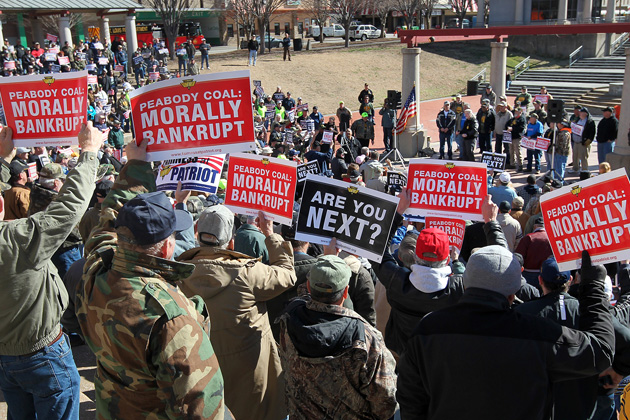
A protest rally against Peabody Energy. Coal mining is declining fast. 
Peabody Energy, the world’s largest publicly owned coal producer, with mines around the world from Australia to the United States, filed for bankruptcy protection in the United States on Wednesday.
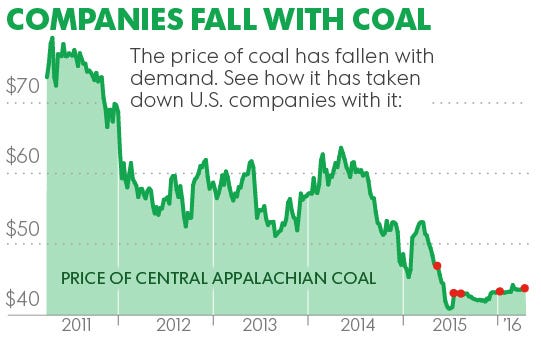
The company was weighed down by the collapse of coal prices, increasing competition from natural gas and tightening regulations to control climate change.
The immediate crisis for the company, which is based in St. Louis, was its inability to sustain debt payments that financed its expansion in Australia in recent years to meet expected rising demand in Asia, particularly China. China is now trying to partly wean itself off coal to improve air quality.
The bankruptcy filing came as no surprise after the company announced last month that it was delaying interest payments on two loans. It comes after a number of bankruptcy filings over the last two years by other coal companies, including industry giants like Arch Coal, Patriot Coal, Walter Energy and Alpha Natural Resources.
“This was a difficult decision, but it is the right path forward for Peabody,” Glenn Kellow, the company’s president and chief executive, said in a statement. “This process enables us to strengthen liquidity and reduce debt, build upon the significant operational achievements we’ve made in recent years, and lay the foundation for long-term stability and success in the future.”
The collapse in natural gas prices over the last three years and new environmental regulations by the Obama administration have led to a rapid decline of the industry, especially in the Appalachia region, where mines are deep and expensive to operate. Domestic production last year slumped to a three-decade low.
Coal was once the provider of roughly half of the nation’s power, but it was surpassed by natural gas as the No. 1 source of electricity for the first time a year ago.
The Paris climate agreement signed in December has convinced many investors that the coal industry is in a death spiral. At the same time, there is a glut of coal on global markets, in part because of uneven economic growth in Europe and emerging markets.
But many analysts say the bankruptcy filings do not mean the coal industry will disappear. Under Chapter 11 bankruptcy protection laws, the companies have been exchanging debt to lenders for equity in the company, known in financial parlance as a debt-for-equity swap.
Most energy experts say coal will probably provide as much as a third of the nation’s power for years to come. They point out that several European and Asian countries continue to rely on coal for electricity, even as they try to turn more to renewable power sources like wind and solar.
Peabody still produces coal for customers in 25 countries on six continents.
“It’s a very mixed picture,” said Daniel Yergin, the energy historian and vice chairman of IHS, the energy consulting firm. “Coal plants in the U.S. will continue to retire, but coal will continue to be part of electricity generation in the United States.”
He added, “China’s plans, even with its renewables push, still show a rise in coal consumption.”
Peabody’s debt troubles, which have been standard across an industry that bet heavily on China and other international markets, originated in a 2011 offer of more than $4 billion for Macarthur Coal, an Australian supplier of metallurgical coal for Asian steel mills.
But expectations for growing Asian economies proved to be unrealistic. Growth in steel production in China was disappointing as the country began to shift its economy from exports toward more domestic consumption. At the same time, India is expanding its railroad system to connect its own coal fields to domestic industry.
Now, with the industry in near free fall, many banks are pulling away from financing coal projects. Utilities are closing aging coal-fired power plants rather than upgrade them to meet new environmental standards, in large part because the glut of natural gas has offered a cheaper alternative.
While filing for protection for its American assets in Federal Bankruptcy Court in the Eastern District of Missouri, Peabody disclosed that it has had problems selling holdings in Colorado and New Mexico. Peabody’s last best hope to avert bankruptcy was its attempt to sell three mines to Bowie Resource Partners, but that company has had trouble raising the full $650 million in debt to acquire them.
Not surprisingly, environmentalists who have been leading an effort to persuade investors and banks to divest from coal cheered the new bankruptcy.
“Peabody Energy’s bankruptcy is a harbinger of the end of the fossil fuel era,” said Jenny Marienau, United States divestment campaign manager with 350.org. “Peabody is crashing because the company was unwilling to change with the times — they doubled down on the dirtiest of all fossil fuels, and investors backed their bet, as the world shifted toward renewable energy.”
Peabody is cutting its payroll and otherwise curbing costs. Late last month, it cut 235 hourly and salaried employees from its North Antelope Rochelle mine in the Powder River Basin, roughly 15 percent of the mine’s work force.
Shares of the company have sold for around $2 in recent days after plunging in value by 99 percent since its high in 2008 just before the financial crisis.