By Eric Blanc, Viewpoint Magazine, February 1, 2018
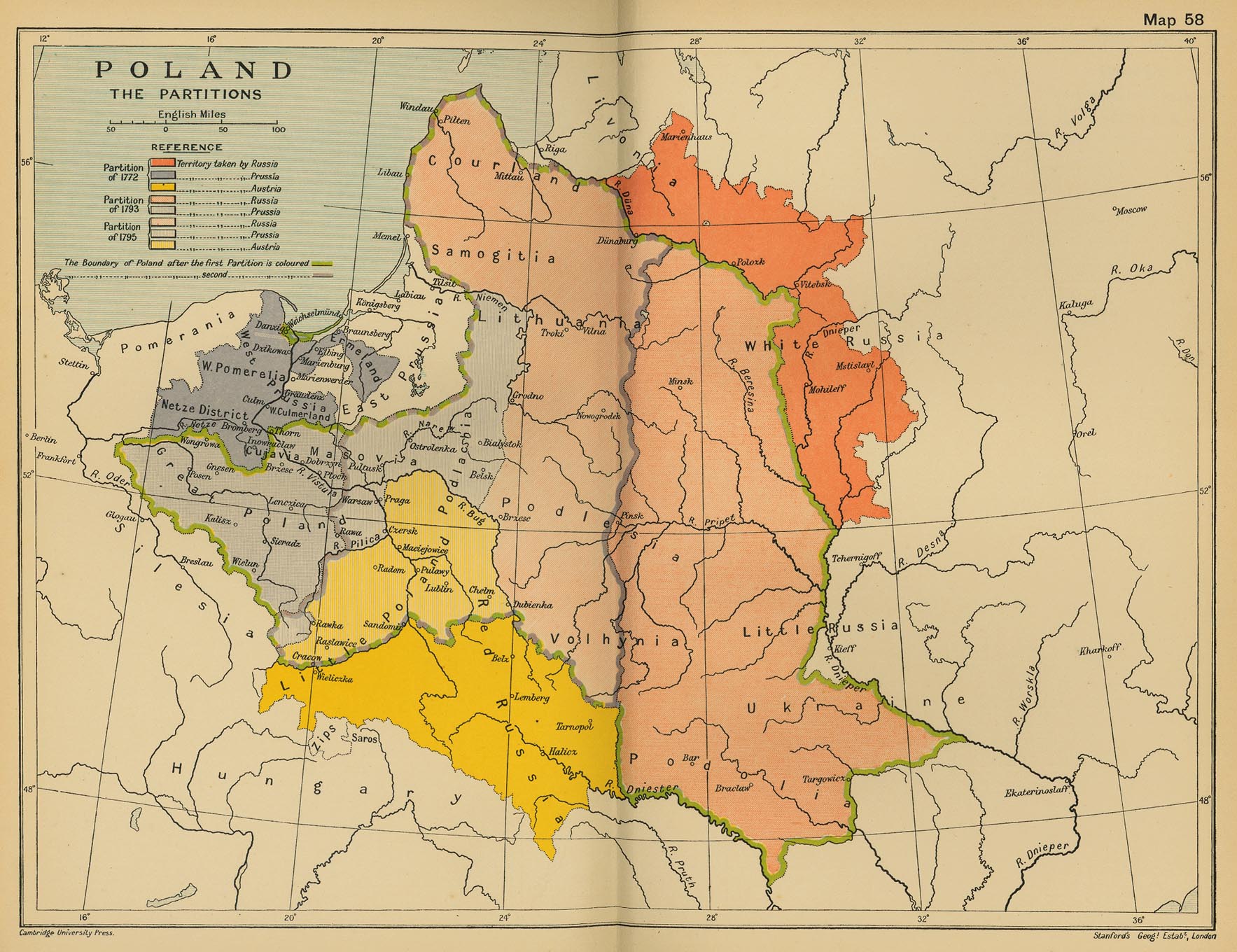 |
| Poland partition of 1772 |
It has often been mistakenly assumed that V.I. Lenin and the Bolsheviks were the first anti-imperial Marxists. Yet over a decade before the 1903 emergence of the Bolshevik faction – and over two decades before it began to seriously address the national question – the Polish Socialist Party (Polska Partia Socjalistyczna, PPS) put the fight for national liberation at the center of its Marxist project.1 From its birth in 1892 onwards, the PPS developed a strategy of merging working-class and anti-imperial struggle, presaging an orientation championed by the early Communist International and socialist activists across Asia, Africa, and Latin America throughout the 20th century.
The history of the PPS – and its internal faction fight, which culminated in the party’s split in 1906 – is too complex to be adequately covered in a short article. Instead, I will focus on three significant aspects of its strategic orientation, particularly as it was articulated by the party’s left wing.2 First, the PPS insisted that only the independent movement and organization of workers could win national liberation. Second, the PPS linked Polish freedom to the liberation of all peoples, including both neighboring nations such as Russia and the Jewish national minority inside of Poland itself. And, finally, leftists in the PPS argued that the impending revolutionary upheaval should seek to simultaneously topple imperial domination and capitalist rule itself.
Class, Nation, and Self-Determination
In 1795 the Polish state was wiped off the map after its final partition by the Russian, Austrian, and Prussian monarchies.3 In subsequent years the “Polish question” became a cause célèbre of radicals and democrats across Europe. Many socialists, including Karl Marx and Frederick Engels, saw Poland as the vanguard of the fight against Tsarism, which was widely considered to be the upholder of reaction across Europe – in fact, the International Workingman’s Association was founded at a rally in large part dedicated to solidarity with the Polish national insurrection of 1863–64. But in the wake of the Russian regime’s violent suppression of the 1863–64 uprising, Poland’s independence struggle dwindled for close to two decades.
The founding of the PPS in 1892 marked both the re-emergence of a strong pro-independence current in Polish political life and its re-articulation on a new political and social basis. Whereas the national struggle had previously been based on the nobility, the PPS proclaimed that only the independent action of the working class could win both social and national liberation. Revolutionary social democracy remained the uncontested framework of the new party, which unanimously resolved that “the class position of the proletariat is the position of the Socialist Party.”4
Given the accommodation of the Polish bourgeoisie and the non-socialist political forces to Tsarist rule, it was understandable that cross-class nationalism held little appeal for PPS militants, including those like Józef Pilsudski who were most focused on the separatist struggle. The PPS explicitly rejected “national unity” as a fiction masking class antagonisms. Only the working class, the party argued, could defend the nation and win independence, as the Polish ruling class had capitulated to the occupying power:
Only the Socialist Party, precisely because it represents national interests, and not class privileges, adheres faithfully to the banner of international revolutionary thought, aiming for universal liberation. Only it can save the country from the suicidal policy which our upper class and petty bourgeoisie have imposed on us. Therefore it is clear that the Polish Socialist Party must ensure that the masses of workers achieve the proper political consciousness, and thus they must maintain their independent political organization.5
In short, the PPS advocated both proletarian class independence and national independence. Synthesizing these two goals remained the party’s essential project – and its core dilemma – in the coming years.
Leftists in the party insisted that the case for Polish independence had to always be articulated from a purely Marxist standpoint. In dozens of articles and pamphlets PPS theorist Kazimierz Kelles-Krauz in particular sought to articulate an “orthodox” Marxist case for national independence. “An independent Poland for the sake of the proletariat, not the proletariat for the sake of Polish independence,” was his motto.6 Independence could only be won through the self-organization and mobilization of workers, given that the native bourgeoisie, fearing the lower classes, had ceased to fight for political democracy.7
The PPS’s main rival was the Social Democracy of the Kingdom of Poland (SDKP) led by Rosa Luxemburg. In 1893, Luxemburg and her comrades had split away from the PPS in opposition to its advocacy of Polish independence. According to the SDKP, the liberation of Polish workers could only come about through a joint struggle with their Russian comrades and the end of national oppression would be won by the abolition of capitalism.
In a minority report submitted for the Zurich 1893 congress of the Second International, Luxemburg put forward her basic theoretical case against the demand for Polish independence. State separation was impossible because the spread of capitalism had economically integrated Poland into Germany, Austria, and Russia: “The socio-economic history of the three parts of the former Polish Kingdom has organically incorporated them into the three partitioning powers and has created in each of these three parts distinct aspirations and political interests.” Workers should thus reject the utopian call for independence – which could only lead to their political subordination to other social classes – and instead forge unity with the other workers in the states under which they lived.8
This did not mean that Luxemburg opposed all demands for national equality. In the July 1893 first issue of the party’s paper, Sprawa Robotnicza [The Workers’ Cause], Luxemburg declared that “here, as elsewhere, the worker is the only defender of every kind of freedom – economic, political, national.”9 Similarly, in response to the government’s Germanization drive in Prussian Poland, Luxemburg wrote a 1900 pamphlet Wobronie narodowości [In Defense of Nationality] to promote the defense of Polish culture:
So it is a crime to speak in one’s own language, which you have taken in with your mother’s milk – so it is a criminal offence to belong to a people, into which you were born. Truly, it is high time for the Polish people to shake off its lifelessness, to express its indignation, to rise to fight against Germanization. How to lead this fight, which path is the most effective to defend the Polish nationality – these are questions that merit serious consideration.10
Luxemburg’s intransigence against the PPS was rooted not in national nihilism, but rather in a conviction that her rivals and their demand for an independent Poland posed a grave threat to the independence of the working-class movement. As such, she dedicated an extraordinary amount of political energy throughout her life to combatting the PPS within Poland and on an international level.
The entrance of the slogan of national self-determination into the discourse of international Marxism can be traced back to a campaign launched by Kelles-Krauz in 1895–96, the major opponent of which was Luxemburg. Aiming to win Western European socialist support for the PPS and its political project, Kelles-Krauz sought to get the upcoming London congress of the Second International to pass the following resolution:
Considering: that the oppression of a nation by another only benefits the capitalists and despots; that it is equally disastrous for the working people of both nations; that in particular Russian Tsarism, drawing its internal and external strength from subordination and partition of Poland, represents a permanent danger for the advance of the international proletariat – the Congress declares: The independence and autonomy of Poland is a political demand as necessary for the whole international workers’ movement as it is for the Polish proletariat.11
As this corresponded to the traditional position of Marx, Engels and their co-thinkers, Kelles-Krauz was confident that such a resolution would pass at the upcoming international congress. Luxemburg would not generate any significant opposition, he assumed, as her party had been recently wiped out by Tsarist repression.12 But the disappearance of the SDKP did not prevent Luxemburg from leading a counter-offensive from exile in Geneva. In the spring and summer of 1896, she published a series of articles in Karl Kautsky’s journal Die Neue Zeit arguing that Marx’s old perspective on Poland no longer corresponded to contemporary reality since Russia was no longer the bulwark of reaction in Europe and because the emergence of a workers’ movement in central Russia posed the possibility of winning political freedom through an empire-wide revolutionary struggle. Independence, furthermore, was a utopian demand running counter to the objective trends of socio-economic development – to fight for it could only result in the subordination and splintering of the workers’ movement.13 For the upcoming London congress she proposed a counter-resolution to the PPS, which reiterated these points.14
Luxemburg’s efforts proved sufficient to distance most leaders of the International from actively supporting the PPS resolution, as they did not want to get involved in a factional dispute on a topic about which they were not particularly concerned. By July, Kelles-Krauz felt obliged to publicly express his frustration at the lack of international support for the resolution:
Imagine if France were partitioned by victorious invaders, Germany, England, Italy – is there any reason to doubt that the first objective of French socialists would be the reconstitution of France and that without this reconstitution the development of socialism would be stopped or at least slowed in the annexed provinces? … But when the Polish Socialist Party declares in its program that the first goal of its political struggle is the establishment of an Independent Democratic Polish Republic, there are – as unlikely as it may be – men who don’t understand and who say this is “patriotism” contrary to socialism and internationalism.15
The deepening of the dispute obliged the German “Pope of Marxism” to reluctantly intervene. Shortly before the opening of the international congress, Kautsky published an important article “Finis Polonais?”16 Agreeing with Luxemburg that Tsarism no longer constituted the major threat to the revolutionary movement of Western Europe, Kautsky concluded that Polish independence had lost its former role in the international arena. But he rejected Luxemburg’s claims that Polish independence was utopian or contrary to socio-economic development. Independence, he argued, was in the interests of the Polish proletariat, thus both Polish Marxists, and the International, should continue to advocate it.
By over-focusing on the danger of Polish nationalism, Kautsky added, Luxemburg risked abetting the Tsarist oppressors of Poland. National sentiment could not be simply ignored, as “the more the Social Democracy firmly takes root in the masses, the more it acts upon and through the masses, the more national differences will make themselves felt – with or without a ‘social-patriotic’ program.”17
For all sides in the debate, the 1896 London congress of the Second International proved to be somewhat anticlimactic. Most international delegates were far more interested in the heated conflict with anarchists – culminating in physical clashes and their expulsion from the International – than in Poland or the national question more generally. The PPS noted this disregard at the London Congress, which it attributed to the absence of national questions obliging socialist attention inside of most Western European countries.18 As French historian Georges Haupt has observed, “indifference and incomprehension towards the national problem” was the norm for socialists in this period.19
The London congress ended up adopting a compromise resolution that neither explicitly supported or opposed Polish independence:
The Congress declares its support for the full right of self-determination for all nations and expresses its sympathy for the workers of every country currently suffering under the yoke of military, national or other despotism. The Congress calls upon the workers of all these countries to join the ranks of the class-conscious workers of the whole world to together fight for the overcoming of international capitalism and the achievement of the aims of international Social-Democracy.20
Both sides publicly claimed that the 1896 resolution had vindicated their perspective, though in private PPS leaders admitted that it fell short of their goals.21 It should be kept in mind that the political meaning of “self-determination” was unclear in 1896 – so much so that the French and English version of the congress minutes used the term “autonomy” in its place.22
The London decision had little immediate effect in Poland, but its long-term impact on worldwide Marxism was major. Kelles-Krauz and the PPS’s efforts had led to the Second International’s first general resolution on the national question, centered on the concept of “national self-determination.” In 1898 this “orthodox” slogan would be echoed by the Russian Social Democratic Party’s founding congress and later Lenin would famously make this the centerpiece of his national strategy.
Internationalism and Anti-Imperial Marxism
One of the most central disputes between the center and left wings of the PPS concerned the extent to which the Polish working class should strategically orient towards an alliance with Russian workers and their struggle for democracy. The 1895 PPS Congress resolved that:
The inclusion of the demand for Polish independence in our program does not mean we oppose any potential changes favorable for the working class in the political regime of the Russian state today; to the contrary, our socialist stance requires that we not only sympathize with any such changes, but moreover it obliges us, depending on the available resources of our party, to actively support any realizable political reforms, such as those on a constitutional level.23
In a significant breach of party democracy, Józef Pilsudski cut this formulation from the August issue of the PPS newspaper, which was mandated to publicize this demand.24 A major factional battle over this issue was only avoided because the PPS left’s main leader Ludwik Kulczycki was arrested by the government in Warsaw a month later.
After the incarceration of Kulczycki, the fight for the PPS to actively support the democratization of Russia was led by Kelles-Krauz, from exile in Paris. Declaring that indifference to the Russians’ fight for a constitution was a “serious error,” he argued that the PPS should “help them in this battle.”25 Yet in many ways Kelles-Krauz’s approach to alliances with Russians dovetailed closely with the PPS center. Both saw the oppressed nationalities of the Western borderlands as the main allies of the Polish proletariat. The struggle against Tsarism, according to this conception, would be led by the Poles in alliance with the separatist movements of Lithuanian, Ukrainian, Latvian, and Finnish workers.26 Kelles-Krauz, like the PPS center, stressed the socio-economic backwardness of Russia, portrayed its revolutionary movement as an auxiliary force, and raised doubts about its ability to win political freedom. He argued that the creation of a democratic Russia, even a federalist one, would not be sufficient to satisfy the national and democratic needs of Poles and other oppressed nationalities, given the uneven economic and cultural development of the different peoples of the empire.27
Karl Kautsky, in a sharp 1904 polemic with Kelles-Krauz, criticized his adherence to Marx’s old vision of Poland as a bulwark against reactionary Russia. The growth of a strong Russian revolutionary movement now made this old position irrelevant. The upcoming revolution, Kautsky predicted, would start not in Germany, as Kelles-Krauz hoped, but in Russia.28
Similar criticisms were raised inside of the PPS itself. Starting in 1903, a new generation of militants based in Poland known as the Młodzi [The Young] pushed the organization in a different direction from the exile leadership.29 They demanded that the PPS press eliminate all anti-Russian epithets and give more coverage to the workers’ movement of Central Russia.30 In late 1903 the Młodzi argued that the summer’s general strike wave represented the “symptoms of an inevitable revolution,” in which the main ally of the Poles would be the Russian proletariat.31 This new orientation was articulated most forcefully in left PPS leader Marian Bielecki’s Zagadnienia Rewolucji [Issues of Revolution]. Though this piece was on the whole a sharp Marxist critique of Kautsky’s overly-defensive revolutionary perspectives, Bielecki announced his agreement with Kautsky on the issue of the Russian movement. Polish socialists must tie the struggle for proletarian and national emancipation to the impending revolution in the Russian Empire, Bielecki argued. Advocating Polish independence as an outpost against Tsarism was simply “outdated” – basic principles of democracy were a “sufficient justification” for the reconstitution of a nation “torn into several pieces.”32
From 1903 onwards, the Młodzi were hegemonic in the PPS in Poland and orienting the party firmly towards a united struggle with Russian workers. Illustrative of the overall evolution of the PPS was the case of Kelles-Krauz. After the outbreak of revolution in January 1905, he dropped his longstanding skepticism of the Russian movement and essentially adopted the orientation of the Młodzi. In one of his last articles before his sudden death from tuberculosis in June 1905, Kelles-Krauz argued:
There is no reason to lose hope and to think that the unleashed Russian crisis will stop halfway, at a constitution granted by Tsar, with a concession of autonomy for the Polish Kingdom; stupid resistance and hesitations by the government accompanied by the stirring up of masses allow us to keep up hope that the solution will rather be a revolution that will overthrow the Tsar and give the nationalities, at least in Poland as we see it, the opportunity to win independence. … The party must seek out communication with those elements in Russian society that also want to lead the crisis across the entire Russian state to its furthest consequences, and not let it stop half way.33
During the 1905 revolution, the PPS was often more active in building unity with the Central Russian revolutionary movement than Luxemburg’s party: in November the PPS sent party leader Feliks Kon to the St. Petersburg soviet to help coordinate the empire-wide struggle.34 Similarly, the PPS initiated a semi-insurrectionary general strike in December 1905 across Poland in response to the Moscow workers’ uprising.
In late 1906, the Pilsudski minority was expelled by the PPS’s Marxist majority for its prioritization of guerrilla warfare and its proto-nationalist separatism. The PPS-Left’s subsequent attempts to join the Russian Social Democratic Workers Party failed only because they were blocked by Luxemburg’s organization, which in 1906 had demanded and won this veto power as a precondition for joining the Russian Social Democratic Workers Party.35
A no less significant component of PPS internationalism was its stance on the “Jewish question.” Given the tendency of so many national movements in the 20th century to marginalize or oppress national minorities in the name of the fight against the foreign occupier, the PPS’s nuanced stance is particularly important to highlight.
Most European socialists and liberals in the early years of the 20th century were assimilationists, i.e., they saw the merging of Jews into the surrounding population as necessary and desirable. According to this conception, the ongoing existence of a distinct Jewish community reflected a holdover from feudalism combined with continued governmental discrimination. Linked to these arguments was the assumption that Jewish culture was exclusively the expression of religious backwardness and segregation from European civilization. A modern secular Jewish culture was therefore a contradiction in terms.
Among non-Jews, the leading opponents of assimilation were, of course, the anti-Semites. They argued that the inherent biological or cultural traits of Jews meant that their merging into society was impossible or unacceptable. For example, the main Polish nationalist current – the National Democrats – declared that the assimilation of Jews was unfeasible given the “specific properties of their race” which made them “alien to Polish society.”36 ND leader Dmowski affirmed that “the Jewish population is undeniably a parasite on the social body of whatever country it inhabits.”37 In the face of such anti-Semitism, assimilationism appeared to many people, Jews and non-Jews alike, as the only viable and coherent alternative.
In practice, however, Russian and Polish socialists’ open advocacy of assimilation likely hurt more than it helped achieve closer unity between the Jewish and non-Jewish socialist movements. Assimilationism was often understandably seen as implying the superiority of the dominant culture and, as such, it was rejected by the main Jewish workers’ organization, the Jewish Bund. By 1902 it was clear that the Bund was winning the struggle for hegemony among the large Jewish working class in Poland and leaders of the PPS began to rethink their initial assimilationist approach
Starting in 1902, the Jewish section of the PPS dropped the party’s push for assimilation and began referring to Jews as a nationality.38 In 1904, Józef Kwiatek, a leader of the PPS and its Jewish Section, published an important pamphlet on the Jewish question, which emphasized the pervasiveness of anti-Semitism among the population in Poland and the need to combat it. His political conclusion was that building working-class unity required:
Not idle talk about the superiority of assimilation over cultural separateness or vice versa, but the idea of the necessity for the co-operation of the working class, which constitutes the vast majority of the nation. … If he (the socialist) is a Jew, let him fight Zionism in words and deeds. If he is a Christian, let him combat anti-Semitism in agitation and by personal example.39
The main push for a new orientation came from Feliks Sachs, an influential leader of the PPS left and the head of the party’s Jewish Committee.40 With the goal of establishing PPS influence on the “Jewish street,” Sachs moved to Vilna in 1902 to edit Der Arbeyter (The Worker), the party’s Yiddish-language newspaper.41 Breaking with traditional PPS assimilationism, Der Arbeyter began referring to Jews as a “nationality.” Sachs explained this decision to the PPS leadership: “We now treat Jews as a nationality equal to all others … we are following ‘the spirit of the times’: if you were here, you would understand and even feel this ‘spirit.’”42
By this time both Pilsudski and Kelles-Krauz had also come to reject the party’s old line on the Jewish question. Pilsudski argued that in order to win over Jewish socialists and establish an alliance with the Bund it was necessary to change the party’s program, which he noted “lacks a guarantee for the rights of Jews as a group.”43 He concluded that “in a future Poland they would have the right to remain Jews if they so wish, and that we would defend their rights as a nationality.”44
Kelles-Krauz elaborated this argument in his 1904 work “W Kwestii Narodowości Żydowskiej” (On the Question of Jewish Nationality). He argued that the spread of Jewish national consciousness (manifest in the strength of the Bund and Zionism) and the rise of Yiddish as a modern language reflected the general tendency of capitalism to create nationalities. To build Polish-Jewish unity in this context required discarding the PPS’s old assimilationism. He concluded that “the concept of civil equality for Jews should be extended to include the right to have their own nationality. We should recognize this nationality to the extent that Jews themselves recognize it.”45
In contrast with the later works of Lenin and Joseph Stalin, Kelles-Krauz did not entirely dismiss the relevance of “national-cultural autonomy.” While this proposal was too limited for territorial nations, he argued, it made sense for “dispersed minority nationalities.”46 There was no reason to oppose national-cultural autonomy for Jews; nor was it possible to predict whether they would assimilate or continue to develop as a national group.47 Non-territorial cultural autonomy, he noted, corresponded well to their needs since territorial solutions were precluded by their geographic dispersion. Kelles-Krauz concluded that, if so wished by Jews, an independent Poland would grant them “full national rights and corporate autonomy,” manifest in autonomous schools and cultural institutions for all Jews who desired such autonomy.48 Therefore, he concluded, the Bund should drop its equivocal stance and openly support the fight for Polish independence. By recognizing national rights for Jews, Kelles-Krauz showed that territorial and non-territorial solutions to the national question were not mutually exclusive. The experience and strategy of the left PPS would seem to show that there was no inherent contradiction between fighting for national independence and promoting full national rights for all peoples living inside a given country.
“Permanent Revolution” in Poland
Poland was the only region of the Russian empire where there was an ongoing debate inside the pre-1905 Marxist movement about the feasibility of a direct socialist revolution. This dispute rather significantly undermines the prevailing historiographic consensus that Rosa Luxemburg’s party was the most radical socialist party in Poland. Leszek Kolakowski, for example, has made the case that the PPS was opportunist, unlike the proto-communist SDKPiL: “It was here [Poland] that socialism for the first time spit up in accordance, more or less, with the principles that subsequently divided social democracy from communism.”49 In reality, the left wing of the PPS was consistently Marxist and even more radical in its socialist orientation than Luxemburg’s party.
Whereas the “orthodox” Marxist opposition to direct socialist revolution was adhered to by both the center PPS and Luxemburg’s SDKPiL, leading PPS leftists argued for the possibility and desirability of moving straight to a socialist overturn, thereby pioneering the strategy of tying national liberation to workers’ power later famously articulated in Leon Trotsky’s theory of permanent revolution.
The “orthodox” Marxist stance was that a period of political freedom under capitalism was a necessary precondition for the fight for socialism. Pilsudski thus argued that in “democratic” countries the proletariat must “directly aim for power,” while in places like Poland where “the working masses do not yet have political rights” the task at hand was to conquer political freedom.50 Luxemburg similarly rejected “the hope for the possibility of a direct path to socialist revolution, skipping the parliamentary-bourgeois phase. … The working class cannot achieve wide-scale organization and consciousness without certain political conditions enabling open class struggle, that is without democratic institutions in the country.”51
PPS leftists, in contrast, pioneered a new approach that synthesized advocacy of direct social revolution with the fight for national independence. At the 1892 founding congress of the PPS, one of the left delegates, Jan Lorentowicz, argued that the program should call for an “Independent Socialist Republic” not an “Independent Democratic Republic.”52Feliks Perl, a leading theorist of the PPS center, opposed this proposal, arguing that “the important issue is whether the political freedom we win will be used for the further development of bourgeois society or used to take the first step to socialism.”53
The call for socialist overturn was most clearly articulated by Kazimierz Kelles-Krauz. In 1896 he wrote:
Who says that the Polish republic that we will win shall necessarily be a bourgeois state? … The day we kick out the Tsarist invasion–the main obstacle to [the socialist program’s] implementation – we will do everything possible at the same time, it goes without saying, to socialize the means of production and democratize the political order. Up to what point will we succeed? That depends on the circumstances and the moment in which the general march of events in Europe and Russia launches us into the struggle. … The abolition of foreign oppression in our country can become the point of departure for the abolition of the capitalist system itself.54
In 1902, Kelles-Krauz developed this orientation in a major polemic against PPS theorists who rejected the idea of a social revolution in Poland or relegated it to a distant future following an extended period of political freedom. Kelles-Krauz called for the PPS to adopt the slogan “the land for those who plough it, the factories to those who work them.” He argued that “our sacred duty in every city, in every neighborhood where the Tsarist army and authorities are forced out, will be to immediately proclaim a socialist republic.” All the major industries would become “property of the nation” and put under workers’ control of production. Whether the revolution would progress towards “the dictatorship of the proletariat” or whether the “social gains of the uprising” would be “partially undone” through a return to private property, he concluded, “cannot be predicted” as this to a considerable extent would depend on the dynamic of the revolutionary struggle in the West.55 Kelles-Krauz repeated this argument until his early death from tuberculosis in 1905 at the age of 33. His last major article – “Polish Independence and the Materialist Conception of History” – thus posed the possibility of the “establishment of the socialist system in Poland at the same time as it gets its independence.”56
This orientation did not remain confined to theoretical publications but was also reflected in the party’s mass agitation. Particularly illustrative are the short list of slogans that invariably concluded the proclamations of the PPS, as with all Marxist parties in this epoch. Initially, PPS leaflets upheld the “orthodox” separation of democratic and social revolution by ending with a democratic political slogan – for example, “Long Live Polish Independence!” or “Down with Tsarism!” – and a long-term socialist slogan like “Long Live Socialism!” Starting in 1903, with the ascent of the PPS left inside of Poland, this separation was increasingly eliminated and replaced by slogans like “Long Live Independent Socialist Poland!” or “Long Live Independent Workers’ Poland and Lithuania.”57
Conclusion
Due to the prevailing Marxist historiographical focus on Bolshevism and central Russia, the distinct contributions and experiences of revolutionaries in the borderlands of the Tsarist Empire have been mostly marginalized. As such, it is remarkably little known that leftist PPS militants as early as the 1890’s pioneered many of the political orientations that became central to the practice of anti-capitalist revolutionaries throughout the 20th century. In this article, I highlighted in particular the left PPS’s strategic articulation of the fight for state independence from a proletarian and internationalist standpoint, the party’s nuanced combination of territorial and non-territorial solutions to national domination, and its advocacy of winning national liberation directly through socialist revolution. I also demonstrated that the origin of the acceptance of the slogan of national self-determination within the organized Marxist movement dates back to the 1895 campaign initiated by PPS leaders within the Second International.
That this important experience has been widely ignored for close to a century underscores the need for a fresh re-examination of the history of the socialist movement; too much of our understanding has been shaped by half-truths and received ideas. A critical engagement with the past remains an indispensable instrument for critically confronting the present.
- Although there is today an important distinction between “anti-imperialism” and “national liberation,” in the period surveyed in this article, the terms “anti-imperial,” “anti-imperialist,” and “national liberation,” were often used interchangeably. In this text, I will use the term “anti-imperial” to avoid confusion.

- Throughout this article I will use the terms “left” and “center” as shorthand for, respectively, the revolutionary Marxist and Józef Pilsudski-led trends in the PPS. By 1903, the party left oriented to mass struggle and a revolutionary alliance with Russian workers – comprised the majority of the PPS and its leadership in Poland. Late in 1906, the party expelled the Pilsudski minority for prioritizing separatist struggle and guerrilla warfare over internationalism and mass action. After the 1906 PPS split, the radical majority named itself the PPS-Left and Pilsudski’s group took on the name PPS-Revolutionary Faction. In 1918, the PPS-Left co-founded the new Polish Communist Party together with Rosa Luxemburg’s organization. I address the post-1906 history of the PPS-Left and its relations with Luxemburg’s current in the forthcoming issue of Historical Materialism.
- Given the regional focus of this article, I will use the term Poland as shorthand for the Polish lands ruled by the Russian Tsar.
- “Protokuł Zjazdu Paryskiego (Ostateczny)” [1892] in Dzieje Zjazdu Paryskiego 1892: Przyczynek do Historii Polskiego Ruchu Socjalistycznego, ed. Leon Wasilewski (Warszawa: Instytut Badania Najnowszej Historji Polski, 1934), 32.
- “Szkic Programu Polskiej Partii Socjalistycznej” [1892] in Polskie Programy Socjalistyczne 1878-1918, ed. Feliks Tych (Warszawa: Ksiąka i Wiedza, 1975), 251.
- Kazimierz Kelles-Krauz [Luśnia], Klasowość Naszego Programu (Paris: A. Reiff, 1894), 20-1.
- Kazimierz Kelles-Krauz, “Niepodległość Polski a Materialistyczne Pojmowanie Dziejów,” [1905] in Wybór Pism Politycznych (Kraków: Nakładem Drukarni Narodowej, 1907), 252, 256-63.
- Rosa Luxemburg [Redakcjęe Sprawy Robotniczej], “Sprawozdanie na III Międzynarodowy Kongres Socjalistyczny i Robotniczy w Zurychu 1893 o Stanie Ruchu Socjaldemokratycznego w Królestwie Polskim w Okresie 1889-1893,” [1903] in Kwestja Polska a Ruch Socjalistyczny, ed. Rosa Luxemburg (Kraków: R. Moszoro, 1905), 176.Polemicizing against this theory, Kelles-Krauz argued that the loyalty of the Polish upper class to the Russian state was “far less due to the Russian markets than fear of disorders, of revolution.” Kelles-Krauz, “Niepodległość Polski,” 252.
- “O Wynaradanianiu (z Powodu Dziesięciolecia Rządów Gen. Gub. Hurki)” [1893] in Socjaldemokracja Królestwa Polskiego i Litwy, Materiały i Dokumenty, Tom 1 1893-1903,eds. Hanna Buczek and Feliks Tych (Warszawa: Książka i Wiedza, 1957), 9.
- Rosa Luxemburg, W obronie narodowości (Poznań: J. Gogowski, 1900), 1-2.
- Kazimierz Kelles-Krauz, “Au Congrès de Londres,” Bulletin Officiel du Parti Socialiste Polonais 10 (1896): 1.
- In 1900, the party was refounded and its name was expanded to include Lithuania, thereby resulting in the acronym SDKPiL.
- Rosa Luxemburg, “Neue Strömungen in der Polnischen Sozialistischem Bewegung in Deutschland und Oesterreich,” Die Neue Zeit 14, no. 32 (1896): 176-81 and 206-16; and Rosa Luxemburg, “Der Sozialpatriotismus in Polen,” Die Neue Zeit 14, no. 41 (1896): 459-70.
- Rosa Luxemburg, “Dwie Rezolucje” [1896] in Socjaldemokracja Królestwa Polskiego i Litwy, eds. Buczek and Tych, 434-36.
- Kazimierz Kelles-Krauz, “Les Motifs de Notre Programme,” Bulletin Officiel du Parti Socialiste Polonais 9 (1896): 1.
- Karl Kautsky, “Finis Poloniae?” Die Neue Zeit 14, no. 42 (1896): 484-91 and no. 43 (1896): 513-25. This article was later published in Polish by the PPS, minus some of its formulations agreeing with Luxemburg; it became one of the party’s most popular pro-independence pamphlets.
- Kautsky “Finis Poloniae?” 521.
- Przedświt Redakcja [Anon.], “Rzut oka na Wynik i Zjazdu,” Przedświt 3, no. 7 (1896): 12.
- Georges Haupt, Claudie Weill, et al., eds., Les Marxistes et la Question Nationale, 1848–1914: Études et Textes (Paris: François Maspero, 1974), 27.
- Verhandlungen und Beschlüsse des Internationalen Sozialistischen Arbeiter- und Gewerkschafts-Kongresses zu London, vom 27. Juli bis 1. August 1896 (Berlin: Expedition der Buchhandlung Vorwärts, Th. Glocke, 1896), 18.
- Feliks Tych, “The Polish Question at the International Socialist Congress in London in 1896, a Contribution to the History of the Second International,” Acta Poloniae Historica 46 (1982): 135.
- For the English, French, and German versions see Congrès International Socialiste des Travailleurs et des Chambres Syndicales Ouvrières, Londres 26 Juillet-2 Août 1896, ed. Michel Winock (Genève: Minkoff Reprint, 1980), 223, 455, 478.
- “Uchwały III zjazdu Polskiej Partyi Socyalistycznej” [1895], in Materyały do Historyi P.P.S. i Ruchu Rewolucyjnego w Zaborze Rosyjskim od r. 1893-1904. Tom I, Rok 1893-1897, ed. Aleksander Malinowski (Warszawa: Odbito w Drukarni Narodowej w Krakowie, 1907), 146.
- Robotnik, no. 9, August 15, 1895.
- Kazimierz Kelles-Krauz [Michal Luśnia], “Nasz Kryzys,” Przedświt 22, no. 3 (1902): 86.
- Kelles-Krauz, “Nasz Kryzys,” 94.
- Kazimierz Kelles-Krauz [Elehard Esse], “Socialistes Polonais et Russes,” L’Humanité Nouvelle: Revue Internationale: Sciences, Lettres et Arts 3, no. 4 (1899): 448-50.
- Karl Kautsky, “Allerhand Revolutionäres,” Die Neue Zeit 22, no. 20 (1904): 622.
- Pilsudski’s wing became known as the Starzy [The Elders].
- Jan Sobczak, Współpraca SDKPiL z SDPRR: 1893–1907: Geneza Zjednoczenia i Stanowisko SDKPiL Wewnątrz SDPRR (Warszawa: Książka i Wiedza, 1980), 214.
- Flis, “Strejki Południowo-Rosyjskie,” Przedświt 23, no. 8 (1903): 349.
- Marian Bielecki [M. Raudonas], “Zagadnienia Rewolucji,” Przedświt 24, no. 5-6 (1904): 201-02.
- Kazimierz Kelles-Krauz [Interim], “Z Całej Polski,” Krytyka 7, no. 1 (1905): 165.
- Sobczak, 386.
- Janina Kasprzakowa, Ideologia i polityka PPS-Lewicy w latach 1907–1914 (Warszawa: Książka i Wiedza, 1965).
- Cited in Brian Porter, When Nationalism Began to Hate: Imagining Modern Politics in Nineteenth Century Poland (New York: Oxford University Press, 2000), 228.
- Cited in Porter, 10.
- Joshua D. Zimmerman, Poles, Jews, and the Politics of Nationality: The Bund and the Polish Socialist Party in late Tsarist Russia, 1892–1914 (Madison: University of Wisconsin Press, 2004), 165-72.
- Józef Kwiatek, Kwestya Żydowska (Kraków: Nakładem Administracyi ‘Prawa Ludu’, ‘Naprzodu’ i ‘Kolejarza’, 1904), 34.
- Zimmerman, Poles, Jews, and the Politics of Nationality, 165-6.
- From 1898 to 1901, Der Arbeyter had been published by the PPS leadership in London and advocated assimilationism.
- Cited in Zimmerman, Poles, Jews, and the Politics of Nationality, 172.
- Cited in Zimmerman, Poles, Jews, and the Politics of Nationality, 168.
- Ibid.
- Kazimierz Kelles-Krauz [Michal Luśnia], “W Kwestii Narodowości Żydowskiej,” Krytyka 6, no. 1 (1904): 128.
- Kazimierz Kelles-Krauz, “Program Narodowościowy Socyalnej Demokracyi Austryackiej a Program P.P.S.,” [1903] in Wybór Pism Politycznych (Kraków: Nakładem Drukarni Narodowej, 1907), 215.
- Kelles-Krauz “Program Narodowościowy,” 216.
- Ibid., 216-17.
- Leszek Kolakowski, Main Currents of Marxism: Its Rise, Growth, and Dissolution, vol. 2 (Oxford: Clarendon Press, 1978), 17.
- Robotnik, no. 9, August 15, 1895.
- Rosa Luxemburg, “‘Pamięci “Proletariatu,’” Przegląd Socjaldemokratyczny 23, no. 2 (1903): 52.
- “Protokuł Zjazdu Paryskiego (Ostateczny)” [1892], in Wasilewski, 28. Lorentowicz was a main leader of a small group of Polish radicals in Paris that published the socialist journal Pobudka (Reveille). According to Pobudka, “political revolution, aimed to liberate Poland from foreign yoke, and social revolution, aimed to liberate the Polish proletariat from economic oppression, must be accomplished simultaneously. As the first cannot be effective without the other, so too is the second impossible without the first.” A.Z., “Nasze Zadanie,” Pobudka no. 10, October 1891.
- “Protokuł Zjazdu Paryskiego (Ostateczny)” [1892], in Wasilewski, 28.
- Kelles-Krauz, “Les Motifs de Notre Programme,” 3, 5.
- Kelles-Krauz, “Nasz Kryzys,” 53-5.
- Kelles-Krauz, “Niepodległość Polski,” 265.
- See for example the following declarations: Łowicki Komitet Robotniczy Polskiej Partyi Socyalistycznej, “Towarzysze Włościanie!”, Przedświt 23, no. 3 (1903): 116; “Odezwa CKR PPS w Związku z Wybuchem Wojny Rosyjsko - Japońskiej,” [1904] in Narastanie Rewolucji w Królestwie Polskim w Latach 1900–1904, ed. Herman Rappaport (Warszawa: Państwowe Wydawnictwo Naukowe, 1960), 488-90; “Odezwa CKR PPS Wzywająca Rezerwistów do Uchylania się od Służby” [1904], in Rappaport, 561-63.


