Saturday, September 28, 2013

1156. Cuba Athletes Can Soon Sign with Foreign Leagues


By Ronald Blum, The Associated Press, September 28, 2013

NEW YORK — It will be up to the U.S. government to decide whether a new wave of Cuban baseball players can quickly make their way to the major leagues.
Cuba announced Friday that athletes from all sports will soon be able to sign contracts with foreign leagues, a break with a decades-old policy that held pro sports to be anathema to socialist ideals.
"I'm excited. I'm from Cuba. I'm happy for the guys from my country to play the best baseball in the world," said Milwaukee Brewers infielder Yuniesky Betancourt, a Cuban defector who left his homeland aboard a speedboat in 2003.
The decision was a step toward a time when the path from Havana to Yankee Stadium might mean simply hopping on a plane rather than attempting a perilous sea crossing or sneaking out of a hotel at midnight in a strange land.
But American baseball fans shouldn't throw their Dodgers or Rockies caps in the air in celebration just yet. The Cold War-era embargo against Cuba means it may not happen soon.
Economic restrictions were imposed by the U.S. after Cuba nationalized American businesses and aligned itself with the Soviet Union. They have been kept in place to try to pressure the authoritarian country to allow its people more freedom.
"Our policy has not changed. Cuban players need to be unblocked by a license from the Office of Foreign Assets Control in order to play for the MLB," said John Sullivan, spokesman for the U.S. Treasury Department's Office of Foreign Assets Control. "In order to qualify, the players must prove that they have permanent residency outside of Cuba."
Major League Baseball said the impact of Friday's announcement can't be predicted.
"Given that we do not have any details of this change in policy, it would be premature for us to speculate what effect it may have," the commissioner's office said in a statement.
"There are no provisions in the major league rules or bylaws that make it more difficult for Cuban ballplayers to play Major League Baseball, but MLB and its clubs have and will continue to act in accordance with the laws and policies of the United States government."
Athletes' wages are not made public in Cuba but are believed to be somewhere around the $20 a month that most other state employees earn — a tiny fraction of the millions many U.S. big leaguers make.
"It's the dream of many athletes to test themselves in other leagues — the big leagues, if at some point my country would allow it," said Yasmani Tomas, who is one of Cuba's top talents, batting .345 last season with the powerhouse Havana Industriales.
Under the new policy, athletes will be eligible to play abroad as long as they fulfill their commitments at home, the Communist Party newspaper Granma reported.
For baseball players, that means being available for international competitions as well as Cuba's November-to-April league.
"We have seen the press reports. This is an internal Cuban matter," Deputy State Department spokeswoman Marie Harf said. "Generally speaking, the United States welcomes any reforms that allow Cubans to depart from and return to their country."
President Raul Castro's government hopes the move will stem defections by athletes who are lured abroad by the possibility of lucrative contracts, a practice that saps talent from Cuba's teams.
"I think this could help stop the desertions a little bit," said Yulieski Gourriel, a talented 29-year-old third baseman who batted .314 last year for the Sancti Spiritus.
"I don't even want to talk about how much I've been offered, because every time we leave the country, there are these offers. I've never paid attention because I've always said I'm not interested."
A number of his countrymen, however, are interested.
Cuban defectors now in the major leagues include outfielder Yasiel Puig, who signed a $42 million, seven-year contract with the Los Angeles Dodgers in July 2012 and had a sensational rookie season, helping Los Angeles win its division.
Hard-throwing reliever Aroldis Chapman signed a $30.25 million, six-year deal with Cincinnati before the 2010 season.
Texas Rangers outfielder Leoyns Martin was surprised Friday when told about the news.
"Really? Oh my gosh," said Martin, wearing his Cuba Baseball jacket from the 2009 World Baseball Classic.
Martin defected after playing for Cuba's national team in a 2010 tournament in Japan.
"I don't want to talk about that," Martin said. "That's a long history in my life."
Professional sports were essentially done away with under Fidel Castro in 1961, two years after the Cuban revolution, and athletes became state employees just like factory workers and farmhands.
Sport as private enterprise was deemed incompatible with the Marxist society Castro intended to create. In 2005, he railed against the "parasites that feed off the athlete's hard work" in professional sports.
Friday's announcement is part of a trend toward relaxing that stance under Castro's brother, who became president in 2006.
Earlier this year, Cuba ended a five-decade ban on professional boxing, joining an international semipro league where fighters compete for sponsored teams and earn $1,000 to $3,000 a month.

Thursday, September 26, 2013

1155. Cuba Sanctions More Private Businesses


By Anne-Maries Garcia, Associated Press, September 26, 2013
Real estate marketing in Cuba
Real estate agents, auto body workers and home builders can come out of the shadows in Cuba's expanding private economy under rules announced Thursday that allow 18 new categories of independent employment under President Raul Castro's economic reforms.
Among the most notable of the newly allowed private professions are real estate agents, who have long operated on the margin of the law. Even after the communist government legalized the buying and selling of homes in 2011 for the first time in decades, it was still technically against the rules to make money connecting buyers with sellers.
The number of approved independent employment activities rises to 199 with the newly legalized professions, which also include rental agents, repair and maintenance service providers, iron workers and welders.
The decision to license the latest crop of professions came about because the country is now better positioned to supply "prime materials, equipment and other inputs to the network of stores," Labor Ministry official Jose Barreiro was quoted as saying by Communist Party newspaper Granma.
In all more than 430,000 private employment licenses have been issued since the reforms began in 2010, and 436,342 independent workers are currently operating, Granma said. Some were already working independently before the reforms began.
Critics have lamented that so far there has not been a push to let many educated professionals such as lawyers, health care workers or scientists work independently of the state.
Published into law Thursday in the government's Official Gazette, the new rules bar the resale of imported goods such as clothing.
Many entrepreneurs who operate under tailors' licenses appear to make more money selling garments brought into the country one overstuffed duffel bag at a time than they generate from actual sewing.
"I'm worried, disgusted and disconcerted," said Reina Margarita Moreira, who sells clothing and household items at a kiosk in central Havana. "We don't agree with this measure. ... We knew a change was coming and we thought they would modify the concept of the license and raise the taxes, but we never thought they would prohibit us from selling clothing brought in from abroad."
"I have children and grandchildren to support," said her colleague Diana Sanchez. "I feel really bad. Three years ago they let us work here legally, and now they forbid it. I don't understand it."
Mariela Carrera, a 45-year-old homemaker who was shopping at the open-air bazaar, said Cubans want to dress in international fashions and predicted that the measure would only push sales of imported clothing back into the black market.
"And the state isn't going to make any money off that if nobody's paying taxes," she said.
Also prohibited will be the "speculative" resale of goods bought in state-run retail stores.
"The issue of goods purchased in stores for resale has generated constant opinions among the people, who complain about shortages and the high prices set by the hoarders," Barreiro said.
"Order will be imposed, since nobody is allowed to buy merchandise in a state-run establishment and then speculate with it," he added.
Granma said it will be a crime to obtain merchandise "for the purpose of resale at a profit."

Tuesday, September 24, 2013

1154. World Population to Reach 9.6 billion by 2050–says UN


By United Nations, June 13, 2013

India expected to become world’s largest country, passing China around 2028, while Nigeria could surpass the United States by 2050
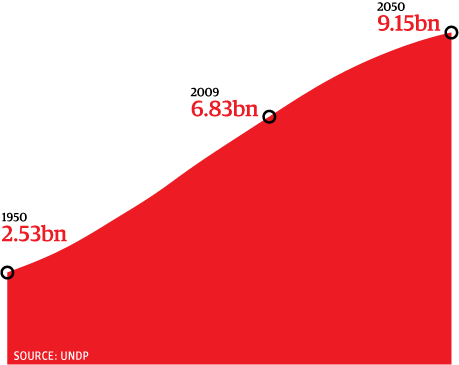
New York, 13 June—The current world population of 7.2 billion is projected to increase by almost one billion people within the next twelve years, reaching 8.1 billion in 2025 and 9.6 billion in 2050, according to a new United Nations report, World Population Prospects: The 2012 Revision, launched today.
Most of the population growth will occur in developing regions, which are projected to increase from 5.9 billion in 2013 to 8.2 billion in 2050. During the same period, the population of developed regions will remain largely unchanged at around 1.3 billion people. Growth is expected to be most rapid in the 49 least developed countries, which are projected to double in size from around 900 million inhabitants in 2013 to 1.8 billion in 2050.
At the country level, much of the overall increase between now and 2050 is projected to take place in high-fertility countries, mainly in Africa, as well as countries with large populations such as India, Indonesia, Pakistan, the Philippines and the United States.
“Although population growth has slowed for the world as a whole, this report reminds us that some developing countries, especially in Africa, are still growing rapidly,” said Wu Hongbo, the UN Under-Secretary-General for Economic and Social Affairs.
Fertility higher than expected
Compared to the UN’s previous assessment of world population trends, the new projected total population is higher, particularly after 2075. Part of the reason is that current fertility levels have been adjusted upward in a number of countries as new information has become available. In 15 high-fertility countries of sub-Saharan Africa, the estimated average number of children per woman has been adjusted upwards by more than 5 per cent.
“In some cases, the actual level of fertility appears to have risen in recent years; in other cases, the previous estimate was too low,” said John Wilmoth, Director of the Population Division in the UN’s Department of Economic and Social Affairs.
In addition, slight modifications to the expected fertility trajectories of a few populous countries have led to higher projections of their future population size. Another contributing factor is a more rapid increase in life expectancy at birth anticipated for several countries: longer life, like higher fertility, generates larger populations. Advances in methodology have also contributed to changes in projected population trends.
Give or take a billion
Most results presented are based on the UN’s “medium-variant” projection, which assumes a substantial reduction in the fertility levels of intermediate- and high-fertility countries in the coming years. For these countries, it is assumed that the pace of future fertility decline will be similar to that observed for other countries, mostly in Asia and Latin America, when they underwent similar declines during the second half of the 20 century.
“The actual pace of fertility decline in many African countries could be faster or slower than suggested by this historical experience,” Mr. Wilmoth said. “Small differences in the trajectory of fertility over the next few decades could have major consequences for population size, structure and distribution in the long run.”
The “high-variant” projection, for example, which assumes an extra half of a child per woman (on average) than the medium variant, implies a world population of 10.9 billion in 2050. The “low-variant” projection, where women, on average, have half a child less than under the medium variant, would produce a population of 8.3 billion in 2050. Thus, a constant difference of only half a child above or below the medium variant would result in a global population of around 1.3 billion more or less in 2050 compared to the medium-variant forecast.

More and more large countries
The new projections include some notable findings at the country level. For example, the population of India is expected to surpass that of China around 2028, when both countries will have populations of around 1.45 billion. Thereafter, India’s population will continue to grow for several decades to around 1.6 billion and then decline slowly to 1.5 billion in 2100. The population of China, on the other hand, is expected to start decreasing after 2030, possibly reaching 1.1 billion in 2100.
Nigeria’s population is expected to surpass that of the United States before the middle of the century. By the end of the century, Nigeria could start to rival China as the second most populous country in the world. By 2100 there could be several other countries with populations over 200 million, namely Indonesia, the United Republic of Tanzania, Pakistan, the Democratic Republic of the Congo, Ethiopia, Uganda and Niger.
Large variations in fertility levels
Based on the information in the report, countries of the world can be classified into three groups depending on their current levels of fertility. In recent decades many countries have experienced major reductions in average family size.
It is now estimated that 48 per cent of the world’s population lives in “low-fertility” countries, where women have fewer than 2.1 children on average over their lifetimes. Low-fertility countries now include all of Europe except Iceland, plus 19 countries of Asia, 17 in the Americas, two in Africa and one in Oceania. The largest low-fertility(2) countries are China, the United States, Brazil, the Russian Federation, Japan and Viet Nam.
Another 43 per cent lives in “intermediate-fertility” countries, where women have on average between 2.1 and 5 children. Intermediate-fertility countries are found in many regions, with the largest being India, Indonesia, Pakistan, Bangladesh, Mexico and the Philippines.
The remaining 9 per cent of the world lives in “high-fertility” countries, where the average woman has 5 or more children. Of the 31 high-fertility countries, 29 are in Africa and two are in Asia (Afghanistan and Timor-Leste).
Africa growing rapidly
More than half of global population growth between now and 2050 is expected to occur in Africa. According to the UN’s medium-variant projection, the population of Africa could more than double by mid-century, increasing from 1.1 billion today to 2.4 billion in 2050, and potentially reaching 4.2 billion by 2100.
Rapid population increase in Africa is anticipated even if there is a substantial reduction of fertility levels in the near future. The medium-variant projection assumes that fertility will fall from 4.9 children per women in 2005-2010 to 3.1 in 2045-2050, reaching 2.1 by 2095-2100. The gap for Africa between the high and low variants of the new projections, corresponding to half a child more or less per woman compared to the medium variant, amounts to roughly 600 million people by 2050 (2.7 vs. 2.1 billion) and potentially 3.2 billion people by 2100 (6.0 vs. 2.8 billion).
Regardless of the uncertainty surrounding the future population of Africa, the region will play a central role in shaping the size and distribution of world population during this century.
Europe shrinking
Beyond Africa, the population of the rest of the world is expected to grow by just over 10 per cent between 2013 and 2100, with Europe’s population projected to decline by 14 per cent. Fertility in almost all European countries is now below the level required for full replacement of the population in the long run (around 2.1 children per woman on average). Fertility for Europe, as a whole, is projected to increase from 1.5 children per woman in 2005-2010 to 1.8 in 2045-2050, and to 1.9 by 2095-2100. Despite this increase, childbearing in low-fertility countries is expected to remain below the replacement level, leading to a likely contraction of total population size.
Longer lives around the world
Life expectancy is projected to increase in developed and developing countries in

Life expectancy is projected to increase in the world’s least developed countries (LDCs), which include many countries highly affected by HIV/AIDS. Life expectancy at birth in the LDCs was estimated to be 58 years in 2005-2010 but is expected to increase to about 70 years in 2045-2050, and 78 years by 2095-2100.
Low fertility drives population ageing
As fertility declines and life expectancy rises, the proportion of the population above a certain age rises. This phenomenon, known as population ageing, is occurring throughout the world.
Overall, the more developed regions have been leading this process, and their experience provides a point of comparison for the expected ageing of the populations of less developed regions. In 1950, the number of children (persons under age 15) in the more developed world was more than twice the number of older persons (those aged 60 years or over), with children accounting for 27 per cent of the total population and older persons for only 12 per cent. By 2013, the proportion of older persons in the more developed regions had surpassed that of children (23 versus 16 per cent), and in 2050, the proportion of older persons is expected to be about double that of children (32 versus 16 per cent).
Population ageing is less advanced in developing regions, especially in countries where fertility remains relatively high. In these regions, the proportion of children declined from 38 per cent in 1950 to 28 per cent in 2013, while the proportion of older persons increased from 6 to 9 per cent. However, a period of more rapid population ageing lies ahead for the less developed regions. By 2050, their proportion of older persons is projected to reach 19 per cent, whereas their proportion of children is projected to decline to 22 per cent.
For China and other areas, especially in East Asia, where fertility has been below the replacement level for several years, the report points out that population ageing is more advanced and is progressing more rapidly than in other parts of the developing world.
About the report
The report’s figures are based on a comprehensive review of available demographic data from around the world, including the 2010 round of population censuses. This information has been carefully compiled and systematically analyzed over the past two years by demographers working within the Population Division of the United Nations Department of Economic and Social Affairs.
------------------------------------------------------------------------------------------------
For the results of World Population Prospects: The 2012 Revision, visit www.unpopulation.org
or contact the Office of the Director, Population Division, UN Department of Economic and Social Affairs, tel.: +1 (212) 963-3179, email: population@un.org. Send media inquiries to Mr. Wynne Boelt, UN Department of Public Information, tel.: +1 (212) 963-8264, email: boelt@un.org.

Saturday, September 21, 2013

1153. Raccoons in Alabama: How Can We Help Them?


By Kim Severson, The New York Times, September 19, 2013
April Russ fed a baby raccoon that she and her husband, John, are caring for in Woodville, Ala. The state has said raccoons should not be rehabilitated.


WOODVILLE, Ala. — There are at least two types of Alabamian you don’t want to anger. One is a wild raccoon. The other is a person who rehabilitates wild raccoons.

The state conservation agency that gives permits to volunteers who help injured and orphaned wildlife sent out a letter this month telling 72 groups and individuals to stop rehabilitating certain animals.
Instead, the animals should be left to their fate or euthanized, either with a bullet or at the hand of a veterinarian. From the state’s perspective, the move would help prevent rabies and keep the food chain in balance.
“There is no biological reason to rehabilitate these animals,” said Ray Metzler, assistant chief of wildlife for the Alabama Department of Conservation and Natural Resources. “People need to learn to let nature take its course.”
On the list were feral pigs, coyotes, bats and foxes — animals that do not often end up in the care of the volunteers. But at the top of the list were raccoons.
Raccoons have never had it easy in Alabama, where a hunting license and a good coon dog are cultural currency in some parts of the state.
Hunting associations here can legally keep up to 10 raccoons in a cage to train coon hounds. And since the 1950s, the state has offered permits for an event called “coon on the log.”
The contests, which are rarer these days, are designed to test a coon hound’s mettle. A raccoon is tied to a log and floated into a lake. Owners then release their dogs and see which ones have the fortitude to knock the raccoon into the water.
But rehabbers, as the people devoted to helping injured wildlife call themselves, love raccoons. They are as cuddly as puppies and easy to train when they are young but extraordinarily ornery once they hit adolescence, which is when rehabbers generally release them back into the wild.
John Russ, a 65-year-old former Marine, just last week released two raccoons on his 144-acre sanctuary here.
He and other rehabbers say the new restrictions stem from a conflict between members of one rehabilitation group and local wildlife officials. But they also believe an inherent anti-raccoon bias is at play. “These guys, they have some issue with raccoons,” Mr. Russ said. “They always have.”
A hunter-first mentality, the rehabbers say, led to the state’s suggestion that raccoons, along with possums and skunks, which are also on the list, be euthanized or just left to fend for themselves.
Baby raccoons are often orphaned because trees felled to clear land leave animals homeless or new ribbons of roadways bring more cars, which kill mothers.
“A Ford truck is not nature taking its course,” said April Russ, Mr. Russ’s wife, who is also a rehabber.
The state’s rehabbers have vowed to fight the ban, even if it brings trouble in a state where keeping a wild animal without a permit is illegal.
“If somebody brings me a baby raccoon, I’m not going to turn it away,” Mr. Russ said. “It’s a death sentence.”
Pleas for support have been sent to People for the Ethical Treatment of Animals, and to Ellen DeGeneres and Bob Barker, both animal rights activists. Two petitions with at least 28,000 signatures are being prepared for Gov. Robert Bentley.
Word is getting out to more rehabbers, a tight-knit group that has worked for decades to develop national guidelines. They share best practices, like what to feed a baby squirrel, how large a raccoon nesting box should be or how to make sure animals do not get too accustomed to humans while they are nursed back to health.
“The whole world is going to see this horrific thing happening in Alabama,” said Kim Baker of Coast and Canyon Wildlife Rehabilitation in Malibu, Calif.
Mr. Metzler insists there is nothing nefarious in the new policy, which he said was developed not out of a dislike for rehabbers or raccoons, but after a year of study and consultation with federal wildlife and rabies experts.
He said the goal was to standardize policies that regulate both rehabbers and people who get paid to remove nuisance wildlife, like a snake in a garage or a raccoon in an attic.
“We are not trying to put them out of business by any means,” Mr. Metzler said, adding that rehabbers can still save rabbits, deer and squirrels.
“The point is we would like for people to leave wildlife alone,” he said. “That raccoon that’s accustomed to eating out of the dog bowl — it’s not going to survive in the wild.”

Thursday, September 19, 2013

1152. Cuban Music Icon Silvio Rodriguez Challenges State Censorship


By Marc Frank, Reuters, September 18, 2013
Rodriguez in a photo with Fidel Castro (no date)
The best known musician in Cuba and a staunch supporter of the island's communist revolution, Silvio Rodriguez, has challenged state censorship by inviting a recently sanctioned colleague to join him at two concerts this weekend on the Caribbean island.
Jazz musician Robertico Carcasses shocked authorities last week when he called for direct presidential elections, freedom of information and tolerance of dissent. He spoke out during a televised mega-concert to demand the return of four Cuban agents imprisoned in the United States 15 years ago.
The Ministry of Culture, which controls music venues and all recording, responded by banning Carcasses and his jazz-fusion group, Interactivo, from state venues until further notice, touching off a debate among artists and intellectuals on social media.
Rodriguez's invitation to Carcasses to perform represents perhaps the most serious challenge in decades to the state's control of culture and thought.
"I took the decision to do this precisely in the next two concerts, after learning that he had been sanctioned with an indefinite suspension from concerts and other public activities sponsored by the ministry," Rodriguez said in his blog, Segunda Cita (Second Meeting), on Tuesday.
"I do not agree with the excessive sanction of barring a musician from doing his work," Rodriguez said.
Soon after Rodriguez extended the invitation, the ministry met with Carcasses and his band. Rodriguez said on his blog on Wednesday that the ministry was expected to lift the sanction on Carcasses but there was no official word. The controversy has not been mentioned by state-run media.
Despite his gesture of support for Carcasses, Rodriguez was sharply critical of what he termed Carcasses' "stupidity."
"As a Cuban citizen Robertico has the right to say what he thinks," he wrote. "I would have preferred that he would do this in another concert, in a record, somewhere else, because the struggle for the freedom of the (agents) is sacred to the Cuban people."
Carcasses, in a statement issued after his suspension, stuck to his guns, repeating his words at the concert, but he apologized if he had caused further pain to the families of the agents and for not consulting fellow band members before speaking up.
"I want ... free access to information so I can have my own opinion. Elect the president by direct vote and not another way ... Neither militant nor dissident, all Cubans with the same rights," were some of the forbidden words uttered by Carcasses in improvised lyrics.
The Communist Party is the only legal party in Cuba and presidents are elected by a single chamber parliament.
The concert where Carcasses made his comments was staged in front of the U.S. diplomatic mission in Havana, culminating a day of support activities to bring the Cuban agents home.
The agents were sentenced to long prison terms in the United States for spying on violence-prone exiles and U.S. military bases in Florida.
Carcasses' protest and the state's response has touched off a controversy in Cuba reminiscent of that which followed the black power salute of Afro-American athletes during the 1968 Olympic Games.
Artists and intellectuals appear nearly unanimous in their criticism of Carcasses's choice of time and place to make his statement, while most also have expressed disagreement with his suspension. 

Sunday, September 15, 2013

1151. The Syria Solidarity Movement: First Newsletter


By The Syria Solidarity Movement, September 15, 2013

This is the first newsletter of the Syria Solidarity Movement.  Many of you supported our work as part of the Free Palestine Movement, which sent delegations to two Gaza Flotillas and participated in several billboards and bus ads for Palestinian human rights.

More recently, you provided funds for one delegate (Paul Larudee) and part of the funds for another (Amir Massoumi) to participate in a peace delegation to Syria, led by Nobel Peace Laureate Mairead Maguire, and you received dispatches describing the visit and the findings of the delegation.

We pledged that any further Syria advocacy would be separate from the Free Palestine Movement, and the creation of the Syria Solidarity Movement is a fulfillment of that pledge.  We recognize that some of you may wish to be on only one of the two lists, and we will of course unsubscribe you if you wish.  However, both lists will be active only when there is something to report or some action that we ask you to take.

We are not the voice of the Syrian people, but we are the voice of people throughout the world – and especially those who are in countries whose governments are part of the problem – who listen to the Syrian people.  Syrians do not speak with a unanimous voice, but our solidarity is based upon principles that many of them have articulated, and which accord with international law and standards, as follows:
  1. Above all else, we respect Syrian solutions to Syrian problems.
  2. We oppose all military intervention in Syria, including the provision of any arms, military training, intelligence, personnel or equipment except for the purpose of national self defense.
  3. We advocate a reduction of arms and a ceasefire by all combatants.
  4. We advocate massive provision of humanitarian aid for all displaced Syrians, wherever they may be, including Syrian territory.  This aid should be administered under the supervision of the United Nations or similar international agencies.
  5. We advocate a Syrian national dialogue under international auspices, in a location and with protections and guarantees that permit all parties to feel safe, and without the exclusion of any parties.
Some argue that we should include other principles, such as advocacy of a secular society and a government based on nondiscrimination and human rights.  Although we understand and respect such arguments, we believe that it is not our place to make such declarations, but rather to support Syrian declarations of their principles.

We will shortly be reporting to you about some of our ongoing activities, including actions to prevent U.S. military intervention in Syria, a North American tour by Mother Agnes-Mariam of Mussallaha ("Reconciliation"), the peace organization in Syria that invited the international peace delegation in May, 2013, the gathering of deterrence volunteers in Syria to defy military intervention, and other activities.

We welcome your participation and your inquiries.

The Syria Solidarity Movement

To make a U.S. tax-exempt donation, go to http://www.syriasolidaritymovement.org/donate-2/

1150.Cuba: A New Media Model?


By Fernando Ravsberg, Havana Times, July 25, 2013
The school in is the media, knowing what to do, not
waiting for another signal,” said Antonio Molto the new president of the Cuban
Journalists Association. Photo: Raquel Perez
 
“We can’t lay the blame entirely on journalists or entirely on the media. We must lay the blame on the Party, in the first place, and we have to begin to criticize ourselves for what we have failed to do in order to develop our press,” said Cuban Vice-President Miguel Diaz Canel.
He declared this at the close of the 9th Congress of the Cuban Journalists Association (UPEC). It is the first time anyone in the leadership of the Cuban Communist Party (PCC) acknowledges the Party’s responsibility for the shortcomings and distortions characteristic of the Cuban press.
The call for self-criticism was accompanied by the election of a new UPEC leadership, made up of eager journalists of proven professionalism, who are versed in the use of new information technologies – something which ought to make them more conscious of the pressing need for changes.
Raul Garces, UPEC’s recently-elected vice-chair, stressed that the Cuban press is going through a critical moment. “There are two paths we can take: either we fix the problem together once and for all, or the credibility and persuasive power of the Cuban media will simply collapse.”
In his address to the journalist’s Congress, he acknowledged that “we have gradually adopted a model which portrays reality by contrasting the alleged “hell abroad” with Cuba’s supposed “domestic paradise”. We have often substituted reasoned argument with propaganda.”
The new UPEC chair, Antonio Molto, sent out a clear message to Cuban journalists, stating that “all you have to learn is that the media, knowing what they have to do, should not wait for any sign from above, that the go-ahead is already there.”
According to Molto, however, no few pitfalls are to be found down this path, for “we’ve had a lot of claptrap and rubbish. Learning to communicate with the public, getting to understand a democracy that isn’t only top-down, where diversity has a place and is respected, will be a long process.”
The new model for the media “hasn’t been put into writing yet. There are notes, suggestions, and theses. The model, however, has by no means been worked out,” Molto affirmed.
The school in is the media, knowing what to do, not waiting for another signal,” said Antonio Molto the new president of the Cuban Journalists Association. Photo: Raquel Perez
The fragments of the UPEC Congress sessions broadcast on Cuban television showed a serious debate, where participants questioned many aspects of the country’s media and proposed old and new ideas to transform the press into something that society demands and needs.
The Congress questioned the current relationship between the Communist Party and the press, the salaries of journalists, the lack of equipment, the refusal of government officials to share public information, the absence of journalistic legislation, the “thin skin” of some politicians and the lack of authority of media managers show when faced with pressure from these politicians.
The Congress, in a last analysis, saw more criticism than laments, more serious analysis than tantrums, and more proposals than conformism. And the best part, to quote Molto, is that the new model “hasn’t been put into writing yet. There are notes, suggestions, and theories. The model, however, has by no means been worked out.”
This opens up the possibility of collective action, through which common journalists can become something more than salaried workers forced to adhere to pre-established norms, as is the case nearly everywhere around the world, through which they can take part in the creation of the norms themselves.
Cuban journalists have all of the professional passion, talent and knowledge needed to take on this challenge. The two presentations at the Congress were a demonstration of the knowledge that journalists have in the area of communications.
Some insist that countries are shaped by their enemies and that this applies particularly to Cuba, forced to conceal nearly every one of its steps from the watchful gaze of its northern neighbor, who is always waiting to use the slightest slip against it.
Caught between foreign aggression and those at home who affirm that criticisms give “weapons to the enemy”, the Cuban press is today what it was forced to be. To blame everyday journalists for this would be a bit trivial, superficial and unjust.
At this precise moment, however, it seems as though the entire nation is conspiring to bring about a new, improved journalism in Cuba. There are still risks involved, but to let such an opportunity pass without at least trying to achieve this would be unforgivable.