By Amy Harmon, The New York Times, July 27, 2013
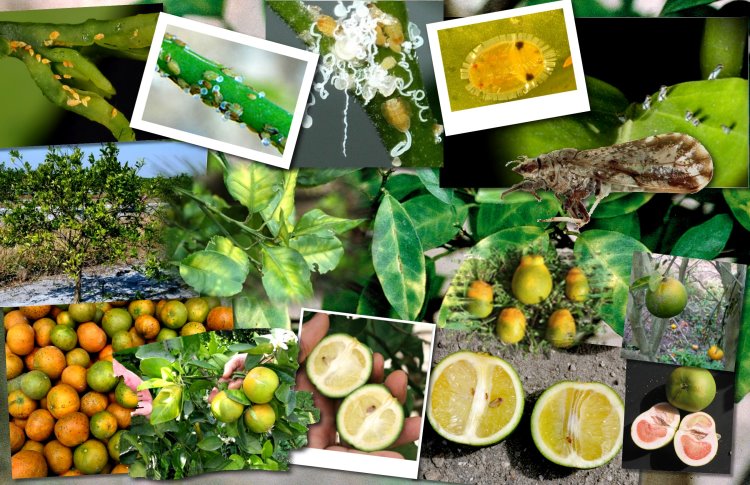 |
| Damaged caused by Citrus Greening |
CLEWISTON, Fla. — The call Ricke Kress and every other citrus grower in Florida dreaded came while he was driving.
“It’s here” was all his grove manager needed to say to force him over to the side of the road.
The disease that sours oranges and leaves them half green, already ravaging citrus crops across the world, had reached the state’s storied groves. Mr. Kress, the president of Southern Gardens Citrus, in charge of two and a half million orange trees and a factory that squeezes juice for Tropicana and Florida’s Natural, sat in silence for several long moments.
“O.K.,” he said finally on that fall day in 2005, “let’s make a plan.”
In the years that followed, he and the 8,000 other Florida growers who supply most of the nation’s orange juice poured everything they had into fighting the disease they call citrus greening.
To slow the spread of the bacterium that causes the scourge, they chopped down hundreds of thousands of infected trees and sprayed an expanding array of pesticides on the winged insect that carries it. But the contagion could not be contained.
They scoured Central Florida’s half-million acres of emerald groves and sent search parties around the world to find a naturally immune tree that could serve as a new progenitor for a crop that has thrived in the state since its arrival, it is said, with Ponce de León. But such a tree did not exist.
“In all of cultivated citrus, there is no evidence of immunity,” the plant pathologist heading a National Research Council task force on the disease said.
In all of citrus, but perhaps not in all of nature. With a precipitous decline in Florida’s harvest predicted within the decade, the only chance left to save it, Mr. Kress believed, was one that his industry and others had long avoided for fear of consumer rejection. They would have to alter the orange’s DNA — with a gene from a different species.
Oranges are not the only crop that might benefit from genetically engineered resistance to diseases for which standard treatments have proven elusive. And advocates of the technology say it could also help provide food for a fast-growing population on a warming planet by endowing crops with more nutrients, or the ability to thrive in drought, or to resist pests. Leading scientific organizations have concluded that shuttling DNA between species carries no intrinsic risk to human health or the environment, and that such alterations can be reliably tested.
But the idea of eating plants and animals whose DNA has been manipulated in a laboratory — called genetically modified organisms, or G.M.O.’s — still spooks many people. Critics worry that such crops carry risks not yet detected, and distrust the big agrochemical companies that have produced the few in wide use. And hostility toward the technology, long ingrained in Europe, has deepened recently among Americans as organic food advocates, environmentalists and others have made opposition to it a pillar of a growing movement for healthier and ethical food choices.
Mr. Kress’s boss worried about damaging the image of juice long promoted as “100 percent natural.”
“Do we really want to do this?” he demanded in a 2008 meeting at the company’s headquarters on the northern rim of the Everglades.
Mr. Kress, now 61, had no particular predilection for biotechnology. Known for working long hours, he rose through the ranks at fruit and juice companies like Welch’s and Seneca Foods. On moving here for the Southern Gardens job, just a few weeks before citrus greening was detected, he had assumed his biggest headache would be competition from flavored waters, or persuading his wife to tolerate Florida’s humidity.
But the dwindling harvest that could mean the idling of his juice processing plant would also have consequences beyond any one company’s bottom line. Florida is the second-largest producer of orange juice in the world, behind Brazil. Its $9 billion citrus industry contributes 76,000 jobs to the state that hosts the Orange Bowl. Southern Gardens, a subsidiary of U.S. Sugar, was one of the few companies in the industry with the wherewithal to finance the development of a “transgenic” tree, which could take a decade and cost as much as $20 million.
An emerging scientific consensus held that genetic engineering would be required to defeat citrus greening. “People are either going to drink transgenic orange juice or they’re going to drink apple juice,” one University of Florida scientist told Mr. Kress.
And if the presence of a new gene in citrus trees prevented juice from becoming scarcer and more expensive, Mr. Kress believed, the American public would embrace it. “The consumer will support us if it’s the only way,” Mr. Kress assured his boss.
His quest to save the orange offers a close look at the daunting process of genetically modifying one well-loved organism — on a deadline. In the past several years, out of public view, he has considered DNA donors from all over the tree of life, including two vegetables, a virus and, briefly, a pig. A synthetic gene, manufactured in the laboratory, also emerged as a contender.
Trial trees that withstood the disease in his greenhouse later succumbed in the field. Concerns about public perception and potential delays in regulatory scrutiny put a damper on some promising leads. But intent on his mission, Mr. Kress shrugged off signs that national campaigns against genetically modified food were gaining traction.
Only in recent months has he begun to face the full magnitude of the gap between what science can achieve and what society might accept.
Millenniums of Intervention
Even in the heyday of frozen concentrate, the popularity of orange juice rested largely on its image as the ultimate natural beverage, fresh-squeezed from a primordial fruit. But the reality is that human intervention has modified the orange for millenniums, as it has almost everything people eat.
Before humans were involved, corn was a wild grass, tomatoes were tiny, carrots were only rarely orange and dairy cows produced little milk. The orange, for its part, might never have existed had human migration not brought together the grapefruit-size pomelo from the tropics and the diminutive mandarin from a temperate zone thousands of years ago in China. And it would not have become the most widely planted fruit tree had human traders not carried it across the globe.
The varieties that have survived, among the many that have since arisen through natural mutation, are the product of human selection, with nearly all of Florida’s juice a blend of just two: the Hamlin, whose unremarkable taste and pale color are offset by its prolific yield in the early season, and the dark, flavorful, late-season Valencia.
Because oranges themselves are hybrids and most seeds are clones of the mother, new varieties cannot easily be produced by crossbreeding — unlike, say, apples, which breeders have remixed into favorites like Fuji and Gala. But the vast majority of oranges in commercial groves are the product of a type of genetic merging that predates the Romans, in which a slender shoot of a favored fruit variety is grafted onto the sturdier roots of other species: lemon, for instance, or sour orange. And a seedless midseason orange recently adopted by Florida growers emerged after breeders bombarded a seedy variety with radiation to disrupt its DNA, a technique for accelerating evolution that has yielded new varieties in dozens of crops, including barley and rice.
Its proponents argue that genetic engineering is one in a continuum of ways humans shape food crops, each of which carries risks: even conventional crossbreeding has occasionally produced toxic varieties of some vegetables. Because making a G.M.O. typically involves adding one or a few genes, each containing instructions for a protein whose function is known, they argue, it is more predictable than traditional methods that involve randomly mixing or mutating many genes of unknown function.
But because it also usually involves taking DNA from the species where it evolved and putting it in another to which it may be only distantly related — or turning off genes already present — critics of the technology say it represents a new and potentially more hazardous degree of tinkering whose risks are not yet fully understood.
If he had had more time, Mr. Kress could have waited for the orange to naturally evolve resistance to the bacteria known as C. liberibacter asiaticus. That could happen tomorrow. Or it could take years, or many decades. Or the orange in Florida could disappear first.
Plunging Ahead
Early discussions among other citrus growers about what kind of disease research they should collectively support did little to reassure Mr. Kress about his own genetic engineering project.
“The public will never drink G.M.O. orange juice,” one grower said at a contentious 2008 meeting. “It’s a waste of our money.”
“The public is already eating tons of G.M.O.’s,” countered Peter McClure, a big grower.
“This isn’t like a bag of Doritos,” snapped another. “We’re talking about a raw product, the essence of orange.”
The genetically modified foods Americans have eaten for more than a decade — corn, soybeans, some cottonseed oil, canola oil and sugar — come mostly as invisible ingredients in processed foods like cereal, salad dressing and tortilla chips. And the few G.M.O.’s sold in produce aisles — a Hawaiian papaya, some squash, a fraction of sweet corn — lack the iconic status of a breakfast drink that, Mr. Kress conceded, is “like motherhood” to Americans, who drink more of it per capita than anyone else.
If various polls were to be believed, a third to half of Americans would refuse to eat any transgenic crop. One study’s respondents would accept only certain types: two-thirds said they would eat a fruit modified with another plant gene, but few would accept one with DNA from an animal. Fewer still would knowingly eat produce that contained a gene from a virus.
There also appeared to be an abiding belief that a plant would take on the identity of the species from which its new DNA was drawn, like the scientist in the movie “The Fly” who sprouted insect parts after a DNA-mixing mistake with a house fly.
Asked if tomatoes containing a gene from a fish would “taste fishy” in a question on a 2004 poll conducted by the Food Policy Institute at Rutgers University that referred to one company’s efforts to forge a frost-resistant tomato with a gene from the winter flounder, fewer than half correctly answered “no.” A fear that the genetic engineering of food would throw the ecosystem out of whack showed in the surveys too.
Mr. Kress’s researchers, in turn, liked to point out that the very reason genetic engineering works is that all living things share a basic biochemistry: if a gene from a cold-water fish can help a tomato resist frost, it is because DNA is a universal code that tomato cells know how to read. Even the most distantly related species — say, humans and bacteria — share many genes whose functions have remained constant across billions of years of evolution.
“It’s not where a gene comes from that matters,” one researcher said. “It’s what it does.”
Mr. Kress set the surveys aside.
He took encouragement from other attempts to genetically modify foods that were in the works. There was even another fruit, the “Arctic apple,” whose genes for browning were switched off, to reduce waste and allow the fruit to be more readily sold sliced.
“The public is going to be more informed about G.M.O.’s by the time we’re ready,” Mr. Kress told his research director, Michael P. Irey, as they lined up the five scientists whom Southern Gardens would underwrite. And to the scientists, growers and juice processors at a meeting convened by Minute Maid in Miami in early 2010, he insisted that just finding a gene that worked had to be his company’s priority.
The foes were formidable. C. liberibacter, the bacterium that kills citrus trees by choking off their flow of nutrients — first detected when it destroyed citrus trees more than a century ago in China — had earned a place, along with anthrax and the Ebola virus, on the Agriculture Department’s list of potential agents of bioterrorism. Asian citrus psyllids, the insects that suck the bacteria out of one tree and inject them into another as they feed on the sap of their leaves, can carry the germ a mile without stopping, and the females can lay up to 800 eggs in their one-month life.
Mr. Kress’s DNA candidate would have to fight off the bacteria or the insect. As for public acceptance, he told his industry colleagues, “We can’t think about that right now.”
The ‘Creep Factor’
Trim, silver-haired and described by colleagues as tightly wound (he prefers “focused”), Mr. Kress arrives at the office by 6:30 each morning and microwaves a bowl of oatmeal. He stocks his office cabinet with cans of peel-top Campbell’s chicken soup that he heats up for lunch. Arriving home each evening, he cuts a rose from his garden for his wife. Weekends, he works in his yard and pores over clippings about G.M.O.’s in the news.
For a man who takes pleasure in routine, the uncertainty that marked his DNA quest was disquieting. It would cost Southern Gardens millions of dollars just to perform the safety tests for a single gene in a single variety of orange. Of his five researchers’ approaches, he had planned to narrow the field to the one that worked best over time.
But in 2010, with the disease spreading faster than anyone anticipated, the factor that came to weigh most was which could be ready first.
To fight C. liberibacter, Dean Gabriel at the University of Florida had chosen a gene from a virus that destroys bacteria as it replicates itself. Though such viruses, called bacteriophages (“phage” means to devour), are harmless to humans, Mr. Irey sometimes urged Mr. Kress to consider the public relations hurdle that might come with such a strange-sounding source of the DNA. “A gene from a virus,” he would ask pointedly, “that infects bacteria?”
But Mr. Kress’s chief concern was that Dr. Gabriel was taking too long to perfect his approach.
A second contender, Erik Mirkov of Texas A&M University, was further along with trees he had endowed with a gene from spinach — a food, he reminded Mr. Kress, that “we give to babies.” The gene, which exists in slightly different forms in hundreds of plants and animals, produces a protein that attacks invading bacteria.
Even so, Dr. Mirkov faced skepticism from growers. “Will my juice taste like spinach?” one asked.
“Will it be green?” wondered another.
“This gene,” he invariably replied, “has nothing to do with the color or taste of spinach. Your body makes very similar kinds of proteins as part of your own defense against bacteria.”
When some of the scientist’s promising trees got sick in their first trial, Mr. Kress agreed that he should try to improve on his results in a new generation of trees, by adjusting the gene’s placement. But transgenic trees, begun as a single cell in a petri dish, can take two years before they are sturdy enough to place in the ground and many more years to bear fruit.
“Isn’t there a gene,” Mr. Kress asked Mr. Irey, “to hurry up Mother Nature?”
For a time, the answer seemed to lie with a third scientist, William O. Dawson at the University of Florida, who had managed to alter fully grown trees by attaching a gene to a virus that could be inserted by way of a small incision in the bark. Genes transmitted that way would eventually stop functioning, but Mr. Kress hoped to use it as a stopgap measure to ward off the disease in the 60 million citrus trees already in Florida’s groves. Dr. Dawson joked that he hoped at least to save the grapefruit, whose juice he enjoyed, “preferably with a little vodka in it.”
But his most promising result that year was doomed from the beginning: of the dozen bacteria-fighting genes he had then tested on his greenhouse trees, the one that appeared effective came from a pig.
One of about 30,000 genes in the animal’s genetic code, it was, he ventured, “a pretty small amount of pig.”
“There’s no safety issue from our standpoint — but there is a certain creep factor,” an Environmental Protection Agency official observed to Mr. Kress, who had included it on an early list of possibilities to run by the agency.
“At least something is working,” Mr. Kress bristled. “It’s a proof of concept.”
A similar caution dimmed his hopes for the timely approval of a synthetic gene, designed in the laboratory of a fourth scientist, Jesse Jaynes of Tuskegee University. In a simulation, Dr. Jaynes’s gene consistently vanquished the greening bacteria. But the burden of proving a synthetic gene’s safety would prolong the process. “You’re going to get more questions,” Mr. Kress was told, “with a gene not found in nature.”
And in the fall of 2010, an onion gene that discouraged psyllids from landing on tomato plants was working in the Cornell laboratory of Mr. Kress’s final hope, Herb Aldwinckle. But it would be some time before the gene could be transferred to orange trees.
Only Dr. Mirkov’s newly fine-tuned trees with the spinach gene, Mr. Kress and Mr. Irey agreed, could be ready in time to stave off what many believed would soon be a steep decline in the harvest. In the fall of 2010, they were put to the test inside a padlocked greenhouse stocked with infected trees and psyllids.
The Monsanto Effect
Mr. Kress’s only direct brush so far with the broader battle raging over genetically modified food came in December 2010, in the reader comments on a Reuters article alluding to Southern Gardens’ genetic engineering efforts.
Some readers vowed not to buy such “frankenfood.” Another attributed a rise in allergies to genetic engineering. And dozens lambasted Monsanto, the St. Louis-based company that dominates the crop biotechnology business, which was not even mentioned in the article.
“If this trend goes on, one day, there will be only Monsanto engineered foods available,” read one letter warning of unintended consequences.
Mr. Kress was unperturbed. Dozens of long-term animal feeding studies had concluded that existing G.M.O.’s were as safe as other crops, and the National Academy of Sciences, the World Health Organization and others had issued statements to the same effect.
But some of his researchers worried that the popular association between G.M.O.’s and Monsanto — and in turn between Monsanto and the criticisms of modern agriculture — could turn consumers against Southern Gardens’ transgenic oranges.
“The article doesn’t say ‘Monsanto’ anywhere, but the comments are all about Monsanto,” Dr. Mirkov said.
It had not helped win hearts and minds for G.M.O.’s, Mr. Kress knew, that the first such crop widely adopted by farmers was the soybean engineered by Monsanto with a bacteria gene — to tolerate a weed killer Monsanto also made.
Starting in the mid-1990s, soybean farmers in the United States overwhelmingly adopted that variety of the crop, which made it easier for them to control weeds. But the subsequent broader use of the chemical — along with a distaste for Monsanto’s aggressive business tactics and a growing suspicion of a food system driven by corporate profits — combined to forge a consumer backlash. Environmental activists vandalized dozens of field trials and protested brands that used Monsanto’s soybeans or corn, introduced soon after, which was engineered to prevent pests from attacking it.
In response, companies including McDonald’s, Frito-Lay and Heinz pledged not to use G.M.O. ingredients in certain products, and some European countries prohibited their cultivation.
Some of Mr. Kress’s scientists were still fuming about what they saw as the lost potential for social good hijacked both by the activists who opposed genetic engineering and the corporations that failed to convince consumers of its benefits. In many developing countries, concerns about safety and ownership of seeds led governments to delay or prohibit cultivation of needed crops: Zambia, for instance, declined shipments of G.M.O. corn even during a 2002 famine.
”It’s easy for someone who can go down to the grocery store and buy anything they need to be against G.M.O.’s,” said Dr. Jaynes, who faced such barriers with a high-protein sweet potato he had engineered with a synthetic gene.
To Mr. Kress in early 2011, any comparison to Monsanto — whose large blocks of patents he had to work around, and whose thousands of employees worldwide dwarfed the 750 he employed in Florida at peak harvest times — seemed far-fetched. If it was successful, Southern Gardens would hope to recoup its investment by charging a royalty for its trees. But its business strategy was aimed at saving the orange crop, whose total acreage was a tiny fraction of the crops the major biotechnology companies had pursued.
He urged his worried researchers to look at the early success of Flavr Savr tomatoes. Introduced in 1994 and engineered to stay fresh longer than traditional varieties, they proved popular enough that some stores rationed them, before business missteps by their developer ended their production.
And he was no longer alone in the pursuit of a genetically modified orange. Citrus growers were collectively financing research into a greening-resistant tree, and the Agriculture Department had also assigned a team of scientists to it. Any solution would have satisfied Mr. Kress. Almost daily, he could smell the burning of infected trees, which mingled with orange-blossom sweetness in the grove just beyond Southern Gardens’ headquarters.
A Growing Urgency
In an infection-filled greenhouse where every nontransgenic tree had showed symptoms of disease, Dr. Mirkov’s trees with the spinach gene had survived unscathed for more than a year. Mr. Kress would soon have 300 of them planted in a field trial. But in the spring of 2012, he asked the Environmental Protection Agency, the first of three federal agencies that would evaluate his trees, for guidance. The next step was safety testing. And he felt that it could not be started fast enough.
Dr. Mirkov assured him that the agency’s requirements for animal tests to assess the safety of the protein produced by his gene, which bore no resemblance to anything on the list of known allergens and toxins, would be minimal.
“It’s spinach,” he insisted. “It’s been eaten for centuries.”
Other concerns weighed on Mr. Kress that spring: growers in Florida did not like to talk about it, but the industry’s tripling of pesticide applications to kill the bacteria-carrying psyllid was, while within legal limits, becoming expensive and worrisome. One widely used pesticide had stopped working as the psyllid evolved resistance, and Florida’s citrus growers’ association was petitioning one company to lift the twice-a-season restrictions on spraying young trees — increasingly its only hope for an uninfected harvest.
Others in the industry who knew of Mr. Kress’s project were turning to him. He agreed to speak at the fall meeting of citrus growers in California, where the greening disease had just been detected. “We need to hear about the transgenic solution,” said Ted Batkin, the association’s director. But Mr. Kress worried that he had nothing to calm their fears.
And an increasingly vocal movement to require any food with genetically engineered ingredients to carry a “G.M.O.” label had made him uneasy.
Supporters of one hotly contested California ballot initiative argued for labeling as a matter of consumer rights and transparency — but their advertisements often implied the crops were a hazard: one pictured a child about to take a joyful bite of a pest-resistant cob of corn, on which was emblazoned a question mark and the caption “Corn, engineered to grow its own pesticide.”
Yet the gene that makes corn insect-resistant, he knew, came from the same soil bacterium long used by organic food growers as a natural insecticide.
Arguing that the Food and Drug Administration should require labels on food containing G.M.O.’s, one leader of the Environmental Working Group, an advocacy group, cited “pink slime, deadly melons, tainted turkeys and BPA in our soup.”
Mr. Kress attributed the labeling campaigns to the kind of tactic any industry might use to gain a competitive edge: they were financed largely by companies that sell organic products, which stood to gain if packaging implying a hazard drove customers to their own non-G.M.O. alternatives. He did not aim to hide anything from consumers, but he would want them to understand how and why his oranges were genetically engineered. What bothered him was that a label seemed to lump all G.M.O.’s into one stigmatized category.
And when the E.P.A. informed him in June 2012 that it would need to see test results for how large quantities of spinach protein affected honeybees and mice, he gladly wrote out the $300,000 check to have the protein made.
It was the largest single expense yet in a project that had so far cost more than $5 million. If these tests raised no red flags, he would need to test the protein as it appears in the pollen of transgenic orange blossoms. Then the agency would want to test the juice.
“Seems excessive,” Dr. Mirkov said.
But Mr. Kress and Mr. Irey shared a sense of celebration. The path ahead was starting to clear.
Rather than wait for Dr. Mirkov’s 300 trees to flower, which could take several years, they agreed to try to graft his spinach gene shoots to mature trees to hasten the production of pollen — and, finally, their first fruit, for testing.
Wall of Opposition
Early one morning a year ago, Mr. Kress checked the Agriculture Department’s Web site from home. The agency had opened its 60-day public comment period on the trees modified to produce “Arctic apples” that did not brown.
His own application, he imagined, would take a similar form.
He skimmed through the company’s 163-page petition, showing how the apples are equivalent in nutritional content to normal apples, how remote was the likelihood of cross-pollination with other apple varieties and the potentially bigger market for a healthful fruit.
Then he turned to the comments. There were hundreds. And they were almost universally negative. Some were from parents, voicing concerns that the nonbrowning trait would disguise a rotten apple — though transgenic apples rotten from infection would still turn brown. Many wrote as part of a petition drive by the Center for Food Safety, a group that opposes biotechnology.
“Apples are supposed to be a natural, healthy snack,” it warned. “Genetically engineered apples are neither.”
Others voiced a general distrust of scientists’ guarantees: “Too many things were presented to us as innocuous and years later we discovered it was untrue,” wrote one woman. “After two cancers I don’t feel like taking any more unnecessary risks.”
Many insisted that should the fruit be approved, it ought to be labeled.
That morning, Mr. Kress drove to work late. He should not be surprised by the hostility, he told himself.
Mr. Irey tried to console him with good news: the data on the honeybees and mice had come back. The highest dose of the protein the E.P.A. wanted tested had produced no ill effect.
But the magnitude of the opposition had never hit Mr. Kress so hard. “Will they believe us?” he asked himself for the first time. “Will they believe we’re doing this to eliminate chemicals and we’re making sure it’s safe? Or will they look at us and say, ‘That’s what they all say?’ ”
The major brands were rumored to be looking beyond Florida for their orange juice — perhaps to Brazil, where growers had taken to abandoning infected groves to plant elsewhere. Other experiments that Mr. Kress viewed as similar to his own had foundered. Pigs engineered to produce less-polluting waste had been euthanized after their developer at a Canadian university had failed to find investors. A salmon modified to grow faster was still awaiting F.D.A. approval. A study pointing to health risks from G.M.O.’s had been discredited by scientists, but was contributing to a sense among some consumers that the technology is dangerous.
And while the California labeling measure had been defeated, it had spawned a ballot initiative in Washington State and legislative proposals in Connecticut, Vermont, New Mexico, Missouri and many other states.
In the heat of last summer, Mr. Kress gardened more savagely than his wife had ever seen.
Driving through the Central Valley of California last October to speak at the California Citrus Growers meeting, Mr. Kress considered how to answer critics. Maybe even a blanket “G.M.O.” label would be O.K., he thought, if it would help consumers understand that he had nothing to hide. He could never prove that there were no risks to genetically modifying a crop. But he could try to explain the risks of not doing so.
Southern Gardens had lost 700,000 trees trying to control the disease, more than a quarter of its total. The forecast for the coming spring harvest was dismal. The approval to use more pesticide on young trees had come through that day. At his hotel that night, he slipped a new slide into his standard talk.
On the podium the next morning, he talked about the growing use of pesticides: “We’re using a lot of chemicals, pure and simple,” he said. “We’re using more than we’ve ever used before.”
Then he stopped at the new slide. Unadorned, it read “Consumer Acceptance.” He looked out at the audience.
What these growers wanted most, he knew, was reassurance that he could help them should the disease spread. But he had to warn them: “If we don’t have consumer confidence, it doesn’t matter what we come up with.”
Planting
One recent sunny morning, Mr. Kress drove to a fenced field, some distance from his office and far from any other citrus tree. He unlocked the gate and signed in, as required by Agriculture Department regulations for a field trial of a genetically modified crop.
Just in the previous few months, Whole Foods had said that because of customer demand it would avoid stocking most G.M.O. foods and require labels on them by 2018. Hundreds of thousands of protesters around the world had joined in a “March Against Monsanto” — and the Agriculture Department had issued its final report for this year’s orange harvest showing a 9 percent decline from last year, attributable to citrus greening.
But visiting the field gave him some peace. In some rows were the trees with no new gene in them, sick with greening. In others were the 300 juvenile trees with spinach genes, all healthy. In the middle were the trees that carried his immediate hopes: 15 mature Hamlins and Valencias, seven feet tall, onto which had been grafted shoots of Dr. Mirkov’s spinach gene trees.
There was good reason to believe that the trees would pass the E.P.A.’s tests when they bloom next spring. And he was gathering the data the Agriculture Department would need to ensure that the trees posed no risk to other plants. When he had fruit, the Food and Drug Administration would compare its safety and nutritional content to conventional oranges.
In his office is a list of groups to contact when the first G.M.O. fruit in Florida are ready to pick: environmental organizations, consumer advocates and others. Exactly what he would say when he finally contacted them, he did not know. Whether anyone would drink the juice from his genetically modified oranges, he did not know.
But he had decided to move ahead.
Late this summer he will plant several hundred more young trees with the spinach gene, in a new greenhouse. In two years, if he wins regulatory approval, they will be ready to go into the ground. The trees could be the first to produce juice for sale in five years or so.
Whether it is his transgenic tree, or someone else’s, he believed, Florida growers will soon have trees that could produce juice without fear of its being sour, or in short supply.
For a moment, alone in the field, he let his mind wander.
“Maybe we can use the technology to improve orange juice,” he could not help thinking. “Maybe we can find a way to have oranges grow year-round, or get two for every one we get now on a tree.”
Then he reined in those thoughts.
He took the clipboard down, signed out and locked the gate.


