Thursday, May 9, 2013

1057. Synthetic Biology: Dreaming of Trees Aglow at Night!


By Andrew Pollack, The New York Times, May 7, 2013
Antony Evans, left, and Kyle Taylor show E. coli with jellyfish genes. Photo credit: Peter DaSilva for The New York Times


Hoping to give new meaning to the term “natural light,” a small group of biotechnology hobbyists and entrepreneurs has started a project to develop plants that glow, potentially leading the way for trees that can replace electric streetlamps and potted flowers luminous enough to read by.

The project, which will use a sophisticated form of genetic engineering called synthetic biology, is attracting attention not only for its audacious goal, but for how it is being carried out.
Rather than being the work of a corporation or an academic laboratory, it will be done by a small group of hobbyist scientists in one of the growing number of communal laboratories springing up around the nation as biotechnology becomes cheap enough to give rise to a do-it-yourself movement.
The project is also being financed in a D.I.Y. sort of way: It has attracted more than $250,000 in pledges from about 4,500 donors in about two weeks on the Web site Kickstarter.
The effort is not the first of its kind. A university group created a glowing tobacco plant a few years ago by implanting genes from a marine bacterium that emits light. But the light was so dim that it could be perceived only if one observed the plant for at least five minutes in a dark room.
The new project’s goals, at least initially, are similarly modest. “We hope to have a plant which you can visibly see in the dark (like glow-in-the-dark paint), but don’t expect to replace your light bulbs with version 1.0,” the project’s Kickstarter page says.
But part of the goal is more controversial: to publicize do-it-yourself synthetic biology and to “inspire others to create new living things.” As promising as that might seem to some, critics are alarmed at the idea of tinkerers creating living things in their garages. They fear that malicious organisms may be created, either intentionally or by accident.
Two environmental organizations, Friends of the Earth and the ETC Group, have written to Kickstarter and to the Agriculture Department, which regulates genetically modified crops, in an effort to shut down the glowing plant effort.
The project “will likely result in widespread, random and uncontrolled release of bioengineered seeds and plants produced through the controversial and risky techniques of synthetic biology,” the two groups said in their letter demanding that Kickstarter remove the project from its Web site.
They note that the project has pledged to deliver seeds to many of its 4,000 contributors, making it perhaps the “first-ever intentional environmental release of an avowedly ‘synthetic biology’ organism anywhere in the world.” Kickstarter told the critics to take up their concerns with the project’s organizers. The Agriculture Department has not yet replied.
Antony Evans, the manager of the glowing plant project, said in an interview that the activity would be safe.
“What we are doing is very identical to what has been done in research laboratories and big institutions for 20 years,” he said. Still, he added, “We are very cognizant of the precedent we are setting” with the do-it-yourself project and that some of the money raised would be used to explore public policy issues.
Synthetic biology is a nebulous term and it is difficult to say how, if at all, it differs from genetic engineering.
In its simplest form, genetic engineering involves snipping a gene out of one organism and pasting it into the DNA of another. Synthetic biology typically involves synthesizing the DNA to be inserted, providing the flexibility to go beyond the genes found in nature.
The glowing plant project is the brainchild of Mr. Evans, a technology entrepreneur in San Francisco, and Omri Amirav-Drory, a biochemist. They met at Singularity University, a program that introduces entrepreneurs to futuristic technology.
Dr. Amirav-Drory runs a company called Genome Compiler, which makes a program that can be used to design DNA sequences. When the sequence is done, it is transmitted to a mail-order foundry that synthesizes the DNA.
Kyle Taylor, who received his doctorate in molecular and cell biology at Stanford last year, will be in charge of putting the synthetic DNA into the plant. The research will be done, at least initially, at BioCurious, a communal laboratory in Silicon Valley that describes itself as a “hackerspace for biotech.”
The first plant the group is modifying is Arabidopsis thaliana, part of the mustard family and the laboratory rat of the plant world. The organizers hope to move next to a glowing rose.
Scientists have long made glowing creatures for research purposes, including one or more monkeys, cats, pigs, dogs and worms. Glowing zebra fish have been sold in some aquarium shops for years.
These creatures typically have the gene for a green fluorescent protein, derived from a jellyfish, spliced into their DNA. But they glow only when ultraviolet light is shined on them.
Others going back to the 1980s have transplanted the gene for luciferase, an enzyme used by fireflies, into plants. But luciferase will not work without another chemical called luciferin. So the plants did not glow unless luciferin was constantly fed to them. In 2010, researchers at Stony Brook University reported in the journal Plos One that they had created a tobacco plant that glowed entirely on its own, however dimly. They spliced into the plant all six genes from a marine bacterium necessary to produce both luciferase and luciferin.
Alexander Krichevsky, who led that research, has started a company, BioGlow, to commercialize glowing plants, starting with ornamental ones, since it is still impractical to replace light bulbs.
“Wouldn’t you like your beautiful flowers to glow in the dark?” he said, invoking the glowing foliage in the movie “Avatar.”
Dr. Krichevsky declined to provide more about the products, timetables or the investors backing his company, which is based in St. Louis.
Whether it will ever be possible to replace light bulbs remains to be seen and depends to some extent on how much of the plant’s energy can be devoted to light production while still allowing the plant to grow. Mr. Evans said his group calculated, albeit with many assumptions, that a tree that covers a ground area of 10 meters (nearly 33 feet) by 10 meters might be able to cast as much light as a street lamp.
While the Agriculture Department regulates genetically modified plants, it does so under a law covering plant pests.
BioGlow has already obtained a letter from the department saying that it will not need approval to release its glowing plants because they are not plant pests, and are not made using plant pests. The hobbyist project hopes to get the same exemption.
Todd Kuiken, senior research associate at the Woodrow Wilson Center in Washington, who has been studying the governance of both synthetic biology and the do-it-yourself movement, said the glowing plant project was an ideal test case.
“It exposes the gaps and holes in the regulatory structure, while it is, I would argue, a safe product in the grand scheme of things,” Dr. Kuiken said. “A serious look needs to be taken at the regulatory system to see if it can handle the questions synthetic biology is going to raise.”

1056. Cuban Five: René González Renounces His U.S. Citizenship to Remain in Cuba


By Sergio Alejandro Gómez and Livia Rodríguez Delis, Granma International, May 7, 2013 
René González and his wife Olga Salanueva
DURING a press conference in Havana, René González, one of the five Cuban heroes unjustly convicted in the U.S. for anti-terrorist activities, said, “My commitment to this people is the only possible response I can make to the solidarity, affection and support 11 million Cubans have shown me.”
Accompanied by his family, René affirmed that he considered himself “a Cuban patriot, who identifies with our struggle and our project.” His priority, he continued, will be to join the campaign to free his four brothers.
“Until they are all here, we must continue fighting,” René said, “They are going to persevere, they will not surrender.”
 He had but one word for U.S. President Barack Obama: courage. This is the only thing that the President needs to do justice, René believes.
In reference to the international campaign to free the four Cubans who remain imprisoned, René commented, “U.S. society must be reached. The people in that country must know that the U.S. government put us in prison to protect their own terrorists. The people must know that a judge told me terrorism is bad, but that I didn’t have the right to combat it there.”
Addressing his difficult years in prison, he said that he very much appreciated the thousands of letters he received and laments not having been able to answer each and every one. He commented that the dignity and status afforded to those who were fighting for justice, by the prison population, also helped.
“Each of us,” René said, “confronted this test with our own resources. I exercised and read. Tony is communicating all the time; Ramón has his sports; Fernando is studying and Gerardo has that sense of humor which allows him to rise above any tragedy.”
René also shared his impressions of the Cuba he has re-encountered. He recalled that during his visit last year, he was joking with some young men in Cotorro (Havana) and said that the streets have more potholes. “But the people have the same essence and that makes me happy,” he added.
A journalist asked about his grandson, Ignacio René, Irmita’s son, “A baseball player or a pilot?”
René responded immediately, “If it’s up to me, I’d say pilot, because I’m terrible at baseball.”
Renunciation of U.S. citizenship process initiated
“I’m very happy to be in Cuba, with my family and my people, to rejoin the society I belong to,” René said after initiating the process of renouncing his U.S. citizenship at the U.S. Interests Section in Havana, with his attorney Phillip Horowitz.
“I have many mixed emotions about the process. My father died; I came to see him and in these circumstances, this opportunity arose, but we’ll continue to move forward.”
The anti-terrorist arrived at the Interests Section, also accompanied by his family, and was received with demonstrations of affection and support from residents in the area, who noticed his arrival. In reference to the specifics of the process, René explained that this is technical procedure, which he initiated by completing the necessary application to renounce his citizenship and that he was treated professionally by the Interests Section staff.
“I will subsequently be provided with a Loss of Citizenship Certificate from the Department of State and, once this happens, I will no longer be a U.S. citizen. I will be a proud Cuban citizen,” he added.
He indicated that the process should be complete by May 16, within the period designated by Judge Joan Lenard when she accepted his request to modify the terms of his probation, allowing him to remain in Cuba, in exchange for renouncing his U.S. citizenship.
According to the judge’s stipulations, on May 23, René must present a report on his status and a copy of the document certifying his loss of citizenship to the court. From the bottom of his heart, the designated Hero of the Republic of Cuba reiterated the necessity of continuing the struggle to free his four brothers.
“It is an injustice and a crime that they are imprisoned. We must continue to fight, because their families and the Cuban people need them.”

Tuesday, May 7, 2013

1055. Rich Countries Drag Feet at Climate Talks


By Stephen Leahy, IPS, May 7, 2013

UXBRIDGE, Canada, May 7 2013 (IPS) - Another week of international climate negotiations ended in Bonn, Germany last Friday, but there was little mid-level bureaucrats could do when world leaders remain in thrall to the fossil fuel industry, say environmentalists.
“The main barrier to confronting the climate crisis isn’t lack of knowledge about the problem, nor is it the lack of cost-effective solutions,” said Alden Meyer, director of strategy at the Union of Concerned Scientists.
“It’s the lack of political will by most world leaders to confront the special interests that have worked long and hard to block the path to a sustainable low-carbon future. Until this changes, we’re not going to see the action we need,” said Meyer, who has attended virtually every climate negotiation over the past 19 years.
Canada offers a perfect example. Its much-promoted strategy for future prosperity is based on pumping two billion of tonnes of climate-heating CO2 into the atmosphere. Tens of billions of dollars are being invested in the Alberta tar sands to increase production from 1.6 million barrels a day to four to five million a day by 2020.
That translates into one billion tonnes of CO2 a year from tar sands extraction and burning the resulting fuels.
Canada is also one of the world’s largest natural gas producers, with aggressive expansion plans estimated to result in adding 0.5 billion tonnes of CO2 annually by 2020 for production and burning.
Top this off with 80 to 100 million tonnes of CO2 from coal and Canada’s ‘normal’ domestic emissions of half a billion tonnes and Canada’s future prosperity will be based on profiting from dumping two billion tonnes of CO2 into the atmosphere.
The science is clear that to have a good chance of keeping global temperature increases below two degrees C requires global emissions to decline at least six to 10 billion tonnes below 2011 levels by 2020. And this decline must continue to push emissions lower every year thereafter. Instead emissions are increasing each year.
At least 78 percent of Canada’s proven oil, bitumen, gas and coal reserves, and 89 percent of proven-plus-probable reserves would need to remain underground as part of Canada’s effort to stay below two degrees C, according to a recent study by the Canadian Centre for Policy Alternatives (CCPA).
“Business-as-usual for the fossil fuel industry is incompatible with the need to keep the global temperature increase to two degrees C or less,” said CCPA senior economist Marc Lee.
“We are in need of a ‘managed retreat’ from fossil fuel investments,” said Lee.
However, under the Stephen Harper government Canada has pulled out of the Kyoto climate treaty, and reduced its support for energy efficiency and clean energy while continuing to provide more than one billion dollars in annual subsidies or tax incentives for fossil fuel companies.
Despite propaganda that rich countries like Canada take the dangers of climate change seriously, it is absolutely clear they do not. “World leaders are acting like Dr. Jekyll and Mr. Hyde,” Meyer said in a statement.
Developed countries must look at the gap between where the science says their targets should be in 2020, which is 50 percent below 1990 levels, and their current commitments are of just 13 percent, said Augustine Njamnshi of the Pan African Climate Justice Alliance (PACJA).
Despite all this the Bonn meeting ended with a positive dynamic, according to many participants. The Association of Small Island States launched a plan designed to have countries commit to deeper cuts in carbon emissions in the next few years. And there was much discussion around the issue of equity or fairness in terms of emissions reductions for a new climate treaty to be signed in 2015.
However, there were no commitments or specifics, said Njamnshi in a statement.
These discussions will continue at a two-week meeting in June also in Bonn. In November, leaders are slated to attend the annual U.N. climate conference known as COP 19 in Warsaw. There they need to agree on action to shrink the gap between pledges and what science says is needed, said Jan Kowalzig of Oxfam Germany.
“We’re on track to four degrees of warming which will be disastrous for most countries,” Kowalzig told IPS.
In Bonn, there was good discussion on how to reduce the gap, including the Association of Small Island States’ plan to have governments make specific commitments on renewable energy and energy efficiency at COP 19, he said.
The Climate Action Network, a coalition of over 90 civil society organisations including Oxfam, “wholeheartedly support this initiative”, he said.
An action plan for phasing out fossil subsidies also needs to be agreed on at COP 19. In addition, developed countries like Canada, the U.S. and Australia must come prepared to increase “their pathetically low emissions reduction targets”, Kowalzig said.

1054. Plants 'Talk' to Plants to Help Them Grow


By phys.org, May 7, 2013
Chili pepper (Capsicum annuum) 


Having a neighborly chat improves seed germination, finds research in BioMed Central's open access journal BMC Ecology. Even when other known means of communication, such as contact, chemical and light-mediated signals, are blocked chilli seeds grow better when grown with basil plants. This suggests that plants are talking via nanomechanical vibrations.

Monica Gagliano and Michael Renton from the University of Western Australia attempted to grow chilli seeds (Capsicum annuum) in the presence or absence of other chilli plants, or basil (Ocimum basilicum). In the absence of a neighboring plant, germination rates were very low, but when the plants were able to openly communicate with the seeds more seedlings grew.

However when the seeds were separated from the basil plants with black plastic, so that they could not be influenced by either light or chemical signals, they germinated as though they could still communicate with the basil. A partial response was seen for fully grown chilli plants blocked from known communication with the seeds.

Dr Gagliano explained, "Our results show that plants are able to positively influence growth of seeds by some as yet unknown mechanism. Bad neighbors, such as fennel, prevent chilli seed germination in the same way. We believe that the answer may involve acoustic signals generated using nanomechanical oscillations from inside the cell which allow rapid communication between nearby plants."

Friday, May 3, 2013

1053. Help Lynne Stewart's Fight Against Cancer and for Her Freedom


By Jeff Mackler, May 3, 2013
Visit Justice for Lynne Stewart


I just learned a few moments ago that federal probation officers in New York
visited members of Lynne's family today to ascertain whether they could
provide adequate Brooklyn, New York facilities for Lynne to live and be cared
for.

Of course, the family confirmed this immediately.

While we must use extreme caution in predicting an immediate and positive
outcome from this fact, we can state that government procedures with regard to
granting the compassionate release that tens of thousands around the world
have demanded include recommendations or administrative procedures from the
Bureau of Prisons to the presiding judge in Lynne' case.

This is Federal District Court Judge John Koeltl who, it appears, has the
authority to direct federal probation officers to investigate whether a
suitable facility for Lynne's care is available if Lynne were to be
transferred to her desired medical facility, in the case, the world renown
Sloan Kettering Cancer Center in New York.

Lynne emailed me  yesterday to state that her second chemotherapy treatment
was only partially successful in reducing her metastasized breast cancer in
the area of her lymph nodes and sternum. But the cancerous spots on her lugs
remain unchanged.

Now more than ever, first rate medical care is critical to save Lynne's life
and continue her battle for freedom.

Lynne has cautioned us all to not let up in this battle. "Like a tree that
grows in Brooklyn," says Lynne in an illusion to the 1943 Betty Smith novel of
a poor Irish-American family's struggle to establish roots and live a decent
live in early twentieth century Brooklyn, "I will not be content until my feet
are firmly planted in my Brooklyn home."

It appears that the worldwide campaign for compassionate release for Lynne has
taken root. But this is not the time for speculation with regard to the
exigencies of America's criminal "justice" system.

Lynne's live still hangs by a string. She survived the horrific ordeal of two
chemotherapy treatments that nearly ended it and had to be confined to a
hospital isolation ward when her white blood count fell to dangerously low
levels.

Her cancer has been in part and temporarily restrained, but not the malignant
tumors that persist in her lungs.

Demand compassionate release  for Lynne now! Sign the petition to do so in any
of the following manners depending on the state of your computer.

1)   Go to Lynne's website at LynneStewart.org and click on "Justice for
Lynne Stewart." Follow the directions on the right side of the first page.

2) Sign the petition on the change.org site.

3. Another way is to include the link directly to the change.org site in an
email message or article

http://www.change.org/petitions/petition-to-free-lynne-stewart-save-her-life-release-her-now-2

This leads people to the site directly and with one click and we lead people
to Lynne's website.

It's easy enough to locate the petition on the change.org site - there is a
search option in the browser and Lynne Stewart leads people to the petition
site. Also, the petition has been listed as one of the "popular" human rights
petitions from the beginning.

3. Some people will have difficulty using the change.org site. Either their
server is too slow, their computer a few years old and the browser software
too old. There is a note on the petition site telling people what to do. In
that case they send their message of support to ralph.poynter@gmail.com. Ralph
Potnter is Lynne's lifelong companion, husband and leader of her national
defense.

Stay on the alert to attend a possible New York court hearing wherein Judge
Koeltl may make a final determination on Lynne's demand for compassionate
release.

Finally, send your generous donation payable to the LYNNE STEWART ORGANIZATION
and mail it to:

1070 Dean Street, Brooklyn, New York 11216

Act now!

In solidarity and for Lynne's freedom and life itself,

Jeff Mackler, West Coast Coordinator, Lynne Stewart Defense Committee
jmackler@lmi.net  510-268-9429

Note: Jeff Mackler is available for West Coast fundraising and  speaking
engagements on Lynne's case.

Thursday, May 2, 2013

1052. Roberto Zurbano: The Country to Come: and My Black Cuba? The Original Article as Submitted to the New York Times


By Roberto Zurbano, Negra Cubana Tenía Que Ser, April 29, 2013
Roberto Zurbano
AN INTRODUCTORY NOTE
There is a Yoruba proverb which says “By losing you win.” Reflection, criticism, and greater commitments for change are what I have won in these recent days, first turbulent and then clarifying. Because of these discussions, today I better understand the people and the positions they have defined with regard to racism.
At the end of a month there have been dozens of texts published in and outside of Cuba. My questions are still the same and my convictions even stronger. The answers multiply, ramify and achieve new pathways in the debate. The original Spanish text has been requested more than once; in my March 26th note, I explained why I could not make it immediately available: it was not merely out of respect for my contractual arrangement, but also a moral response to the New York Times.
Finally, I bring to light the promised texts, the original Spanish as written before it was translated by the Times and a new translation to English, more decent, professional and respectful of the original than the version that was finally printed. The translation is the fruit of friendship and commitment to the anti-racist cause. These are the texts and the road map that explain the distortions that I have denounced. As for the ideas in my original article I maintain both the responsibility and the spirit to discuss them in and outside of Cuba.
In fulfilling this ethical responsibility, I am also sending these texts to Afromodernidades, Desde la Ceiba, Negra Cubana Tenía Que Ser and Observatorio Crítico, all blogs and newsletters from the island that have given dignified coverage on this and other important discussions on contemporary Cuban society. And, it is also being sent to AfroCubaweb, the dean of all websites on Afro-Cuban culture, where for decades we have found respect, commitment, and professionalism when discussing our issues.
Roberto Zurbano
Callejón de Hammell
La Habana
March 26, 2013

A critical testimony from within the island is also a way of looking at oneself from outside Cuba, from the color of one’s skin, as if we were to question the future of Afro-Cubans from a History…that repeats itself? 
Change is the most recent news coming out of Cuba, but for Afro-Cubans it seems more a dream than reality. In the last five years dozens of absurd prohibitions have been lifted for ordinary Cubans, among them staying at a hotel, buying a cellphone, selling one’s house, starting a private business, and traveling abroad. These measures are called an opening, but they are really no more than efforts to normalize the conditions of citizenship. The economic results of these gestures will bring about true change and permit Cuba to exit History and enter, once and for all, into the Present. The Future (the country to come) approaches swiftly, desperately, and in that race dreams and utopias shared until recently by Cubans melt away.
Blacks have had to face the new opening of the private sector in Cuba with a disadvantage. We inherited more than two centuries of slavery and sixty years of exclusion in the Republican Period (1902-1959), and over half a century of revolutionary rule (1959-2013) has still not been able to overcome them, because of the way that racism is disguised and renews itself when not debated or not openly confronted politically and culturally. If the 1960s meant opportunity for everyone, the seventies revealed that not everyone had the capacity to take advantages of those opportunities; the eighties showed a high percentage of black professionals who in the nineties were excluded from the privileged social spaces of tourism and the mixed economy. Already in the XXIst century it’s evident that the black population is under-represented in their access to political, economic, and academic power, in contrast to their over-representation in the informal market, illegal activities, and marginal neighborhoods.
If the nineties began to see two types of currency (peso and dollar) circulate in the country, people also lived two contrasting realities: the first allows white families to receive remittances from abroad, especially Miami, the nerve center of an overwhelmingly white Cuban exile community. The other reality is the sector of the Cuban population that does not receive remittances, that black majority that saw the socialist utopia flicker out from the most uncomfortable quarters of the island. For them, entering the new economy is a challenge. In the last twenty years black Cubans have suffered a reversal or paralysis of the great social mobility that propelled them from 1959 to 1989. Paradoxically, during the same period, books and official discourse declared the end of racism in Cuba. To deny the racial utopia was tantamount to committing a counterrevolutionary act, so denouncing racism has been extremely difficult, but, through a certain cultural and political activism, there has been public acknowledgement of the problem and racism has officially been recognized. I think that to abandon the anti-racist struggle, especially against what I call neo-racism (less overt forms of racial exclusion), would be politically disingenuous with nefarious future consequences.
Raúl Castro announced that he would be serving his last term in office (2013-2018) and with it a political era in Cuba will come to a close. By then the island will be another type of country and we hope that women, youth, and blacks will be able to guide the nation on a path where diversity is recognized and practiced, where the diverse national projects that have lain dormant in the hearts and minds of many will be heard. The new political generations of Cubans will learn to walk on their own, feet on the ground, heads upright. I hope that before 2018 organizations like the Cofradía de la Negritud (Black Brotherhood), the Comité Ciudadano de Integración Racial (Citizens Committee for Racial Integration), the Articulación Regional Afrodescendiente (Regional Network of People of African Descent ), the Comisión José Aponte (the José Aponte Commission) and other groups that form part of the Cuban anti-racist movement will grow both in the legal and organizational sense so as to find solutions that have been put off for so long, but that the black majority still awaits. Black Cubans also hope for an end to the embargo, but more urgently, they need to elevate their self-esteem, improve their material conditions, increase their access to better jobs, and achieve recognition of their cultural worth, and not just in a commercial sense. Black Cubans also want to be protagonists in the new ways in which the nation will be understood and built.
I’m not asking that in the next elections (2018) we elect a black president, but that this journey allows us to form new leaders, empower communities and build consensus as well as strategic alliances inside and outside the country. Our racial consciousness still remains insufficient and it would make it a small (or ephemeral), triumph to have a black Cuban figure isolated at the top in a prejudiced milieu, leading a country whose political and cultural links to Africa some Cubans still try to hide. Eventually we will be able to have a black Pope or President whose hands will not be tied. As for me, I will continue to struggle for and dream of a country where black people are the builders, owners, and critics of our destiny as Cubans, where we will enjoy fuller citizenship. That country has yet to arrive, but aside from dreaming it, I go out searching for it every morning.
March 13, 2013
Roberto Zurbano. Essayist and cultural critic, specialist in literature, race, and alternative music. Author of various books and essays, among them “Cuba 2012: Twelve Difficulties in Confronting (Neo) Racisms”. He is currently working on the following books: “The Invisible Triangle of 20th Century Cuba: Literature, Race, and Nation”, and “Out of the Club, a Map of the Cuban Hip Hop Nation”. Mr. Zurbano directs the Editorial Fund of Casa de las Américas, where he has been active in inserting issues of race into that institution’s cultural programming.

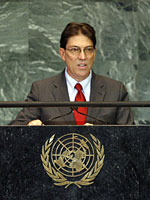
1051. Cuba Demands U.S. Must Shut Guantanamo Bay Prison and Base

Cuba's Foreign Minister
Bruno Rodriguez Parrilla
 

By Herald Sun, May 2, 2013 
CUBA'S foreign minister has demanded that Washington shut its controversial jail at Guantanamo Bay and return the long-held military base to Havana.
The comments by Bruno Rodriguez Parrilla to the UN Human Rights Council in Geneva came a day after US President Barack Obama vowed again to shut the military prison, saying it was damaging US interests.
"We are deeply concerned about the legal limbo that supports the permanent and atrocious violation of human rights at the illegal naval base in Guantanamo, a Cuba territory that was usurped by the United States, a centre of torture and deaths of prisoners who are under custody," Mr Parrilla said.
He said 160 people had been detained in Guantanamo for 10 years, "without any guarantees, without being tried by a court or the right to legal defence".
"That prison and military base should be shut down and that territory should be His comments came as the UN's human rights office said that force-feeding Guantanamo Bay hunger strikers is a breach of international law.
"If it's perceived as torture or inhuman treatment - and it's the case, it's painful - then it is prohibited by international law," Rupert Coville, spokesman for the UN high commissioner for human rights, said.
Out of 166 inmates held at the prison at the remote US naval base in southeastern Cuba, 100 are on hunger strike, according to the latest tally from military officers. And of those, 21 detainees are being fed through nasal tubes.
Mr Coville explained that the UN bases its stance on that of the World Medical Association, a 102-nation body whose members include the United States, which is a watchdog for ethics in healthcare.
In 1991 the WMA said that forcible feeding is "never ethically acceptable".
"Even if intended to benefit, feeding accompanied with threats, coercion, force or use of physical restraints is a form of inhuman and degrading treatment. Equally unacceptable is the force feeding of some detainees in order to intimidate or coerce other hunger strikers to stop fasting," it said.
That WMA ruling followed a 1975 declaration that artificial feeding methods should never be used without a prisoner's permission, and that a prisoner had the right to refuse all food if a physician considered the individual capable of "unimpaired and rational judgment" about the consequences.
Artificial feeding can be used if a prisoner agrees to it, or if the detainee is ruled unable to make a competent decision and left no unpressured advance instructions refusing it, according to the WMA.
The hunger strike, which is now into its 12th week, has upped the pressure on Washington to shut what US President Barack Obama has called a legal "no man's land".
On Tuesday, Mr Obama vowed to renew a push to close the prison, saying he did not want any inmates to die and urging Congress to help him find a long-term solution that would allow for prosecuting terror suspects while closing Guantanamo.
The inmates are protesting their indefinite detention without charges or trials at the facility, which was set up by his predecessor, George W Bush, to hold those captured in Afghanistan and elsewhere after the attacks of September 11, 2001.