Friday, March 16, 2012

718. Climat Change and Humans Caused Mammoth Extinction


By Richard A. Kerr, Science Now, March 5, 2012
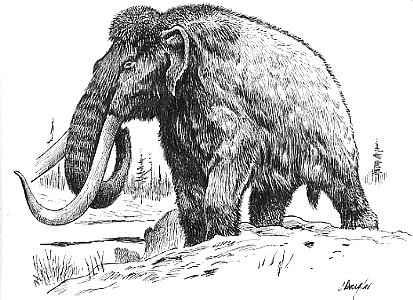
The past few tens of millennia were hard times for the "megafauna" of the world. Hundreds of big-bodied species—from the mammoths of North America to the 3-meter-tall kangaroos of Australia to the 200-kilogram-plus flightless birds of New Zealand—just disappeared from the fossil record. A new, broad analysis continues the century-long debate over the loss of the big animals, coming down on the middle ground between blaming migrating humans for wiping them all out and climate change alone for doing them in.
As in most contentious scientific debates, uncertainties in the data have fueled the dispute over what took out the megafauna. Typically, researchers would try to pin down exactly when, say, the mammoths of North America died out, when the climate changed the fastest as the world came out of the last ice age, and, most difficult, when humans from Asia first arrived on the scene. If the extinction in a particular area seemed to coincide with severe climate change or with the arrival of humans, one or the other could be blamed. If it seemed to have been the humans, researchers assumed the new arrivals must have hunted down too many mammoths, brought a lethal disease with them, or altered the environment somehow, perhaps by too much burning.
But the case-by-case tactic has not yet carried the day for either side. So zoologists Graham Prescott and David Williams and their colleagues at the University of Cambridge in the United Kingdom decided to take a broader approach. In a paper published today in the Proceedings of the National Academy of Sciences, they lay out their analysis of the extinction of 110 genera of megafauna on five landmasses in relation to the timing of four kinds of climate change and the arrival of humans.
The Cambridge group compiled dates from previous studies for the arrival of humans and the extinction of megafauna on each landmass: Australia, Eurasia, New Zealand, North America, and South America. And they took the temperature record locked in an Antarctic ice core as a guide to global climate change. Then they compared how well climate change and human arrivals, alone or in combination, could predict the timing and severity of extinctions on the five landmasses. To sort out the importance of timing uncertainties, they tested 320,000 different extinction scenarios. "We tested a lot of models across a huge range of human arrival times and extinction times," Prescott says. "It seems likely that both climate and human factors played a role" in most cases.
"What they found makes sense," says mammalian paleoecologist Anthony Barnosky of the University of California, Berkeley. "It makes a clear case for there being an interaction. It shows what happens when two bad things happen at once." Barnosky and environmental scientist Barry Brook of the University of Adelaide in Australia have found such a human-climate synergy operating in megafaunal extinctions when severe climate change coincided with human arrivals. A similar synergy is happening today, they say, as global warming intensifies and the human population continues to grow.
But others have concerns about the latest study—for example, the way it lumps together events occurring as much as 10,000 years apart to test for coincidence. "When you have such a challenging problem, what are you willing to ignore in the details to get the big picture?" asks ecological statistician Andrew Solow of Woods Hole Oceanographic Institution in Massachusetts. "I'm worried that too much of the detail was omitted. This is a first step."

717. A Little Gorilla in Us All


sn-gorillas.jpg
Kamila
By Elizabeth Pennisi, Science Now,  March 7, 2012
Ever since the human genome was sequenced a decade ago, researchers have dreamed about deciphering DNA from our three great ape cousins as well. Now the final remaining genome, that of the gorilla, is in hand, and it reveals interesting connections between us and them. Surprisingly, parts of our genome are more similar to the gorilla's than they are to the chimp's, and a few of the same genes previously thought key to our unique evolution are key to theirs, too.
Today there are four groups of great apes: chimps and bonobos, humans, gorillas, and orangutans. The genome of the chimp—our closest relative—was published in 2005; the orangutan sequence came out in early 2011. Now researchers have analyzed the DNA of a western lowland gorilla named Kamilah, who lives at the San Diego Zoo. In addition, they sequenced DNA from three other gorillas, including one eastern lowland gorilla, a rare species estimated at only 20,000 individuals. "It's essential to have all of the great ape genomes in order to understand the features of our own genome that make humans unique," says Gregory Wray, an evolutionary biologist at Duke University in Durham, North Carolina, who was not involved in the study. Adds paleoanthropologist David Begun of the University of Toronto in Canada: "It will allow us to begin to identify genetic changes specific to humans since our divergence from chimps."
Humans and apes are nearly identical in the vast majority of base pairs, or letters of the genetic code: The human genome is 1.37% different from the chimp's; 1.75% different from the gorilla's; and 3.4% different from the orangutan's, researchers from the Wellcome Trust Sanger Institute in Hinxton, U.K., and their colleagues report today in Nature. Although chimps and humans are indeed closest kin, 15% of the human genome more closely matches the gorilla's. Those genes' activity patterns are similar too, says Sanger evolutionary genomicist and lead author of the study Aylwyn Scally: "Some of our functional biology is more gorillalike than chimplike."
Moreover, with all the great ape genomes to compare, researchers are better able to assess when gorillas, chimps, and humans evolved—a matter of current debate. The molecular data indicate that humans and chimps went their separate ways only about 4.5 million years ago. But fossils that old and older look either ape or protohuman, so some paleontologists argue for a split as far back as 7 million years ago. Scally's group comes up with a date of about 6 million years ago, adjusting what would have been a more recent estimate by assuming that the mutation rate slowed over time in ape evolution. Another possible complication is that interbreeding may have occurred in the incipient species, slowing the actual separation of the DNA into distinct genomes, Scally points out. The authors suggest that ancestors of the gorilla separated from the human-chimp line about 10 million years ago, consistent with previous estimates.
"I am very happy to see the authors conclude [with] divergence dates that are consistent with both the fossil and genetic records," Begun says. "Usually one line of evidence is used to discredit the other."
The comparison with other sequenced genomes revealed that over the course of great ape evolution, about 90% of the genome has been influenced by natural selection. In each of the chimp, human, and gorilla, more than 500 genes have been evolving faster than expected, suggesting that they have changed in a way that confers some advantage. In the gorilla, one of the faster-evolving genes is involved in the hardening of skin, as happens in the knuckle pads for knuckle walking. Hearing genes that have evolved rapidly in humans also show accelerated evolution in gorillas. Some researchers had thought that those human genes might partly underlie language evolution, but that idea will need some rethinking now, Scally says. The researchers also saw parallel acceleration in the evolution of genes for brain development in gorillas and humans.
As part of the study, Scally and colleagues compared the genomes of eastern and western lowland gorillas and concluded that the species split up 0.5 million years ago but continued to interbreed a little after that. Moreover, many millennia ago, for some unknown reason, the eastern lowland gorilla population severely shrank, causing low genetic diversity and low numbers. Some researchers have suggested that the small population is due to recent human activity, but the new analysis suggests "it's a long-term thing," Scally says. "That's not to say that current human activity hasn't been a big threat."
Much more work remains to be done comparing the gorilla genome with other great apes. But already "it has provided a lot of important information regarding mechanisms and timing of speciation, gene evolution, [and] gene flow between [species and] subspecies," says gylcobiologist and great ape expert Ajit Varki of the University of California, San Diego, who was not involved in the study. "This information is, of course, of great interest to many investigators."

Thursday, March 15, 2012

716. Book Review: Gaia's Garden: A Guide to Home-Scale Permaculture Design

By Kamran Nayeri, March 15, 2012

Toby Hemenway. Gaia's Garden:A Guide to Home-Scale Permaculture Design, Second Edition, 
White River Junction, Vermont: Chelsea Green Publishing Company, 2009 

About 10,000 years ago, some groups of our species made a transition from gatherer-hunter way of life to permanent agrarian settlements. Recent research show that this transition, called the Agricultural Revolution, was not some rational choice for a better way of life.  It is suggested that climate change forced some gatherer-hunters to use existing knowledge and technology to eke out a living from agriculture and that standard of living of the early agricultural settlers was probably lower than their gatherer-hunter contemporaries.  However, it was on the basis of these agrarian settlements that class societies emerged and evolved up to the present day capitalist world economy.  In the process, competing social organizations—whether gatherer-hunter groups or pastoral (nomadic) tribes—were either suppressed or absorbed into class societies’ “civilization.”  Thus, the emergence and rise of class society (domination and exploitation of direct producers by a ruling class) was founded on the basis of domination and exploitation of nature.  Modern humans either domesticated animals and plants to suit our perceived needs or destroyed whoever and whatever got in Our Way of Life.  Under industrial capitalism this process has reach its critical point with the planetary crisis we face today.  Either we reverse course and attain a harmonious social organization that lives in harmony with the rest of nature or much of life on which we depend will be destroyed.   Permaculture should be placed in this context, as a revolutionary theoretical and practical step in the direction of reversing humanity’s catastrophic course.

While permaculture finds its roots in earlier forms of farming such as forest farming of indigenous people or organic agriculture, Australians Bill Mollison and David Holmgren formulated it as a method during the 1970s. According to Mollison permaculture is "a philosophy of working with, rather than against nature; of protracted and thoughtful observation rather than premature and thoughtless labor; and of looking at plants and animals in all their functions, rather than treating any area as a single project system."[1]  Peraculture originally meant “permanent agriculture.”  However, as the social aspects of the theory became better understood it has come to mean “permanent culture.” As a young field, permaculture is evolving rapidly.

As a novice gardener I purchased Toby Hemenway’s Gaia’s Garden to learn about gardening; I certainly recommend it highly to others like myself instead of any traditional gardening books.  However, it is perhaps even more useful for more experienced gardeners who are getting tired of fighting Mother Nature to maintain their garden.

The book has three parts:

  • Part One: The garden as Ecosystem;
  • Part Two: The Pieces of the Ecological Garden;
  • Part Three: Assembling the Ecological Garden.

Part One, Chapter One introduces permaculture and the garden as an ecosystem and tells the story of a number of successful permaculturally designed gardens.  Chapter two introduces some ecological principles relevant to garden design and some techniques that is explored in some detail later in the book.  Chapter Three provides a road map for designing a permaculture garden.  

Part Two deals with four components of the garden as an ecosystem: soil, water, plants and insects, birds and other helpful animals.

Chapter Four is about the soil (Hemenway notes how it is degraded in English language as “dirt”). As Hemenway points out that soil is where “the dead are brought back to life.” Only recently scientists have began to view the soil not just in terms of its physics and chemistry but also as something alive.  A teaspoon of good pasture soil contains a billion bacteria, a million fungi and ten thousand amoebae.  Combined with clay, silt, sand, water, air, humus, assorted molecules, and small critters that make up the rest of soil, it is a complex life giving force.  Hemenway offers a great introduction to understanding and developing healthy soil.  Topics covered include recycling, composting and mulching.

Chapter Five deals with water conservation and use and is similarly informative and practical.  It begins with the observation that only 3 percent of the Earth’s water is fresh water and that three quarter of fresh water is frozen. Half of what remains is embedded in rock 2,500 feet or more below the surface.  Thus, only 0.375 percent of the planet’s water is useable and accessible in the form of lakes, rivers, groundwater, and atmospheric water.  Water is indeed a scare resource.  Hemenway covers a number of techniques for catching water, designing grey water systems, and creating wetlands.

Chapter Six is on plants and begins with an instructive outline of the many roles of a tree. This outline is powerful because in a couple of pages it undermines the mechanical worldview of nature so prevalent today where speices are viewed in terms of their utility or disutility for humans (click here for the text). Instead, Hemenway demonstrates how a tree is multifunctional and part of a complex ecosystem in which everything and everybody is connected to everything and everybody else.  He then singles out a number of plants for illustration including Maxillian sunflower, goumi, maypop, comfrey, mashua and bamboo.  Given this context, plants are also classified and discussed as mulch makers, nutrient accumulators, nitrogen fixers, soil fumigators and pest replants, insectary plants, fortress plants, and so on.

In Chapter Seven Hemenway introduces the reader to the role insects, birds and other helpful animals (e.g. chicken, ducks, rabbits) play in a permaculture design.  He discusses predatory insects, parasitic insects, pollinators and weed feeders.  He also discusses birds and how to attract them to the garden as well as techniques such as chicken “tractors” and rabbit cages (more on these later).

Part Three deals with the implementation of the permaculture design.  In Chapter Eight Hemenway discusses creating plant communities—where each plant supports others.  He begins with early attempts to return from monoculture to polyculture including Ianto Evans’s polyculture and Jakakot’s advanced polyculture.  Next, he introduces the concept of guilds defined as “a group of plants and animals harmoniously interwoven into a pattern of mutual support, often centered around one major species, that benefits humans while creating habitat.” (p. 183).

Chapter Nine offers design ideas for garden guilds using natural plant communities as guide.  He introduces techniques such as function-stacking in guilds. He then proceeds to “super guilds” (a guild is organized around a tree and a super guild around a number of trees). 

Chapter Ten introduces the concept of food forest. Chapter Eleven offers techniques for permaculture design for cities where land and space is scarce. Hemeway devotes the last chapter (Chapter Twelve) to brining together all the key ideas he has introduced in the book and adds a few more general ideas to show how the whole is larger than the sum of its parts. In fact, some readers may want to browse this short chapter before reading the book to get a sense of how various ideas may will come together.

Hemenway has written a wonderful book about permaculture home-scale garden design with many practical suggestions rooted in a philosophy of nature that  includes aesthetics and ethics.  Expanding on the ideas of Masanobu Fukuoka (the visionary founder of the Natural Farming movement) he writes:

“…[G]uilds ask for a subtle adjustment of our relation with our environment.  The order of a conventional row-crop garden is the order of the machine.  This regimentation invites us to view plants as mechanical food factories. We fuel them with fertilizers, service them with rakes and hoes, and measure their production in bushels, bins, and tons. We view the plants as part of our dominion. In a guild, we are but one living being among many others; and, like all other animals enfolded by this community, we nurture and are nurtured by an almost-wild place. We prune and cull, as do the deer and mice. The fruit we leave does not rot on the ground to breed disease; it is gladly devoured by many companions.  We turn over a bit of soil, and the worms turn over yet more. We participate rather than rule. With guilds, we begin to shed the mantle of command and return to nature the many responsibilities we have unnecessarily assumed.” (p. 207)

In my view, this ethics of permaculture is consistent with the ethics of ecological socialism—a future society where permacture will become the norm and not a marginal activity.  However, Hemenway is not always consistent is applying this ethics.  The idea of “chicken tractors” and “rabbit cages” suggested by him in Chapter Seven as a way to scratch the land and/or produce manure is not consistent either with the ethics he outlines in the book and quoted above or with the ethics of an increasing number of people who are concerned if not with animal liberation, are at least concerned with their welfare.  The idea of “Free range chicken” trumps Hemenway’s “chicken tractors”  and the like. 

1.  "Healthy Environments and You". Shirley MacLaine.com, Inc. and MacLaine Enterprises, Inc.

Tuesday, March 13, 2012

715. How Ancient Plants and Soil Fungi Turned Earth Green


Colonized plant.
(Credit: Image courtesy of University of Sheffield)
ScienceDaily, November 2, 2010 

New research by scientists at the University of Sheffield has shed light on how Earth's first plants began to colonize the land over 470 million years ago by forming a partnership with soil fungi.

The research, published in Nature Communications, has provided essential missing evidence showing that an ancient plant group worked together with soil-dwelling fungi to 'green' Earth in the early Palaeozoic era, nearly half a billion years ago.

The research, which also involved experts from the Royal Botanic Gardens, Kew, Imperial College London and the University of Sydney, has provided new insights into our understanding of the evolving dynamic behavior of Earth's land plants and fungi.

Scientists have long-suspected that soil fungi formed mutually beneficial relationships with early land plants to play an essential role in assisting their initial colonization of terrestrial environments. However, until now there has been a lack of evidence demonstrating if and how the earliest ancient land plants, from the early Palaeozoic era (over 470 million years ago), might have cooperated with fungi for mutual benefit.

The team studied a thalloid liverwort plant, which is a member of the most ancient group of land plants that still exists and still shares many of the original features of its ancestors. They used controlled-environment growth rooms to simulate a CO2-rich atmosphere, similar to that of the Palaeozoic era when these plants originated. This environment significantly amplified the benefits of the fungi for the plant's growth and so favored the early formation of the association between the plant and its fungal partner.

The team found that when the thalloid liverwort was colonized by the fungi, it significantly enhanced photosynthetic carbon uptake, growth and asexual reproduction, factors that had a beneficial impact on plant fitness. The plants grow and reproduce better when colonized by symbiotic fungi because the fungi provide essential soil nutrients. In return, the fungi also benefit by receiving carbon from the plants. The research found that each plant was supporting fungi that had an area of 1-2 times that of a tennis court.

Professor David Beerling, from the Department of Animal and Plant Sciences at the University of Sheffield, said: "By studying these ancient plants we open a window on the past to investigate how the earliest land plants evolved. Our results support the idea that the 'greening' of the Earth was promoted by a symbiosis between plants and fungi. It shows that plants didn't get a toe-hold on land without teaming up with fungi -- this has long been suspected, but until now not investigated. It will require us to think again about the crucial role of cooperation between organisms that drove fundamental changes in the ecology of our planet."

Martin Bidartondo from the Jodrell Laboratory at the Royal Botanic Gardens, Kew, said: "Fungi are present in every type of habitat throughout the world and are essential for many plants to grow. It is exciting that we are now beginning to discover the fungi associated with 'lower' plants, and that many more still remain to be investigated."


Story Source:
The above story is reprinted from materials provided by University of Sheffield.
Note: Materials may be edited for content and length. For further information, please contact the source cited above.

Journal Reference:
  1. Claire P. Humphreys, Peter J. Franks, Mark Rees, Martin I. Bidartondo, Jonathan R. Leake, David J. Beerling.Mutualistic mycorrhiza-like symbiosis in the most ancient group of land plantsNature Communications, 2010; 1 (8): 103 DOI: 10.1038/ncomms1105

714. The Darwin-Wallace Mystery Solved: Darwin Vindicated from Accusations of Deceit


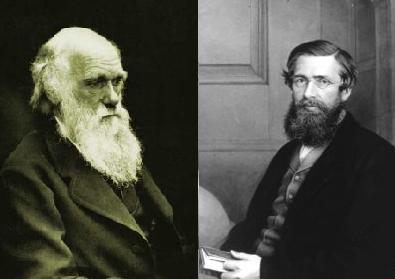
Charles Darwin (L) and Alfred Russel Wallace (R)
ScienceDaily, March 8, 2012  

A National University of Singapore. study has traced historical shipping records and vindicated Darwin from accusations of deceit.

For the past four decades, Charles Darwin had been accused of keeping the essay of fellow naturalist Alfred Russel Wallace for a fortnight, thereby enabling him to revise elements of his theory of evolution, before jointly announcing the theory of evolution by natural selection in July 1858. Just recently, two researchers from the National University of Singapore (NUS), supported by a private donation, reconstructed the route taken by Wallace's letter to Darwin from Ternate and provided evidence that Wallace sent the letter a month later than historians had always assumed, thus clearing Darwin of the accusations against him.

Dr John van Wyhe, a historian of science and Senior Lecturer in the Departments of Biological Sciences & History at NUS and his collaborator Dr Kees Rookmaaker, published their study, titled "A new theory to explain the receipt of Wallace's Ternate Essay by Darwin in 1848," in the Biological Journal of the Linnean Society in December 2011.

The controversy
Alfred Russel Wallace, the naturalist who spent eight years in Singapore and South East Asia between 1854 and 1862, discovered evolution by natural selection independently of Charles Darwin. Wallace had a dramatic eureka moment while living on the island of Ternate in the Moluccas (now Indonesia). He wrote up his ideas in an essay which he sent in 1858, to Charles Darwin, for him to pass on to noted geologist Charles Lyell. Darwin's accusers claim that he waited two weeks to do so, lying about the date of receipt to give himself time to revise his own ideas in the light of Wallace's.

Wallace's essay was published together with an essay by Darwin in 1858 and marks the first publication of the theory of evolution which then resulted in one of the greatest revolutions in the history of science.

How the mystery began
In 1972 a researcher found another letter from Wallace to a friend named Bates that was sent on the March 1858 steamer from the island of Ternate in modern Indonesia. The letter still bore postmarks from Singapore and London which showed that it arrived in London on 3 June 1858 -- two weeks before Darwin said he received the essay from Wallace. Thus began the mystery -- how could two letters from Wallace leave Ternate on the same steamer and travel along the same mail route back to London but Darwin received his two weeks later than Bates did? This mystery has led to numerous conspiracy theories. For example, several writers have claimed that Darwin stole ideas from Wallace's essay during the time he kept the letter secret. But most other evidence suggests that Darwin received the letter when he said he did.

So did Darwin receive the letter when he said he did, or not?

"I initially assumed that it was impossible to solve since so many historians had examined it before. But it occurred to me that we really have no contemporary evidence of when Wallace sent the essay to Darwin, only his much later recollection that he sent it by the next post after writing it in February. That suggested that the essay was sent in March 1858. But this recollection from years later seemed to me not very reliable as evidence of what really happened at the time. The other evidence that Darwin received it on 18 June 1858 seemed more likely. All of his correspondence changed dramatically after that date for example. Since that side of the correspondence was all one really had to go on, it occurred to me to trace the letter from Darwin's end, rather than Wallace's," said Dr van Wyhe.

If Darwin really received it on 18 June- how could it get there? It had come to his house in the countryside from London the day before, the 17th.

Dr van Wyhe then found that a steamer arrived in England the day before, the 16th with mail from India and South East Asia. This was surely not a coincidence -- Wallace's letter must have been on that ship. Dr van Wyhe then had to trace back the remainder of the 9,240 miles of the journey from England, through the Mediterranean, across Egypt, to Sri Lanka, Penang, Singapore, Jakarta and so on. His assistant on the Wallace Online project, Dr Kees Rookmaaker, who speaks Dutch, was an invaluable help as he was able to check the ship arrival and departure times in the Dutch newspapers and sources for the Dutch East Indies, while Dr van Wyhe went through the English newspapers. It was an exciting detective story tracing the connections that mail batch took from London to South East Asia.

"Eventually our mail itinerary was completed all the way back to Ternate and we were astonished to find that there was an unbroken series of mail connections to Ternate -- not in March as all other writers before had assumed, but in April 1858! My further research has clarified why Wallace mailed it later than we assumed and many other parts of this famous, but misunderstood chapter in the history of science," added Dr van Wyhe.

"First of all, we now know that Wallace was replying to an early letter from Darwin- and that letter from Darwin arrived in Ternate on the March steamer. We have assembled the first complete collection of all the surviving Wallace correspondence from Ternate and nearby islands. These reveal that he never replied to a letter on the same steamer which delivered it. Apparently the turn over time was too short. Therefore this is an additional reason to doubt that Wallace could have sent the famous letter to Darwin in March as so long assumed," said Dr van Wyhe.

Dr van Wyhe is currently completing a major new book on Wallace in South East Asia which aims to radically revise the traditional story of Wallace and his famous independent discovery of evolution.

Dr van Wyhe is the Director of the research project in Singapore -- Wallace Online, a website which aims to be the definitive and reliable source of Wallace's work. It will contain all of Wallace's books and article, as well as a complete collection of his specimens collected from South-east Asia, and much more, such as a revised itinerary of his whereabouts during these years and his notebooks edited for the first time to modern scholarly standards. The website will be launched in 2013, the centenary of the death of Wallace.

This study was supported by a generous private donation to the Darwin Online-Wallace Online projects.

Story Source:
The above story is reprinted from materials provided by National University of Singapore, via AlphaGalileo.

713. Honey Bees Have Personalities Too, Study Finds


Bees Seek Adventure, Studies ShowScienceDaily, March 8, 2012 

A new study in Science suggests that thrill-seeking is not limited to humans and other vertebrates. Some honey bees, too, are more likely than others to seek adventure. The brains of these novelty-seeking bees exhibit distinct patterns of gene activity in molecular pathways known to be associated with thrill-seeking in humans, researchers report.

The findings offer a new window on the inner life of the honey bee hive, which once was viewed as a highly regimented colony of seemingly interchangeable workers taking on a few specific roles (nurse or forager, for example) to serve their queen. Now it appears that individual honey bees actually differ in their desire or willingness to perform particular tasks, said University of Illinois entomology professor and Institute for Genomic Biology director Gene Robinson, who led the study. These differences may be due, in part, to variability in the bees' personalities, he said. "In humans, differences in novelty-seeking are a component of personality," he said. "Could insects also have personalities?"

Robinson and his colleagues studied two behaviors that looked like novelty-seeking in honey bees: scouting for nest sites and scouting for food.

When a colony of bees outgrows its living quarters, the hive divides and the swarm must find a suitable new home. At this moment of crisis, a few intrepid bees -- less than 5 percent of the swarm -- take off to hunt for a hive.

These bees, called nest scouts, are on average 3.4 times more likely than their peers to also become food scouts, the researchers found.

"There is a gold standard for personality research and that is if you show the same tendency in different contexts, then that can be called a personality trait," Robinson said. Not only do certain bees exhibit signs of novelty-seeking, he said, but their willingness or eagerness to "go the extra mile" can be vital to the life of the hive.

The researchers wanted to determine the molecular basis for these differences in honey bee behavior. They used whole-genome microarray analysis to look for differences in the activity of thousands of genes in the brains of scouts and non-scouts.

"People are trying to understand what is the basis of novelty-seeking behavior in humans and in animals," who Robinson, who also is affiliated with the Neuroscience Program at Illinois. "And a lot of the thinking has to do with the relationship between how the (brain's) reward system is engaged in response to some experience."

The researchers found thousands of distinct differences in gene activity in the brains of scouting and non-scouting bees.

"We expected to find some, but the magnitude of the differences was surprising given that both scouts and non-scouts are foragers," Robinson said.
Among the many differentially expressed genes were several related to catecholamine, glutamate and gamma-aminobutyric acid (GABA) signaling, and the researchers zeroed in on these because they are involved in regulating novelty-seeking and responding to reward in vertebrates.

To test whether the changes in brain signaling caused the novelty-seeking, the researchers subjected groups of bees to treatments that would increase or inhibit these chemicals in the brain.

Two treatments (with glutamate and octopamine) increased scouting in bees that had not scouted before. Blocking dopamine signaling decreased scouting behavior, the researchers found.

"Our results say that novelty-seeking in humans and other vertebrates has parallels in an insect," Robinson said. "One can see the same sort of consistent behavioral differences and molecular underpinnings."

The findings also suggest that insects, humans and other animals made use of the same genetic "toolkit" in the evolution of behavior, Robinson said. The tools in the toolkit -- genes encoding certain molecular pathways -- may play a role in the same types of behaviors, but each species has adapted them in its own, distinctive way.

"It looks like the same molecular pathways have been engaged repeatedly in evolution to give rise to individual differences in novelty-seeking," he said.
The National Science Foundation, National Institutes of Health and Illinois Sociogenomics Initiative supported this research.
Collaborators on this study included researchers from Wellesley College and Cornell University.

Story Source:
The above story is reprinted from materials provided by University of Illinois at Urbana-Champaign.
Note: Materials may be edited for content and length. For further information, please contact the source cited above.

Journal Reference:
  1. Z. S. Liang, T. Nguyen, H. R. Mattila, S. L. Rodriguez-Zas, T. D. Seeley, G. E. Robinson. Molecular Determinants of Scouting Behavior in Honey BeesScience, 2012; 335 (6073): 1225 DOI: 10.1126/science.1213962

712. Oceans Will Not Survive "Business As Usual"


Change in sea surface pH caused by
huma produced CO2 between 1700s and 1900s
By Barry Bates, IPS, March 12, 2012  

Brussels--Our oceans face a grim outlook in the coming decades. Ocean acidification, loss of marine biodiversity, climate change, pollution and over-exploitation of resources all point to the urgent need for a new paradigm on caring for the earth’s oceans—"business as usual" is simply not an option anymore, experts say.

The extreme rate of acidification – the term used to describe the decrease in ocean pH levels caused by man-made CO2 emissions – has happened before, Carol Turley of Plymouth Marine Laboratory said, a claim that might have been comforting if she hadn’t been referring to the time when dinosaurs died out.

This is a "huge environmental crisis," she told attendees at an information session at European Parliament this month, addressing challenges and solutions for the world’s oceans months ahead of the United Nations Conference on Sustainable Development, Rio+20, slated to be held in Brazil in June.

Turley joked that she’s often called the "acid queen" because of her bleak message, though the plight of more than 70 percent of the earth’s surface is not in the least bit humorous.

Each year, the ocean absorbs roughly 26 percent of total CO2 emissions, which have increased by 30 percent since the beginning of the Industrial Revolution in 1750, according to the International Ocean Acidification Reference User Group.

Ocean acidification affects marine life with calcium carbonate skeletons and shells, making them sensitive to even small changes in acidity. Acidification also reduces the availability of calcium for plankton and shelled species, which constitute the base of the entire marine food chain, creating a disastrous domino affect that could wipe out entire ecosystems.

"[The] earth system is truly under the influence of man," said Wendy Watson-Wright, assistant director general and executive secretary of the Intergovernmental Oceanographic Commission (IOC) of the United Nations Education, Scientific and Cultural Organisation (UNESCO).

The oceans could be 150 percent more acidic by 2100, she added. This means drastic decreases in yields from fisheries, and mass extinction of marine life.

The world is currently losing natural resources at a rate humans haven’t even begun to describe, she said.

Changing public opinion
 Sadly, rallying the public behind the necessity of ocean preservation has proved difficult.

Global attention has largely been focused on the economy, particularly on the latest bout of economic chaos in the United States and Europe.

"Our greatest challenge is to convince citizens that environmental targets (don’t go) against economic progress," European Union Commissioner for Maritime Affairs and Fisheries, Maria Damanaki, stressed.

For some, it’s a problem of "out of sight, out of mind," said Watson-Wright, arguing that people disregard oceans as a priority since they live on land. But even landlocked countries have a great stake in ocean sustainability, she stressed.

With Rio+20, designed to commemorate the 20th anniversary of the first United Nations Conference on Environment and Development, only a few months away, it is past time to discuss solutions.

Raphaël Billé, program director for biodiversity and adaptation at the Institute for Sustainable Development and International Relations (IDDRI), called for stronger language on environmental goals, in order to improve political momentum in the priority themes articulated by the conference organisers.

He noted that Rio+20 is less than concrete in terms of political agreements, but is an opportunity to assess progress and renew political commitments, in the hopes of paving the way for hard decisions later.

Can Rio+20 be a game changer?
 Rio+20 will feature oceans as one of seven themes, which also include food, energy, cities, water, and disasters.

Since the first meeting in Rio 20 years ago, there has been some progress on protections for the oceans, according to UNESCO, which includes decisions made within the Johannesburg Plan of Implementation, agreed upon during the Earth Summit in 2002.

Plans for the world’s oceans at Rio+20 are outlined as ten proposals under four main objectives, according to UNESCO’s IOC: taking concrete action to reduce stressors and restore the structure and function of marine ecosystems; support for a "Blue-Green" economy; moving toward policy, legal and institutional reforms; and supporting marine research and monitoring, evaluation, and technology.

The concerns over our planet’s oceans are not new, IDDRI pointed out in an article submitted to the U.N. in early November 2011; most of these problems have been recognised for decades, and, according to the article, "The only way forward is to recognise the overall failure of oceanic governance, to study the successes at hand, and to develop strategies that seriously take both into account."

The article also mentioned the conflicts between oceanic governance and resistance to make it more sustainable, especially when costs begin to add up.

Though various experts have expressed doubt that the meeting in Rio will yield sufficient results for the planet, activists and scientists alike are turning up the heat on conference attendees to leverage political power at the gathering to make tough, lasting decisions that might give the oceans and their essential ecologies a shot at survival.