Tuesday, January 10, 2012

655. Housing Market Booms in Cuba


Santiago walks in front of his home he is selling in Camaguey, some 550 km (340 miles) east of Havana January 2, 2012. Hundreds of handwritten signs stuck on doorways and in windows announce 'se vende' or 'for sale' in provincial cities and towns across Cuba as the island's nascent housing market begins to bloom.  REUTERS-Marc FrankBy  Marc Frank, Reuters, January 9, 2012
Santiago de Cuba--Hundreds of handwritten signs stuck on doorways and in windows announce "se vende" or "for sale" in provincial cities and towns across Cuba as the island's nascent housing market begins to bloom.
Buyers walk the streets looking at homes the whereabouts of which were passed along by word of mouth as sellers outside of Havana have limited access to the Internet or other means to advertise their sales.
There are hovels and there are splendid little places tucked between crumbling buildings. There are two-story homes in need of repair and a few in immaculate condition. Some places go for the equivalent of a few thousand dollars, others for much more.
Buying and selling homes was banned for decades in Cuba. The best one could do was trade dwellings in what Cubans call a "permuta" and expand or decrease the size of where you lived by a single room.
That all changed when the ban was lifted in November, along with much of the previous paperwork and bureaucratic tangles, though Cubans can still own just one home and vacation place and non-resident foreigners are excluded from the market.
The measure appears to be the most popular yet as President Raul Castro, who replaced his ailing brother Fidel in 2008, works to reform the Soviet-style economy and gradually lifts some of the more onerous restrictions on people's daily lives.
Trading one's home was a nightmarish process that could take months and even years under the old system, and often required bribes and under-the-table payments.
The new system requires a simple notary and payment through the bank and appears to be working relatively well according to more than a dozen people selling their homes from one end of the island to the other.
"The new law is really good because there are people who get divorced, or who have money but no place to live, or live in a big place and want a smaller one, or have big families in a little place and want something larger and now with this law they can meet their needs much more easily," Tania Vigaroa, in the process of selling her home in eastern Holguin, said.
Most of the sellers say they would like to move to a smaller home and that permutas plus payments are now to difficult to find because people prefer to buy or sell.
In neighboring Santiago de Cuba the other day a haggard looking receptionist at the San Pedro notary office, where the waiting room was full, said the three notaries working there had no time to talk.
"This place has been overflowing since they changed the law, every day is the same," said receptionist Milaidy, who asked that her last name not be used, adding there were three other offices in the city.
Most sellers have become used to strangers on the prowl for a home. They are a hospitable lot, welcoming the passerby to come in for a look.
"I'm asking $55,000. The house has three rooms, two bathrooms, a big back yard, kitchen, dining room and living room and this is right near the center of town," said Jose Ramirez in the city of Ciego de Avila, in central Cuba.
"A number of people have come by so we will see. It's a respectable sum, but my daughter was recently divorced and lives across town and I want to be near her for support. There is a house over there that costs exactly the same amount," he said.
Some 60 miles to the east, in the city of Camaguey, bicycle-taxi driver Roberto Sosa says "no problem," when asked to peddle the Cuban version of a rickshaw around town for a look at what's on the market.
OVERSEAS INTEREST
An hour and five homes later one place catches the eye on Virgin Street. The neighborhood needs a plaster and paint job and the road needs paving, but the half-block-long, five bedroom single story house, freshly painted and with new tile floors, is splendid.
"We want $35,000 and have a possible buyer, but she is checking with her family in Miami," said the owner's son, who gave his name only as Santiago.
Bicitaxi peddler Sosa wasn't surprised.
"Most of the houses sold are (being bought) with the help of family abroad, if not it wouldn't be possible because their value is going up a lot now," he said, pointing out most local residents make only the equivalent of $20 or $30 per month.
Emilio Morales in Miami wasn't surprised either.
"A number of law firms, mainly here in the United States and Spain, have already called asking about the law for clients who want to know how they can buy property in Cuba," the former marketing strategist for CIMEX, one of the largest state-run trading and retail corporations on the island, said in a telephone interview.
Morales, now CEO of The Havana Consulting Group, a startup company specializing in potential Cuban markets, including residential real estate, said there was plenty of interest.
"Here in Miami there are a lot of people interested in buying property in Cuba for diverse reasons, some to start restaurants, cafeterias or other businesses and others to have a place to retire and live out their old age," he said.

Monday, January 9, 2012

654."Incredible Edible Park" in Irvine Feeds 200,000 People

By Beth Buczynski, Care2, January 8, 2012


Millions of people go to bed hungry in the United States every day. Even though America is one of the richest countries in the world, a large percentage of its citizens don’t have the means to secure high quality, healthy foods for their families.
Meanwhile, thousands of miles of land sit vacant or unused. Some of these vacant parcels have market potential, writes Michael A. Pagano, but many won’t rebound soon, if ever. What if instead of allowing these lots to collect weeds and litter, cities helped residents to transform them using edible landscaping?
The City of Irvine decided to try just such an experiment. In 2008, the city was looking for a way to develop a 7-acre vacant lot that cost taxpayers over $4,000 a year to maintain (i.e. control the weeds). By collaborating with Southern California Edison and the Second Harvest Food Bank, among others, the City created the Incredible Edible park. Just over three years later, produce harvested from the park helps the food bank feed 200,000 hungry people every month. The site now also includes a bike trail that connects to the Irvine trail system and the City has plans to add additional acres in the future.
Watch the video below to take a tour of the park with John from Growing Your Greens, and ask yourself why there isn’t a park like this in every city.


Related Reading:

653. Why Latin America Calls on Philosophers


By Santiago Zabala, Aljazeera, January 9, 2012
Barcelona, Spain - I just returned from the sixth International Forum of Philosophy in Maracaibo, Venezuela, where philosophers from four continents were invited to discuss "State, Revolution and the Construction of Hegemony". The event was inaugurated by the vice-presidents of Venezuela and Bolivia, televised by several channels, and on the last day, a prize of $150,000 was awarded to the best book presented within the Libertador Award for Critical Thinking of 2011.
Similar to the World Social Forum of Brazil, both the prize and forum aim to reflect not only upon the social progress that characterises these nations, but also the progress taking place in rest of the world; this is why only thinkers whose position is essentially leftist are invited, that is, those in the service of the weak, marginalised, and oppressed sectors of society.
Regardless of how effective the conference's statement is on the governors that read it, what is interesting for us - European academics - is the institutional significance that is given to philosophy in the region. Is there a philosophy conference or forum in the United States or EU where vice-presidents take time to inaugurate a similar event?
The attendees might have all been progressive socialists (or even Marxists in some cases) and therefore have found from the start a certain sympathy from these democratically elected politicians (in Latin America, only Honduras does not have a democratically elected government), but our Western neoliberal governors do not promote similar conferences for their preferred intellectuals. We can only dream that the vice-presidents of Italy or Canada would finance a similar conference for 50 philosophers to reflect upon their policies. Perhaps the day will come, but in the meantime, we must ask ourselves what this Latin American forum tells us about the relation between philosophy and government.
Before exploring this relation, it is necessary to remember that most Latin American countries today are governed by socialist governments whose main objective is to elevate from poverty those citizens that were discarded by the neoliberal (and in some cases dictatorial) states that ruled the region in the past. This is why for more than a decade now, such renowned progressive intellectuals as Noam Chomsky, and many others have been endorsing Chavez, Morales, and other democratically elected presidents for their social programmes and economic independence from the IMF.
But despite the social progress (since 2003, extreme poverty has been reduced by 72 per cent in Venezuela), ecological initiatives (Morales has been declared the "World Hero of Mother Earth" by the president of the United Nations General Assembly), and economic efficiency (unlike the EU, Latin American economies will grow by 4.7 per cent in 2012) of these governments, a campaign of hatred and disinformation has been taking place throughout our Western media in order to discredit these achievements.
Perhaps, as Oliver Stone pointed out in his brilliant documentary South of the Border, this campaign is a symptom of fear that citizens in the West might also begin to demand similar policies. After all, while in Europe we are cutting social services following the European Central Bank demands, Latin American states are increasing them, just as so many western protesters ("indignados", Occupy Wall Street, and other courageous movements) demand.
These Latin American countries are not calling philosophers to obtain from them rational justifications or hoping that some of us write propaganda articles for their policies. Rather, they are showing their awareness that history has not ended. I'm referring here to Francis Fukuyama's famous theory of "the end of history" ("liberal democracy is the only legitimate form of government broadly accepted"), which has now been assimilated, if not completely incorporated, by our capitalist culture.
But history in Latin America has neither ended nor started anew. It's simply proceeding as an alternate to our capitalist logic of economic enrichment, technological progress and cultural superiority. The Latin American countries do not aim to dominate others, but simply to evoke those whom Walter Benjamin called the "losers of history", that is, the ones who have not succeeded within our neoliberal democratic system. These unsuccessful "shareholders" are represented not only by underprivileged citizens, but also by underdeveloped nations and continents. In this condition, philosophy is called upon to think historically - that is, to maintain living history. But how?
As an interpretative discipline determined to question the (cultural, scientific or political) foundations of thought, philosophy is obligated to remain unsatisfied, that is, to always search for alternative models, possibilities and histories. These alternatives are what keep history alive, that is, maintain the possibilities of greater freedom, wider democracy and alternative systems. In order to achieve this, the organisers of the forum decided to follow the hermeneutic principle of dialogue, that is, the conversation where truth becomes a constant exchange of different views: In a sincere dialogue, none of the interlocutors know beforehand the definitive truth or where the discussion will lead; instead, they are led by the conversation.
Thus, the 50 participants of the forum were divided into separate groups, and the different themes of the conference were discussed openly from each philosophical position. A statement resulted from each group, and these are now been delivered to the governors of Venezuela in order to encourage them to continue and improve the social progress they've already achieved. I'm sure not all our propositions and analysis will be welcome or applied, but the fact that national political leaders requested such gatherings for over a decade now indicates the significance they attribute to philosophy for the well-being of the state.
Despite the fact we were all invited to this forum because of our sympathies for contemporary Latin American policies, the organisers knew very well that our different philosophical positions would enrich rather than damage the discussion. In sum, Latin America calls philosophers, as the late Richard Rorty used to say, "to continue the conversation" because its politicians are honest enough to recognise that history has not ended with their socialist democratic form of government.
Santiago Zabala is ICREA Research Professor at the University of Barcelona. His books include The Hermeneutic Nature of Analytic Philosophy (2008), The Remains of Being (2009), and most recently, Hermeneutic Communism (2011, co-authored with Gianni Vattimo), all published by Columbia University Press. His webpage is www.santiagozabala.com.

Sunday, January 8, 2012

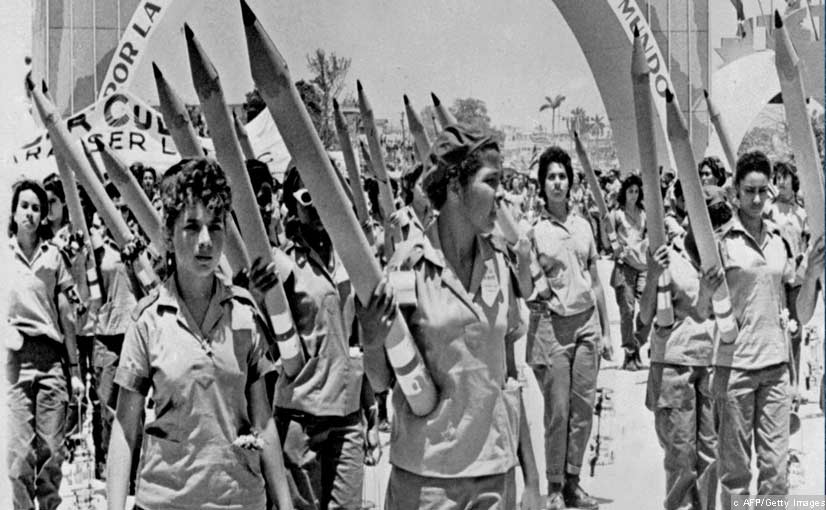
652. Cuba: Fiftieth Anniversary of the Literacy Campaign


By Yenia Silva Correa, Granma International, January 5, 2012

As the United Nations Literacy Decade (2003 - 2012) is about to come to an end, the number of people in the world who are still illiterate is alarming: 64.7 million children have received no formal schooling and 793 million adults remain illiterate.

Cuba undertook a year-long national literacy campaign which was completed on December 22, 1961 with Cuba being proclaimed a territory free of illiteracy.
The campaign's organizational structures were put in place starting January 1961. In order to teach the country’s 1.045 million illiterates to read and write, volunteer teachers' brigades were organized: the Conrado Benítez, Frank País and Patria o Muerte Brigades, which included schoolteachers and both young and adult volunteers.
Those who were already professional teachers were in charge of training the volunteers – most of them teenagers and more than half of them young women – and of preparing and drafting the instructional booklets to be used.
However, the project to liberate the country of illiteracy was no bed of roses. The Cuban Revolution, still in its infancy in 1961, was confronting counterrevolutionary bands in the Escambray mountains (in the center of the country), had proclaimed the socialist nature of the Revolution and had emerged victorious from the Bay of Pigs mercenary invasion; however, nothing stopped the advance of the literacy campaign.
Not even the murder of young volunteer teachers working in rural areas diminished the enthusiasm of those who had assumed with determination one of the noblest efforts within the revolutionary process, and one which was crucial to social justice.
After 12 months, Fidel Castro's commitment to the UN General Assembly in September 1960, "…next year, our people are set to wage a battle against illiteracy!" was fulfilled.
The national illiteracy rate fell to 3.9% for a population of more than 6.9 million inhabitants. This heroic deed would have been impossible without the contribution of Cuban and Latin American students, workers and teachers and the political will of the Cuban leadership.
Many of the literacy teachers later became the professional teachers of many generations of Cubans, and repeated that experience on internationalist missions as teachers in educational brigades in other countries
Others went into different professions, but never forgot the days when they left the cities with their primers and manuals in hand to teach others to read and write.
That period initiated a progressive increase in national educational levels which characterized the following decades of the Revolution. Schools, teachers and scholarships at all levels mushroomed throughout the country and Cuban teachers could be found throughout Africa and Latin America.
A RIGHT FOR ALL
While a lack of state policies means that literacy efforts are not a priority in many parts of the world, UNESCO acknowledges that this is a human right which paves the way for formal education.
For Cuba, the literacy campaign experience did not end in December of 1961, on the contrary. At the beginning of this century action was needed in relation to adult education in other countries and thus the Yo si puedo (Yes, I Can) program came into being.
Following the basic principles of the Literacy Campaign, the Yo si puedo project has been implemented in more than 30 countries, and in the case of Venezuela, Bolivia and Nicaragua, was the tool utilized to eradicate illiteracy.
In 2006, the UNESCO King Sejong Literacy Prize was awarded to the Cuban Youth and Adult Literacy program. However, no recognition can be greater than having taught 3.5 million people to read and write; many of them are already receiving the follow-up Yo si puedo seguir (I Can Do More) program, which totally completes their elementary education.

651. Cuba: 4.9% Infant Mortality Rate in 2011

Cuba's 2011 infant mortality rate is lowest in Americas
By Josè De La Osa, Granma International, January 5, 2012


For the last four years Cuba has achieved an infant mortality rate of below 5.0 per 1,000 live births, the lowest in the Americas together with Canada – sustained by the revolutionary government’s health policies which guarantee equality of access to medical services for mothers and children.

Social justice is unmistakably revealed on observing the status of this indicator in the country’s 15 provinces and the special municipality of the Isle of Youth. None of those recording a result higher than the national average of 4.9 are not in excess of 7.9.
The United States, which has maintained its criminal economic blockade of the country for more than 50 years, records an infant mortality rate of 7.0 although, taking into account the humiliating inequalities between rich and poor, rates in areas inhabited by the most dispossessed are, on average, 2.5 times higher. Approximately seven million U.S. children lack any health coverage.
As is known, the infant mortality rate, which measures the risk of death during the first year of life – the most critical for human beings’ survival – is an expression of the quality with which a country treats and protects mothers and children, their health, their material security, education and socialization. Thus it is an international demographic indicator which demonstrates these advances in a synthetic way.
According to preliminary data given to Granma January 1 by the Ministry of Public Health Statistics Office, in 2011 there were 133,063 births, 5,317 more than in 2010.
Seven provinces achieved rates of below 4.0. These are Las Tunas (3.5), Artemisa (3.9), Pinar del Río (4.0), Holguín (4.0), Havana (4.3), Ciego de Ávila (4.4) and Granma (4.4). Of the country’s 168 municipalities, 17 have zero infant mortality.
When experts are consulted every year as to how Cuba makes these favorable infant mortality rates possible, responses are usually in a similar vein: political will and determination, a highly educated population, an all-encompassing vaccination program with a virtually 100% coverage of children, and a universal health system, accessible and free of charge, which is currently restoring the initial concept of the Family Doctor and Nurse Program in order to attain a more efficient and sustainable health system.
All that is complemented by highly qualified health workers, with their proverbial human dedication and solidarity.
The multifaceted care given to pregnant women in Cuba is known. For the significance that means for the security and happiness of Cuban families, it is worth recalling national genetic services in the area of public health.
A genetic risk study is made in the early stages of pregnancy; followed by a hemoglobin electrophoresis to identify carriers of sickle cell anemia and, if the mother is a carrier, the father is given the test and if they both are, the baby is checked at birth to diagnose whether s/he is healthy, a carrier or sick.
Genetic ultrasounds are made in the first and second trimesters of pregnancy, plus an alpha-fetoprotein study to identify possible central nervous system defects. In the case of pregnant woman aged over 37, at greatest risk of having a Downs Syndrome baby, they are given the option of prenatal screening.
Specialists with the Maternal-Infant Attention Program affirm that even greater security for women and their offspring can be achieved, and have called on women of reproductive age to establish adequate family planning which includes previous investigations, in order to ensure their good health during pregnancy and to minimize risks.
Family doctors provide these services and a follow up on disorders related to pre-conception risks. Within the program, women are asked to consult a doctor at least six months before planning a wanted pregnancy. Risks of this nature are basically related to malnutrition, anemia, hypertension, diabetes mellitus, hypothyroidism, and infections of the uterus, urinary tract and respiratory system (asthma).
A continued reduction in the infant mortality rate as an expression of human development requires both the efforts of the national public health system and greater individual and social commitment to adopting measures leading to responsible pregnancies.


17 MUNCIPALITIES WITH ZERO INFANT MORTALITY, 2011
PROVINCES MUNICIPALITIES PROVINCES MUNICIPALITIES
Pinar del Río Viñales Cienfuegos Palmira
Artemisa Mariel Rodas
Guanajay Ciego Ávila Bolivia
Mayabeque Melena del Sur Majagua
Matanzas Perico Camagüey Najasa
Pedro Betancourt Holguín Cueto
Los Arabos Granma Buey Arriba
Villa Clara Quemados Guantánamo Caimanera
Cifuentes
Source: MINSAP National Statistics Office.
 

Saturday, January 7, 2012

650. In the Eyes of a Dog


If a human first gets the attention of a dog, the dog will
follow the direction of the person's gaze.

By Sarah C. P. Williams, Science Now, January 5, 2012
Sit a dog in front of a television screen, and it may not always look intently at what it sees. But show a person on that screen who looks directly at the dog and says "hello," and the canine will pay attention. In fact, a new study shows that a dog will go so far as to follow the gaze of the human on screen when he or she looks to one side or the other—something not even chimps can do.
Researchers already knew that dogs were attuned to human communication signals. In addition to their obvious facility at learning commands, dogs, like young children, can signal where a human puts an object if the human feigns ignorance, even if it's been moved, and they follow the direction of our finger when we point at things, a task chimps fail at. But are dogs capable of following more subtle cues, such as our shifting gaze?
To find out, cognitive scientist Ernő Téglás of the Central European University in Budapest adapted a technique that had previously been used only on children. In one example of the test, a child watches a woman on a video screen who has toys on either side of her. The woman then either looks straight toward the camera and says "hello" in a high-pitched voice known to engage children or looks downward and says "hello" in a more dull, low-pitched voice. Then the person looks to the toy on one side or the other for 5 seconds. Whether a child also looks at the toy on the same side is recorded. To modify this experiment for dogs, Téglás substituted empty plastic pots for the children's toys and had a stranger on the screen say "hi, dog!" in one of the two intonations while looking at the camera or downward. As each dog watches the video, a specially programmed camera below the television screen follows, and records, the dog's eye movements.
Téglás and his colleagues used 22 dogs of different breeds for the study. They found that the canines always looked at the person on the video for the same amount of time. But when the person initially directed his or her attention at the dog and spoke in a high-pitched voice, the dog looked at the same pot as the person 69% of the time. When the person avoided eye contact and spoke in a low voice, the dog didn't look at one pot more often than the other.
The results, published today in Current Biology, were almost identical to those seen in 6-month-old human infants. "We were surprised by the high similarity of the performances," Téglás says. "Dogs are receptive to these cues in a way that is very similar to infants."
The precision of the eye-tracking device will allow scientists to develop a new generation of tests on how dogs interact with humans, says Juliane Kaminski, a developmental psychologist at the Max Planck Institute for Evolutionary Anthropology in Leipzig, Germany, who was involved in earlier studies on how dogs interpret finger pointing. "It opens many new opportunities."
Now that the scientists have shown that the test works on dogs, they plan to separate the two factors—eye contact and tone of voice—to test each one's effect on the dog's attention, Téglás says. They also can compare different dog breeds with each other. This may help answer the question of how dogs' skills at interpreting human communication have evolved.
"Dog skills with human communication seem to be a special adaptation to live with humans and the result of certain selection pressures during domestication," Kaminski says. If this is true, researchers would expect dog breeds that have been domesticated the longest to perform best at tests such as gaze following. But don't plan on being able to compare your dog with all the other neighborhood canines—dogs likely interpret the cues from their owner differently than those from a stranger.

Friday, January 6, 2012

649. Food as Commodity


Source: FAO

By Fred Magdoff, Monthly Review, January 8, 2011
Food is one of the most basic of human needs. Routine access to a balanced diet is essential for both growth and development of the young, as well as for general health throughout one’s life. Although food is mostly plentiful, malnutrition is still common. The contradiction between plentiful global food supplies and widespread malnutrition and hunger arises primarily from food being considered a commodity, just like any other.
For many millennia following the origin of our species, humans were hunters and gatherers—an existence that one might think of as tenuous. However, judging from archeological evidence as well as recent examples, hunters and gatherers generally ate a diverse diet that supplied adequate nutrition. For example, studies in the 1960s and ‘70s of the Kung of southern Africa, foragers for literally thousands of years, indicate that although they ate meat that they hunted, about two-thirds of their food was plant-based—nuts (supplying more than one-third of caloric intake), fruits, roots, and berries—and their diet provided approximately 2,400 calories a day. The groups of hunter-gatherers were egalitarian, with everyone participating in the provisioning of food.
Agriculture, which developed some seven to ten thousand years ago, provided surplus food that allowed the development of cities and the hierarchies and civilizations that went along with them—farmers, artisans, priests, kings, warriors, scribes, and other functionaries. But just because there was a surplus did not mean that people were better nourished than hunter-gatherers. In fact, the narrowing of available foods used from the wide variety in the hunter-gatherers’ diets, along with the reliance primarily on grains to provide calories, is thought to have caused a decrease in the health of early agriculturalists—as indicated by their decreased height compared that of hunter-gatherers. In these agricultural societies surplus food production was mainly appropriated for the use of the non-food producing classes. Most pre-capitalist agricultural societies had many producers relative to non-productive classes.
In some ancient empires imperial tribute took the form of food shipped long distances from the place of production. North Africa, for example, was the granary for Rome. Much of Chinese history involved constructing infrastructure to store and provide food far from its place of production. Nevertheless, in much of the world (including feudal Europe) food was produced either by peasant farmers and consumed by their families or else appropriated by landed aristocracies on a fairly local basis. What markets existed were often on a barter basis and trade in food was in kind, without becoming a commodity.
This changed with capitalism or generalized commodity production. The endless accumulation of profits, the motive force of the capitalist system, occurs through the production of commodities or services to sell at a price in excess of the production costs. Production for the purpose of sale and profit, instead of production for use, is a defining characteristic of capitalism and essentially all commodity exchanges take place in markets. During the early stages of capitalism, when most people still lived and worked on the land, a large portion of food was produced to be consumed locally in the rural areas and did not exist as a commodity. However, farmers near growing cities and/or near water transport shipped food to the industrializing urban centers.
The commodity nature of food became much more pronounced as capitalism grew and conquered most of the world’s societies. Imperial powers brought the peasants of their colonies into the money economy by extracting monetary rather than in-kind taxes. The need to obtain money to pay taxes began a process that converted a portion of the food produced into commodities.
The industrial phase of capitalism caused rural populations to decline in Europe, North America, and Japan. People were forced off the land and looked for work in the cities, moving to the growing industrial centers. (Many also migrated from Europe to North America, Australia, New Zealand, South Africa, and elsewhere.) The development of canals, railroads, and road systems allowed for long-distance transport of food within large landmasses. Advances in shipping by sea also greatly decreased the cost of global trade in food.
Almost all of the crops and animals raised using the scale and approach of industrial farming are sold as undifferentiated commodities. Farmers sell their crops to buyers who resell the raw commodities to be processed—or themselves process the raw commodity—with the semi-processed commodities then sold to final processors/packagers who sell to wholesalers who then sell to retailers who finally sell food to the public. Thus, the farmers producing the bulk of food in the wealthy countries have become greatly separated from the public that finally purchases their products—not just physically, but also by the long chain of intermediaries between farms and people’s tables. Farm mechanization has increased labor productivity, leading to fewer farmers and larger farms. As industrial methods were applied to raising crops and animals, the agriculture-input sector grew dramatically and became highly concentrated—with relatively few companies now producing and selling farm machinery, fertilizers, pesticides, and seeds. Industrialized food systems also saw concentration and centralization of production and growing monopoly power. For example, large integrated “protein” (meat) firms now contract with farmers to produce poultry and hogs in large facilities under crowded and inhumane conditions. Because corporations mandate that their contractors be located near where they decide to build slaughtering facilities, this frequently means long distance transport of feed. Beef cows are increasingly raised in large feedlots.
Indeed farming, the actual raising of crops and animals, is only one part of the whole food system. The commodity nature of all parts of the agricultural/food system—farm inputs, actual farming, purchasing and processing raw agricultural goods, and wholesaling and retailing—means that many different types of commodities are produced and sold. Farming itself has been reduced to a component in a larger system of agribusiness, with many of the remaining small farmers in the United States increasingly becoming subcontractors to large corporations. The input side of agriculture was one of the last sectors of the economy to go through concentration of ownership, leading to fewer machinery companies, fewer “agrichemical” (fertilizer and pesticide) companies, and fewer seed companies. A few input and purchasing/processing corporations are able to exert near monopoly power. One of the most recent developments in the inputs sector has been the creation of transgenic (genetically modified, or GM) varieties of crops. Industry consolidation was stimulated by the greater control exerted on prices (and farmers), and today about 40 percent of the entire global seed market is controlled by three firms—Monsanto, DuPont, and Syngenta.
Globally there is still a significant portion of food produced on small landholdings for personal consumption or very local markets—in Latin America, Africa, and Asia. However, in the United States, Western Europe, and Australia (and now in Brazil, and even more recently, Argentina, Paraguay, and Bolivia) crops are increasingly produced on large, highly mechanized farms for either national or international sale. Most of these countries actively promote large-scale production for export, to either obtain foreign exchange or to help their international balance of payments situation.
Implications
There are a number of important implications of the commodity nature of food production, processing, and consumption. In capitalist economies, as noted, nearly all enterprise is for the sake of producing commodities for sale—whether the “product” is an absolute necessity such as food and health care, or a luxury such as a private jet plane or a huge house. More and more of the natural world, including water supplies and the very genes of life, are being brought under private control with the aim of making profits, rather than to supply the needs of people.
However, there is a critical contradiction when any basic human need is produced and sold as a commodity, whether we are considering food, health care, drinking water, or shelter. Capitalism naturally produces a stratification of wealth that includes the unemployed, the working poor, a better-off working class, a middle class, and a relatively small group of very rich individuals. The bottom strata of society—encompassing the members of what Marx called the reserve army of labor—are absolutely essential to the smooth working of the system. It allows easy access to labor when the economy expands and helps keep wages down, as workers are aware that they can easily be replaced.1 Even in a wealthy country such as the United States the numerous unemployed and those in low-paying jobs cannot afford all of their basic living costs—rent, electricity, transportation (irrational patterns of development plus inadequate public transportation means that cars are frequently needed to get to work), clothes, medical care, food, etc.
Given that poverty in the United States is not absolute destitution, the poor sometimes have options: they may purchase more or less food of higher or lower nutritional value, skip meals, get food stamps (now called SNAP, the Supplemental Nutrition and Assistance Program), or receive food assistance from charities. The poor commonly have little money left for food after rent and utilities are paid. In the summer of 2011, approximately 46 million people were receiving food assistance through Federal programs, inadequate as it is. Still, despite the abundance of food, a high average per capita income, and various forms of assistance available, some 50 million people in the United States are considered to be “food insecure.” Of these, over 12 million adults and 5 million children have “very low” food security, with one or more members of their households lowering their food intake.
In some parts of the global South, of course, conditions are far worse. The commodity nature of food results in food price levels far above many people’s meager means, producing a lack of adequate nutrition. The United Nations estimates that there are close to one billion people worldwide who suffer from malnutrition. This leads to severe health problems and death for millions. Food deprivation, though falling short of severe malnutrition, is still a very serious condition. Hence, a sense of injustice associated with rising food prices and unequal access to food was a major factor spurring revolts in the Arab world over the last year.
Because food products are commodities, and the whole point of the food/agriculture system is to sell more and make more profits, there is massive advertising surrounding food, especially the most profitable sector—processed foods. High caloric but low nutritional-value foods, such as sugary breakfast cereals, are pushed on children. And because these processed foods are relatively inexpensive and available at local convenience stores that often do not carry higher quality food like fruits and vegetables, the commodity nature of food is part of the explanation for the surge in obesity, especially among the poor.
Food crops have many different uses other than direct human consumption. They can be processed into a variety of forms—breads (pitas, tortillas), potato chips, frozen dinners, pasta, ice cream, etc. Corn is commonly processed to obtain industrial starch and sugars (high in fructose). A relatively high percent of the corn and soybeans grown in the United States are used to feed poultry and hogs as well as beef and dairy cows (that, from an environmental point of view, should be eating grass and legume forages that the bacteria in their rumens convert into usable energy and protein for the animals). And with the push to lessen dependence on imported oil and to have a supposedly more “green” source of liquid fuels—corn, soy, rape, sugar cane, palm oil, and jatropha (a non-food crop raised only to make biofuel) are being grown to produce either ethanol or biodiesel.
In the United States and Europe, there are governmental mandates and subsidies encouraging production of both food and non-food crops, which are then used for biofuel feedstocks. This is an important part of the explanation for the tight markets and high prices for corn and oil crops. A UN Food and Agriculture Organization report says: “By generating a new demand for food commodities that can outbid poor countries and food-insecure populations, industrial biofuels highlight the tension between a potentially unlimited demand (in this case for energy) and the constraints of a world with finite resources.”2 It was the search for another market for corn that induced Dwayne Andreas, CEO of the grain purchaser/processor and feed grain conglomerate Archer Daniels Midland (ADM), to gain influence over politicians and spend lavishly on both Democrats and Republicans. ADM was the main backer for the corn-to-ethanol industry and might be considered the grandfather of the current mandate to mix a certain percent of ethanol with gasoline (in the process of increasing from 10 to 15 percent).
The commodity nature of food by itself limits access by the poor. Market pressures and incentives contribute to the interchangeability of key food crops that can also be used for animals or fuel production; the possibility to grow crops for strictly industrial use instead of food, if the price is right; and huge amounts of hoarding and speculation on agricultural commodities (see below). Land can be used to grow crops for a number of purposes: food for people, food crops that are also potentially feeds for animals, and industrial feedstocks (cotton, jatrohpa, corn to make sugar or other products, and crops like hay which are strictly for animals). Market prices guide farmers’ production. When ethanol prices increase, more land goes into corn for ethanol. If cotton prices increase, a portion of the land that would have gone to grow corn and soybeans will be planted with cotton. Market prices also guide the ultimate utilization of crops that have multiple uses. For example, should soybeans be used to make vegetable oil for human use, be feed to animals, or be converted into biodiesel fuel? The need to feed hungry people does not enter the calculation.
When a poor (so-called “developing”) country attempts to solve its food problem primarily by encouraging farmers to produce more, bumper crops tend to depress prices, thus helping the poor gain greater food access. However, depressed prices may be problematic for farmers, many of whom themselves are poor. This has happened recently in Zambia, where “massive production can send prices tumbling. The smallest farmers, who are the least productive, suffer doubly by producing little and getting paid a pittance for the crop.”3 Thus, bumper crops in capitalist agricultural tend to favor the larger farmers, especially those using inputs such as irrigation and fertilizers that help produce high yields. However, the resulting low prices may force large numbers of small farmers, many unable to protect their crops from the vagaries of nature and lacking the financial resources to weather hard times, into deeper poverty.
A new dimension has been added to the phenomena of food as a commodity—a new land grab, with private capital and sovereign wealth funds purchasing or leasing land in Africa, Asia, and Latin America to produce food and biofuels for markets for the home countries of the investors.4 As with food, the most basic input for its production, soil, becomes a commodity ripe for either speculation or to go to the highest bidder. In many countries of the global South, traditional land tenure systems are thrown aside as land is purchased or rented under long-term agreement by private capital or national sovereign wealth funds. The purpose is either to make money, or to produce food or fuel (jatropha or other fuel crops) for the “home” markets. This creates even more rapid “depeasantization” as more farmers are pushed off the land and into city slums that have no jobs for them. It is estimated that some 20 million hectares (50 million acres) have either been sold or are under long-term lease to foreign countries or foreign capital. “In Africa they are calling it the land grab, or the new colonialism. Countries hungry to secure their food supplies—including Saudi Arabia, the Emirates, South Korea (the world’s third largest importer of corn), China, India, Libya, and Egypt—are at the forefront of a frantic rush to gobble up farmland all around the world, but mainly in cash-starved Africa.”5
The “highest and best use” of any commodity is where it can get the best price, regardless of the social, ecological, or humanitarian consequences. One small example of the contradictions that arise from this is a result of the growing market in the North for quinoa, a grain grown in the Andes that is especially nutritious because of its balance of amino acids. This benefits farmers by increasing crop prices, but at the same time it means that this traditional and nutritious food is becoming too expensive for local people.6
Another implication of the commodity nature of food is that it is increasingly subject to speculative price movements. Raw commodities such as metals and food crops have become a prime target of speculators who want to bet on the price changes of tangible products, rather than completely relying on the complex bets embodied in many “financial instruments.” The Chicago Board of Trade (CBOT, owned by the Chicago Mercantile Exchange), opening in 1848, is the oldest organized foodstuffs futures and options trading exchange. Throughout most of its history the CBOT and the other commodity exchanges were used primarily by those interested in hedging prices because they bought, sold, or used the physical products—farmers, buyers, and food processors. It was a sound way to protect your business against the vagaries of weather and competition. But with the financialization of the economy everything has become fair game for speculation, so food and other agricultural products (as well as other raw commodities) have become just more bets that can be made. With the so-called “Commodity Futures Modernization Act,” commodity markets were deregulated in 2000 and “structured” financial products were developed to allow various types of speculation. In addition to straight bets on individual commodities, commodity index funds (pioneered by Goldman Sachs) begun to track prices of commodities. The amount of money in these funds increased from $13 billion in 2003 to $317 billion in 2008. As U.S. hedge fund manager Mike Masters explained: “Speculators today have about 70 percent of the open interest in commodity markets. Ten years ago, they controlled roughly 30 percent of the market.”7 With so much money flowing into the food commodity markets, prices are driven up in a speculative upswing. This, of course, does not mean that commodity prices will only keep going up—they fluctuate based on economic conditions, world food stock levels, crop yields, rumors, and fads. But speculation drives prices up and down further and faster, and as a result contributes to hunger for many—sometimes millions—when prices peak, and to the ruin of small producers when prices crash.
When food—a basic necessity for human health and survival that is currently produced in sufficient quantity to feed everyone in the world a basic nutritious diet—is a commodity, the results are routine hunger, malnutrition, premature deaths, and famines when tight supplies result in exceptionally high prices. There are examples of farmers and the public organizing alternative ways to grow food for people instead of the market—such as Community Supported Agriculture (CSA) farms in which people purchase (frequently on a sliding scale according to ability to pay) a share of the produce during grown during the season. These types of arrangements between farmers and the public are encouraging because they demonstrate an alternate approach to food. However, the only way to guarantee that food reaches all people in sufficient quantity and quality is to develop a new system that considers food a human right and no longer considers it a commodity. Only then will we be able to fulfill the slogan, “Food for People, Not for Profit.”
NOTES
1.              For a discussion of the reserve army see Fred Magdoff and Harry Magdoff, “Disposable Workers: Today’s Reserve Army of Labor,” Monthly Review 55, no. 11 (2004): 18–35.
2.             High Level Panel of Experts on Food Security and Nutrition, “Price volatility and food security,” Committee on World Food Security, Rome, July 2011, http://fao.org.
3.             Samuel Fromartz, “The Production Conundrum,” The Nation, October 3, 2011, 20–22.
4.             GRAIN, “The New Farm Owners: Corporate Investors and the Control of Overseas Farmland,” in Fred Magdoff and Brian Tokar, eds., Agriculture and Food in Crisis: Conflict, Resistance, and Renewal (New York: Monthly Review Press, 2010).
5.              Margareta Pagano, “Land Grab: The Race for the World’s Farmland,” The Independent, May 3, 2009, http://independent.co.uk.
6.             Simon Romero and Sarah Shahriari, “Quinoa’s Global Success Creates a Quandary at Home,” The New York Times, March 19, 2011, http://nytimes.com.
7.              Deborah Doane, “As food speculators make money, the world’s poorest suffer,” CNN Opinion, June 22, 2011, http://cnn.com.