Thursday, December 8, 2011

616. My Occupy L.A. Arrest


L.A.P.D. Attacks Occupy L.A.
By Patrick Meighan, December 6, 2011


My name is Patrick Meighan, and I’m a husband, a father, a writer on the Fox animated sitcom “Family Guy”, and a member of the Unitarian Universalist Community Church of Santa Monica.
I was arrested at about 1 a.m. Wednesday morning with 291 other people at Occupy LA. I was sitting in City Hall Park with a pillow, a blanket, and a copy of Thich Nhat Hanh’s “Being Peace” when 1,400 heavily-armed LAPD officers in paramilitary SWAT gear streamed in. I was in a group of about 50 peaceful protestors who sat Indian-style, arms interlocked, around a tent (the symbolic image of the Occupy movement). The LAPD officers encircled us, weapons drawn, while we chanted “We Are Peaceful” and “We Are Nonviolent” and “Join Us.”
As we sat there, encircled, a separate team of LAPD officers used knives to slice open every personal tent in the park. They forcibly removed anyone sleeping inside, and then yanked out and destroyed any personal property inside those tents, scattering the contents across the park. They then did the same with the communal property of the Occupy LA movement. For example, I watched as the LAPD destroyed a pop-up canopy tent that, until that moment, had been serving as Occupy LA’s First Aid and Wellness tent, in which volunteer health professionals gave free medical care to absolutely anyone who requested it. As it happens, my family had personally contributed that exact canopy tent to Occupy LA, at a cost of several hundred of my family’s dollars. As I watched, the LAPD sliced that canopy tent to shreds, broke the telescoping poles into pieces and scattered the detritus across the park. Note that these were the objects described in subsequent mainstream press reports as “30 tons of garbage” that was “abandoned” by Occupy LA: personal property forcibly stolen from us, destroyed in front of our eyes and then left for maintenance workers to dispose of while we were sent to prison.
When the LAPD finally began arresting those of us interlocked around the symbolic tent, we were all ordered by the LAPD to unlink from each other (in order to facilitate the arrests). Each seated, nonviolent protester beside me who refused to cooperate by unlinking his arms had the following done to him: an LAPD officer would forcibly extend the protestor’s legs, grab his left foot, twist it all the way around and then stomp his boot on the insole, pinning the protestor’s left foot to the pavement, twisted backwards. Then the LAPD officer would grab the protestor’s right foot and twist it all the way the other direction until the non-violent protestor, in incredible agony, would shriek in pain and unlink from his neighbor.
It was horrible to watch, and apparently designed to terrorize the rest of us. At least I was sufficiently terrorized. I unlinked my arms voluntarily and informed the LAPD officers that I would go peacefully and cooperatively. I stood as instructed, and then I had my arms wrenched behind my back, and an officer hyperextended my wrists into my inner arms. It was super violent, it hurt really really bad, and he was doing it on purpose. When I involuntarily recoiled from the pain, the LAPD officer threw me face-first to the pavement. He had my hands behind my back, so I landed right on my face. The officer dropped with his knee on my back and ground my face into the pavement. It really, really hurt and my face started bleeding and I was very scared. I begged for mercy and I promised that I was honestly not resisting and would not resist.
My hands were then zipcuffed very tightly behind my back, where they turned blue. I am now suffering nerve damage in my right thumb and palm.
I was put on a paddywagon with other nonviolent protestors and taken to a parking garage in Parker Center. They forced us to kneel on the hard pavement of that parking garage for seven straight hours with our hands still tightly zipcuffed behind our backs. Some began to pass out. One man rolled to the ground and vomited for a long, long time before falling unconscious. The LAPD officers watched and did nothing.
At 9 a.m. we were finally taken from the pavement into the station to be processed. The charge was sitting in the park after the police said not to. It’s a misdemeanor. Almost always, for a misdemeanor, the police just give you a ticket and let you go. It costs you a couple hundred dollars. Apparently, that’s what happened with most every other misdemeanor arrest in LA that day.
With us Occupy LA protestors, however, they set bail at $5,000 and booked us into jail. Almost none of the protesters could afford to bail themselves out. I’m lucky and I could afford it, except the LAPD spent all day refusing to actually *accept* the bail they set. If you were an accused murderer or a rapist in LAPD custody that day, you could bail yourself right out and be back on the street, no problem. But if you were a nonviolent Occupy LA protestor with bail money in hand, you were held long into the following morning, with absolutely no access to a lawyer.
I spent most of my day and night crammed into an eight-man jail cell, along with sixteen other Occupy LA protesters. My sleeping spot was on the floor next to the toilet.
Finally, at 2:30 the next morning, after twenty-five hours in custody, I was released on bail. But there were at least 200 Occupy LA protestors who couldn’t afford the bail. The LAPD chose to keep those peaceful, non-violent protesters in prison for two full days… the absolute legal maximum that the LAPD is allowed to detain someone on misdemeanor charges.
As a reminder, Antonio Villaraigosa has referred to all of this as “the LAPD’s finest hour.”
So that’s what happened to the 292 women and men were arrested last Wednesday. Now let’s talk about a man who was not arrested last Wednesday. He is former Citigroup CEO Charles Prince. Under Charles Prince, Citigroup was guilty of massive, coordinated securities fraud.
Citigroup spent years intentionally buying up every bad mortgage loan it could find, creating bad securities out of those bad loans and then selling shares in those bad securities to duped investors. And then they sometimes secretly bet *against* their *own* bad securities to make even more money. For one such bad Citigroup security, Citigroup executives were internally calling it, quote, “a collection of dogshit”. To investors, however, they called it, quote, “an attractive investment rigorously selected by an independent investment adviser”.
This is fraud, and it’s a felony, and the Charles Princes of the world spent several years doing it again and again: knowingly writing bad mortgages, and then packaging them into fraudulent securities which they then sold to suckers and then repeating the process. This is a big part of why your property values went up so fast. But then the bubble burst, and that’s why our economy is now shattered for a generation, and it’s also why your home is now underwater. Or at least mine is.
Anyway, if your retirement fund lost a decade’s-worth of gains overnight, this is why.
If your son’s middle school has added furlough days because the school district can’t afford to keep its doors open for a full school year, this is why.
If your daughter has come out of college with a degree only to discover that there are no jobs for her, this is why.
But back to Charles Prince. For his four years of in charge of massive, repeated fraud at Citigroup, he received fifty-three million dollars in salary and also received another ninety-four million dollars in stock holdings. What Charles Prince has *not* received is a pair of zipcuffs. The nerves in his thumb are fine. No cop has thrown Charles Prince into the pavement, face-first. Each and every peaceful, nonviolent Occupy LA protester arrested last week has has spent more time sleeping on a jail floor than every single Charles Prince on Wall Street, combined.
The more I think about that, the madder I get. What does it say about our country that nonviolent protesters are given the bottom of a police boot while those who steal hundreds of billions, do trillions worth of damage to our economy and shatter our social fabric for a generation are not only spared the zipcuffs but showered with rewards?
In any event, believe it or not, I’m really not angry that I got arrested. I chose to get arrested. And I’m not even angry that the mayor and the LAPD decided to give non-violent protestors like me a little extra shiv in jail (although I’m not especially grateful for it either).
I’m just really angry that every single Charles Prince wasn’t in jail with me.
Thank you for letting me share that anger with you today.
Patrick Meighan

Wednesday, December 7, 2011

615. An Important Victory: Pennsylvania DA Will Not Seek Mumia Execution!


By Jeff Mackler, December 6, 2011

Mumia's attorneys and supporters are now focused on the fight for a new trial before a new jury where evidence of Mumia's innocence can for the first time be presented in full public view. Mumia's 1982 racist frame-up trial has been widely condemned, with organizations ranging from Amnesty International, the European Parliament and the NAACP to heads of state in France and South Africa demanding a new trial.

Winning a new trial for anyone convicted of murder is no easy task. Mumia's legal team must meet an extremely high legal standard. This includes presenting "compelling and not been previously litigated new evidence" that could not have been "previously discovered  through due diligence." A special investigator and associated team has been hired to begin this difficult and arduous process.

We have reached the end of one struggle and the beginning of another. But, better to fight on for Mumia's freedom in the context of a threat of execution NOT hanging over his head.

In truth, the recent Supreme Court action, essentially affirming previous decisions of the Federal District Court and the U.S. Court of Appeals for the Third Circuit that Mumia's death sentence was unconstitutional, was a political decision as well as an affirmation of the "letter of the law," one that was 30 years in coming and one that never would have come had it not been for a massive national and international effort on Mumia's behalf.

A Philadelphia, if not national decision, was obviously made at the highest levels to avoid a new sentencing hearing where evidence of innocence could have been presented that would have exposed the entire racist and frame-up nature of Mumia's 1982 trial.

Such a hearing, the DA likely judged, might have led to a level of  public outrage and exposure of the criminal "justice" system sufficient in itself to force a new trial despite formal legal restrictions to the contrary. The risk to an institution where the racism inherent in U.S. society, expressed in the actions and mentality of corrupt police officers, judges, prosecutors and reactionary laws, makes justice for the poor and oppressed an impossibility, was too great to contemplate. Mumia's trial and "conviction" classically revealed all of the elements of a rigged racist and classist  judicial system. Philadelphia officials chose to avoid any further risk to its credibility.

One fact is certain. After 30 years of insisting that justice has been done – that Mumia's rights were fully protected – the State of Pennsylvania has been proven, through state institutions of its own choosing, to have violated the U.S. Constitution. Mumia has been unconstitutionally held in a tiny death row cell, in virtual isolation from all family and friends - all physical contact barred - for thirty years.

This constitutional violation was scored by Mumia's legal team almost three decades ago when Mumia's first appeal included the simple assertion that the presiding Judge Albert Sabo violated the law by falsely instructing the jury regarding their deliberation. This is the same "hanging judge" Sabo who stated before two witnesses in his private antechambers that he was "going to help 'em fry the n****r."

Sabo falsely told the jury that in order to not execute Mumia and instead arrive at a sentence of life in prison without possibility of parole, they had to be unanimous with regard to considering any and all mitigating circumstances. Contrary to Judge Sabo the law states clearly in the Supreme Court's 1988 Mills v. Maryland case, that a single juror is sufficient to place any mitigating circumstance sufficient to negate a death penalty decision, before the jury for its consideration.

Sunday, December 11 at 2:00 pm is set for a mass meeting to open a new phase in the struggle for Mumia's freedom. Join us at the Laney College Forum, Oakland, CA at 2 pm. (one block from the Lake Merritt BART station). Speakers include: Angela Davis, Ramona Africa, Barbara Becnel, Jeff Mackler, Boots Riley, Crystal Bybee, Bishop Desmond Tutu (via video) and Michelle Alexander (via video). Admission free for Peralta students. All others $10 sliding scale. See attached flyer.

In Philadelphia, a parallel meeting featuring Cornel West is set for Friday, Dec. 9, 7:30 PM at the National Constitution Center.

On the West Coast contact Jeff Mackler for further information: 510-268-9429  jmackler@lmi.net

In Philadelphia contact: 267-760-7344

614. The Age of Thirst in the American West


By William DeBuys. Truthout, December 4, 2011
Consider it a taste of the future: the fire, smoke, drought, dust, and heat that have made life unpleasant, if not dangerous, from Louisiana to Los Angeles. New records tell the tale: biggest wildfire ever recorded in Arizona (538,049 acres), biggest fire ever in New Mexico (156,600 acres), all-time worst fire year in Texas history (3,697,000 acres).
The fires were a function of drought.  As of summer’s end, 2011 was the driest year in 117 years of record keeping for New Mexico, Texas, and Louisiana, and the second driest for Oklahoma. Those fires also resulted from record heat.  It was the hottest summer ever recorded for New Mexico, Texas, Oklahoma, and Louisiana, as well as the hottest August ever for those states, plus Arizona and Colorado.
Virtually every city in the region experienced unprecedented temperatures, with Phoenix, as usual, leading the march toward unlivability. This past summer, the so-called Valley of the Sun set a new record of 33 days when the mercury reached a shoe-melting 110ยบ F or higher. (The previous record of 32 days was set in 2007.)
And here’s the bad news in a nutshell: if you live in the Southwest or just about anywhere in the American West, you or your children and grandchildren could soon enough be facing the Age of Thirst, which may also prove to be the greatest water crisis in the history of civilization.  No kidding.
If that gets you down, here’s a little cheer-up note: the end is not yet nigh.
In fact, this year the weather elsewhere rode to the rescue, and the news for the Southwest was good where it really mattered.  Since January, the biggest reservoir in the United States, Lake Mead, backed up by the Hoover Dam and just 30 miles southwest of Las Vegas, has risen almost 40 feet. That lake is crucial when it comes to watering lawns or taking showers from Arizona to California.  And the near 40-foot surge of extra water offered a significant upward nudge to the Southwest’s water reserves.
The Colorado River, which the reservoir impounds, supplies all or part of the water on which nearly 30 million people depend, most of them living downstream of Lake Mead in Los Angeles, San Diego, Phoenix, Tucson, Tijuana, and scores of smaller communities in the United States and Mexico.
Back in 1999, the lake was full. Patricia Mulroy, who heads the water utility serving Las Vegas, rues the optimism of those bygone days.  “We had a fifty-year, reliable water supply,” she says. “By 2002, we had no water supply. We were out. We were done. I swore to myself we’d never do that again.”
In 2000, the lake began to fall -- like a boulder off a cliff, bouncing a couple of times on the way down. Its water level dropped a staggering 130 feet, stopping less than seven feet above the stage that would have triggered reductions in downstream deliveries. Then -- and here’s the good news, just in case you were wondering -- last winter, it snowed prodigiously up north in Colorado, Utah, and Wyoming.
The spring and summer run-off from those snowpacks brought enormous relief. It renewed what we in the Southwest like to call the Hydro-Illogic cycle: when drought comes, everybody wrings their hands and promises to institute needed reform, if only it would rain a little. Then the drought breaks or eases and we all return to business as usual, until the cycle comes around to drought again.
So don’t be fooled.  One day, perhaps soon, Lake Mead will renew its downward plunge.  That’s a certainty, the experts tell us.  And here’s the thing: the next time, a sudden rescue by heavy snows in the northern Rockies might not come. If the snowpacks of the future are merely ordinary, let alone puny, then you’ll know that we really are entering a new age.
And climate change will be a major reason, but we’ll have done a good job of aiding and abetting it. The states of the so-called Lower Basin of the Colorado River -- California, Arizona, and Nevada -- have been living beyond their water means for years. Any departure from recent decades of hydrological abundance, even a return to long-term average flows in the Colorado River, would produce a painful reckoning for the Lower Basin states.  And even worse is surely on the way.
Just think of the coming Age of Thirst in the American Southwest and West as a three-act tragedy of Shakespearean dimensions.
The Age of Thirst: Act I
The curtain in this play would surely rise on the Colorado River Compact of 1922, which divided the river’s water equally between the Upper and Lower Basins, allocating to each annually 7.5 million acre-feet, also known by its acronym "maf." (An acre-foot suffices to support three or four families for a year.) Unfortunately, the architects of the compact, drawing on data from an anomalously wet historical period, assumed the river’s average annual flow to be about 17 maf per year.  Based on reconstructions that now stretch back more than 1,000 years, the river’s long-term average is closer to 14.7 maf.  Factor in evaporation from reservoirs (1.5 maf per year) and our treaty obligation to Mexico (another 1.5 maf), and the math doesn’t favor a water-guzzling society.
Nonetheless, the states of the Lower Basin have been taking their allotment as if nothing were wrong and consequently overdrafting their account by up to 1.3 maf annually.  At this rate, even under unrealistically favorable scenarios, the Lower Basin will eventually drain Lake Mead and cutbacks will begin, possibly as soon as in the next few years.  And then things will get dicier because California, the water behemoth of the West, won’t have to absorb any of those cutbacks.
Here’s one of the screwiest quirks in western water law: to win Congressional approval for the building of a monumental aqueduct, the Central Arizona Project (CAP), which would bring Colorado River water to Phoenix and Tucson, Arizona agreed to subordinate its Colorado River water rights to California’s.  In that way, the $4 billion, 336-mile-long CAP was born, and for it Arizona paid a heavy price. The state obliged itself to absorb not just its own losses in a cutback situation, but California’s as well.
Worst case scenario: the CAP aqueduct, now a lifeline for millions, could become as dry as the desert it runs through, while California continues to bathe. Imagine Phoenix curling and cracking around the edges, while lawn sprinklers hiss in Malibu. The contrast will upset a lot of Arizonans.
Worse yet, the prospective schedule of cutbacks now in place for the coming bad times is too puny to save Lake Mead.
The Age of Thirst: Act II
While that Arizona-California relationship guarantees full employment for battalions of water lawyers, a far bigger problem looms: climate change. Models for the Southwest have been predicting a 4ยบC (7.2ยบF) increase in mean temperature by century’s end, and events seem to be outpacing the predictions.
We have already experienced close to 1ยบ C of that increase, which accounts, at least in part, for last summer’s colossal fires and record-setting temperatures -- and it’s now clear that we’re just getting started.
The simple rule of thumb for climate change is that wet places will get wetter and dry places drier. One reason the dry places will dry is that higher temperatures mean more evaporation. In other words, there will be ever less water in the rivers that keep the region’s cities (and much else) alive. Modeling already suggests that by mid-century surface stream-flow will decline by 10% to 30%.
Independent studies at the Scripps Oceanographic Institute in California and the University of Colorado evaluated the viability of Lake Mead and eventually arrived at similar conclusions: after about 2026, the risk of “failure” at Lake Mead, according to a member of the Colorado group, “just skyrockets.” Failure in this context would mean water levels lower than the dam’s lowest intake, no water heading downstream, and the lake becoming a “dead pool.”
If -- perhaps “when” is the more appropriate word -- that happens, California’s Colorado River Aqueduct, which supplies water to Los Angeles, San Diego, and the All-American Canal, which sustains the Imperial and Coachella Valleys, will go just as dry as the Central Arizona Project aqueduct. Meanwhile, if climate change is affecting the Colorado River’s watershed that harshly, it will undoubtedly also be hitting the Sierra Nevada mountain range.
The aptly named Lester Snow, a recent director of California’s Department of Water Resources, understood this. His future water planning assumed a 40% decline in runoff from the Sierras, which feeds the California Aqueduct. None of his contemplated scenarios were happy ones. The Colorado River Aqueduct and the California Aqueduct make the urban conglomerations of southern California possible. If both fail at once, the result will be, as promised, the greatest water crisis in the history of civilization.
Only Patricia Mulroy has an endgame strategy for the demise of Lake Mead. The Southern Nevada Water Authority is, even now, tunneling under the lake to install the equivalent of a bathtub drain at close to its lowest point. At a cost of more than $800 million, it will drain the dregs of Lake Mead for Las Vegas.
Admittedly, water quality will be a problem, as the dead pool will concentrate pollutants. The good news, according to the standard joke among those who chronicle Sin City’s improbable history, is that the hard-partying residents and over-stimulated tourists who sip from Lake Mead’s last waters will no longer need to purchase anti-depressants. They’ll get all the Zoloft and Xanax they need from their tap water.
And only now do we arrive at the third act of this expanding tragedy.
The Age of Thirst: Act III
Those who believe in American exceptionalism hold that the historical patterns shaping the fate of other empires and nations don’t apply to the United States. Be that as it may, we are certainly on track to test whether the U.S. is similarly inoculated against the patterns of environmental history.
Because tree rings record growing conditions year by year, the people who study them have been able to reconstruct climate over very long spans of time. One of their biggest discoveries is that droughts more severe and far longer than anything known in recent centuries have occurred repeatedly in the American Southwest. The droughts of the Dust Bowl in the 1930s, of the 1950s, and of the period from 1998 to 2004 are remembered in the region, yet none lasted a full decade.
By contrast, the drought that brought the civilization of the ancestral Puebloans, or Anasazi, centered at Chaco Canyon, to its knees in the twelfth century, by contrast, lasted more than 30 years. The one that finished off Mesa Verdean culture in the thirteenth century was similarly a “megadrought.”
Jonathan Overpeck, a climate scientist at the University of Arizona who played a major role in the Nobel-Prize-winning work of the Intergovernmental Panel on Climate Change, tells me that the prospect of 130° F days in Phoenix worries him far less than the prospect of decades of acute dryness. “If anything is scary, the scariest is that we could trip across a transition into a megadrought.” He adds, “You can probably bet your house that, unless we do something about these greenhouse gas emissions, the megadroughts of the future are going to be a lot hotter than the ones of the past.”
Other scientists believe that the Southwest is already making the transition to a “new climatology,” a new normal that will at least bring to mind the aridity of the Dust Bowl years. Richard Seager of Columbia University, for instance, suggests that “the cycle of natural dry periods and wet periods will continue, but… around a mean that gets drier. So the depths -- the dry parts of the naturally occurring droughts -- will be drier than we’re used to, and the wet parts won’t be as wet.”
Drought affects people differently from other disasters. After something terrible happens -- tornados, earthquakes, hurricanes -- people regularly come together in memorable ways, rising above the things that divide them. In a drought, however, what is terrible is that nothing happens. By the time you know you’re in one, you’ve already had an extended opportunity to meditate on the shortcomings of your neighbors. You wait for what does not arrive. You thirst. You never experience the rush of compassion that helps you behave well. Drought brings out the worst in us.
After the Chacoan drought, corn-farming ancestral Puebloans still remained in the Four Corners area of the Southwest. They hung on, even if at lower population densities. After the Mesa Verdean drought, everybody left.
By the number of smashed crania and other broken bones in the ruins of the region’s beautiful stone villages, archaeologists judge that the aridifying world of the Mesa Verdeans was fatally afflicted by violence. Warfare and societal breakdown, evidently driven by the changing climate, helped end that culture.
So it matters what we do. Within the limits imposed by the environment, the history we make is contingent, not fated. But we are not exactly off to a good start in dealing with the challenges ahead. The problem of water consumption in the Southwest is remarkably similar to the problem of greenhouse gas pollution. First, people haggle to exhaustion over the need to take action; then, they haggle over inadequate and largely symbolic reductions. For a host of well-considered, eminently understandable, and ultimately erroneous reasons, inaction becomes the main achievement. For this drama, think Hamlet. Or if the lobbyists who argue for business as usual out west and in Congress spring to mind first, think Iago.
We know at least one big thing about how this particular tragedy will turn out: the so-called civilization of the Southwest will not survive the present century, not at its present scale anyway. The question yet to be answered is how much it will have to shrink, and at what cost. Stay tuned. It will be one of the greatest, if grimmest, shows on Earth.

William deBuys is the author of seven books, including the just published A Great Aridness: Climate Change and the Future of the American Southwest (a Pulitzer Prize finalist), and The Walk (an excerpt of which won a Pushcart Prize). He has long been involved in environmental affairs in the Southwest, including service as founding chairman of the Valles Caldera Trust, which administers the 87,000-acre Valles Caldera National Preserve in New Mexico. 

613. Global Carbon Emission in 2010 Show a Record Jump


By Justin Gillis, The New York Times, December 4, 2011

Global emissions of carbon dioxide from fossil-fuel burning jumped by the largest amount on record last year, upending the notion that the brief decline during the recession might persist through the recovery.

Emissions rose 5.9 percent in 2010, according to an analysis released Sunday by the Global Carbon Project, an international collaboration of scientists tracking the numbers. Scientists with the group said the increase, a half-billion extra tons of carbon pumped into the air, was almost certainly the largest absolute jump in any year since the Industrial Revolution, and the largest percentage increase since 2003.

The increase solidified a trend of ever-rising emissions that scientists fear will make it difficult, if not impossible, to forestall severe climate change in coming decades.

The researchers said the high growth rate reflected a bounce-back from the 1.4 percent drop in emissions in 2009, the year the recession had its biggest impact.
They do not expect the extraordinary growth to persist, but do expect emissions to return to something closer to the 3 percent yearly growth of the last decade, still a worrisome figure that signifies little progress in limiting greenhouse gases. The growth rate in the 1990s was closer to 1 percent yearly.
The combustion of coal represented more than half of the growth in emissions, the report found.

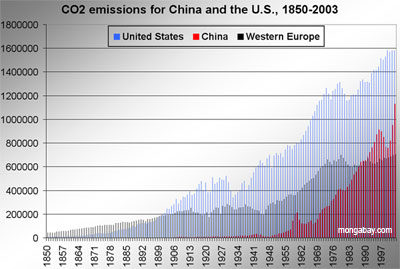
In the United States, emissions dropped by a remarkable 7 percent in the recession year of 2009, but rose by just over 4 percent last year, the new analysis shows. This country is the world’s second-largest emitter of greenhouse gases, pumping 1.5 billion tons of carbon into the atmosphere last year.
The United States was surpassed several years ago by China, where emissions grew 10.4 percent in 2010, with that country injecting 2.2 billion tons of carbon into the atmosphere. Carbon dioxide emissions are usually measured by the weight of carbon they contain.

The new figures come as delegates from 191 countries meet in Durban, South Africa, for yet another negotiating session in a global control effort that has been going on, with minimal success, for the better part of two decades.

“Each year that emissions go up, there’s another year of negotiations, another year of indecision,” said Glen P. Peters, a researcher at the Center for International Climate and Environmental Research in Oslo and a leader of the group that produced the new analysis. “There’s no evidence that this trajectory we’ve been following the last 10 years is going to change.”

Scientists say the rapid growth of emissions is warming the Earth, threatening the ecology and putting human welfare at long-term risk. But their increasingly urgent pleas that society find a way to limit emissions have met sharp political resistance in many countries, including the United States, because doing so would entail higher energy costs.

The new figures show a continuation of a trend in which developing countries, including China and India, have surpassed the wealthy countries in their overall greenhouse emissions. In 2010, the combustion of fossil fuels and the production of cement sent more than nine billion tons of carbon into the atmosphere, the new analysis found, with 57 percent of that coming from developing countries.
Emissions per person, though, are still sharply higher in the wealthy countries, and those countries have been emitting greenhouse gases far longer, so they account for the bulk of the excess gases in the atmosphere. The level of carbon dioxide, the main such gas, has increased 40 percent since the Industrial Revolution.

On the surface, the figures of recent years suggest that wealthy countries have made headway in stabilizing their emissions. But Dr. Peters pointed out that in a sense, the rich countries have simply exported some of them.
The fast rise in developing countries has been caused to a large extent by the growth of energy-intensive manufacturing industries that make goods that rich countries import. “All that has changed is the location in which the emissions are being produced,” Dr. Peters said.

Many countries, as part of their response to the economic crisis, invested billions in programs designed to make their energy systems greener. While it is possible those will pay long-term dividends, the new numbers suggest they have had little effect so far.

The financial crisis “was an opportunity to move the global economy away from a high-emissions trajectory,” said a scientific paper about the new figures, released online on Sunday by the journal Nature Climate Change. “Our results provide no indication of this happening.”

Friday, December 2, 2011

612. Climate Change: The Vanishing Adirondacks

A river flows  in the Adirondacks
By Lisa W. Foderaro, The New York Times, December 2, 2011

PAUL SMITHS, N.Y. — Jerry Jenkins, an ecologist with the Wildlife Conservation Society, narrates with encyclopedic precision the serene, timeless landscape of the Osgood River, as he moves past it with each dip of his canoe paddle.

That is sphagnum moss carpeting the banks of a bog that stretches across hundreds of acres, a signature feature of northern landscapes. Those are tamaracks and black spruces — cold-tolerant conifer trees found mostly in Canada — rising from the shores. A pair of gray jays alights on a branch: they, too, are at the southern end of their range.
Mr. Jenkins, who is the author of the book “Climate Change in the Adirondacks: The Path to Sustainability,” spends much of his time on the water and in the woods, documenting the ecosystem with a notebook and a camera. He thus brings an unusual perspective to the scene. Where a casual observer might behold diversity and continuity, he projects decades into the future and finds absence and loss.
“Nothing we see here is found at temperatures 10 degrees warmer, and very little makes it to five degrees warmer,” Mr. Jenkins said matter-of-factly on a mild fall day. “We will be in a climate that this community has never known in its history. One has to go back to world climate levels we haven’t seen in 15 million years.”
Such warming is what scientists’ temperature models forecast if significant steps are not taken, and soon, to cut carbon emissions. The Adirondack Mountains, host to two Winter Olympics, could lose much of their ice and snow by the end of the century.
A rise of 10 degrees in temperature would put the six-million-acre state park, a mix of public and private lands, in the same climate zone as the mountains of North Carolina and Georgia. So while Mr. Jenkins pursues his field studies and lectures, he also makes time to capture the present, taking some 30,000 photographs in recent years.
“Maybe it’s a baseline measurement, or maybe it’s an elegy,” Mr. Jenkins, 68, said of his photographic record of alpine flowers and mighty pines. “We may be the last generation to see the big bogs and the boreal creatures.”
A major study of the impact of climate change on New York State drew similar conclusions. In a 600-page report published last month, scientists from Cornell and Columbia Universities, as well as the City University of New York, said that temperatures would rise as much as nine degrees by the 2080s. They also projected the decline and eventual loss of spruce-fir forests and alpine tundra in the Adirondacks.
Mr. Jenkins has yet to detect signs of stress in trees and plants, which respond slowly to alterations in temperature. Northern mammals like moose and pine martens are holding steady, though they, too, are sure to suffer. “They are both at their thermal limits here,” he said.
Yet there is ample evidence elsewhere that the region is already reacting to a warmer climate. “For the hunters, farmers, hikers and birders, the change in the climate, especially in the past 10 to 15 years, is just too great to write off,” he said.
Hard frosts that a generation ago came in mid-September now arrive in October. Lake Champlain, a huge freshwater body that divides New York and Vermont, once froze over completely every winter, but now remains open in the middle some years.
Ornithologists have recorded recent declines in northern bird species like the black-backed woodpecker, olive-sided flycatcher and rusty blackbird. Loggers have told Mr. Jenkins that their winter operating season — the period when they haul timber over frozen earth — has been shortened by almost six weeks.
Until recently, Mr. Jenkins said, he thought climate change would have its initial impact on nature, and only later would it affect environments made by people. But then came Tropical Storm Irene in August. In the High Peaks region, up to 10 inches of rain sent boulders, trees and torrents of water down mountainsides, destroying roads and houses. That storm followed persistent flooding last spring that devastated farms in the Champlain Valley. (Scientists say intense rainfalls are a hallmark of climate change.)
From a young age, Mr. Jenkins was captivated by nature. The son of an Air Force pilot and a nurse’s aide, he grew up mostly on Long Island. “My mother, bless her soul, read me ‘The Boys Book of Snakes’ and books about the seashore,” he recalled.
He took to the mountains at Williams College in western Massachusetts, where he was admitted at 15, studying philosophy, math and physics. Despite the fact that he is missing his right forearm, a result of a birth defect, Mr. Jenkins became an outdoorsman. Even now, he spends days camping alone — “I’ve never had an intense experience in a motel,” he said — and can hoist a three-man canoe over his head by himself.

“He knows everything about everything,” said David W. Wolfe, a professor of plant and soil ecology at Cornell who worked on the climate study. “He’s that old-fashioned sort of naturalist who, through detailed observation and having a breadth of knowledge, can put all the pieces together. There are fewer and fewer people like that out there.”
After doing freelance work for government and conservation groups for 35 years, Mr. Jenkins joined the staff of the Wildlife Conservation Society’s Adirondack program in 2005. He lives south of the Adirondacks, in White Creek, where his 160-year-old farmhouse is heated by a wood stove and powered by solar panels. He recently bought a Prius.
During his climate presentations, Mr. Jenkins tries to end on an upbeat note. He caps his alarming assessment — illustrated with charts and maps and landing like a punch to the solar plexus — with a prescription for personal change. His book on Adirondack climate, published last year by Cornell University Press, lays out strategies for residents, business owners and local officials.
He recently spoke at a youth climate summit at the Wild Center in Tupper Lake. Despite the audience’s consumerist tendencies, he preached thrift.
“Thrift means not buying stuff, turning down the heat, not making five trips to town a week,” he said. “The easy things help pay for the hard things, like solar panels and hybrid cars.”
In his private moments, however, Mr. Jenkins admits to pondering this time in history with an existential foreboding. And he speaks of the Adirondack landscape with a certain wistfulness, waxing lyrical about conifers and sedges, long vistas and light on water, “peacefulness and oldness.” Then he goes back to work.

611. The Housing Bubble: A Banker's Confession


By Nicholas D. Kristof, The New York Times, November 30, 2011

If you want to understand why the Occupy movement has found such traction, it helps to listen to a former banker like James Theckston. He fully acknowledges that he and other bankers are mostly responsible for the country’s housing mess.
As a regional vice president for Chase Home Finance in southern Florida, Theckston shoveled money at home borrowers. In 2007, his team wrote $2 billion in mortgages, he says. Sometimes those were “no documentation” mortgages.
“On the application, you don’t put down a job; you don’t show income; you don’t show assets,” he said. “But you still got a nod.”
“If you had some old bag lady walking down the street and she had a decent credit score, she got a loan,” he added.
Theckston says that borrowers made harebrained decisions and exaggerated their resources but that bankers were far more culpable — and that all this was driven by pressure from the top.
“You’ve got somebody making $20,000 buying a $500,000 home, thinking that she’d flip it,” he said. “That was crazy, but the banks put programs together to make those kinds of loans.”
Especially when mortgages were securitized and sold off to investors, he said, senior bankers turned a blind eye to shortcuts.
“The bigwigs of the corporations knew this, but they figured we’re going to make billions out of it, so who cares? The government is going to bail us out. And the problem loans will be out of here, maybe even overseas.”
One memory particularly troubles Theckston. He says that some account executives earned a commission seven times higher from subprime loans, rather than prime mortgages. So they looked for less savvy borrowers — those with less education, without previous mortgage experience, or without fluent English — and nudged them toward subprime loans.
These less savvy borrowers were disproportionately blacks and Latinos, he said, and they ended up paying a higher rate so that they were more likely to lose their homes. Senior executives seemed aware of this racial mismatch, he recalled, and frantically tried to cover it up.
Theckston, who has a shelf full of awards that he won from Chase, such as “sales manager of the year,” showed me his 2006 performance review. It indicates that 60 percent of his evaluation depended on him increasing high-risk loans.
In late 2008, when the mortgage market collapsed, Theckston and most of his colleagues were laid off. He says he bears no animus toward Chase, but he does think it is profoundly unfair that troubled banks have been rescued while troubled homeowners have been evicted.
When I called JPMorgan Chase for its side of the story, it didn’t deny the accounts of manic mortgage-writing. Its spokesmen acknowledge that banks had made huge mistakes and noted that Chase no longer writes subprime or no-document mortgages. It also said that it has offered homeowners four times as many mortgage modifications as homes it has foreclosed on.
Still, 28 percent of all American mortgages are “underwater,” according to Zillow, a real estate Web site. That means that more is owed than the home is worth, and the figure is up from 23 percent a year ago. That overhang stifles the economy, for it’s difficult to nurture a broad recovery unless real estate and construction revive.
All this came into sharper focus this week as Bloomberg Markets magazine published a terrific exposรฉ based on lending records it pried out of the Federal Reserve in a lawsuit. It turns out that the Fed provided an astonishing sum to keep banks afloat — $7.8 trillion, equivalent to more than $25,000 per American.
The article estimated that banks earned up to $13 billion in profits by relending that money to businesses and consumers at higher rates.
The Federal Reserve action isn’t a scandal, and arguably it’s a triumph. The Fed did everything imaginable to avert a financial catastrophe — and succeeded. The money was repaid.
Yet what is scandalous is the basic unfairness of what has transpired. The federal government rescued highly paid bankers from their reckless decisions. It protected bank shareholders and creditors. But it mostly turned a cold shoulder to some of the most vulnerable and least sophisticated people in America. Last year alone, banks seized more than one million homes.
Sure, some programs exist to help borrowers in trouble, but not nearly enough. We still haven’t taken such basic steps as allowing bankruptcy judges to modify the terms of a mortgage on a primary home. Legislation to address that has gotten nowhere.
My daughter and I are reading Steinbeck’s “Grapes of Wrath” aloud to each other, and those Depression-era injustices seem so familiar today. That’s why the Occupy movement resonates so deeply: When the federal government goes all-out to rescue errant bankers, and stiffs homeowners, that’s not just bad economics. It’s also wrong.

610. Farming Practices Are Destroying the Ogallala Aquifer


Qgallala Aquifer lies beneath mid-western states
By Julene Blair, The New York Times, November 30, 2011

Longmont, Colo. Imagine  you are a farmer in the center of the country, where it seldom rains enough. Now imagine that a well driller came to your farm and told you that he could bore a hole deep into the ground, and that forever after you could pump out as much water as you needed to grow your crops. That is exactly what happened on the Great Plains in the mid-20th century. The wondrous resource containing all that water was the Ogallala Aquifer.

The Ogallala underlies portions of eight large states — 174,000 square miles of crop and range land all the way from South Dakota to Texas. Over the last several months, it became about as famous as a geologic formation can get. With the nation’s environmentalists at their side, Nebraska landowners battled ferociously against the Keystone XL pipeline, which would have carried oil extracted from Canadian tar sands through the environmentally sensitive Nebraska Sand Hills. If the pipeline leaked, they argued, chemicals and oil would seep down into the aquifer, contaminating a precious resource responsible for 27 percent of the nation’s irrigated agriculture.
They won — for now. President Obama agreed last month to reconsider the pipeline’s route. So is the Ogallala now safe? Not quite. Regardless of whether the pipeline was a good or bad idea, it was never the real danger. The true threat is posed by agriculture as it’s currently practiced on the Great Plains by the farmers themselves, many of whom opposed the pipeline vehemently. The aquifer is being wasted and polluted. Wasted, that is, on corn, a thirsty crop that requires over 20 inches of irrigation water in parts of the Plains. And polluted with pesticides and nitrogen fertilizers.
It’s not that I don’t empathize with the Nebraska farmers. I grew up on a Kansas farm. Like them, we called our Ogallala water “precious” and bragged that it was the best in the world. But the aquifer’s only natural recharge comes from rain and snow. In our Kansas district, less than half an inch of that reached the aquifer in a given year. We were allowed to pump out over 30 times that amount.
When I expressed concern, my father assured me that the government would step in to stop us someday. Until then, he liked to tease, “I got mine!” But the government has not stepped in. Controls imposed by local water districts — run by irrigators themselves — and by state legislators dependent on the farm vote have been minimal at best.
As a result, in some areas of Kansas and Texas, farmers can no longer pump enough to water their crops. If current withdrawal rates continue, usable water in most areas will be gone by the end of this century.
The aquifer in the Nebraska Sand Hills gets more recharge than elsewhere, because rain and snowmelt seep quickly through sand. Opponents of the Keystone XL pipeline argued that this characteristic made that part of the aquifer particularly susceptible to contamination. They were right. But contaminants are already there. According to a report by the United States Geological Survey in 2009, 90 percent of samples taken from shallow groundwater in Nebraska portions of the Ogallala contained nitrate from fertilizers.
The Ogallala is a geologic formation, not an underground lake that can be widely contaminated by a localized spill. Water fills the spaces between sandstone, gravel, clay and other sediments, which slow the water’s lateral travel. A pipeline leak would have been minor compared to the damage that chemically dependent agriculture causes.
Chemicals trickle inexorably downward with each rainfall or application of irrigation water, creating a situation that the Geological Survey has referred to as “creeping normalcy.” Over the coming decades, it warned, contaminants will continue to creep down into the aquifer, and more wells will exceed federal safety levels.
Already, 14 percent of all Ogallala irrigation wells tested contained one pesticide or more. Most common was Atrazine. This herbicide, used ubiquitously in cornfields, is a known hormone disruptor and is suspected of, among other things, retarding fetal development. Five percent of the irrigation wells contained nitrate levels equal to or in excess of safety standards set by the Environmental Protection Agency. Excess nitrate levels in drinking water can impair the blood’s ability to deliver oxygen in infants, causing “blue baby syndrome.”
Why haven’t viable environmental groups formed to protect the Ogallala? Because corn contributes so much to the economy that its reign is seldom questioned. Federal subsidy payments to corn growers and the federal mandate to produce ethanol underwrite the waste and pollution.
These subsidies should end. When the farm bill comes up for reauthorization next year, Congress should instead pay farmers to reduce their dependence on irrigation and chemicals. The eastern Nebraska climate is moist enough to grow corn without irrigation. That is how the University of Nebraska football team came to be the Cornhuskers. And the more arid High Plains to the west are known as the nation’s breadbasket because wheat, a drought-tolerant crop, thrives there.
The Keystone XL pipeline posed a potential threat to a limited region. But agricultural waste and pollution are damaging the entire Ogallala Aquifer right now. In an era of growing population and advancing drought, we cannot afford complacency in the face of “creeping normalcy.”
Julene Bair, the author of “One Degree West: Reflections of a Plainsdaughter,” is at work on a memoir.