Wednesday, November 2, 2011

569. Book Review: The Origin of Our Species


By Elaine Graham-Leigh, Counterfire, October 27, 2011

The origin of homo sapiens might seem a question of purely scientific interest, but it is actually also an intensely political one. From the Just So stories of evolutionary psychology to various ideas about innate human behaviour, there are no shortage of arguments seeking to justify aspects of modern society with reference to the prehistoric past. This is not restricted to the history of our own species, homo sapiens, as our earlier evolutionary history can also be held to be extremely relevant for understanding the present.


An example of this was the development of the theory, in the 1950s and 1960s, about the supposedly violent behaviour of an ancient hominid species called Australopithecus africanus, which was then usually thought to be an ancestor of all later hominid species (the group of species to which homo sapiens belongs). A palaeontologist, Raymond Dart, who discovered various africanus fossils in southern Africa, believed that he had found evidence of hunting, murder and cannibalism, and that it was this which had enabled africanus to give rise to the later hominid species. He called it ‘the predatory transition from ape to man’, and this was developed in the popularisation of his theory in the 1960s into the conclusion that violence was not only innate to modern humans, but that it was in some way what made us human.  The usefulness of this theory to right-wing arguments against the peace movement was, of course, entirely coincidental. 


The science underpinning this argument for innate human violence was fairly swiftly demolished, with poor old africanus appearing now to have been more prey than predator. However, this is not the only instance of perceived hominid history being used to justify a right-wing view of society. A particular point of contention has been the question of where homo sapiens first evolved from its precursor hominid species, and what that means for differences (or not) between modern human populations; the biological reality of race.


The older theory for the development of homo sapiens is what is known as the multiregional model. This is based on theories first developed in the 1930s, reworked by US scientist Carleton Coon in the 1960s, and picked up in the 1970s and 1980s by a number of multiregionalists. Broadly, this theory argues that homo sapiens populations in different parts of the world evolved separately in those areas.

The multiregionalists accepted that earlier hominid species had evolved in Africa, but argued that once the hominid species called homo erectus had dispersed from Africa about one million years ago, the erectus populations in each area had given rise to their own modern humans. For Europe, the argument was that homo erectus had arrived from Africa and developed into the Neanderthals, who had then in turn developed into modern Europeans, but also that modern humans in other parts of the world would have had a different post-erectus evolutionary history. 

This separate evolution meant that perceived racial differences – in skin colour, stature, facial features and so on – were real differences expressing the fact that a million years separated, for example, a sub-Saharan African and a WASP. In addition, the idea that there were real different racial groups of modern humans, which had evolved separately, enabled the multiregionalists to suggest that they might have evolved at different rates. All were still just about human, but now some seemed to be more human than others.

Carelton Coon even singled out Australian aboriginies as an example of a group which was less evolved, just in case anyone could not work out for themselves that it would not be white Europeans who were thought to have lagged behind in evolutionary terms.

Some aboriginal groups have tried to turn this on its head, arguing that their right to the land is strengthened if they are effectively homo erectus, but the general racist effect of this theory should be evident.

For the multiregionalists, what was key was that the unavoidable African part of their evolutionary history was as peripheral, and as long ago, as they could make it. They could not argue that the evolution of hominids up to homo erectus happened outside Africa, because the weight of evidence was against them, but they could locate their own homo sapiens origins safely in Europe, via the Neanderthals. They were unable to believe that anything as impressive as white men could have anything recently to do with Africa. As Coon argued, ‘If Africa was the cradle of mankind, it was only an indifferent kindergarten.’ 

The alternative theory, developed by Chris Stringer, among others, throughout his career, is the Out of Africa Theory, or theory of Recent African Origins (RAO), so renamed because there appears to have been not one African exodus but several. As the name implies, this theory contradicts the multiregional model by arguing that homo sapiens evolved relatively recently in Africa and spread out from there to become the globally-dispersed species we are today. This theory turns the idea of the biological reality of race on its head. If we are all so recently related, it follows that differences in appearance between populations from different areas must be literally skin deep. Indeed, work on the DNA of different populations shows that because everyone whose ancestors were part of the out of Africa dispersal are descended from a fairly limited gene pool, there is more variation between different modern population groups within Africa than there is between groups from anywhere else in the world.


The RAO theory has become the most generally accepted version of human origins, and presents a conveniently clear scientific refutation of some unpleasant racist theories. However, theories of human origins are changing all the time as new remains are found, or new techniques developed for dating finds or tracking DNA variations. This new book from Chris Stringer brings us up to date with recent years of developments, including the startling discovery of a new hominid species, (although not a human ancestor), the tiny ‘Hobbit’, homo floriensis. It is a fascinating read, but from the point of view of the political arguments over human origins theories, a rather challenging one. 

It is always a bad idea to rest the repudiation of right-wing interpretations of ‘facts’ about the world on the basis of our own ‘facts’ alone, rather than on disputing the ideology behind reactionary arguments. Scientific facts are always subject to new discoveries and can be challenged. The problem with a broad-brush rendering of the RAO as an answer to racist science, is that it can imply that it is only the fact of homo sapiens’ recent evolution in Africa which means that racist arguments about the superiority of some groups over others are not correct. In other words, it can appear that if new evidence emerged in support of regional differences in homo sapiens’ evolution, that would pull the rug out from underneath our repudiation of scientific justifications for racism. The challenge presented by Stringer’s new book is that the nuanced version of the RAO which it presents has had to accommodate some regional differences. The simple story of African origins told by summaries of the RAO turns out not to be quite right.


Part of the multiregional hypothesis was that homo sapiens in Europe was descended from European Neanderthal populations. By contrast, the RAO held that Neanderthals died out without leaving descendants, being replaced by the more successful homo sapiens, either by competition or genocidal violence, depending on how far the individual commentator was in favour of the ‘nature red in tooth and claw’ version of human prehistory. However, advances in studies of Neanderthal DNA now indicate that while homo sapiens clearly did not evolve from Neanderthals in Europe or anywhere else (the evolutionary progenitor of homo sapiens appears to have been homo heidelbergensis, from which both homo sapiens and Neanderthals evolved), modern Europeans and Asians have DNA which is closer to Neanderthal DNA than is modern Africans’. This indicates that modern humans outside Africa may have had some Neanderthal ancestors. The Neanderthal DNA is about 2%, a reasonably significant input, which requires explanation in any model of human origins.

Stringer maintains that it is unlikely that this interbreeding happened in Europe, as European homo sapiens do not appear to have inherited their cold adaptions of light skin, hair and eyes from the similarly cold-adapted European Neanderthal populations. The most likely hypothesis, Stringer argues persuasively, is that homo sapiens leaving Africa encountered people descended from an earlier exodus of homo heidelbergensis into the Middle East. This is not the only evidence of interbreeding between homo sapiens and other hominid populations. Modern Melanesians, for example, have as much as 8% DNA which appears to have originated in the Denisovians, a hominid species also descended from homo heidelbergensis and closely related to Neanderthals. This is so high a retention of archaic DNA that Stringer speculates that it may be providing some selective advantage, such as resistance to endemic diseases.


There is clearly a danger that these discoveries could be used to resuscitate the otherwise moribund multiregionalist theory. It is probably not a coincidence that the multiple authors of a recent paper published in Science on Neanderthal and Denisovian DNA, ‘The shaping of modern human immune systems by multiregional admixture with archaic humans’ [italics mine].  Stringer however makes it clear that the RAO theory is amended but not contradicted by these discoveries of contact between homo sapiens and other hominid species.


In the first place, Africa retains its importance in human origins, rather than being pushed aside as in multiregionalist theory. By the last chapter, it is clear that what we are moving towards is a multiregional theory of human origins within Africa, with different archaic populations potentially encountering and breeding with each other over a long period of time, interspersed with incidences of dispersal out of Africa. While the theories discussed earlier in the book of how homo sapiens could have bred with Neanderthals and Denisovians remain valid, the point here is that different homo sapiens populations could have acquired their differing traces of archaic DNA before they ever left Africa. Regional differences between early homo sapiens populations could have been due to the accidents of which groups ended up in which areas, rather than to the archaic populations they encountered there. It is important also to understand that ancient regional differences would not be the same as perceived more recent ones.


Just as important as this reassertion of the importance of Africa for human origins is Stringer’s consideration of what modernity means in human evolution. It is easy when thinking about the evolution of homo sapiens to reduce it to a question of genetics, but this would be a mistake. Stringer points out that in fact genetic divisions between species are often not as clear cut as a lay understanding would have it. The definition of a species in fact is closer to being groups which in the wild would not breed with each other, rather than groups which could not successfully breed with each other even if persuaded to do so by scientists in a lab. In other words, the definition of a species is behavioural as much as it is genetic, and for Stringer the evidence for the emergence of modern human behaviours is as important as that for the development of modern human bodies.

The evidence for modern behaviours like tool use, use of symbolic art and burying the dead, which set hominids apart from other animal species, is patchy, with incidences appearing early in human pre-history but separated from each other in time and space. Stringer suggests that this suggestion of patchy cultural development is not an accident of evidence survival but reflects a reality about how modern human behaviour developed. His point is that it needs a certain group size to maintain cultural and technological knowledge over generations, and a certain degree of contact with other groups to share further developments.


If small groups become isolated they can lose important knowledge, as for example seems to have happened to the first settlers in Tasmania. When they arrived there, about 40,000 years ago, the island was connected to the Australian mainland, and the settlers had a variety of tools, clothing and shelters. However, about 14,000 years ago, climatic changes turned Tasmania into an island, and the now-isolated inhabitants gradually seem to have lost much of their cultural and technical knowledge, even eventually the knowledge of how to make fire. Stringer suggests that this may be an illustration of how culture was developed and lost again many times among different groups in human prehistory. The key breakthrough for the development of fully modern human behaviour was not ability to develop this sort of culture, but the ability to sustain a large enough population to keep it. 

It was this, rather than genetic differences, which ultimately made the difference between homo sapiens and Neanderthals. 

There is considerable evidence for Neanderthal culture, including burying the dead, tool-making and decorative painting, and it seems unlikely that these were simply imitations of homo sapiens’ culture, as has been suggested. The problem for Neanderthals may well have been that, given the ice-age climate which they had to deal with, they were never able to develop sufficiently large and connected groups to maintain and extend these cultural developments. The survival of us, rather than Neanderthals, may be more to do with the contingent effects of climate than any innate superiority of homo sapiens’ evolution. As Stringer says, lacking the last Ice Age, it might have been Neanderthals rather than homo sapiens which survived: ‘Would they have eventually looked back at their own success, at the benefits of the Eurasian environment, and the problems of surviving in Africa for their failed relatives, the ones with the weird foreheads?’ (p.238). 


It is reasonable to be concerned that any suggestion that some people today have DNA from non-homo sapiens hominid species will be interpreted as meaning that some people are less human than others. However, the lesson of this valuable book is that these archaic hominid species, if the contingent events which drove them extinct had worked out differently, would have been different but actually no less human than us. Engels argued in the Dialectics of Nature that the essential element in the transition from ape to man was labour; humans became human because their bipedality freed their hands to make tools and therefore work to transform their environment.  Stringer’s conclusions seem to lead us back to this insight. That some of us may have Neanderthal or Denisovian DNA is fascinating for human history, but tells us nothing about modern regional differences. What made us human was behaviour, not our genes.


The loss of the basic RAO theory has taken away the one-sentence simple response to racists who like to imply that black people are less evolved than they are. In its place, Stringer has given us a dialectical understanding of our evolution and what it means to be a modern human, which is ultimately a much more powerful refutation of the ongoing perversion of the study of human origins by the right.

568. Breaking a Long Silence on Population Control


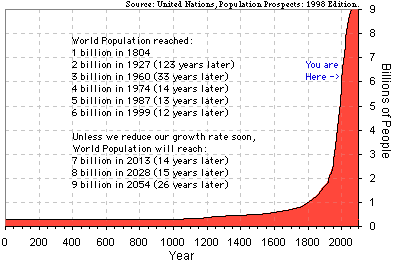
Exponential human population growth
(this chart shows how the rate of growth has been underestimated)

By Mireya Navarro, The New York Times, October 31, 2011

Major American environmental groups have dodged the subject of population control for decades, wary of getting caught up in the bruising politics of reproductive health.

The condoms' packages were designed to start a discussion about how human population growth affects other species.
Yet, virtually alone, the Center for Biological Diversity is breaking the taboo by directly tying population growth to environmental problems through efforts like giving away condoms in colorful packages depicting endangered animals. The idea is to start a debate about how overpopulation crowds out species and hastens climate change — just when the world is welcoming Baby No. 7 Billion.
“Wrap with care, save the polar bear,” reads one of the packages. “Wear a condom now, save the spotted owl,” says another.
KierĂ¡n Suckling, executive director of the center, a membership-based nonprofit organization in Tucson, said he had an aha moment a few years ago. “All the species that we save from extinction will eventually be gobbled up if the human population keeps growing,” he said.
In the United States, the birth rate has fallen steadily since the baby boom, from 3.6 births per woman in 1960 to 2.0 today, or just under the replacement level, at which a population replaces itself from one generation to the next. Yet even at that rate, demographers estimate, the country will grow from 311 million people now to 478 million by the end of the century, because of both births and immigration.
The highest birth rates — from five to more than six births per woman — are occurring in a handful of nations in Africa and Asia, including Nigeria and Yemen. Yet among large economies, the United States is second only to Australia in the amount of carbon dioxide it emits per capita, according to the latest figures from the federal Energy Information Administration.
“Every person you add to the country makes all these tremendous demands on the environment,” said Joel E. Cohen, chief of the Laboratory of Populations at Rockefeller University and Columbia University.
But experts are reluctant to suggest an ideal birth rate. “There isn’t any magic number,” Dr. Cohen said.
As recently as the 1970s, the subject of population control was less controversial, partly because the baby boom years had given rise to concerns about scarcity of resources, some population experts and environmentalists said. Then came China’s coercive one-child policy and a rise in social conservatism in the United States, combined with the country’s aversion to anything perceived as restricting individual freedoms, be it the right to bear arms or children.
Some groups also fear whipping up anti-immigrant sentiment and opposition to family planning. Immigration now accounts for about one-third of the growth rate in the United States.
“We see reluctance and fear to deal with this issue,” said Jose Miguel Guzman of the United Nations Population Fund.
Groups contacted for this article generally declined to discuss the issue or did not return calls.
The Center for Biological Diversity’s condom campaign, begun on college campuses last year, now includes video ads in Times Square and lobbying in Washington for more family planning services. It is an aggressive strategy even for the center, which is best known for barraging federal agencies with lawsuits intended to protect species and ecosystems.
The condom campaign is intended to raise awareness and help reduce unintended pregnancies. “Reproduction is always going to be a matter of free will,” said Randy Serraglio, the manager of the campaign. “This is about getting people to make the connection.”
A study published last year in the Proceedings of the National Academy of Sciences showed how slowing the country’s population growth rate to 1.5 births per woman from 2.0 could result in a 10 percent drop in greenhouse gas emissions by midcentury and a 33 percent drop by the end of the century.
But the notion that curbing births is an effective way to control emissions is not an easy sell.
When Oregon State University released a study two years ago calculating the extra carbon dioxide emissions a person helps generate by choosing to have children, the researchers received hate mail labeling them “eugenicists” and “Nazis.”
The study, which also calculated the impact of a birth beyond the child’s lifetime “should the offspring reproduce,” said that each American child generated seven times as much carbon dioxide over time as one child in China, and 169 times as much as one in Bangladesh. Reducing car travel, recycling and making homes more energy efficient would have a fraction of the impact on emissions that reducing the birth rate would, it found.
“There are important consequences to having children, and we tried to quantify them,” said Paul A. Murtaugh, an associate professor of statistics and one of the study’s co-authors. “It should be on the table. It needs to be.”

Some groups, like the World Wildlife Fund and Conservation International, said they worked on population-related  issues mostly internationally. The president of the National Audubon Society declined an interview without explanation. The chairwoman of the Green Group, a loose association of several dozen environmental organizations, did not return calls or e-mails.
The Natural Resources Defense Council president, Frances Beinecke, said her group focused on addressing climate change through energy strategies and conservation efforts. “Particularly in this economic environment, we’re not in a position to just add, add, add,” Ms. Beinecke said of her group’s agenda.
Kevin Knobloch, president of the Union of Concerned Scientists, said the research on reducing emissions by cutting birth rates was not yet “robust” enough to make a convincing case for a clear way forward.
A country’s carbon footprint does not necessarily shrink when the birth rate drops, Mr. Knobloch said. In India and China, he pointed out, smaller families have consumed more as their incomes rose — a common trend in developing countries. “It gets complex very quickly,” he said.
Carl Pope, the chairman of the Sierra Club, said his organization now had one population officer on staff who was working on international reproductive health services. In this country, Mr. Pope said, there are reasons for keeping a low profile on the issue.
“Look at Planned Parenthood,” he said, recalling the group’s bruising battle with Republican lawmakers over federal financing last spring. “There’s a huge atmosphere of intimidation. The moment you say ‘family planning,’ immediately somebody pulls out abortion.”
The 2.0 fertility rate in the United States is higher than the rates in other developed countries, including Germany and Japan (1.3), Canada (1.6) and Britain (1.8), according to figures from the United Nations.
John Seager, president of the group Population Connection, said organizations had been more assertive about lobbying the Obama administration for money to finance family planning services overseas.
Unintended pregnancies account for roughly half of all annual births in the United States, according to studies by the Guttmacher Institute, which is based in New York and promotes reproductive health worldwide.
By tackling such pregnancies, the fertility rate could be brought down to about 1.9 births per woman, slightly below replacement level yet high enough to ease concerns about economic stagnation and support for the elderly, said John Bongaarts, a demographer with the Population Council, a research group in New York.
Dr. Bongaarts described the inaction by environmental groups as a missed opportunity. “The global warming community is staying away from anything having to do with population,” he said, “and that’s frustrating.”

Tuesday, November 1, 2011

567. In Some Cases, Even Bad Bacteria May Be Good


Helicobacter pylori

By Kate Murray, The New York Times, October 31, 2011
Overuse of antibiotics has led to the creation of drug-resistant bacteria — so-called superbugs, like methicillin-resistant staphylococcus aureus. But now some researchers are exploring an equally unsettling possibility: Antibiotic abuse may also be contributing to the increasing incidence of obesity, as well as allergies, inflammatory bowel disease, asthma and gastroesophageal reflux.
Among those sounding the alarm is Dr. Martin Blaser, a professor of microbiology at New York University Langone Medical Center. In a commentary published in August in the journal Nature, he asserted that antibiotics are permanently altering microbial flora of the human body, also known as the microbiome or microbiota, with serious health consequences.
The human gut in particular is home to billions of bacteria, but little is known about this hidden ecosystem. Take Helicobacter pylori, a bacterium associated with an increased risk of ulcers and gastric cancer. Many doctors are quick to prescribe antibiotics to kill it even when the patient has no symptoms.
But in 1998, in a paper published in the British Medical Journal, Dr. Blaser was more circumspect, arguing that H. pylori might not be such a bad actor after all. “We’re talking about a bug that’s been in the human gut for at least 58,000 years,” Dr. Blaser said in an interview. “There’s probably a reason for that.”
His lab has since produced a stream of findings supporting his suspicion. Dr. Blaser and his colleagues discovered, for instance, that the stomach behaves differently after a course of antibiotics eradicates resident H. pylori.
After a meal, levels of ghrelin, a hunger hormone secreted in the stomach, are supposed to fall. But in subjects without H. pylori, the amount of ghrelin in the bloodstream held steady, in essence telling the brain to keep eating.
Moreover, mice in Dr. Blaser’s lab fed antibiotics in dosages similar to those given to children to treat ear and throat infections — which is enough to kill H. pylori in many patients — had marked increases in body fat even though their diets remained the same. (Indeed, farmers have long given antibiotics to livestock to promote weight gain without increasing caloric intake.)
These results dovetail with research by Peter Turnbaugh, a Harvard University geneticist, in collaboration with Dr. Jeffrey Gordon, a gastroenterologist at Washington University in St. Louis. They have found that the ratios of various bacteria in the guts of obese mice and obese humans were significantly different from those of lean controls, suggesting that altering the stomach’s microbial balance with antibiotics might put patients at risk for gaining weight.
Antibiotic overuse may be the root of other health problems, too. An epidemiologist at New York University, Yu Chen, has found an inverse correlation between H. pylori infection and childhood-onset asthma, hay fever and skin allergies in 7,600 participants in the National Health and Nutrition Survey.
Observation research has shown that the elimination of H. pylori actually increases the risk of gastric reflux, which is itself associated with asthma as well as esophageal diseases. Researchers in Switzerland and Germany have reported that mice given H. pylori actually are protected against asthma.
Dr. Barry Marshall, the professor of clinical biology at the University of Western Australia in Perth who was awarded the Nobel Prize in Medicine in 2005 for his part in the discovery of H. pylori and its role in gastritis and peptic ulcer disease, had a more measured reaction. “I’ve never killed anyone giving them antibiotics for H. pylori, but people have been killed who didn’t get antibiotics to get rid of it,” he said.
Patients whose internal flora are disrupt by antibiotics tend to reacquire the bugs over time, particularly if the person lives with others, Dr. Marshall said.
Nevertheless, he agreed with Dr. Blaser that antibiotics are overused and even said he foresaw a day when a detoxified strain of H. pylori might be administered as a treatment for conditions like obesity and asthma.
But wider use of antibiotics may be wreaking havoc far beyond that resulting from the loss of H. pylori. “We have so far focused on H. pylori because we have the diagnostic tests to detect it, but you could say H. pylori is an indicator organism for what is probably a vast and disappearing microbiota and increasing disease risk,” said Dr. Blaser.
The National Institutes of Health shares his concern, not only awarding him a $6.5 million grant last year to investigate the role of the disappearing microbiota in the current obesity epidemic but also allocating $115 million in 2008 to fund the Human Microbiome Project, which proposes to identify microbes that reside on and within a healthy human being.
“You can think of it as the second human genome project, where we will sequence the genes of the tremendous diversity of bacteria that populate our bodies,” said Julie Segre, senior investigator at the N.I.H.’s Human Genome Research Institute. “We will take samples from 200 healthy volunteers to get an idea of what is a normal, healthy microbiota.”
It’s an ambitious project, given that bodily bacteria outnumber human cells 10 to one. But researchers involved in the effort said advances in DNA sequencing technology make it an achievable goal. The effort is so far focusing only on microbes on the skin and in the nose, mouth, gut and genital area.
Dr. David Relman, professor of microbiology and immunology at Stanford University, said the Human Microbiome Project is important because it’s not just antibiotics that are changing the human microbiota: “Many aspects of modern life, including diet, smaller families, more hygienic practices and improved public sanitation, are affecting our bacterial communities.”
Getting a genetic snapshot of bacteria populating humans today would provide a benchmark for tracking further degradation and resulting disorders.
“We need to get an understanding of how our microbial communities operate and what to feed them so they will bloom again,” said Dr. Relman. “It’s intriguing and entirely possible that in the future we will get a cocktail of strains and species of bacteria to repair the collateral damage that antibiotics and other practices have done to our inner ecology.”
Dr. Blaser’s ideas have not always been popular, but he is gratified by the gathering interest in the human microbiome and its links to health. “I know I am now doing the most important work of my career,” he said.

566. A Tales of Animal Cannibalism


Midsize cane toads lure younger cane toads, which the bigger toads then swallow 
whole. A mother caecilian, top right, stays by her young and literally feeds them 
her self. Tamarin monkeys don't eat their offspring, except when they do. 
The female redback spider makes a meal of her mates.

By Natalie Angier, The New York Times, October 31, 2011

When Richard Shine, a biologist at the University of Sydney in Australia, first heard the mystery of the missing eggs, he feared it was another case of what might be called invasive toadkill. He and his colleagues were studying the cane toad, Rhinella marina, a big, warty, sludge-colored Latin American amphibian that was brought to the continent years ago in an ill-fated effort at beetle control.

The researchers already knew that many large Australian carnivores like freshwater crocodiles and marsupial quolls had died after naĂ¯vely feasting on the highly toxic adult toads. Now it seemed that smaller predators were going after the toad’s equally poisonous eggs, and Dr. Shine worried that they too would be doomed.
Follow-up field studies soon revealed the identity of the caviar thieves. To the researchers’ astonishment, Dr. Shine said, it was cane toads themselves — or rather their tadpoles, which would swim over to each fresh batch of Rhinella eggs and “desperately consume” every slick black spherelet they could find.
Significantly, the tadpoles weren’t simply hungry for a generic omelette. Reporting in the journal Animal Behaviour, Dr. Shine and his co-workers showed that when given a choice between cane toad eggs and the similar-looking egg masses of other frog species, Rhinella tadpoles overwhelmingly picked the cannibal option. Oh, little cane toads lacking legs, how greedily you snack on pre-toads packed in eggs!
Life after metamorphosis brought scant relief from fraternal threats. The scientists also demonstrated that midsize cane toads wriggle digits on their hind feet to lure younger cane toads, which the bigger toads then swallow whole. “A cane toad’s biggest enemy is another cane toad,” Dr. Shine said. “It’s a toad-eat-toad world out there.”
Rhinella’s brutal appetite is among a string of recent revelations of what might be called extreme or uncanny cannibalism, when one animal’s determination to feed on its fellows takes such a florid or subversive turn that scientists are left, as Mark Wilkinson of the Natural History Museum in London put it, “gobsmacked” by the sight.
There are males that demand to be cannibalized by their lovers and males that seek to avoid that fate by stopping midcourtship and hammily feigning rigor mortis. There are mother monkeys that act like hipster zombies, greeting unwanted offspring with a ghoulish demand for brains; and there are infant caecilians — limbless, soil-dwelling amphibians — that grow fat by repeatedly skinning their mother alive.
In the past, animal cannibalism was considered accidental or pathological: Walk in on a mother rabbit giving birth, and the shock will prod her to eat her bunnies. Now scientists realize that cannibalism can sometimes make good evolutionary sense, and for each new example they seek to trace the selective forces behind it.
Why do cane toad tadpoles cannibalize eggs? Researchers propose three motives. The practice speeds up maturation; it eliminates future rivals who, given a mother toad’s reproductive cycle, are almost certainly unrelated to you; and it means exploiting an abundant resource that others find toxic but to which you are immune.
“We’re talking about a tropical animal that was relocated to one of the driest places on earth,” Dr. Shine said. “Cannibalism is one of those clever tricks that makes it such a superb colonizer and a survival machine.”
Maydianne Andrade, a biologist at the University of Toronto Scarborough in Ontario, has studied the redback spider, a type of black widow in which males willingly fling themselves onto the fangs of their much bigger mates. Dr. Andrade has found that the self-sacrificial act is simply the grand finale of an elaborate Ringling Brothers courtship performance that can last hours.
The suitor leaps around the web to vibrate its silken strands just so. He vaults up and over the female, back to front, side to side, again and again. He somersaults tantalizingly close to her mouth and then flips himself clear.
Is she ready to mate? She allows the male to mount her and fill one of her paired sperm storage organs, but then, hold on buster, it’s time for more jitterbugging, more lordly leaping. The male dances around her jaws again, she lets him fill sperm receptacle No. 2, his genitals break off to help seal the deal, and that’s it. He somersaults toward her fangs for real, she makes a quick meal of him, and he dies in arachnirvana, his gametes well positioned to sire thousands of next-generation redbacks.
But woe to any suitor that lacks a daredevil stripe. The female will cut short his wan routine, cannibalize him prematurely and then instantly mate with a rival, as if out of spite.

Dr. Andrade said the male redback’s suicidal efforts made sense. Males are the size of rice grains and blown about by the wind, females are spottily distributed and hard to find, and a vast majority of males never encounter a single female. For the lucky few who do, there’s no time to waste: This is their one shot at legacy, and they throw their hearts and parts in her hands.

 “It’s what we call a terminal investment,” Dr. Andrade said.
For males with better dating prospects than the redback, the idea of connubial cannibalism may not seem so sexy, and the males do what they can to keep peckish females at bay. Among some species of widow spiders, males are preferentially drawn to females that smell as if they’ve just finished dinner, and hence are less likely to view approaching mate as a meal.
Studying Pisaura mirabilis, a slender, half-inch-long brown garden spider found in Denmark, Trine Bilde of Aarhus University and her colleagues have discovered that the males sometimes resort to a particularly melodramatic anticannibalism gambit. A male woos a female with a nuptial gift, a fresh-caught insect neatly bundled in silk and held aloft in his fangs. The female latches onto the gift with her fangs, and if she starts eating it calmly, the male slowly positions himself around her and starts transferring sperm.
If, however, the female grabs the parcel a little too hungrily, the male counters the predatory threat by playing spider possum. “He’s still holding onto the gift, but he stretches himself out into a deathlike pose, completely motionless, with his legs lagging behind,” Dr. Bilde said.
The female starts running around with the gift, the limp male dangling from it. Only when she finally grows tranquil enough to treat her present with care will the male dare to rouse himself back to life and lovemaking.
“This sort of death-feigning behavior has never been observed before in a sexual context,” Dr. Bilde said. “It’s very spectacular to see.”
Another skin-tingling spectacle is the kind of living cannibalism recently identified in two species of caecilians. These limbless tropical amphibians may live in soil and look like worms, but the mothers act like saints. For some three months after her young have hatched, the mother stays by their side, and repeatedly, literally feeds them herself.
Over a three-day period, the outer layer of the female’s skin gradually swells with lipids and turns pale and glisteny. When moment and maternal epidermis are ripe, a half-dozen famished young caecilians surround her, and using rows of temporary, specialized teeth that look like slotted spoons or grappling hooks, they peel her, potato-style, from top to tail. They tug and yank. They fight over hanks.
“Within 10 minutes of fairly frenzied activity, they have peeled all the mother’s skin off,” said Dr. Wilkinson of the Natural History Museum, who with his colleagues reported on skin-feeding behavior in the journals Nature and Biology Letters. Mother Caecilia doesn’t seem to mind. Like a lactating Madonna, “she remains placid the whole time,” Dr. Wilkinson said.
Not all mothers are martyrs, of course, and even the good ones may have their monstrous moments. Tamarin monkeys are normally famed for extravagant devotion to their offspring, but in a recent issue of the journal Primates, Laurence Culot, now of SĂ£o Paulo State University in Brazil, and her colleagues described witnessing a rare case of maternal cannibalism among wild mustached tamarins of Peru.
A mother tamarin holding her infant son was foraging for fruit with her adult daughter. One moment the charming tableau looked fine, baby monkey clinging adorably to mother’s fur. The next, the researchers watched as the mother bit through the baby’s skull and ate out its brain. And once the mother had polished off the entire head, her adult daughter partook of some shoulder.
“I was really, really surprised — it was a totally unexpected thing to see among wild tamarins,” Dr. Culot said. “I couldn’t help thinking, ‘Oh, my God, I forgot my camera!’ ”
The researchers propose that, in a way, the grisly act was an expression of maternal love. The adult daughter turned out to be pregnant at the time. Tamarin infants are so demanding that rearing them is a group affair, and if the mother’s infant survived, the daughter’s wouldn’t have a chance. Through a shared act of cannibalism, mother and daughter made their pact.

Monday, October 31, 2011

565. Concerns Are Raised About Genetically Engineered Mosquitoes


Genetically modified Aedes aegypti mosquito
to fight dengue fever 

By Andrew Pollack, The New York Times, October 30, 2011

These mosquitoes are genetically engineered to kill — their own children.

Researchers on Sunday reported initial signs of success from the first release into the environment of mosquitoes engineered to pass a lethal gene to their offspring, killing them before they reach adulthood.

The results, and other work elsewhere, could herald an age in which genetically modified insects will be used to help control agricultural pests and insect-borne diseases like dengue fever and malaria.
But the research is arousing concern about possible unintended effects on public health and the environment, because once genetically modified insects are released, they cannot be recalled.
Authorities in the Florida Keys, which in 2009 experienced its first cases of dengue fever in decades, hope to conduct an open-air test of the modified mosquitoes as early as December, pending approval from the Agriculture Department.
“It’s a more ecologically friendly way to control mosquitoes than spraying insecticides,” said Coleen Fitzsimmons, a spokeswoman for the Florida Keys Mosquito Control District.
The Agriculture Department, meanwhile, is looking at using genetic engineering to help control farm pests like the Mediterranean fruit fly, or medfly, and the cotton-munching pink bollworm, according to an environmental impact statement it published in 2008. Millions of genetically engineered bollworms have been released over cotton fields in Yuma County, Ariz.
Yet even supporters of the research worry it could provoke a public reaction similar to the one that has limited the acceptance of genetically modified crops. In particular, critics say that Oxitec, the British biotechnology company that developed the dengue-fighting mosquito, has rushed into field testing without sufficient review and public consultation, sometimes in countries with weak regulations.
“Even if the harms don’t materialize, this will undermine the credibility and legitimacy of the research enterprise,” said Lawrence O. Gostin, professor of international health law at Georgetown University.
The first release, which was discussed in a scientific paper published online on Sunday by the journal Nature Biotechnology, took place in the Cayman Islands in the Caribbean in 2009 and caught the international scientific community by surprise. Oxitec has subsequently released the modified mosquitoes in Malaysia and Brazil.
Luke Alphey, the chief scientist at Oxitec, said the company had left the review and community outreach to authorities in the host countries.
“They know much better how to communicate with people in those communities than we do coming in from the U.K.” he said.
Dr. Alphey was a zoology researcher at Oxford before co-founding Oxitec in 2002. The company has raised about $24 million from investors, including Oxford, he said. A major backer is East Hill Advisors, which is run by the New England businessman Landon T. Clay, former chief executive of Eaton Vance, an investment management firm.
Oxitec says its approach is an extension of a technique used successfully for decades to suppress or even eradicate pests, which involves the release of millions of sterile insects that mate with wild ones, producing no offspring.
But the technique has not been successfully used for mosquitoes, in part because the radiation usually used to sterilize the insects also injures them, making it difficult for them to compete for mates against wild counterparts.
Oxitec has created Aedes aegypti mosquitoes, the species that is the main transmitter of the dengue and yellow fever viruses, containing a gene that will kill them unless they are given tetracycline, a common antibiotic.
In the lab, with tetracycline provided, the mosquitoes can be bred for generations and multiplied. Males are then released into the wild, where tetracycline is not available. They live long enough to mate but their progeny will die before adulthood.
The study published on Sunday looked at how successfully the lab-reared, genetically modified insects could mate. About 19,000 engineered mosquitoes were released over four weeks in 2009 in a 25-acre area on Grand Cayman island.
Based on data from traps, the genetically engineered males accounted for 16 percent of the overall male population in the test zone, and the lethal gene was found in almost 10 percent of larvae. Those figures suggest the genetically engineered males were about half as successful in mating as wild ones, a rate sufficient to suppress the population.
Oxitec has already said a larger trial on Grand Cayman island in 2010 reduced the population of the targeted mosquito by 80 percent for three months. That work has not yet been published.
Dr. Alphey said the technique was safe because only males were released, while only females bite people and spread the disease, adding that it should have little environmental impact. “It’s exquisitely targeted to the specific organism you are trying to take out,” he said.

The company is focusing on dengue fever rather than malaria because a single mosquito species is responsible for most of its spread, while many species carry malaria. Also, unlike for malaria, there are no drugs to treat dengue, and bed nets do not help prevent the disease because the mosquito bites during the day.
There are 50 million to 100 million cases of dengue each year, with an estimated 25,000 deaths. The disease causes severe flulike symptoms and occasionally, hemorrhagic fever.
The Oxitec technique, however, is not foolproof.
Alfred M. Handler, a geneticist at the Agriculture Department in Gainesville, Fla., said the mosquitoes, while being bred for generations in the lab, can evolve resistance to the lethal gene and might then be released inadvertently.
Todd Shelly, an entomologist for the Agriculture Department in Hawaii, said in a commentary published on Sunday by Nature Biotechnology that 3.5 percent of the insects in a lab test survived to adulthood despite presumably carrying the lethal gene.
Also, the sorting of male and female mosquitoes, which is done by hand, can result in up to 0.5 percent of the released insects being female, the commentary said. If millions of mosquitoes were released, even that small percentage of females could lead to a temporary increase in disease spread.
Oxitec and a molecular biologist, Anthony A. James of the University of California, Irvine, say they have developed a solution — a genetic modification that makes female mosquitoes, but not males, unable to fly. The grounded females cannot mate or bite people, and separating males from females before release would be easier.
In a test in large cages in Mexico, however, male mosquitoes carrying this gene did not mate very successfully, said Stephanie James, director of science at the Foundation for the National Institutes of Health, which oversaw the project.
In Arizona, pink bollworms sterilized by radiation have already helped suppress the population of that pest. To monitor how well the program is working, the sterile bugs are fed a red dye. That way, researchers can tell if a trapped insect is sterile or wild.
But the dye does not always show up, leading to false alarms that wild bollworms are on the loose. Giving the sterilized bugs a coral gene that makes them glow with red fluorescence is a better way to identify them, said Bruce Tabashnik, an entomologist at the University of Arizona. He is an author of  published in the journal PLoS One in September.
Experts assembled by the World Health Organization are preparing guidelines on how field tests of genetically modified insects should be conducted. Proponents hope the field will not face the same opposition as biotechnology crops.
“You don’t eat insects,” said Dr. James of the Foundation for the National Institutes of Health. “This is being done for a good cause.”