Friday, April 8, 2011

265. From Nasser to Mubarak: Part 3. What Is To Be Done?


Children of the Middle East and
North Africa Deserve a Better Future
By Kamran Nayeri, April 8, 2011

In Part 1, I argued that a singular characteristic of the current Arab revolt is the historical failure of Arab (petit) bourgeois nationalism. Revolting against colonial regimes but unable to fulfill the promise of a modern bourgeois republic, these regimes became increasingly dictatorial and dependent, first on Moscow (during the Cold War period) and then on the very same imperialist powers they rebelled on. There is no exception—even Syria, which remains partially politically independent, has come to common understanding with the United States and has served as torture center in Washington's “war on terror” campaign.  

In Part 2, I noted how the Middle East and North Africa were carved up chiefly by British and French imperialisms (a main exception is Israel which was largely constituted by the U.S. imperialism) into countries with little history torn by tribal, ethnic, religious and sectarian conflicts.  Thus, imperialism created weak and dependent Arab states they could more easily control. Only Egypt, Morocco, and Tunisia (and Iran and Turkey with largely non-Arab populations) have a long history as a country.

These historical facts explain the common characteristics of the current Arab upsurge spearheaded by a new generation of frustrate and undefeated Arab youth.  Most explanations for the upsurge capture aspects of this multidimensional reality; that is search for dignity”, or “fight for bread”, or “self-determination, including for Palestinians”, or for “democracy”, or the “global capitalist slump.” However, the popular character of the upsurge—its multi-class, multi-generational, multi-ethnic, and at times, with active participation of women-- suggests an overall desire for independence, democracy and social justice that glues the “masses” at the current stage.

It is important also to note that the current upsurge is not yet a political revolution (characterized by the takeover of the state by a new set of social groups within the ruling class) or a social revolution (a new class establishes its own state). In fact, nowhere the political transformation has gone further than forcing a hated strongman out of power without replacing his regime.  Yet, in every case where the mass movement has not been suppressed more political space has opened up for the working people.

It would be useful also to note some important differences by country.  As can be expected, the Egyptian and Tunisian uprising are the most promising because both countries have a longer history and have higher degree of capitalist development.  Thus, working people and the trade unions have come to play a more significant role and women have been more involved. As we look at Libya and especially Yemen, the conflict appears more tribal and there is hardly any sign of independent involvement of workers or women.  Therefore, there is a stronger democratic movement in Egypt and Tunisia than in Yemen or even Libya even though in these latter two countries too the opposition is fighting against decades old dictatorships.  The degree of social differentiation and development of modern social classes and groups matter not only for the character of the existing movement but also for their revolutionary potential.

Imperialist Hands Off!

If the Arab uprising has anything to do with empowering the Arab working people, it is absolutely essential to oppose any form of imperialist intervention

The United States and other imperialist powers have responded to the Arab upsurge with a well-known strategy. They have united to make sure that Arab masses would not upset the fundamental interests of the imperialist system. Thus, their support for neo-colonial regimes such as in Saudi Arabia or those they deem friendly such as in Yemen (in each case, subject to the pressure of mass movement). Elsewhere ruled by post-colonial regimes as in Syria and Libya, they look for an opportunity to replace the existing set up with one that serves them better. At the same time, each imperialist power maneuvers to increase its sphere of influence vis-à-vis others (inter-imperialist rivalry).  

In case of Libya, Paris, London and Washington united to pass a Security Council resolution authorizing them to attack Libya under the cover of conducting a “humanitarian” mission: to “protect” the Libyan opposition. The opposition appears to have a regional rather than a national character—much like the case in Iraq where Washington was able to exploit ethnic and religious divisions in the south and the north to intervene and the invade the country.  The opposition to Qaddafi seems to have first emerged in Benghazi among the professionals and some local police and army officers, who had been long opposed to Qaddafi, riding a wave of rebellion by disaffected youth. A section of this “leadership” has worked closely with the imperialist powers and quickly moved from civic protest to armed struggle initiating a civil war.  Once Qaddafi moved to militarily suppress them, the opposition leaders asked for the American and European military intervention.   Thus unlike elsewhere in the Arab world, there is a civil war in process in Libya with imperialism propping the opposition forces. It is now acknowledged that C.I.A. operatives have worked with the opposition on the ground for some time.

Jon Lee Anderson who spent several weeks in Benghazi describes the Libyan rebels in April 4 issue of the New Yorker as follows:

“The hard core of the fighters has been the shabab—the young people whose protests in mid-February sparked the uprising. They range from street toughs to university students (many in computer science, engineering, or medicine), and have been joined by unemployed hipsters and middle-aged mechanics, merchants, and storekeepers. There is a contingent of workers for foreign companies: oil and maritime engineers, construction supervisors, translators. There are former soldiers, their gunstocks painted red, green, and black—the suddenly ubiquitous colors of the pre-Qaddafi Libyan flag.

“And there are a few bearded religious men, more disciplined than the others, who appear intent on fighting at the dangerous tip of the advancing lines. It seems unlikely, however, that they represent Al Qaeda.”

Let me just note two crucial elements missing from Anderson's description.  There is little independent presence of workers and women among the rebels. With the significant portion of immigrant workers, the Libyan workers movement is rather weak and immigrant African and Arab workers have been leaving the country in large numbers.  

Two week into imperialist bombing of Libya, it is clear that this opposition is unable to win a military victory against Qaddafi forces. The aerial bombing is not sufficient to overthrow Qaddafi.  Steven Erlanger reports in the New York Times (April 7): “The United States has had C.I.A. agents on the ground with the rebels in eastern Libya for some time, and there is unconfirmed reports that they may be helping to train the rebel army’s raw recruits.”  


From the beginning of the imperialist assault there has been tension in the imperialist coalition. Taking a lesson from the Iraq war, some in the Obama administration (including Secretary of Defense Gates) do not want to take on training and arming the anti-Qaddafi forces (see Thomas Friedman’s column on this here). Gates has openly offered the French to take on this task (the French imperialist have been a "hawk" in the Libyan war and are currently engaged in three shooting wars: Afghanistan, Libya and Ivory Coast). 

Thus, the position of certain leftists academics (e.g. Gilber Achcar, Juan Cole, Marc Cooper, in the U.S., philosopher Jean-Luc Nancy in France) who have supported intervention in Libya by the U.S. and other imperialist powers on “humanitarian” grounds serves to offer legitimacy to a classic case of imperialist adventure. In fact, these positions are identical with the “liberal internationalists” within the Obama administration, including his aide Samantha Power and Hillary Clinton and U.S. representative to the UN, Susan Rice, who reportedly helped convince Obama to authorize the current war against Libya. 

Their argument is that Qaddafi would have massacred his opposition without “international” intervention and they evoke genocides committed in Rwanda and the Balkans.  Power has argued for the "duty of nations" to intervene in such situation.

However, Powers and others fail to offer any credible institutional arrangement that can actually defend civilians in such cases.  They point to the United Nations Security Council as if it was a representative of the peoples of the planet.  The United Nations Security Council is a post-World War II institutional arrangement that gave the victors (U.S. Britain, France, Russia, and China) veto power over key decisions of the United Nations.  It is notorious for rubber-stamping imperialist interventions around the world from the Korean War up to the present war in Libya.  Governments represented at the United Nations are not some collection civic institutions expressing the will of the peoples of the world but the ruling elites (typically capitalist ruling classes) that always place their self-interest above any humanitarian cause.

But if it is the imperialists that are to save the Libyan people from their dictator, who is to save them from imperialism?  Are not the current problems of the peoples of the Middle East and North Africa in good measure due to the past and current policies of the British, French and American imperialisms. 

Furthermore, why did not these "left" and liberal ladies and gentlemen demand the same for the cases of Ivory Coast (where 100,000 people have fled the country) Bahrain when Saudi Arabia and United Arab Emirates sent armed forced to help the Sunni minority government to crush Shiite protesters who compose 70% of the population that face systematic discrimination? Or why they have not called for similar measures in the decades long history of Israeli militaristic oppression of the millions of Palestinians (like the current siege of Gaza)? 

It is easy to understand imperialism’s positions on these cases.  Libya has vast oil and water resources and ruled by an erratic autocrat that is not exactly a neocolonial puppet. The Emir of Bahrain is nothing more than an American puppet that has turned Bahrain into the base for the U.S. Fifth Fleet.  In Washington jargon, Power, Achcar, Cole and Cooper are “liberal internationalists.”  The logic of their position is that imperialism should police the world for “humanitarian” causes (as it sees fit). This is essentially the “civilizing mission” of colonialism defended by “social chauvinists” of the Second International a century ago.

More accurately, Power, Achcar, Cole and Cooper take a liberal imperialist position that despite a century old history of imperialist brutality around the world pretend that Washington, Paris and London or NATO will protect the Arab masses.  They conveniently forget the French crime against humanity in the Algerian war of independence when they killed millions of Algerians and now propose that imperialist france will protect the Libyan peoples right to liberty! Or the British who razed Kenya and killed tens of thousands of freedom fighters in the war against the Mau Mau uprising will now defend Libyan peoples?  Or the Master of Destruction of the Planet in Washington that are waging a murderous war Afghanistan, Iraq, Pakistan and have brought us the horrors of Abu-Ghraib, Guantanamo, and “Kill-Team” in Afghanistan will somehow obey orders from ivy tower leftists or liberal humanitarians to conduct aerial bombing of Libya to protect its people (they need to, and, they may send in ground forces to occupy Libya)!

No to the Arab Tyrants, No to Qaddafi!

The road to progress in the Middle East and North Africa has to pass through empowerment of its working people. That means all current neocolonial and post-colonial regimes would have to go.

This includes the Arab (petty) bourgeois nationalist demagogues who sometimes call themselves  “socialist” as in Libya and Syria. Both these regimes are brutally repressive, and despite their origin in Arab nationalism, have gradually come to some level of understanding with imperialism (even though they still are not regimes imperialism prefers). Thus, positions taken by President Daniel Ortega of Nicaragua and President Hugo Chavez of Venezuela that give support to Qaddafi regime should be rejected. Hugo Chavez has also extended his political support to the Syrian President Bashar el-Assad. There is nothing progressive in the anti-Western demagogic pronouncement of Arab post-colonial leaders. True anti-imperialism begins with empowering Arab working people not by oppressing and exploiting them—which is exactly what these regimes do. Further, Chavez's and Ortega's positions undermine confidence of working people of Latin America and the Middle East and North Africa in socialism by equating it with support for corrupt regimes. (The Cuban position is more complex but also has failed to welcome openly the mass upsurge of in the Middle East and North Africa no doubt because of the mistaken political support for these "anti-imperialist" regimes). 

For an Ecological Socialist Federation of the Middle East and North Africa!

The present upsurge makes it clear that people across the Middle East and North Africa emulate and support each other despite high cost in repression.  Despite the specificity of each country’s situation, there is a recognition that the region suffers from a common set of problems. These include the artificial border created by the British and French imperialist before World War II and creation of the state of Israel after the war. The latter has served as a colonial-settler Jewish state without any specific border.  According to the reactionary Zionist ideology a large part of the Middle East ("historic Jewish land") should be cleansed of non-Jewish population; a vision supported by a number of predatory wars and constant military pressure. The task of the neocolonial Arab regimes has been to pacify their population and all bourgeois Arab regimes have used the Palestinian causes to advance their petty interests in dealing with imperialism and with Israel. Still, the complexity of political divisions in the Middle East and North Africa goes well beyond the so-called Arab-Israeli conflict.  Arab countries are not entirely made of Arabs. For example, Kurdish nationality for the most part resides in Iran, Iraq, Syria and Turkey. Berber and Bedouin people live among others in North Africa and Middle East.  The region has given birth to Jewish, Christian and Islamic religions (and many of their various sects) as well others. There is an African presence in the region as well.  More recently, people from other continents have moved to the region—Jews from Europe and immigrant workers from Africa and Asia.

The way forward in the Middle East and North Africa is to recognize this reality through a vision of equal rights for each national, ethnic, religious, and gender group in a federated republic of the Middle East and North Africa.  The peaceable and progressive way forward for the Palestinian and Jews is not a two state “solution” with an garrison style Jewish state continuing to discriminate against its Palestinian citizens and refuse to allow those expelled from their homeland to return as its has for decades and to forcibly take and keep land from Arabs and Bantustan type of “state” for the Palestinians (copying the South African apartheid “solution”), but a democratic secular Palestine where Jews, Muslims and Christians as well as others (including atheists) can live in peace and with equal rights. 

The main cause of the continuous crisis in the Middle East and North Africa is imperialism and capitalism.  To empower the working people of the region, it is necessary for them to gain state power. There is no reason for working people to keep a capitalist economy or continue to be subservient to the world capitalist market.

Finally, Middle East and North Africa is mostly known for its oil and gas exports—two major sources of global warming.  If biodiversity on Earth—which is life itself—is to survive we have to stop using fossil fuels. The Ecological Socialist Federation of the Middle East and North will lead the world out of dependence on fossil fuels and in developing alternative renewable energy resources.  It will create a nuclear free region by getting rid of Israeli nuclear weapons and all current or future nuclear programs such as the one in Iran or Syria. For thousands of years the region has suffered environmental and ecological degradation. Forests given way to deserts and species have disappeared.  It is high time to honor all life on Earth and revive the Middle East and North Africa as the true cradle of ecological socialist civilization where humans live in harmony amongst themselves and with other species and nature.  


Such a vision is utopian but also a realistic alternative for emancipation of the working peoples of the Middle East and North Africa. In 1979, the Iranian revolution created the grassroots movements that could have taken state power and inaugurate an ecological socialist revolution. Yet, the failure of the Iranian working people to maintain these grassroots organizations by handing over power to Ayatollah Khomeini and his associates resulted in the bloody repression that has lasted over three decades.  There are indications of similar grassroots movement being formed across the Middle East and North Africa. It is high time to strengthen and join these forces within and across national boundaries.  Thus, the need for a vision of an Ecological Socialist Middle East and North Africa.

Around the world, it is high time to rise in solidarity with the Arab uprising. A good place to start is to join with or build anti-war coalitions to stop imperialist wars against Afghanistan, Iraq, Libya and Pakistan with demand for a nuclear free world. 

Wednesday, April 6, 2011

264. Brazil Rejects Panel’s Request to Stop Mega Dam


Site of Belo Monte Dam

By Alexi Barrionuevo, The New York Times, Aril 5, 2011
Brazil’s government emphatically refused on Tuesday to suspend work on a huge hydroelectric dam in the Amazon, despite pleas that the project could displace tens of thousands of indigenous people and cause environmental harm.
The Inter-American Commission on Human Rights, part of the Organization of American States, ’had asked Brazil on Friday to halt construction of the Belo Monte dam, slated to be the world’s third largest, until it complied with its legal obligations to consult with indigenous groups.
The commission said the consultations needed to be “free, prior, informed, of good faith and culturally appropriate.” Among its requests were measures to prevent the spread of diseases that could result from the population flow during construction.
But on Tuesday Brazil’s Ministry of Foreign Affairs ’called the demands “premature and unjustified,” saying the government had complied with its obligations under Brazilian law.
The dispute is the latest in the long battle between the government, which is determined to construct the dam to keep up with rising energy demand, and an array of environmental and human rights advocates, including Hollywood titans and former President Bill Clinton.
The $17 billion dam would divert the flow of the Xingu River along a 62-mile stretch in Pará state. Environmental groups say it would flood more than 120,000 acres of rain forest and local settlements, displacing 20,000 to 40,000 people and releasing large quantities of methane. Brazil says the number of displaced would be much lower.
President Dilma Rousseff, who was chief of staff and energy minister under her predecessor, Luiz Inacio Lula da Silva, has expressed an unwavering commitment to Belo Monte despite her stated desire to be more sensitive to human rights.
Brazil uses hydroelectric power for more than 80 percent of its energy, and David Fleischer, a political science professor at Brasilia University, said the government “is going to move forward with the Belo Monte project regardless of any complaints or protests.”
Higher federal courts have rejected legal challenges to the project, which is nearing a final decision by Ibama, Brazil’s environmental protection agency.
A president of Ibama, Roberto Messias Franco, resigned last April, reportedly over government pressure to approve environmental licenses for Belo Monte. His successor, Abelardo Bayma Azevedo, asked to leave for “personal reasons” days after Ms. Rousseff became president in January.
Meanwhile, groups allied against Belo Monte have continued the fight. The director James Cameron has traveled to the Xingu region three times to meet with indigenous leaders; last month he was accompanied by former Gov. Arnold Schwarzenegger of California.
At a sustainability conference in Manaus last month, Mr. Clinton called on Brazil to show leadership in finding alternative energy solutions.
Noting that he was “naturally sympathetic with indigenous peoples,” he added, “I want you to lead the rest of the world into the 21st century on this.”

Tuesday, April 5, 2011

263. Whale and Dolphin Death Toll During BP Gulf of Mexico Disaster May Have Been Greatly Underestimated


Dead Dolphins Washed Ashore

ScienceDaily, April 1, 2011

The Deepwater Horizon oil spill of 2010 devastated the Gulf of Mexico ecologically and economically. However, a new study published in Conservation Letters reveals that the true impact of the disaster on wildlife may be gravely underestimated. The study argues that fatality figures based on the number of recovered animal carcasses will not give a true death toll, which may be 50 times higher than believed.

"The Deepwater oil spill was the largest in US history, however, the recorded impact on wildlife was relatively low, leading to suggestions that the environmental damage of the disaster was actually modest," said lead author Dr Rob Williams from the University of British Columbia."This is because reports have implied that the number of carcasses recovered, 101, equals the number of animals killed by the spill."

The team focused their research on 14 species of cetacean, an order of mammals including whales and dolphins. While the number of recovered carcasses has been assumed to equal the number of deaths, the team argues that marine conditions and the fact that many deaths will have occurred far from shore mean recovered carcasses will only account for a small proportion of deaths.
To illustrate their point, the team multiplied recent species abundance estimates by the species mortality rate. An annual carcass recovery rate was then estimated by dividing the mean number of observed strandings each year by the estimate of annual mortality.

The team's analysis suggests that only 2% of cetacean carcasses were ever historically recovered after their deaths in this region, meaning that the true death toll from the Deepwater Horizon disaster could be 50 times higher than the number of deaths currently estimated.

"This figure illustrates that carcass counts are hugely mis-leading, if used to measure the disaster's death toll," said co-author Scott Kraus of the New England Aquarium "No study on carcass recovery from strandings has ever recovered anything close to 100% of the deaths occurring in any cetacean population. The highest rate we found was only 6.2%, which implied 16 deaths for every carcass recovered."

The reason for the gulf between the estimates may simply be due to the challenges of working in the marine environment. The Deepwater disaster took place 40 miles offshore, in 1500m of water, which is partly why estimates of oil flow rates during the spill were so difficult to make.
"The same factors that made it difficult to work on the spill also confound attempts to evaluate environmental damages caused by the spill," said Williams. "Consequently, we need to embrace a similar level of humility when quantifying the death tolls."

If the approach outlined by this study were to be adopted the team believe this may present an opportunity to use the disaster to develop new conservation tools that can be applied more broadly, revealing the environmental impacts of other human activities in the marine environment.

"The finding that strandings represent a very low proportion of the true deaths is also critical in considering the magnitude of other human causes of mortality like ship strikes, where the real impacts may similarly be dramatically underestimated by the numbers observed" said John Calambokidis, a Researcher with Cascadia Research and a co-author on the publication.

"Our concern also applies to certain interactions with fishing gear, because there are not always systematic data with which to accurately estimate by-catch, especially for large whales," noted Jooke Robbins, a co-author from the Provincetown Center for Coastal Studies. "When only opportunistic observations are available, these likely reflect a fraction of the problem."

"While we did not conduct a study to estimate the actual number of deaths from the oil spill, our research reveals that the accepted figures are a grave underestimation," concluded Dr. Williams. "We now urge methodological development to develop appropriate multipliers so that we discover the true cost of this tragedy."


Story Source:
The above story is reprinted (with editorial adaptations by ScienceDaily staff) from materials provided by Wiley-Blackwell, via EurekAlert!, a service of AAAS.

Journal Reference:
  1. Rob Williams, Shane Gero, Lars Bejder, John Calambokidis, Scott D. Kraus, David Lusseau, Andrew J. Read, Jooke Robbins. Underestimating the damage: interpreting cetacean carcass recoveries in the context of the Deepwater Horizon/BP incidentConservation Letters, 2011; DOI: 10.1111/j.1755-263X.2011.00168.x

262. Climate Change: Multitude of Species Face Extinction


Over Half Europe's Amphibians
Face Extinction by 2050

By Carl Zimmer, The New York Times, April 4, 2011

Over the past 540 million years, life on Earth has passed through five great mass extinctions. In each of those catastrophes, an estimated 75 percent or more of all species disappeared in a few million years or less.

For decades, scientists have warned that humans may be ushering in a sixth mass extinction, and recently a group of scientists at the University of California, Berkeley, tested the hypothesis. They applied new statistical methods to a new generation of fossil databases. As they reported last month in the journal Nature, the current rate of extinctions is far above normal. If endangered species continue to disappear, we will indeed experience a sixth extinction, over just the next few centuries or millennia.

The Berkeley scientists warn that their new study may actually grossly underestimate how many species could disappear. So far, humans have pushed species toward extinctions through means like hunting, overfishing and deforestation. Global warming, on the other hand, is only starting to make itself felt in the natural world. Many scientists expect that as the planet’s temperature rises, global warming could add even more devastation. “The current rate and magnitude of climate change are faster and more severe than many species have experienced in their evolutionary history,” said Anthony Barnosky, the lead author of the Nature study.
But equally as strong as the conclusion that global warming can push extinctions is the difficulty in linking the fate of any single species to climate. Policy makers would like to get a better idea of exactly what to expect — how many species will risk extinction, and which ones are most likely to wink out of existence. But scientists who study the impact of global warming on biodiversity are pushing back against the pressure for detailed forecasts. While it’s clear that global warming’s impact could potentially be huge, scientists are warning that it’s still impossible to provide fine-grained predictions.
“We need to stand firm about the real complexity of biological systems and not let policy makers push us into simplistic answers,” said Camille Parmesan, a biologist at the University of Texas. She and others studying climate’s effects on biodiversity are calling for conservation measures that don’t rely on impossible precision.
Dr. Parmesan herself has gathered some of the most compelling evidence that global warming is already leaving its mark on nature. In 2003, she and Gary Yohe, an economist at Wesleyan University, analyzed records of the geographical ranges of more than 1,700 species of plants and animals. They found that their ranges were moving, on average, 3.8 miles per decade toward the poles. Animals and plants were also moving up mountain slopes.
These were the sorts of changes you’d expect from global warming. The warmer edges of a range might become too hot for a species to survive, while the cooler edge becomes more suitable. What’s more, only worldwide climate change could explain the entire pattern. “Because it’s happening consistently on a global scale, we can link it to greenhouse gases changes,” Dr. Parmesan said.
Dr. Parmesan and her colleagues have continued to expand their database since then. But other researchers have been moving in the opposite direction, seeking to attribute changes in individual species to climate change. Last year, for example, Michael Kearney of the University of Melbourne and his colleagues published a study on the common brown butterfly of Australia. From 1941 to 2005, adult butterflies had been emerging from their pupae 1.5 days earlier per decade around Melbourne.
To see if the brown butterfly is actually responding to climate change, Dr. Kearney and his colleagues first analyzed historical temperature records in Melbourne. Temperatures have gradually risen over the past 60 years. Computer models indicate that natural climate cycles can explain only a small part of the change.
The scientists then observed how temperature affects how brown butterflies develop. The warmer the temperature, the faster the butterflies emerged from their pupae. Dr. Kearney and his colleagues used those results to build a mathematical model to predict how long the butterflies would develop at any given temperature. They determined that Melbourne’s local warming should have led to the butterflies emerging 1.5 days earlier per decade — exactly what the butterflies are, in fact, doing.
In the journal Nature Climate Change, Dr. Parmesan and her colleagues argue that trying to attribute specific biological changes to global warming is the wrong way to go. While the global fingerprint of climate change may be clear, the picture can get blurry in individual species. “When you go to the local level, the outcome of climate change on one particular species is not dependent just on what climate change is doing,” said Dr. Parmesan.
In Europe, for example, the map butterfly has expanded its range at both its northern and its southern edge. Global warming probably has something to do with its northern expansion. But the butterflies are also benefiting from the mowing of roadsides, which allows more nettle plants to grow. Because map butterflies feed on nettles, they’re able to survive across a broader range of Europe.
A number of experts applaud the commentary from Dr. Parmesan and her colleagues. “I think they really hit the nail on the head,” said Richard Pearson, the director of biodiversity informatics research at the American Museum of Natural History. “Biologists shouldn’t get drawn heavily into the attribution debate.”
But some researchers counter that such studies can be worthwhile cases where global warming’s impact on an individual species is clear. “The fact that the task may simply be too challenging in most cases does not mean that it will be impossible or a waste of effort in some particular cases,” said Dáithí Stone, a climate scientist at the University of Cape Town in South Africa.

Tracking the effects of climate change on species today can help show how nature may respond to it in decades to come. And many scientists think that the future looks grim. As temperatures rise, many species may not be able to shift their ranges to stay in a comfortable environment. Instead, their ranges may shrink, pushing them toward extinction.
Over the past decade, Dr. Pearson and other researchers have developed models to predict these future range shifts. They typically calculate the “climate envelope” in which species live today, and then use global warming projections to find where their climate envelopes will be in the future.
These models first came to prominence in 2004, when an international team of scientists published a study of more than a thousand species. They estimated that 15 percent to 37 percent of all species could become “committed to extinction” by 2050, thanks to climate change.
“It was a big splash for the field,” recalled Dr. Pearson. But in his new book, “Driven to Extinction,” Dr. Pearson recounts how he cringed to see the research boiled down to simple, stark headlines that said a million species were doomed.
“Biodiversity is under severe threat from climate change, but we need to be careful that we don’t give a false impression of what our confidence is,” said Dr. Pearson. “We have to give a nuanced sense of what we do know and what we can say with confidence.”
Seven years after the million-species headlines, Dr. Pearson says that extinction models still have a long way to go. “We’ve made some incremental improvements, but I don’t think they’re hugely better,” he said.
“It’s been a very powerful tool, but my concern is that it’s very weak on biology,” said Georgina Mace of Imperial College London. In the latest issue of Science, she and her colleagues use the fossil record to demonstrate how seemingly similar species can respond in different ways to climate change.
When the planet warmed at the end of the ice age 11,000 years ago, for example, the change was too much for Irish elk, which became extinct. Moose, on the other hand, have survived. Some moose populations stayed put; other populations shifted to more suitable places.
Dr. Mace and her colleagues call for new models that can assess the sensitivity of species to climate, as well as their ability to adapt. In some cases, that adaptation may be evolution. Species may become better able to tolerate warmer temperatures or a change in rainfall. In other cases, animals may adapt by changing their behavior.
Polar bears, for example, are having a harder time hunting seals because of melting sea ice. “They don’t say, we can’t eat seals anymore, so we’re just going to starve,” Dr. Pearson said. Instead, some bears are getting more food on land, raiding goose nests for their eggs.
While this switch may slow the decline of polar bears, it’s not great news for the geese. Dr. Pearson notes that all the influences that species have on one another will also determine how climate change affects them. “Predicting how communities will respond is really tricky,” he said.
Dr. Mace argues that a fuller accounting of how species cope with climate could let scientists revise their estimate for how many species could become extinct. “I think it could be a lot worse for some groups of species, and not as bad for others,” she said.
Humans add even more complexity to the forecast. Cities and farms now block the path for many species that might otherwise be able to spread to more suitable habitats, for example. Dr. Parmesan thinks much more research should go into the interactions of global warming and other human impacts. Scientists in Australia have found that coral reefs are more resilient against global warming, for example, if they’re protected from overfishing. The warming oceans stimulate the growth of deadly algae on the reefs. But grazing fish can keep the algae in check.
Such research will become the basis for decisions about which species to help, and how. Dr. Mace believes that some especially vulnerable species may need to be moved to new habitats in order to survive. Dr. Parmesan thinks that reducing other pressures, like overfishing, will make species more resilient to climate change. “We know that climate change wouldn’t be such a big problem if systems weren’t already stressed,” Dr. Parmesan said. “We really need to focus on reducing these other stressors.”
Dr. Pearson, on the other hand, argues for setting aside more land in parks and reserves. More space will help keep species ranges large even if those ranges shift.
“We need to give nature the opportunity to respond,” he said.

261. Japan Dumps Radioactive Water Into Ocean


Japan Dumps Radioactive
Water Into Ocean

By Hiroko Tabuchi and Ken Belson, The New York Times, April 4, 2011 

The Tokyo Electric Power Company began dumping more than 11,000 tons of radioactive water from the Fukushima Daiichi nuclear plant into the Pacific Ocean on Monday, mostly to make room in storage containers for increasing amounts of far more contaminated runoff.

The water, most of it to be released over two days, contains about 100 times the legal limit of radiation, Tokyo Electric said. The more contaminated water has about 10,000 times the legal limit.

The effort would help workers clearing radioactive water from the turbine buildings at the damaged reactors, making it less dangerous to reach some of the most crucial controls for their cooling systems, which were knocked out by the 9.0-magnitude earthquake and tsunami that struck northeast Japan on March 11. The hopes are that the cooling systems can be revived and bring the plant back under control.
But the pumping effort is not expected to halt, or even alter, a gushing leak from a large crack in a six-foot-deep pit next to the seawater intake pipes near the No. 2 reactor. The leak, discovered Saturday, has been spewing an estimated seven tons of highly radioactive water an hour directly into the ocean; attempts to trace and plug it have so far failed.
Tokyo Electric, the plant’s operator, has been pumping hundreds of tons of water into four of the plant’s six reactors to cool nuclear fuel in the cores of three and in spent-fuel storage pools at those three and a fourth.
But leaks whose source is unclear — from the reactor containment units themselves or from pipes, valves or other connected units — have flooded areas of the plant, creating new complications in the effort to stave off full meltdowns of the fuel.
Workers have been pumping the runoff into storage tanks, most urgently the highly radioactive water flooding the turbine building of the No. 2 reactor. But the storage system is now full, and adding capacity will take time.
Tokyo Electric is rushing tanks to the plant, though they may not arrive until mid-April, a company spokesman said. The company also plans to moor a giant artificial island off the coast to store contaminated water, though getting the island in place will take at least a week, he said.
Tokyo Electric said it would dump about 4,800 tons of water a day for two days. An additional 1,500 tons will also be released from the No. 5 and No. 6 reactors, after runoff was found flooding parts of their turbine buildings.
The concern there is that the water could damage the backup diesel generators for the reactors’ cooling systems, said Yukio Edano, the chief cabinet secretary. That water will be released 300 tons at a time over five days.
“Unfortunately, the water contains a certain amount of radiation,” Mr. Edano said. “This is an unavoidable measure to prevent even higher amounts of radiation from reaching the sea.”
Mr. Edano said he had ordered the company to monitor the effects of radioactive materials in the water on sea life. Consuming seafood caught in the area every day for a year would result in the intake of about 0.6 millisieverts of radiation, or about a quarter of the average annual exposure to radiation in Japan, a company spokesman said at a news conference.
But the Japanese government has said it could take months to stem the release of radioactive material from the plant, and marine biologists expressed concern.
“We’re seeing the levels of radioactive materials in the water increase, which means this problem is going to continue to get worse and worse,” said Kenya Mizuguchi, emeritus professor of maritime science and technology at Tokyo University.
Elements like cesium 137, which has a half-life of 30 years, collect in larger fish as they consume smaller fish, which means the problem may grow over time.
Iodine 131 and other elements that have far shorter half-lives are not as dangerous because it can take weeks for fish to make it to supermarkets and restaurants, according to Hiroki Otani, who teaches in the health and welfare department at Tokyo Metropolitan University.
But Mr. Otani said the government needed to share more data on the impact on shellfish and different types of seaweed that do not move around the ocean.
Mixing radioactive water with uncontaminated seawater can lead to a rapid decrease in radiation levels, according to an analysis by the International Atomic Energy Agency on Friday.
The agency, citing samples taken by the Japanese authorities on March 24 and 27, said radiation levels in the water about 19 miles offshore from the nuclear plant were only about one-thousandth the level closer in, at about 360 yards from the shore. Nevertheless, the level of radiation at 19 miles offshore was still hundreds to thousands of times as high as levels sampled in the same site in 2005.
The agency said in a different analysis that the short-term concern from radioactive water would be iodine 131, owing to “possible enrichment in the marine food chain.”
Seafood businesses are being hurt. The price for some fish like inada, or young yellowtail, has fallen by half or more in recent days, according to Seizaburo Tsuruoka, deputy chief of the Isumi-East Fisheries Cooperatives in Chiba Prefecture, south of Fukushima.
Mr. Tsuruoka said his fishermen tested their fish and had not found that they were radioactive. He added that the ocean current was traveling from south to north this season. He worries, though, what will happen when the tide reverses in autumn.
“While the government says, ‘Don’t worry,’ the company says it will release water from the plant,” Mr. Tsuruoka said. “I’m sure the general public feels very uncomfortable, and we get hurt.”
To try to prevent radioactive silt from drifting deeper into the ocean, Tokyo Electric intends to drape a curtain in the waters off the plant, Reuters reported, quoting Hidehiko Nishiyama, deputy director general of Japan’s Nuclear and Industrial Safety Agency.
In Vienna on Monday, Japan’s crisis was a major focus as the International Atomic Energy Agency began a 10-day gathering of representatives of dozens of countries on nuclear safety.

Saturday, April 2, 2011

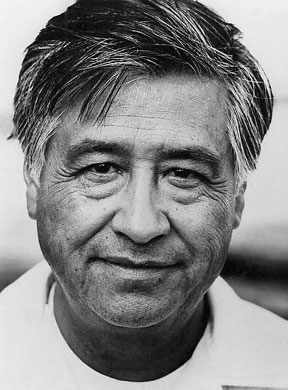
260. Cesar Chávez and Animal Rights


Cesar Chávez
By Don Brook, ZNET (republished by United Farm Workers), May 30, 2007
Cesar Chávez (March 31, 1927 - April 23, 1993) was a great organizer and leader and a powerful advocate for farm workers, people of color, and other poor people (“We are engaged in a struggle for the freedom and dignity which poverty denies us”), as well as for unions (especially the United Farm Workers, which he co-founded with Dolores Huerta, who once quipped that half the leadership was vegetarian), unity, civil rights, environmentalism (indeed, his last public remarks were against toxic chemicals), and non-violence (“Nonviolence is the only way to peace and justice”). Less known though no less important, he was also passionate about animal rights and vegetarianism (“I feel very deeply about vegetarianism and the animal kingdom”).
Indeed, Cesar Chávez recognized that all oppressions are connected and intertwined and he saw these and other social issues and struggles as being intimately related to each other, all of which are necessary for achieving comprehensive rights and complete liberation. Yet, Cesar Chávez’s beliefs in animal rights and his vegetarianism are less-commonly known than his other beliefs and practices, too often excluded from his biographies and celebrations. Although he didn’t focus on the major health and environmental benefits of vegetarianism, Cesar Chávez did discuss poisonous pesticides and viewed animal rights as an integral component in the struggle for universal justice.
In the interest of balance, here is Cesar Chávez, in his own words, on the issues of animal rights, vegetarianism, and their connections to other struggles:
“I became a vegetarian after realizing that animals feel afraid, cold, hungry and unhappy like we do. I feel very deeply about vegetarianism and the animal kingdom. It was my dog Boycott who led me to question the right of humans to eat other sentient beings.” 
“Kindness and compassion towards all living beings is a mark of a civilized society. Racism, economic deprival, dog fighting and cock fighting, bullfighting and rodeos are all cut from the same defective fabric: violence. Only when we have become nonviolent towards all life will we have learned to live well ourselves.” (in a message to Eric Mills of the Action for Animals)
“We need, in a special way, to work twice as hard to help people understand that the animals are fellow creatures, that we must protect them and love them as we love ourselves...We know we cannot be kind to animals until we stop exploiting them – exploiting animals in the name of science, exploiting animals in the name of sport, exploiting animals in the name of fashion, and yes, exploiting animals in the name of food.” (upon acceptance of a Lifetime Achievement Award in 1992 from In Defense of Animals)   

If we truly want to honor the inspirational life of Cesar Chávez, we need to carry on his vital work by continuing to make the linkages amongst various social problems while being active in the struggles to solve them. ¡Sí, se puede!

Dan Brook is a writer, speaker, activist, community mediator, and an instructor of sociology at San Jose State University. He also maintains Eco-Eating at www.brook.com/veg, The Vegetarian Mitzvah at www.brook.com/jveg, No Smoking? at www.brook.com/smoke, and welcomes comments via Brook@california.com. 

Friday, April 1, 2011

259. Alarcon: Obama Should Drop False Charges against the Cuban Five


By Radio Cadena Agramonte, March 31, 2011
Cuban Parliament President Ricardo Alarcon reasserted on Wednesday that US President Barack Obama should drop false charges against the Cuban Five and release them.


During the Round Table aired by Cuban radio and television, Alarcon, also a Politburo member, informed about the procedures currently used in favor of the antiterrorists, imprisoned for over 12 years now for crimes they didn’t commit.


Antonio Guerrero, Gerardo Hernandez, Ramon Labañino, Rene Gonzalez and Fernando Gonzalez were arrested on September 12, 1998, and subjected to a politicized trial in Miami, which concluded in 2001 with unjustified sentences.


In the exercise of their right to defend their homeland, these Cubans reported criminal actions planned by anti-Cuban extremist groups operating in south Florida with Washington’s consent.


Alarcon pointed out that this week he met with former U.S. President James Carter during his stay in Cuba, along with relatives of the Five, with the release of which the visitor agreed, and the outstanding work of later lawyer Leonard Weinglass was recalled.

He referred to the victory won by
Weinglass in his defense of the Five in August 2005, which raised the issue of the unconstitutionality of the trial in Miami due to the interference of the US government and the bias of the press against the defendants in an environment of terrorism and threats.  


Alarcon said that, in accordance with procedures currently in force, documents of collateral appeal were presented in the cases of Antonio Guerrero and Gerardo Hernandez, the only option of a defendant after going through all levels of the U.S. legal system.


The appeal, taking aspects not analyzed during the original trial as a starting point, requests the annulment, proscription or correction of the trials originally carried out against the Five on the basis of manipulation of evidence.


Alarcon added that in 2006 information was known in the United States, according to which the federal government had paid tens of thousands of dollars to the journalists that carried out that illegal campaign.


He specified that the U.S. government excluded an important part of the evidence that could have benefited the defendants —it still hides it— and organized a real media plot against them by way of media outlets in Miami.


In the case of Antonio Guerrero —his original sentence was life imprisonment plus 10 years and that was later on modified to 30 years—, a memorandum requesting the annulment of the trial was presented explaining that, on the occasion of the trial against him, the U.S. government, far from providing all the evidence it had, manipulated and distorted it.


Alarcon cited details on the evidence of malfeasance, which have come to the surface, and pointed out that the memorandum includes names of reporters in charge of distorting facts to influence the public opinion against the Cuban Five, in Miami and abroad, and the amounts of money given to them.


In the case of Gerardo Hernandez, sentenced to two life terms plus 15
years, Alarcon recalled that an affidavit was brought forward on March 16 at the court of Florida’s southern district, in support of the motion requesting to ban, reject or correct the trial and the 28 U.S.C. 2255 sentence in question.


Hernandez offers details on the circumstances that invalidated him to adequately exert his defense in the original trial for charges of conspiracy to commit murder, referred to the incident of 1996 on the shooting down of light aircrafts that violated Cuban airspace.

He underlined that the US government has refused to present the images available, which would show the veracity of the facts pointed out.

Gerardo requests permission to demonstrate the erroneous interpretations made in this regard by the district attorney on the evidence, thus giving the jury the possibility of knowing the truth.


Lastly, Alarcon reiterated that the cause of the Cuban Five, regardless of legal procedures, is won on the streets, as Weinglass used to say, by promoting solidarity with the truth about the case of the Cuban patriots.