Monday, December 13, 2010

127. UN Climate Change Conference in Cancun Concludes

The United Nations Climate Change Conference tool place in Cancun, Mexico, from November 29 to December 10, 2010.  No party expressed high expectations that this conference will lead to any decisions proportionate to the scale of the planetary crisis posed by climate change.  The mainstream media, at least in the U.S., mostly ignored it.  However, the conference organizers managed to put together a number of measure that the representatives from 190 countries voted for.  For the text of these agreement click here. For the main text of agreement click here.  Even the New York Times evaluated the out come as "moderate deal on emissions." It is no secret that the UN scientific committee on climate change has been calling for dramatic lowering of carob dioxide emissions because the warming process can become self-sustaining in short term.  The Cuban delegation warned that "adoption here in Cancun [of] concrete decisions on a second period of commitments of Kyoto."  But Meena Raman of the Malaysia-based Third World Network protesting in Cancun noted: "The mitigation paradigm had changed from one which is legally binding--the Kyoto Protocol with an aggregate target which is system based, science based--to one which is voluntary, a pledge-and-review system."  How was this done? The smaller governments were “bullied, hustled around, lured with petty bribes, called names and coerced into accepting the games of the rich and emerging-rich nations”, says Soumya Dutta of the South Asian Dialogues on Ecological Democracy. “Many debt-ridden small African nations are seeing the money that they might get through the scheming designs of Reduced Emissions from Deforestation and forest Degradation (REDD), and have capitulated under the attack of this REDD brigade. It’s a win-win situation, both for the rich nations, as well as for the rich of the poor nations. The real poor are a burden in any case, to be kept at arms length - if not further.” WikiLeaks just exposed how "diplomatic" relations actually work and the UN climate change meeting in Cancun is no exception.  Climate change policy requires ecocenterism (Earth-centered) policy to drive national priorities, not the interests of corporations, ruling classes, and the elites. 

Below is the statement of the Bolivian delegation that decided to vote against the measures adopted. 

--KN

*     *     *

The Bolivian delegation, Cancun, December 11, 2011

The Plurinational State of Bolivia believes that the Cancun text is a hollow and false victory that was imposed without consensus, and its cost will be measured in human lives. History will judge harshly.

There is only one way to measure the success of a climate agreement, and that is based on whether or not it will effectively reduce emissions to prevent runaway climate change. This text clearly fails, as it could allow global temperatures to increase by more than 4 degrees, a level disastrous for humanity. Recent scientific reports show that 300,000 people already die each year from climate change-related disasters. This text threatens to increase the number of deaths annually to one million. This is something we can never accept.

Last year, everyone recognized that Copenhagen was a failure both in process and substance. Yet this year, a deliberate campaign to lower expectations and desperation for any agreement has led to one that in substance is little more than Copenhagen II.

A so-called victory for multilateralism is really a victory for the rich nations who bullied and cajoled other nations into accepting a deal on their terms. The richest nations offered us nothing new in terms of emission reductions or financing, and instead sought at every stage to backtrack on existing commitments, and include every loophole possible to reduce their obligation to act.

While developing nations - those that face the worst consequences of climate change - pleaded for ambition, we were instead offered the “realism” of empty gestures. Proposals by powerful countries like the US were sacrosanct, while ours were disposable. Compromise was always at the expense of the victims, rather than the culprits of climate change. When Bolivia said we did not agree with the text in the final hours of talks, we were overruled. An accord where only the powerful win is not a negotiation, it is an imposition.

Bolivia came to Cancun with concrete proposals that we believed would bring hope for the future. These proposals were agreed by 35,000 people in an historic World People’s Conference Cochabamba in April 2010. They seek just solutions to the climate crisis and address its root causes. In the year since Copenhagen, they were integrated into the negotiating text of the parties, and yet the Cancun text systematically excludes these voices. Bolivia cannot be convinced to abandon its principles or those of the peoples we represent. We will continue to struggle alongside affected communities worldwide until climate justice is achieved.

Bolivia has participated in these negotiations in good faith and the hope that we could achieve an effective climate deal. We were prepared to compromise on many things, except the lives of our people. Sadly, that is what the world’s richest nations expect us to do. Countries may try to isolate us for our position, but we come here in representation of the peoples and social movements who want real and effective action to protect the future of humanity and Mother Earth. We feel their support as our guide. History will be the judge of what has happened in Cancun.


Other sources:
President Evo Morales' speech at the UN climate change conference
12. "Don't Change the Climate, Change the System"

Saturday, December 11, 2010

126. Cuba to Begin Charging for Some of Its International Medical Care

Latin American School of Medicine
(ELAM), Havana

cubastandard.com, December 7, 20101

As part of an overhaul to make Cuba’s healthcare system more efficient, the government is planning to charge for some of the medical services it provides abroad, AFP first reported.
Only countries that can afford it will have to pay for services, said a Public Health Ministry memo published Sunday on the official Infomed Website.

“The medical services will remain free for poor countries,” says the memo, titled “Transformaciones necesarias en el sistema de Salud Pública.” “But they will be sold to those whose economy allows it, with the goal to reduce our expenses and contribute to the development of the national health system.”

The island exports billions of dollars worth of medical services every year, as Cuban medicine has become a worldwide leader in healthcare services for people in poor and rural areas, as well as in disaster zones. At least 38,000 medical workers from Cuba are currently deployed in 77 countries, most of them in Venezuela. Started in 1998, the Escuela Latinoamericana de Medicina (ELAM) in Havana is currently training 7,200 students from all over the world and graduates some 1,500 doctors per year. Also, Cuba is in charge of a $700 million program to rebuild Haiti’s healthcare infrastructure, and more recently, Cuban doctors have played a central role in combating a cholera outbreak in that country.

In a sign of Cuba’s increasingly pragmatic approach to exporting medical services, the Panamanian foreign minister announced during a visit to Cuba in November that his government will pay for the hands-on specialty training of Panamanian doctors in Cuban hospitals. The Central American country is building a public health infrastructure that includes five hospitals and 22 clinics, which require hundreds of doctors.

While Cuba has not charged recipient countries for medical services, some of the programs it provides in Africa, Asia and Latin America are funded by third countries such as Venezuela, Brazil, South Africa and Norway.

The only exception so far has been Venezuela, which, under a bilateral agreement, is paying at least $5 billion in oil and cash per year for the services of Cuban doctors and for training of Venezuelan and third-country medical students in Cuba. The Cuban contingent has been central to the development of the medical portion of Venezuela’s massive “Barrio Adentro” program.

Venezuela has also funded “Operación Milagro,” a billion-dollar program led by Cuba that has given free eye surgery to hundreds of thousands of low-income Latin Americans. Cuba has provided eye surgery on the island, but it has also built up and staffed Operación Milagro clinics in third countries such as Bolivia and Mexico.
Thanks mainly to cooperation with Venezuela, five years ago the revenues generated by Cuba’s service exports have surpassed those of tourism, nickel and sugar.

Cuba has proposed to the European Union and Canada that its doctors and medical services could be part of triangulated aid service provided in developing countries. So far, no agreement has materialized.

The medical readjustment program is part of broad cost-cutting efforts in the wake of a financial crisis.

Of some 600,000 health workers in Cuba, up to 100,000 are dispensable according to health sources quoted by AFP. Health workers considered dispensable include nurses, technicians and administrators, but not doctors, Health Minister Roberto Morales said in October. Many of these health workers will be transferred to other activities; those who cannot be reassigned will be trained and sent abroad, according to the memo.

Friday, December 10, 2010

125. "Cuba Is Getting Ready for Climate Change; Its Neighbors Not So Much"

By Sheena Gayle, Gleaner, December 10, 2010
While Cuba is prepared for the significant climate change that is set to adversely impact the Caribbean, other countries in the region are said to be lagging behind in their preparation efforts.
Dr Barbara Carby, director of the Disaster Risk Reduction Centre at the University of the West Indies, told a Gleaner Editors' Forum on Comprehensive Disaster Management for the Caribbean that these Caribbean islands need to prepare for the impact of climate change.
Several stakeholders from the Caribbean who attended the fifth annual Caribbean Conference on Disaster Management at the Rose Hall Resortand Spa attended the forum.
"I was in Cuba a few weeks ago and the Cuban national coordinator was able to articulate Cuba's position on climate change: how many communities they are going to have to relocate, the way they are diversifying their agriculture and their irrigation system, etc. They have sat down and come up with their national policy and had cross-sectoral discussions already," Carby said.
She added: "Of the other Caribbean countries I have dealt with, Cuba is the only one that came up with that."
Carby's contribution came against the background of predictions that several of these Caribbean countries are poised to lose some land mass within the next 30 years because of rising sea levels caused by climate change.
"We should start at the policy framework that is going to guide everything else. If we are talking about the tourism sector, then whatever the tourism sector does must fit into the national policy. We can't have everyone doing what they want to do," Carby said.
Major impact
Climate change could impact tourism and major historical infrastructure that are built along the coastline in the region
Meanwhile, executive director at the Office of Disaster Preparedness and Emergency Management (ODPEM), Ronald Jackson, expressed concern about the failure of developed nations to discuss the issue of mass relocation by persons in the Caribbean due to the rising sea levels.
"A decade ago, we were talking about climate change and we weren't taking action then. Now we are still talking about it. I fear that for small islands and developing states, there may be very little action that can be taken. That is out of their control, given the projected sea-level rise," Jackson said.
"Once our land masses begin to disappear, there are decisions we are going to make which may lead to migratory patterns in the Caribbean. Are developed countries prepared to take on that responsibility of Caribbean territories that are not able to adapt due to limited land mass to do so?" Jackson asked.

124. Anthropology a Science? The Experts Disagree

By Nicholas Wade, The New York Times, December 10, 2010


Anthropologists have been thrown into turmoil about the nature and future of their profession after a decision by the American Anthropological Association at its recent annual meeting to strip the word “science” from a statement of its long-range plan.


The decision has reopened a long-simmering tension between researchers in science-based anthropological disciplines — including archaeologists, physical anthropologists and some cultural anthropologists — and members of the profession who study race, ethnicity and gender and see themselves as advocates for native peoples or human rights.


During the last 10 years the two factions have been through a phase of bitter tribal warfare after the more politically active group attacked work on the Yanomamo people of Venezuela and Brazil by Napoleon Chagnon, a science-oriented anthropologist, and James Neel, a medical geneticist who died in 2000. With the wounds of this conflict still fresh, many science-based anthropologists were dismayed to learn last month that the long-range plan of the association would no longer be to advance anthropology as a science but rather to focus on “public understanding.”


Until now, the association’s long-range plan was “to advance anthropology as the science that studies humankind in all its aspects.” The executive board revised this last month to say, “The purposes of the association shall be to advance public understanding of humankind in all its aspects.” This is followed by a list of anthropological subdisciplines that includes political research.


The word “science” has been excised from two other places in the revised statement.


The association’s president, Virginia Dominguez of the University of Illinois, said in an e-mail that the word had been dropped because the board sought to include anthropologists who do not locate their work within the sciences, as well as those who do. She said the new statement could be modified if the board received any good suggestions for doing so.


The new long-range plan differs from the association’s “statement of purpose,” which remains unchanged, Dr. Dominguez said. That statement still describes anthropology as a science.


Peter Peregrine, president of the Society for Anthropological Sciences, an affiliate of the American Anthropological Association, wrote in an e-mail to members that the proposed changes would undermine American anthropology, and he urged members to make their views known.


Dr. Peregrine, who is at Lawrence University in Wisconsin, said in an interview that the dropping of the references to science “just blows the top off” the tensions between the two factions. “Even if the board goes back to the old wording, the cat’s out of the bag and is running around clawing up the furniture,” he said.


He attributed what he viewed as an attack on science to two influences within anthropology. One is that of so-called critical anthropologists, who see anthropology as an arm of colonialism and therefore something that should be done away with. The other is the postmodernist critique of the authority of science. “Much of this is like creationism in that it is based on the rejection of rational argument and thought,” he said.


Dr. Dominguez denied that critical anthropologists or postmodernist thinking had influenced the new statement. She said in an e-mail that she was aware that science-oriented anthropologists had from time to time expressed worry about and disapproval of their nonscientific colleagues. “Marginalization is never a welcome experience,” she said.

Tuesday, December 7, 2010

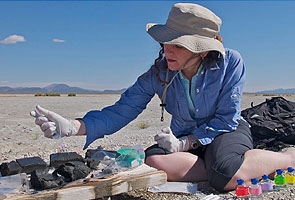
123. Controversy about the Reported Arsenic-Based Bacterium

The article below report critical assessment of the recently reported finding "A Bacterium That Grew by Using Arsenic Instead of Phosphorus."   The controversy is interesting because its subject matter is of central importance to the definition of life.  It is also instructive in terms of how scientists disagree and settle their disagreements.  This in itself is of paramount importance to ecosocialists because the scientific method not only advances scientific knowledge but also influence how scientific opinion is shaped.  Can ecosocialists find similar methods for advancing their agenda and resolve their difference?  


--KN
*     *     *


By Carl Zimmer, Slate, December 7, 2010 


Dr. Felisa Wolfe-Simon
On Thursday, Dec. 2, Rosie Redfield sat down to read a new paper called, "A Bacterium That Can Grow by Using Arsenic Instead of Phosphorus." Despite its innocuous title, the paper had great ambitions. Every living thing that scientists have ever studied uses phosphorus to build the backbone of its DNA. In the new paper, NASA-funded scientists described a microbe that could use arsenic instead. If the authors of the paper were right, we would have to expand our notions of what forms life can take.


Redfield, a microbiology professor at the University of British Columbia, had been hearing rumors about the papers for days beforehand. On Monday, NASA released a Sphinxlike press release: "NASA will hold a news conference at 2 p.m. EST on Thursday, Dec. 2, to discuss an astrobiology finding that will impact the search for evidence of extraterrestrial life." Like a virulent strain of bacteria, speculation exploded over the next three days. "Did NASA Discover Life on One of Saturn's Moons?" asked Gawker, a Web site that does not often ask questions about astrobiology.


The truth was revealed on Thursday. At NASA's press conference, the scientists described their research, which was just then being posted on the Web site of the journal Science. They had not found life on one of Saturn's moons; instead, they had gone to the arsenic-laced waters of Mono Lake in California and isolated a strain of bacteria they dubbed GFAJ-1.
Back at the lab, they grew the bacteria in a broth of nutrients. When they gradually reduced the supply of phosphate (a molecule composed of one phosphorus atom and four oxygen atoms) and replaced it with arsenate (one arsenic and four oxygen atoms), the bacteria still managed to grow. The scientists examined the DNA of these hardy microorganisms and inferred that it contained arsenic.
Advertisement


As soon Redfield started to read the paper, she was shocked. "I was outraged at how bad the science was," she told me.


Redfield blogged a scathing attack on Saturday. Over the weekend, a few other scientists took to the Internet as well. Was this merely a case of a few isolated cranks? To find out, I reached out to a dozen experts on Monday. Almost unanimously, they think the NASA scientists have failed to make their case. "It would be really cool if such a bug existed," said San Diego State University's Forest Rohwer, a microbiologist who looks for new species of bacteria and viruses in coral reefs. But, he added, "none of the arguments are very convincing on their own." That was about as positive as the critics could get. "This paper should not have been published," said Shelley Copley of the University of Colorado.


None of the scientists I spoke to ruled out the possibility that such weird bacteria might exist. Indeed, some of them were co-authors of a 2007 report for the National Academies of Sciences on alien life that called for research into, among other things, arsenic-based biology. But almost to a person, they felt that the NASA team had failed to take some basic precautions to avoid misleading results.


When the NASA scientists took the DNA out of the bacteria, for example, they ought to have taken extra steps to wash away any other kinds of molecules. Without these precautions, arsenic could have simply glommed to the DNA, like gum on a shoe. "It is pretty trivial to do a much better job," said Rohwer.


In fact, says Harvard microbiologist Alex Bradley, the NASA scientists unknowingly demonstrated the flaws in their own experiment. They immersed the DNA in water as they analyzed it, he points out. Arsenic compounds fall apart quickly in water, so if it really was in the microbe's genes, it should have broken into fragments, Bradley wrote Sunday in a guest post on the blog We, Beasties. But the DNA remained in large chunks—presumably because it was made of durable phosphate. Bradley got his Ph.D. under MIT professor Roger Summons, a professor at MIT who co-authored the 2007 weird-life report. Summons backs his former student's critique.


But how could the bacteria be using phosphate when they weren't getting any in the lab? That was the point of the experiment, after all. It turns out the NASA scientists were feeding the bacteria salts which they freely admit were contaminated with a tiny amount of phosphate. It's possible, the critics argue, that the bacteria eked out a living on that scarce supply. As Bradley notes, the Sargasso Sea supports plenty of microbes while containing 300 times less phosphate than was present in the lab cultures.


"Low levels of phosphate in growth media, naive investigators and bad reviewers are the stories here," said Norman Pace of the University of Colorado, a pioneer of identifying exotic microbes by analyzing their DNA, who was another co-author on the weird-life report.
I asked two of the authors of the study if they wanted to respond to the criticism of their paper. Both politely declined by email.


"We cannot indiscriminately wade into a media forum for debate at this time," declared senior author Ronald Oremland of the U.S. Geological Survey. "If we are wrong, then other scientists should be motivated to reproduce our findings. If we are right (and I am strongly convinced that we are) our competitors will agree and help to advance our understanding of this phenomenon. I am eager for them to do so."


"Any discourse will have to be peer-reviewed in the same manner as our paper was, and go through a vetting process so that all discussion is properly moderated," wrote Felisa Wolfe-Simon of the NASA Astrobiology Institute. "The items you are presenting do not represent the proper way to engage in a scientific discourse and we will not respond in this manner."


While Redfield considers Wolfe-Simon's research "flim-flam," she think it's fine for the NASA scientists to hold off responding to their critics. She is working on a formal letter to Science detailing her objections. But Jonathan Eisen of UC-Davis doesn't let the scientists off so easily. "If they say they will not address the responses except in journals, that is absurd," he said. "They carried out science by press release and press conference. Whether they were right or not in their claims, they are now hypocritical if they say that the only response should be in the scientific literature."


Some scientists are left wondering why NASA made such a big deal over a paper with so many flaws. "I suspect that NASA may be so desperate for a positive story that they didn't look for any serious advice from DNA or even microbiology people," says John Roth of UC-Davis. The experience reminded some of another press conference NASA held in 1996. Scientists unveiled a meteorite from Mars in which they said there were microscopic fossils. A number of critics condemned the report (also published in Science) for making claims it couldn't back up. And today many scientists think that all of the alleged signs of life in the rocks could have just as easily been made on a lifeless planet.


The controversy over the Martian meteorite still sputters on today because they contain only a few alleged fossils, rather than living bacteria. There are only a limited number of tests that scientists can run on the rocks, and their results remain murky. Fortunately, that's not the case for GFAJ-1. Critics say that a few straightforward tests on the bacteria would show whether they really do have arsenic-based DNA once and for all. And the NASA scientists say they're ready to hand out GFAJ-1 to researchers who want to study it. This controversy may be burning brightly at the moment, but it probably won't burn for long.

Related post:

116. Newly Discovered Arsenic-Based Bacteria Challenges Genetic Model of Life

122. And Just What Is Socialism?

Armando Hart Dávalos
Ecosocialism builds in part on the theory and history of socialist experiments around the world.  The Cuban revolution is a living part of this tradition.  However as Joseph Hansen noted, the Cuban revolutionary leadership emerged as "revolutionaries of action."  That is, they arrived at the head of a socialist revolution without having theoretically prepared for it.  Ernesto Che Guevara similarly remarked that the Cuban revolutionaries arrived at Marxism through their own struggle.   Thus, the Cuban revolution unfolded from the Cuban and Latin American revolutionary heritage; unlike the revolutionary struggle in Eastern Europe or Asia that was shackled by Stalinism.  


Given this context, Our Place in the World will post writings and speeches by Cuban leaders that deal with their conception of socialism.  The brief article below by Armando Hart Dávalos, the former minster of Cultural and historic leader of the Cuban revolution, appeared in the July issue of Cuba Socialista, the theoretical journal of the Cuban Communist Party.  If my memory serves me right, this article is based on a keynote closing speech Hart gave to the Third International Conference "The Work of Karl Marx and the Challenges of the 21st Century" in Havana in May 2006. 


--KN


*     *     * 


By Armando Hart Dávalos, Cuba Socialista, November, 1o, 2007

Speaking of today’s debate about the content of 21st century’s socialism, it becomes a theoretic as well as a practical necessity the articulation of both Caribbean’s and Latin American’s intellectual tradition, the ALBA, symbol of an alliance between Martí and Bolivar, with the socialist ideology as interpreted by Hugo Chávez and Fidel Castro.

During the 20th century there was such a distortion of Marx’, Engels’ and Lenin’s ideas on what socialism should be about, that today we are strongly urged to go directly to their original writings. Let’s see what Marx and Engels had to say, and also the ideas of Martí and Juárez on this subject.

In the paper “Feuerbach: Opposition of the Materialist and Idealist Outlooks,” Marx and Engels state: “For us, communism is not a condition that must be imposed, an ideal that needs to abide by reality. We call communism the real movement that cancels and surpasses the actual status of things (…).”

Friedrich Engels in a letter to Otto Von Boenigk on August 21, 1890, suggests: “To my mind, the so-called ‘socialist society’ is not anything immutable. Like all other social systems, it should be conceived in a state of constant flux and change. Its crucial difference from the present order consists, naturally, in production being organized on the basis of common ownership by the nation of all means of production.”

In a letter sent by Friedrich Engels to Joseph Bloch in September 1890, Engels poses: “(…) history happens in such a way that the final result derives from conflict between many different individual wills, each of which is what it is by virtue of a number of special conditions in life; they are the innumerable forces that crisscross one another, an infinite group of force parallelograms that add up to one – the historic event – that in itself may be considered the product of a single force that, as a whole, acts without conscience and without will; since what one wants stumbles with the resistance placed by another, the end result becomes something nobody wanted.”

In another letter sent by Engels to Karl Kautsky in September 1892, Engels states: “But as to the social and [political] economic phases these countries – in reference to those we call today underdeveloped countries – will then have to pass through before they likewise arrive at socialist organization, we today can only advance rather idle hypotheses, I think. One thing alone is certain: the victorious proletariat can force no blessings of any kind upon any foreign nation without undermining its own victory by so doing.” 

In his letter to the editors of the Annals, Karl Marx states: “My historical understanding of the origins of capitalism in Western Europe is bent on converting it into a historic and philosophical theory of a general trajectory to which all peoples have been tragically subjected to, whatever the historical circumstances taking place, to be finally expressed in that economic formation that, (…) assures man’s development in each and every aspect. (This is allowing me too great an honor and, at the same time, too much mocking) […]

“Studying separately each of these historical processes and later comparing each to the others, we will easily find the key to explain these phenomena, results that we would never obtain by using the universal key of a general philosophic theory of history that has its major advantage in the fact of its being a supra-historic theory.”

Friedrich Engels writes to Joseph Bloch in September 1890, “…According to the materialist conception of history, the ultimately determining element in history is the production and reproduction of real life. Other than this neither Marx nor I have ever asserted anything else. Hence if somebody twists this into saying that the economic element is the only determining one, he transforms that proposition into a meaningless, abstract, senseless phrase.”

In the first point of the Theses on Feuerbach, Karl Marx states: “The chief defect of all hitherto existing materialism – that of Feuerbach included – is that the thing, reality, sensuousness, is conceived only in the form of the object or of contemplation, but not as sensuous human activity, practice, not subjectively. Hence, in contradistinction to materialism, the active side was developed abstractly by idealism – which, of course, does not know real, sensuous activity as such.”

In a letter to Werner Sombart dated March 11, 1895, Engels writes: “The entire conception of Marx is not a doctrine but a method. It does not offer made dogmas, only starting points for subsequent investigation and the method for such investigation.”

On the same grounds, I elicit from the reader that he/she studies this paragraph from José Martí: “A thing which I must celebrate a lot, it’s the love in which you treat others and your respect as a person, those Cubans that are sincerely searching for, with this or that name, a higher level of cordiality, and an indespensable balance to the administration of all worldy things. An aspiration must be judged by its nobility, and not for this or that wart brought about by human passion. The socialist ideas, like so many others, encounter two dangers: foreign writings – confusing and incomplete – and that of pride and concealed rage of ambitious people, that they use to elevate themselves in the world and which start with pretense, so that they may find shoulders to climb, from where they can show themselves to be frenetic defenders of the helpless.”

Later on Martí adds: “But with our people it isn’t so much the risk, as it is in societies more enraged, and of a lesser natural clarity; our task will be to explain, flat and deep, as you will do it – the idea is not to compromise sublime justice on the way or in the excesiveness in which we ask for it. And always with justice, you and I, because errors by which it is being carried give no authority to those of good upbringing from deserting when called for its defense.”

Also to be studied is the following paragraph from Karl Marx to be compared with one by Benito Juárez that is given afterwards. Marx says in the Critique of the Gotha Program written in late April, early May 1875: “In a higher phase of communist society, after the enslaving subordination of the individual to the division of labor, and therewith also the antithesis between mental and physical labor, has vanished; after labor has become not only a means of life but life's prime want; after the productive forces have also increased with the all-around development of the individual, and all the springs of co-operative wealth flow more abundantly – only then can the narrow horizon of bourgeois right be crossed in its entirety and society inscribe on its banners: From each according to his ability, to each according to his needs!”

Fourteen years before, on January 11, 1861, Benito Juárez wrote something which was later discovered by historians that stated:

”To each according to his ability and to each ability according to deeds and education. That way there will be neither privileged classes nor unjust preferences (…)”

“Socialism is the natural tendency to better the condition or the free development of both physical and moral competences.”

As underlined before, Engels expressed that Marxism is a method for investigation and study, and Lenin, in his own right, declared that it was a guide for action. Using both method and guide we can tackle the concrete problems of our time, while also heeding the warning that there is no general formula that can be applied to all situations and all nations. It is up to us, starting with the concrete development of our societies, and the intellectual tradition and politics of our region, to find creative ways and paths, and the optimal form to channel that true socialism of the 21st century, the one aspired by our nations.

Any analysis we carry out must start from our history and the links established during the centuries between the Latin American and Caribbean nations which make our region the one with the loftiest calling towards integration given our impressive spiritual [cultural] heritage.

In the 21st century we should find inspiration in the enlightened ideas of Marx, Engels and Lenin as expressed in the original writings, and relate them to whatever is found to have validity with those ideas of Bolivar, Martí and other past illustrious leaders and thinkers of our America.