Sunday, June 13, 2010

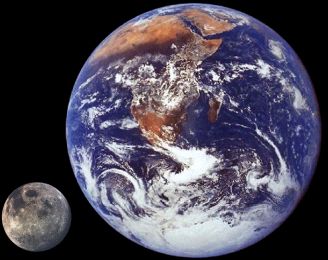
52. Earth and Moon Perhaps Formed Later than Previously Thought


ScienceDaily (June 7, 2010) — Astronomers have theorized that the planet Earth and the Moon were created as the result of a giant collision between two planets the size of Mars and Venus. Until now, the collision was thought to have happened when the solar system was 30 million years old, or approximately 4,537 million years ago. But new research shows that Earth and the Moon must have formed much later -- perhaps up to 150 million years after the formation of the solar system.


The research results have been published in the scientific journal Earth and Planetary Science Letters.


"We have determined the ages of the Earth and the Moon using tungsten isotopes, which can reveal whether the iron cores and their stone surfaces have been mixed together during the collision," explains Tais W. Dahl, who did the research as his thesis project in geophysics at the Niels Bohr Institute at the University of Copenhagen in collaboration with professor David J. Stevenson from the California Institute of Technology (Caltech).

Turbulent collisions

The planets in the solar system are thought to have been created by collisions between small dwarf planets orbiting the newborn Sun. In the collisions, the small planets melted together and formed larger and larger planets. Earth and the Moon are believed to be the result of a gigantic collision between two planets the size of Mars and Venus. The two planets collided at a time when both had a core of metal (iron) and a surrounding mantle of silicates (rock). But when did it happen and how did it happen? The collision took place in less than 24 hours and the temperature of the Earth was so high (7000ยบ C), that both rock and metal must have melted in the turbulent collision. But were the stone mass and iron mass also mixed together?

Until recently it was believed that the rock and iron mixed completely during the planet formation and so the conclusion was that the Moon was formed when the solar system was 30 million years old or approximately 4,537 million years ago. But new research shows something completely different.

Dating with radioactive elements

The age of Earth and the Moon can be dated by examining the presence of certain elements in Earth's mantle. Hafnium-182 is a radioactive substance, which decays and is converted into the isotope tungsten-182. The two elements have markedly different chemical properties and while the tungsten isotopes prefer to bond with metal, hafnium prefers to bond to silicates, i.e. rock.


It takes 50-60 million years for all hafnium to decay and be converted into tungsten, and during the Moon forming collision nearly all the metal sank into Earth's core. But did all the tungsten go into the core?


"We have studied to what degree metal and rock mix together during the planet forming collisions. Using dynamic model calculations of the turbulent mixing of the liquid rock and iron masses we have found that tungsten isotopes from the Earth's early formation remain in the rocky mantle," explains Dahl.

The new studies imply that the moon forming collision occurred after all of the hafnium had decayed completely into tungsten.
"Our results show that metal core and rock are unable to emulsify in these collisions between planets that are greater than 10 kilometres in diameter and therefore that most of the Earth's iron core (80-99 %) did not remove tungsten from the rocky material in the mantle during formation," explains Dahl.

The result of the research means that Earth and the Moon must have been formed much later than previously thought -- that is to say not 30 million years after the formation of the solar system 4,567 million years ago but perhaps up to 150 million years after the formation of the solar system.

Saturday, June 12, 2010

51.Cuban Dissidents Cheer Bill to End U.S. Travel Ban

For the past 48 year, the U.S. government has denied the constitutional right of the American people to freely travel to Cuba.  While it is not formally a travel ban,  Americans are barred from spending money in Cuba unless the government (Office of Foreign Assets Control of the Department of Treasury) approves of their travel plan.  In effect, a small number of Americans each year receive OFAC approval to visit Cuba.  The large majority of non-Cuban Americans have to visit the island risking government harassment (currently, Cuban Americans are exempted from the travel ban).   The central argument presented for this restrictive policy is that the monies spend by U.S. visitors will aid "the communist enemy" that denies human rights to its people. So, it is highly interesting that 74 Cuban dissidents signed a letter that cheers a bill in U.S. Congress that will let Americans to visit Cuba freely and to expand U.S. food exports to the island.  KN

*     *     *
By WILL WEISSERT (AP, June 10, 2010) 

HAVANA — Seventy-four Cuban opposition activists — including the island's best-known blogger and a hunger striker who has garnered worldwide attention — signed a letter Thursday cheering proposed legislation that would lift the U.S. travel ban to their country.
The a statement addressed to the U.S. Congress supports a bill to let Americans visit Cuba freely and expand U.S. food exports to the island.
"We share the opinion that the isolation of the people of Cuba benefits the most inflexible interests of its government, while any opening serves to inform and empower the Cuban people and helps to further strengthen our civil society," the letter said.
It was released by the Center for Democracy in the Americas, a Washington-based group that advocates freer travel and trade with Cuba.
Signers include blogger Yoani Sanchez and hunger striker Guillermo Farinas, as well as Elizardo Sanchez, head of Cuba's most prominent human rights group.
It applauds a proposal introduced on Feb. 23 by Rep. Collin Peterson, a Minnesota Democrat, that would bar the president from prohibiting travel to Cuba or blocking transactions required to make such trips. It also would bar the White House from stopping direct transfers between U.S. and Cuban banks. That would make it easier for the island's government to pay for U.S. exports.
While travel to Cuba is technically not illegal, U.S. law bars most Americans from spending money here. Cuban-Americans, journalists, politicians and a few others can visit with special permission from the U.S. government. Washington's 48-year-old embargo chokes off nearly all trade between the U.S. and Cuba — though cash-up-front sale of U.S. food and farm products to the island has been allowed for the past decade.
Peterson's bill must pass the House Committee on Agriculture before it can go to a vote by the full House.
A string of similar measures to expand travel to and trade with Cuba have died without reaching a full vote by either the House or Senate in recent years, but it is unusual for so many prominent Cuban dissidents to join in supporting a single piece of U.S. legislation.
Cuba's government offered no comment. It routinely dismisses activists who criticize the country's single-party government as paid agents of Washington out to undermine the communist system.
Sanchez's blog, "Generacion Y," uses caustic, often witty posts to describe life in Cuba. In November, President Barack Obama took the unusual step of providing written answers to questions she submitted to the White House.
Farinas stopped eating and drinking after the death of jailed hunger striker Orlando Zapata Tamayo on Feb. 23. He is not imprisoned but has received nutrients since then through a tube at his home in central Cuba.
Other signers included Miriam Leiva, a founding member of the Damas de Blanco, or Ladies in White, a support group for wives and mothers of 75 opposition activists jailed during a government crackdown on organized dissent in March 2003. Her husband, dissident economist Oscar Espinosa Chepe, also signed the letter, as did Juan Juan Almeida Garcia, whose father fought alongside Fidel Castro during Cuba's 1959 revolution and rose to the rank of vice president before his death last year.

Sunday, June 6, 2010

50. A New, Superior Method of Calculating Greenhouse Gas Value of Ecosystems


ScienceDaily (May 26, 2010) — Researchers at the University of Illinois have developed a new, more accurate method of calculating the change in greenhouse gas emissions that results from changes in land use. 

The new approach, described in the journal Global Change Biology, takes into account many factors not included in previous methods, the researchers report.
There is an urgent need to accurately assess whether particular land-use projects will increase or decrease greenhouse gas emissions, said Kristina Anderson-Teixeira, a postdoctoral researcher in the Energy Biosciences Institute at Illinois and lead author of the new study. The greenhouse gas value (GHGV) of a particular site depends on qualities such as the number and size of plants; the ecosystem's ability to take up or release greenhouse gases over time; and its vulnerability to natural disturbances, such as fire or hurricane damage, she said.
Greenhouse gases trap heat in the atmosphere and contribute to climate change. The most problematic greenhouse gases include carbon dioxide (CO2); methane (CH4), which is about 25 times more effective than CO2 at trapping heat but persists in the atmosphere for much less time; and nitrous oxide (N2O), an undesirable byproduct of crop fertilization.
The new approach accounts for emissions of each of these gases, expressing their net climatic effect in "carbon-dioxide equivalents," a common currency in the carbon-trading market. This allows scientists to compare the long-term effects of clearing a forest, for example, to the costs of other greenhouse gas emissions, such as those that result from burning fossil fuels for transportation, electricity, heat or the production of biofuels.
At first glance, biofuels appear carbon-neutral because the plants absorb carbon dioxide from the atmosphere and store the carbon in their tissues as they grow, said plant biology and Energy Biosciences Institute professor Evan DeLucia, who co-wrote the paper. That carbon is released when the plants are used as fuels. These emissions are balanced by the uptake of CO2, so -- in theory, at least -- no new carbon is added to the atmosphere, he said.
But the full impact of a new biofuel crop should account for all of the greenhouse gases absorbed and released in the process of introducing new crops, he said.
Researchers and policymakers are already in the habit of conducting "life-cycle" analyses of biofuel crops, taking into account many of the greenhouse gas effects of growing the crops and producing the fuel, such as the combustion of fuel in farm equipment, emissions from the processing plant, and emissions from associated land-use changes.
But current methods of estimating the greenhouse gas value of ecosystems -- whether for biofuels life-cycle analyses or other purposes -- often get it wrong, Anderson-Teixeira said. When considering the cost of replacing a tropical forest with cropland, for example, some may look only at the amount of carbon stored in the trees as a measure of a forest's GHGV.
"What some analyses miss is the potential for that forest to take up more carbon in the future," she said. "And they're missing the greenhouse gas costs -- the added emissions that result from intensively managing the land -- that are associated with that new cropland."
Current approaches also routinely fail to consider the timing of greenhouse gas releases, DeLucia said.
"If you cut down a forest, all that carbon doesn't go up into the atmosphere instantly," he said. "Some of it is released immediately, but the organic matter in roots and soils decays more slowly. How we deal with the timing of those emissions influences how we perceive an ecosystem's value."
Using the new method, the researchers calculated the GHGV of a variety of ecosystem types, including mature and "re-growing" tropical, temperate and boreal forests; tropical and temperate pastures and cropland; wetlands; tropical savannas; temperate shrublands and grasslands; tundra; and deserts.
"In general, unmanaged ecosystems -- those that we are leaving alone, such as a virgin forest or an abandoned farm where trees are re-growing -- are going to have positive greenhouse gas values," Anderson-Teixeira said. Managed ecosystems such as croplands or pastures generally have low or negative greenhouse gas values, she said. (See chart.)
The calculations would of course vary as a result of local conditions, the researchers said, and the GHGV does not account for the other services a particular ecosystem might provide, such as flood control, improved air and water quality, food production or protection of biodiversity.
"To understand the place of nature these days, we've got to put a value on it," DeLucia said. "It's got to compete with all the other values that we put out there. This is by far the most comprehensive way to value an ecosystem in the context of greenhouse gases."
The Energy Biosciences Institute, focused on the development of next-generation biofuels as well as various applications of biology to the energy sector, is a collaboration among the U. of I., the University of California at Berkeley, the Lawrence Berkeley National Laboratory, and BP, which is supporting the institute with a 10-year, $500-million grant. The EBI has facilities at several locations, including the U. of I. Institute for Genomic Biology.

Tuesday, June 1, 2010

49. On the British Petroleum's Ecological Disaster in the Gulf of Mexico


We just learned that the British Petroleum’s oil spill in the Gulf of Mexico that began on April 20 may continue “through August.” Simultaneously, Carol Browner, President Obama’s climate change and energy policy advisor, claimed without any sense of irony that: “We re prepared for the worse.  We have been prepared from the beginning.” 

Nothing is further from the truth.  Mr. Obama addressed the BP disaster 38 days after it began. And only in calculated public relations response to give the appearance that the government cares and acts to protect public interest in the face of the worse oil spill in the U.S. history.

Facts of the case known so far reveal the following truth: the U.S. government serves corporate interests, in this case the interests of BP (the second largest European oil and gas company). 

For decades, the U.S. government has granted the oil and natural gas industry’s every wish. In particular, it has allowed it “to police itself” (a very curious concept).  For years, the Minerals Management Service (MMS), the arm of the Interior Department that oversees drilling in the gulf, has minimized the environmental risks of drilling. In the BP case, it failed to require a backup shutdown system that is standard in much of the rest of the world, even though its own staff declared such a system necessary. It exempted many offshore drillers from the requirement that they file plans to deal with major oil spills. And it specifically allowed BP to drill Deepwater Horizon without a detailed environmental analysis.
Given this cozy relationship, rampant corruption in the MMS should not come as a surprise. According to reports by Department of Interior’s inspector general, abuses at the agency went beyond undue influence: there was “a culture of substance abuse and promiscuity” — cocaine, sexual relationships with industry representatives, and more. Protecting the environment was presumably the last thing on these government employees’ minds. During the month following the April 20 rig blow up, MMS gave 23 new permits for drilling in the Gulf of Mexico.  This proved to be too much.  MMS Director Elizabeth Birnbaum and several key employees of the MMS resigned or were fired (without a public explanation).
It is estimated that 12,000 to 25,000 barrels of oil spills into the Gulf each day.  At this rate, total spill has already surpassed what was spilled into the ocean by Exxon Valdez tanker in 1989.  Yet, so far the government has stood aside leaving to BP the task of stopping the leakage and clean up.  For its part, BP has kept the public and even the government in the dark about the critical decisions and actions it has taken both before and after the spill.  The public does not know exactly how and why the rig exploded and what role BP management decisions played in the series of events leading to it.  In its efforts to stop the leakage, BP has been less than forthcoming with the public and the government. For example, many scientists and environmentalists, and the government asked BP not to use chemical dispersants Corexit EC9500A and Corexit EC9527A as they are deemed highly toxic to marine life. Yet BP claimed these chemicals to be safe and continued to use them. So, it is entirely disingenuous of the President or his advisor Ms. Browner to claim that the government is and has been prepared to deal with this disaster in the interest of protecting public interest and nature's ecological balance.  In the final analysis,  it is the oil and natural gas industry that derives the U.S. government policies and not the other way around.  


And the industry knows this well.  In a letter published in the New York Times on May 29, Erik Milito of American Petroleum Institute, an oil and gas industry organization, reminds the readers that
“Access to affordable energy affects every sector of our economy, every state and every American family.  Furthermore, oil and natural gas are key ingredients in manufacturing of thousands of products…that Americans use daily. 
“Halting domestic development won’t reduce our need for oil and natural gas; it will only outsource it. And it will place thousands of jobs, both offshore and on-shore, at risk…
“Our industry is not waiting for any commission to initiate improvements in safety and environmental performance. We’ve already brought together the sharpest minds in the business to advise the Interior Department on how drilling can be made safer and more effective…” 
The industry knows from historical experience that after the dust is cleared everything goes back to business as usual as it did in the case of Exxon Valdes.  It is instructive to recall that Exxon, despite of spending two billion dollars did not retrieve more than 14% of the oil spilled in the 1989 leakage.  There is no reason to hope that BP will do any better (don't be fooled by promises of "new technology." Was it not such promises are used to drill in ever more dangerous places?).
Of course, the dominance of the oil and natural gas industry in public policy is not limited to this industry. In the past two years, we have witnessed the use of taxpayers money for the multi-trillion dollar bailout of the financial industry and the bailout of GM and Chrysler.  In each case, we have been told that the American pubic cannot afford letting these corporations fail!  In the health care reform debate, we witnessed how the health insurance and pharmaceutical industries and other corporate and financial interets were able to block any reform that would consider health care as human rights, not a arena to make a profit. Just before the BP rig blow out, Obama administration broke a 30 year policy of not opening up new off-shore sites for drilling and budgeted billions for financing for new nuclear power plants.
It is a simple fact that capitalism is the rule of capital and a socioeconomic system in which making profits comes before human's or nature's needs.  It is also a simple fact that, in the final analysis, in any capitalist system the government is nothing more than the executive committee of capitalist ruling class.  These are essential truths that should frame crafting policies to protect the public and the ecological and environmental systems we depend on for our lives.  However, this very basic fact is totally lost to the U.S. environmental establishment that has a cozy relationship with "its" corporate and government “partners.”  


So far,  U.S. and international socialist movements have also defaulted in their responsibility to provide broad response to defend nature and society against their capitalist enemies (Make no mistake, this not an "American" disaster but an ecological disaster of vast proportions. Already eastern U.S. seaboard and Caribbean nations such as Cuba and Bahamas are threatened).  This is because environmental concerns are not seen as part of “working class interests,” or if they are, they are seen as such because they threaten the livelihood of working people.  Nature and other species are treated as if they are "resources" without any rights of their own.  But we humans are merely a small part of the magnificent web of life on Earth. Without a living planet there can be no human society.  And a living planet can only be defended against capitalist and industrial society if we can envision an ecosocailist future in which we live not in constant struggle to dominate nature but to learn to live in harmony with it.  

48. Cuban Communist Party Paper Opens a Debate on the Economy


BY JUAN O. TAMAYO

JTAMAYO@ELNUEVOHERALD.COM

Many Cubans regard the Granma newspaper as a supremely boring propaganda vehicle worthy of its status as the ``Official Organ of the Central Committee of the Cuban Communist Party.''
Yet in recent months Granma has published a jarringly lively and often critical set of letters to the editor on how to fix an economy ravaged by decades of over-centralization, inefficiency and corruption.
``Let us all . . . push for new mechanisms, structures or whatever one wants to call them. But let's do it without delay because tomorrow, tomorrow could be too late,'' wrote J. Rodrรญguez Pรฉrez.
But a shift toward capitalism, J.L. Marichal Castillo warned in another letter, ``would no doubt generate another Revolution . . . but this time instead of 20,000 dead it would cost hundreds of thousands.''
Raรบl Castro opened the doors to the polemic when he called for a frank debate of the shortcomings of Cuba's economy -- 95 percent controlled by the government -- after replacing his ailing brother Fidel, who disappeared from public view in 2006.
Academics, artists and others joined in with gusto, writing columns that ranged from calls to ``democratize socialism'' to attacks on ``neo-stalinism.'' But the columns mostly appeared in specialized journals or web pages where few average Cubans could read them.
Granma is Cuba's largest newspaper, however, with a circulation estimated at 400,000, and the two pages it has devoted every Friday to letters to the editor since March 2008 have drawn much attention.
Initially, most of the letters printed focused on mundane issues such as gripes against neighbors' loud music, a shortage of sanitary napkins and unruly pets.
But more recently they have focused on the market incentives -- some call it ``privatization'' -- being considered as a fix for Cuba's economy. They include turning over 30,000 state-run retail shops like bakeries and cafeterias to employees or workers' cooperatives.
``To fail to recognize that we're in a critical situation is to stick our heads in the sand. To . . . move toward fully capitalist formulas is to betray a homeland that has cost so much blood, sweat and tears,'' wrote Marichal Castillo.
``We cannot conceive of cooperatives, associations or whatever they are called, without rules that can swiftly `take out of circulation' those who [engage in] unlawful or disproportionate enrichment or any other negative social manifestation,'' he added.
A.J. Fernandez Alonso wrote that while he favored turning over the small shops to employees, ``many people, with complete justification, are terrified to say the word `privatization.' And the fear of someone getting rich is latent.''
But most of the opinions have favored the ``privatization'' -- some with daringly direct language -- although many of the writers tack on seemingly obligatory language saying that they want to preserve Cuba's ``socialist system.''
``Competition and privatization, which so many criticize and fear, are an engine driving good-quality services,'' wrote J.R. Cepero Donates. ``If my service is not good, I simply do not have a clientele, I do not sell, and therefore, I do not earn the necessary income to make my business profitable.''
``We must, without deviating from the socialist path, change everything that needs to be changed in our economic reality,'' added Cepero, a University of Havana student.
J. Miguel Valdรฉs, a student at a Havana technical university, wrote that all socialist systems ``must be dialectic and adapt to new conditions in order to survive. It's useless to hold on to systems that perhaps worked in past times, if they are inefficient today.''
``I reaffirm again the urgency of adopting measures to prolong our socialism and the conquests that have cost the people so much to achieve,'' he added.
Stronger still was J. Rodrรญguez Pรฉrez, whose May 7 letter described the two sides of the argument on economic reforms.
``On one side, recalcitrant defenders of a socialism that is dogmatic, pure and hard, state-run, unmovable and with a lot of rhetoric . . . pretty far from our daily reality. In sum, a socialism incapable of recognizing that times have changed,'' he wrote.
``On the other, defenders . . . of a socialism that is dynamic, changing, evolving like life itself . . . who tend to search for new forms and methods, always within socialism, for [fixing] our old deficiencies.''
But it was A. Rรญos Hernรกndez, who wrote one of the most scathing letters to editors.
``I oppose those who defend . . . the production and organizational schemes that have exhausted their role in history. For example, those who believe that all [small shops] must be maintained at all costs because that's socialism,'' he wrote. ``Lies. Socialism is the [state] control over the means of production, but not all, only the main ones, those that really define the economy of a country.''
``I disagree with those who believe socialism will collapse just because a group of bricklayers form a cooperative to build a house, or a plumber fixes a plugged drain or a mechanic fixes a car,'' he added.
``I disagree with those who believe that . . . any change will result in [socialism's] destruction,,'' he added. ``It's the other way: The socialism that does not change, that does not adapt to new situations, is condemned to failure. Remember the socialism of [eastern] Europe.''

Read more: http://www.miamiherald.com/2010/05/31/v-fullstory/1657514/cubas-largest-newspaper-publishes.html#ixzz0pcJRsVoA

Friday, May 28, 2010

47. Obama's Copenhagen Accord Misses the Promised 2 Degree Celsius Climate Target


April 22, 2010 - The current national emissions-reduction pledges accompanying the Copenhagen Accord will not limit global warming to two degrees Celsius. In fact, they imply a global mean temperature increase of more than three degrees Celsius this century. This is reported by a team of researchers led by Joeri Rogelj and Malte Meinshausen of the Potsdam Institute for Climate Impact Research in the current edition of the journal “Nature”.
“It is amazing how unambitious these pledges are,” the researchers remark in the opinion piece. The Copenhagen Accord has a stated aim of keeping global warming to below two degrees Celsius. However, according to countries’ stated ambitions for reducing emissions, global yearly emissions of greenhouse gases will increase by 10 to 20 percent above current levels and reach amounts equivalent to 47.9 to 53.6 gigatonnes of carbon dioxide (GtCO2-eq) by 2020. This would result in a greater than fifty percent chance that warming will exceed three degrees Celsius by 2100, the authors calculated. To be on track for meeting the “below 2° C” climate target, global emissions of no more than 40 to 44 GtCO2-eq have to be achieved by 2020.
Many countries have indicated that working towards the stronger end of their pledged ranges is conditional on a global agreement that doesn’t currently exist. The less ambitious ends of these targets are thus more likely to reflect the real outcome of the Copenhagen Accord, the authors point out. “In the worst case, we could end up with emissions allowances exceeding the business-as-usual projections,” says Joeri Rogelj.
In their analysis, the researchers take into account so-called loopholes, most notably surplus allowances. If a country reduces its emissions more than its target stated in the Kyoto protocol, it can use these surplus allowances later. “Under the Kyoto Protocol, some countries’ targets were so weak that large amounts of surplus allowances have been and will be generated over the 2008 to 2012 period, even without any environmental policy effort,” the authors state. They estimate that this adds up to 11 GtCO2-eq. “Because anything profitable is likely to be pursued,” the authors assume that countries will increasingly make use of surplus allowances from now until 2020.
The researchers compiled national emissions estimates from the pledges submitted to the Copenhagen Accord and, for countries that didn’t submit targets, from previous announcements. For the remaining countries that have not made any announcements they assumed a business-as-usual growth scenario. They ran these numbers through a coupled carbon cycle climate model, finding that temperatures would even exceed three degrees Celsius warming by 2100. “48 GtCO2 emissions by 2020 is not on track to meet the 2° C goal – it is like racing towards a cliff and hoping to stop just before it,” says Malte Meinshausen, who recently lead-authored an article in “Nature” on the global total emissions budget that remained to respect the 2° C climate target (see related press release).
As of 13 April, 76 countries, accounting for about 80 percent of global emissions, have submitted pledges to limit their emissions of greenhouse gases by 2020. Japan and Norway are the only two developed countries to make pledges in line with the 2° C limit, the researchers report (seewww.climateactiontracker.org). The United States provided a 2020 target of 17 percent below 2005 levels, equivalent to just 3 percent below 1990 levels, while 25 to 40 percent in total would be required for developed countries as a whole. The less ambitious end of China’s target to lower its CO2 emissions per unit of gross domestic product by 40 percent compared to 2005 corresponds to business-as-usual development. The European Union offered a range of 20 to 30 percent cuts. Reducing emissions by 20 percent would lead to smaller annual reductions from now to 2020 than have been accomplished on average over the past 30 years.
The analysis is a collaboration of researchers at PIK, Ecofys (www.ecofys.com) and Climate Analytics (www.climateanalytics.org).
Article: Rogelj, J. et al. (2010). Copenhagen Accord pledges are paltry. Nature 464, 1126–1128, DOI: 10.1038/4641126a

Monday, May 24, 2010

46. Chris Jordan: An American Self-Portrait (Photographic Waste Art)

There are many sources of information about the wastefulness and hazardous way of American consumer culture bred and fed by unbridled capitalism.  Here is a visual artistic account by photographer Chris Jordan that focuses on a few of these products very effectively.