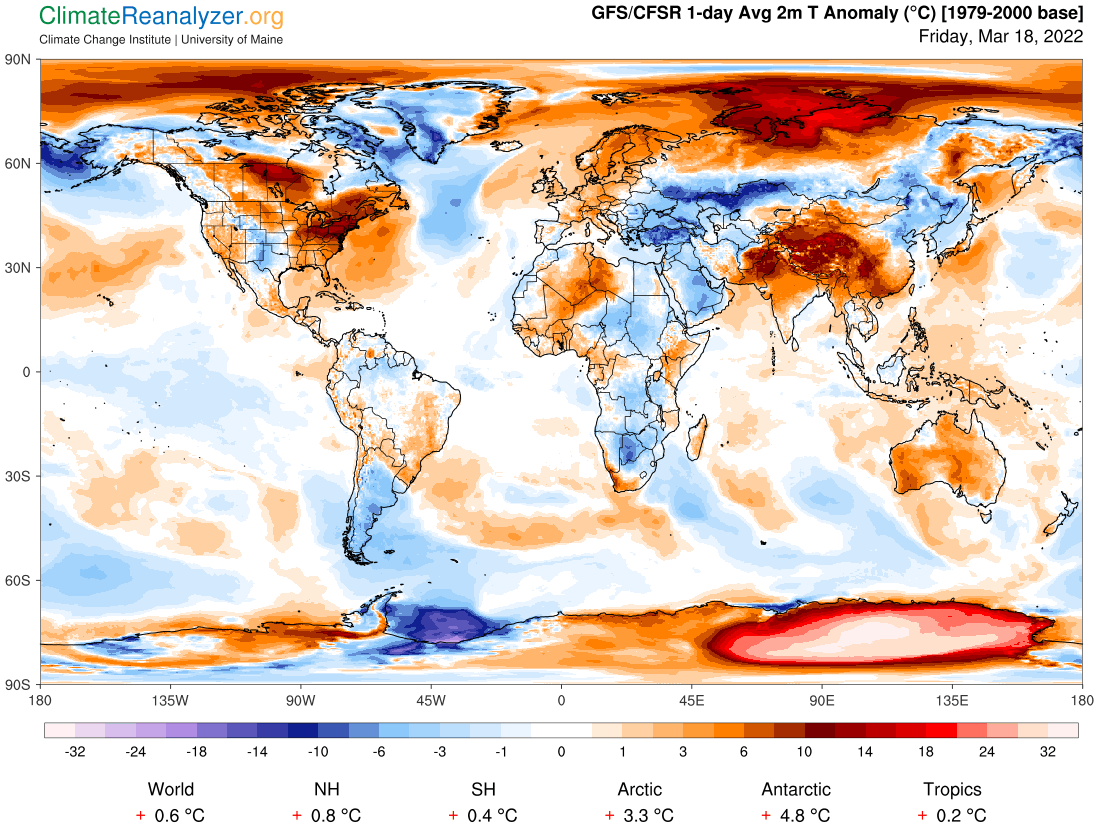
Eastern Antarctica on Friday recorded temperatures that are 70 degrees higher than normal for this time of the year,The Washington Post reported.
Temperatures in the eastern part of the continent have soared 50 to 90 degrees above normal, raising concern from the scientific community.
The Post reported that instead of temperatures being between minus 50 and minus 60 degrees Fahrenheit, they’ve been closer to zero or 10 degrees Fahrenheit, which is considered to be a massive heat wave by Antarctic standards.
According to a popular weather twitter account Extreme Temps, "extraordinary anomalies in Antarctica" have lead to historic records on Friday.
"In about 65 record years in Vostok, between March and October, values above -30°C were never observed," climate journalist Stefano Di Battista told the news outlet in an email.
A researcher studying polar meteorology at the Université Grenoble Alpes Dr. Jonathan Wille also tweeted that this heatwave was "never supposed to happen."
Eastern Antarctica on Friday recorded temperatures that are 70 degrees higher than normal for this time of the year, The Washington Post reported.
Temperatures in the eastern part of the continent have soared 50 to 90 degrees above normal, raising concern from the scientific community.
The Post reported that instead of temperatures being between minus 50 and minus 60 degrees Fahrenheit, they’ve been closer to zero or 10 degrees Fahrenheit, which is considered to be a massive heat wave by Antarctic standards.
According to a popular weather twitter account Extreme Temps, "extraordinary anomalies in Antarctica" have lead to historic records on Friday.
"In about 65 record years in Vostok, between March and October, values above -30°C were never observed," climate journalist Stefano Di Battista told the news outlet in an email.
A researcher studying polar meteorology at the Université Grenoble Alpes Dr. Jonathan Wille also tweeted that this heatwave was "never supposed to happen."
March marks the beginning of autumn in Antarctica, when temperatures usually tend to fall, The Post noted.
As soon as Edward Holmes saw the dark-ringed eyes of the raccoon dogs staring at him through the bars of the iron cage, he knew he had to capture the moment.
It was October 2014. Dr. Holmes, a biologist at the University of Sydney, had come to China to survey hundreds of species of animals, looking for new types of viruses.
On a visit to Wuhan, a commercial center of 11 million people, scientists from the city’s Center for Disease Control and Prevention brought him to Huanan Seafood Wholesale Market. In stall after stall of the poorly ventilated space, he saw live wild animals — snakes, badgers, muskrats, birds — being sold for food. But it was the raccoon dogs that made him pull out his iPhone.
As one of the world’s experts on virus evolution, Dr. Holmes had an intimate understanding of how viruses can jump from one species to another — sometimes with deadly consequences. The SARS outbreak of 2002 was caused by a bat coronavirus in China that infected some kind of wild mammal before infecting humans. Among the top suspects for that intermediate animal: the fluffy raccoon dog.
“You could not get a better textbook example of disease emergence waiting to happen,” Dr. Holmes, 57, said in an interview.
The tall, bald Englishman did his best not to draw attention to himself as he snapped a picture of the raccoon dogs, which look like long-legged raccoons but are more closely related to foxes. He then took a few more pictures of other animals in cages of their own. As a vendor began clubbing one of the creatures, Dr. Holmes pocketed his phone and slipped away.
The photos faded from his mind until the last day of 2019. As Dr. Holmes was browsing Twitter from his Sydney home, he learned of an alarming outbreak in Wuhan — a SARS-like pneumonia with early cases linked to the Huanan market. The raccoon dogs, he thought.
“It was a pandemic waiting to happen, and then it bloody well happened,” he said.
From that day on, Dr. Holmes was swept into a vortex of discoveries and controversies related to the origins of the virus — making him feel like “the Forrest Gump of Covid,” he joked. He and a Chinese colleague were the first to share the genome of the new coronavirus with the world. He then discovered crucial clues about how the pathogen most likely evolved from bat coronaviruses.
And in the contentious geopolitical debate over whether the virus may have leaked from a Wuhan laboratory, Dr. Holmes has become one of the strongest proponents of an opposing theory: that the virus spilled over from a wild animal. With colleagues in the United States, he recently published tantalizing clues that raccoon dogs kept in the very iron cage he photographed in 2014 could have set off the pandemic.
Dr. Holmes’s Covid research has won him international acclaim, including Australia’s top science prize. But it has also garnered claims that his research had been overseen by the Chinese military, along with a flood of attacks on social media and even death threats.
Through it all, Dr. Holmes has continued to publish a torrent of studies on Covid. Longtime colleagues attribute his steady output through unsteady times to an exceptional knack for building big scientific teams, and a willingness to dive into controversial debates if he thinks they are important.
“He’s the right kind of person with the right kind of mind-set, because of the fact that he can be open-minded and engaged and thoughtful, and not become defensive,” said Pardis Sabeti, a geneticist at the Broad Institute of M.I.T. and Harvard who worked with Dr. Holmes on Ebola.
Hunting for Viruses
Growing up in western England, a young Edward Holmes had a biology teacher who put a poster of an orangutan on the wall that read, “I’m not your cousin.”
The teacher told the class not to read the garbage in their textbook about evolution. That made the 14-year-old eager to dive in.
He went on to study the evolution of apes and humans, and then turned to viruses. Over three decades — working in Edinburgh, Oxford, Pennsylvania and finally Sydney — Dr. Holmes has published more than 600 papers on the evolution of viruses including H.I.V., influenza and Ebola.
When he was invited to come to the University of Sydney, in 2012, he seized the chance to move closer to Asia, where he feared that the wildlife trade could set off a new pandemic.
“He goes where the fire is,” said Andrew Read, an evolutionary biologist at Penn State University, who worked with Dr. Holmes at the time.
As he was preparing for the move, Dr. Holmes got an email out of the blue from a Chinese virologist named Yong-Zhen Zhang, asking if he’d like to study viruses with him in China. Their collaboration quickly expanded into a sweeping search for new viruses in hundreds of species of animals. They studied spiders plucked off the walls of huts and fish hauled up from the South China Sea.
They ultimately found more than 2,000 virus species new to science, with many surprises among them. Scientists used to think that influenza viruses infected primarily birds, for example, which could then pass them along to mammals like ourselves. But Dr. Holmes and Dr. Zhang found that fish and frogs get the flu, too.
eye-opening
“That’s been quite an eye-opening,” said Andrew Rambaut, an evolutionary biologist at the University of Edinburgh who was not involved in the surveys. “The diversity of viruses that are out there is just enormous.”
On one of their survey trips in 2014, Dr. Holmes and Dr. Zhang formed a partnership with scientists at the Wuhan Center for Disease Control and Prevention to survey animals in the surrounding Hubei Province. The C.D.C. scientists brought them to the Huanan market to see a worrying case of wildlife trade.
After the visit, Dr. Holmes hoped he and his colleagues could use the genetic sequencing techniques they had developed for their animal surveys to look for viruses in the animals at the market. But his colleagues were more interested in searching for viruses in sick people.
Dr. Zhang and Dr. Holmes began working with doctors at Wuhan Central Hospital, fishing for viral RNA in samples of lung fluid from people with pneumonia. Because of this collaboration, he was named a guest professor with the Chinese Center for Disease Control and Prevention from 2014 to 2020.
Last month, Dr. Holmes and his colleagues published their first report on the project, based on samples from 408 patients collected in 2016 and 2017. Many were sick with more than one virus, it turned out, and some were also infected with bacteria or fungi. The researchers even saw evidence of a hidden outbreak: Six patients were infected with genetically identical enteroviruses.
Dr. Holmes and Dr. Zhang also continued surveying the virosphere, examining soil, sediments and animal feces from across China. But in late December 2019, that work ground to a halt.
Covid’s Arrival
When Dr. Zhang got wind of a new pneumonia in Wuhan, he asked colleagues at the Wuhan Central Hospital to ship him lung fluid from a patient. It arrivedon Jan. 3, and he used the techniques he and Dr. Holmes had perfected to search for viruses. Two days later, Dr. Zhang’s team had assembled the genome of a new coronavirus, SARS-CoV-2.
Other scientific teams in China had also sequenced the virus. But none made it public, because the Chinese government had barred scientists from publishing information about it.
Dr. Zhang and Dr. Holmes began writing a paperabout the genome, which would later appear in the journal Nature. Dr. Zhang flouted the ban and uploaded the virus genome to a public database hosted by the U.S. National Institutes of Health. But the database requires a lengthy review of new genomes, and so days passed without the information going online.
Dr. Holmes urged his collaborator to find another way to share the genome with the world. “It felt like it had to happen,” Dr. Holmes said.
On Jan. 10, they agreed to share it on a forum for virologists, and Dr. Holmes put it online.
That decision was a turning point, according to Jason McLellan, a structural biologist at the University of Texas at Austin who worked on the mRNA technology powering the Moderna vaccine. Only with that genetic sequence could researchers start working on tests, drugs and vaccines. Until then, Dr. McLellan said, scientists like himself were like runners in their starting blocks, waiting for a starter’s pistol.
“It fired the moment Edward and Yong-Zhen posted the genome sequence,” he said. “Immediately, Twitter was abuzz, emails were being exchanged, and the race was on.”
But according to Chinese media reports, Dr. Zhang paid a price for defying his country’s information ban. The day after the genome sequence went live, his laboratory at the Shanghai Public Health Clinical Center was reportedly ordered to close for “rectification.”
Dr. Zhang later insisted to a reporter at Nature that the move was not a punishment, and that his lab later reopened. Email requests to Dr. Zhang to comment for this story went unanswered. Dr. Holmes declined to comment about Dr. Zhang’s current situation.
Yong-Zhen Zhang, a Chinese virologist, and his team assembled the genome of SARS-CoV-2 and made it public, defying China’s ban on publishing information about it.
Credit.: Keith Brasher/The New York Times
After the coronavirus genome was sequenced, Dr. Holmes was puzzled to see some bits of genetic material that looked like they might have been put there through genetic engineering.
On a Feb. 1, 2020, telephone conference, Dr. Holmes shared his worries with other virus experts, including Dr. Francis Collins, the director of the N.I.H., and Dr. Anthony S. Fauci, America’s top infectious disease expert. Other scientists explained on the call that those features of the genome could easily have been produced through the natural evolution of viruses.
Soon afterward, Dr. Holmes helped researchers at the University of Hong Kong analyze a coronavirus, found in a pangolin, that was closely related to SARS-CoV-2. The virus looked especially similar in its surface protein, called spike, which the virus uses to enter cells.
Finding such a distinct biological signature in a virus from a wild animal strengthened Dr. Holmes’s confidence that SARS-CoV-2 was not the product of genetic engineering. “Suddenly what looks odd is clearly natural,” Dr. Holmes said.
Dr. Holmes and his colleagues laid out some of these findings in a letter published in March 2020. That same month, he published some of his photos of caged animals at the Huanan market in a commentary he wrote with Dr. Zhang, suggesting that it might have been the site of an animal spillover.
But the idea that the virus had been engineered in a lab continued to gain traction, and Dr. Holmes came under attack for his work with Chinese scientists.
In May 2020, The Daily Telegraph, an Australian newspaper,linked him to the Chinese military with an article titled, “How the Red Army Oversaw Coronavirus Research.”
The newspaper based its claim on the fact that two scientists involved in the pangolin study had secondary affiliations with a Chinese military lab. Dr. Holmes, who said he never met the scientists, noted that they had helped with sequencing RNA from the pangolin tissue.
The University of Sydney responded on Dr. Holmes’s behalf with a statement: “We strongly defend the right of our researchers to collaborate with scientists around the world in line with all relevant Australian laws and government guidelines.” The university noted that Dr. Holmes’s research was entirely supported by Australian grants.
In late 2020, the World Health Organization organized a group of experts to travel to China to investigate the origin of the novel coronavirus. Dr. Holmes sent them his 2014 market photos, but they never made it into the W.H.O.’s report.
“Some of the Chinese delegation suggested that I might have fabricated those pictures,” Dr. Holmes said. (Peter Daszak, the president of EcoHealth Alliance and one of the investigators of the W.H.O. report, corroborated this account: The Chinese investigators said the photos were “not verifiable, and could have been faked,” Dr. Daszak said.)
Preventing Future Spillovers
In reports published last month, Dr. Holmes and over 30 collaborators analyzed early Covid cases, finding that they clustered around the market, and examined the mutations in early coronavirus samples.
Chris Newman, a wildlife biologist at the University of Oxford and a co-author of one of the studies, said that his Chinese colleagues saw a number of wild mammals for sale at the Huanan market in late 2019. Any of them might have been responsible for the pandemic, Dr. Holmes said.
“You can’t prove raccoon dogs yet, but they’re certainly a suspect,” he said.
Some critics have questioned how sure Dr. Holmes and his colleagues can be that a Huanan animal was to blame. Although many of the earliest Covid cases were linked to the market, it’s possible that other cases of pneumonia have not yet been recognized as early Covid cases.
“We still know far too little about the earliest cases — and there are likely additional cases we don’t know about — to draw final conclusions,” said Filippa Lentzos, an expert on biosecurity at King’s College London. “I remain open to both natural spillover and research-related origins.”
Another problem: If infected animals indeed started the pandemic, they’ll never be found. In January 2020, when researchers from the Chinese C.D.C. arrived at the market to investigate, all the animals were gone.
But Dr. Holmes argues that there’s more than enough evidence that animal markets could spark another pandemic. Last month, he and Chinese colleagues published a study of 18 animal species often sold at markets, obtaining them either in the wild or on breeding farms.
“They were absolutely full of virus,” Dr. Holmes said.
Over 100 vertebrate-infecting viruses came to light, including a number of potential human pathogens. And some of these viruses had recently jumped the species barrier — bird flu infecting badgers, dog coronaviruses infecting raccoon dogs. Some of the animals were sick with human viruses, too.
The simplest way to reduce the odds of future pandemics, Dr. Holmes has argued, is to carry out studies like this one at the interface between humans and wildlife. His own experience discovering new viruses has convinced him that it doesn’t make sense to try to catalog every potential threat in wildlife.
“You could never possibly sample every virus out there and then work out which one of those can infect humans,” Dr. Holmes said. “I don’t think that’s viable.”
Editor's Note: There must be no doubt that Russia's invasion and war in Ukraine have been provoked by the United States and its NATO allies. In my essay, Humanity at Crossroads, I have documented this with references to the policy debates in Washington. I have already also posted "Why John Mearsheimer Blames the U.S. for the Crisis in Ukraine," a March 1 interview with the Chicago University political scientist who has been a dissenter to the Wolfowitz Doctrine first formulated on February 18, 1992, in response to the collapse of the Soviet Union. What follows is a summary of a policy brief published by RAND Corporation on how to contain Russia as a challenger to the U.S. imperialist hegemony. Here is part of Wikipedia's entry for what RAND Corporation is: "The RAND("research and development")is an Americannonprofitglobal policythink tankcreated in 1948 byDouglas Aircraft Companyto offer research and analysis to theUnited States Armed Forces. It is financed by theU.S. governmentand privateendowments,corporations,universities, and private individuals.
"The company has grown to assist other governments, international organizations, private companies, and foundations with a host of defense and non-defense issues, including healthcare. RAND aims for interdisciplinary and quantitative problem solving by translating theoretical concepts from formal economics and the physical sciences into novel applications in other areas, using applied science and operations research."
RAND has approximately 1,850 employees. KN
❖
This brief summarizes a report that comprehensively examines nonviolent, cost-imposing options that the United States and its allies could pursue across economic, political, and military areas to stress—overextend and unbalance—Russia’s economy and armed forces and the regime's political standing at home and abroad. Some of the options examined are clearly more promising than others, but any would need to be evaluated in terms of the overall U.S. strategy for dealing with Russia, which neither the report nor this brief has attempted to do.
Today’s Russia suffers from many vulnerabilities—oil and gas prices well below peak that have caused a drop in living standards, economic sanctions that have furthered that decline, an aging and soon-to-be-declining population, and increasing authoritarianism under Vladimir Putin’s now-continued rule. Such vulnerabilities are coupled with deep-seated (if exaggerated) anxieties about the possibility of Western-inspired regime change, loss of great power status, and even military attack.
Despite these vulnerabilities and anxieties, Russia remains a powerful country that still manages to be a U.S. peer competitor in a few key domains. Recognizing that some level of competition with Russia is inevitable, RAND researchers conducted a qualitative assessment of “cost-imposing options” that could unbalance and overextend Russia. Such cost-imposing options could place new burdens on Russia, ideally heavier burdens than would be imposed on the United States for pursuing those options.
The work builds on the concept of long-term strategic competition developed during the Cold War, some of which originated at RAND. A seminal 1972 RAND report posited that the United States needed to shift its strategic thinking away from trying to stay ahead of the Soviet Union in all dimensions and toward trying to control the competition and channel it into areas of U.S. advantage. If this shift could be made successfully, the report concluded, the United States could prompt the Soviet Union to shift its limited resources into areas that posed less of a threat.
The new report applies this concept to today’s Russia. A team of RAND experts developed economic, geopolitical, ideological, informational, and military options and qualitatively assessed them in terms of their likelihood of success in extending Russia, their benefits, and their risks and costs.
Figure 1. Russian Petroleum Exports Are Declining
Year
Percentage of the total value of exports
2012
~70
2013
~70
2014
~68
2015
63
2016
47
SOURCE: United Nations (UN), UN Comtrade Database, electronic online database, 2017.
Economic Cost-Imposing Measures
Expanding U.S. energy production would stress Russia’s economy, potentially constraining its government budget and, by extension, its defense spending. By adopting policies that expand world supply and depress global prices, the United States can limit Russian revenue. Doing so entails little cost or risk, produces second-order benefits for the U.S. economy, and does not need multilateral endorsement.
Imposing deeper trade and financial sanctions would also likely degrade the Russian economy, especially if such sanctions are comprehensive and multilateral. Thus, their effectiveness will depend on the willingness of other countries to join in such a process. But sanctions come with costs and, depending on their severity, considerable risks.
Increasing Europe’s ability to import gas from suppliers other than Russia could economically extend Russia and buffer Europe against Russian energy coercion. Europe is slowly moving in this direction by building regasification plants for liquefied natural gas (LNG). But to be truly effective, this option would need global LNG markets to become more flexible than they already are and would need LNG to become more price-competitive with Russian gas.
Encouraging the emigration from Russia of skilled labor and well-educated youth has few costs or risks and could help the United States and other receiving countries and hurt Russia, but any effects—both positive for receiving countries and negative for Russia—would be difficult to notice except over a very long period. This option also has a low likelihood of extending Russia.
Economic Cost-Imposing Options
Likelihood of Success in Extending Russia
Benefits
Costs and Risks
Expand U.S. energy production
HIGH
HIGH
LOW
Impose deeper trade and financial sanctions
HIGH
HIGH
HIGH
Increase Europe’s ability to import LNG from sources other than Russia
MODERATE
HIGH
MODERATE
Encourage emigration from Russia of skilled labor and well-educated youth
LOW
LOW
LOW
NOTE: For all the tables in this brief, high and low rankings for costs and risks are inverted in desirability from the rest of the table; i.e., low costs are good in the same way that a high likelihood of success is. Thus, a low cost is shaded in light orange while a low likelihood of success is shaded in dark orange. All assessments listed in the tables in this brief are based on analysis by the report’s authors.
Geopolitical Cost-Imposing Measures
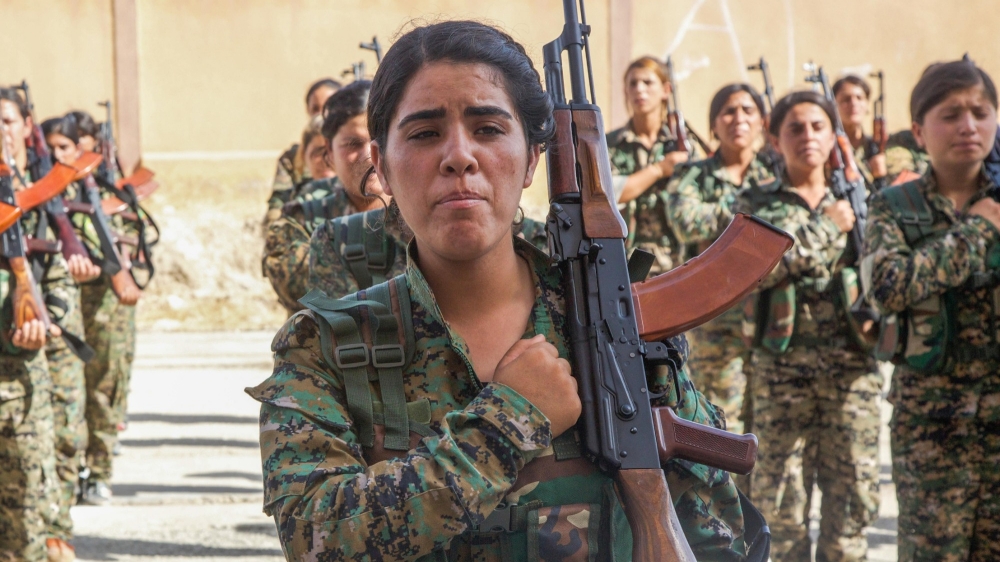
Syrian Democratic Forces trainees, representing an equal number of Arab and Kurdish volunteers, stand in formation at their graduation ceremony in northern Syria, August 9, 2017.
Photo by Sgt. Mitchell Ryan/DoD
Providing lethal aid to Ukraine would exploit Russia’s greatest point of external vulnerability. But any increase in U.S. military arms and advice to Ukraine would need to be carefully calibrated to increase the costs to Russia of sustaining its existing commitment without provoking a much wider conflict in which Russia, by reason of proximity, would have significant advantages.
Increasing support to the Syrian rebels could jeopardize other U.S. policy priorities, such as combating radical Islamic terrorism, and could risk further destabilizing the entire region. Furthermore, this option might not even be feasible, given the radicalization, fragmentation, and decline of the Syrian opposition.
Promoting liberalization in Belarus likely would not succeed and could provoke a strong Russian response, one that would result in a general deterioration of the security environment in Europe and a setback for U.S. policy.
Expanding ties in the South Caucasus—competing economically with Russia—would be difficult because of geography and history.
Reducing Russian influence in Central Asia would be very difficult and could prove costly. Increased engagement is unlikely to extend Russia much economically and likely to be disproportionately costly for the United States.
Flip Transnistria and expel the Russian troops from the region would be a blow to Russian prestige, but it would also save Moscow money and quite possibly impose additional costs on the United States and its allies.
Geopolitical Cost-Imposing Options
Likelihood of Success in Extending Russia
Benefits
Costs and Risks
Provide lethal aid to Ukraine
MODERATE
HIGH
HIGH
Increase support to the Syrian rebels
LOW
MODERATE
HIGH
Promote liberalization in Belarus
LOW
HIGH
HIGH
Expand ties in the South Caucasus
LOW
LOW
MODERATE
Reduce Russian influence in Central Asia
LOW
LOW
MODERATE
Flipping Transnistria
LOW
LOW
MODERATE
NOTE: For all the tables in this brief, high and low rankings for costs and risks are inverted in desirability from the rest of the table; i.e., low costs are good in the same way that a high likelihood of success is. Thus, a low cost is shaded in light orange while a low likelihood of success is shaded in dark orange. All assessments listed in the tables in this brief are based on analysis by the report’s authors.
Ideological and Informational Cost-Imposing Measures
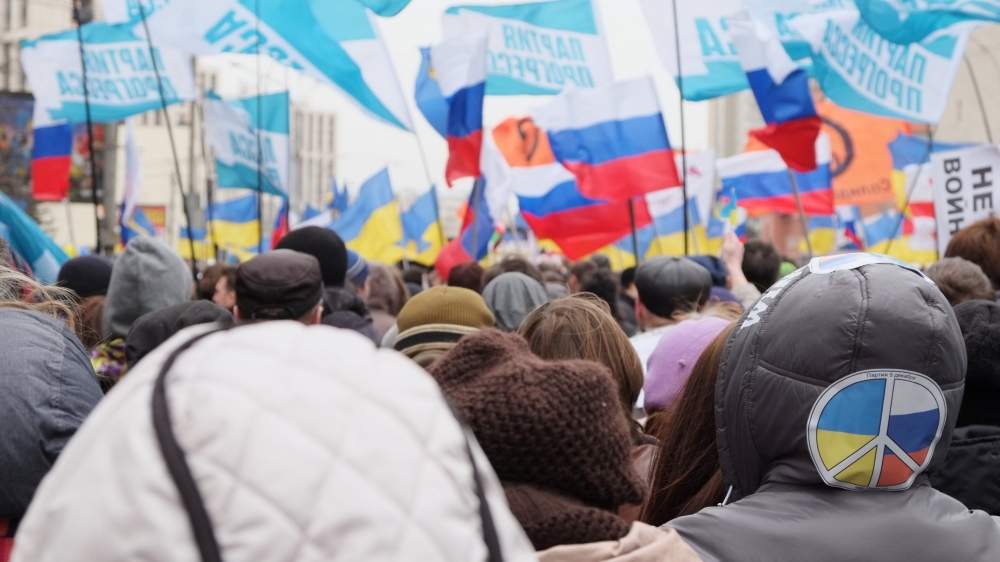
Muscovites protesting the war in Ukraine and Russia’s support of separatism in the Crimea on the Circular Boulevards in Moscow on March 15, 2014.
Photo by Dmitry Vereshchagin/Adobe Stock
Diminishing faith in the Russian electoral system would be difficult because of state control over most media sources. Doing so could increase discontent with the regime, but there are serious risks that the Kremlin could increase repression or lash out and pursue a diversionary conflict abroad that might run counter to Western interests.
Creating the perception that the regime is not pursuing the public interest could focus on widespread, large-scale corruption and further challenge the legitimacy of the state. But it is hard to assess whether political volatility and protests would lead to a more extended Russia—less able or inclined to threaten Western interests abroad—or to a Russia more inclined to lash out in retaliation or to distract, making this a high-risk option.
Encouraging domestic protests and other nonviolent resistance would focus on distracting or destabilizing the Russian regime and reducing the likelihood that it would pursue aggressive actions abroad, but the risks are high and it would be difficult for Western governments to directly increase the incidence or intensity of anti-regime activities in Russia.
Undermining Russia’s image abroad would focus on diminishing Russian standing and influence, thus undercutting regime claims of restoring Russia to its former glory. Further sanctions, the removal of Russia from non-UN international forums, and boycotting such events as the World Cup could be implemented by Western states and would damage Russian prestige. But the extent to which these steps would damage Russian domestic stability is uncertain.
While none of these measures has a high probability of success, any or all of them would prey on the Russian regime’s deepest anxieties and might be employed as a deterrent threat to diminish Russia’s active disinformation and subversion campaigns abroad.
Ideological and Informational Cost-Imposing Options
Likelihood of Success in Extending Russia
Benefits
Costs and Risks
Diminish faith in the Russian electoral system
LOW
MODERATE
HIGH
Create the perception that the regime is not pursuing the public interest
MODERATE
MODERATE
HIGH
Encourage domestic protests and other nonviolent resistance
LOW
MODERATE
HIGH
Undermine Russia’s image abroad
MODERATE
MODERATE
MODERATE
NOTE: For all the tables in this brief, high and low rankings for costs and risks are inverted in desirability from the rest of the table; i.e., low costs are good in the same way that a high likelihood of success is. Thus, a low cost is shaded in light orange while a low likelihood of success is shaded in dark orange. All assessments listed in the tables in this brief are based on analysis by the report’s authors.
Air and Space Cost-Imposing Measures
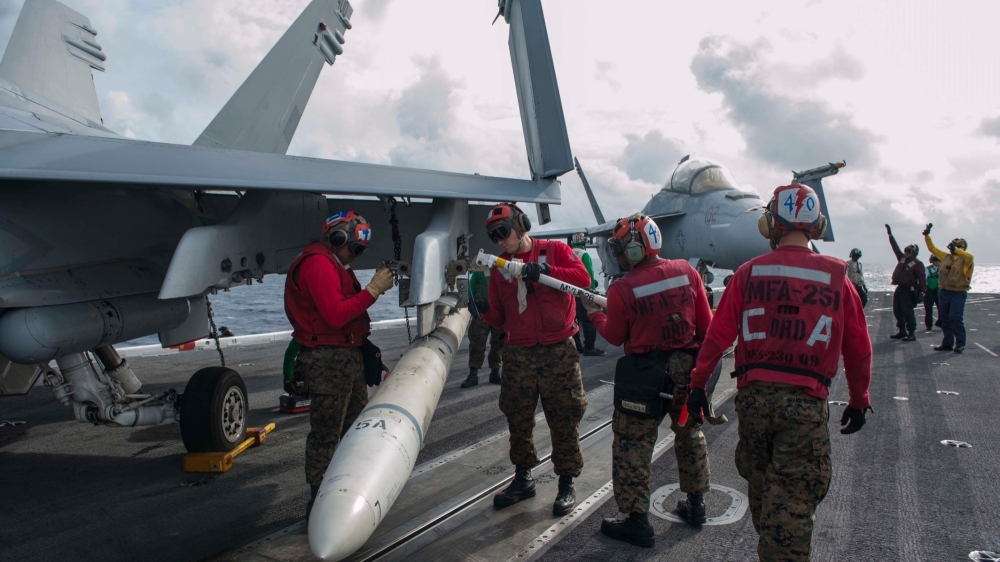
Marines assigned to the Thunderbolts of Marine Fighter Attack Squadron (VMFA) 251 remove a training AGM-88 HARM from an F/A-18C Hornet on the flight deck of the Nimitz-class aircraft carrier USS Theodore Roosevelt (CVN 71).
Photo by Anthony N. Hilkowski/DVIDS
Reposturing bombers within easy striking range of key Russian strategic targets has a high likelihood of success and would certainly get Moscow’s attention and raise Russian anxieties; the costs and risks of this option are low as long as the bombers are based out of range of most of Russia’s theater ballistic and ground-based cruise missiles.
Reposturing fighters so that they are closer to their targets than bombers as a way to achieve higher sortie rates to compensate for their smaller payloads would likely concern Moscow even more than reposturing bombers, but the likelihood of success is low and risks are high. Because each aircraft would need to fly multiple sorties during a conventional conflict, Russian leaders would probably be confident that they could destroy many fighters on the ground and shut down their deployment airfields early on with few or no additions to their missile inventory.
Deploying additional tactical nuclear weapons to locations in Europe and Asia could heighten Russia’s anxiety enough to significantly increase investments in its air defenses. In conjunction with the bomber option, it has a high likelihood of success, but deploying more such weapons might lead Moscow to react in ways contrary to U.S. and allied interests.
Repositioning U.S. and allied ballistic missile defense systems to better engage Russian ballistic missiles would also alarm Moscow but would likely be the least effective option because Russia could easily saturate current systems and any planned upgrades with a small percentage of its existing missile inventory, leaving many missiles still available to hold U.S. and allied targets at risk.
There are also ways to get Russia to extend itself in strategic competition. In terms of benefits, such developments would exploit Moscow’s demonstrated fear of U.S. airpower capabilities and doctrines. Developing new low-observable, long-range bombers, or simply adding significantly more of types that are already available or programmed (B-2s and B-21s) would be worrisome for Moscow, as would developing autonomous or remotely piloted strike aircraft and producing them in high numbers. All options would likely incentivize Moscow to devote ever-greater resources to making its command and control systems harder, more mobile, and more redundant.
A key risk of these options is being drawn into arms races that result in cost-imposing strategies directed against the United States. For example, investing in ballistic missile defense systems and space-based weapons would alarm Moscow, but Russia could defend against such developments by taking measures that would probably be considerably cheaper than the costs of these systems to the United States.
As for likelihood of success, some options are good cost-imposing strategies, but some—such as investing more in HARMs or other electronic warfare technologies—are clearly better than others, and some approaches should be avoided, such as those that focus on space-based weapons or ballistic missile defense systems.
The United States might goad Russia into a costly arms race by breaking out of the nuclear arms control regime, but the benefits are unlikely to outweigh U.S. costs. The financial costs of a nuclear arms race would probably be as high for the United States as they would be for Russia, perhaps higher. But the more serious costs would be political and strategic.
Air and Space/Nuclear Cost-Imposing Options
Likelihood of Success in Extending Russia
Benefits
Costs and Risks
Option 1: Changing air and space force posture and operations
Reposture bombers
HIGH
MODERATE
LOW
Reposture fighters
LOW
MODERATE
HIGH
Deploy additional tactical nuclear weapons
HIGH
LOW
HIGH
Reposition U.S. and allied ballistic missile defense systems
LOW
LOW
MODERATE
Option 2: Increasing aerospace research and development (R&D)
Invest more in low-observable aircraft
MODERATE
MODERATE
MODERATE
Invest more in autonomous or remotely piloted aircraft
HIGH
MODERATE
MODERATE
Invest more in long-range strike aircraft and missiles
HIGH
HIGH
MODERATE
Invest more in longer-range high-speed antiradiation missiles (HARMs)
HIGH
MODERATE
MODERATE
Invest more in new electronic warfare technologies
MODERATE
MODERATE
LOW
Focus on long-range, precision-guided conventional missiles (e.g., conventional prompt global strike)
MODERATE
MODERATE
HIGH
Focus on space-based weapons
LOW
MODERATE
HIGH
Focus on “spaceplanes”
LOW TO MODERATE
MODERATE
HIGH
Focus on small satellites
LOW
MODERATE
HIGH
Option 3: Increasing air and missile components of the nuclear triad
Break out of the nuclear arms control regime
LOW
MODERATE
HIGH
NOTE: For all the tables in this brief, high and low rankings for costs and risks are inverted in desirability from the rest of the table; i.e., low costs are good in the same way that a high likelihood of success is. Thus, a low cost is shaded in light orange while a low likelihood of success is shaded in dark orange. All assessments listed in the tables in this brief are based on analysis by the report’s authors.
Maritime Cost-Imposing Measures
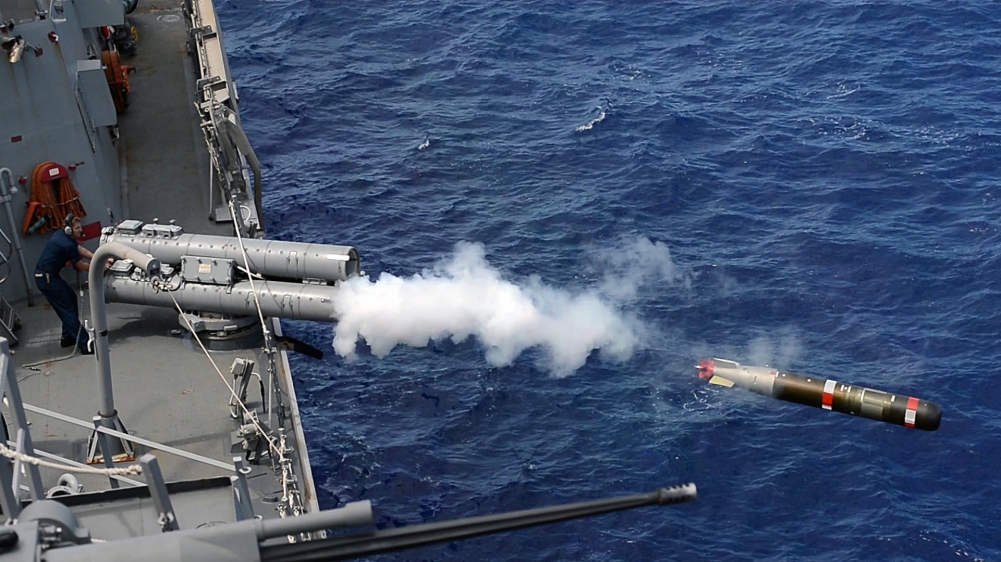
A U.S. sailor aboard the guided missile destroyer USS Mustin (DDG 89) fires a torpedo at a simulated target during Valiant Shield 2014 in the Pacific Ocean September 18, 2014.
Photo by Petty Officer 3rd Class Declan Barnes/DVIDS
Increasing U.S. and allied naval force posture and presence in Russia’s operating areas could force Russia to increase its naval investments, diverting investments from potentially more dangerous areas. But the size of investment required to reconstitute a true blue-water naval capability makes it unlikely that Russia could be compelled or enticed to do so.
Increasing naval R&D efforts would focus on developing new weapons that allow U.S. submarines to threaten a broader set of targets or enhance their ability to threaten Russian nuclear ballistic missile submarines (SSBNs), which could impose anti-submarine warfare costs on Russia. There are limited risks, but success depends on being able to develop these capabilities and on whether they are sufficiently capable of influencing Russian expenditures.
Shifting nuclear posture toward SSBNs would entail increasing the percentage of the U.S. nuclear triad assigned to SSBNs by increasing the size of that fleet. While it might force Russia to invest in capabilities that can operate in a blue-water environment in two oceans and would reduce risks to U.S. strategic posture, the option is unlikely to entice Russia into changing its strategy and, thus, extending itself.
Checking the Black Sea buildup would involve deploying strengthened North Atlantic Treaty Organization (NATO) anti-access and area denial over the Black Sea—perhaps in the form of long-range, land-based anti-ship missiles—to drive up the cost of defending Russian bases in Crimea and lower the benefit to Russia of having seized this area. Russia would certainly mount a vigorous diplomatic and informational campaign to dissuade coastal NATO and non-NATO states from participating. Also, operating in the Black Sea is politically and logistically more difficult for the U.S. Navy than the Russian Navy; it is also more dangerous for the former in a conflict.
Maritime Cost-Imposing Options
Likelihood of Success in Extending Russia
Benefits
Costs and Risks
Increase U.S. and allied naval force posture and presence
MODERATE
MODERATE
LOW
Increase naval R&D efforts
MODERATE
MODERATE
MODERATE
Shift nuclear posture toward SSBNs
LOW
LOW
LOW
Check the Black Sea buildup
MODERATE
MODERATE
MODERATE
NOTE: For all the tables in this brief, high and low rankings for costs and risks are inverted in desirability from the rest of the table; i.e., low costs are good in the same way that a high likelihood of success is. Thus, a low cost is shaded in light orange while a low likelihood of success is shaded in dark orange. All assessments listed in the tables in this brief are based on analysis by the report’s authors.
Land and Multidomain Cost-Imposing Measures
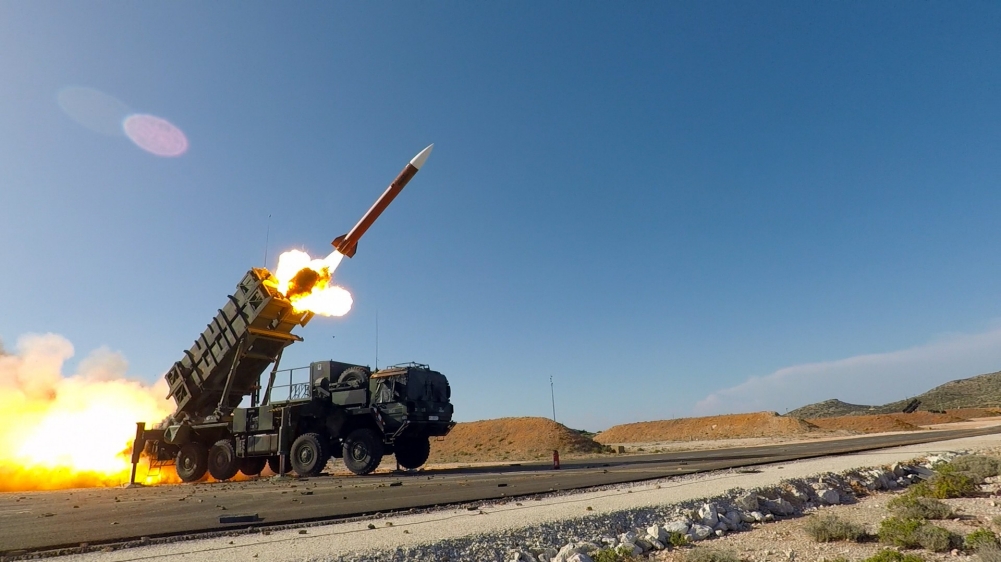
Exercise Artemis Strike was a German-led tactical live-fire exercise with live Patriot and Stinger missiles at the NATO Missile Firing Installation in Chania, Greece, from October 31 to November 9, 2017. More than 200 U.S. soldiers and approximately 650 German airmen participated in the realistic training within a combined construct, exercising the rigors associated with force projection and educating operators on their air missile defense systems.
Photo by Anthony Sweeney/DVIDS
Increasing U.S. forces in Europe, increasing European NATO member ground capabilities, and deploying a large number of NATO forces on the Russian border would likely have only limited effects on extending Russia. All the options would enhance deterrence, but the risks vary. A general increase in NATO ground force capabilities in Europe—including closing European NATO member readiness gaps and increasing the number of U.S. forces stationed in traditional locations in Western Europe—would have limited risks. But large-scale deployments on Russia’s borders would increase the risk of conflict with Russia, particularly if perceived as challenging Russia’s position in eastern Ukraine, Belarus, or the Caucasus.
Increasing the size and frequency of NATO exercises in Europe may help to enhance readiness and deterrence, but it is unlikely to prompt a costly Russian response unless the exercises also send risky signals. Large-scale NATO exercises held near Russia’s borders and exercises that practice counterattack or offensive scenarios could be perceived as showing the intent and willingness to consider offensive operations. For example, a NATO exercise simulating a counterattack to retake NATO territory lost to advancing Russian forces might look like an exercise to prepare for an invasion of a piece of Russian territory, such as Kaliningrad.
Developing but not deploying an intermediate-range missile could bring Russia back into conformity with the Intermediate-Range Nuclear Forces Treaty but could also prompt an acceleration of Russian missile programs. Withdrawing from that treaty and building the missiles but not deploying them in Europe would add little to U.S. capabilities and would probably prompt Russia to deploy such missiles itself—and, perhaps, invest more in ballistic missile defense. Taking the further step of deploying the missiles to Europe, assuming that NATO allies were willing, would also almost certainly prompt a Russian response, potentially involving substantial resources, or at least the diversion of substantial resources from other defense spending, though it is hard to assess what share would be directed toward defensive capabilities versus offensive or retaliatory ones.
Incremental investments in new technologies to counter Russian air defenses and increase U.S. long-range fires could significantly improve defense and deterrence while compelling increased Russian investment in countermeasures. Investments in more-revolutionary, next-generation technologies could have even greater effects, given the Russian concerns about new physical principles, but depending on the capability, such investments could also risk strategic stability by threatening the Russian regime and leadership security in a crisis.
Land and Multidomain Cost-Imposing Options
Likelihood of Success in Extending Russia
Benefits
Costs and Risks
Option 1: Increasing U.S. and NATO land forces in Europe
Increase U.S. forces in Europe
MODERATE
MODERATE
MODERATE
Increase European NATO member ground capabilities
LOW
HIGH
LOW
Deploy large number of NATO forces on the Russian border
MODERATE
MODERATE
HIGH
Option 2: Increasing NATO exercises in Europe
Increase the size of U.S participation
LOW
MODERATE
MODERATE
Generate a mass mobilization of European NATO member forces
LOW
HIGH
MODERATE
Hold exercises on Russia’s borders
MODERATE
MODERATE
HIGH
Hold exercises practicing counterattack or offensive scenarios
MODERATE
MODERATE
HIGH
Option 3: Withdrawing from the Intermediate-Range Nuclear Forces Treaty
Fund a missile development program without withdrawing
MODERATE
LOW
MODERATE
Withdraw and build missiles but do not deploy to Europe
HIGH
LOW
MODERATE
Withdraw, build missiles, and deploy to Europe
HIGH
MODERATE
HIGH
Option 4: Investing in new capabilities to manipulate Russian risk perceptions
Invest in incremental improvements in counter–anti-access and area denial capabilities (e.g., enhanced Army Tactical Missile Systems, advanced anti-radiation guided missiles)
HIGH
MODERATE
MODERATE
Invest in revolutionary, swarm counter–anti-access and area denial capabilities
HIGH
HIGH
HIGH
Invest in incremental improvements in counter–ground forces/fires (e.g., enhanced Javelin)
LOW
LOW
LOW
Invest in revolutionary, unmanned ground forces/fires capabilities
MODERATE
MODERATE
MODERATE
Invest in weapons based on “new physical principles” (e.g,. directed-energy counter–air-defense weapons)
MODERATE
HIGH
HIGH
NOTE: For all the tables in this brief, high and low rankings for costs and risks are inverted in desirability from the rest of the table; i.e., low costs are good in the same way that a high likelihood of success is. Thus, a low cost is shaded in light orange while a low likelihood of success is shaded in dark orange. All assessments listed in the tables in this brief are based on analysis by the report’s authors.
Implications for the Army
The task of “extending Russia” need not fall primarily on the Army or even the U.S. armed forces as a whole. Indeed, the most promising ways to extend Russia—those with the highest benefit, the lowest risk, and greatest likelihood of success—likely fall outside the military domain. Russia is not seeking military parity with the United States and, thus, might simply choose not to respond to some U.S. military actions (e.g., shifts in naval presence); other U.S. military actions (e.g., posturing forces closer to Russia) could ultimately prove more costly to the United States than to Russia. Still, our findings have at least three major implications for the Army.
The U.S. Army should rebuild its linguistic and analytical expertise on Russia. Because Russia does pose a long-term threat, the Army needs to develop the human capital to engage in this strategic competition.
The Army should consider investing and encouraging the other services to invest more in capabilities, such as Army Tactical Missile Systems, Indirect Fire Protection Capability Increment 2, longer-range anti-air defense, and other systems designed to counter Russian anti-access and area denial capabilities. The Army also might consider spending some R&D resources on less-mature, more-futuristic systems (e.g., swarm unmanned aerial vehicles or remote combat vehicles). While these measures would likely be insufficient in themselves to greatly extend Russia, they would benefit U.S. deterrence efforts and could augment a broader whole-of-government policy.
Even if the Army were not directly involved in extending Russia per se, it would play a key role in mitigating the possible blowback. All the options to extend Russia incur some risk. As a result, enhancing U.S. deterrence posture in Europe and increasing U.S. military capabilities (e.g., an enhanced Javelin or active protection systems for Army vehicles) might need to go hand in hand with any move to extend Russia, as a way of hedging against the chance of tensions with Russia escalating into conflict.
Conclusions
The most-promising options to “extend Russia” are those that directly address its vulnerabilities, anxieties, and strengths, exploiting areas of weakness while undermining Russia’s current advantages. In that regard, Russia’s greatest vulnerability, in any competition with the United States, is its economy, which is comparatively small and highly dependent on energy exports. Russian leadership’s greatest anxiety stems from the stability and durability of the regime, and Russia’s greatest strengths are in the military and info-war realms. The table below draws from the earlier tables to identify the most-promising options.
Most of the options discussed, including those listed here, are in some sense escalatory, and most would likely prompt some Russian counterescalation. Thus, besides the specific risks associated with each option, there is additional risk attached to a generally intensified competition with a nuclear-armed adversary to consider. This means that every option must be deliberately planned and carefully calibrated to achieve the desired effect. Finally, although Russia will bear the cost of this increased competition less easily than the United States will, both sides will have to divert national resources from other purposes. Extending Russia for its own sake is not a sufficient basis in most cases to consider the options discussed here. Rather, the options must be considered in the broader context of national policy based on defense, deterrence, and—where U.S. and Russian interests align—cooperation.
Most-Promising Cost-Imposing Options
Likelihood of Success in Extending Russia
Benefits
Costs and Risks
Expand U.S. energy production
HIGH
HIGH
LOW
Impose deeper trade and financial sanctions
HIGH
HIGH
HIGH
Increase U.S. and allied naval force posture and presence
MODERATE
MODERATE
LOW
Reposture bombers
HIGH
MODERATE
LOW
Invest more in autonomous or remotely piloted aircraft
HIGH
MODERATE
MODERATE
Invest more in long-range strike aircraft and missiles
HIGH
HIGH
MODERATE
Invest more in longer-range HARMs
HIGH
MODERATE
MODERATE
Invest more in new electronic warfare technologies
MODERATE
MODERATE
LOW
NOTE: For all the tables in this brief, high and low rankings for costs and risks are inverted in desirability from the rest of the table; i.e., low costs are good in the same way that a high likelihood of success is. Thus, a low cost is shaded in light orange while a low likelihood of success is shaded in dark orange. All assessments listed in the tables in this brief are based on analysis by the report’s authors.