Thursday, November 14, 2019

3291. Video: Do You Want to Eat Some Pesticides?

By Propaganda Watch, November 11, 2019

The propaganda shills of the corporate GMO frankenfood pushers are finally putting their mouths where their propaganda is. How? By eating pesticide, of course! Get the skinny on this PR stunt and what it tells us about the nature of biotech propaganda on this week's edition of #PropagandaWatch.

Wednesday, November 13, 2019

3290. 5 Global Trends Shaping Our Climate Future


By Brad Plumer, The New York Times, November 12, 2019


Wind turbines, solar panels and electric vehicles are spreading far more quickly around the world than many experts had predicted. But this rapid growth in clean energy isn’t yet fast enough to slash humanity’s greenhouse gas emissions and get global warming under control.

That’s the conclusion of the International Energy Agency, which on Tuesday published its annual World Energy Outlook, an 810-page report that forecasts global energy trends to 2040. Since last year, the agency has significantly increased its future projections for offshore wind farms, solar installations and battery-powered cars, both because these technologies keep getting cheaper and because countries like India keep ramping up their clean-energy targets.

But the report also issues a stark warning on climate change, estimating that the energy policies countries currently have on their books could cause global greenhouse gas emissions to continue rising for the next 20 years. One reason: The world’s appetite for energy keeps surging, and the rise of renewables so far hasn’t been fast enough to satisfy all that extra demand. The result: fossil fuels use, particularly natural gas, keeps growing to supply the rest.

“Without new policies in place, the world will miss its climate goals by a very large margin,” said Fatih Birol, the agency’s executive director.

Here are some of the report’s main takeaways:

Renewable electricity is set to surpass coal. Soon.

The world’s consumption of coal, the dirtiest of all fuels, is starting to stall. The report notes that global investment in new coal-fired power plants has slowed sharply in recent years, as countries like India are increasingly finding that a combination of solar panels and battery storage can often be a cheaper way to produce electricity.

Under current policies, the report predicts that renewables such as wind, solar and hydropower will surpass coal as the world’s dominant source of electricity by 2030, growing to 42 percent of global generation. Coal would drop to 34 percent. Natural gas, which is cleaner than coal but which still produces plenty of planet-warming emissions, is also poised to cut into coal’s market share.

Still, the agency notes that coal is far from dead: Hundreds of coal plants that have already been built in Asia are only 12 years old on average and are capable of operating for decades to come. It will be extremely difficult for the world to rapidly reduce its greenhouse gas emissions, the report warns, unless these existing plants are run less frequently, retired early or retrofitted with technology to capture their carbon dioxide pollution and bury it underground. This carbon capture technology remains costly and has struggled to gain traction.

Offshore wind goes big. And mainstream.

For years, it’s been much cheaper for most countries to build wind turbines on land. But in places like Europe’s North Sea, energy companies have recently been erecting large turbines offshore that can harvest the stronger and steadier winds over the ocean. And costs are falling fast, making the technology an increasingly attractive option for some countries.

Offshore wind now supplies 2 percent of the European Union’s electricity; the agency expects production there to increase ninefold by 2040. Companies are also planning major new offshore wind farms in the United States, China, South Korea and Japan. If developers can overcome regulatory and permitting hurdles, offshore wind could become a vital tool for slashing emissions in the years ahead.

S.U.V.s are erasing progress from electric cars

Last year, consumers around the world bought 2 million electric cars, spurred by a combination of falling battery costs and generous vehicle incentives in places like China and California. The agency expects purchases of electric cars to accelerate worldwide and, as a result, predicts that global gasoline and diesel use for cars could finally peak by the mid-2020s.

But this projection comes with a caveat: Even as countries promote electric cars, a growing number of people in the United States, Europe, China and India are also buying larger S.U.V.s, which consume more gasoline than conventional cars. In 2000, just 18 percent of passenger vehicles sold worldwide were S.U.V.s. Today, it’s 42 percent.

If this love affair with S.U.V.s continues, the report notes, it could wipe out much of the oil savings from the nascent electric-car boom. One key question, then, is whether carmakers can figure out how to manufacture, and convince people to buy, battery-powered versions of popular S.U.V. models.

Energy efficiency efforts are slowing

In addition to switching to cleaner sources of energy, countries can also curb their emissions by improving the energy efficiency of their factories, homes and vehicles through policies like building codes and fuel economy standards.

On this score, the report has bad news: In 2018, the energy intensity of the global economy, a measure of efficiency, improved by just 1.2 percent, one of the slowest rates in years. And many countries are weakening their policies, including the United States, where the Trump administration plans to roll back standards that would have required more efficient light bulbs.

Mr. Birol noted that there was significant room for improvement in nearly every country. “Two out of three buildings worldwide today are being built without efficiency codes and standards,” he said. “And those buildings can last for five to six decades, so focusing on efficiency is very important.”

What happens in Africa is crucial

This year’s report also highlights the role of Africa, which is projected to urbanize over the next few decades at a faster pace than China did in the 1990s and 2000s. If Africa pursues the same fossil-fuel heavy path to development that China did, greenhouse gas emissions could rise considerably.

But, Mr. Birol said, there are reasons to think that African nations can chart a cleaner path. The continent, for instance, currently has about 40 percent of the world’s potential for solar energy but still has less than 1 percent of the world’s solar panels. “I think energy developments in Africa are going to surprise many of the pessimists,” he said.

Monday, November 11, 2019

3289. Naomi Oreskes, Why Science Failed to Stop Climate Change

By Naomi Oreskes, TomDispatch.com, November 10, 2019
[Note from TomDispatch: Today’s author, Naomi Oreskes, who's done yeoman’s work on climate change issues over the years, has a new book, Why Trust Science? Here are two recommendations for it from figures I admire: Naomi Klein says, “How do we get to the truth? How do we safeguard scientific knowledge (and ourselves) from those whose interests are threatened by it? With her trailblazing work on climate denial and much else, Naomi Oreskes offers an essential perspective on these questions. She tackles them head-on in this clear, utterly compelling book.” Elizabeth Kolbert (author of The Sixth Extinction) agrees, saying the book “should be read by progressives, conservatives, and everyone in between. It’s an important, timely, and utterly compelling book.” Tom]
I saw the piece in the Guardian in July 2018 and must admit I was stunned by it. It wasn’t that, on the issue of climate change, I hadn’t already read plenty of bad news about what was to come for humanity. Somehow, though, this story got to me -- maybe because, once upon a time in another universe, I was a China-scholar-to-be. The headline read: “Unsurvivable heatwaves could strike the heart of China by end of the century.” As a result, the Guardian reported, parts of the heavily populated North China plain -- populated by 400 million people today -- could become “uninhabitable” by 2100 or even earlier.
I mean, tell me that isn’t shocking. Or to jump to the present, what about the recent study that recalibrated what sea-level rise would mean for coastal communities and found, according to the New York Times, that “some 150 million people are now living on land that will be below the high-tide line by midcentury.” That's just 30 years from now!  Look at the accompanying maps in that piece and, as you’ll see, southern Vietnam “could all but disappear.” Talk about “uninhabitable.” The same obviously applies, for example, to parts of Florida (where the president is now moving his residence to escape taxes). That state, after all, has five of the 20 urban areas in this country expected to suffer the most from rising sea levels: Miami, Miami Beach, Panama City, St. Petersburg, and Tampa.
Back in 2013, I coined the term "terrarists" to describe the men who run what may be the most profitable corporations on the planet, giant energy companies like ExxonMobil, Chevron, and Shell,  and to capture what they were doing to the rest of us. Today, Naomi Oreskes, author of the new book Why Trust Science?, offers a genuinely shocking account of how those companies invested significant sums from the money they made broiling this planet and much effort into the promotion of misinformation and disinformation about the harm fossil fuels are doing -- and how effective they’ve been at it. Just look at the Republican Party, once considered the party of the environment and now a party of pyromaniacs. It’s truly a tale from hell, one that threatens the wellbeing of all our children and grandchildren. Tom
The Greatest Scam in History
How the Energy Companies Took Us All
By Naomi Oreskes
It’s a tale for all time. What might be the greatest scam in history or, at least, the one that threatens to take history down with it. Think of it as the climate-change scam that beat science, big time.
Scientists have been seriously investigating the subject of human-made climate change since the late 1950s and political leaders have been discussing it for nearly as long. In 1961, Alvin Weinberg, the director of the Oak Ridge National Laboratory, called carbon dioxide one of the “big problems” of the world “on whose solution the entire future of the human race depends.” Fast-forward nearly 30 years and, in 1992, President George H.W. Bush signed the U.N. Framework Convention on Climate Change (UNFCCC), promising “concrete action to protect the planet.”
Today, with Puerto Rico still recovering from Hurricane Maria and fires burning across California, we know that did not happen. Despite hundreds of scientific reports and assessments, tens of thousands of peer-reviewed scientific papers, and countless conferences on the issue, man-made climate change is now a living crisis on this planet. Universities, foundations, churches, and individuals have indeed divested from fossil fuel companies and, led by a 16-year-old Swedish girl, citizens across the globe have taken to the streets to express their outrage. Children have refused to go to school on Fridays to protest the potential loss of their future. And if you need a measure of how long some of us have been at this, in December, the Conference of Parties to the UNFCCC will meet for the 25th time.
Scientists working on the issue have often told me that, once upon a time, they assumed, if they did their jobs, politicians would act upon the information. That, of course, hasn’t happened. Anything but, across much of the planet. Worse yet, science failed to have the necessary impact in significant part because of disinformation promoted by the major fossil-fuel companies, which have succeeded in diverting attention from climate change and successfully blocking meaningful action.

Making Climate Change Go Away
Much focus has been put on ExxonMobil’s history of disseminating disinformation, partly because of the documented discrepancies between what that company said in public about climate change and what its officials said (and funded) in private. Recently, a trial began in New York City accusing the company of misleading its investors, while Massachusetts is prosecuting ExxonMobil for misleading consumers as well.
If only it had just been that one company, but for more than 30 years, the fossil-fuel industry and its allies have denied the truth about anthropogenic global warming. They have systematically misled the American people and so purposely contributed to endless delays in dealing with the issue by, among other things, discounting and disparaging climate science, mispresenting scientific findings, and attempting to discredit climate scientists. These activities are documented in great detail in How Americans Were Deliberately Misled about Climate Change, a report I recently co-authoredas well as in my 2010 book and 2014 filmMerchants of Doubt.
A key aspect of the fossil-fuel industry’s disinformation campaign was the mobilization of “third-party allies”: organizations and groups with which it would collaborate and that, in some cases, it would be responsible for creating.
In the 1990s, these allied outfits included the Global Climate Coalition, the Cooler Heads Coalition, Informed Citizens for the Environment, and the Greening Earth Society. Like ExxonMobil, such groups endlessly promoted a public message of denial and doubt: that we weren’t really sure if climate change was happening; that the science wasn’t settled; that humanity could, in any case, readily adapt at a later date to any changes that did occur; and that addressing climate change directly would wreck the American economy. Two of these groups -- Informed Citizens for the Environment and the Greening Earth Society -- were, in fact, AstroTurf organizations, created and funded by a coal industry trade association but dressed up to look like grass-roots citizens’ action organizations.
Similar messaging was pursued by a network of think tanks promoting free market solutions to social problems, many with ties to the fossil-fuel industry. These included the George C. Marshall Institute, the Cato Institute, the Competitive Enterprise Institute, the American Enterprise Institute, and the Heartland Institute. Often their politically motivated contrarian claims were presented in formats that make them look like the scientific reports whose findings they were contradicting.
In 2009, for instance, the Cato Institute issued a report that precisely mimicked the format, layout, and structure of the government’s U.S. National Climate Assessment. Of course, it made claims thoroughly at odds with the actual report’s science. The industry also promoted disinformation through its trade associations, including the American Legislative Exchange Council, the American Petroleum Institute, the U.S. Chamber of Commerce, the National Black Chamber of Commerce, and the National Association of Manufacturers.
Both think tanks and trade organizations have been involved in personal attacks on the reputations of scientists. One of the earliest documented was on climate scientist Benjamin Santer at the Lawrence Livermore National Laboratory who showed that the observed increase in global temperatures could not be attributed to increased solar radiation. He served as the lead author of the Second Assessment Report of the U.N.’s prestigious Intergovernmental Panel on Climate Change, or IPCC, responsible for the 1995 conclusion that “the balance of evidence suggests a discernible human impact on the climate system.” Santer became the target of a vicious, arguably defamatory attack by physicists from the George C. Marshall Institute and the Global Climate Coalition, who accused him of fraud. Other climate scientists, including Michael Mann, Jonathan Overpeck, Malcolm Hughes, Ray Bradley, Katharine Hayhoe, Kevin Trenberth, and, I should note, myself, have been subject to harassment, investigation, hacked emails, and politically motivated freedom-of-information attacks.
How to Play Climate Change for a Fool
When it came to industry disinformation, the role of third-party allies was on full display at the House Committee on Oversight hearings on climate change in late October. As their sole witness, the Republicans on that committee invited Mandy Gunasekera, the founder and president of Energy45, a group whose purpose, in its own words, is to “support the Trump energy agenda.”
Energy45 is part of a group known, bluntly enough, as the CO2 Coalition and is a perfect example of what I’ve long thought of as zombie denialism in which older players spouting industry arguments suddenly reappear in new forms. In this case, in the 1990s and early 2000s, the George C. Marshall Institute was a leader in climate-change disinformation. From 1974-1999, its director, William O’Keefe, had also been the executive vice president and later CEO of the American Petroleum Institute. The Marshall Institute itself closed in 2015, only to re-emerge a few years later as the CO2 Coalition.
The comments of Republican committee members offer a sense of just how deeply the climate-change disinformation campaign is now lodged in the heart of the Trump administration and congressional Republicans as 2019 draws to an end and the planet visibly heats. Consider just six of their “facts”:
1) The misleading claim that climate change will be “mild and manageable.” There is no scientific evidence to support this. On the contrary, literally hundreds of scientific reports over the past few decades, including those U.S. National Climate Assessments, have affirmed that any warming above 2 degrees Centigrade will lead to grave and perhaps catastrophic effects on “health, livelihoods, food security, water supply, human security, and economic growth.” The U.N.’s IPCC has recently noted that avoiding the worst impacts of global warming will “require rapid and far-reaching transitions in energy... infrastructure... and industrial systems.”
Recent events surrounding Hurricanes Sandy, Michael, Harvey, Maria, and Dorian, as well as the devastating wildfire at the ironically named town of Paradise, California, in 2018 and the fires across much of that state this fall, have shown that the impacts of climate change are already part of our lives and becoming unmanageable. Or if you want another sign of where this country is at this moment, consider a new report from the Army War College indicating that “the Department of Defense (DoD) is precariously unprepared for the national security implications of climate change-induced global security challenges.” And if the Pentagon isn’t prepared to manage climate change, it’s hard to imagine any part of the U.S. government that might be.
2) The misleading claim that global prosperity is actually being driven by fossil fuels. No one denies that fossil fuels drove the Industrial Revolution and, in doing so, contributed substantively to rising living standards for hundreds of millions of people in Europe, North America, and parts of Asia. But the claim that fossil fuels are the essence of global prosperity today is, at best, a half-truth because what is at stake here isn’t the past but the future. Disruptive climate change fueled by greenhouse gas emissions from the use of oil, coal, and natural gas now threatens both the prosperity that parts of this planet have already achieved and future economic growth of just about any sort. Nicholas Stern, the former chief economist of the World Bank and one of the foremost experts on the economics of climate change, has put our situation succinctly this way: “High carbon growth self-destructs.”
3) A misleading claim that fossil fuels represent “cheap energy.” Fossil fuels are not cheap. When their external costs are included -- that is, not just the price of extracting, distributing, and profiting from them, but what it will cost in all our lives once you add in the fires, extreme storms, flooding, health effects, and everything else that their carbon emissions into the atmosphere will bring about -- they couldn’t be more expensive. The International Monetary Fund estimates that the cost to consumers above and beyond what we pay at the pump or in our electricity bills already comes to more than $5 trillion dollars annually. That’s trillion, not billion. Put another way, we are all paying a massive, largely unnoticed subsidy to the oil, gas, and coal industry to destroy our civilization. Among other things, those subsidies already “damage the environment, caus[e]... premature deaths through local air pollution, [and] exacerbat[e] congestion and other adverse side effects of vehicle use.”
4) A misleading claim about poverty and fossil fuels. That fossil fuels are the solution to the energy needs of the world’s poor is a tale being heavily promoted by ExxonMobil, among others. The idea that ExxonMobil is suddenly concerned about the plight of the global poor is, of course, laughable or its executives wouldn’t be planning (as they are) for significant increases in fossil-fuel production between now and 2030, while downplaying the threat of climate change. As Pope Francis, global justice leader Mary Robinson, and former U.N. Secretary General Ban Ki-Moon -- as well as countless scientists and advocates of poverty reduction and global justice -- have repeatedly emphasized, climate change will, above all, hurt the poor. It is they who will first be uprooted from their homes (and homelands); it is they who will be migrating into an increasingly hostile and walled-in world; it is they who will truly feel the heat, literal and figurative, of it all. A fossil-fuel company that cared about the poor would obviously not be committed, above all else, to pursuing a business model based on oil and gas exploration and development. The cynicism of this argument is truly astonishing.
Moreover, while it’s true that the poor need affordable energy, it is not true that they need fossil fuelsMore than a billion people worldwide lack access (or, at least, reliable access) to electricity, but many of them also lack access to an electricity grid, which means fossil fuels are of little use to them. For such communities, solar and wind power are the only reasonable ways to go, the only ones that could rapidly and affordably be put in place and made available.
5) Misleading assertions about the costs of renewable energy. The cheap fossil fuel narrative is regularly coupled with misleading assertions about the allegedly high costs of renewable energy. According to Bloomberg News, however, in two-thirds of the world, solar is already the cheapest form of newly installed electricity generation, cheaper than nuclear, natural gas, or coal. Improvements in energy storage are needed to maximize the penetration of renewables, particularly in developed countries, but such improvements are happening quickly. Between 2010 and 2017, the price of battery storage decreased a startling 79% and most experts believe that, in the near future, many of the storage problems can and will be solved.
6) The false claim that, under President Trump, the U.S. has actually cut greenhouse gas emissions. Republicans have claimed not only that such emissions have fallen but that the United States under President Trump has done more to reduce emissions than any other country on the planet. One environmental reporter, who has described herself as “accustomed to hearing a lot of misinformation” about climate change, characterized this statement as “brazenly false.” In fact, U.S. CO2 emissions spiked in 2018, increasing by 3.1% over 2017. Methane emissions are also on the rise and President Trump’s proposal to rollback methane standards will ensure that unhappy trend continues.
Science Isn’t Enough
And by the way, when it comes to the oil companies, that’s just to start down a far longer list of misinformation and false claims they’ve been peddling for years. In our 2010 book, Merchants of Doubt, Erik Conway and I showed that the strategies and tactics used by Big Energy to deny the harm of fossil-fuel use were, in many cases, remarkably similar to those long used by the tobacco industry to deny the harm of tobacco use -- and this was no coincidence. Many of the same PR firms, advertising agencies, and institutions were involved in both cases.
The tobacco industry was finally prosecuted by the Department of Justice, in part because of the ways in which the individual companies coordinated with each other and with third-party allies to present false information to consumers. Through congressional hearings and legal discovery, the industry was pegged with a wide range of activities it funded to mislead the American people. Something similar has occurred with Big Energy and the harm fossil fuels are doing to our lives, our civilization, our planet.
Still, a crucial question about the fossil-fuel industry remains to be fully explored: Which of its companies have funded the activities of the trade organizations and other third-party allies who deny the facts about climate change? In some cases, we already know the answers. In 2006, for instance, the Royal Society of the United Kingdom documented ExxonMobil’s funding of 39 organizations that promoted “inaccurate and misleading” views of climate science. The Society was able to identify $2.9 million spent to that end by that company in the year 2005 alone. That, of course, was just one year and clearly anything but the whole story.
Nearly all of these third-party allies are incorporated as 501(c)(3) institutions, which means they must be non-profit and nonpartisan. Often they claim to be involved in education (though mis-education would be the more accurate term). But they are clearly also involved in supporting an industry -- Big Energy -- that couldn’t be more for-profit and they have done many things to support what could only be called a partisan political agenda as well. After all, by its own admission, Energy45, to take just one example, exists to support the “Trump Energy Agenda.”
I’m an educator, not a lawyer, but as one I can say with confidence that the activities of these organizations are the opposite of educational. Typically, the Heartland Institute, for instance, has explicitly targeted schoolteachers with disinformation. In 2017, the institute sent a booklet to more than 200,000 of them, repeating the oft-cited contrarian claims that climate science is still a highly unsettled subject and that, even if climate change were occurring, it “would probably not be harmful.” Of this booklet, the director of the National Center for Science Education said, “It’s not science, but it’s dressed up to look like science. It’s clearly intended to confuse teachers.” The National Science Teaching Association has called it “propaganda” and advised teachers to place their copies in the recycling bin.
Yet, as much as we know about the activities of Heartland and other third-party allies of the fossil-fuel industry, because of loopholes in our laws we still lack basic information about who has funded and sustained them. Much of the funding at the moment still qualifies as “dark money.” Isn’t it time for citizens to demand that Congress investigate this network, as it and the Department of Justice once investigated the tobacco industry and its networks?
ExxonMobil loves to accuse me of being “an activist.” I am, in fact, a teacher and a scholar. Most of the time, I’d rather be home working on my next book, but that increasingly seems like less of an option when Big Energy’s climate-change scam is ongoing and our civilization is, quite literally, at stake. When citizens are inactive, democracy fails -- and this time, if democracy fails, as burning California shows, so much else could fail as well. Science isn’t enough. The rest of us are needed. And we are needed now.
Naomi Oreskes is professor of the history of science and affiliated professor of earth and planetary sciences at Harvard University. She is coauthor, with Erik Conway, of Merchants of Doubt. Her latest book is Why Trust Science?
Follow TomDispatch on Twitter and join us on Facebook. Check out the newest Dispatch Books, John Feffer’s new dystopian novel (the second in the Splinterlands series) Frostlands, Beverly Gologorsky's novel Every Body Has a Story, and Tom Engelhardt's A Nation Unmade by War, as well as Alfred McCoy's In the Shadows of the American Century: The Rise and Decline of U.S. Global Power and John Dower's The Violent American Century: War and Terror Since World War II.
Copyright 2019 Naomi Oreskes

3288. How Scientists Got Climate Change So Wrong


By Eugene Linden, The New York Times, November 8, 2019
Credit...Hiroko Masuike/The New York Times
For decades, most scientists saw climate change as a distant prospect. We now know that thinking was wrong. This summer, for instance, a heatwave in Europe penetrated the Arctic, pushing temperatures into the 80s across much of the Far North and, according to the Belgian climate scientist Xavier Fettweis, melting some 40 billion tons of Greenland’s ice sheet.

Had a scientist in the early 1990s suggested that within 25 years a single heatwave would measurably raise sea levels, at an estimated two one-hundredths of an inch, bake the Arctic and produce Sahara-like temperatures in Paris and Berlin, the prediction would have been dismissed as alarmist. But many worst-case scenarios from that time are now realities.

Science is a process of discovery. It can move slowly as the pieces of a puzzle fall together and scientists refine their investigative tools. But in the case of climate, this deliberation has been accompanied by inertia born of bureaucratic caution and politics. A recent essay in Scientific American argued that scientists “tend to underestimate the severity of threats and the rapidity with which they might unfold” and said one of the reasons was “the perceived need for consensus.” This has had severe consequences, diluting what should have been a sense of urgency and vastly understating the looming costs of adaptation and dislocation as the planet continues to warm.

In 1990, the Intergovernmental Panel on Climate Change, the United Nations group of thousands of scientists representing 195 countries, said in its first report that climate change would arrive at a stately pace, that the methane-laden Arctic permafrost was not in danger of thawing, and that the Antarctic ice sheets were stable.

Relying on the climate change panel’s assessment, economists estimated that the economic hit would be small, providing further ammunition against an aggressive approach to reducing emissions and to building resilience to climate change.

As we now know, all of those predictions turned out to be completely wrong. Which makes you wonder whether the projected risks of further warming, dire as they are, might still be understated. How bad will things get?

So far, the costs of underestimation have been enormous. New York City’s subway system did not flood in its first 108 years, but Hurricane Sandy’s 2012 storm surge caused nearly $5 billion in water damage, much of which is still not repaired. In 2017, Hurricane Harvey gave Houston and the surrounding region a $125 billion lesson about the costs of misjudging the potential for floods.

The climate change panel seems finally to have caught up with the gravity of the climate crisis. Last year, the organization detailed the extraordinary difficulty of limiting warming to 2.7 degrees Fahrenheit (1.5 degrees Celsius), over the next 80 years, and the grim consequences that will result even if that goal is met.More likely, a separate United Nations report concluded, we are headed for warming of at least 5.4 degrees Fahrenheit. That will come with almost unimaginable damage to economies and ecosystems. Unfortunately, this dose of reality arrives more than 30 years after human-caused climate change became a mainstream issue.

The word “upended” does not do justice to the revolution in climate science wrought by the discovery of sudden climate change. The realization that the global climate can swing between warm and cold periods in a matter of decades or even less came as a profound shock to scientists who thought those shifts took hundreds if not thousands of years.

Scientists knew major volcanic eruptions or asteroid strikes could affect climate rapidly, but such occurrences were uncommon and unpredictable. Absent such rare events, changes in climate looked steady and smooth, a consequence of slow-moving geophysical factors like the earth’s orbital cycle in combination with the tilt of the planet’s axis, or shifts in the continental plates.

Then, in the 1960s, a few scientists began to focus on an unusual event that took place after the last ice age. Scattered evidence suggested that the post-ice age warming was interrupted by a sudden cooling that began around 12,000 years ago and ended abruptly 1,300 years later. The era was named the Younger Dryas for a plant that proliferated during that cold period.

At first, some scientists questioned the rapidity and global reach of the cooling. A report from the National Academies of Science in 1975 acknowledged the Younger Dryas but concluded that it would take centuries for the climate to change in a meaningful way. But not everyone agreed. The climate scientist Wallace Broecker at Columbia had offered a theory that changes in ocean circulation could bring about sudden climate shifts like the Younger Dryas.

And it was Dr. Broecker who, in 1975, the same year as that National Academies report playing down the Younger Dryas, published a paper, titled “Climatic Change: Are We on the Brink of a Pronounced Global Warming?” in which he predicted that emissions of carbon dioxide would raise global temperatures significantly in the 21st century. This is now seen as prophetic, but at the time, Dr. Broecker was an outlier.

Then, in the early 1990s, scientists completed more precise studies of ice cores extracted from the Greenland ice sheet. Dust and oxygen isotopes encased in the cores provided a detailed climate record going back eons. It revealed that there had been 25 rapid climate change events like the Younger Dryas in the last glacial period.

The evidence in those ice cores would prove pivotal in turning the conventional wisdom. As the science historian Spencer Weart put it: “How abrupt was the discovery of abrupt climate change? Many climate experts would put their finger on one moment: the day they read the 1993 report of the analysis of Greenland ice cores. Before that, almost nobody confidently believed that the climate could change massively within a decade or two; after the report, almost nobody felt sure that it could not.”

In 2002, the National Academies acknowledged the reality of rapid climate change in a report, “Abrupt Climate Change: Inevitable Surprises,” which described the new consensus as a “paradigm shift.” This was a reversal of its 1975 report.

“Large, abrupt climate changes have affected hemispheric to global regions repeatedly, as shown by numerous paleoclimate records,” the report said, and added that “changes of up to 16 degrees Celsius and a factor of 2 in precipitation have occurred in some places in periods as short as decades to years.”

The National Academies report added that the implications of such potential rapid changes had not yet been considered by policymakers and economists. And even today, 17 years later, a substantial portion of the American public remains unaware or unconvinced it is happening.

Were the ice sheets of Greenland and Antarctica to melt, sea levels would rise by an estimated 225 feet worldwide. Few expect that to happen anytime soon. But those ice sheets now look a lot more fragile than they did to the climate change panel in 1995, when it said that little change was expected over the next hundred years.

In the years since data has shown that both Greenland and Antarctica have been shedding ice far more rapidly than anticipated. Ice shelves, which are floating extensions of land ice, hold back glaciers from sliding into the sea and eventually melting. In the early 2000s, ice shelves began disintegrating in several parts of Antarctica, and scientists realized that process could greatly accelerate the demise of the vastly larger ice sheets themselves. And some major glaciers are dumping ice directly into the ocean.

By 2014, a number of scientists had concluded that an irreversible collapse of the West Antarctic ice sheet had already begun, and computer modeling in 2016 indicated that its disintegration in concert with other melting could raise sea levels up to six feet by 2100, about twice the increase described as a possible worst-case scenario just three years earlier. At that pace, some of the world’s great coastal cities, including New York, London and Hong Kong, would become inundated.

Then this year, a review of 40 years of satellite images suggested that the East Antarctic ice sheet, which was thought to be relatively stable, may also be shedding vast amounts of ice.

As the seas rise, they are also warming at a pace unanticipated as recently as five years ago. This is very bad news. For one thing, a warmer ocean means more powerful storms, and die-offs of marine life, but it also suggests that the planet is more sensitive to increased carbon dioxide emissions than previously thought.

The melting of permafrost has also defied expectations. This is ground that has remained frozen for at least two consecutive years and covers around a quarter of the exposed land mass of the Northern Hemisphere. As recently as 1995, it was thought to be stable. But by 2005, the National Center for Atmospheric Research estimated that up to 90 percent of the Northern Hemisphere’s topmost layer of permafrost could thaw by 2100, releasing vast amounts of carbon dioxide and methane into the atmosphere.

For all of the missed predictions, changes in the weather are confirming earlier expectations that a warming globe would be accompanied by an increase in the frequency and severity of extreme weather. And there are new findings unforeseen by early studies, such as the extremely rapid intensification of storms, as on Sept. 1, when Hurricane Dorian’s sustained winds intensified from 150 to 185 miles per hour in just nine hours, and last year when Hurricane Michael grew from tropical depression to major hurricane in just two days.

If the Trump administration has its way, even the revised worst-case scenarios may turn out to be too rosy. In late August, the administration announced a plan to roll back regulations intended to limit methane emissions resulting from oil and gas exploration, despite opposition from some of the largest companies subject to those regulations. More recently, its actions approached the surreal as the Justice Department opened an antitrust investigation into those auto companies that have agreed in principle to abide by higher gas mileage standards required by California. The administration also formally revoked a waiver allowing California to set stricter limits on tailpipe emissions than the federal government.

Even if scientists end up having lowballed their latest assessments of the consequences of the greenhouse gases we continue to emit into the atmosphere, their predictions are dire enough. But the Trump administration has made its posture toward climate change abundantly clear: Bring it on!
It’s already here. And it is going to get worse. A lot worse.

Wednesday, November 6, 2019

3287. Over 11,000 Scientists Around the World Declare a 'Climate Emergency'

By Doyle Rice, USA Today, November 5, 2019
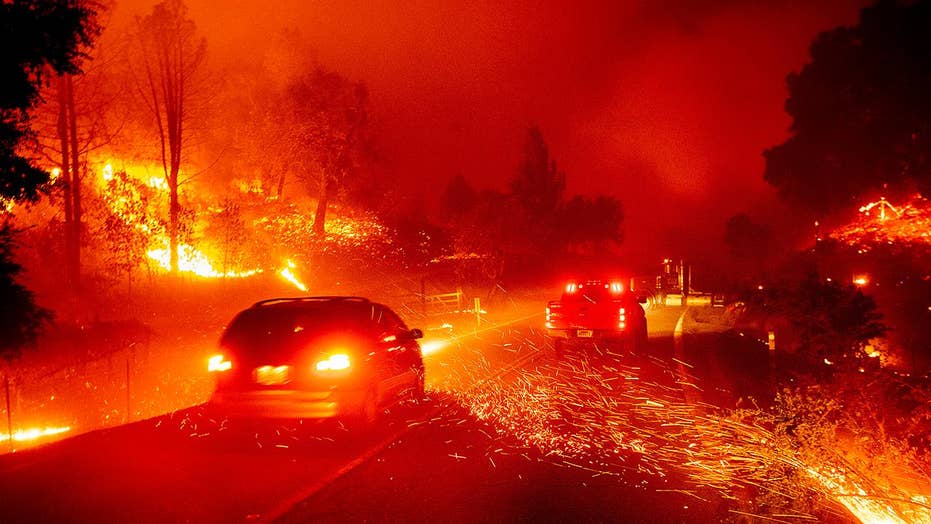
Kancide wildfire, California, October 2019
A global team of more than 11,000 scientists from over 150 countries officially declared that the world is in a "climate emergency," according to a new paper released Tuesday.
“Scientists have a moral obligation to warn humanity of any great threat,” said  Thomas Newsome of the University of Sydney, one of the paper's authors, in a statement. “From the data we have, it is clear we are facing a climate emergency.” 
The scientists warned that “untold human suffering” is unavoidable without deep and lasting shifts in human activities that contribute to greenhouse gas emissions and other factors related to climate change.
“Despite 40 years of major global negotiations, we have generally conducted business as usual and are essentially failing to address this crisis,” said William Ripple, a professor of ecology at Oregon State University and co-lead author of the paper. “Climate change has arrived and is accelerating faster than many scientists expected.”
This is the first time a group of scientists have come together to use the word "emergency" in regards to climate change.
The warning came with steps that can be taken to reverse negative trends, but the authors said it may take a groundswell of public pressure to convince political leaders to take corrective action. Since 1992, when more than 1,700 scientists signed a “World Scientists’ Warning to Humanity” published by the Union of Concerned Scientists, global trends have worsened.
“Global surface temperature, ocean heat content, extreme weather and its costs, sea level, ocean acidity, and area burned in the United States are all rising,” Ripple said. “Globally, ice is rapidly disappearing as demonstrated by decreases in minimum summer Arctic sea ice, Greenland and Antarctic ice sheets, and glacier thickness. All of these rapid changes highlight the urgent need for action.”
The paper concludes by saying, "we believe that the prospects will be greatest if decision-makers and all of humanity promptly respond to this warning and declaration of a climate emergency, and act to sustain life on planet Earth, our only home."
The paper was published in the journal BioScience.

Thursday, October 10, 2019

3286. Christian Parenti and Eco-Modernism

By Louis Proyect, The Unrepentant Marxist, October 5, 2019


As should be abundantly clear at this point, the Bhaskar Sunkara publishing empire has little to do with ecosocialism. It unfurled its banner in the Summer 2017 Jacobin issue that included Leigh Phillips and Michal Rozworski’s recommendation of nuclear energy as well as other ecomodernist nostrums. In the latest Catalyst, there’s an article by pro-nuclear Syracuse University professor Matt Huber that continues along those lines. All three have a special animosity toward any notion of ecological limits, with Huber being irked by André Gorz’s call: “The only way to live better is to produce less, to consume less, to work less, to live differently.”

Two days ago, Christian Parenti’s “Saving the Planet Without Self-Loathing” appeared in Jacobin that, like the three authors mentioned above, took a hard line against the idea of ecological limits. He wrote:

This worldview has driven much of conservationism. It is at the heart of the concern with “overpopulation.” It lurks within the common left anxiety about “development” and “growth.” And it is found in the “jobs vs. environment” debate.

To start with, there are two ways of understanding overpopulation. In 1968, Paul R. Ehrlich and his wife, Anne Ehrlich, wrote “The Population Bomb”, a book that by the authors’ own admission was an attempt to apply Malthus’s ideas to the contemporary world. On the other hand, the combination of an expanding population expecting to enjoy the life-style of the average citizen in a G8 country will be impossible to realize. The world’s population today is 7.6 billion and is expected to be around 11 billion by the end of the century. If a car, air-conditioning, and meat 3 or 4 times a week are considered non-negotiable, then we are in trouble.

Last August, Leigh Phillips wrote an article for Jacobin titled “In Defense of Air-Conditioning” that had this subtitle “Opposition to air-conditioning is just another form of austerity politics. Nothing’s too good for the working class — especially not freedom from the heat.” He assures us that there would be no downside to making air-conditioning a universal right since Canadians enjoy electricity without environmental consequences: “While it may seem fantastical in much of the US, north of the border, the provinces of Ontario, British Columbia, and Québec have grids that are almost entirely fossil-fuel free (91 percent, 95 percent, and 99 percent clean, respectively), primarily from hydroelectric or nuclear power.” Leaving aside the obvious risks associated with nuclear power, one has to wonder if Phillips has any idea of the damage hydroelectric dams have done to indigenous people in Canada as I pointed out in a CounterPunch article 5 years ago. Perhaps Phillips agrees with Huber that such “marginal” populations do not offer sufficient social weight for an effective “strategy”. Perhaps? No, probably definitely.

Parenti alludes to the common left anxiety about “development” and “growth.” It sounds to me as if he is trying to pick a fight with “degrowth” advocates like Jason Hickel but is not quite up to the task. It should be mentioned that Parenti believes that there are technical solutions to climate change that might be capable of allowing everybody to keep their air-conditioners running 24/7. As pointed out by Ian Angus, Parenti wrote an article for Dissent that backed carbon capture and sequestration (CCS) as a “fairly simple” way of solving the climate change crisis. Angus debunked this claim:

There is only one commercial plant in the entire world that captures CO2 directly from the air. According to the journal Science, it takes in just 900 tons of CO2 a year, roughly the amount produced by 200 cars. The company that built it says that capturing just one percent of global CO2 emissions would require 250,000 similar plants. “Fairly simple” just doesn’t apply.

Parenti’s main goal in this article is to debunk the notion that “Western environmentalism has long suffered from”, namely an implicit Malthusianism that sees humanity as intruders upon a harmonious and static thing called “nature.” It might have been helpful if Parenti had named some names but it is likely that he is referring to Deep Ecology, a movement with some misanthropic tendencies that are associated with David Foreman, who was a co-founder of Earth First! Foreman left the Sierra Club after it rejected his anti-immigration proposals. Nowadays, Foreman is involved with the Rewilding Institute, a project that might lead to a ban on cattle ranching in most of the West and repopulating it with native grasses and bison. In my view, something like this will be necessary for the survival of humanity whether or not Parenti gets it.

Parenti addresses the Jacobin readers as if they were in junior high school:

The truth is, we are not intruders. In reality, humans have always been an environment-making species. In fact, every species is.
What we call “nature” or “the environment” is ultimately just the sum total of layer upon layer of organism-environment interactions. Thus it is dynamic, not static. Every organism interacts with, and impacts, its environment. At the same time, every organism is always also part of the external environment of all other organisms.
Environment making is what life forms do. Bees need flowers from which to collect nectar and pollen; in the process of their foraging, bees pollinate flowering plants, helping them reproduce and spread. Thus, bees are central to producing a habitat that produces bees.

To survive, beavers need beaver ponds. But they do not find their niche habitat — they make it by compulsive dam building. When beavers build, they also destroy. In areas they flood, previously established plant communities drown — including, on occasion, bee habitat.

This is followed by a little lecture on Engels’s “The Part Played by Labor in the Transition from Ape to Man” that from Parenti’s presentation sounds to my ears like early ecomodernism:

Just as our ancient ancestors “learned to consume everything edible” thanks to the technology of fire management, Engels noted that fire allowed humans “to live in any climate” and thus “spread over the whole of the habitable world.”… The further afield early humans moved, the more technology they created and used, the more environments they helped shape.

How odd that Parenti would not refer to the section in Engels’s article that most ecosocialists know almost by heart:

Let us not, however, flatter ourselves overmuch on account of our human victories over nature. For each such victory nature takes its revenge on us. Each victory, it is true, in the first place brings about the results we expected, but in the second and third places it has quite different, unforeseen effects which only too often cancel the first. The people who, in Mesopotamia, Greece, Asia Minor and elsewhere, destroyed the forests to obtain cultivable land, never dreamed that by removing along with the forests the collecting centres and reservoirs of moisture they were laying the basis for the present forlorn state of those countries. When the Italians of the Alps used up the pine forests on the southern slopes, so carefully cherished on the northern slopes, they had no inkling that by doing so they were cutting at the roots of the dairy industry in their region; they had still less inkling that they were thereby depriving their mountain springs of water for the greater part of the year, and making it possible for them to pour still more furious torrents on the plains during the rainy seasons.

Like a physician reassuring a 75-year old person with some deadly illness that they can live to 78 at least, Parenti tells us: “In other words, human labor can have life-encouraging effects, or it can do the exact opposite, depending on how labor and production are organized.” So, everybody knows what this means. Capitalism is life-discouraging and socialism is life-encouraging.

Except that the examples supplied by Parenti of “life-encouraging” human labor don’t have very much to do with socialism. He hails a fish farm in Spain and Chinese rice-growing. While there’s no point in denigrating such efforts, you don’t get the sense of the apocalyptic future that faces us at the end of the 21st century. Like everybody else on the Sunkara Express, Parenti believes in the Green New Deal. While the Jacobin/DSA sees this as tantamount to overthrowing capitalism, those with cooler heads see it as something likely not to come into existence under capitalism.

In a 2015 article written before the GND had become for the Jacobin/DSA what Trotsky’s Transitional Program was for me in my impetuous youth, Parenti wrote an article titled “Shadow Socialism in the Age of Environmental Crisis” that will give you a clear idea on where he stands on the most urgent issue of our day, namely how to get rid of the capitalist system that Malcolm X called “vulturistic”.

Shadow socialism is nothing more than government ownership of, for example, canals and railroads in the 19th century and the New Deal in the 20th:

Then comes the New Deal in which America’s Shadow Socialism becomes explicit. The effort to get out of the crisis of the Great Depression relied on the state to jump-start capitalism, to redistribute wealth downward to common people, to create markets by giving poor people jobs and income so they could buy the products of industry and keep the economy turning over. And the state itself purchased (and still purchases) large amounts of technology, invested heavily, and consumed a vast amount of output.

In the conclusion of his article, Parenti sheepishly apologizes to wild-eyed young radicals who probably made the mistake of reading Howard Zinn rather than Michael Harrington:

Let me end with that and an apology or explanation. I know this doesn’t sound revolutionary or radical, but what I’m trying to do is to be very, very realistic. Because I don’t think it is sufficient to be outraged about this and invoke the righteousness of our cause. We have to come up with credible solutions and stories that will really work and strategies that will work at different time frames. So, okay, what I’ve suggested here is not the solution to all problems associated with capitalism. It’s not even the solution to the environmental crisis. It’s just a realistic approach to dealing with climate change so as to buy time, so as to pull back from the brink, so that we can continue struggling. If we don’t take things that seriously and get comfortable with the contradictions implied in that, I think we will not be able to address the climate crisis. But we do have the means to do it economically and technologically, and so it is just a matter of politics.

Is this the end result of Parenti making a career as a professional intellectual rather than as a professional revolutionary as I tried back in 1967? He worked for George Soros’s Open Society for many years and is now ensconced in the John Jay School of Criminal Justice in NY. It is becoming clear to me that it exactly such people who are providing the brain-power, such as it is, for Sunkara’s publishing empire. But don’t fret. This kind of pablum leaves a vacuum that will be filled by genuine sans culottes, not the pretend kind that write for Jacobin.