Friday, March 25, 2016

2251. Cuba’s Sustainable Agriculture at Risk in U.S. Thaw

By Miguel Altieri, The Conversation, March 25, 2016
Organic farm in Alamar, Havana. Melanie Lukesh Reed/Flickr
President Obama’s trip to Cuba this week accelerated the warming of U.S.-Cuban relations. Many people in both countries believe that normalizing relations will spur investment that can help Cuba develop its economy and improve life for its citizens.
But in agriculture, U.S. investment could cause harm instead.
For the past 35 years I have studied agroecology in most countries in Central and South America. Agroecology is an approach to farming that developed in the late 1970s in Latin America as a reaction against the top-down, technology-intensive and environmentally destructive strategy that characterizes modern industrial agriculture. It encourages local production by small-scale farmers, using sustainable strategies and combining Western knowledge with traditional expertise.
Cuba took this approach out of necessity when its economic partner, the Soviet bloc, dissolved in the early 1990s. As a result, Cuban farming has become a leading example of ecological agriculture.
But if relations with U.S. agribusiness companies are not managed carefully, Cuba could revert to an industrial approach that relies on mechanization, transgenic crops and agrochemicals, rolling back the revolutionary gains that its campesinos have achieved.

The shift to peasant agroecology

For several decades after Cuba’s 1959 revolution, socialist bloc countries accounted for nearly all of its foreign trade.
When Cuban trade with the Soviet bloc ended in the early 1990s, food production collapsed due to the loss of imported fertilizers, pesticides, tractors and petroleum. The situation was so bad that Cuba posted the worst growth in per capita food production in all of Latin America and the Caribbean.
But then farmers started adopting agroecological techniques, with support from Cuban scientists.
Thousands of oxen replaced tractors that could not function due to lack of petroleum and spare parts. Farmers substituted green manures for chemical fertilizers and artisanally produced biopesticides for insecticides. At the same time, Cuban policymakers adopted a range of agrarian reform and decentralization policies that encouraged forms of production where groups of farmers grow and market their produce collectively.


Havana market. Julia Dorofeeva/Shutterstock

As Cuba reoriented its agriculture to depend less on imported chemical inputs and imported equipment, food production rebounded. From 1996 though 2005, per capita food production in Cuba increased by 4.2 percent yearly during a period when production was stagnant across Latin America and the Caribbean.
In the mid-2000s, the Ministry of Agriculture dismantled all “inefficient state companies” and government-owned farms, endorsed the creation of 2,600 new small urban and suburban farms, and allowed farming on some three million hectares of unused state lands.
Urban gardens, which first sprang up during the economic crisis of the early 1990s, have developed into an important food source.
Today Cuba has 383,000 urban farms, covering 50,000 hectares of otherwise unused land and producing more than 1.5 million tons of vegetables. The most productive urban farms yield up to 20 kg of food per square meter, the highest rate in the world, using no synthetic chemicals. Urban farms supply 50 to 70 percent or more of all the fresh vegetables consumed in cities such as Havana and Villa Clara.

The risks of opening up

Now Cuba’s agriculture system is under increasing pressure to deliver harvests for export and for Cuba’s burgeoning tourist markets. Part of the production is shifting away from feeding local and regional markets, and increasingly focusing on feeding tourists and producing organic tropical products for export.
President Obama hopes to open the door for U.S. businesses to sell goods to Cuba. In Havana last Monday during Obama’s visit, U.S. Agriculture Secretary Tom Vilsack signed an agreement with his Cuban counterpart, Agriculture Minister Gustavo Rodriguez Rollero, to promote sharing of ideas and research.
“U.S. producers are eager to help meet Cuba’s need for healthy, safe, nutritious food,” Vilsack said. The U.S. Agriculture Coalition for Cuba, which was launched in 2014 to lobby for an end to the U.S.-Cuba trade embargo, includes more than 100 agricultural companies and trade groups. Analysts estimate that U.S. agricultural exports to Cuba could reach US$1.2 billion if remaining regulations are relaxed and trade barriers are lifted, a market that U.S. agribusiness wants to capture.


Agriculture Secretary Tom Vilsack and Alabama Congresswoman Terri Sewell tour a Havana farmers' market, November 2015. US Department of Agriculture/FlickrCC BY

When agribusinesses invest in developing countries, they seek economies of scale. This encourages concentration of land in the hands of a few corporations and standardization of small-scale production systems. In turn, these changes force small farmers off of their lands and lead to the abandonment of local crops and traditional farming ways. The expansion of transgenic crops and agrofuels in BrazilParaguay and Bolivia since the 1990s are examples of this process.
If U.S. industrial agriculture expands into Cuba, there is a risk that it could destroy the complex social network of agroecological small farms that more than 300,000 campesinos have built up over the past several decades through farmer-to-farmer horizontal exchanges of knowledge.
This would reduce the diversity of crops that Cuba produces and harm local economies and food security. If large businesses displace small-scale farmers, agriculture will move toward export crops, increasing the ranks of unemployed. There is nothing wrong with small farmers capturing a share of export markets, as long as it does not mean neglecting their roles as local food producers. The Cuban government thus will have to protect campesinos by not importing food products that peasants produce.
Cuba still imports some of its food, including U.S. products such as poultry and soybean meal. Since agricultural sales to Cuba were legalized in 2000, U.S. agricultural exports have totaled about $5 billion. However, yearly sales have fallen from a high of $658 million in 2008 to $300 million in 2014.
U.S. companies would like to regain some of the market share that they have lost to the European Union and Brazil.
There is broad debate over how heavily Cuba relies on imports to feed its population: the U.S. Department of Agriculture estimates that imports make up 60 to 80 percent of Cubans' caloric intake, but other assessments are much lower.
In fact, Cuba has the potential to produce enough food with agroecological methods to feed its 11 million inhabitants. Cuba has about six million hectares of fairly level land and another million gently sloping hectares that can be used for cropping. More than half of this land remains uncultivated, and the productivity of both land and labor, as well as the efficiency of resource use, in the rest of this farm area are still low.
We have calculated that if all peasant farms and cooperatives adopted diversified agroecological designs, Cuba would be able to produce enough to feed its population, supply food to the tourist industry and even export some food to help generate foreign currency.
President Raul Castro has stated that while opening relations with the U.S. has some benefits,
We will not renounce our ideals of independence and social justice, or surrender even a single one of our principles, or concede a millimeter in the defense of our national sovereignty. We have won this sovereign right with great sacrifices and at the cost of great risks.
Cuba’s small farmers control only 25 percent of the nation’s agricultural land but produce over 65 percent of the country’s food, contributing significantly to the island’s sovereignity. Their agroecological achievements represent a true legacy of Cuba’s revolution.

Tuesday, March 22, 2016

2250. Another Large Solar Company, Abengoa, Is in Crisis

By Raphael Minder, The New York Times,  March 17, 2016
Recent Abengoa SA stock price. Chart: CNBC

Announcing government support for clean-energy projects, President Obama hailed a Spanish company, saying its new solar technology would supply tens of thousands of American homes with renewable power, while spurring local employment.

“It’s good news,” Mr. Obama said in 2010, “that we’ve attracted a company to our shores to build a plant and create jobs right here in America.”

Since then, the Spanish company, Abengoa, has built two American plants, in Arizona and California, supplying electricity to more than 160,000 homes. It is the world leader in a technology known as solar thermal, with operations from Algeria to Latin America.
But Abengoa’s global ambitions are now the source of its troubles.

Saddled with debt from its expansion, the company is scrambling to avoid what would be the largest bankruptcy in Spanish corporate history. Creditors and shareholders are taking the company to court as losses mount and crucial financial support disappears.
The company’s changing fortunes, from industry darling to financial invalid, are an extreme example of the challenges facing players in the renewable energy business.

Clean-energy technologies will play a crucial role as countries try to meet the ambitious targets set by the United Nations climate accord last December. But many of the technologies underpinning renewables are proving economically unsustainable in the short term, particularly with oil prices declining and governments reducing incentives.
The financial reality is forcing companies globally to adjust. A big British utility, SSE, is rethinking its wind farms, as the country cuts subsidies. SolarCity and other American renewable companies left Nevada after the state withdrew its support of rooftop systems.

In Abengoa’s case, its signature American projects still have around $2 billion in outstanding loans guaranteed by the United States government, and the company benefited heavily from subsidies in Spain. But its solar thermal projects have been slow to turn a profit and generate little income in the interim, amplifying its cash squeeze.

Its fall from grace, said Valeriano Ruiz Hernández, a retired professor at Seville University who taught many of the company’s engineers, is “a genuine hammer blow” for Spain and its renewable energy sector.

“I always had the intuition that so much corporate ambition would end up bursting at the seams,” he said.

Founded by two engineers in Seville in 1941, Abengoa initially set out to manufacture a type of electricity meter. Though the meter never gained traction, the company began installing auxiliary panels for power stations and electrical systems for buildings.

By the 1960s, it began expanding overseas to Central and South America, with projects like erecting transmission lines in Argentina. It made its first foray into renewables in the 1980s.

In 2007, the company established the world’s first commercial solar thermal power plant in Sanlúcar la Mayor. On the outskirts of Seville, a handful of towers dominate the farming landscape, rising above sunflower and cattle fields like modern obelisks to solar energy.

In a solar thermal power plant, mirrors reflect the sun’s rays toward the top of each tower, concentrating the light and generating high enough temperatures to heat up a transfer fluid. That heat creates steam to power a turbine, generating electricity.
Abengoa now accounts for more than a quarter of the five gigawatts produced worldwide by solar thermal plants. Unlike conventional solar power, the thermal technology allows energy to be stored, meaning the turbines can generate power for hours after the sun sets.

The same year the Sanlúcar plant opened, Abengoa’s stock price hit a record high of 7.39 euros a share. By November, when it began insolvency proceedings, it had fallen below 40 euro cents. It now sits at 71 euro cents.

Since then, Abengoa has been looking for a lifeline to restructure its $10.3 billion of debt.

Spanish law gives the company four months to right the ship. And last week, Abengoa said it had reached an agreement with creditors, a deal that requires final approval.

As part of the restructuring, Abengoa’s global activities — from transmission lines across the Amazon, to water desalination plants in Algeria and Ghana — could all be up for grabs.

“My expectation is that a lot of Spanish know-how will end up in foreign hands,” said Javier García Breva, a renewable energy expert who is president of N2E, a consultancy.
For now, Abengoa says the deal will not affect its operations in the United States, where the company holds a 42 percent stake in Atlantica Yield, which runs two solar thermal plants in Gila Bend, Ariz., and near Barstow, Calif.

The plants, known as Solana and Mojave, have drawn criticism for years over the American government’s backing.

The projects were partly financed by $605 million in federal grants and tax credits, according to Good Jobs First, a research center that tracks public subsidies. Abengoa also received a combined $2.9 billion in loan guarantees from the United States.

“The whole reason Abengoa Solar had to get the guarantee from the government is that no private lender thought the risk was worth it,” the Institute of Energy Research, a prominent renewables critic that has received financing from the oil industry, said in 2011.

Abengoa says that nearly $1 billion of the federally guaranteed loans has been repaid. American taxpayers, it says, will incur no costs for the projects as long as they continue operating normally.

Abengoa’s problems extend from the balance sheet to the courtroom.

It is facing lawsuits in the United States and Spain from shareholders and creditors. The suits make a variety of claims, with one accusing the company of misleading investors about downplaying its capital needs and another accusing individual executives of acting against investor interests.

An Abengoa spokeswoman said the company would not comment on the cases.
At home, crucial revenue supports that Abengoa and other clean-power producers relied on have been removed.

Looking to cut its debt load, Spain slashed subsidies for renewables. In particular, companies that signed long-term deals to sell green power to customers at guaranteed rates saw those prices cut. The move, which applies retroactively to the summer of 2013, has prompted legal action from international investors who say it is a breach of their contracts.

The multitude of problems is amplifying the pain for Abengoa, which lost $1.3 billion last year. In February, its employees were paid late and, as part of the negotiations with creditors, it asked for more time to repay one of its bonds.

The ripple effects are being felt beyond the company.

A short drive away from Sanlúcar, a research and business park was meant to feed off Abengoa’s presence. Regional authorities originally set aside $22.4 million to develop the area as a hub for clean technology and environmentally focused companies. But three years after opening, only $3.6 million has been spent on it, and it has failed to attract other companies.

Abengoa’s problems have also cast a pall on Spain’s renewables sector. Industry groups, fearful of a withdrawal of government support, are on the defense.

“The problem of Abengoa is not the failure of a sector, far from it,” said Luis Crespo, the president of Estela, the European solar thermal electricity association. “We really hope policy makers don’t start mixing up cost and value.”

2249. As Coal’s Future Grows Murkier, Banks Pull Financing

By Michael Corkery, The New York Times, March 18, 2016


Tens of thousands of miners were on strike and coal prices were skyrocketing in October 1902. Afraid of unrest, President Theodore Roosevelt sought the help of John Pierpont Morgan.

The powerful banker, who held great sway over the coal industry, brokered a deal with the miners that ended the strike.

“My dear sir,” the president wrote to Mr. Morgan. “Let me thank you for the service you have rendered the whole people.”

America’s coal industry is now facing another dark hour, but this time there are few financiers willing to save it.

Mr. Morgan’s bank, now JPMorgan Chase, announced two weeks ago that it would no longer finance new coal-fired power plants in the United States or other wealthy nations. The retreat follows similar announcements by Bank of America, Citigroup and Morgan Stanley that they are, in one way or another, backing away from coal.

While coal has been declining over the last several years, Wall Street’s broad retreat is an ominous sign for the industry.

“There are always going to be periods of boom and bust,” said Chiza Vitta, a metals and mining analyst with the credit rating firm Standard & Poor’s. “But what is happening in coal is a downward shift that is permanent.”

On Wednesday the world’s largest private-sector coal company, Peabody Energy, said that it might have to file for bankruptcy protection, following a path already taken by three of the nation’s other large coal companies.

Peabody has been trying to sell three of its mines in Colorado and New Mexico to raise cash. But the sale to Bowie Resource Partners appears to have stalled amid the difficult financing environment. Bowie did not comment. A Peabody spokesman said the company “stands ready to complete the sale of assets to Bowie.”

Coal, like railroads, steel and other engines of the nation’s industrial expansion in the 19th and early 20th centuries, helped drive Wall Street’s profits for generations. More than a century later, the coal industry is in a free fall and the banks are pulling away.
“Given the state of the coal industry today, I think Mr. Morgan himself might make the same decision,” said Jean Strouse, a biographer of the banker.

Some banks say they are trying to do their part to curtail climate change by moving away from coal projects and financing ventures that produce less carbon. But bankers also say there is a more basic reason for the shift: Lending to coal companies is too risky and could ultimately prove unprofitable.

Coal companies are being squeezed by competition from less expensive energy sources like natural gas and by stiffer regulations — pressures that show no signs of letting up.
As a result, even the most secure loans — like those made to companies emerging from bankruptcy, known as debtor-in-possession loans — are increasingly off limits for many banks, according to bankers and industry lawyers.

And it is not just big banks. Even many more daring investors like hedge funds and private equity firms, which are usually eager to pounce on industries in distress, are shying away from coal because of deep uncertainty about its future.

It is a starkly different scene in the oil industry, where investors are raising hundreds of millions of dollars to snap up the debt and equity of troubled companies that are struggling with an oversupply of oil. Despite the immediate stress, many investors expect the oil glut will burn off by next year and prices will rebound.

But in the coal country of Appalachia, it is unclear whether many unprofitable mines can ever make money again.

“There is certainly no $40 billion titan looking to make a big play in coal right now,” said Marshall Huebner, co-leader of the insolvency and restructuring practice at Davis Polk & Wardwell who has represented several coal companies in recent bankruptcies.

Despite the challenges, the coal industry still powers roughly a third of the nation’s electricity. Industry officials say the business will eventually bounce back, once supplies burn off and demand for coal rebounds in places like China.

“Coal is part of our future, and I think the banks are taking a shortsighted view,” said Mike Duncan, president of the American Coalition for Clean Coal Electricity, an industry group. “They are ignoring a huge market and buying into rhetoric that just doesn’t work.”

Environmental groups, meanwhile, are hoping the banks’ reluctance will hasten the collapse of coal. Groups like the Rainforest Action Network have been pressuring banks for months to reduce coal lending.

“With much of the world committed to stabilizing the climate, we need the banks to follow quickly with measures to end coal financing altogether,” said Ben Collins, a senior campaigner at Rainforest Action Network.

But the banks’ retreat could inflict collateral damage on an industry that employs tens of thousands of workers and needs financing not only to keep operating, but also to clean up coal mines after they close. If coal companies are unable to pay for the mine reclamation, taxpayers could be on the hook for the cleanup costs.

As big American lenders pull back, a few foreign banks, like Deutsche Bank, have been willing to step in, industry officials say.

In its latest annual corporate responsibility report, Deutsche Bank said it was phasing out financing for projects that employ so-called mountaintop removal mining, which environmentalists say is particularly harmful. But the bank’s policy statement did not commit to the type of broad reduction in coal exposure that many American lenders have made in recent months.

In a statement, a bank spokeswoman said that Deutsche Bank is one of the “most prominent banks when it comes to clean energy financing.” She added that the bank “has very strict guidelines governing any financing decisions. We conduct a thorough and detailed analysis on a case-by-case approach, drawing on a deep understanding of wider socioeconomic and environmental trends.”

Even most American banks are not cutting off funding to the industry overnight, saying that for the moment coal remains a major source of energy, particularly outside the United States.

JPMorgan, for instance, is halting financing of new coal-fired plants in wealthy nations like the United States, but will continue to lend to such plants in the developing world, where in some places the coal market is still thriving. To receive financing, however, these plants need to use certain environmentally sound technologies, according the bank’s new policy.

Changes to the coal lending policy at Bank of America have created tension between senior leadership and rank-and-file bankers.

Senior leaders wanted the bank’s energy lending strategy to reflect “a transition from a high-carbon to a low-carbon economy,” said James Mahoney, who oversees public policy issues at the bank and worked on the new coal policy. It is part of Bank of America’s current effort at “responsible growth” — which entails not taking undue risks like lending to a troubled industry, Mr. Mahoney said.

But the shift has been uncomfortable for some of the bankers serving the coal industry.

It put them in a difficult position to say to the companies they have worked with for years, ‘We are pulling back,’ ” Mr. Mahoney said. “It runs counter to everything we do as a client-focused company.

Speaking at an environmental conference at the United Nations in January, Bank of America’s chief executive, Brian T. Moynihan, acknowledged the internal tensions around coal but said that the bank was trying to pull back gradually from the sector.

“When you have real clients involved, these decisions get difficult,” Mr. Moynihan said. “But I think the view of the people working on it is: We have to help people make the transition.”

That transition seemed to accelerate last week with the warning from Peabody that it would miss $71 million in interest payments.

One of Peabody’s best hopes for avoiding bankruptcy, analysts said, was the potential sale of three mines to Bowie Natural Resources.

Bowie is a rare breed of coal company. It has been expanding its operations, focusing largely on Utah, a state that still relies primarily on coal to generate electricity. Still, Bowie in recent weeks has apparently had trouble raising the full $650 million in debt to acquire the mines.

In many debt deals, banks would cover the shortfall. But Deutsche Bank and Citigroup agreed only to make their best effort to raise the debt for Bowie. The banks did not commit any of their own money, as a traditional underwriter might do.

Those best efforts might not be enough.

Monday, March 21, 2016

2248. First Nation Rejects a Billion Dollars Offer for a Pipeline Challenging Trudeau's Climate Plan

By Martin Luckas, The Guardian, March 20, 2016
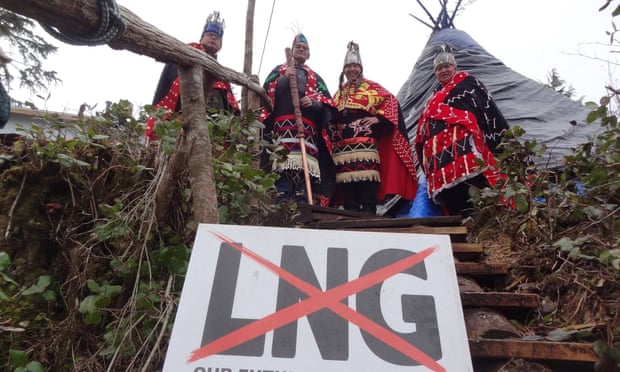
Indigenous leaders gather on Lelu island where the Lax Kw’alaams First Nation has set up camp to protest the construction of the Petronas LNG terminal. Photo: SkeenaWatershed Coalition.
Everything has a price. Everyone can be bought. We assume this principle is endemic to modern life — and that accepting it is most obvious to the impoverished. Except all over the world, people are defying it for a greater cause. That courage may be even more contagious.

It has been in full supply in north-west Canada, where an oil giant is aiming to construct one of country’s biggest fossil fuel developments: a pipeline to ship liquified natural gas (LNG) out of British Colombia. To export it overseas via tankers, Malaysian-owned Petronas must first win approval for a multi-billion dollar terminal on the coast.

That happens to be at the mouth of Canada’s second-largest salmon river, on the traditional territory of the Lax Kw’alaams First Nation. One of the world’s longest un-dammed rivers, the Skeena abounds in the fish relied on by surrounding wildlife — and by First Nations and an entire regional economy.

Last year, following our modern principle, Petronas offered the First Nation an offer they imagined couldn’t be refused: in exchange for their support, a whopping $1.15 billion in cash. But put to a vote, the Lax Kw’alaams resoundingly said “no” — every single community member.

When Petronas made the offer, Lax Kw’alaams hereditary chief Yahaan says he believed the community — poor and with few employment prospects — might vote yes.

“Opportunities like that don’t come to your door every day,” he says. “But I give my people credit for taking that bold step. They showed their love and their passion for the land and water. No amount of money can compare to the richness of the river and what it gives us.”

They knew something even a billion dollars couldn’t persuade them to ignore: that you couldn’t pick a worse place to transform into an industrial landscape. The proposed site for the LNG plant is smack in the middle of a unique estuary, a coastal Mecca for fish: where every year hundreds of millions of young salmon, having travelled down the river after birth, feed and nurture as part of their journey to adulthood.

When the British Columbia government gave Petronas a green-light anyway — ignoring the unanimous ‘no’ vote and the legal duty to consult all impacted First Nations — Yahaan and community members sprung into action. In the summer of 2015 they set up camp on Lelu island, right in the path of Petronas at the mouth of the river. Monitoring the area on boats, they peacefully turned away workers from sensitive sites.

The camp, still up today, is a defence not just of wild salmon and aboriginal rights. Like many such outposts manned by Indigenous peoples across Canada, it is a defence of an entire worldview. On one side stands a government — wedded to an extractivist mentality — that is bent on carving up the province with tens of thousands of fracking wells. It promises an extravagant illusion of 100,000 jobs, which in truth amount to just a few thousand that will vanish as this resource boom, like all others, goes bust. And as Indigenous peoples’ rights have become more powerful, the government and its corporate partners have responded the way they know how: hiking the sums by which to buy them off.

On the other side, the salmon protectors, feeding tens of thousands and supporting a commercial and recreational economy crucial to British Columbians. Promoting an abundance of life instead of threatening to extinguish it. Taking care with the land so that it can take care of people. Getting by on what the earth can continually restore rather than depleting forever what lies beneath.

This is an Indigenous outlook, but one ever more people share. It is in sync with the knowledge that our energy sources must work not against natural cycles but with them — harnessing the power of the sun, water and wind. This can provide jobs in far greater numbers than fossil fuels. And this is the kind of economy we need more of: regenerating naturally, creating enduring local benefits, existing in balance with the natural world. It is, in other words, everything a dirty energy economy is not.

The most dangerous imbalance of all that would be generated by this industrial project, Yahaan says, has only deepened the community’s opposition: its contribution to climate change. Far from clean, emissions from an LNG industry would shatter the provincial government’s emission targets. The Petronas plant and its associated fracking alone could become the country’s largest carbon polluter.

All this means that the courageous resistance of this First Nation has put Prime Minister Justin Trudeau’s climate plan on trial. The new Liberal government — which will have final say on the project — has raised enormous expectations. And raised those of First Nations: as Trudeau has said repeatedly, “governments grant permits, but only communities grant permission.” But as he has mouthed these words, he has pledged to build pipelines and fulfill ex-Prime Minister Stephen Harper’s dream of getting fossil fuels to overseas markets. Trudeau can build LNG up, or bring down emissions: he cannot do both. Will it be on the shores of this beautiful, irreplaceable corner of the world that Trudeau’s contradiction flounders?

The signs so far are mixed. The federal government has said they’ll give the same tax breaks to the LNG industry that Harper was prepared to. On Friday they approved a smaller but controversial LNG project in southern British Columbia. And yet the federal government is clearly feeling the heat of opposition: after tens of thousands of public comments criticizing the Petronas project, a decision that was to come down March 22 has been delayed for three months.

The British Columbia government’s response to date has been worse. “I’m not sure what science the forces of no bring together up there except that it’s not really about the science,” Premier Christy Clark declared. “It’s not really about the fish. It’s just about trying to say no. It’s about fear of change. It’s about a fear of the future.”

It must have been a complete fluke for the “forces of no” that the results of a study assessing the project were published in Science, one of the world’s premier academic journals. Its conclusion? The LNG plant could lead to the collapse of BC’s wild salmon run.

It must be another coincidence that the government’s own scientific studies showed, already 40 years ago, that any development in this region could “completely destroy” the river’s complex ecosystem.

And still yet another coincidence that the government’s current studies continue to point out the problems with an LNG industry: its emissions, in a worse case scenario, “would be comparable to those from Alberta’s oilsands.”

The provincial government’s denigration has a different purpose: laying the grounds to marginalize and criminalize its Indigenous opposition. Yahaan says the RCMP who escorted Petronas workers regularly threatened community members patrolling in boats. “They said they were watching us from land, air, and water. A police sergeant told me, ‘we could have ripped anyone out of those boats, but we didn’t want to make it seem like we were protecting the corporations.’”

In the face of this, support for the Lax Kw’alaams has only been growing. In January, several neighbouring Indigenous nations, locals non-native groups and opposition politicians signed onto the Lelu Declaration, a powerful call from the First Nation to protect the area from industrial development and hold it in trust for generations to come.

Their stance is a challenge not just to Trudeau. It is a challenge to all those who choose to side with the extractive economy that offers security in the short-run but guarantees peril in the long-term. Last year, I sat in a meeting where activists from around the country debated how to propel us to the next economy. After a labour unionist pleaded for caution when it came to risking the jobs of the oil industry, an Indigenous leader named Arthur Manuel stood up. “Look at the example of Lax Kw’alaams,” he said. “We, the poorest communities in Canada, turn down money all the time.” If this First Nation can find the courage to risk another way, what excuse do the rest of us have?

These Indigenous “forces of no,” derided by Christy Clark, ignored by Justin Trudeau, have taken to calling themselves by another name: the Forces of Know. They hold a few things certain, but one could not be more fundamental. It is that their approach, anchored in ancient knowledge and arched toward a habitable future, is how the world can be saved: by loving the natural world and living economies more than mere money and profit.