Showing posts with label carnivore diet. Show all posts

Tuesday, June 23, 2015

1896. Is It OK to Eat Dogs?

By Julian Baggini, The Guardian, June 22, 2015


Whenever western meat-eaters get up in arms over barbarous foreigners eating cute animals, it’s easy to throw around accusations of gross hypocrisy. Easy, because such accusations are often true. But responses to the dog meat festival in Yulin, China, which draws to a close today, merit more careful consideration. The double standards at play here are numerous, complicated, and not always obvious.

One so-called hypocrisy is nothing of the sort. If you find yourself disgusted by the thought of dogs being killed, cooked and eaten, but you eat other animals, that does not make you a hypocrite. If you’ve grown up seeing dogs as companion animals and haven’t even seen the reality of livestock slaughter, of course you’re going to find the idea somewhat distressing. You only become a hypocrite if you take your personal revulsion as a reason to morally oppose the eating of dogs. If you accept that your gut reaction – quite literally, in this case – is no more morally significant than the disgust you might feel when thinking about eating insects, you are no hypocrite for feeling it.

If you are one of the more than 3.8 million people who signed an online petition against the festival, however, you might be standing on shakier ground. Obviously if your only objection is that the animals being eaten are dogs rather than pigs, who are equally as intelligent, your indignation is fairly hollow. But I imagine most objectors believe there is more to it than just their preference for friendly, furry beasts with names.

For instance, some may be moved to sign because the petition claims the dogs are “beaten to death, skinned alive and eaten”. The festival organisers dispute this. I have no idea if the claim stands up, but given that we know that the web is awash with misinformation, I would think it irresponsible to simply believe it without question. After all, if you want to skin an animal it makes much more sense to kill it first, purely for practical reasons. Is there not a whiff of orientalism here: a too-quick readiness to believe that the Chinese behave barbarously?

Others might have been motivated by the pictures of dogs crammed together in cages. This is indeed cruel, but this is how animals are abused in many parts of the world. If you don’t like how the Chinese treat their dogs, then protest against their pork and chicken farming, too. Remember also that in westernised industrial farming, animals are often kept in similar conditions all their lives, not just on market day. So do sign the petition, just as long as you also campaign against intensive farming and studiously ignore any meat that comes from it.

That point also applies to vegetarians. Vegans are the only group who can oppose the festival without any fear of hypocrisy. Vegetarians who do not avoid dairy products or eggs from intensively reared animals cannot complain when they see dogs in cages. Saying “at least dairy cows and egg-laying hens aren’t killed” is no escape clause. It is an odd kind of concern for animal welfare that accepts animals suffering day after day but objects to swift slaughter. The moral choice between killing a well-reared animal and keeping a tortured one alive only until it has fulfilled its use is clear.

Some might be appalled by the petition’s claim that the trade relies on “the abduction of strays and pets”. But “abduction” is a loaded word when it comes to strays. After all, usually it is considered more ethical to eat wild animals than farmed meat, not less. The stealing of pets is of course wrong, but not primarily on animal welfare grounds.

Moral outrage is always easier when the target appears to be far from home. What should appal us about Yulin is not which particular animal is being killed, but that too many animals in the west are treated nearly or just as cruelly. Our problem is not that we ought to be less disgusted at what’s happening in China, but that we ought to be more disgusted by what’s going on in many farms here. Signing a petition about what’s happening in China is easy – and unlikely to have much effect. Refusing to buy from producers here that treat animals just as badly takes more work. But at least it might have an effect.

Monday, June 2, 2014

1433. Book Review: Meatonomics, the Bizarre Economics of the Meat & Dairy Industries

By Bruce Friedrich, The Huffington Post, September 3, 2013

The meat industry in the United States is big business: The vast majority of Americans eat meat, and we eat a lot of it--roughly 200 pounds per person every single year (in animals, that's about 30 chickens, 1 turkey, one-third of a pig, one-tenth of a cow, and dozens of fin fish).
And although per capita consumption has fallen in recent years, we're still eating far more than our parents and grandparents--including six times as many chickens per capita as were consumed in the 1930's.
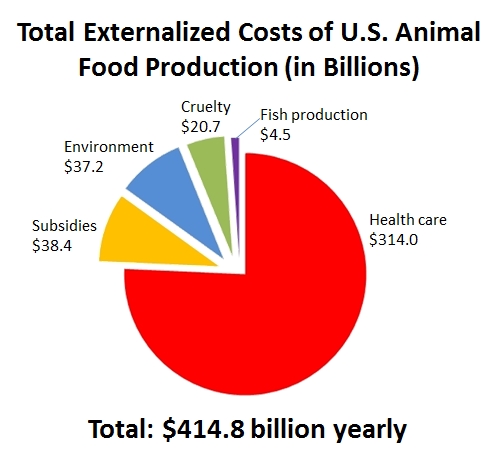
Now, for the first time, we know how much our national meat habit is costing us: Roughly 414 billion dollars annually in external health, environmental, and animal welfare costs, according to a superbly researched new book, Meatonomics, by California attorney David Robinson Simon.
If those costs were incorporated into the price, according to Simon's analysis, animal products would cost almost three times as much as they do today. With the true costs included, consumption levels would plummet.
Simon stresses that his figures are conservative: Because his estimates are limited to those supported by published research, he necessarily omitted some costs that have gone unmeasured in the scientific and economic literature. For example, Simon's numbers on health care assign only a fraction of the heart disease tally to meat, even though we know that a low fat vegan diet will reverse the disease for almost everyone who has it.
His numbers on the environment look at lost property values due factory farms destroying local environments and carbon offsets, but of course, the external effects of warming are far greater than the value of the offsets, and property values can't capture the fact that these industrial farms destroy communities and ruin lives.
Finally, his quantification of the cruelty meted out by these industries discusses just five meat industry abuses--such as cramming pigs and chickens into tiny crates where they never spread their limbs or go outside--and relies on consumer willingness to pay to get rid of them. It's an impressive analysis, based on work published by Oxford University Press and carried out by agricultural economists from Oklahoma State University, but of course these are the sorts of things that defy valuation.
The fact that $414 billion is conservative is in no way a problem with the book, of course--the real figures are incalculable, and conservative figures are more than adequate to accomplish Simon's task of explaining that the USDA's promotion of meat, and the lack of inclusion of external costs, mean that Americans consume vastly more of the stuff than we would if we were paying the true costs.
Simon's solution comes in three parts: An excise tax on all products that contain animal ingredients, a tax credit for every American (basically giving back most of the tax revenues), and a reformulation of the USDA's mission away from promoting the consumption of animal products to instead promote the public health.
The tax and subsidies are proposals that should be supported by all sides of the political spectrum: Progressives should love them for their positive impact on human health, the environment, and animals. Conservatives should love the consumption focus, as well as the tax relief and reward of responsible behavior.
Though enacting Simon's proposals will require a steep climb, Simon makes his case persuasively: The meat industry is harming our health, destroying our environment, and abusing billions of animals annually. As he notes in discussing prospects for his plans: "Change does happen, often in swift and surprising ways."

Meatonomics deserves a prime spot in the library of everyone who cares about the politics of food.

Thursday, March 13, 2014

1351. Industrial Farming and Your Diet

By Nicholas Kristof, The New York Times, March 12, 2014

Where does our food come from? Often the answer is Tyson Foods, America’s meat factory.
Tyson, one of the nation’s 100 biggest companies, slaughters 135,000 head of cattle a week, along with 391,000 hogs and an astonishing 41 million chickens. Nearly all Americans regularly eat Tyson meat — at home, at McDonalds, at a cafeteria, at a nursing home.
“Even if Tyson did not produce a given piece of meat, the consumer is really only picking between different versions of the same commoditized beef, chicken, and pork that is produced through a system Tyson pioneered,” says Christopher Leonard, a longtime agribusiness journalist, in his new book about Tyson called “The Meat Racket.”
Leonard’s book argues that a handful of companies, led by Tyson, control our meat industry in ways that raise concerns about the impact on animals and humans alike, while tearing at the fabric of rural America. Many chicken farmers don’t even own the chickens they raise or know what’s in the feed. They just raise the poultry on contract for Tyson, and many struggle to make a living.
Concerned by the meat oligopoly’s dominance of rural America, President Obama undertook a push beginning in 2010 to strengthen antitrust oversight of the meat industry and make it easier for farmers to sue meatpackers. The aim was grand: to create a “new rural economy” to empower individual farmers.
Big Meat’s lobbyists used its friends in Congress to crush the Obama administration’s regulatory effort, which collapsed in “spectacular failure,” Leonard writes.
Factory farming has plenty of devastating consequences, but it’s only fair to acknowledge that it has benefited our pocketbooks. When President Herbert Hoover dreamed of putting “a chicken in every pot,” chicken was a luxury dish more expensive than beef. In 1930, whole dressed chicken retailed for $6.48 a pound in today’s currency, according to the National Chicken Council. By last year, partly because of Tyson, chicken retailed for an average price of $1.57 per pound — much less than beef.
Costs came down partly because scientific breeding reduced the length of time needed to raise a chicken to slaughter by more than half since 1925, even as a chicken’s weight doubled. The amount of feed required to produce a pound of chicken has also dropped sharply.
And yet.
This industrial agriculture system also has imposed enormous costs of three kinds.
First, it has been a catastrophe for animals. Chickens are bred to grow huge breasts so that as adults they topple forward and can barely breathe or stand.
“These birds are essentially bred to suffer,” says Laurie Beacham of the American Society for the Prevention of Cruelty to Animals, which argues that there’s an inherent cruelty in raising these “exploding chickens.”
Poultry Science journal has calculated that if humans grew at the same rate as modern chickens, a human by the age of two months would weigh 660 pounds.
Second, factory farming endangers our health. Robert Martin of the Johns Hopkins Bloomberg School of Public Health notes that a farm with 10,000 hogs produces as much fecal waste as a small city with 40,000 people, but the hog operation won’t have a waste treatment plant. Indeed, the hogs in a single county in North Carolina produce half as much waste as all the people in New York City, Martin says.
Leonard writes in his book that in 68 percent of the counties where Tyson operates, per capita income has grown more slowly over the last four decades than the average in that state. We may think of rural America as a halcyon pastoral of red barns and the Waltons, but today it’s also a land of unemployment, poverty, despair and methamphetamines.
It’s easy to criticize the current model of industrial agriculture, far harder to outline a viable alternative. Going back to the rural structure represented by the inefficient family farm on which I grew up in Oregon isn’t a solution; then we’d be back to $6.48-a-pound chicken.

But a starting point is to recognize bluntly that our industrial food system is unhealthy. It privatizes gains but socializes the health and environmental costs. It rewards shareholders — Tyson’s stock price has quadrupled since early 2009 — but can be ghastly for the animals and humans it touches. Industrial meat has an acrid aftertaste.