By Andy Skuce, The Bulletin of Atomic Scientists, October 4, 2016
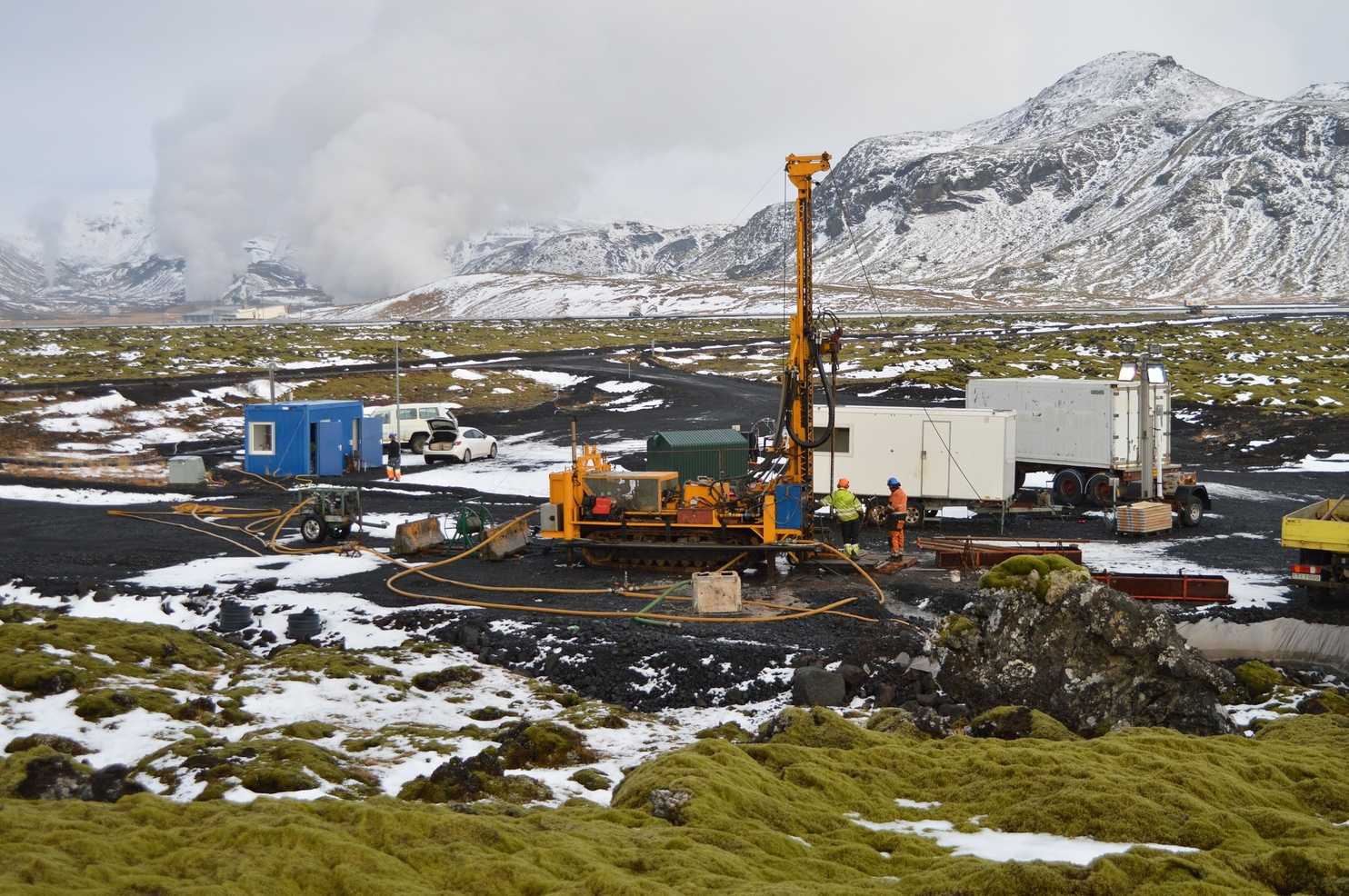 The The CarbFix I pilot plant in Iceland in 2014. Photo: Juerg Matter. The The CarbFix I pilot plant in Iceland in 2014. Photo: Juerg Matter. |
A recent experiment in Iceland garnered a lot of press lately, including The New York Times and the “Latest News” section of Science. It’s easy to see why: Scientists showed that carbon dioxide injected more than 1,000 feet underground into formations of basalt rock—which much of Iceland is made of—reacted very quickly with the minerals present in the rock to form new minerals that remain stable essentially forever. Chemically speaking, they turned carbon dioxide (CO2) into calcite (CaCO3), the principle constituent of marble and limestone. Or, at the risk of oversimplifying, the researchers converted gas into stone, using what is essentially soda water.
At first glance, this approach promises to achieve a long-sought goal: to remove carbon dioxide emissions—one of the chief greenhouse gases behind global warming—from the atmosphere, and lock them away deep underground in a carbon “sink,” where they can do no more harm. Known as carbon capture and sequestration, or CCS, the work in Iceland with basalts marks an important technical advance in a line of attack that scientists have long pursued.
The timing couldn’t be better. For years, many scenarios used in the computerized simulations of carbon emissions mitigation have called for a big contribution from CCS. Indeed, the models used by the Intergovernmental Panel on Climate Change (IPCC) require the large-scale deployment of this technology, while the Paris Agreement specifically calls for “removals by sinks of greenhouse gases in the second half of this century.” This language stems from the growing recognition that the world is likely to overshoot the carbon budget required to hold the increase in global average surface temperatures to “well below 2 degrees Celsius above pre-industrial levels” and avoid the problems of rising sea levels, droughts, extinction events, mass migrations, and other disastrous consequences of climate change. As a matter of fact, of the 400 IPCC scenarios that keep warming below the Paris agreement target, 344 involve the deployment of negative emissions technologies, wrote Kevin Anderson in Nature Geoscience.
But is carbon capture and sequestration ready for prime time? Will CCS technology work on a large scale? How expensive is it, how practical, and how soon can it be deployed? Is carbon capture and sequestration—also known as carbon capture and storage—about to take off in a big way, as some articles in the popular press imply? Or is it more a case of something that is barely out of the proof of concept stage, with years (or decades) of further R&D needed—time that we do not have? In other words, while it is important to continue studying this approach, is carbon capture and sequestration in basalts something more likely to prove useful in the more distant future—and not on a scale and a time frame that will be anywhere nearly as effective in our lifetimes as cutting back on carbon emissions and switching to renewable energy?
Sequestering CO2 in basalts. To get a better idea of the current situation, we first need to better understand the CCS process in these rock formations.
Basalts are natural CO2 sequestration sites. Geologists estimate that exposed basalts, especially in the tropics, absorb about 180 million tons of carbon dioxide every year, while basalts on the sea floor react with dissolved CO2 in the seawater to take up about 150 million tons of carbon dioxide annually—although there is considerable uncertainty in both estimates. These processes, along with other weathering activity, are important for absorbing the CO2 emissions from volcanoes (estimated at around 500 million tons per year) on geological timescales. Weathering and volcanic emissions over the past 10,000 years have at least provided a stable equilibrium of CO2 concentrations in the atmosphere of around 280 parts per million—until the Industrial Revolution came along, that is.
Although the eruptions from volcanoes appear mighty, their outgassing is dwarfed by the human emissions of CO2 caused by the burning of fossil fuels, which are approximately 100 times greater than these natural processes. Eventually, weathering reactions with minerals will take up the excess human emissions and return the atmosphere to a pre-industrial condition, but this could take hundreds of thousands of years—essentially forever on a human timescale. For rock weathering to help solve the climate crisis in the immediate coming decades, a way has to be found to greatly speed up these reactions. One solution may be to expose the rocks to concentrated doses of CO2 at high temperatures, in the presence of water—which is what the scientists in Iceland did.
In a peer-reviewed article in the journal Science, Juerg Matter—associate professor of geoengineering at the University of Southampton—and his colleagues reported on their experiment, in which volcanically-sourced CO2 was dissolved in water and injected into basalts at depths between 400 and 800 meters. Using isotopic and chemical tracers, they were able to demonstrate that 95 percent of the CO2 they injected had become mineralized in the space of two years—much faster than expected. Once CO2 has reacted with the calcium, magnesium, and iron-rich minerals naturally present in the basalt, stable and benign carbonate minerals like calcite are formed. This process holds out the hope that CO2 sequestration can be permanent, and that long-term monitoring can be dispensed with. This is in line with some of the latest thinking about solving the climate crisis.
Why CCS? According to the International Energy Agency: “Carbon capture and storage (CCS) is the only technology able to deliver significant emissions reductions from the use of fossil fuels.”
And Oxford University climate scientist Myles Allen claims: “A global ban on fossil fuels is neither affordable nor enforceable, so capture and disposal of CO2 is the only option. Assuming we don’t want to turn the world over to cultivating biofuels and resort to eating insects, then there will always be some uses of fossil fuels for which there is no effective non-fossil substitute, much as environmentalists hate to admit it.”
One major reason for the pro-CCS enthusiasm is that, according to the modellers cited in the latest IPCC report, deploying CCS on a large scale is cost effective. In cases where atmospheric concentrations of carbon dioxide are limited to 450 parts per million, mitigation costs increase by 138 percent, compared to the baseline scenarios in which no CCS is deployed.
But there are naysayers, such as climate expert Joe Romm, who wrote in an article for Climate Progress: “CCS simply hasn’t yet proven to be practical, affordable, scalable, and ready to be ramped up rapidly.”
So, who’s right?
Obstacles. There certainly are some key snags that need to be overcome if CCS is to be used on a wide scale in basalts. (There are several different ways in which to approach carbon capture and storage; we are focusing primarily here on the method that has caught the most attention lately: converting carbon dioxide gas to solid form in basalt rock formations.)
For one thing, whatever type of CCS technology that is used, human beings would have to develop a huge carbon capture and sequestration industry that is about triple the size of the entire current fossil fuel industry. And we’d have to do it fast—at a rate of about one new CCS plant completed every working day for the next 70 years, or from now until the year 2087.
For another thing, the CCS-in-basalts process used in the Iceland experiment requires almost unimaginable amounts of water. And once the water and CO2 have been processed, an equally large area must be found to store that volume of resulting material. And at this point it is unknown how well the results in Iceland can be applied at large scale in other locales.
Let us examine some of these problems in more detail, one at a time.
A huge new industry to capture and store carbon would have be created from scratch, very fast. As I wrote elsewhere earlier this year, there are currently only 14 CCS plants beyond the proof of concept stage, of any kind, in operation in the world. Each one has an average capacity of about two million metric tons of carbon dioxide per year. That means that if we were to use this CCS-in-basalts approach, we would have to scale up phenomenally fast, if we are to meet the role of carbon capture and storage in some IPCC scenarios.
For example, a prominent published model that limits warming to 2 degrees Celsius envisages primary energy use in the year 2100 to be approximately 25 percent renewables and nuclear energy; 15 percent fossil fuels without CCS (mostly natural gas); and 60 percent fossil fuels and bioenergy with CCS. In this model, 30 billion metric tons of CO2 from fossil fuels would be sequestered annually in 2090, in addition to 10 billion tons of CO2 from biofuels. To put these figures in perspective, the mass of all coal, oil, and gas currently extracted from the Earth amounts to around 12 billion tons. If CCS is to provide a solution to the climate crisis, then over the span of 60 to 70 years, a new industry about three times the size (measured as mass) of the current fossil fuel industry would have to be developed.
That means that if we started in 2020 we would have to build 250 CCS plants the size of the current ones every year, or about one every working day for 70 years. University of Manitoba energy historian Vaclav Smil has argued convincingly that it is impossible to imagine that such a rapid transformation of the global energy system could take place. Smil says "... [I]n order to sequester just a fifth of current CO2 emissions we would have to create an entirely new worldwide absorption-gathering compression-transportation- storage industry whose annual throughput would have to be about 70 percent larger than the annual volume now handled by the global crude oil industry, whose immense infrastructure of wells, pipelines, compressor stations and storage took generations to build.”
The process requires almost unimaginable amounts of water. The technique used in Iceland requires huge amounts of water, approximately 25 tons of water for every ton of CO2. (Using less water and higher concentrations of CO2 would run the risk of the CO2 coming out of solution at the temperatures and pressures of the disposal zone.)
To use a real-world example: One of the best onshore candidate areas for basalt sequestration in the USA is the Columbia River Plateau, located in eastern Washington, northeast Oregon, and western Idaho. As an illustration of how much water might be required, if attempts were made to sequester all US carbon dioxide emissions from fossil fuels (5.2 billion metric tons in 2014), some 130 billion tons of water would be used, or approximately half the annual flow of the Columbia River(240 billion tons). Of course, sequestration on such a scale would never be attempted there, but the calculation at least points up the potential conflict between future projects and agriculture in this semi-arid region, which depends on irrigation from river water.
And sites undersea aren’t much better.
The most extensive area of basaltic rock on the planet lies on the ocean floor, in places such as the Juan de Fuca plate in the Pacific Ocean west of Washington, Oregon, and Northern California. One advantage of offshore sequestration is, of course, the ready supply of any amount of water needed. A second is that the basalts are capped by 400 to 800 meters of impermeable marine sediments that would provide a seal preventing any gas leaks. The size of this sequestration resource would provide for more than a century’s worth of capacity for current US emissions. Perhaps the biggest advantage of such a marine location is that there are no people living above the disposal site.
But there are considerable technical and financial problems to operating CCS plants offshore. The water in the area is more than 2700 meters deep, requiring the use of floating injection and drilling platforms. The most suitable areas are 200 to 400 kilometers from land, which means that long undersea CO2 pipelines would have to be built, in addition to any overland gathering systems. Even a test project along the lines of the Icelandic experiment would be very expensive.
We don’t know how well the results in Iceland can be applied elsewhere. Mineralization occurs so quickly that the pores and fractures near the injection site might clog up so swiftly that further injection in a scaled-up deployment could be hampered. Such complications could perhaps be overcome by drilling new wells or hydraulic fracture treatments. Then there’s the problem of magnitude: The Icelandic experiment is very much a pilot project and the amount of CO2 sequestered by it is small, just 220 metric tons. When that amount is scaled up to thousands or millions of tons, the rocks may react very differently. To make an impact on the global climate requires the technology to be scalable to billions of tons per year.
The consequences of injecting large volumes of fluid into geological formations are unknown. The usual, favored sequestration technology involves injecting CO2 into geologic formations such as depleted oil and gas fields, or saline sandstone reservoirs. In these cases, the carbon dioxide would be injected as a supercritical liquid—a phase having very low viscosity and a density about half that of water, rather than the carbon dioxide solution in water used in the Iceland experiment. Calculations based on the most detailed published two-degree mitigation scenario by Detlef van Vuuren and others at Utrecht University in 2011 estimate that the mass of carbon dioxide in need of disposal by the end of this century would be 40 billion metric tons annually. Converted to a supercritical fluid—in other words, into something that takes up even less space than the soda water experiment in Iceland—this would be would be more than 60 billion cubic meters per year. For comparison, this is about three times the average annual discharge of the Hudson River, or one-eighth the volume of Lake Erie. Even though the volume of the compressed carbon dioxide fluid is much less than the volume it takes up in the form of a gas at the surface, the quantities are still colossal.
And the consequences of injecting such large volumes of supercritical CO2 into geological formations are unknown. Displacement of existing fluids could create problems, including raising pore pressures and triggering earthquakes. Any disposal site would have to be monitored for leakage over centuries. Slow leakage would defeat the purpose of sequestration, while fast leakage could contaminate overlying aquifers. Catastrophic leakage could pose a health hazard. In view of this, it seems likely that large-scale onshore geological sequestration of CO2 would face just as much public resistance as hydrofracking for oil and gas extraction currently does.
There is currently no economic case for deploying CCS. There is at least one other hitch to the use of any kind of carbon capture and storage: The economics of CCS are marginal, even in cases where CO2 is stripped from natural gas—which has to be done anyway to make the gas saleable—and then injected into ailing oil fields to enhance recovery. To extract CO2 from the combustion exhausts of fossil fuel or biofuel power stations and sequester it can cost from $50 to $100 per ton of CO2. In the absence of carbon pricing or enhanced oil recovery, there is no economic case to be made for undertaking this. Private capital is likely to avoid funding CCS until there are clear signs that a high carbon price, or equivalent emissions cap regulations, are imminent.
More research needed. What all this means is that we should realize that there is a very long way to go before the technology to capture carbon and sequester it in basalt formations or other geological reservoirs can be considered feasible at the needed scale, despite the headlines. Given the formidable technical, political, and funding obstacles, it seems unlikely that this particular approach to carbon capture and storage will ever live up to the projections made by IPCC modellers. (In some parts of the world, CCS technology is a non-starter. As Juerg Matter told The Guardian: “In Europe you can forget about onshore CCS.”)
But despite that, pure research into carbon capture and storage should continue, even if the odds are long against the success of the large-scale use of this technology in basalt formations or other geological reservoirs in the coming decades.
Some application of CCS, in some form, is likely to eventually be necessary. To stabilize rising global temperatures requires not just greatly reducing emissions, but getting them to zero. Even if it were possible to greatly reduce emissions, the last few billion tons could be very hard to eliminate from processes like cement manufacture, agriculture, steel-making, some forms of transportation, and fossil-fuel back up for electrical generation to supplement renewable energy. To get to net zero will require at least some CCS and negative emission technologies.
CCS in conjunction with biomass burning, or air capture of CO2, appears to be one of the best bets for achieving negative emissions. There are other measures that can be taken at the margins, such as enhancing soil carbon take-up, and encouraging reforestation. But because of delays in reducing emissions, and the likely consequent overshoot in safe carbon emission budgets, there will be a need for a range of technologies capable of reducing the concentrations of carbon dioxide in the atmosphere. But all negative emissions technologies will take time to implement, and time is the one commodity that humans are certainly squandering.
Eventually, negative emissions technologies, including CCS, may have to be developed and deployed as a kind of emergency planetary liposuction. But it would be far better to first reduce our diet of fossil fuels as quickly as possible through conservation, increased energy efficiency, and the deployment of emissions-free technologies.