Showing posts with label Global Waarming. Show all posts

Saturday, November 24, 2018

3095. Worsening Effects of Climate Change in the US

By Oliver Milman, The Guardian, November 23, 2018

Ahome is overshadowed by towering smoke plumes in Paradise, California . Climate change-related risks will continue to grow without additional action’, the report is set to warn.
A home is overshadowed by towering smoke plumes in Paradise, California . Climate change-related risks will continue to grow without additional action’, the report is set to warn. Photograph: Josh Edelson/AFP/Getty Image

Climate change is already harming Americans’ lives with “substantial damages” set to occur as global temperatures threaten to surge beyond internationally agreed limits, a major US government report has warned.

The influence of climate change is being felt across the US with increases in disastrous wildfires in the west, flooding on the east coast, soil loss in the midwest and coastal erosion in Alaska, according to the US National Climate Assessment. The Guardian saw a draft of the report before publication on Friday.

The draft outlined that “impacts of climate change are intensifying across the country, and that climate-related threats to Americans’ physical, social, and economic wellbeing are rising”. Climate change-related risks “will continue to grow without additional action”, it added.
The quadrennial report, the combined work of 13 federal agencies, was released by the Trump administration on the day after Thanksgiving. Scientists who worked on the report said their research was not watered down but claimed the release was timed to bury the findings during the holiday season.
Global temperatures could be limited to 2C above pre-industrial era if greenhouse gas emissions are slashed but “without significant reductions, annual average global temperatures could increase by 9F (5C) or more by the end of this century”, a previously released chapter states.
Even 2C warming is likely to have major ramifications for societies, as the recent Intergovernmental Panel on Climate Change (IPCC) report spelled out. Heating the planet well beyond this would create a “totally different world”, said Michael Oppenheimer, a climate scientist at Princeton University.
“It would be indescribable, it would turn the world upside down in terms of its climate. There would be nothing like it in the history of civilization.”
Oppenheimer, with many other scientists, has said warming of around 3C is more likely given the advance of renewable energy and expected emissions reductions in the future.
“That is more of an economic, political and technology question,” a report author who wished to remain unnamed told the Guardian. “It’s hard to say what we are on track for right now.”
The draft report warned that the current response was insufficient to stave off the worst impacts, stating that “neither global efforts to mitigate the causes of climate change nor regional efforts to adapt to the impacts currently approach the scales needed to avoid substantial damages to the US economy, environment, and human health and well-being over the coming decades”.
Another report author said: “Climate change is loading the dice against us, it’s going to affect our water, food and ecosystems. This report is important because it shows it’s already happening where we live, not on far off islands or at the poles.”
Included in the dozens of draft report chapters:
  • The summary states the “earth’s climate is now changing faster than at any point in the history of modern civilization, primarily as a result of human activities. The impacts of global climate change are already being felt in the United States and are projected to intensify in the future.”
  • Average sea levels along the US coast have increased by around 9in since the early 20th century as the oceans have warmed and land ice has melted. If emissions are not constrained, “many coastal communities will be transformed by the latter part of this century”.
  • Fisheries, tourism, human health and public safety are being “transformed, degraded or lost due in part to climate change impacts, particularly sea level rise and higher numbers of extreme weather events”.
  • Wildfires have burned at least 3.7m acres in the US in all but three years from 2000 to 2016. “More frequent and larger wildfires, combined with increasing development at the wildland-urban interface portend increasing risks to property and human life,” the report states.
  • More than 100m people in the US live in places with poor air quality and climate change will “worsen existing air pollution levels”. Increased wildfire smoke risks heightening respiratory and cardiovascular problems, while the prevalence of asthma and hay fever is also likely to rise.
  • Major groundwater supplies have declined over the last century, with this decrease accelerating since 2001. “Significant changes in water quantity and quality are evident across the country,” the report finds.
  • Climate change will “disrupt many areas of life” by hurting the US economy, affecting trade and exacerbating overseas conflicts. Low-income and marginalized communities will be worst hit.
The national climate assessment is mandated by Congress to compile the latest research on climate change. The last report came out in 2014. Donald Trump has since announced the US will withdraw from the Paris climate deal, with his administration working to dismantle every major policy designed at lowering emissions.

The release of the report comes as California is racked by its most deadly wildfire on record, the so-called Camp fire, which razed the town of Paradise. At least 84 people have died and tens of thousands of people have had to flee the fire, which has occurred at the same time as a smaller blaze further south, near Los Angeles.
Trump has downplayed assertions by scientists and firefighters that climate change is making California more wildfire-prone, instead pointing to “gross mismanagement” of forest areas. Ryan Zinke, the interior secretary, has said conservationist lawsuits by “radical environmental groups” were to blame.
While visiting devastated parts of California last weekend Trump was asked if what he had seen and heard had changed his mind about climate change, which he has previously called a “hoax”. Trump responded to the question with a firm: “No.”
“When there are daily images of California burning up it’s hard for the administration to argue climate change isn’t happening,” said Oppenheimer. “The strategy seems to be let sleeping dogs lie and hope the public doesn’t pay much attention to it.”

Monday, October 24, 2016

2480. The International Hydrofluorocarbons (HFCs) Agreement Requires Little Effort from the West

By John Vidal, The Guardian, October 15, 2016 
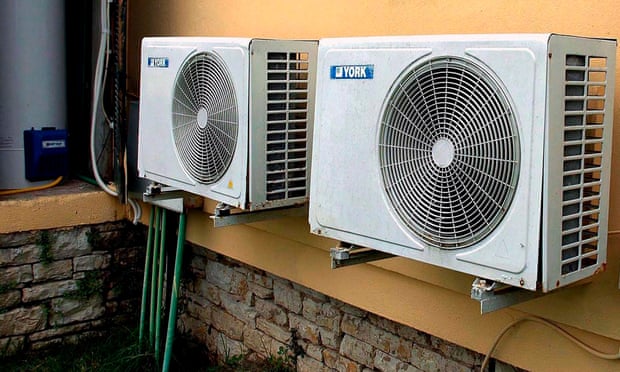
The deal on hydrofluorocarbons, used in air-conditioning and cooling systems, has taken years to negotiate. Photograph: Dimitra Louvrou/EPA.

They went to Kigali to eliminate hydrofluorocarbons (HFCs) and take 0.5C out of future global warming, and the 170 countries who successfully negotiated an amendment to the Montreal Protocol agreed to get rid of 90% of them. Job done. Not bad for four days and three long nights’ work.

In fact, the Kigali deal on HFCs, announced on Saturday morning, is fiendishly complicated and has taken years to negotiate in different technical and political forums. It was only struck by an ambitious agreement to give countries different timescales to phase them out, alongside major chemical and big food companies accepting change, the personal determination of the US secretary of state, John Kerry, to get a deal before the election and developing countries agreeing to invest heavily in new technologies.

Rich countries, including the US, Japan and nations in Europe, will now start phasing out synthetic HFCs in 2019, whereas China agreed to peak emissions in 2024, while India and less ambitious countries chose 2028.

As such, the deal reflects countries’ differing levels of development. Because nearly all HFCs are made by a handful of giant northern chemical companies and are used in air-conditioning units and cooling systems made and sold in rich countries, it was relatively easy for their governments to put pressure on a single global industry. Besides, the alternatives, like hydrocarbons, ammonia and CO2, are widely available, safe, have been approved and are on the market.

The deal will make little difference to rich countries. The EU had already started to phase out HFCs and since 2011 had banned them being used in cars. Many global food and drink companies, like Coca-Cola, Pepsico and Unilever, have already started to switch fluorinated greenhouse gases with climate-friendly and other natural refrigerants that are more energy-efficient and can save money. The new agreement is welcomed by many chemical and manufacturing companies because it gives them market advantage over inferior products made in poor countries, as well as green kudos.

But a deal proved much harder for India, China and other developing countries to strike. Their companies have relied on old refrigeration and coolant technologies, and they will now have to invest heavily in R&D and upgrade or replace their factories and equipment. Just as in the wider climate negotiations, they accepted that they were part of the problem and possibly on track to become the main HFC users, but they insisted that, like climate change itself, this was primarily a western problem foisted on them.

The deal has been widely welcomed because it keeps the Paris agreement on track and is an important step towards reducing global emissions. Coming on the heels of a new deal to cap aviation emissions, and just weeks before the shipping industry tries to clean up its act and the UN climate talks resume, it is overwhelmingly positive.

In fact, the Kigali meeting need never have happened. HFCs were widely recognised as powerful climate-warming gases many years ago and governments deliberately missed the chance to eliminate them in 1987 when they agreed the Montreal Protocol to phase out CFC gases and save the ozone layer.

The ozone hole is at last slowly recovering and HFCs are now seen as just a small but important part of the growing climate-change problem. If only it took just a few long nights of negotiations to eliminate fossil fuels too.