Showing posts with label Capitalist elections. Show all posts

Wednesday, September 28, 2016

2456. To Defeat Hitler Vote for Hindenburg! – “Lesser Evil” Voting Then and Now

By Stanley Heller, Economic Uprising, July 2, 2016
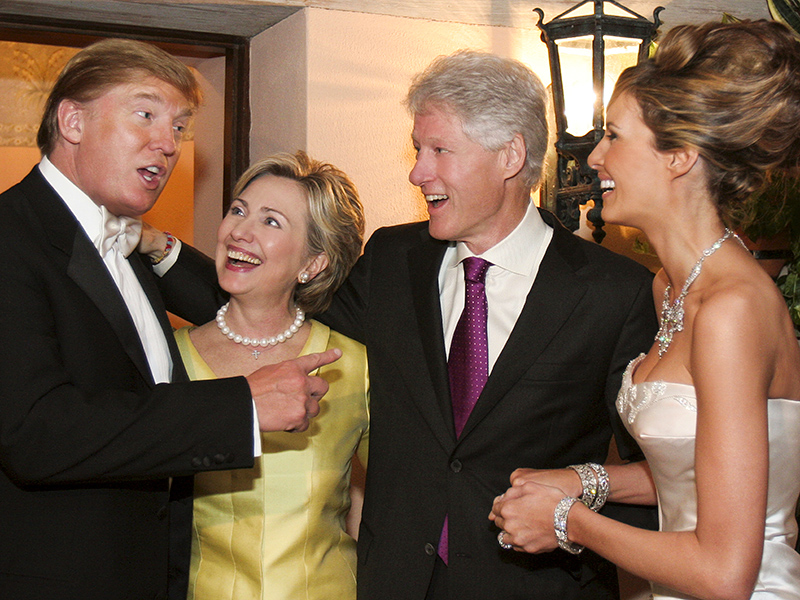
Hillary and William Clinton at Trump's wedding
In 1932 in Germany there were four national elections including two for the powerful position of president. The two leading candidates for president of Germany were Adolf Hitler and Paul von Hindenburg. Today when we hear the word Hindenburg we think of the zeppelin with that name that burned in New Jersey in 1937, but Paul Ludwig Hans Anton von Beneckendorff und von Hindenburg was a very famous man for decades in Germany.  During “the Great War”, which we now call World War I, he was Chief of the General Staff of the German army. In the last years of the war he was in effect military dictator of Germany.  The German revolution ousted the Kaiser from power, but the leaders of the SPD (the very big German socialist party which supported the war) allied with counterrevolutionary forces and after massacres of the revolutionary Left made Germany into a capitalist republic.  Hindenburg, who should have been in disgrace for his failed war leadership, came through the period with his reputation unscathed.
Longstory short.  The SPD steadily weakens. Hindenburg is elected President of Germany in 1925. The Great Depression hits Germany like a hammer and the Nazis go from getting 3% of the vote in 1928 to 18% in 1930.  Their goons are running the streets. The German communists (KPD) follow the orders of Soviet ruler Joe Stalin to totally go it alone.  They claim that the SPD were just another kind of fascist, “social fascists”  For its part the SPD refuses to work with the communists.  In 1932 Hindenberg runs for reelection, the KPD runs its own candidate and the SPD supports Hindenburg as the “lesser of two evils”.
Most people will agree that Hitler was the ultimate evil, so Hindenburg was certainly “lesser”, but the SPD strategy did not work as planned. Hindenburg won the April 1932 run-off presidential with a solid 53% of the vote. “Mission accomplished” or so the SPD thought. Hindenburg stayed in office and he continued to choose the Chancellors and cabinet. However, the string of men he picked totally failed to rescue the German economy. Then Hindenburg made a fateful decision.  In January 1933 he appointed Adolph Hitler as chancellor in a deal that gave the Nazis only 3 of the 11 cabinet positions.  This was thought all that would be needed to keep Hitler under control.  Brilliant plan. Hindenburg was putty in Hitler’s hands.  Within two months Hitler had bullied Hindenburg to sign an Enabling” Act” which gave the Nazi leader dictatorial powers.
So what has this got to do with today?  Well, we have a candidate running for president who a lot of people have compared to Hitler.  And we have as his opponent a woman who
stands for the status quo, a millionaire who does the bidding of Wall Street, a bloody war “hawk” with notches on her belt from the wars in Afghanistan and Iraq, and Libya, a blind supporter of Israeli war crimes in Palestine and elsewhere. Yet people are running to herto defeat Trump, to save them from “Hitler”. (See Halle/Chomsky defense of lesser evil voting )
Now obviously, obviously things are a lot different in the U.S. now compared to  Germany in the ‘30’s. Joblessness though a lot higher than the “unemployment rate” is not as massive as in the ‘30’s.  The U.S. hasn’t felt the shock of a terrible defeat in war and a loss of territory. Though Trump has been embraced by enthusiastic neo-Nazis their gangs are not (yet) running riot.
On the other hand there are two threats we live under that were unheard of in the 1930’s. One is nuclear war. We were told with communism gone there would be an “end of history” and the danger of nuclear war would be gone, but any chance for nuclear disarmament in the 1990’s was completely thrown away by Bill Clinton.   At present the U.S. government still has hundreds of nuclear weapons on hair trigger, meaning they could launch in minutes.  Russia probably still has the same.  With NATO expanding and Putin conquering, the two nuclear powers are eyeball to eyeball again.
The other threat is out of control global warming.  Climate scientist Robert Howarth (who was on the short list in 2011 for Time magazine’s person of the year) says we’re on a path to go over the crucial 1.5 degree centigrade increase in just 13 years.  Carbon dioxide emissions in the U.S. have leveled off in recent years, but methane emissions from fracking have undone all the good and the total global warming gases are increasing at record levels. This is a path to catastrophe, a catastrophe from which there may not be a recovery.  Somewhere between 1.5 and 2 degrees world temperature increase the permafrost releases massive amounts of methane and we go into a feedback loop of another big jump in temperatures.  One of many results is that large areas of the world become either under water or uninhabitable.  If you think we have refugee problems now, wait until there’s tens or scores of millions of climate refugees.
Hillary Clinton will absolutely not save the world from either menace.  She raised no objection to Obama’s trillion dollar nuclear modernization program or his (or was it her) drive to stick NATO right in the face of Putin.  Clinton supported the Keystone XL pipeline as Secretary of State and only changed her mind under relentless pressure from Bernie Sanders.  She calls for an 80% cut in carbon emissions by 2050.  That sounds like a big deal, but it’s a totally inadequate measure to stop the warming that’s coming, a death sentence for coastal cities and genocide for Africa.  Let me emphasize this climate menace is on the way. The balance of nuclear terror may hold for more decades, but the things that balance global gases, like the world’s oceans can no longer do the job.
So who should we vote for in the U.S. presidential election?
Before we answer that question there are others to deal with first.    What is the minimum we need for continued human civilization (as opposed to a global war of all against all as livable land areas dwindle) and what would create the force, the movement, the organization necessary to win the minimum changes?
For climate I see no way to avoid intolerable climate change unless there is a government takeover of the energy, heating and transportation industries and a “Manhattan Project” crash program for 100% renewable energy by 2030.  The bloated armaments industry which lives on wars and the need for ever more nuclear “modernization” should be nationalized, too.  Its industries need to be converted to peace time use and its workers hired in “green” jobs. This has to planned at the highest level and worker run at the day to day level.  We need a new system, a social democracy that is able to maintain a sustainable ecology, in short “ecosocialism”.
Now the Democrats and Republicans are both staunch defenders of (somewhat different versions of) capitalism and nothing in the short run is going to change that. Unfortunately if we have 13 years to fix the climate all we have is the short run.  The recent farce at the Democratic platform committee where every proposed method of weaning away from fossil fuel was rejected should disabuse those who think the Democrats can be a vehicle for the necessary drastic changes need in the next decade.
The largest Left party is the Green Party which gets a miniscule vote in national elections and gets denounced for taking away votes that naturally belong to the “lesser evil”.  It’s hampered by a voting system totally stacked against third parties.  (As a result no party other than the Democrats and Republicans has won a single presidential electoral vote in almost 50 years.)  It sees its role as running in elections, period.  It rarely takes part in creating social movement or anti-war actions.
That’s not enough.  There needs to be something else, something that will run in elections, but that will also organize massive disruption to undo the power structure and build a new ecosocialist society. It has to be an ever rising tide of democracy and environmentalism.  We must do what is necessary to build the build that movement, that force and we can’t be intimidated by the fear of being taunted as the “spoiler” in elections.  We have to say in advance that if our actions result in a more repressive, more racist and environmental Know Nothing party taking over for a while, so be it.   We’ll have to grit our teeth and deal with it.  There’s no time for glacial progress. Human society is at stake.
 On June 20 Juan Gonzalez, the great journalist, former Young Lords leader and current co-anchor on Democracy Now!  spoke at the Bernie Sanders’ “Peoples Summit” .  He told the thousands attending, “Don’t make the mistakes of 1968 that elected Nixon.”  What were those mistakes according to Gonzalez? People came to Chicago to “confront” the Democrats who were about to nominate Hubert Humphrey.  Also SDS told people not to vote.   Gonzales claimed “there would have been a positive change, if Nixon had not been elected.”  The lesson, though Gonzalez didn’t say it outright is “vote for Hillary”.
Actually, what Gonzalez proposed would have been suicide for the movement. Hubert Humphrey was Lyndon Johnson’s lickspittle and junior partner in war crimes against Vietnam.   A Humphrey victory could well have led to eight more years of genocide for the people of Vietnam. Instead Chicago in ’68 was a milestone of direct action.  Neither the Chicago police riot nor the prosecution of protest leaders on bogus charges dampened spirits .   The Yippie and Left protests of ‘68  led to many more direct actions and the eventual radicalization of part of the U.S. military.  Thousands of U.S. soldiers would no longer fight for the empire.  They refused to be cannon fodder.  That scared the bejeezus out of the power structure and that’s what ended the war.
 Two more recent movements come to mind, the 2006 immigrant “boycott”  and what’s going on in France today.  On May 1, 2006 millions of Latinos “boycotted” work , maybe five million undocumented and documented workers went on a one day strike.  They came out into the street to protest an anti-immigrant law that was making its way through Congress.  The law was never passed.   Fast forward ten years and the neoliberal Socialist Party of France proposes a labor law to reduce labor rights.  For a month tens of thousands have come into the streets night after night to demand its defeat.
So what do we do here in the U.S. this election year?  As far as the election I’d counsel voting for Jill Stein of the Green Party for president.    I don’t have illusions that the Green Party will win the presidency. Nor do I think a “Green New Deal” is at all an adequate way to dealing with capitalism and I don’t like Stein’s blindness about Russia’s horrific role in Syria .  However, the Green Party will actually be on the ballot in 30 or 40 states.  A vote for the Green Party will be noticed and it’s the best vehicle we have to send out a certain message.
The message the vote will deliver to the public is that we’re uncompromising, yes “uncompromising”.  We’re not dogmatic about some belief or program, but we’re uncompromising about the need to preserve human civilization and to avoid a massive die off of human and animal life.  We realize that politics as usual is a death sentence and we won’t participate in our own executions. We intend to promote an ecosocialist tide and turn it into an unstoppable deluge.
Our main work is not electoral. During and after the election we continue our base work, organizing in the neighborhoods, workplaces and in the streets, coming out to the July 24 anti-fracking march, standing with immigrants, denouncing great power aggression and  indifference to the plight of Syrians, condemning the Saudi-U.S. war on Yemen.  We need to organize the millions of angry people that came out for Bernie and who are now being told to dive into the Democratic Party graveyard.
The Left in the ‘30’s had a slogan “socialism or barbarism”.  It needs to be updated for a world that faces even greater perils.  Ecosocialism or the abyss.

2455. Learning from History: Who’s going to be the lesser-evil in 1968?

By Hal Draper, Independent Socialist, January 1967


Hal Draper (1914-1990)
In 1968, when the presidential sweepstakes come up again, liberals all over the country are likely to face the California Syndrome. At the risk of sounding like a Californian, I’m referring to the political pattern that was acted out in the recent Brown-Reagan [1] contest in that state – whose denizens have this in common with New Yorkers, that they tend to think that whatever is happening in their state is What’s Happening. Sometimes it is.

In ’68 the problem is going to be: vote for Lyndon Johnson [2] again or not. Among all those schizophrenic people you know whose heart is in the famous Right Place – viz. a little left of center – ulcers are going to ulcerate, psychiatrists’ couches will get political, and navels will be contemplated with a glassy stare. Johnson or Nixon? Johnson or Romney [3]? Johnson or Reagan [4]? Johnson or anybody? As a matter of fact, even before this point is reached, there bids fair to be a similar pattern inside the Democratic Party machine itself: Johnson or Kennedy-Fullbright, [5] or its equivalent.

Now radicals have been wont to approach this classic problem with two handy labels, which in fact are fine as far as they go. One is called the Tweedledum-Tweedledee pattern, and the other is called the Lesser Evil pattern. Neither of these necessarily quite describes What’s Happening. To see why, let’s take a quick look at both of them in terms of 1968.

1 The ’68 race could be a Tweedledum-Tweedledee affair, and it may be. For example, Johnson versus Governor Romney. One can defy even Max Lerner [6] to insert even a razor-thin sentence between the politics respectively represented by these two millionaires. In fact, there is bound to be a sector of liberal sentiment which would indeed see the Lesser Evil in Romney, since there is as yet no evidence that Romney is quite as rascally a liar as the present Leader of the Free World. But roughly speaking, these two are politically indistinguishable: this is the defining characteristic of the Tweedledum-Tweedledee pattern. (The sociological label for this invented by the professorial witch-doctors is Consensus Politics.)
2 In contrast, the Lesser Evil pattern means that there is a significant political difference between the two candidates, but –To explain the “but,” let’s take – for reasons that will appear – not a current example, but the classic example.

The day after Reagan’s election as governor of California, a liberal pro-Brown acquaintance met me with haggard face and fevered brow, muttering “Didn’t they ever hear of Hitler? Didn’t they ever hear of Hitler?” Did he mean Reagan was Hitler? “Well,” he said darkly, “look how Hitler got started ...” A light struck me about what was going on in his head. “Look,” I said, “you’ve heard of Hitler, so tell me this: how did Hitler become chancellor of Germany?”

My pro-Brown enthusiast was taken aback: “Why, he won some election or other – wasn’t it – with terror and a Reichstag fire and something like that.” – “That was after he had already become chancellor. How did he become chancellor of Germany?”

Don’t go away to look it up. In the 1932 presidential election the Nazis ran Hitler, and the main bourgeois parties ran Von Hindenburg, the Junker general who represented the right wing of the Weimar republic but not fascism. The Social-Democrats, leading a mass workers’ movement, had no doubt about what was practical, realist, hard-headed politics and what was “utopian fantasy”: so they supported Hindenburg as the obvious Lesser Evil. They rejected with scorn the revolutionary proposal to run their own independent candidate against both reactionary alternatives – a line, incidentally that could also break off the rank-and-file followers of the Communist Party, which was then pursuing the criminal policy of “After Hitler we come” and “Social-fascists are the main enemy.”

So the Lesser Evil, Hindenburg, won; and Hitler was defeated. Whereupon President Hindenburg appointed Hitler to the chancellorship, and the Nazis started taking over.
The classic case was that the people voted for the Lesser Evil and got both.
Now 1966 America is not 1932 Germany, to be sure, but the difference speaks the other way. Germany’s back was up against the wall; there was an insoluble social crisis; it had to go to revolution or fascism; the stakes were extreme. This is exactly why 1932 is the classic case of the Lesser Evil, because even when the stakes were this high, even then voting for the Lesser Evil meant historic disaster. Today, when the stakes are not so high, the Lesser Evil policy makes even less sense.

In 1964, you know all the people who convinced themselves that Lyndon Johnson was the lesser evil as against Goldwater [7], who was going to do Horrible Things in Vietnam, like defoliating the jungles. Many of them have since realized that the spiked boot was on the other foot; and they lacerate themselves with the thought that the man they voted for “actually carried out Goldwater’s policy.” [8] (In point of fact, this is unfair to Goldwater: he never advocated the steep escalation of the war that Johnson put through; and more to the point, he would probably have been incapable of putting it through with as little opposition as the man who could simultaneously hypnotize the liberals with “Great Society” rhetoric.)

So who was really the Lesser Evil in 1964? The point is that it is the question which is a disaster, not the answer. In setups where the choice is between one capitalist politician and another, the defeat comes in accepting the limitation to this choice.

New development
For the moment, so much for the Lesser Evil pattern. But there is an interesting difference between the classic case (Hitler and Hindenburg in 1932) and the Johnson-Goldwater case. There really was a significant political difference between Hitler and Hindenburg; the general himself would never have fascized Germany. If he called the Nazi to the chancellorship, it was because he believed that the imposition of government responsibility was the way to domesticate the wild-talking Nazis, that the burden of actually having to run the country would turn the “irresponsible” extremists into tame politicians like all the others, in the pattern usually seen (as with the Hubert Humphreys [9]). But Hindenburg himself was not a Hitler and he really was a Lesser Evil. What the classic case teaches is not that the Lesser Evil is the same as the Greater Evil – this is just as nonsensical as the liberals argue it to be but rather this: that you can’t fight the victory of the rightmost forces by sacrificing your own independent strength to support elements just the next step away from them.

This latter pattern is what has been going on in this country for the last two decades. Every time the liberal labor left has made noises about its dissatisfaction with what Washington was trickling through, all the Democrats had to do was bring out the bogy of the Republican right.

The lib-labs would then swoon, crying “The fascists are coming!” and vote for the Lesser Evil. In these last two decades, the Democrats have learned well that they have the lib-lab vote in their back pocket, and that therefore the forces to be appeased are those forces to the right. The lib-labs were kept happy enough if Hubert Humphrey showed up at a banquet to make his liberal speeches; or, before that, by the Kennedy myth which bemused them even while the first leader on this planet poised his finger over the nuclear-war button and said “Or else!” With the lib-lab votes in a pocket, politics in this country had to move steadily right-right-right-until even a Lyndon Johnson could look like a Lesser Evil. This is essentially why – even when there really is a Lesser Evil – making the Lesser Evil choice undercuts any possibility of really fighting the Right.

But now notice this: when the Lesser Evil named Johnson was elected in 1964, he did not call in the Greater Evil to power, as did Hindenburg. He did not merely act in so flabby a manner that the Right wing alternative was thereby strengthened – another classic pattern. These patterns would have been old stuff, the historic Lesser Evil pattern in full form.

What was bewildering about Johnson was that the Lesser Evil turned out to be the Greater Evil, if not worse. Was it then the Tweedledum-Tweedledee pattern, after all? Am I merely then saying that the apparent difference between Johnson and Goldwater (even within the framework of capitalist politics) was just an illusion? Is the conclusion merely that all capitalist politicians have to be the same, that therefore the case against voting for the Lesser Evil is that there is no Lesser Evil?

I don’t think that’s the answer; I think there is a third pattern around, which is neither Tweedledee-Tweedledum nor the classic Lesser Evil choice. If the Johnson-Goldwater contest was one example, then an even better one was provided by the recent Brown-Reagan race. For Pat Brown really is a liberal, whatever you may think of Johnson; and thereby hangs the tale.

Because this genuine liberal, Pat Brown, acted for eight years as governor of California in no important respect differently from what a conservative Republican would have done. The operative word is acted. He sold out the water program to the big landholding companies as his two Republican predecessors never dared to do. He fought tooth and nail for the bracero system [10] as no Republican governor of an agricultural state dared to do.

It was he (not Clark Kerr [11]) who in 1964 unleashed an army of police against the Berkeley students. After the Watts uprising, it was he who named John J. McCone’s commission to whitewash the whole business, and who then supported the right wing’s anti-riot law to intimidate the ghetto. It was Brown who gave the liberal Democratic CDC the final decapitation when he personally mobilized all his strength to oust Si Casady as CDC head. [12] If half of this had been done by a Reagan, the lib-labs would be yelling “Fascism” all over the place. (As they will during the next four years, no doubt.)

And I repeat that I don’t think this took place simply because Pat Brown was a Tweedledee reflecting image of Reagan. Here is a somewhat different interpretation:

A profound change has taken place in this country since the days of the New Deal – has taken place in the nature of capitalist politics, and therefore in the two historic wings of capitalist politics, liberalism and conservatism. In the 1930’s there was a genuine difference in the programs put before capitalism by its liberal and conservative wings. The New Deal liberals proposed to save capitalism, at a time of deep-going crisis and despair, by statification – that is, by increasing state intervention into the control of the economy from above. It is notorious that some of the most powerful sectors of the very class that was being saved hated Roosevelt like poison. (This added to the illusions of the “Roosevelt revolution” at the time, of course.) Roosevelt himself always insisted that a turn toward state-capitalist intervention was necessary to save capitalism itself; and he was right. In fact, the New Deal conquered not only the Democratic but the Republican Party. When Roosevelt’s New Deal and Truman’s Fair Deal were succeeded by Eisenhower’s regime, the free-enterprise-spouting Republican continued and even, intensified exactly the same social course that Roosevelt had begun. (This is the reality behind the Birchite charge that Eisenhower is a “card-carrying Communist”!)

In the three and a half decades since 1932, and before, during and after a second world war which intensified the process, the capitalist system itself has been going through a deep-going process of bureaucratic statification. The underlying drives are beyond the scope of this article; the fact itself is plain to see. The liberals who sparked this transformation were often imbued with the illusion that they were undermining the going system; any child can now see that they knew not what they did. The conservatives who denounced all the steps in this transformation, and who had to be dragged kicking and screaming into the new stage, were also imbued with the very same illusion. But even Eisenhower – who has never been accused of being an egghead, and who, before he was nominated for the presidency, made exactly the same sort of free-enterprise-hurrah speeches as Reagan was paid to make for General Electric – even he was forced to act, in the highest office, no differently from a New Deal Democrat. Because that is the only way the system can now operate.

Fruits of lesser evilism
Under the pressure of bureaucratic-statified capitalism, liberalism and conservatism converge. That does not mean they are identical, or are becoming identical. They merely increasingly tend to act in the same way in essential respects, where fundamental needs of the system are concerned. And just as the conservatives are forced to conserve and expand the statified elements of the system, so the liberals are forced to make use of the repressive measures which the conservatives advocate: because the maintenance of the system demands it. [13] Just as when Truman vetoed Taft-Hartley [14] and then invoked it against striking workers. What is more, because the liberal politicians can point a warning finger towards the right and because the lib-labs will respond to it, they are even more successful than the conservatives in carrying out those measures which the conservatives advocate. It is not necessary to claim that even that pitiful man, Hubert Humphrey, is merely a hypocrite. No, I fully believe, myself, that he is as sincere a liberal as the next lib-lab specimen. It is liberalism which requires the examination, not Humphrey’s morals. Nor was that even more pathetic man, Adlai Stevenson, simply a rascal when he found himself lying like a trooper at the UN in the sight and knowledge of the whole world. [15]

So besides Tweedledee-Tweedledums and besides the Lesser Evils who really are different in policy from the Greater Evils, we increasingly are getting this third type of case: the Lesser Evils who, as executors of the system, find themselves acting at every important juncture exactly like the Greater Evils, and sometimes worse. They are the product of the increasing convergence of liberalism and conservatism under conditions of bureaucratic capitalism. There never was an era when the policy of the Lesser Evil made less sense than now.

That’s the thing to remember for 1968, as a starter.

Notes
1. Edmund G. “Pat” Brown (Democrat): California state attorney general, 1951-59; Governor of California, 1959-67
2. Lyndon B. Johnson: the Texas Democratic vice-president was sworn in as president in 1963 after the assassination of John F. Kennedy. He went on to win election to a full term in a landslide against GOP candidate Barry Goldwater in the presidential race in 1964. At the time of the writing of this article, Johnson was planning to run as president; but he later announced he would not seek another term as president after the January, 1968 Tet Offensive exposed the U.S.’s inability to win the war in Vietnam and his poll figures dropped precipitously.
3. George W. Romney: Served three consecutive terms as governor of Michigan, from 1962 to 1968. Chairman of American Motors Corp. from 1954-1962, and a contender for the 1968 Republican presidential nomination.
4. At this time, Ronald Reagan was the Republican governor of California. He later (1980) was elected president and served two terms. His presidency personified the new drift to the right in U.S. politics – a ruling class backlash against the political and social movements of the 1960s and early 1970s. He was famous, like the current president, for making inane statements such as: “Trees cause more pollution than automobiles do.”
5. This refers to a hypothetical 1968 presidential ticket of Sen. Robert F. Kennedy and Sen. J. William Fulbright. Kennedy served as attorney general in brother John F. Kennedy’s brief presidential administration, and then became a senator in 1964. He was assassinated on June 5, 1968. Fulbright of Arkansas (who once employed Bill Clinton as an intern) was chair of the Senate Foreign Relations Committee. Fulbright was an early Vietnam hawk who became a leading establishment opponent of the war.
6. A well-known liberal newspaper columnist of the day.
7. Barry Goldwater was the Republican presidential nominee who ran against Johnson in 1964. He advocated using nuclear weapons to defoliate Vietnam.
8. Johnson ran for president in 1964 promising to de-escalate the war in Vietnam. When he won the election, he did the opposite, sending hundreds of thousands more troops.
9. Hubert Humphrey: elected as vice president with President Johnson on the Democratic ticket in 1964, and he was his party’s unsuccessful presidential candidate in 1968.
10. The bracero program: a post Second World War government-sponsored plan aimed at importing low-paid Mexican labor to the U.S. Mexicans under this program were allowed to come and work in the U.S., but were required to return to Mexico when their work term expired.
11. President of the University of California system during the Berkeley students’ famous Free-Speech fights in 1964.
12. Original note by author: The reader is referred to the October 1966 issue of Ramparts magazine for a brilliant (and detailed) exposition of all this, including an analysis of how it all could be done by a man who really is a liberal. Ramparts does this in terms of concrete facts; in this article I am generalizing.
13. It is worth noting that although the trend toward statification that Draper describes began to shift by the late 1970s toward “globalization,” i.e. more neo-liberal capitalist policies, the same political pattern was apparent. Not only Republicans Reagan and Bush, but also Democrat Clinton, carried out the neo-liberal policies. Therefore Draper’s point that liberalism and conservatism tend to converge around the particular historic interests of the ruling class still applies.
14. Taft-Hartley: 1947 labor bill that curtailed the rights of unions. Among other things, it empowered the government to obtain an 80-day injunction against any strike that it deemed a peril to national security. The act outlawed sympathy strikes or boycotts (boycott against an already organized company doing business with another company that a union is trying to organize), denied legal protection to workers on wildcat strikes, and outlawed the closed shop.
15. Adlai Stevenson: US diplomat & Democratic politician; governor of Illinois 1949-1953; Democratic presidential candidate 1952, 1956; US ambassador to UN 1961-1965. Famous for making a presentation to the UN in 1962 revealing the presence of Russian nuclear missiles in Cuba. Stevenson’s presentation denied important facts. For example, the U.S. had recently launched an armed CIA invasion of Cuba – landing at the Bay of Pigs in April 1961. Stevenson denied U.S. involvement. Stevenson also left out of his presentation the fact that the U.S. had placed nuclear missiles in Turkey pointed at the Soviet Union.


Monday, September 26, 2016

2454. The Presidential Election: What Is Left?

By Bruce Lesnick, Socialist Action, June 3, 2016

With the imminent demise of the Bernie Sanders campaign for the Democratic Party nomination, discussion has turned to what should come next. Some, including Seattle Socialist City Councilwoman Kshama Sawant, have agitated for creating a generic “party of the left.” But what does that mean? As we shall see, it’s a troublingly vague slogan whose beauty, if it exists at all, is solely in the eye of the beholder.
But first, we must step back and survey the lay of the land. Those inspired by Sanders’ campaign and those disillusioned with the two major parties come in various favors:
1) In the first category, there are those who see the status quo—characterized by unequal distribution of wealth, endless war, rampant racism, unemployment, mass incarceration and diminishing expectations—as fundamentally unjust, while having no coherent analysis whence comes the injustice. These are liberalsprogressives, or populists: concerned, well-meaning individuals who decry society’s illness with no clear idea of its fundamental cause.
2) At the next level are those who have come to suspect that the drive for corporate profits conflicts with the exigencies of humanity as a whole. As a result, this stratum accepts that in order to solve society’s fundamental problems, capitalism might have to go. However, those in this group are fuzzy about what it means to supplant capitalism or how such a change might come about. They favor amending the current system, hoping that gradually, bit-by-bit, it can be converted into something fundamentally different. The historical name for this outlook is social democracy.
We should note that the minimal requirements of this grouping already exceed the program and perspective of many of the popular opposition voices of today—including Bernie Sanders, Ralph Nader, the Green Party, Bill McKibben of 350.org, and others—each of which accepts the continued existence of capitalism and so consigns themselves solidly to the populist category above.
3) In the final category are those who hold that eliminating capitalism means nationalizing the banks and critical industry under workers control; dismantling Wall Street and the Pentagon; building new institutions of workers democracy to replace the current corporate-occupied government; and creating workplace, regional, and national committees of working people to democratically plan and run the economy. This perspective calls for replacing the current political and economic system from top to bottom with a new system, democratically run by working people, which prioritizes human needs over profits. Those who advocate this approach are called revolutionary socialists.
Once again, we can see that the philosophical underpinning of this category (revolutionary socialism) exceeds the program and outlook of some well-known activists—Naomi Klein, Michael Moore, and Cornel West among them—thus positioning these activists squarely in the social democratic camp.
 Beyond horseshoes and hand grenades
 When the goal is to save humanity from extinction, half-measures won’t cut it; close is not good enough. The liberal and social democratic approaches fall short; the revolutionary socialist approach is what is needed to save the world. Of course, one can object to this assertion, but then you have the responsibility to demonstrate why tweaking the current system has gotten us precisely nowhere in the last 250 years.
One might ask, as propagandists for the ruling rich always do, “Why can’t you point to a single example where revolutionary socialism has created the utopia you advocate?” It’s a loaded question, but one requiring a response nonetheless.
First, there is the simple logical rejoinder: if non-existence of an ideal result were grounds for declaring that an approach is a failure, then the pro-capitalist, liberal,   and social democratic strategies would all be condemned on those very grounds—doubly so, in fact, since each of these has been implemented or attempted countless times in recent history, unlike revolutionary socialism.
Then we must answer the disingenuous element inherent in the question as it is posed by defenders of capitalism—a disingenuousness that even some critics of capitalism fail to appreciate as they blithely repeat the challenge. First, every attempt at a revolutionary socialist advance the world-over has been ruthlessly attacked by the very forces who cynically assert that such an advance is not possible or practical. Second, the unfortunate truth is that no socialist revolution has yet occurred in any advanced capitalist country. Therefore, to judge the efficacy of revolutionary socialism by its success or failure in small or isolated countries, under siege by the forces of global capital, is akin to judging the seaworthiness of a ship that’s forced to navigate in a puddle.
If we accept that a full-blown political, social, and economic revolution is what’s needed to fix the world, then certain conclusions are inescapable:
  • For working people to take over the management and running of the government and the economy, they have to be organized.
  • Working people have to be on board with the plan and clear on the goal. They have to be willing and able to fight for political and economic power in their own name.
  • Working people have to be crystal clear as to who’s on which side, and who their friends are and who their enemies are. Current government institutions, police, and spy agencies are not benign vessels that can be bent to the will of whomever gets the most votes. They are the creations of, by, and for the 1%, designed to maintain their minority rule. Those institutions need to be replaced by genuine democratic structures, responsible to and controlled by the majority.
In this context, what does it mean to break free of the Democratic and Republican parties? What does it mean to build an independent party of the “left”?
Breaking free in the very narrow sense of forming a separate party is not enough. Clearly, another party of the 1% would be not be a step forward. Neither would it be sufficient to build a new populist party of those simply disillusioned with the two major parties. To truly break free means to build a party of, by, and for the working class.
But what does that mean? How do you ensure that a new party doesn’t just spout lofty rhetoric but is actually an exclusive instrument of the working class—that it gets its power, authority and marching orders only from that class? You base it on the fighting organizations of that class—labor unions, committees of the unemployed, organizations and communities of the most oppressed sectors of the working class: African American, Latino and Native American. A convenient name for such an organization is a labor party.
Yes, current labor unions are for the most part small, bureaucratic and even corrupt. But that just means we have more work to do. Building a labor party goes hand in hand with organizing. Every workplace and industry that doesn’t currently have a union should fight to organize one. Every existing union that’s hobbled—whose leadership is too cozy with the bosses, that’s saddled with an undemocratic structure, or whose leaders are unwilling to break with the two capitalist parties and fight politically and economically for the needs of the union and the working class as a whole—needs to be overhauled and retaken by the ranks.
This is what really breaking from the two major parties would look like. This is what would really set us on the road to transforming society.
 Left out
 So now it should be clear what’s wrong with calling for a generic “new party of the left” or “new party of the 99%.” It’s too vague. It’s a Rorschach test. Anyone envisioning such a party sees whatever they want to see. Such populist conglomerations are not anchored organically to any class and so cannot be counted on to lead the kind of changes that are needed.
Those who argue for this inkblot concept are caught in a tangle of logical contradictions. For example, is the Green Party that “new party of the 99%”? If so, then why call for the creation of a new party at all? If not, why not? What is the Green Party missing, exactly? Advocates of the “new party of the left” don’t know or don’t say. However, if instead we use the framework outlined above, there is no confusion. We have no trouble recognizing the Green Party and all similar class-agnostic formations as fitting comfortably within the populist category.
 “Safe” states
 Not surprisingly, a lack of precision on what it means to break with the Democratic and Republican parties leads to other problematic positions.
We see Sawant argue that Sanders should run as an “independent” once his bid to win the nomination of a major capitalist party comes up short. But more than that, he is urged to consider not running in states where the race between the two capitalist parties is close. The rationale—the same one the Green Party used in 2004 at great cost to its reputation—is that the “independent” candidate should not be seen to be a “spoiler.” The message here is painfully schizophrenic: break with the parties of the 1%, but—just kidding—if the race is close, make sure the least-worst of the capitalist politicians wins at all costs!
(If Sander’s won the Democratic nomination, would Sawant’s Socialist Alternative party urge everyone to vote Democrat in November? If so, we are witness to a sad reversal, where a fighting socialist organization embraces the notion that change can indeed come through the Democratic Party. If not, how confusing for those whom Socialist Alternative has mobilized to go all out for Sanders in the primaries.)
 In defense of language
 Sanders says he is campaigning for a “political revolution.” Sawant and other genuine socialists have embraced this call and taken it up as their own. This is indeed strange since the expression has historically been used to describe a change at the top that is distinct from a fundamental change of the whole. The expression “political revolution” was popularized by Leon Trotsky in his fight against Stalinism in the Soviet Union. In that context, it was a call to replace the murderous, bureaucratic regime at the head of the Soviet state with a form of workers democracy, while retaining the socialized economy and property relations that had been won in the Russian revolution. The idea was to replace the rot at the top without reverting to capitalism.
Sanders clearly uses the term in a similar way. His political revolution is all about rearranging things at the top without challenging the underlying economic system. Again, a lack of clarity on what independent political action really means, and an over-eagerness to build a vague “new party of the left,” has led some to embrace Sanders’ half-baked slogan instead of critiquing its fatal limitations.
Language matters. It can be used to enlighten or to deceive. If someone is in the habit of substituting the word salad for the word chicken wherever it’s used, and they tell you that they eat nothing but salad every day, that doesn’t make them a vegetarian; it makes them a disingenuous manipulator of language. Sanders calls himself a socialist and pretends to be for some kind of revolution. Ignoring his abuse of language adds to the lack of clarity and makes it harder to explain to people what breaking with the parties of the 1% actually means.
Is building a labor party practical? Absolutely. Organized labor, diminished and battered though it may be, has significant financial and human resources. For the last several elections cycles, tens of millions of dollars and thousands of labor foot soldiers were placed at the disposal of the major capitalist parties. Those resources, shifted from the parties of the 1% to labor’s own campaigns, would give the new-formed party instant viability. Meanwhile, such a shift in resources would deal a body blow to the Democrats and Republicans.
But there’s something more behind the idea of a labor party that really boosts its viability. Working people produce everything. All of society’s wealth, though distributed unequally, has its origin in the labor of ordinary people. This gives us tremendous power. If the 1% took a day off, nobody would notice. But when all working people take the day off, it’s called a general strike, and the entire country grinds to a halt.
What’s needed is not some new party in the abstract, but a new tool that can be used by working people to fight for political power as a class, with the ultimate aim of replacing the rule of the capitalist minority with the democratic rule of the working-class majority. Along the way, in our zeal to build the movement we know is needed to set the world right, we should remember: success is not measured by how many people you have marching behind your banner, but by the number of people marching behind your banner in the right direction.
Bruce Lesnick is a long-time political activist who lives and writes in Washington State. He blogs at blogspot.com. He can be reached at blesnick@bugbusters.net.