By Peter Saunders, Institute of Science in Society, March 2, 2016
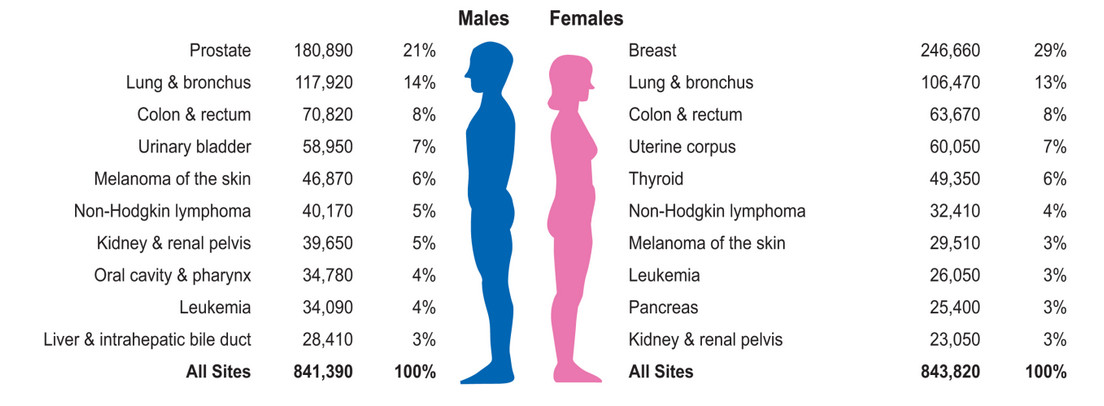 |
| Estimated death from cancer by site in men and women in the United States, 2016 (American Cancer Society) |
Abstract: While copying errors during stem cell division are a significant cause of cancer, they are not as important as mutations caused by factors such as radiation and chemical carcinogens; being careful about the environment and our lifestyle are effective ways of reducing our chances of developing cancer
Cancer is a disease, or a group of diseases, in which cells in the body grow and multiply uncontrollably; they can invade and destroy the surrounding healthy tissue and they can spread to other parts of the body. Cells become malignant, i.e. cancerous, through mutations that occur either as damage caused by radiation or by various (mostly chemical) carcinogens, or else through copying errors when the cells are dividing and the DNA is being replicated [1] (but see [2] Cancer an Epigenetic Disease, SiS 54). It is now widely believed that the mutations that matter are in the stem cells, undifferentiated cells that can either differentiate into the specialised cells that make up a tissue or divide to produce more stem cells [1].
Cancer is far more common in some tissues than in others. In the UK, one in eight women will be diagnosed with breast cancer at some time in their lives, one in 18 with lung cancer and one in 214 with liver cancer [3]. The incidence of cancer also varies from country to country: for women the age standardised rate per 100 000 is 325 in France, 318 in the US, 273 in the UK and 217 in Japan. The rates for men are generally higher [4]. (Because older people are more likely to develop cancer, for international comparisons the rates have to be ‘age adjusted’ to what they would be if all countries had the same age distribution.)
These variations give us clues about the causes of cancer and how to prevent it. The best known example is the discovery that lung cancer is far more common among smokers than among non-smokers. This implied that discouraging smoking would be an effective and inexpensive way of reducing the number of cases of lung cancer. Experience has shown this to be correct, despite determined opposition from the tobacco industry and dragging of feet by governments.
Just plain bad luck
Why are the rates so different for different tissues? Let’s concentrate on copying errors for a moment. The chance that an error will occur in any division is about the same for all cells but the number of stem cell divisions over a lifetime varies considerably from tissue to tissue. So if copying errors in stem cells were the only causes of cancer, the lifetime risk of cancer in any tissue would be proportional to the total number of stem cell divisions. If we plotted the lifetime risk of cancer in different tissues against the number of cell divisions, the points would all lie on a straight line.
Of course copying errors on division are not the only causes of cancer and the points do not all lie on a straight line. But in a recent study, Cristian Tomasetti and Bert Vogelstein [5] at Johns Hopkins University in Baltimore found that they lie reasonably close to a straight line (the solid black line in Figure 1). The correlation coefficient is 0.81, which is generally accepted to indicate a strong linear correlation.
Copying errors are not, however, the only cause of cancer. We know that radiation and a large number of carcinogens are also implicated. What we need to know is how significant the other causes are. There may not be very much we can do about stem cell divisions and copying errors, and if that’s how most harmful mutations occur, getting cancer is largely a matter of bad luck. Avoiding carcinogens may improve our chances a bit, but not by much. The more important carcinogens are as a cause, however, the more important it is to do all we can to avoid them, both as individuals (e.g. by not smoking) and as a society (e.g. by banning the use of known carcinogens).
A standard statistical method for dealing with this sort of question (but see below) is to suppose that the variation in the incidence of cancer is the sum of two causes: intrinsic (e.g. stem cell divisions) and extrinsic (e.g. radiation and carcinogens). The proportion that is due to stem cell divisions can be shown to be equal to the square of the correlation coefficient, which for the data in Fig 1 is about 0.81. This suggests that 65 % of cancer is just bad luck and at most 35 % is due to things we can do something about.
Tomasetti and Vogelstein argue on the basis of their results that for a majority of cancers (lung cancer in smokers and colorectal cancers are among the exceptions) primary prevention such as changes in our lifestyles or in the environment is unlikely to make a major impact. We should be concentrating instead on early detection and treatment.
If this were true, it would be good news for the manufacturers of chemicals known to be carcinogens and governments reluctant to spend money to cut down on pollution.
Not entirely
In a recent paper, however, Song Wu and colleagues at Stony Brook University in New York State refute this argument [6]. They deal with Tomasetti and Vogelstein’s analysis but also draw on a number of different kinds of evidence. They point out that there is a great deal of variation among countries in the rates of many cancers, including breast cancer (almost 5 times as high in Europe as in Eastern Asia), and prostate cancer (almost 25 times higher in Australia and New Zealand than in South-Central Asia). What is more, when immigrants move from a country with a lower rate to one with a higher rate, they soon acquire the higher risk of their new country. This points very strongly to environmental factors; the genetic makeup of migrants cannot change in a couple of generations.
For many cancers, the environmental risk factors are known to be large. The best known is of course lung cancer; about 85 % of cases are due to long term exposure to tobacco smoke [7]. An estimated 75 % of the risk of colorectal cancer is attributable to diet, and for melanoma the risk ascribed to sun exposure is around 75 % [6].
There have also been studies of what are called mutational signatures in cancers, traces in the genome of cancer cells left by different mutagenic processes. There are about 30 distinct signatures, and only two are strongly correlated with the age of the patient. That suggests that these two are acquired at a more or less constant rate over the patient’s lifetime, and are probably the results of intrinsic processes. The others seem to be acquired at different rates in life and are probably caused by extrinsic factors; indeed several have been linked to factors such as ultra-violet radiation and smoking. Wu and colleagues point out that only a few cancers have large proportions of intrinsic mutations; most have large proportions of extrinsic mutations: almost 100% for myeloma, lung and thyroid cancers and 80-90% for bladder, colorectal and uterine cancers.
What about the correlation that Tomasetti and Vogelstein found? Even if their analysis is correct, the most it can tell us is that the number of stem cell divisions accounts for 65 % of the variation in cancer rates among tissues. That’s not the same as saying that it is 65 % of the cause of cancer.
To see the distinction, imagine a large class of Asian students. All of them were born with black hair, but some have hair of a different colour because they have dyed it. The variability in hair colour is entirely due to the environment and not at all due to heredity. But we would be quite wrong to infer from this that heredity is not the reason almost all Asians have black hair. In the same way, Tomasetti and Vogelstein cannot infer from their analysis that errors in stem cell divisions are 65 % of the cause of cancer.
Wu and colleagues adopt a different approach. They argue that we would expect all tissues with the same number of cell divisions to have the same intrinsic risk of cancer. We do not know what that is, but it cannot be less than the smallest lifetime risk in any tissue with that number of divisions. We can therefore take this smallest risk as an estimate of the intrinsic risk, with the higher risks observed in other tissues reflecting factors that are additional and almost certainly extrinsic.
Wu and colleagues therefore drew the regression line (the dashed red line labelled ‘“intrinsic” risk line’ in Fig. 1) that best fits not all the data but only the points corresponding to these minimal risk tissues. This, they argue, gives a good estimate of the intrinsic risk for a tissue with a given number of stem cell divisions. It follows that variations from the line give good estimates of the extrinsic risks.
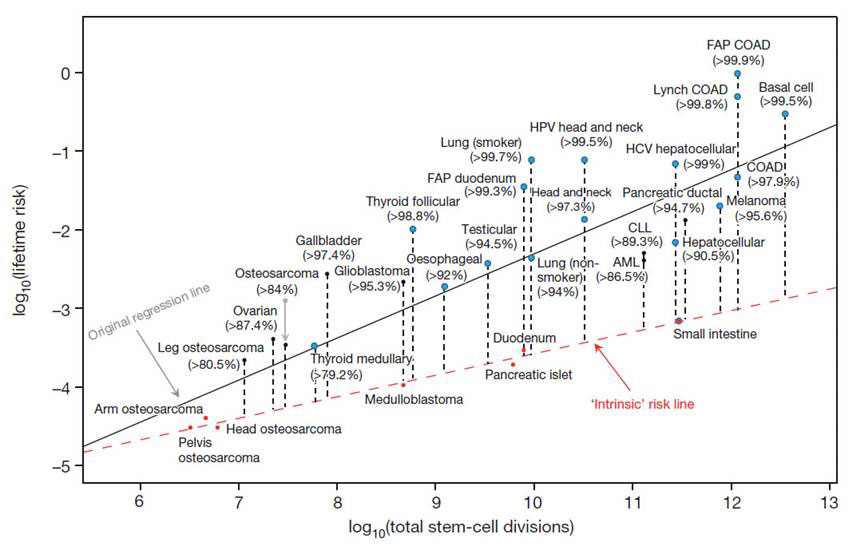
Figure 1 Estimate of intrinsic and extrinsic risks (see text for details)
Most cancer risks lie well above the “intrinsic” regression line, and Wu and colleagues estimate that the proportion of risk that is not accounted for by intrinsic factors is typically larger than 90 %.
Of course even the values on the intrinsic risk line may also include extrinsic factors. If that is the case, however, it means that Wu and colleagues have overestimated the intrinsic risk. As their claim is that the intrinsic risk is much smaller than that claimed by Tomasetti and Vogelstein, this strengthens rather than weakens their argument.
Like Tomasetti and Vogelstein, Wu and colleagues assume that it is errors in stem cell divisions that largely account for the intrinsic risk. To check that their analysis does not depend crucially on this assumption, they carry out a similar calculation using total tissue cell divisions, i.e. assuming that every dividing cell has the potential to initiate cancer. They find much the same result: the proportion of the risk that cannot be attributed to intrinsic factors is still mostly greater than 90 %.
Finally, Wu and colleagues modelled the potential lifetime cancer risk due to intrinsic stem cell mutation, varying the number of driver gene mutations needed for cancer to develop. They found that if one or two mutations were enough, the lifetime risk for most cancers would be much higher than is actually observed. If three or more are required, the intrinsic risks are even less than those predicted from their analysis of Tomasetti and Vogelstein’s data, and of course much less than the 65 % claimed by the authors themselves. This is further support for the conclusion that the contribution of extrinsic factors to the lifetime risk of cancer is greater than 70-90 % for most common cancers.
To conclude
The chief causes of cancer are almost certainly extrinsic: radiation, chemical carcinogens, etc. This is a very important finding, because if Tomasetti and Vogelstein were right and most cancers were due to copying errors, and bearing in mind that whatever we do we cannot avoid all extrinsic causes, then it might seem that the scope for preventing cancer by reducing our exposure to all but the most obvious carcinogens would be comparatively small.
That would of course suit the manufacturers of known carcinogens. It would also suit governments, who find it very difficult to regulate or ban harmful products in the face of determined and well-funded obstruction from industry. Remember how long it took to get action on asbestos and tobacco. And the tobacco industry is still fighting hard against measures to discourage smoking.
There were an estimated 14.1 million cases of cancer in the world in 2012 [8]. Even if extrinsic factors played only a minor role in most of these, we would still want to do all we can to reduce their effect. A small fraction of 14.1 million is still a lot of human beings. When, however, we realise that they are far and away the most important contributors to cancer, it becomes a matter of urgency.
A current case in point is glyphosate, the world’s most widely and pervasively used herbicide, recently classified by the World Health Organization expert panel as ‘probable human carcinogen’ [9] (Glyphosate ‘Probably Carcinogenic to Humans’ Latest WHO Assessment, SiS 65) which already justifies a worldwide ban. Actually, the range of available evidence is sufficient to classify it definitely carcinogenic (see [10] Glyphosate is Carcinogenic, Banishing Glyphosate). It would be reprehensible and irresponsible for regulatory agencies to succumb to pressure from industry to keep glyphosate in use, and worse, to increase its allowable limit in food, feed, and drinking water [11] ("Serious Deficiencies" in EFSA Glyphosate Re-assessment Signals EU Re-approval, SiS 69).
References
- Reya T, Morrison SJ, Clarke MF and Weissman IL. Stem cells, cancer and cancer stem cells. Nature 2001, 414, 105-111.
- Ho MW. Cancer an epigenetic disease. Science in Society 54, 8-11, 2012.
- Lifetime risk of cancer. Cancer Research UK, accessed 21 January 2016, http://www.cancerresearchuk.org/content/lifetime-risk-of-cancer#undefined.
- Data for cancer frequency by country. World Cancer Research Fund International, accessed 21 January 2016, http://www.wcrf.org/int/cancer-facts-figures/data-cancer-frequency-country.
- Tomasetti C and Vogelstein B. Variation in cancer risk among tissues can be explained by the number of stem cell divisions. Science2015, 347, 78-80.
- Wu S, Powers S, Zhu W and Hannun YA. Substantial contribution of extrinsic risk factors to cancer development. Nature 2016, 529, 43-47. doi: 10.1038/nature16166. Epub 2015 Dec 16.
- Lung Cancer. Wikipedia, 24 January 2016, https://en.wikipedia.org/wiki/Lung_cancer
- Worldwide Data. World Cancer Research Fund international, accessed 21 January 2016, http://www.wcrf.org/int/cancer-facts-figures/worldwide-data
- Ho MW and Swanson N. Glyphosate ‘probably carcinogenic to humans’ latest WHO assessment. Science in Society 65, 16-17+23, 2015.
- Ho MW and Saunders PT. Glyphosate is carcinogenic. In Sirinathsinghji E and Ho MW. Banishing Glyphosate, ISIS special report, London, 2015, http://www.i-sis.org.uk/Banishing_Glyphosate.php
- Sirinathsinghji E. “Serious deficiencies” in EFSA glyphosate re-assessment signals EU re-approval. Science in Society 69 (to appear) 2016.


