Thursday, January 18, 2024

3635. Fidel Castro's Speech on May 1, 2000

By Fidel Castro Ruz, Cuba Debate, April 27, 2020


Speech by Fidel Castro Ruz, President of the Republic of Cuba, at the mass rally called by the Cuban youths, students and workers on the occasion of the International Labor Day at the Revolution Square. May Day, 2000. Photo: CubaDebate. 

Compatriots:

We extend our gratitude to the admirable personalities accompanying us today, and our recognition to the workers, students and all of the people filling this square.

We are living through days of intense and crucial battle. For five months we have been fighting restlessly. Millions of our compatriots, almost without exception, have participated in this fight. Our consciousness and the ideas sown by the Revolution throughout more than four decades have been our weapons.

Revolution means to have a sense of history; it is changing everything that must be changed; it is full equality and freedom; it is being treated and treating others like human beings; it is achieving emancipation by ourselves and through our own efforts; it is challenging powerful dominant forces from within and without the social and national milieu; it is defending the values in which we believe at the cost of any sacrifice; it is modesty, selflessness, altruism, solidarity and heroism; it is fighting with courage, intelligence and realism; it is never lying or violating ethical principles; it is a profound conviction that there is no power in the world that can crush the power of truth and ideas. Revolution means unity; it is independence, it is fighting for our dreams of justice for Cuba and for the world, which is the foundation of our patriotism, our socialism and our internationalism.

In real and concrete terms, for 41 years now we have confronted a neighbor located just 90 miles away, the most formidable power that has ever existed in a world that has become unipolar and hegemonic.

This time the struggle has taken on a particularly critical character, as a consequence of the kidnapping of a child. Has he by chance been the only one? No! Many Cuban children have been separated from one of their parents and illegally taken to the United States without the slightest possibility to recover them by turning to the U.S. authorities.

In just the first two and a half years of the Revolution, some 14,000 children were taken out of the country clandestinely, in this case with the consent of their fathers, mothers, or both. These parents were victims of deceit, taken in by a carefully crafted and deliberately fabricated rumor based on a fictitious law spread by the U.S. intelligence services and their agents in Cuba leading these parents to believe that they would be deprived of their paternal rights over their children. The subsequent abrupt suspension by the U.S. government of regular flights between Cuba and the United States left these parents separated from their children, many of whom suffered terribly feeling helpless and uprooted.

On this most recent occasion, a humble father turned to our government for help: his son, who had not even turned six, had suffered a horrible tragedy. Without the father’s knowledge or consent, the child had been taken out of the country illegally as part of an irresponsible and hazardous misadventure organized by an aggressive and violent criminal. As Elián’s maternal grandmother Raquel stated upon arrival in New York on January 21 seeking her grandson’s liberation, that abusive individual had dragged her daughter into this tragedy.

The boat sank and the boy watched his mother drown. She was an excellent worker, a member of the Young Communist League and the Communist Party, and all those who knew her thought highly of her. She was one of the victims among the 11 Cubans who lost their lives that day. Like many others throughout the last 34 years, they were led to their deaths by a monstrous and bloody aberration known as the Cuban Adjustment Act, which promotes illegal migration and the smuggling of humans. Like millions of people from poor countries on this and other continents, they travel to the United States lured by the ostentatious luxury and extravagant displays of consumer societies.

In the particular case of Cuba, these attractions are enhanced by the tremendous privileges granted by the aforementioned legislation exclusively to the Cubans traveling illegally to the United States from Cuba, which come on top of four decades of a blockade and an economic war as abhorrent as this law. Thus, in spite of the migratory agreements signed by the two countries, Florida is being filled with criminals who arrive by illegal means. Five out of every ten individuals who reach the United States in this way have criminal records that include burglary and other similar crimes.

As it is known, this child managed to survive by remaining adrift on an inner tube for more than 30 hours. The Cuban-American terrorist mob, created by irresponsible U.S. administrations after their own image and likeness, took control of the child as an invaluable poster boy. A corrupt and sinister individual –simply a distant relative who had only seen the child once in his life– was given temporary custody. Completely under the mob’s control, he refused to surrender Elián when his father claimed the boy after he was released from hospital.

Consequently, with their usual tenacity our people immediately began the fight to demand that the child be returned to his father and the close relatives with whom he had always lived.

According to international law and the legal standards prevailing both in the United States and Cuba, the proper procedure would have been to immediately return the child to his country of origin and to resolve any dispute in a Cuban court of law. However, almost 10 days would pass before a response was given to the diplomatic note presented by the Ministry of Foreign Relations demanding the return of the child as requested by the father from the very beginning. By that time, the first public protests had taken place in Cuba, and they have continued up until today.

It is obvious that they underestimated our people, who have not rested a single day in fighting for something absolutely just, and who have conveyed to the American people and the rest of the world their message of pain and indignation over the injustice committed against a humble Cuban family and the terrible crime perpetrated against this child. Elián has endured almost five months of mental torture, psychological pressure and political manipulation. Not even Dante could have described the hell he has been through!

These events aroused the sympathies of tens of millions of American families with children, grandchildren, great-grandchildren, nieces and nephews of Elian’s age. For them, as for the rest of the world, it became increasingly clear that there could be no political or ideological justification for such a barbaric and harsh crime against a child and his father, regardless of their nationality.

The Miami terrorist mob and its allies from the extreme right in the United States have accused us of politicizing the case, when we have actually been fighting against this crime through peaceful means. Not a single window has been broken at the U.S. Interests Section, not a single stone has been thrown at that building, not a single American official or visitor has been harassed, not a single U.S. flag has been trampled on or burned in our streets.

I wonder what the U.S. government would have done if a similar situation had been created with a barely six years old American child kidnapped in Cuba and subjected to the appalling treatment this child has sustained in that country.

Throughout almost five months –from the time the child was found off the Florida coast– inconceivable things have happened and all kinds of abuses and mistakes have been made. Despite their knowledge of the situation, until very shortly before the boy was rescued, the various branches of the U.S. administration showed little concern over his mental health and the scandalous public exhibition and manipulation of which he was a victim, or something even more reprehensible: the physical dangers he was facing.

The chief of the commando force involved in the rescue operation recently stated that the resistance to the raid was perfectly organized and that there were numerous armed men around the house where the child was being held captive, just as the Cuban government had warned the State Department and publicly denounced between March 22 and April 22.

The last seven-point proposal sent by the Attorney General to the child’s father, at close to 10:00 p.m. on Friday, April 21 –approximately seven hours before Elián was freed from his kidnappers at 5:00 a.m. the following day– contained three points that I did not want to read at the mass rally in Jagüey Grande where we commemorated the painful episode of the Bay of Pigs mercenary invasion. I felt they were simply too grotesque and so I opted for the 24 four-hour truce of which I spoke, in recognition of the decision finally adopted by the Attorney General, although we remained profoundly concerned about future events. Those points were:

“2. Saturday morning Elián and Lázaro’s family will fly to Washington on a USMS (United States Marshall Service) plane under the supervision of the USMS. DOJ (Department of Justice) will transport them directly to Airlie House. The child will be guarded by USMS.

“3. During the residence at Airlie, Elián will live with Juan Miguel, who will have full authority over Elián except for any condition of parole or other limitations imposed by the INS such as departure control. Upon Juan’s arrival at Airlie House, the AG (Attorney General) will parole Elián into Juan Miguel’s care. Lázaro’s family will reside at Airlie House in separate quarters.

“4. The parties will remain in residence at the site while the CA (Court of Appeals) 11 injunction remains in effect, or until the AG in consultation with experts determines it is appropriate to change the arrangements.

Nothing could be more humiliating, or more closely resemble the imprisonment or kidnapping of Juan Miguel with his wife and two sons. It was the beginning of a new stage in the psychological torture of the whole family, even worse than that sustained by the boy in Miami.

Those who have seen Marisleysis’ hysteria on television and know who the sinister Lázaro really is, and also all the honest psychiatrists, fully understand what this absurd and impossible cohabitation would have meant for Elián and his family. This is precisely what the Cuban American National Foundation (CANF) was demanding. It was such a proposal that led to Juan Miguel’s almost suicidal decision to immediately leave for Miami with his wife and son to personally rescue Elián.

But, those crazed counterrevolutionary ringleaders were so stupid that they opposed this proposal, even though it was exactly what they themselves had been demanding, except that they wanted it to take place in Miami, and not in Washington.

The well-known Congressman Bob Menéndez, a lobbyist and close ally of the Miami mob, together with an assistant under-Secretary of State spent Friday, April 21, desperately searching for a place similar to Airlie House in the Miami area.

These facts I have related to demonstrate the shameful lengths reached by the Attorney General to avoid the use of force. Nobody in our country ignores the potential dangers lying on the twisted path taken by the U.S. authorities –under pressure from the CANF– to resolve what would have been a simple migratory case if it had not involved a Cuban child.

Here are a few facts that support this statement:

First: The three judges on the panel responsible for ruling on the mob’s appeal are not trustworthy. The response to the Attorney General’s request for them to legally direct Lázaro González to surrender the child, after his obvious failure to abide by the INS order, will go down in history as a prime example of outrageous, biased and overbearing conduct. On that day, they decreed that a child of any age and nationality could apply for asylum in the United States against his or her parents’ will. On the other hand, the martyred child has been forced to remain in the United States until the legal proceedings have concluded. Nothing was said, however, about the failure to abide by the order issued to the kidnapper to surrender the child. The Attorney General had no choice. She was forced to either make shameless concessions or to use force. She did both. Only fate and the skill of the marshals prevented the worst from happening, and the child was rescued safe and sound.

What guarantee does the father now have that the reunion with his son will be final? None!

Second: The Nuevo Herald reported on April 26 that on the previous day, Tuesday, April 26, a group of 11 senators had called a meeting with Attorney General Janet Reno in order to “discuss concerns.” When she was asked, “what would happen if the Atlanta Court of Appeals or any other court decided that the child should be granted asylum,” the Attorney General answered, “Then I believe we will have to send him back to Miami.”

The danger that this court will decide that the child has the right to asylum is real. It would fully coincide with the doctrine that it followed in its April 19 ruling and with what the terrorist mob demanded. Nobody could guess the reaction of the international public, and the public in the United States itself, if Elián were torn away from Juan Miguel and sent back to the living hell of the González’ house, now that they have seen everything that was done to the child in Miami and witnessed the moving images of the father and son’s reunion. It is impossibility, but this is what the Attorney General said, and this is what the Atlanta panel could decide.

Third: On April 26, the ANSA news agency issued the following report from Washington: “‘Wye River’ –that is the name of the place where Juan Miguel and his family are staying– ‘was chosen because it is very good for a child, who can play on its grounds. And it is big enough so that the relatives can potentially be there without bothering one another,’ said a Department of Justice official who asked for anonymity.”

As you can see, this is a recurrence of the old and sinister idea contained in the previously mentioned horrifying points in the proposal sent to Juan Miguel on the critical night of Friday, April 21. And none other than an “anonymous” Justice Department official stated it.

Fourth: On April 26, Gregory Craig, Juan Miguel’s attorney, presented to the three-judge panel at the Atlanta Court of Appeals what is known as an emergency motion requesting Juan Miguel’s intervention in the proceedings. The motion also requested that Juan Miguel replace Lázaro González as the child’s sole legal representative, both in his capacity as the only surviving parent and as Elián’s “next friend”, a strange term used in the U.S. legal proceedings when a minor has no close relative to represent him or her in court, which obviously does not apply in Elián’s case.

On the following day, April 27, the Atlanta panel refused to recognize Juan Miguel as the child’s sole representative, but granted him the right to intervene in the proceedings, although voting was divided on the latter point.

With regard to this matter, the New York Times reported on April 28, “In a mixed decision on the Elián González case, a federal appeals court today put off a request by the boy’s father to serve as his sole legal representative, which would have effectively ended the court challenge… In its ruling, the appellate court panel said it was ‘hesitant’ to grant Juan Miguel González the right to intervene in the case at this late date, but had agreed to the request because he was the boy’s father. One of the three judges dissented.

“The court also said it would be ‘premature’ to decide whether the boy’s father should serve as Elián’s sole representative.”

The well-founded motion presented by Juan Miguel’s attorney and his sound arguments were dismissed by the panel with regard to the father serving as sole representative of his son.

According to legal experts, if the ruling to be made by the three judges on May 11 is divided, that is, based on a two-to-one vote, the losing side could request that all of the judges on the Atlanta Court of Appeals pass judgment on the case and not only the three who have been assigned to it.

In any case, the experts say, this recourse would mean a further possibility of prolonging the duration of legal proceedings, and could always be followed by an appeal before the Supreme Court.

There are five other alternatives that could be pursued to draw out the proceedings indefinitely.

At the same time, the mob’s attorneys have applied for various orders and definitions.

Fifth: Going back to April 25, AP reported the following from Laredo, Texas: “‘The Clinton administration should try to persuade Elián González’s father to stay in the United States to raise his son here,’ said Republican presidential candidate George W. Bush. ‘I hope the government explains to the father that, if he prefers to, he can raise his son in freedom, that the father can stay here in the United States. It is important for our government to remember that the mother was fleeing in search of freedom, to bring her son to freedom. I hope that the government convinces the father to raise his son in the United States of America.’”

Sixth: On the following day, according to a wire report from the EFE news agency, Hillary Clinton, the U.S. president’s wife, during a radio interview in Buffalo, New York, “expressed her hope that the father of the little Cuban boy Elián González, Juan Miguel, will eventually decide to seek exile and live in the United States.

“‘I hope that this taste of freedom and opportunity he has had with his son during this time might help him to reconsider staying definitively in the United States.

“‘I am convinced that many people would be happy to take him in if he decides to defect,’ said the first lady, using the term applied to soldiers who resolve to abandon their own country and seek refuge in another, usually an enemy country.”

In other words, they do not mind talking about instigating the defection of a father who has been viciously slandered for months. They cannot even conceive of an honorable Cuban. First, they accused him of being a coward, who did not dare to travel to the United States and did not even care about his son. Then, they claimed that the Cuban government would not allow him to go to the United States, so that he did not defect. Now, that they have seen him arrive with his wife and infant son, at the exact time, hour and minute he should do so, they have still not recovered from their amazement at Juan Miguel’s dignity, courage and sense of honor. They are trying to keep him there indefinitely in the hope of enticing him away. They are all working in unison in pursuit of the same goal: to ensure that the boy never returns to Cuba, and thus deal a moral blow to the proud and heroic people that produced Juan Miguel and Elián.

Where are the ethics of that country’s political leaders? How can they be so utterly ignorant of the realities of Cuba? Why such contempt? How long will they go on believing their own lies?

On April 27, a whole series of limitations and obstacles were suddenly imposed on the movements of the Cuban officials responsible for Juan Miguel, his wife and his two sons, who are currently 70 miles away. Only four visas were granted for the children who should travel to the United States to help with Elián’s recovery, and they have been limited to a 15-day stay. An absurd formula has been developed by which they must rotate every two weeks; and none of the crucially needed specialists requested by the family has received permission to travel to the United States. Obviously, the purpose was to isolate Juan Miguel, his wife and the two children in the distant Wye River estate in Maryland.

Coinciding with Mr. Bush and Mrs. Hillary Clinton’s statements, Secretary of State Madeleine Albright said in an interview with the Fox TV network, “We have some very serious problems with Cuba and we are going to maintain the embargo law” –that is what she calls the blockade and the economic war– “and the Cuban Democracy Act” –that is how she refers to the genocidal Helms-Burton Act.

It is amazing, though, because nobody in Cuba had asked the U.S. government for forgiveness nor had anyone asked it to put an end to this blockade, which is becoming increasingly unsustainable and is definitely crumbling because it is obsolete and it is ever more costly in political and moral terms for the United States.

The forefathers who instituted our homeland’s heroic tradition of challenging the United States’ two-hundred-year old dream of annexing Cuba taught us that rights are demanded, not begged for. Nothing will be easy with regard to Cuba in the future. Forty years resisting all sorts of aggressions and injustices, and the war of ideas we have been waging ceaselessly throughout five long months have made us much stronger.

We will fight tirelessly against the murderous Cuban Adjustment Act; against the cruel Helms-Burton Act, whose sponsors deserve to stand trial for the crime of genocide, according to the conventions signed in 1948 and 1949 by both Cuba and the United States; and against the Act whose namesake, Robert Torricelli, is an ally of the Miami terrorist mob.

We will fight against the blockade and the economic war that our people have endured for almost half a century. We will fight against all subversive activities carried out from within the United States, including terrorist acts aimed at destabilizing our nation, and we will fight for the return to our homeland of the territory illegally occupied in our country. We will fulfill everything we pledged in the Baraguá Oath, in honor of the indelible and immortal memory of Antonio Maceo, the Bronze Titan.

We do not blame the American people; we blame those who are responsible for the lies used to deceive them for much longer than Lincoln ever imagined. On the contrary, we pay tribute to the overwhelming majority of those people who, despite all those lies, have opposed the odious crime committed against a small Cuban boy.

It would be wise for the current and future leaders of the United States to realize that David has grown and that he has gradually become a moral giant who does not throw stones with his sling, but rather examples and ideas against which the Goliath of finances, colossal wealth, nuclear weapons, the most sophisticated technology and worldwide political power based on selfishness, demagogy, hypocrisy and lies is completely helpless.

To ensure that they do not get their hopes too high over their ridiculous and Pyrrhic victory arising from the loathsome resolution adopted in Geneva, based on slander and imposed by the U.S. government through humiliating pressures and the backing of its NATO allies, during that same session Cuba put forward six resolutions in favor of Third World nations. They were all adopted by an overwhelming majority, with the United States voting against every single one, generally with the sole support or abstention of the small group of its wealthy European allies.

The peoples of an ungovernable world, who suffer poverty and indigence and are exploited and plundered at an ever-growing rate, will be our best comrades in arms. We certainly lack the financial resources to cooperate with them. Instead, we have an extraordinary and selfless human capital that the wealthy countries do not have and never will possess.

Long live patriotism!

Long live socialism!

Long live internationalism!

Patria o muerte!

Venceremos!

3634. Why Am I Committed to the Fidelist Conception of Revolution?

By Olga Fernandez Rio, CubaDebate, November 28, 2016


There are many reasons for an entire people to pay tribute to the leader of the Cuban Revolution in a moment as sad as his physical departure. But despite the pain, it is a time for reflection and commitment to the one who educated us to think and feel like Cubans; the one who united us and created the conditions for the people to act as protagonists of the collective work that has been and will continue to be the Cuban Revolution; the sensitive and detached man; the one who elevated our small country to a global example and paradigm. Together with Che he will always remind us that imperialism is not even a bit like that.

But our task and commitment today is to grow as a people, delve into their thoughts and work and contribute to disseminating it so that it is reaffirmed as the shield and sword of the nation.

Do not forget that his intellectual production - born from the daily struggle and the challenges of the revolutionary process for more than 60 years - is a comprehensive work in which several facets stand out, such as his permanent reflection on the importance of the historical contexts that mark the paths revolutionaries; understand society as a whole; his conception of history as a condition of the present and a source for its analysis; the relationships between theory and practice and between strategy and tactics, together with the non-mechanistic management of the regularities of social development, contradictions and opportunities. Added to this are his commitment to the integrality and continuity of the social revolution, the recognition of the place of the human being in this process and the role of ethics, individuality, criticism and self-criticism.

All of this is summarized in his concept of Revolution that he summarized on May 1, 2000 and that today, within the framework of the tribute to our Fidel, we are called to claim, not out of fanaticism, but because it is a profound concept that is an undoubted contribution to the theory and praxis of social revolution. Implicit in this concept is his humanist sensitivity, which led him to adopt the independence ideology of José Martí and to develop an intelligent receptivity to Marxism from anti-dogmatic positions.

His concept of Revolution highlights the necessary interpretation of the historical conditions that in Cuba favored transformations in a simultaneous process of national liberation and construction of socialism that was capable of solving the problems derived from underdevelopment and dependence on the northern neighbor. He expresses a high sense of ethical responsibility translated into the necessary correlation between ethics and politics with the truth as a flag and as a commitment.

His conception of revolution is consistent with his work as a revolutionary leader who from very early claimed national independence and sovereignty along with the communist ideal, and demystified the scheme that considered him alien to Latin American needs and conditions. This is also one of his great merits, both in his tactical handling and in demonstrating that the essence of socialism is not contradictory with the revolutionary roots and traditions on our continent, including workers' struggles and expressions of internationalism.

An analysis of his life and work - so committed to the people, as well as so integral in itself - shows that for Fidel revolution and construction of socialism are concepts referring to the same anti-capitalist and pro-socialist process in which the education of the masses Popular movements, their active participation and their political culture are conditions that guarantee their advancement.

Although the concept that he most used is revolution, he also used the construction of socialism, which is theoretically and politically valid to refer to the process of socialist transition that takes place in a context of global capitalist predominance, of control by a system transnational institutional on which this predominance is based and interference and blockade by the United States to prevent the advance of the Cuban Revolution.

In Fidel's conceptions, revolution and construction of socialism are expressed as unity. The first marks the meaning of social transformation, as proposed on May 1, 2000, of "changing everything that has to be changed," and the second has to do with the nature of the contents of those changes, which are not just any change, but those aimed at adding favorable conditions to socialist society.

Added to this is that in his commitment and revolutionary efforts Fidel relied on criticism as a thermometer that measures the result of the changes and revolutionary advance; It is critical as an educational work and as an instrument of change that introduces a concept that has become political, rectification, understood as self-criticism and adjustment of the socialist order strategy.

Among others, an example of this educational capacity of criticism was revealed on November 17, 2005 in his intervention in the Aula Magna of the University of Havana in which, at the same time, he recognized the meritorious feat of the people who prevented that the collapse of socialism occurred in Cuba as occurred in other countries, he carried out a deep analysis of endogenous problems that could jeopardize its continuity, hence they had to be faced. On that occasion, in addition to warning about the possible reversibility of socialism, he recognized that one of the biggest mistakes made was thinking that we knew about the construction of socialism, a reflection that deserves a much deeper analysis than we are in a position to carry out at this time. reflections. It is a debt that the Cuban social sciences owe in relation to the theory of social revolution that needs greater depth in the current conditions of our country and the processes of change that take place in Latin America.

And it is precisely Fidel's thought and work that is an important contribution to that theory and to the revolutionary praxis that must accompany it. It is enough to point out that if we return to Fidel's conceptions of revolution as a “sense of the historical moment” and about the people as a plural revolutionary subject; his criticism of capitalism and imperialism; the socioeconomic coordinates that he links with the seizure of political power, the hegemony of the workers conceived within the framework of the necessary national unity, and socialism as a solution based on the conditions of our country, we find the keys to interpret his conceptions on the construction of socialism that become contributions of obligatory reference in the development of the theory of social revolution. Added to this is his handling of tactics, the way of confronting the enemy's contradictions, the ability to unite forces and the keen notion of the ideal moment and opportunity for action.

Today, when millions of human beings consider fighting for a more just world and society and when in several countries the popular movement of workers, peasants, indigenous people, social activists, together with intellectuals and academics, return to criticizing capitalism with renewed vigor , Fidel Castro's conceptions contribute to the analysis and transformation of the unjust social order prevailing in the world. The same happens in Cuba when socialism has been ratified as a development option with the determination and determination not to stray from the chosen route that includes cycles of rectifications and adjustments in accordance with the various contexts that influence the national reality.

In that effort, as the singer-songwriter says, "a machete may get tangled in the weeds," but the important thing is to know how to untangle it and for this we Cubans have a powerful weapon: the revolutionary legacy of Fidel Castro. Do not forget that there are already capacities created to continue involving Cubans more and more in solving the challenges of various kinds that are faced during the construction of socialism.

In this effort, the analysis of Fidel's work cannot be missed, which today is more necessary than ever when it defends the revolution as a mass movement, hence the weight he has given to educational work and direct dialogue with the people. that thanks to his work is full of educated and cultured men, women and young people, capable of consolidating the political power that has been deployed since 1959, and capable of carrying out the revolution as a comprehensive and continuous process of national liberation of an anti-imperialist and socialist nature.

3633. The Bolshevik Revolution On Its Centenary: What We Must Not Forget

By Olga Fernandez Rio, CubaDebate, November 7, 2017

Lenin with Leon Trotsky as the leader of the Red Army at his side
at the second anniversary of the Russian October revolution

The October Revolution of 1917 in Russia has a lot to do with the current search for a better world to which millions of human beings aspire for having provoked a far-reaching revolutionary transformation, beyond the Russian - later Soviet - borders, and for being the first experience of disconnection from capitalist and imperialist domination.

The merits of this important event are multiplied if we take into account the economic conditions of Russia at the beginning of the 20th century, an immense semi-feudal country, with millions of illiterate people and only a few pockets of industrial development. Added to this is that when he overthrew the reactionary tsarist monarchy and embarked on revolutionary change, he had to face the economic and military aggression of practically all the capitalist powers of the time.

In those difficult conditions, the revolution caused a colossal socioeconomic, political and cultural transformation in favor of the interests of the dispossessed majorities and excluded from wealth and rights.

It was an experience of search and discovery of a cultural and civilizational change and, as many recognize, it was a hurricane of hope, not only for Russia and for the Soviet republics that were later formed, but for the workers of the world determined to achieve a better distribution of wealth and the cessation of exploitation, along with the dignity of work.

The Great October Socialist Revolution revolutionized the world, motivated the implementation of organizational formulas to confront capital and like a wave, communist parties, unions, worker and peasant movements, along with women's organizations in defense of their rights, multiplied. time the confrontation with colonialism and neocolonialism grew.

That revolution infused with new vigor the popular struggle on our continent, brewing since the end of the 19th century when North American imperialism - as José Martí had foresaw - expanded with interventionist boots and usurpers of natural wealth. In this context, the working class grew in some countries with greater industrial development under the influence of revolutionary ideas, Marxist in many cases, anarchist in others, brought by European immigrants who arrived in Latin America and the Caribbean. They were revolutionary ideas and actions that multiplied after 1917.

The revolution of 1917 in Russia had a lot to do with the social conquests obtained by broad popular masses throughout the 20th century and with the patriotic and internationalist capacities developed in the people of the Soviet republics who, together with the Red Army, were decisive. in the confrontation and defeat of fascism. It also had a lot to do with the reasons that led the USSR to become the second world power, to become a balancing factor that made possible better conditions for the achievement of independence of many colonial countries. That immense country was the one that sent the first man, the first woman and the first Latin American to space, which is not simple symbolism, but a sign of scientific and technological development in favor of peace.

Capitalism itself could not avoid the impacts of the revolution and was forced to adapt to a new context in which a strong rival appeared that later led to bipolarity. The reformist theses and actions in favor of the so-called “Welfare State” in the formations of European capitalism was one of those impacts, as was the policy of the so-called New Deal (1933-1938) adopted by the President of the United States Franklin Delano Roosevelt. .

It was a genuine revolution with incalculable historical and political value, which cannot be underestimated due to the deviations that at some point distanced leaders and sectors of Soviet society from the conceptual and political bases of the revolution and from the honest Marxist roots of the ideals and actions of Vladimir I. Lenin and other leaders of that feat.

It is not on this occasion that we are going to judge the distortions about the socialist ideal, nor the perversion of democratic practices that later permeated the USSR, nor will we stop with points of view about the dismantling of the construction of socialism that led to the collapse of a society that rose with notable successes as an alternative to capitalism. But much less are we going to detract from what the October Revolution and the existence of the USSR and the European socialist camp meant for the underdeveloped world and for the advancement of the Cuban Revolution.

The truth is that what happened was an extraordinary experience whose achievements and errors require deepening and analysis. The first as a sample of what is possible for the people to achieve in favor of their interests, and the second to reflect on endogenous factors in a process of socialist transition that can lead to its dismantling, even in a very short time, if not They adequately resolve the contradictions inherent to that type of process.

These are topics that must be explored in depth along with questions about conceptual, socioeconomic and political approaches that were established in the USSR on very sensitive problems, especially for the people.

This is the case of the correlation between development and economic growth without the deployment of an individual and social consciousness permeated by socialist and communist values; the distancing of party, state and government structures from the masses and the State from civil society, along with the undervaluation of the subjective factor in a revolutionary process and its role in the necessary renewal of socialist hegemony. Also the social impact of distortions in the field of culture, dogmatism, bureaucratism and corruption deserve serious reflection if we take into account the warnings raised by Lenin before the triumph of the revolution, but especially between 1918 and 1923.

Of many works, notes and reflections presented during a little more than the first five years of the revolution in power, we highlight his analyzes in "The immediate tasks of Soviet power" and Will the Bolsheviks remain in power? where he delved into the complexities associated with the task of governing while representing the interests of workers and peasants. We also highlight the projections on issues of party organization and politics presented in his letter of December 1922 to the party congress, which for many constitutes his political testament with clear references to the important role of workers and peasants, of the popular masses, in a process towards socialism.

The truth is that what led to the collapse of the USSR cannot be attributed to Lenin or Marxism, nor can it be used to disqualify the historical and political value of the Bolshevik Revolution of 2017, an event that is highly topical beyond the celebration of its centenary. It is not about wrapping ourselves in nostalgia, but about analyzing in a balanced way the historical facts, the achievements, the errors, the contradictions that existed, but also the inconsistency of myths and traps that have arisen, especially since 1989, with a view to "substantiating" the supposed unviability of socialism and the inevitability of capitalism, which constitutes an unacceptable historical fatalism.

But above all, the analysis of the October Revolution demonstrates that the lessons of history are an inalienable legacy that nourishes the anti-capitalist and anti-imperialist movement today, they are resources that fuel the actions to face the present and project the future of those who aspire. to a better world. They are lessons for the deployment of socialist transition processes that will always be developed with many unprecedented conditions because no two countries are the same, but at the same time they require compasses that allow directing the course towards a strategy of socialist order. Therefore, it not only contributes to the evaluation of the past, but also to the projection of the present and future of humanity.

Thursday, January 11, 2024

3632. Paul Burkett: May 26, 1956-January 7, 2024

Kamran Nayeri, January 11, 2024


Sadly, I just learned that Paul Burkett died last Sunday from complications of acute myeloid leukemia. I came to know Paul as a fellow Union of Radical Political Economics (URPE) member in the late 1980s and if I remember correctly, he was twice co-participating in the same URPE panel discussion at the American Economic Association annual conferences. Like me, Paul was interested in late capitalist development, which was the theme of his earlier presentation. He collaborated with Martin Hart-Landsberg of Lewis and Clark (Development, Crisis, and Class Struggle 2000). But by the early 1990s, he began researching capitalism and nature, leading to his excellent book Marx and Nature: A Red and Green Perspective (1999). In that book, Paul gave a reading of Marx that illuminates his views on aspects of the problem of society and nature, or what he and John Bellamy Foster later called Marx's ecological insight. 


The last time I saw Paul was in Havana, Cuba, in May 2003 during The Works of Karl Marx and the Challenges of the 21st Century conference, the first of such conferences organized by the Philosophy Institute of Cuba. That conference attracted leftists from the Americas, Europe, and elsewhere and took place in a tense political moment. In March, George W. Bush invaded Iraq under false claims and overthrew Saddam Hussein's regime. Already, Bush's administration was threatening to invade Cuba. On April 2, six men using arms hijacked a ferry in Havana Bay and ordered the captain to sail to the United States. The Cuban government captured and tried those involved, and three ring leaders, Lorenzo Enrique Copello Castillo, Barbaro Leodan Sevilla Garcia, and Jorge Luis Martinez Isaac, were sentenced to death for endangering lives and threatening the security of the country and were executed. 


Some of the participants in the conference created a petition to the Cuban government that condemned the execution of these men and demanded that Cuba end capital punishment on the books since the triumph of the revolution in 1959. Paul and I disagreed on signing the petition. He did, and I did not. I did not, not because I am not against capital punishment; I am. But at the same time, if a revolution faces imperialist invasion and some armed individuals threaten the safety of some citizens and provide a pretext for imperialist invasion, they must be held accountable and dealt with according to the law. In this situation, I would not second guess the government of Cuba at such a critical time. Soon after the petition had circulated, one late afternoon before dinner time, Fidel Castro unexpectedly arrived in the lobby of our hotel. He held a conversation with some of the conference participants. I do not know if Paul attended that meeting; I was already gone for another meeting elsewhere. But Fidel discussed the situation and presented the reason for the executions to those present.  


While I respected his views, I disagreed with Paul's uncritical support for Bernie Sanders. However, he was not alone among socialists and ecosocialists in such illusions. I left System Change, not Climate Change, a network of ecosocialists in part because its key leaders uncritically supported Alexandria Ocasio-Cortez after she was elected and promoted herself as the champion of the vague idea she called Green New Deal to combat climate change from the halls of U.S. Congress.  


Paul was several years ahead of me in recognizing and embracing ecosocialism. I considered myself an ecosocialist starting in 2000, and Paul's book, among others, was part of my coming up to speed about the theories of ecosocialism. I differed with Paul in his rereading of Marx in that while he was a pioneer in finding valuable aspects of Marx's interest in nature, he, Foster, or Saito, who claimed Marx was an ecosocialist, never tried to ask how these insights relate to historical materialism and his labor theory of value which quite consciously set aside nature to focus only on society (see, Nayeri, 2003). I tried to engage Paul in discussing these issues, but he was dismissive. I know now that this lack of interest in such discussion was at least in part due to his critical illness, which he did not disclose to me.


Like Paul, I love jazz and wanted to learn to play saxophone. After the death of his beloved son, Paul picked up the saxophone, learned to play it well, and even composed short pieces he shared with me. However, I noticed there was always something dark in his music, which I attributed to the continued grieving of the loss of his son. Perhaps his failing health was also responsible.  


Paul was a creative and passionate human being and contributed significantly to our understanding of Marx's evolving view of society and nature. I will miss him. 


Below is the obituary in Tribune Star.

TERRE HAUTE - Dr. Paul Burkett, 67, of Terre Haute, IN, died from sudden complications of acute myeloid leukemia on January 7, 2024. He died at home, lovingly attended by his wife Suzanne and son Shaun.

Paul was born in Wyandotte, MI in 1956 to William Loyd Burkett and Dorothy Whalen Burkett.
Paul attended Wyandotte Roosevelt High School, Kalamazoo College, and received his PhD in Economics at Syracuse University. His teaching career began at Syracuse and took him to Auburn Correctional Facility in New York, the University of Miami, and Indiana State University, from which he retired in June of 2020.

Paul was preceded in death by his parents, his twin brother Patrick J. Burkett, and his youngest son Patrick M. Burkett. He is survived by his wife of 38 years, Suzanne (Zann) Carter; sons Ian (Lisa) Hussey and Shaun Hussey; daughter Molly Burkett; granddaughters Sophia Hussey and Raven Renn, and his brothers Philip (DeAnn) Burkett, Charles Burkett, and Richard (Karen) Burkett; as well as many loving nephews and nieces.

An intellectual and scholar, Paul published many books, journal articles, notes, reviews, and book chapters in his field. He felt his most important books are Marx and Nature: A Red And Green Perspective (1999) and Marxism and Ecological Economics (2006). He was passionate about his work, Socialism, the planet, and justice.

And Jazz! He began playing the saxophone when his son Patrick died, as a way to cope with deep grief, and proceeded to bring to his study of the instrument, of jazz, and of music in general, the same focus and fierce dedication he brought to his academic work. Calling himself PapaPatty in honor of Patrick, he played in many venues all around the area for almost two decades.
He asked only for a simple memorial gathering in late spring so that's what we'll do. Any donations in his honor can be made to Doctors Without Borders.
www.debaunfuneralhomes.com

Monday, January 8, 2024

3631. Ongoig Genocidal Zionist State's War in Gaza


By Latin Press Agency, Escambray, January 6, 2024


Almost 90,000 Palestinians, four percent of the total population of Gaza, died, were injured or are missing after three months of Israeli aggression against the territory, the Euro-Mediterranean Human Rights Monitor reported on January 6.

The non-governmental organization denounced in a statement that the Army's continuous air, land and sea attacks destroyed 70 percent of the civil facilities and infrastructure in the enclave.

The approach of the Israeli bombings seems to be aimed at carrying out collective punishment against the population and turning the area into an uninhabitable place, he stressed.

Gaza authorities estimate that since October 7, 22,600 Palestinians have died there and another 58,000 have been injured as a result of military operations by the Armed Forces of the neighboring nation.

The Observatory pointed out that the majority of Gazans were displaced from their homes by the bombs and detailed that during the ongoing war campaign, almost 68,000 homes were destroyed and another 179,000 were damaged.

Israel deliberately destroyed or caused serious damage to essential facilities, including 318 schools, 1,612 industrial centers, 23 hospitals, 57 clinics, 201 mosques and three churches, as well as 169 press and media offices, he stressed.

That country's troops deliberately target Palestinian civilians in order to force them to emigrate, in violation of the norms of international law, he noted.

The entity stated that these actions amount to crimes against humanity and war crimes, including genocide.

Sunday, December 24, 2023

3630. Marx's Abstract Theory of Value and Money in Capital Volume 1

 By Fred Moseley, December 16, 2020


3629. Marx’s Value Theory and the Value Form Interpretation

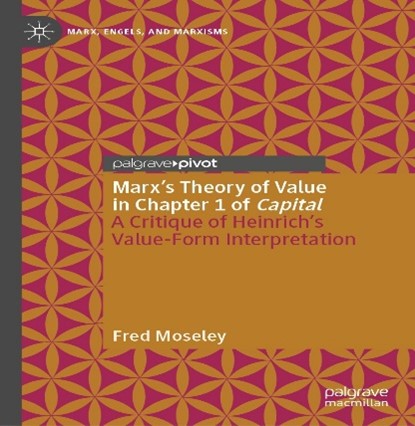
As I mentioned in a recent blog, at the Historical Materialism conference in London in November, there was a book launch for Fred Moseley’s new book Marx’s Theory of Value in Chapter 1 of Capital: A Critique of Heinrich’s Value-Form Interpretation. Michael Heinrich and Winfried Schwarz (a German Marxist who is also critical of Heinrich’s interpretation) participated in the book launch.

Moseley’s book is an examination of Marx’s theory of value in Chapter 1 of Capital, almost paragraph by paragraph in Sections 1 and 2, and a detailed critique of Heinrich’s value-form interpretation of Chapter 1, as presented in his 2021 book How to Read Marx’s Capital, which is a translation of his 2018 book Wie das Marxsche Kapital Lesen?

Heinrich is a well-known German Marxist who has published widely on his value-form interpretation of Marx’s theory of value, and his work is influential not only in Germany, but also in the UK and other countries in Europe and around the world.  He criticises the traditional interpretation of the labour theory of value, according to which the value of commodities is determined solely in production, and he argues that value is created only when it is converted into money through the sale of commodities on the market.

Moseley is one of the foremost scholars in the world today on Marxian economic theory. He has written or edited many books on Marxist theory.  He reckons instead that Marx presented a labour theory of value according to which the value of commodities is determined solely in production by the socially necessary labor time required to produce the commodities.  And Moseley argues in his book that the textual evidence in Chapter 1 overwhelmingly supports the labour theory of value interpretation of Marx’s theory of value.

The relevance and importance of this debate may seem obscure to many readers of Marx.  So Fred Moseley kindly agreed to be interviewed on his new book and the controversy with Heinrich.

MR:  How did this book come about?

FM: ”First of all, I want to thank you for the opportunity to discuss my book with you and your many readers.

Heinrich’s book cited above is a detailed textual study of the first seven chapters of Capital.  Heinrich is not very well known in the US, but he is very influential in Germany and other European countries.  He is something like a David Harvey of Europe.  But I am convinced that Heinrich’s book is a fundamental misinterpretation of Marx’s theory, so I decided to engage critically with Heinrich’s book. 

I started by writing a paper on Chapter 1, the foundation of Marx’s theory and Heinrich’s interpretation.  I presented this paper in a Zoom conference in June 2021 sponsored by Gyeongsang National University in South Korea.  An assistant editor of Palgrave’s Marx, Engels and Marxism series, Paula Rauhala, watched the my presentation and she contacted me and suggested that I write a longer version of my paper as a Palgrave Pivot book.  A Pivot book is a new initiative by Palgrave of short books, with a limit of 50,000 words (which I exceeded by 10,000 words!).  I am grateful to Paula for that suggestion and this little book is the result.”

MR:  Please give us an overview of your book

FM: “My little book is a detailed textual study of Marx’s Chapter 1 and Heinrich’s interpretation of Chapter 1.  The book consists of only 4 chapters. 

Chapter 1 of this book presents my interpretation of Marx’s theory of value in Chapter 1 of Capital, including a section on each of the four sections of Marx’s Chapter 1. Chapter 2 presents Heinrich’s interpretation of Chapter 1 of Capital and my detailed critique of Heinrich’s interpretation 1, with the same four sections.

Chapter 3 is about a 55-page manuscript that Marx wrote in 1872 in preparation for the 2nd German Edition of Volume 1, which is mainly about Section 3 of Chapter 1, entitled ‘Additions and Changes to the First Volume of Capital’, which Heinrich has emphasised in his book and in previous works to provide textual support for his ‘value-form interpretation’ of Chapter 1.  This important manuscript has not yet been translated into English.  A translation of a 4-page excerpt of this manuscript is included in Heinrich’s book as an appendix.  So Chapter 3 of my book presents my interpretation of this manuscript and a critique of Heinrich’s interpretation.  A translation of this entire manuscript should be a high priority of Marxian scholarship.

My book is very abstract theory, about the most abstract part of Marx’s theory, the beginning of Marx’s theory in which he presents the foundation of his labour theory of value. Marx said in the Preface to the 1st edition of Volume 1 of Capital that “beginnings are always difficult in all sciences”, and that is certainly true of Marx’s theory.  The best way to read my book is to have Heinrich’s book and Volume 1 of Capital close at hand.”

MR:  How would you summarise the main conclusions of your book?

FM: “The main conclusions of my book are the following:

1. The subject of analysis of Chapter 1 is the commodity, not a separate, isolated commodity, but a representative commodity, a commodity that represents all commodities and the properties that all commodities have in common (use-value and exchange-value). In the Preface to the 1st editionMarx described the commodity as the “elementary form” or the “cell form” of capitalist production.  So Marx analyses the properties of a representative commodity similar to the way cellular biology analyses the properties of a representative cell.  It’s like putting a commodity under a microscope and analysing its main properties.

Marx’s representative commodity in Chapter 1 is assumed to have been produced, but not yet exchanged.  This is crucial for the critique of Heinrich’s interpretation.  According to Heinrich, the subject of analysis of Chapter 1 is not the properties of a representative commodity, but instead is what he calls an “exchange relation” between two commodities, which he argues is the end result of two actual exchanges between the two commodities and money on the market. 

2.  The value of commodities is derived in Section 1 of Chapter 1 from the property of the exchange-value of the representative commodity (i.e. from the property that each commodity is equal to all other commodities in definite proportions).  And this general relation of equality between each commodity and all commodities requires a common property that is possessed by all commodities and that determines the proportions in which different commodities are equal. 

Marx argued that this common property of all commodities that determines their exchange-values is the objectified abstract human labour contained in commodities. And this is the result of the abstract human labour expended in production to produce the commodities.

According to Heinrich, on the other hand, the value of commodities is not derived from a relation of equality between all commodities, but instead is derived from an analysis of an “exchange relation” between two commodities, which he argues presupposes actual exchanges of the two commodities with money on the market.

3.  The magnitude of the value of each commodity is “exclusively determined” (p. 129) by the quantity of socially necessary labour-time expended in production to produce each commodity.  Heinrich argues, on the other hand, that the magnitude of value of a commodity depends in part on the relation between supply and demand for the commodity on the market.  This is the best-known assumption of the value-form interpretation of Marx’s theory of value.

4.  The labour that produces commodities has a dual character in production:  both concrete labour and abstract labour are characteristics of the same labour process in production.  Section 2 of Chapter 1 in particular presents very strong textual evidence to support this interpretation of the dual character in production of labour that produces commodities.  

Weaving and tailoring are Marx’s two examples in Section 2.  The labour process of weaving produces the use-value of linen, its dual character also being abstract human labour that produces the value of the linen.  The same dual character is true of the labour process of tailoring (and all other particular labour activities).  The values of the linen and the coat are compared by comparing the labour-time required to produce each one of them and nothing is said in this about exchange in this section.

Heinrich argues, on the other hand, that labour in production is only concrete labour and is not yet abstract labour.  Abstract labour comes to exist only in exchange, and thus the dual character of the labour that produces commodities comes to exist only in exchange. According to Heinrich’s interpretation, tailoring and weaving (and any other labour process) possess only a single character in production, not a dual character.  This interpretation is clearly contradicted by Section 2.”

MR:  Please say more about Heinrich’s interpretation of “exchange relation”.  That seems to be a central concept in Heinrich’s interpretation.

FM: “Heinrich’s concept of “exchange relation” is completely original with him.  No one else puts so much emphasis on this term and defines it the way he does.  And it is a new concept in his interpretation; it was not included in his 2012 book Introduction to Marx’s Capital.  And unfortunately, he does not explain this very well in this book, especially for such a fundamental concept.  There is nothing in his Introduction about this concept; there are only 1½ pages in an appendix in the back of the book on the abstractions that result in this concept (which he doesn’t refer to once in the rest of the book) and 1½ pages in his first discussion of this concept on pp. 53-54.  And from then on, he just presumes his interpretation of exchange relation and applies it to different passages in Marx’s text. 

I am pretty sure that most readers of Marx (especially beginning readers) will not understand the meaning and significance of Heinrich’s concept of exchange relation in his interpretation.  A young Marx scholar from Australia wrote a 2000-word review of Heinrich’s book for Marx and Philosophy and she didn’t mention the concept of exchange relation at all.  I myself had to work pretty hard to understand it because it is so poorly presented.

Heinrich defines exchange relation as an exchange between two commodities.  To take one of his examples that is borrowed from Marx: 

1 quarter of wheat is exchanged for x boot-polish.

Heinrich comments that this definition seems like direct barter exchange between the two commodities, but he states that this is not so, because direct barter seldom actually happens in capitalism.  Instead, Heinrich interprets the exchange relation between two commodities as the end result of two actual acts of exchange between the two commodities and money on the market. Thus…

1 qtr. of wheat is sold for 10 shillings and 10 shillings is used to purchase x book-polish

The important point is that Heinrich’s concept of exchange relation between two commodities presupposes actual exchanges between these two commodities and money on the market. Heinrich does not clearly specify whether these acts of exchange that are presupposed in his interpretation of the exchange relation are assumed to be actual acts of exchange on the market.  However, they must be actual acts of exchange in order to be consistent with Heinrich’s general value-form interpretation, according to which commodities possess value only if they have been actually exchanged on the market. 

Before actual exchange, according the Heinrich’s interpretation, commodities do not possess value (indeed, products are not even commodities) before exchange.  Products of labour become commodities and commodities come to possess value only as a result of actual exchanges on the market.  Therefore, since the commodities that Marx analyses in Section 1 (e.g. wheat and boot-polish) are assumed to possess value, in order to be consistent with Heinrich’s general value-form interpretation, he must also assume that these commodities have been actually sold and bought on the market.  If the commodities have not been actually exchanged on the market, then these commodities would not possess value, according to Heinrich’s general value-form interpretation.

However, there is absolutely no textual evidence in any of Marx’s several drafts of Chapter 1 to support Heinrich’s idiosyncratic interpretation of the exchange relation between two commodities – that it presupposes actual acts of exchange between these two commodities and money on the market.  This interpretation is Heinrich’s invention.  He does not cite any other authors with a similar interpretation of exchange relation, because there are none. And the exchange relation is the most important concept in Heinrich’s interpretation of Chapter 1. If his fundamental concept of exchange relation is a misinterpretation of Marx’s theory, then the rest of Heinrich’s interpretation of Chapter 1 is a misinterpretation and is unacceptable.

I think it is clear that the subject of analysis of Chapter 1 is the commodity, a representative commodity that is used to analyse the properties that all commodities have in common – use-value and value.  Chapter 1 is not about exchange at all.  The commodity that is analysed in Chapter 1 has been produced, but not yet exchanged.  Exchange is not considered until Chapter 2 (“The Process of Exchange”).

In recent weeks, while preparing for the HM conference and for this interview, I have come to realise more clearly that there is a fundamental contradiction in what Heinrich is trying to accomplish in his recent book.  In his previous works, he has presented (many times and all over the world) a strong value-form interpretation of Marx’s theory of value, according to which the value of a commodity exists only as a result of an actual exchange on the market. Before exchange, a commodity does not possess value (it only possesses use-value).  For the textual evidence to support this interpretation, he has used a handful of key passages that are taken from various texts in isolation and out of context.  As we know, one can always find passages that seem to support almost any interpretation of Marx’s theory.  And Heinrich is very good at this quotation game.

However, his most recent book is different; it is an attempt to interpret the first seven chapters of Volume 1, especially Chapter 1, as a value-form theory – and that Marx was the original value-theorist!  Heinrich goes from page to page in Chapter 1 and consistently tries to interpret key passages in a value-form way.  This is a very difficult task because there are so many passages in these chapters, especially Chapter 1, that contradict a value-form interpretation.  Indeed, in my view, Heinrich’s task is an impossible task.  My book follows his detailed commentaries point by point and exposes the errors in his value-form interpretation.”

MR:  What was the main disagreement between you and Heinrich in your book launch at the recent Historical Materialism conference?

FM: “Not surprisingly, the main disagreement in the session was over the meaning of exchange relation in two paragraphs in Section 1.  He argued that I misinterpreted Marx’s concept of exchange relation, not as an act of exchange between two commodities, but as a relation of equality between two commodities, and that I just substituted my meaning of exchange relation for Marx’s meaning in the two passages.  And he argued that these two passages are proof that that Section 1 analyses individual commodities as part of an exchange relation.

But that is not true.  I did not just substitute my meaning of exchange relation for Marx’s meaning in these paragraphs.  Rather, I argued that the exchange relation in these paragraphs is a synonym for exchange-value. The exchange-value of each commodity is defined in the preceding paragraphs in Section 1 as the property of each commodity that is equal to all other commodities in definite proportions that are mutually consistent. That implies that all commodities possess a common property that determines the proportions in which different commodities are equal.  Therefore, the exchange relation between two commodities in these paragraphs is also a relation of equality between two commodities, which implies the necessity of a common property possessed by each one of them.

Instead I argued that Heinrich is the one who misinterprets Marx’s concept of exchange relation with his strange definition as the end result of actual exchanges between the two commodities and money on the market,. There is absolutely no textual evidence to support this interpretation of actual market exchanges presupposed in Chapter 1.  My interpretation of exchange relation as a relation of equality between commodities is much more reasonable and plausible than Heinrich’s complicated and idiosyncratic interpretation of the end result of actual exchanges between commodities and money on the market. “

MR:  Are there other points that you would like to emphasise?

“I also want to mention Heinrich’s unusual interpretation of the word “common” in Marx’s derivation of value in Section 1 – that value is the common property of commodities that determines their exchange-values – because it is an important point in his interpretation that he has emphasised in all his writings, including in the book I am criticising. 

Take the concluding paragraph of Marx’s derivation of value on p. 128: “All these things now tell us is that human labour-power is expended to produce them, human labour is accumulated in them.  As crystals of this social substance, which is common to them all, they are values – commodity values. ” I argue that Marx’s meaning of “common to them all” in this passage is the usual meaning of “common” , namely that the same property is possessed by each individual commodity by itself, on its own.

Heinrich argues, on the other hand, that the meaning of “common” in this passage and in other passages is ambiguous – i.e. it could also mean a property that each individual commodity possesses, not by itself, but only together with another commodity in an exchange relation (exchange relation again!), and this is what Marx means here and elsewhere when he says that value is a common property of commodities.  According to Heinrich, outside of an exchange relation, an individual commodity does not possess the ‘common property’ of value.

However, I don’t think Marx’s meaning of “common to them all” is ambiguous at all; Marx states that the common property of commodities is the human labour accumulated in them as a result of the labour expended to produce them (each one of them), prior to and independent of its exchange with another commodity.  Nothing is said about exchange and exchange relation in this key concluding passage.

Three paragraphs before the passage just quoted, Marx presents a geometric example of area as a common property of different geometric figures.  Area is a ‘”common property” of each figure, independent of its comparison to the area of another figure.  The similarity between the area of geometric figures and the value of commodities is that, in both cases, the objects possess a common property independently of a quantitative comparison between them.  Heinrich does not comment on this illuminating geometric example which contradicts his interpretation that the common element of value is created in the exchange itself.  Clearly, the area of geometric figures is not created by a comparison of their areas.

One other point I want to mention.  In working on this book, I noticed for the first time that Marx repeatedly used the phrase the “own value” of an individual commodity in Section 3 of Chapter 1 (seven times); for example, the “own value” of 10 yards of linen or the “own value” of a coat (see pp. 100 and 104-06 of my book).  The own values of the linen and the coat are compared and equated, but nothing is said about exchange.  These passages are clear and unambiguous textual evidence that each individual commodity possess its “own value”, independent of acts of exchange between commodities and money on the market. This directly contradicts Heinrich’s interpretation that an individual commodity possesses value only if it has been actually exchanged with money on the market.  Heinrich quotes only 3 of these 7 ‘own value’ passages and presents little or no commentary on any of them. Twice he quotes the adjoining sentences, but not these revealing sentences.”

MR:  What difference does this debate over the details of Marx’s value theory make in the bigger picture?

FM: “I think it is important to get the details of Marx’s theory of value straight, because it is the foundation for Marx’s theory of surplus-value as a theory of exploitation in Volume 1.  And the theory of value is also the foundation of his theory of the falling rate of profit and crises that you have presented so well in your own work. In the Preface to the 1st edition of Capital, Marx stated: “To the superficial observer, the analysis of these forms [the commodity-form of the product of labor and the value-form of the commodity] seems to turn upon minutiae.  It does in fact deal with minutiae, but so does microscopic anatomy.” Microscopic anatomy is necessary for the understanding of organic bodies, and similarly Marx’s theory of value is necessary for an understanding of the capitalist economy.

My book is specifically about Heinrich’s book, but it applies to the value-form interpretation of Marx’s theory in general.  And my conclusion is that Marx’s theory of value cannot be reasonably be interpreted as a value-form theory.  I think that is an important conclusion.  We should move on from the value-form interpretation of Marx’s theory.

I worry about Heinrich’s influence on the understanding of Marx’s theory.  His interpretation is very influential in Germany and elsewhere in the world, especially among young people.  And I am convinced that it is a fundamental misinterpretation of Marx’s theory.  So I think it is important to engage with his popular but mistaken interpretation. I hope that my book will be read especially by young people and it will encourage them to make a deeper study of Marx’s theory of value in Chapter 1 of Capital and beyond.

Let me add my pennyworth to what I think are the wider issues arising from this debate between Heinrich and Moseley (MR). 

Marx put it this way: “As the commodity is immediate unity of use value and exchange-value, so the process of production, which is the process of the production of a commodity, is the immediate unity of process of labour and process of valorisation.”  So, for Marx, it’s the process of production, the exertion of human labour that creates value.  As Marx once put it: “Every child knows that any nation that stopped working, not for a year, but let us say, just for a few weeks, would perish. And every child knows, too, that the amounts of products corresponding to the differing amounts of needs demand differing and quantitatively determined amounts of society’s aggregate labour.”

The value-form approach of Heinrich is implicitly a simultaneist approach. Its characteristic feature is the belief that value comes into existence only at the moment of realisation on the market. Consequently, production and realisation are collapsed into each other and time is wiped out. But the process of production and circulation (exchange) is not simultaneous, but temporal.  At the start of production there are inputs of raw materials and fixed assets from a previous production period.  So there is already (constant or ‘dead labour’) value in the commodity before exchange. Then production takes place to make a new commodity using human labour. This creates ‘potential’ new value, which is realised later (in a modified quantity) when sold.

But why does all this matter?  For me, Marx’s value theory is about showing the fundamental contradiction in capitalism between production for social need (use-value) and production for profit (exchange value). Under capitalism, units of production are commodities that have a dual character which epitomises this contradiction. 

For Marx, money is a representative of value, not value itself. If we think that value is only created when selling the commodity for money and not before, then the labour theory of value is devalued into a theory of money. Then, as mainstream neoclassical economics argues, we don’t need a labour theory of value at all because the money price will do. Money prices are what mainstream economics looks at, ignoring or dismissing value by human labour power – and therefore the exploitation of labour by capital for profit. It removes the basic contradiction of capitalist production. 

Also, it leads to a failure to understand the causes of crises in capitalist production. It is no accident that Heinrich dismisses Marx law of profitability as illogical, ‘indeterminate’ and irrelevant to explaining crises and instead looks to excessive credit and financial instability as the causes. Heinrich even claims that in later years, Marx dropped his law of profitability although the evidence for that is non-existent.

If profits (surplus value) from human labour disappear from any analysis to be replaced by money, then we no longer have a Marxist theory of crisis or any theory of crisis at all.