On the composting site that David Buckel, a renowned L.G.B.T. rights lawyer, ran in Red Hook, Brooklyn, the rich new soil was created without using any fossil fuels.
Sometime before dawn on April 14, David Buckel left his small brick house on the edge of Prospect Park in Brooklyn, pulling a shopping cart. He passed the magnolia tree in the garden, the stone sculptures he had made. Then instead of walking to work, as he usually did on Saturdays, he went into the park.
He turned onto the road that loops around the meadows and ball fields, and after less than a quarter of a mile, he veered onto the grass. The place he chose would surprise people later, when they came with flowers: It wasn’t a plaza or a spot where crowds gathered — just a stretch of patchy lawn on the shoulder of the road.
It’s not clear how long Mr. Buckel stood there, or when he doused himself with gas, but at 5:55 a.m., as the light began to gather before sunrise, he sent an email to the news media explaining what he was about to do. The first 911 call came at 6:08 a.m.: man on fire.
When responders arrived, the flames were going out. Mr. Buckel, a prominent civil rights lawyer turned environmental advocate, was dead. He was 60.
It is impossible to know all the reasons a person commits suicide. Mr. Buckel suggested one: He was trying to call attention to pollution and global warming. “My early death by fossil fuel reflects what we are doing to ourselves,” he wrote in his email.
His suicide is one of the few known cases of political self-immolation in the United States since the 1960s — when demonstrators set themselves on fire to protest the war in Vietnam — and perhaps the first one anywhere in the name of climate change.
But his political message still left Mr. Buckel’s friends and family at a loss: Why would someone in his position resort to such a drastic measure to make his message heard? Why would someone who was committed to the quiet, daily work of making change — and who was notoriously private — stage a dramatic public suicide? He told no one of his plan, not his husband and partner of 34 years, Terry Kaelber, nor the lesbian couple with whom they raised their college-age daughter. He did not say goodbye to them.
Before dawn on April 14, Mr. Buckel left this small brick house near Prospect Park in Brooklyn, pulling a shopping cart.
News reports of his death featured photos of Mr. Buckel in his prime — a serious-looking lawyer who not long ago was at the forefront of the fight for marriage equality. A teacher who came across his body early that April morning described it as “mummified” by the fire.
“How do you get from that, to this?” said Adam Aronson, a lawyer and former colleague.
In the days after he died, Mr. Buckel was remembered for his work at Lambda Legal, a national organization that defends the civil rights of lesbian, gay, bisexual and transgender people. From about 1995 to 2008 he argued cases for L.G.B.T. youth and was a director of the marriage project, strategizing cases in Iowa and New Jersey.
Among his victories: Nabozny v. Podlesny, in which a federal court ruled for the first time that schools had an obligation to protect students from anti-gay bullying, and Brandon v. County of Richardson, where a sheriff was found liable for failing to protect a young transgender man murdered in Nebraska, an episode that inspired the 1999 film “Boys Don’t Cry.”
He brought an intense commitment to all that he did that could border on obsession. “David’s personality was such that anything he wanted to do, he would work really hard to understand it, more so than the average person,” said his husband, Mr. Kaelber.
Evan Wolfson worked with Mr. Buckel at Lambda Legal. “He was very passionate, very idealistic,” he said. Then he paused, searching for the right word. “But he could be absolute. He could be absolutist. He might sometimes take a position that I would challenge as not being realistic or strategic.”
When Mr. Buckel went to court, “he was impeccably color-coordinated and there was never a wrinkle or a crease in the wrong place,” Mr. Aronson said. His office was tidy to the point of seeming sterile. Before snapping a binder clip on a document, he folded a piece of paper over the pages, so it wouldn’t leave a mark, a former legal assistant remembered.
For the last decade, Mr. Buckel applied that intensity to running a compost site in Red Hook, on the Brooklyn waterfront.
He had grown up around soil and flowers in Batavia, N.Y. His mother worked in her family’s flower shop, Stroh’s Flowers; his father helped local farmers improve their operations. As a child, Mr. Buckel — the second-youngest of five boys — played in the family’s greenhouses and worked on an aunt’s chicken farm.
After Mr. Buckel left Lambda in late 2008, he was inspired by President Barack Obama’s call to volunteerism and took a composting class at the Brooklyn Botanic Garden. He was captivated by the idea of community composting, which involves locals in the process of turning orange rinds and coffee grounds and flower stems into enriched soil, while reducing landfill waste and greenhouse gases.
At the time, a composter named Charlie Bayrer and an ad hoc group of volunteers were collecting food scraps and composting on some old baseball diamonds in Red Hook that had been turned into an urban farm. Mr. Buckel apprenticed himself to Mr. Bayrer after doing some grant-writing for the farm, “and he really latched onto it quickly,” Mr. Bayrer recalled. “I kind of came up with these basic parameters — X number of volunteers and tools, and then David created something on an entirely different level.”
In just a few years, Mr. Buckel created one of the largest compost sites in the country operated without heavy machinery — using only solar power, wind power and the labor of volunteers.
Brenda Platt, co-director of the Institute for Local Reliance, in Washington, D.C., visited Mr. Buckel’s site at Red Hook Community Farm in 2014 after meeting him at a composting convention. “It was meticulously organized,” she said. “The boots were lined up, hanging upside down — you know, like wine glasses? The tools were lined up.” The buckets were divided by color and stacked into pyramids.
At night, Mr. Buckel would lie in bed staring at the ceiling, he later told his assistant, picturing the compost piles in their various states of decomposition, planning which ones had to go where.
“His skill was instructing volunteers like a symphony conductor,” said Alexander Jagiello, who works for the NYC Compost Project hosted by the Queens Botanical Garden. “You had people showing up to turn a windrow — which is a compost pile — week after week.”
Once the city’s Department of Sanitation started delivering food scraps from Greenmarkets to composting sites as part of the NYC Compost Project, Mr. Buckel’s site was processing up to 225 tons of organic waste a year.
Ina video he made in 2014, he wore cargo pants, a fabric hat and glasses that darken in the sun. In a soft, even voice, he went through his method. “To help with motivation,” he said, “we explain the importance of each toss of the pitchfork or shovel, because of the oxygen molecules attaching to the material.”
It’s about efficiency, he said, but also about the humans involved.
Mr. Buckel had been helping people from early on. After he graduated from the University of Rochester in 1980, he started working with hospice patients as a home health attendant — a job that seemed connected to events in his own life.
Two of his brothers had gone to Vietnam when he was a child and were injured. Around the time he was finishing college, his mother learned she had lung cancer, and after a torturous but swift decline, she died. She was some months shy of 60.
“It just devastated the family,” said a cousin, John Marr. “The father just kind of drifted away after that. He got in his car and drove and drove.”
As their father spent ever longer periods in Florida, Mr. Buckel and his brothers — once known as the Buckel brothers, as close as could be — went their separate ways. When Mr. Buckel’s father died in his 80s, the family found their old photographs ruined in the trunk of his car.
Mr. Buckel changed his middle name after his mother died to Stroh, her maiden name. “He was always a more sensitive and gentle soul,” said a niece, Kristi Buckel Hébert.
He met his husband in Rochester in the mid-1980s, and after he earned his law degree from Cornell University in 1987, the two moved to New York. Eventually, they found the house off Prospect Park, in Windsor Terrace, where they moved with the two women with whom they raised their daughter, and Mr. Buckel grew his garden.
His colleague, Mr. Wolfson, befriended Mr. Buckel not long after he arrived in New York, when they were both Lambda Legal volunteers. After they joined Lambda’s staff, they worked closely on a case against the Boy Scouts. “He was serious, in a thoughtful sense,” Mr. Wolfson said. “He was not grim or morose — we could laugh together and joke.”
But he remained guarded about his private life. Steven Goldstein, an activist who created Garden State Equality to press for same-sex marriage in New Jersey while Mr. Buckel pushed a case through the courts, did not even know for many years that Mr. Buckel had a child.
“We were an odd couple working for marriage equality, the talkative Jew and the buttoned-up WASP,” Mr. Goldstein said.
Despite Mr. Buckel’s reserve, Mr. Goldstein said, he retained a quixotic hopefulness that transformational changes were possible. When the New Jersey Supreme Court ruled in 2006 that same-sex couples were entitled to equal protections, and opened the way for civil unions, it was considered a major victory, but Mr. Buckel was disappointed: He wanted marriage, nothing less.
Mr. Buckel resigned from Lambda Legal a few years later, just as the movement for marriage equality was gaining momentum nationwide. Former colleagues remembered there being disagreements over direction and strategy at the time, and some said he may have left sooner than he would have wished.
In Mr. Buckel’s new role as compost guru, people sought him out. They came after growing disillusioned with corporate jobs, they came to him with ideas: What about carting compost on bikes? Compostable silverware? Mr. Jagiello, the Queens composter, came looking for guidance after working as a paralegal for the police department. “He was very willing to teach,” he said — with one condition, you had to shovel.
Mr. Buckel was perhaps most devoted to the volunteers who came from low-income backgrounds and were training for jobs. “I interview a lot of people for entry-level jobs in composting and I’m not exaggerating when I say I’ve heard the sentence ‘David Buckel changed my life’ dozens of times,” said Emily Bachman, the manager of the compost program for GrowNYC, an organization that provides sustainability services.
For the last three years, the person who worked most closely with Mr. Buckel was one of those volunteers, Domingo Morales, who first came to Red Hook as part of a program for public housing youth, and eventually became his assistant and right-hand man. Until Mr. Buckel’s death, they worked together five days a week, Tuesday through Saturday.
On a recent morning, Mr. Morales stood on the compost site as a cold wind blew in off the water. “This is David’s baby,” said Mr. Morales, with an open, gaptoothed smile. He wore tall rubber boots, soil-flecked gloves and a wool cap. Mr. Buckel’s hat was still hanging from a nail on the compost shed.
“He was my mentor, my father figure,” Mr. Morales said.
In these years, Mr. Buckel pursued another longstanding interest — Buddhism. “He believed in things like being mindful, right action, thought and speech,” said his husband, Mr. Kaelber, noting they traveled to the Himalayas and Bhutan.
In his suicide letter, Mr. Buckel alluded to recent cases of self-immolation in Tibet. The letter was also laced through with phrases used by Buddhist monks to explain the spiritual roots of the protest tactic.
Mr. Buckel used to end every day with a routine: thanking volunteers for doing something good for the earth. But around February, that ritual changed. When volunteers circled, he shared grim news. “More than 90 percent of the world’s population breathes polluted air,” Mr. Morales recalled him saying. “The Arctic Circle is experiencing record-breaking temperatures.”
Later, as they left, Mr. Buckel said about climate change, “Nobody cares, why does nobody believe it?”
Two weeks before he died, Mr. Buckel seemed particularly agitated when he came to work one day. “I asked if he was stressed,” Mr. Morales said. “He dismissed it.” Then Mr. Buckel started sending him emails — lists of contacts, instructions for how to complete annual reports, forms to be turned over to officials. He began labeling everything on the site, every switch and key, and showed him how to work the solar panels, the lights.
“What, you going to retire on me?” Mr. Morales remembered saying. “Naw, you’re stuck with me forever.”
In those days, the news had broke that Scott Pruitt, the head of the Environmental Protection Agency under President Trump, wanted to end Obama-era standards on vehicle emissions, a devastating blow to anyone fighting climate change.
If the agency rolled back the rules on emissions, it would wipe out all the efforts made by people like Mr. Buckel — walking to work, processing hundreds of tons of food waste without a drop of gas.
Mr. Buckel’s husband and the women with whom they lived said he had been increasingly distressed over the environment and the state of the national debate, but had not been ill or shown signs of depression. To honor his wishes, they said in brief telephone interviews that they wanted to focus on the message he left behind.
Mr. Buckel’s suicide letter was a few pages long and touched on many subjects, revealing a man who had grown deeply despondent. But it made his cause clear: “Pollution ravages our planet,” he wrote. “Most humans on the planet now breathe air made unhealthy by fossil fuels, and many die early deaths as a result.”
He concluded: “Here is a hope that giving a life might bring some attention to the need for expanded action.”
The last time that Mr. Morales saw him, Mr. Buckel looked exhausted. The next morning he said nothing to his family before leaving home.
Later, when Mr. Kaelber was asked what had precipitated his husband’s suicide, he said, “I think a lot of it, unfortunately, was all that’s going on with the Trump administration and the rollback by Pruitt.”
The day Mr. Buckel died, Mr. Morales received a text from him at 5:25 a.m. saying he wouldn’t be at work. At 5:55 a.m., he got the letter Mr. Buckel emailed to several news organizations. He was arriving at the Red Hook site and dismissed it at first, taking it for one of the news stories they’d exchange.
“I sent him a text at 6:40 saying, ‘Please tell me that email is just a joke.’”
Above Mr. Buckel’s letter, there was a note. “I apologize for leaving this world early and leaving you with some big challenges to tackle,” it said. “You are ready. I am so proud of you and what you have accomplished, both in your professional and your personal life. It was an honor and a pleasure to serve the Earth with you.”
Mr. Morales, not wanting to believe what he had read, showed it to a few other workers later that morning. He did a Google search for “self-immolation.”
“It popped up — Prospect Park,” he said. “We just dropped to the ground.”
Mr. Buckel chose to die not before thousands, but alone. He chose to do it at an early hour, perhaps so the sight of a burning man would be less likely to traumatize children, or be caught on video.
Even the location, that forgettable strip of grass just off the road, seemed intended to disrupt life as little as possible. “I apologize to you for the mess,” he wrote in a note to the police, which was found with his letter in the shopping cart. He had stapled his business card to the letter, and left his identification on a lanyard nearby, to remove any doubt.
He kept his cellphone with him, which was found in melted pieces by his body, along with a knife and some keys.
Among the many unanswered questions about the death of David Buckel was why he had a folding shopping cart with him. There was no fuel canister in it, nothing but an empty black plastic bag — the kind he and Mr. Morales filled with the rich new soil made on their compost site. The earth around Mr. Buckel was burned in a nearly perfect circle. The police said the ground was too scorched to tell, but it is possible that when he went to Prospect Park that day, he took some soil with him, hauling it in the cart. It is possible Mr. Buckel’s last moments were spent spreading it out, making a ring around himself, so the flames wouldn’t spread.
Fifty-six years after Rachel Carson’s “Silent Spring” warned of bird die-offs from pesticides, a new bio-crisis may be emerging. A study published last falldocumented a 76 percent decline in the total seasonal biomass of flying insects netted at 63 locations in Germany over the last three decades. Losses in midsummer, when these insects are most numerous, exceeded 80 percent.
This alarming discovery, made by mostly amateur naturalists who make up the volunteer-run Entomological Society Krefeld, raised an obvious question: Was this happening elsewhere? Unfortunately, that question is hard to answer because of another problem: a global decline of field naturalists who study these phenomena.
Most scientists today live in cities and have little direct experience with wild plants and animals, and most biology textbooks now focus more on molecules, cells and internal anatomy than on the diversity and habits of species. It has even become fashionable among some educators to belittle the teaching of natural history and scientific facts that can be “regurgitated” on tests in favor of theoretical concepts.
That attitude may work for armchair physics or mathematics, but it isn’t enough for understanding complex organisms and ecosystems in the real world. Computer models and equations are of little use without details from the field to test them against.
Are we in the midst of a global insect Armageddon that most of us have failed to notice? Here’s another data point: A decades-long decline in plant-pollinating hawk moths has been reported in the Northeast,but its causes and consequences are uncertain because we know so little about the ecology of these insects. In days past, compiling such information would have made a respectable life’s work for a Linnaeus, Humboldt or Darwin. Now such creatures are often ignored because studying them seems unlikely to generate publications, headlines or grants that provide academics with tenure and prestige.
This leaves us with little more than anecdotal evidence to work with. A recent story in The Telegraph noted that automobile windscreens in Britain are no longer heavily caked with splattered insects. It reminded me of the tiny wings, legs and antennas that used to smear the front of my car after midsummer drives during the 1970s. Nowadays, a drive through northern New York, where I live, yields barely a blemish. Is it because cars are more streamlined? Not likely. Last July, I examined parked vehicles in Saranac Lake and found little or no bug debris, even on license plates or the blunt fronts of vans.
What’s behind the decline? Probably not climate change, according to the researchers in the German study who also monitored local weather during the survey. What about collisions with vehicles? Despite my experience and the dashboard observations in Britain, one study published in 2015 estimated that hundreds of billions of insects are being killed in North America by cars and trucks every year. The study’s authors called for additional research to determine whether what they found is “contributing to the substantial declines of pollinating insects occurring on a global scale, thus putting the ecological functioning of natural areas and agricultural productivity in jeopardy.”
Cars were probably not the culprit in the German study, though, because it focused on nature reserves where road carnage is minimal. For some experts, the process of elimination leaves pesticides among the likely suspects.
Why care about this new silence of the bugs? An across-the-board decline in flying insects, if true, means that an entire sector of the animal kingdom is in trouble, representing an immense diversity of life-forms, from butterflies and beetles to hoverflies and damselflies. The eminent biologist Edward O. Wilson, who has spent much of his life studying ants, has warned: “If all mankind were to disappear, the world would regenerate back to the rich state of equilibrium that existed ten thousand years ago. If insects were to vanish, the environment would collapse into chaos.”
So there it is. Could it be that whatever might be causing these insect deaths could be a threat to us too?
The widely reported decline of honeybees in the United States pales in comparison with the drop-off of bugs in Germany, if not in scale, then in the loss of biodiversity. Insects represent the vast majority of all animal species. Because they are pollinators and a vital part of the food chain, their absence would strike deep at the roots of life on earth.
I’m a lake scientist, and my colleagues and I have been struggling to explain our own mystery: a restructuring of plankton communities in lakes worldwide in recent decades, which we’ve documented by examining sediment cores extracted from lake bottoms. This could signal problems for water quality, fisheries or other aspects of lake ecology. Had we not taken the core samples, the geographic scale of this change might remain undetected, because funding and rigorous field monitoring of plankton composition in lakes has often been lacking.
Some experts have attributed the plankton shift to climate change, others to nitrogen pollution from agricultural runoff, but we need more long-term field studies to confirm the cause and anticipate its effects. The German insect data suggest another possibility. Could agricultural chemicals be poisoning aquatic organisms, including plankton and insects that begin their lives as aquatic larvae? We simply don’t know.
In Britain, the news report about car-insect collisions was based on a study that relied on data from volunteers who monitored gridlike “splat-o-meters” on their license plates. We need more of this sort of scientist-directed crowdsourcing. Citizen scientists and a few field-research-oriented college communities like my own at Paul Smith’s College in the Adirondacks of New York are turning their yards, gardens, lakes and forests into long-term monitoring stations. Online clearinghouses like iNaturalist, Budburst and the North American Breeding Bird Survey compile and archive field data for others to use, and show that many species are changing their ranges and migration habits in response to climate change.
In the United States, research scientists associated with a network of more than two dozen long-term ecological monitoring centers have also been conducting more detailed field research for several decades. But these efforts are still not enough to keep track of a rapidly changing world. We need new crops of professionals trained in field biology and ecology to focus on important but less charismatic or commercially valued creatures than songbirds and honeybees.
In 1996, an editorial in Conservation Biology warned that “naturalists are dying off,” and asked: “Will the next generation of conservation biologists be nothing but a bunch of computer nerds with no firsthand knowledge of natural history?”
Two decades later, we are beginning to realize how lucky we are that dedicated expert and amateur naturalists remain to observe and record the distinctive flash of a firefly or the soft clatter of dragonfly wings. But we need more of them, and soon.
The Times needs your voice. We welcome your on-topic commentary, criticism and expertise.
Curt Stager is a professor of natural sciences at Paul Smith’s College and the author, most recently, of “Still Waters: The Secret World of Lakes.”
The first man on the moon held an American flag. In the not-too-distant future, astronauts on the moon may be holding fuel pumps.
The future for American commercial space activity is bright. Space entrepreneurs are already planning travel to Mars, and they are looking to the moon as the perfect location for a way station to refuel and restock Mars-bound rockets. As much as this sounds like the plot of “2001: A Space Odyssey,” it is coming closer to reality sooner than you may have ever thought possible.
A privately funded American space industry is the reason. This industry is making progress in leaps and bounds. The global space economy is approaching $350 billion and is expected to become a multitrillion-dollar industry. There are more than 800 operational American satellites in orbit, and by 2024 that number could exceed 15,000. Thanks to public-private partnerships, for the first time in seven years American rockets will soon carry NASA astronauts into space. Long dormant, Cape Canaveral is now bustling with activity. America is leading in space once again.
Space tourism may only be a year away. Tickets for human flights into lower earth orbit have already sold for $250,000 each. Earth-based mining companies may soon face stiff competition from the mining of gold, silver, platinum and rare earths on asteroids and even other planets. A race is already developing to create the technology that will bring those crucial resources back to earth.
Competition is already fierce, with Russia and China challenging the United States for leadership, and about 70 other countries working their way into space. But today’s space race is different. It is driven by innovative companies that are finding new solutions to get to space faster, cheaper and more effectively.
As these companies advance new ideas for space commerce and nontraditional approaches to space travel, they seek the legitimacy and stability that comes with government support and approval. They yearn for a government that acts as a facilitator, not just a regulator. Government must create frameworks that enable, rather than stifle, industry.
Unfortunately, our system for regulating private space exploration and commerce has not kept up with this rapidly changing industry. For example, when it comes to licensing cameras in space, we review small, high school science-project satellites the same as billion-dollar national defense assets, leaving too little time and too few resources for crucial national security needs.
On Thursday, President Trump signed Space Policy Directive 2, which will make important strides toward modernizing our outdated space policies. These changes include creating a new office, the Space Policy Advancing Commercial Enterprise Administration, within my office to oversee coordination of the department’s commercial space activities, establishing a “one-stop shop” to work on behalf of the budding private space sector.
This will be a major change. At my department alone, there are six bureaus involved in the space industry. A unified departmental office for business needs will enable better coordination of space-related activities. To this end, I have directed all Commerce Department bureaus with space responsibilities to assign a liaison to the new Space Administration team, including the International Trade Administration, Bureau of Industry and Security, National Telecommunications and Information Administration and National Oceanic and Atmospheric Administration.
When companies seek guidance on launching satellites, the Space Administration will be able to address an array of space activities, including remote sensing, economic development, data-purchase policies, GPS, spectrum policy, trade promotion, standards and technology and space-traffic management. The new office will also enable the department to manage its growing responsibilities in space.
The department will take on a greater role when it comes to regulation and promotion of space activity. But as the agency charged with promoting job creation and economic growth, we will not engage only in oversight, but will support American companies so they can compete and lead on a level playing field.
Collectively, these efforts will unshackle American industry and ensure American leadership in space. This is essential to technological innovation, economic growth, jobs and national security. But, perhaps more important, it is rejuvenating the American passion for space exploration.
I can still remember when President John F. Kennedy declared that America would put a man on the moon and when Neil Armstrong took that first step on the lunar landscape. Glued to televisions, Americans were filled with excitement and national pride during the Apollo missions.
Last month I felt that same passion as I visited the Space Symposium in Colorado Springs with Vice President Mike Pence. “As we push human exploration deeper into space, we will unleash the boundless potential of America’s pioneering commercial space companies,” the vice president told the crowd.
This is a very special time in space history — there is a convergence of technology, capital, and political will. The United States must seize this moment. Wilbur Ross is U.S. secretary of commerce.
The toxification of the planet with synthetic chemicals may be more dangerous to people and wildlife than climate change, says Ehrlich. Photo: Linh Pham/Getty Images
A shattering collapse of civilisation is a “near certainty” in the next few decades due to humanity’s continuing destruction of the natural world that sustains all life on Earth, according to biologist Prof Paul Ehrlich.
In May, it will be 50 years since the eminent biologist published his most famous and controversial book, The Population Bomb. But Ehrlich remains as outspoken as ever.
The world’s optimum population is less than two billion people – 5.6 billion fewer than on the planet today, he argues, and there is an increasing toxification of the entire planet by synthetic chemicals that may be more dangerous to people and wildlife than climate change.
Ehrlich also says an unprecedented redistribution of wealth is needed to end the over-consumption of resources, but “the rich who now run the global system – that hold the annual ‘world destroyer’ meetings in Davos– are unlikely to let it happen”.
The Population Bomb, written with his wife Anne Ehrlich in 1968, predicted “hundreds of millions of people are going to starve to death” in the 1970s – a fate that was avoided by the green revolution in intensive agriculture.
Many details and timings of events were wrong, Paul Ehrlich acknowledges today, but he says the book was correct overall.
“Population growth, along with over-consumption per capita, is driving civilisation over the edge: billions of people are now hungry or micronutrient malnourished, and climate disruption is killing people.”
Ehrlich has been at Stanford University since 1959 and is also president of the Millennium Alliance for Humanity and the Biosphere, which works “to reduce the threat of a shattering collapse of civilisation”.
“It is a near certainty in the next few decades, and the risk is increasing continually as long as perpetual growth of the human enterprise remains the goal of economic and political systems,” he says. “As I’ve said many times, ‘perpetual growth is the creed of the cancer cell’.”
It is the combination of high population and high consumption by the rich that is destroying the natural world, he says. Research published by Ehrlich and colleagues in 2017 concluded that this is driving a sixth mass extinction of biodiversity, upon which civilisation depends for clean air, water and food.
High consumption by the rich is destroying the natural world, says Ehrlich. Photograph: Paulo Whitaker/Reuters
Advertisement
The solutions are tough, he says. “To start, make modern contraception and back-up abortion available to all and give women full equal rights, pay and opportunities with men.
“I hope that would lead to a low enough total fertility rate that the needed shrinkage of population would follow. [But] it will take a very long time to humanely reduce total population to a size that is sustainable.”
He estimates an optimum global population size at roughly 1.5 to two billion, “But the longer humanity pursues business as usual, the smaller the sustainable society is likely to prove to be. We’re continuously harvesting the low-hanging fruit, for example by driving fisheries stocks to extinction.”
Ehrlich is also concerned about chemical pollution, which has already reached the most remote corners of the globe. “The evidence we have is that toxics reduce the intelligence of children, and members of the first heavily influenced generation are now adults.”
He treats this risk with characteristic dark humour: “The first empirical evidence we are dumbing down Homo sapiens were the Republican debates in the US 2016 presidential elections – and the resultant kakistocracy. On the other hand, toxification may solve the population problem, since sperm counts are plunging.”
Reflecting five decades after the publication of The Population Bomb (which he wanted to be titled Population, Resources, and Environment), he says: “No scientist would hold exactly the same views after a half-century of further experience, but Anne and I are still proud of our book.” It helped start a worldwide debate on the impact of rising population that continues today, he says.
The book’s strength, Ehrlich says, is that it was short, direct and basically correct. “Its weaknesses were not enough on overconsumption and equity issues. It needed more on women’s rights, and explicit countering of racism – which I’ve spent much of my career and activism trying to counter.
Empty half the Earth of its humans. It's the only way to save the planet.
“Too many rich people in the world is a major threat to the human future, and cultural and genetic diversity are great human resources.”
Accusations that the book lent support to racist attitudes to population controlstill hurt today, Ehrlich says. “Having been a co-inventor of the sit-in to desegregate restaurants in Lawrence, Kansas in the 1950s and having published books and articles on the biological ridiculousness of racism, those accusations continue to annoy me.”
But, he says: “You can’t let the possibility that ignorant people will interpret your ideas as racist keep you from discussing critical issues honestly.”
By Tony Perrorttet, Photography by Néstor Martí, smithsonian.com, May 2018
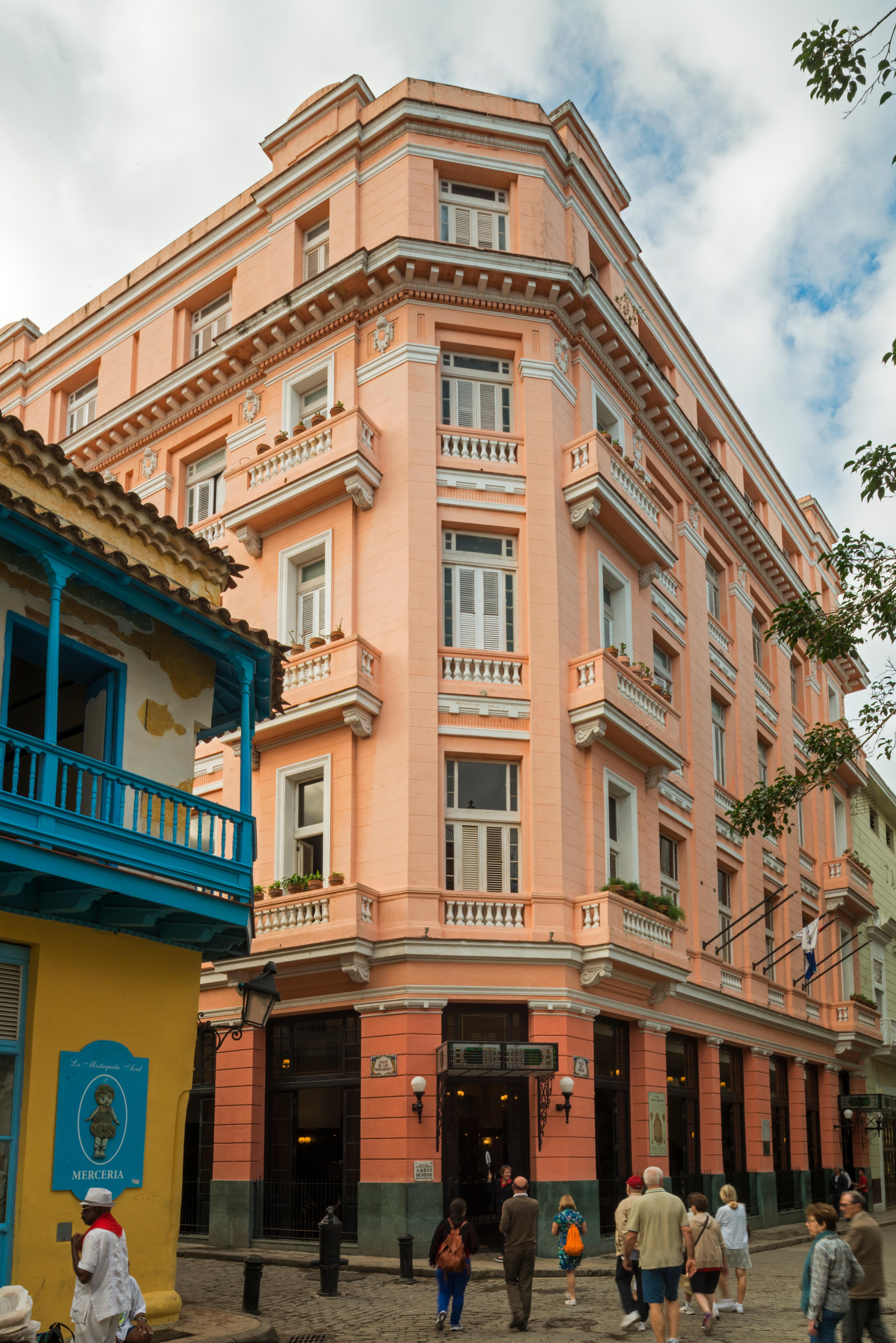
Formerly an arcade and office building, dating to 1917, the structure underwent a city-led restoration and reopened last year as the Hotel Manzana Kempinski.
In a sweltering morning in Old Havana, a courtly figure in a crisp gray guayabera shirt weaves through the Plaza de Armas, the city’s Spanish colonial heart, trying not to attract attention. Although none of the foreigners lolling beneath the banyan trees and royal palms recognize him, a ripple of excitement passes through the Cubans, who nudge each other, smile and stare. Perhaps only on this island obsessed with its operatic past could a historian become a celebrity on a par with a Clooney or DiCaprio. Eusebio Leal is the official historian of the city of Havana, a regal-sounding position that brings with it enormous influence and exposure—he starred for many years in his own TV show where he explored Old Havana’s streets—and he is as far from the cliché of the dusty, isolated academic as it is possible to get. In fact, Leal is credited with almost single-handedly bringing Old Havana from the brink of ruin to its current status as the most ravishing and vibrant architectural enclave in the Western Hemisphere.
Deftly dodging well-wishers, Leal ducks into the Historical Library, where some 50 female workers line up to kiss him on the cheek and offer flustered greetings. In his hectic round of duties, he has come to honor one of Cuba’s countless obscure intellectual champions—a certain Alfredo Zayas Méndez, who founded this archive 80 years ago, an exalted act in a nation with the highest level of education in Latin America. Standing before a plaque, Leal orates off the cuff for 45 minutes about the biblio-hero Zayas, a rhetorical tour de force that includes fond personal anecdotes, philosophical musings on “the importance of memory” and flirtatious exchanges that make the audience collapse into helpless laughter. He then takes questions, poses for snapshots, examines a restoration plan for the Havana Capitol—offering his expert opinion about work on the dome—before dashing off with his minder to a high-level government meeting.
The whirlwind visit leaves everyone a little dazed. At age 75, Leal shows no signs of slowing his notoriously hectic pace. For the last 50 years, almost as long as the Cuban revolution has lasted, his outsized personality has been inseparable from Old Havana itself. Working within the Communist system, he pioneered a capitalist network that would save the district’s architectural heritage at the same time as maintaining its community life so that it would not become a “living museum” like Venice or Old San Juan. A consummate politician, he combined a deft personal touch with the poorest residents while navigating the high corridors of government and hobnobbing with Fidel Castro. Although he has stepped back from direct power in the last couple of years following a serious illness, he is still regularly loaded with international honors, as both Cubans and foreigners—even Miami exiles—fall over themselves to pile him with praise.
“Eusebio Leal is a legendary figure in the preservation world,” says Joshua David, president of the World Monuments Fund in New York, who visited Havana for a workshop on architectural restoration in February 2017. “He pioneered innovative ways to fund restoration in Old Havana, which at the same time supported social programs like health clinics and old age homes.” “He’s an incredibly complex, brilliant man,” declares Gregory Biniowsky, a left-wing Canadian lawyer who has worked in Havana since 1995 and has dealt with Leal and his Office of the Historian (OHC) regularly. “He’s the best of the revolution.” Leal’s own workers are intensely loyal. “He inspires everyone,” says Mariela Mulet, the chief of the Prado Investment Group working on the Capitol. “He saved Old Havana though his own willpower. There won’t be another one like him in a long time.” On the street, the support is even more effusive: “Leal is the only person who Cubans would erect a monument to while he is still alive,” declares Alian Alera, a young librero, or bookseller. “When I was a boy, I was there when he personally came and presented my father with his book-selling license.” “Without Leal, Havana would be nothing like what it is today,” sums up the American historian Nancy Stout, who worked with his office on several books. “A lot of Cubans would do anything for him.”
Today, Old Havana still protrudes into Havana Harbor like a clenched fist, surrounded on three sides by glistening blue waters, and a stroll through its streets provides a unique glimpse of the first European steps in the New World. The city was founded in 1519, when the Spanish still had one foot in the Middle Ages and captains would casually write in their ships’ logs about sea serpents, dragons and men with two heads. Like Christopher Columbus, who had made landfall in Cuba on his first voyage 27 years earlier, settlers grappled to understand what they saw. They imagined the tracks of crocodiles were those of enchanted lions and groups of distant cranes were monks in robes; the Taíno Indians carried mysterious “firebrands” of flaming leaves they inhaled and called tobacco. With its deep harbor and strategic location, Havana soon became the staging post for brutal missions of discovery. Conquistadors sallied forth in search of El Dorado and the Fountain of Youth—and the wonders they did find, like Cuzco in Peru and Tenochtitlán in Mexico, proved more extraordinary than the fantasies. Soon galleons loaded with Aztec and Inca treasure gathered in Havana beneath a string of honey-stoned fortresses, built to protect against pirates like Sir Francis Drake. Twice a year, armadas of up to 30 boats loaded with gold and silver and their heavy naval escorts would catch the Gulf Stream back to Seville on the Carrera de Indias, the Indies Route. (The same current brought the marlin that would lure fishermen like Ernest Hemingway centuries later, the fish traveling “like cars along a highway,” as he put it in Esquire magazine.)
The story of Leal’s meteoric career rise begins in the same spot Havana was founded nearly five centuries ago, the Plaza de Armas. Dazzled by its intricate facades—a gorgeous brocade of carved curlicues, heavy oak portals and wrought-iron balconies—few visitors notice that the northern flank of the plaza, known as Calle Tacón, is paved with smooth wooden bricks. It was here that a confrontation unfolded with the municipal government that would in a sense define Leal’s future.
In 1967, as a self-taught, 25-year-old historian in revolutionary Havana, Leal learned that a heavy truck had cracked open the asphalt in front of the governor’s palace on the plaza. Investigating the site, he found fragments of a colonial-era wooden street, which the German naturalist Alexander von Humboldt had reported seeing in 1800. (It was laid, legend holds, so a governor’s wife could enjoy her siesta untroubled by carriage wheels rattling on cobblestones.) Apart from a few fragments in Paris, Rome and St. Petersburg, the wooden bricks were a unique find, and Leal soon gained permission to repave the entire stretch in wood. But as he was about to start, news arrived that a cultural delegation from Europe was on its way and government workers were rushing in with asphalt instead. “I realized I would lose the opportunity to create something unique and beautiful,” he recalls. So he lay down in front of the steamrollers—a rare act of civil disobedience in Cuba. The standoff lasted until the mayor of Havana himself came to beg Leal to get out of the way, promising that he would be permitted to re-excavate the street later. “He kept his word and so did I,” recalls Leal with satisfaction. “And the whole world celebrated the discovery of something fantastical and different: the wooden street.”
He then reworks an old Cuban rhyme: “Hay que poner un poco de locura a veces en la cordura.” (“You sometimes need to inject a little madness into the sanity.”) “In other words,” he explains, “if you are too sane, things don’t proceed, nothing happens.”
I had managed to find Leal in a rare moment of calm by meeting him at, of all places, the University of Notre Dame in Indiana, where he had traveled to give a lecture. Trailed by his entourage of embassy officials and aides, we wandered the Catholic college’s verdant grounds to visit Gothic chapels and candle-filled shrines while he painted a picture of Old Havana as vividly as if we were in the Plaza de San Francisco. Today, Leal is frail and thin, but he is still a master orator, speaking in perfectly formed sentences like a Spanish intellectual from another age. Perhaps because of his illness, he was unusually willing to speak about his early life, which had offered few clues to his success. Despite his rebellious streak, Eusebio Leal Spengler was in many ways a quintessential product of the revolution. He was born to a poor family in the shabby, low-rise Cayo Hueso district of Central Havana, a typically Cuban immigrant mix of Spaniards (on his father’s side) and Alsatians (on his mother’s) who traveled to Havana via Charleston, South Carolina. Although he grew up only a few hundred yards from Old Havana, he never visited it until age 7 or 8, he says, when an elderly friend of the family took him to her home. “I was amazed,” he recalls. “I had never seen stairways go up to that height! The magnificence of the cathedrals, the colors, the crowds of vendors selling everything in the street—the way they sang and danced—it was a really fascinating world!” He kept going back as a teenager to explore. “When I could see it closer, with more maturity, I was astonished by the carved stones, the spectacular iron latticework, the enormous doors,” he recalls. “It all impressed me greatly.”
At the time, Old Havana was regarded by government planners as an embarrassing eyesore. As crowded as Manhattan’s Lower East Side in its heyday, it was avoided by wealthier Cubans as a vice-ridden slum. In 1955, the dictator Fulgencio Batista even approved a plan by a New York-based design firm to level the colonial enclave’s core. Catering to Cubans’ passion for American cars, it was slated to become a combination parking lot and highway interchange lined with cheesy boutiques for cruise liners. Luckily, the plan never got past the blueprints; the Cuban revolution intervened.
Leal was 16 when Batista, having made millions from bribes from mafia-run casinos, fled into exile on New Year’s Day, 1959. A devout Catholic, Leal rushed to ring the church bells to usher in the new era, as throngs of Habaneros took to the streets in jubilation. “We were celebrating the end of the massacre,” Leal recalls, “the time when corpses would be found every day in the street, when people disappeared.” A week later, Castro and his barbudos, the “bearded ones,” rode in on their “victory caravan.” “The revolution paralyzed the systematic destruction of buildings,” Leal explains. But Fidel proved to be more interested in Cuba’s impoverished countryside than the capital, which he regarded as a parasite filled with American gangsters and prostitutes that had sucked the country dry. Old Havana was saved from the wrecking ball but left to poetically decay. (In 1959, Fidel guaranteed the district’s social coherence by banning evictions and reducing rents by 30 to 50 percent. Contrary to Marxist dogma, citizens who stayed in Cuba were allowed to keep one home and one holiday residence, according to Biniowsky.)
Still, the revolution transformed Leal’s life. He had been forced to leave school in the sixth grade to help support his single mother, who worked as a washerwoman and cleaner. Now that education was free, he put himself back in school, and began to lap up the deluge of art, music and film. (“Italian Realism, Ingmar Bergman, Orson Welles!”) Above all, the voracious autodidact haunted the libraries. “It was in the silence of the library that I learned the love of books as objects, and their fascinating contents,” he says, poring over works of the ancient Roman engineer Vitruvius and the Renaissance architect Palladio. “I am what I read in those books!” He also sought out the famous Office of the Historian. “By ancient tradition, every old city in Latin America maintains the institution of ‘chronicler,’ who is named for life to save the memory of the city,” he explains. In the early 1960s, the position was taken by a writer with the sonorous name of Emilio Roig de Leuchsenring, and Leal went to study at the small museum he maintained. In 1962, after charming Roig’s wife and secretary, he was introduced to the man himself. They spoke for hours. “He was very eloquent, very accessible,” Leal recalls. “When I was leaving, he took both my hands like a salutation and said, ‘This is not an end, it’s just the beginning.’”
018_e12_havana.jpg
Shops and cafés along Callejón de los Peluqueros (Hairdressers’ Alley) with Arte Corte, a combination hair studio, interactive museum and gallery devoted to the art of barbering, in the foreground. (Néstor Martí)
The prolific Roig was at the center of a circle of left-leaning bohemians. “There were historians, teachers, geographers,” Leal recalls of this golden age. “I was 20 years old, they were mostly 60, 65...some were 80 or more. I used to track them down in the homes,” he laughs, rapping the table with his knuckles as if knocking on a door.
By the time Roig died in 1964, Leal was a regular at the Historian’s Office. (“I wasn’t an employee but a confidant.”) Three years later, when a plan was unveiled to turn the governor’s palace on the Plaza de Armas into the first museum to Havana’s history, Leal was hired as architect, archaeologist and, at times, laborer. (“It was very manual. I was sometimes a construction worker, sometimes a bricklayer.”) At the same time he worked alongside renowned scholars such as Irving Rouse of Yale University. When the museum finally opened in 1976, Leal was the natural choice to be its first director.
By then, his work had drawn the attention of Celia Sánchez, Fidel’s partner in the guerrilla war of the late 1950s who took a passionate interest in Cuban history. Celia had become the unofficial gatekeeper for access to Fidel, and her patronage allowed him to present his ideas to the Maximum Leader. “Leal went to Celia to lay out his personal vision,” says historian Nancy Stout, author of a biography of Sánchez. “She would talk to Fidel and create a momentum that people couldn’t oppose.” It was a valuable friendship: Leal’s Catholicism and energy had ruffled the feathers of many Communist bureaucrats. “When you are riding a horse, you kick up lots of dust and those who follow behind get dust in their eyes, and it bothers them,” he says. “Celia helped and protected me.”
International recognition came when Old Havana and its crown of Spanish forts were declared a Unesco World Heritage site in 1982, among the first sites to receive the accolade. The listing covered 529 acres, including 242 blocks with some 4,000 buildings. Not all of them are colonial. In fact, Old Havana’s streets are a sprawling encyclopedia of Western architecture, with buildings from the 16th to the 20th centuries tossed together—a mix of Rococo, Baroque and neo-Classical styles with crumbling gems such as Art Nouveau pharmacies thrown in. But the Unesco honor came with few funds from Geneva, and foreign tourism was not considered a way to attract income. “Tourism was still regarded as part of a very exploitative past,” says Joseph Scarpaci, director of the Center for the Study of Cuban Culture + Economy and co-author of Havana: Two Faces of the Antillean Metropolis, referring to the mafia-run casinos and brothels that had defined Havana in the 1950s as the “sin city” of the Caribbean: “Fidel had always made it clear that he didn’t want Cuba to be an island of chambermaids and bartenders.” By the end of the 1980s, Old Havana was in a dire state. Its 75,000 residents were often without working plumbing or regular electricity. Landmark buildings were on the verge of collapse and riddled with amateur renovations. Pools of putrid water and garbage gathered in corners, the sidewalks were cracked like eggshells, and there was almost no street lighting. Old Havana, it was sometimes said, was “a 40-watt town”—on a good night.
Renaissance | Castillo de la Real | Fuerza, 1577
(Elizabeth M. LaDuke)
Built in a typical four-point Renaissance ground plan modeled after structures in Seville, the “Castle of the Royal Force” is the oldest stone fortress in the Americas. Atop its west tower is a bronze weathervane called “La Giraldilla.” The female figure, holding a cross in one hand and a palm tree trunk in the other, has become a symbol of Havana.
Salvation came, paradoxically, from economic disaster. The collapse of the Soviet Union and the end of sugar subsidies in 1991 threw Cuba into bankruptcy, beginning a decade of privation euphemistically called “the Special Period in Time of Peace.” Things were desperate by 1993, when Leal accompanied Fidel on a trip to Cartagena, another Spanish port in the Caribbean that the Colombian government was turning into a hugely lucrative tourist attraction. On the flight out, Fidel came to Leal’s seat, he recalls. “He asked me: ‘What can I do—or what can we do—for Habana Vieja?’” Without hesitation, Leal explained that an entirely new economic model was needed where hotels, restaurants and museums would earn hard currency—the U.S. dollar had just been legalized—and profits could be pumped directly back into restoration. The approach departed from decades of state-controlled policy, but Leal told Fidel that “without a sound financial basis, the idea of saving Old Havana is a utopia. It’s a fantasy. It’s like St. Augustine’s City of God.” Saving Old Havana did not mean giving up progressive Socialist principles, Leal assured Fidel. In fact, central to his plan was to keep residents in their homes and use tourism to improve living standards. “We’re not talking about Pompeii or Herculaneum. We’re talking about Havana! We have to invest in schools, playgrounds, services for the elderly.” (Leal drew on liberation theology, he says, which inspires progressive priests to work in poor communities from rural Brazil to Nicaragua: “It’s not possible in Latin America to talk about social justice without taking into account Christian thought.”)
(Map by LaTigre)
Fidel was sold. A trained lawyer, he personally drew up legislation to create a unique company called Habaguanex, which could deal directly with foreign investors and was exempt from returning its profits to the state. (Although the name sounds like a Soviet-era pharmaceutical venture, Habaguanex was actually a heroic Taíno Indian leader of the early 1500s, who quite probably gave his name to Havana as well.) Leal was at last appointed historian of the city, given $1 million in seed money and carte blanche on how to use it. “Fidel gave him everything,” says Stout. “He even had a special security force at the historical sites. Cubans used to joke that he had his own personal army.”
Fidel’s sense of urgency may have been heightened by an incident in Old Havana only a few weeks before. A visiting British journalist for the Independent newspaper was photographing the splendid facade of the College of the Holy Angel in the Plaza Vieja when it started to wobble in front of his eyes. “He said to me, ‘Oh look, it’s falling down,’ in typically dry British style,” recalls Victor Marín, an architect and vice president of ICOMOS, the International Council of Monuments and Sites in Cuba, who was with him at the time. “And as we watched, the whole thing crumbled before our eyes!” Although nobody was hurt, photos of the collapse were plastered around the world, embarrassing the Cuban government, which seemed incapable of looking after its heritage.
Leal’s first ventures in the 1990s were modest: With his team of academics and craftsmen, he opened for paying guests three small restaurants and the Hotel Ambos Mundos, where Ernest Hemingway had lived in the 1930s while writing For Whom the Bell Tolls. (It was conveniently located between El Floridita, a bar known for its excellent daiquiris, and La Bodeguita del Medio, famed for its mojitos.) Thanks to the U.S. trade embargo, workers had to be creative in finding building materials. “I was able to talk to Fidel almost daily about the problems and he would come up with a solution,” Leal recalls. He became Fidel’s “man for capitalism,” managing the only for-profit entity in all of Cuba. Funds from his first humble enterprises were soon put back into restoring more restaurants, bars and hotels, as well as the colonial squares. In Plaza Vieja, an ugly parking lot from the 1950s (which was in theory underground but actually rose a yard above the ground) was imploded and its centerpiece became a fountain of Carrara marble with spouting dolphins, recreated from old drawings of the original design by Giorgio Massari, one of the myriad Italian artisans who flooded Cuba in the 18th century.
Residences were also renovated: Behind the Fototeca de Cuba gallery on the Plaza Vieja, for example, is a Spanish courtyard with eight apartments that are still inhabited by the original residents. Other housing was built from scratch in vacant lots. At the same time, a percentage of the profits went to programs such as breakfasts for schoolchildren, maternal-care facilities, centers for retirees and spaces for young artists. All this made Leal immensely popular, a beacon of hope in the grim economic horizon of the Special Period. “Leal got things done!” says historian Stout. “But he was also there for Habaneros in a very intimate, hands-on way. He would go to the construction sites every day to make sure his workers had lunch!”
As success followed success, the Office of the Historian expanded. In 2003, it took over much of the seaside promenade, or Malecón, and in 2005, Chinatown, while Old Havana became the engine for Cuba’s booming tourist industry. The financial benefit from Fidel’s original $1 million investment is hard to estimate, since Cuban companies do not open their books. But in 2011, the Washington Post reported, the annual revenue of Habaguanex was $119 million with $23 million in profits. The Office of the Historian employed some 3,000 workers, most of whom were locals, and by 2016, it managed some 20 boutique hotels, 25 restaurants, 30 stores, various museums, a radio station and a glossy magazine, Opus Habana—a total of over 300 different entities. (As Cubans joke: “When we want to be, Cubans can be more capitalist than the capitalists.”)
Construction of the five-mile-long sea wall and promenade, the Malecón, began in 1901. Hurricane Irma last year dealt a blow to ongoing repairs. (Néstor Martí)
Leal, meanwhile, became a uniquely Cuban celebrity—a deputy in the National Assembly, known for a series of marriages to much younger women (which Fidel and Raúl Castro attended), and a popular media star. For his hit TV and radio series “Andar La Habana” (“Walk Havana”), he wandered the streets recounting forgotten stories—how, for example, the British captured the city in 1762, then exchanged it for the Spanish colony of Florida. He also became a darling of the foreign media—even in the United States, where National Geographic described him as “a man of action as well as words,” the academic answer to Che Guevara. “He was handsome, he was well-spoken,” recalls Lucy Scott, then a field producer for “CBS News” who interviewed Leal several times. “He knew his stuff but he was also very of-the-moment. Only later did we realize the real depth of his knowledge.” Leal was chosen to give personal tours to visiting dignitaries: Most recently, he showed Pope Francis around in 2015 and President Barack Obama in 2016.
Eventually, Habaguanex became a victim of its own success. Although Leal was above suspicion, corruption scandals began to emerge in the company after 2012. The details are still shadowy (“Cuba is like a Fellini film, you never know what part of the journey you are in,” says Scarpaci), but there were a string of arrests for embezzlement, drug sales and bribery. Leal became seriously ill, and while he was recovering in August 2016, control of Habaguanex was transferred to a sprawling military-run enterprise called GAESA. Leal declared that the move would allow the Historian’s Office to concentrate on its true mission, cultural preservation. And so far, GAESA’s presence has had little practical effect. “They said they would keep up support for our projects, and they have kept their word,” said Ayleen Robainas, an architect and urban planner with the Master Plan office, which oversees the preservation efforts.
Old Havana’s status is now assured as the centerpiece of the Cuban tourism industry. “It’s one of the most extraordinary urban historical centers in the world,” says Joshua David of WMF. “And it’s even more remarkable for its proximity to the United States. You fly a few minutes from Miami and you’re in a completely different world.”
Today, the hand of the Historian’s Office is everywhere in the Old City, its logo on interpretive signs, before-and-after photos (entitled “Para No Olvidar,” “Lest We Forget”) and building sites. The Master Plan office is now a shiny, high-tech warren filled with engineers, architects and sociologists, offering Wi-Fi to local residents and a hall for monthly meetings. (One of its popular events is a weekly seminar on how to start a small business; the office receives 50 applications a week from budding entrepreneurs, mostly for paladares, private restaurants, and casas particulares, bed-and-breakfasts, it says.)
Visitors from around the world now throng the cobbled pedestrian lanes between the four plazas, dubbed “the Golden Kilometer” by the office. Leal’s former headquarters in the Plaza de Armas, the Palacio de los Capitanes Generales, is now surely one of the world’s most charming museums, with emerald peacocks parading around its courtyard filled with palm trees. Next door, the Palacio del Segundo Cabo, built in 1772 as the royal post office for all of Spain’s Latin American possessions, was reborn in May 2017 as a state-of-the-art museum devoted to cultural connections between Cuba and Europe. From there, “a parade of columns,” as Marín dubs the shady colonial patios, leads to the Cathedral (which the Cuban author Alejo Carpentier called “music turned to stone”).
Still, San Cristóbal de la Habana, as the city was formally known, was a rough-hewn place for its first two centuries. The street names evoke its raw early days: On Calle Oficios (trades), artisans hammered leather boots and horseshoes. On Mercaderes (merchants), vendors offered sandalwood from Brazil and cured meats from the old country. Picota (yoke) was where criminals were tied to a post and flogged. The port only grew to its current grandeur in the 18th century, when vast city walls were completed and aristocratic mansions were carved from limestone blocks. Hundreds of merchant ships docked within sight of the plazas, the air rang with the sound of church bells and cockfights, and the streets teemed with smugglers. By then, Cuba’s indigenous people had been almost entirely wiped out, but the rise of sugar plantations turned the trickle of African slaves into a flood that would give Havana its rich racial mix.
As sugar exports made Cuba rich, the city walls were torn down in 1863 and replaced by a grand avenue called the Paseo del Prado built along Old Havana’s margins, lined with spectacular buildings that are being restored today. Leal’s most ambitious project to date is the renovation of the spectacular Capitol Building, which opened in 1929 and resembles the U.S. Capitol in Washington, D.C. Since 2013, artisans have been buffing its splendid bronze doors, polishing its 60 types of marble and removing decades of dust from giant statues. “The U.S. Capitol doesn’t have interior courtyards as the Cuban one does,” said the project’s director, Mariela Mulet, as we strolled through the cavernous interior swarming with artisans. “And our cupola is 12 feet taller!” To prove the point, she finds a key and leads me on a backstage climb up to the dome’s windswept summit. We clamor up wrought-iron interior stairs, go hand-over-hand along rickety scaffolding, then emerge onto the exposed belfry 302 feet above the city just as a thunderstorm hits, lashing our faces with rain globules that sting like needles. The whole of Havana spreads below us in a glorious buffet. “What a view!” Mulet shouts over the gale. “But up here you think: Oy, how much more there is to do!” From this aerie, it is obvious that Old Havana is only a fraction of the sprawling metropolis. Many of Leal’s own people now take an interest after-hours in restoring more modern parts of the city with a design group called Habana Re-Generacion: Along the harbor, for example, are abandoned factories, warehouses and an electricity plant from the early 1900s, when Cuba had some of the most advanced technology in Latin America. There are dreams to bring these structures back to life—the electricity plant could be the next Tate Modern, the warehouses turn eastern Havana into a new Brooklyn—if only for the lack of funds.
**********
Nobody denies that much more work needs to be done in Old Havana as well. “It’s an extraordinary success story,” says David, “but there are also an extraordinary number of buildings in urgent need of repair.” This is obvious only a few steps from the Golden Kilometer, where streets are still in a state of dreamlike decrepitude. Walls are crumbling, trees grow like weeds from abandoned balconies and the streets are still an obstacle course of open sewers and potholes that could swallow a vintage Cadillac. Emergency repairs prop up houses battered by tropical deluges and eroded by salt air.
Like anyone who has undertaken such an ambitious project, Leal is not immune to criticism. “The Cubans have their own narrative of what is unfolding in Old Havana, and they bristle at counternarratives,” says Scarpaci. “I admire Leal, his intelligence and his generosity,” he stresses, but argues that there has been a “Disneyfication” of Old Havana. Courtyards are adorned with dubious contemporary artworks, Scarpaci says, and commercialization has spread, with Benetton and other foreign hard currency stores displacing residents. “What are you going to do in Cuba, write a letter to the editor?”
The residential renovations for the 55,000 current inhabitants have also been drawn-out and complicated. Due to Old Havana’s overcrowding, not all tenants were able to stay in their homes: In one typical building, 61 families shared a handful of bathrooms with little access to water; after the structure was gutted and converted into modern apartments, only 16 families were able to return. Sociologists worked with residents to decide who would stay. The others were relocated to Soviet-style housing projects across the harbor, which are often more comfortable but charmless and remote.
Like all Cubans, residents are also scrambling to cope with Raúl Castro’s reforms of 2011, which permitted 200 professions to earn hard currency and allowed people to sell and rent their homes. This has brought a new phenomenon: gentrification. “Life is changing!” says Victor Marín. “Owners of old American cars who used to be too poor to pay for gas are now driving around tourists and getting rich.” The influx of new money means that the Historian’s Office, he says, “needs to balance the new realities.”
Sometimes these “new realities” blend past and present seamlessly. In 2016, a Cuban DJ who goes by the name Alain Dark turned his family’s rooftop apartment in the heart of the Old City into the open-air Bar Roma. Located in a crumbling apartment building, it can be reached by a rattling iron-cage elevator from the 1920s operated by an elderly resident. “Where was I born?” Dark shouts over the throbbing Cuban pop, then marks out a circle on the tiled floor with his toe. “My mother gave birth to me right here! I grew up in this building.” Covered in tattoos and wearing a baseball cap backwards, he recalls following tourists about the streets as a kid. “I also grew up asking foreigners for Chiclets!” he says with a laugh. “‘Hello, mister, one Chiclet, please? One money?’” The bar now serves lechón, pork sandwiches, and cuba libres to a bohemian crowd that is half foreign, half Cuban—and Dark makes sure that the small cadre of local fashionistas and artists get free drinks, subsidized by sales to outsiders. Elderly neighbors wander in and out of the bar, and those on the same floor open their own apartments and sell snacks to patrons. One elderly lady named Xiomena sitting regally on her frayed lounge chair even makes a little spare cash by providing access to her baño.
Other times, the new realities are more complex. Many Cubans were disconcerted when the first genuine five-star hotel, the Gran Hotel Manzana Kempinski, opened in an iconic 1917 shopping arcade on the edge of Old Havana in spring 2017, largely because in the ground-floor luxury stores items such as $10,000 Rolex watches were being sold by locals who earned about $30 a month. But Habaneros have quickly gotten used to the idea, and are often seen wandering the mall out of curiosity. “It will attract a different kind of tourist,” says Ariel Piedra, one of the local architects on the Manzana. “It won’t be the Canadian fireman who wants to drink a ton of beer and then leave.”
Still, communal life continues with an energy unheard of in other Latin American colonial sites, most of which are virtual ghost towns after dark. Just a few doors away from trendy new cocktail bars like O’Reilly 304 are crowded bodegas, hole-in-the-wall butchers with bloody meat hanging from hooks, and elementary schools where the kids still wear crimson-and-white uniforms introduced in the Soviet age. Every block includes glimpses through windows at rooms where old couples, the husband in a wife-beater, might be watching vintage TVs under peeling posters of Che or Fidel in their prime.
In remote corners of Old Havana, Leal’s work inspired grass-roots ventures nobody could have imagined in 1993. At its northern edge, the once-derelict Callejón de los Peluqueros, Hairdressers’ Alley, is thriving again after a barber known as Papito set up Artecorte, a combined salon and art gallery. Its success has attracted a string of private cafés with outdoor tables in streets blocked to traffic. (“It’s almost like Rome,” marvels Marín.) In the far south, a former red-light district, the self-styled “social entrepreneur” Pavel García, who has the shoulder-length hair and bushy beard of an Old Testament prophet, runs a project called BarrioHabana, which organizes neighborhood kids into soccer teams as a way to get them involved in the arts. The teams now paint murals, join chess clubs and visit Havana’s museums and theaters. “The kids used to think these places were just for tourists and the rich,” says García, “but we show they are for them too!”
**********
Despite his recent illness, Leal is filled with plans for Old Havana’s future. The entire waterfront will be revived to greet an expected influx of cruise ships. The train station will be opened this year as a museum to the Cuban railway system, which was the first in Latin America. And new community projects include “148,” a derelict Art Deco block in the very heart of Old Havana being turned into a combination of low-cost housing, student residences and a cultural center for teenagers, complete with radio, sound and TV recording studios.
And Leal is as open as ever to creative ideas. In January 2017, he visited the Google offices in Manhattan to celebrate a 3-D movie collaboration about Cuba’s national hero, José Martí, who lived in New York in exile for 15 years, in part to promote U.S.-Cuban relations by emphasizing the countries’ shared history. (A statue of Martí stands in the southern edge of New York’s Central Park.) Timing the visit just after President Donald Trump’s inauguration was not accidental, Leal explained, when I met him not long afterward at Notre Dame. Trump’s vow to roll back the Obama-era thaw has thrown the future of Cuba—and Old Havana—into uncertainty once again. In November 2017, new travel rules were brought in that require American tourists to work with an authorized tour group to ensure compliance (although they do not need to go with a group). Americans were also banned from patronizing many GAESA-run hotels and restaurants, but how this might be enforced is unclear.
“I don’t have a crystal ball,” says Leal. “But I know that each era brings its own challenges. All we can do is prepare ourselves intellectually, emotionally, ethically for what is to come.” And with that he leapt up and declared the interview over. (“Now you know more about me than I know about myself!”) He dashed off with his entourage into a waiting limousine for the airport. Matters in Old Havana needed his attention.



/https://public-media.smithsonianmag.com/filer/57/de/57deb85f-ad3c-47c4-a1bd-bc4678564f57/may2018_e13_havana.jpg)


/https://public-media.smithsonianmag.com/filer/0a/cd/0acdee39-0ea0-4fdb-8734-ee455c74a0be/may2018_e02_havana.jpg)