Friday, July 25, 2014

1491. Environmental Damage from Animal Agriculture

By Linda A. DeStefano, Sierra Atlantic, Spring 2011


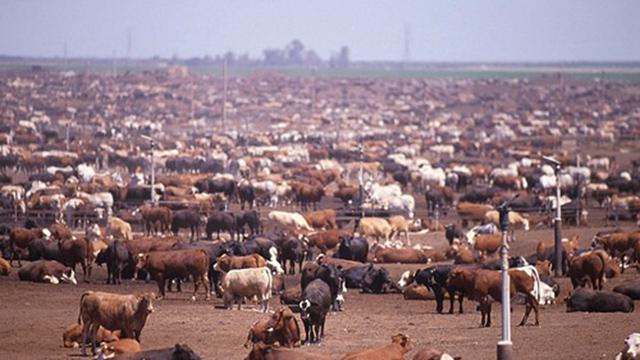
Yet another report from the U.N. alerts us to the environmental damage caused by animal agriculture, including greenhouse gas emissions.

Lacking the memorable title of the first U.N. report (“Livestock’s Long Shadow”), the new report (June 2, 2010) has the unsexy title of “Assessing the Environmental Impacts of Consumption and Production: Priority Products and Materials.”


The section on animal agriculture says:  “A substantial reduction of impacts would only be possible with a substantial worldwide diet change, away from animal products.” Edgar Hertwich, lead author of the report, says: “Animal products cause more damage than (producing) construction minerals such as sand or cement, plastics or metals. Biomass and crops for animals are as damaging as (burning) fossil fuels.”


James Hansen of NASA, a leading climatologist who has spoken out repeatedly and strongly about global warming, says: “ ... if you eat further down on the food chain rather than animals, which have produced many greenhouse gases, and used much energy in the process of growing that meat, you can actually make a bigger contribution in that way than just about anything. So, that, in terms of individual action, is perhaps the best thing you can do.”


A report in the Nov./Dec. 2009 issue of the magazine of the highly respected Worldwatch Institute estimates that a whopping 51 percent of greenhouse gas emissions is caused by animal agriculture. The authors of “Livestock and Climate Change” recommend that environmental activists start lobbying the food industry to see the financial advantage of a massive marketing campaign for meat and dairy analogs (veggie burgers, almond milk, etc.) so that the production and consumption of animals will be dramatically reduced. They advise that consumers should eat a completely plant-based diet rather than switching from one animal to another (such as switching from beef to chicken).


There’s some merit to their recommendation in terms of getting the corporate food industry on board and making it convenient for people to eliminate or significantly reduce their intake of meat, dairy and eggs. However, it’s also important to support local plant-based agriculture (organic, when possible) by buying fresh vegetables, fruits, grains, beans, nuts and seeds and making tasty, healthy dishes, such as rice and beans with a flavorful sauce and veggies on the side.


You can find links to the U.N. report and the Worldwatch Institute magazine article by clicking here.  You will also find downloadable vegan recipes from Sierran Kay Bushnell and two handouts, “Give a Wolf a Break Today: Go Veggie!” and “Don’t Eat a Cow, Man! How Animal Agriculture Adds to Global Warming.”

Thursday, July 24, 2014

1490. About the Shrimp on the Menu

By Mangrove Action Project, April 9, 2013
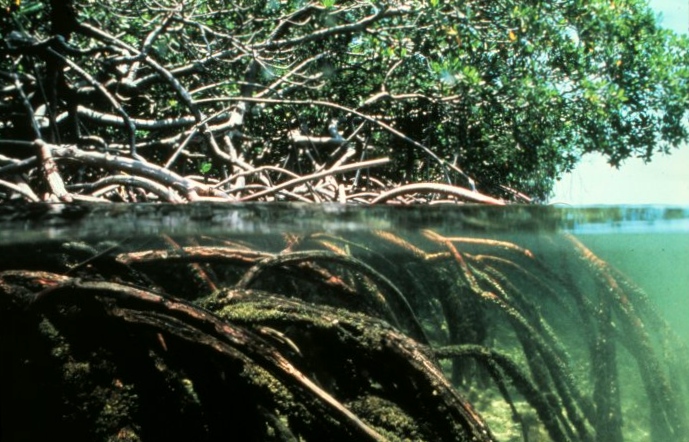
Portion of a mangove forest


Introduction: This a short, educational clip about how shrimp farming destroys mangroves key to integrity of ecosystems on which much life and livelihood depends.  Also, it shows how farmed shrimp is bad for your health.  I urge you to give up eating shrimp entirely, however. A vegan diet is best for your health and for the world. For a a discussion see "How Veganism Can Help Save the World".  KN.


Monday, July 21, 2014

1489. New technique maps life's effects on our DNA: Powerful single-cell technique to study environmental effects on DNA

By Science Daily, July 20, 2014


Researchers at the BBSRC-funded Babraham Institute, in collaboration with the Wellcome Trust Sanger Institute Single Cell Genomics Centre, have developed a powerful new single-cell technique to help investigate how the environment affects our development and the traits we inherit from our parents. The technique can be used to map all of the 'epigenetic marks' on the DNA within a single cell. This single-cell approach will boost understanding of embryonic development, could enhance clinical applications like cancer therapy and fertility treatments, and has the potential to reduce the number of mice currently needed for this research.

'Epigenetic marks' are chemical tags or proteins that mark DNA and act as a kind of cellular memory. They do not change the DNA sequence but record a cell's experiences onto the DNA, which allows cells to remember an experience long after it has faded. Placing these tags is part of normal development; they tell genes whether to be switched on or off and so can determine how the cell develops. Different sets of active genes make a skin cell different from a brain cell, for example. However, environmental cues such as diet can also alter where epigenetic tags are laid down on DNA and influence an organism's long-term health.

Dr Gavin Kelsey, from the Babraham Institute, said: "The ability to capture the full map of these epigenetic marks from individual cells will be critical for a full understanding of early embryonic development, cancer progression and aid the development of stem cell therapies.

"Epigenetics research has mostly been reliant on using the mouse as a model organism to study early development. Our new single-cell method gives us an unprecedented ability to study epigenetic processes in human early embryonic development, which has been restricted by the very limited amount of tissue available for analysis.”

The research, published in Nature Methods, offers a new single-cell technique capable of analysing DNA methylation -- one of the key epigenetic marks -- across the whole genome. The method treats the cellular DNA with a chemical called bisulphite. Treated DNA is then amplified and read on high-throughput sequencing machines to show up the location of methylation marks and the genes being affected.

These analyses will help to define how epigenetic changes in individual cells during early development drive cell fate. Current methods observe epigenetic marks in multiple, pooled cells. This can obscure modifications taking place in individual cells at a time in development when each cell has the potential to form
in a unique way. The new method has already revealed that many of the methylation marks that differ between individual cells are precisely located in sites that control gene activity.

Dr Gavin Kelsey, said: "Our work provides a proof-of-principle that large-scale, single-cell epigenetic analysis is achievable to help us understand how epigenetic changes control embryonic development. The application of single-cell approaches to epigenetic understanding goes far beyond basic biological research. Future clinical applications could include the analysis of individual cancer cells to provide clinicians with the information to tailor treatments, and improvements in fertility treatment by understanding the potential for epigenetic errors in assisted reproduction technologies.”

Prof Wolf Reik, a founder of the Wellcome Trust Sanger Institute Single Cell Genomics Centre, added: "This exciting new method has already given some remarkable insights into how much variation there is in the epigenetic information in embryonic stem cells. This may underlie the enormous plasticity these cells have to develop into many different cell types in the body."

Story Source:
The above story is based on materials provided by Biotechnology and Biological Sciences Research Council

Journal Reference:

1. Sébastien A Smallwood, Heather J Lee, Christof Angermueller, Felix Krueger, Heba Saadeh, Julian Peat, Simon R Andrews, Oliver Stegle, Wolf Reik & Gavin Kelsey. Single-cell genome-wide bisulfite sequencing for assessing epigenetic heterogeneity. Nature Methods, 20 July 2014 DOI: 10.1038/nmeth.3035

1488. Film Review: My Life as a Turkey

By Kamran Nayeri, July 21, 2014

I live on a two-acre house in the countryside west of Sebastopol, California. I choose this location because of its relatively low population density and wildlife presence.  Over the past few years, I have gradually made the land more hospitable to wildlife and began to observe their presence. Some have made this location their "home" as well, including groups of wild turkeys.  Wild turkeys require about 150 acres to roam around looking for food which is what they mostly do from sunrise to sunset.  They do take a rest from time to time, take naps and play. They are very curious birds and have a social life that I have just begun to understand. They compete, cooperate, make friends and fight. They have a unique mating dance with male turkeys spend weeks mostly posturing for females and compete among themselves for mating with females. They pick a location with tall trees their "home" for sometimes up to several weeks. At sunset, they fly up into tall trees. Their flight is very much like an airplane taking off--they require a runway and they do make a run from it. Depending on their age, weight and physical strength they succeed in getting up the tree with one or more tries. Once on the lower branches they fly up to higher branches until they are as high as possible. In this location  they prefer the pine trees that are 80 feet tall. Over time, I have come closer to groups of them and made friends with a few.  One older female turkey who I called Agnus became so close to me that she flapped her wings at my sight and would tolerate me as close as a foot or two.  Agnus was so old that she spent most of her time resting often close to the sliding door next to my home office.  Sometimes, her daughter would come and peck her gently to urge her up. When her group moved on Agnus and her daughter stayed behind for a week or so more. One day, however, they stopped showing up. They had moved on.  
So, it was with great happiness that I came across My Life as a Turkey, a PBS production based on the documented experience of Joe Hutto.  Hutto who lived in Florida's Flatlands has a broad background in natural sciences and a deep interest in wildlife.  
After a local farmer left a bowl of wild turkey eggs on Hutto’s front porch, he decided to incubate them and waited for them to hatch.  As the chicks emerged from their shells and locked eyes with his, Hutto became their unusual but dedicated mother.
For a year and half Hutto spent each day living as a turkey mother, taking on the full-time job of raising sixteen turkey chicks. Hutto dutifully cared for his family around the clock, roosting with them, taking them foraging, and immersing himself in their world. In the process, they revealed their charming curiosity and surprising intellect, even affection towards him.  He became particularly close with one female turkey he named Sweet Pea.  A male turkey he named Turkey Boy eventually become his "brother."  Hutto learned that wild turkeys already know a lot about their environment. For example, they instinctively can tell the difference between poisonous and non-poisonous snakes. He learned that turkeys have individual personalities and preferences. They took friendly interest in some other species like the deer and squirrel and played games with them. They also teamed up to drive dangerous snakes away from their turf.  He also learned how vulnerable they are. Two of the wild turkeys died of infection and when Sweet Pea laid eggs and slept on the ground at night to protect and incubate them she and all her eggs were eaten by predators (a few weeks ago, a sick female turkey that lived here with her sister for a few days was eaten overnight by predators--here they would be raccoons, foxes or coyotes).  
Still, Hutto was able to teach the young turkeys a few things, like the lay of the land, and protected them from the dangers of the forest as best he could. In return, they taught him how to see the world through their eyes. Hutto says that the entire place came alive to him after he began to act as part of the turkey pack.   When the turkeys became old enough to go their separate way, they left all of the sudden. Hutto was heart broken because his adopted family had left but also realized that somehow his window to the wildlife around him narrowed as well.  He did not see the lizards, snakes, deer and others as often as he used to when he was part of the turkey pack. 
The film is done with beautiful cinematography displaying the lush beauty of Florida Flatlands. 
My Life as a Turkey is an hour long and was first aired on PBS on November 27, 2011.  
*     *     *
The following is from the question and answer period with Hutto after airing of the movie. 
Have you always been so connected with animals?
Yes, I suppose I was one of those kids who was born a little congenital scientist or some such thing. I was obsessively drawn to other living things– often to the exclusion of all other priorities. My parents were, if not supportive, at least indulgent to my obsessions. And bless their hearts! They just laid down a linoleum floor in my bedroom, and the rule was: any critter is OK, as long as it stays in the bedroom or outside, it must be well fed and clean, and absolutely no poisonous snakes inside the house! I rarely kept my animals in cages and almost all slept with me in the bed. The list was endless. Big, small, mammal, bird or reptile. I think at one point I had a small bobcat, a gray squirrel, and a seven foot boa constrictor, all living in perfect harmony.
Where was the Florida Turkey piece filmed?
My Life as a Turkey was filmed on a large family ranch in south-central Florida. My original project was conducted adjacent to a National Forest and Wilderness Area southwest of Tallahassee in northern Florida. The ecology in the area of north Florida is very dense, swampy and jungle-like. The Ranch location was, in many ways, a very similar oak hammock ecology with sandy scrub-oak ridges. The plants and animals were basically the same with a few exceptions, however there was open “savannah/prairie” like cattle land which was much more photo-friendly. The north Florida location would have been more of a continuous wall of green. The ranch also afforded better logistic accommodations for the crew, with complete privacy for the turkeys. All the wild animals filmed in the documentary were wild residents with the exception of one or two of the snakes that were obtained from a local snake “Wrangler”.
Did you ever find out who the person was that left the eggs and do you think they were all from the same clutch?
Yes, I knew the fellow who brought me the eggs. He was actually an employee on a very large quail hunting preserve. The eggs were from two separate nests, which allowed me to immediately make discriminations between the family groups according to size, coloration and variations in subtle markings. For example, the color of the legs were distinctive at the time of hatching. Even the eggs looked slightly different in color and speckling. Overall the two family groups were quite different in appearance. And yes, I did have the experience of encountering two of my adult hens when they had 10 week old poults of their own. It was an awkward encounter in the forest where the hens recognized me and were quite unafraid, but of course their poults had never seen a human, and like all wild turkeys, were horrified at my sight and flew in panic. The mother hens were obviously confused but of course had to quickly follow their brood. A lady living miles away had one of my hens living on her place. The hen was relatively tame, would bring her young poults into her yard and garden, but again, the young poults were intolerant of the woman’s company.
Do you think the birds and especially Sweet Pea, were more vulnerable to predation being raised by a human rather than a real turkey mom? Perhaps in the way of being too trusting?
I have been very concerned about this familiarization/ habituation issue that would cause an animal that knows me to somehow be at greater risk from predation or other humans. In the case of the turkeys, I quickly found that 20 million years as a prey species has honed their survival skills to a razors edge and my proximity was essentially inconsequential in the face of any predator. As for other humans, I found that the turkeys were in fact suspicious of other people even at a great distance and could in fact ,with their keen eyes, discriminate between me and anyone else from a quarter of a mile! I have found these powers of discrimination as evident and perhaps even keener in mule deer.
Did you have a sense that the males from your two clutches of eggs might be segregating at all (i.e. hanging out more with genetic relatives)? Did you notice any traits of the males that were socially dominant?
I think Lovett Williams, et al. established or suggested that sibling male wild turkeys tend to stay fraternal throughout their lives– certainly in the first couple of years. That has been my observation as well. However, I think these bonds are somewhat tenuous and involve constant minor conflict to insure the dominance of one particular male. Mature brothers will often display beside an actively breeding dominant gobbler without ever suggesting that they would try to participate in breeding activity. I have photographed this phenomenon many times while concealed in blinds with wild spring flocks. It was not until I lived with the gobbler flock that I raised, that the more subtle dynamics of the male fraternity became obvious. These brotherly hierarchies are generally well established prior to maturity and are formed on the basis of innate individual aggressiveness as well as superior size and strength. A dominant gobbler was probably a dominant poult. Gobblers of course, rarely live to a ripe old age, and so “lone older gobblers” quickly become the norm, but it would be interesting to know how sibling gobblers would preserve their fraternity over many years. And as you probably know, old males will on occasion abstain from all Spring breeding activity and conflict, living a quiet solitary life. I have also observed on several occasions a younger “apprentice” jake, form attachments to an older lone gobbler. I don’t think a fraternal group would ever allow this, but if jake and older gobbler have each lost their family group, I think there is a mutual need for companionship that allows some sort of bond to occur. Conjecture of course.
Were you shocked that “turkey boy” attacked you or was that normal behavior for a tom turkey? Was it a territorial issue? Do you think Turkey Boy was hurt over you leaving?
Hand raised male turkeys have a history of eventually becoming aggressive towards humans. I always thought it might be a possibility– but I was still surprised that my buddy– Turkey Boy– wanted to harm me! It was not so much a territorial issue as just an unfortunate “male thing”.
Turkey Boy and I actually resolved our differences after his breeding season ended. The film had to abbreviate our rather complex relationship for the sake of time. Eventually Turkey Boy left on his own and I never saw him again, and I address this in the book in some detail. So, it was me who was hurt over HIS leaving. After all these years I still miss them. This film is hard for me to watch.
What are the top 3 surprises in your studies?
Top three surprises? Getting the eggs of course was the biggest surprise but at the top of the list would be the overwhelming complexity of these creatures that I encountered. I was already somewhat of a casual authority on these birds– but I found so many interesting surprises. In particular, an extraordinary intelligence characterized by true problem solving reason, and a consciousness that was undeniable, at all times conspicuous, and for me, humbling. It should come as no surprise to any of us, considering what we now know about the universe– the closer you look into reality, whether the microcosm or the macrocosm– whether the particle accelerator or the Hubble telescope– things don’t become less complex– and not just more complex but– infinitely more complex. Even the familiar laws of physics break down and no longer apply and we find ourselves searching for new models and paradigms to explain nature. So too with the nature of living things. We need to see the world once again, with new eyes. The wild turkeys have taught me to never see the world the same way again. You look at any living thing closely enough and sooner or later you realize the complexity is beyond comprehension.
If you could teach the turkeys a human thing, what would you teach? If you were to ask them one turkey question, what would you ask?
Wow, I don’t know of one thing wild turkeys could learn from us that would be useful or helpful. Stay away from the road? I still of course believe wild turkeys to be in many ways, a vastly superior creature. (not entirely tongue-in-cheek). One question I could ask them? What must it be like to exist in a state of complete wakefulness? To be the definition of Sentient. That’s got to be, at the very least, some serious fun!
Why do you think that people always seem surprised that animals show intelligence, reason, use tools, show affection and emotions?
As far as humans finding it difficult to recognize a higher order of experience in other creatures — First, most people honestly don’t have the contact and are not having opportunities to pay attention. We are way to busy just trying to keep it together. The good news bad news answer is, we are also “evolving” out of a darker consciousness, in which humans assumed they were completely removed from the natural world and were entitled to have absolute dominion over it. Even now, we refer to the earth as possessed of our “natural resources”– implying that the natural world is merely the repository of all things consumable by “man”. Humans are, as an evolutionary species, defined in part by an element of aggressive arrogance– highly adaptive for a small creature trying to employ reason rather than overwhelming physical prowess. Because obviously, intellegence is a double edged sword that can turn on us as we become paralyzed by recognizing our conspicuous vulnerability. The old, “none of us is getting out of this alive!” phenomenon. However, is it possible that this arrogance, as seen in the light of our very recent and now overwhelming lack of vulnerability, can and has become, more of an evolutionary artifact? Has it now become mal-adaptive and merely a highly destructive form of ignorance? The good news is, it is possible for us all to become wakeful– pay attention. I think we simply must now become a creature that is truly characterized by reason and consciousness– and perhaps we had better hurry.
What has it been like to reimmerse yourself into human society? Life with the turkeys seems so fulfilling and spiritual, I imagine it would be so difficult to be a part of the human world.
In fact it was rather difficult to re-enter my old life and culture. Living with the turkeys was a very intense emotional experience and yes, as you say, spiritual. I had some difficulty, for a year or two, trying to reintegrate and attach significance to other things. Perhaps like a touch of “PTSD”. I also experienced something very similar when I finally had to leave the mountain after several months living alone with the bighorn sheep above timberline in Wyoming. Living in a wilderness environment for months or years, tones and heightens your awareness. All the associated physical stress also raises the level of intensity. In both cases, the thought of having to return to my “normal” life and just having to be boring old me again was a dreadful notion. Who was it? Byron or someone who said, “I love not man the less but, nature more”, well it’s sort of like that I suppose.
Do you keep in contact with friends and family while doing your studies (via phone or online)?
Not really, and I have a fundamental dislike of the things– don’t know why. When I conducted the turkey study in the 90s, cell phones were not around yet. On the bighorn sheep study, cell phones would not work in a remote wilderness at that time. There is no question that a cell phone will save your life on occasion in the back country. I do carry one now in remote places, but refuse to ever turn it on, except in an emergency. Wilderness is more of a romantic notion than a reality anyway, and a fragile notion at that, so when I have a chance to fulfill the illusion, I would never choose to interrupt, or worse destroy, a magic that is so hard to achieve!
In this re-enactment, was it necessary to have a new brood of poults imprint on you and was it necessary to relive the entire year-plus experience with its intense immersion? Did you find that the “actor” birds naturally assumed the roles of the 1991 birds, one clingy, some adventurous, and so on, and finally one who hung around long enough to emphatically chase you away? Did you find that re-enacting this experience allowed you to have somewhat more detachment the second time around, knowing how the course of the project would unfold? Was the experience much changed by the presence of the cameras and camera operators?
The American PBS version of the film tried to make it clear that this was a “reenactment”, as it says in the opening credits. In fact, the film was a genuine “recreation”– a complete replication of an experiment. It served as a vindication for me, in the sense that if an experiment cannot be replicated it is considered to be of no scientific merit. I of course, had no way of knowing if other young wild turkeys would behave as mine did. So, the simplified explanation is: After permitting was accomplished, the State of Florida trapped wild turkey hens, installed radio collars in Spring, robbed nests when they started laying ,and the backwoods savvy actor, Jeff Palmer incubated and began “imprinting” the eggs. (Hens, by the way, will nest a second time or even a third if they are unsuccessful on the first try.) My roll was strictly on-screen and off screen narration. The guy you see with the birds is always Jeff. They did in fact film for over a year in order to record all the development and life cycle. Wild turkey personalities vary wildly, so conveniently, there were similarities in the group that approximated a Sweet Pea and a Turkey Boy– and yes, poor Jeff got butt kicked by the Turkey Boy character. To my absolute amazement, this film crew– mostly legendary British cinematographer, Mark Smith– managed to actually recreate many events in the book that I considered impossible. He and Jeff were incredible! Jeff had to be with those poults, as I was, and my hat is off that they pulled this project off. I frankly was very pessimistic that this “recreation” was a possibility. I felt that I had been impossibly lucky in the first place and there was probably no way there luck would hold out as well. There were about a thousand things that could have gone wrong at any point along the way that would have killed the entire project. This was an heroic effort by Passion Pictures from London, PBS, BBC, and of course Jeff. And such lovely people– all. I will always be grateful.
The end of the film said you were now living with mule deer, how did you become involved with them?
Leslye and I live on an old historic ranch in Wyoming. We back up to the Wind River Mountains with unbounded wild lands surrounding us. The location is prehistoric winter range for mule deer (and so of course, mountain lions and other large predators), and our winter herd usually averages between 35 and 40 individuals. We have a number of year-round residents as well. I have been studying these deer and developing extraordinary relationships with them for over six years now. They have volunteered and chosen us, by the way. It is suggested that mule deer may have the largest brain of any deer in the world, as well as a number of other unique characteristics. They are in fact– profoundly intelligent, and capable of remarkable communication and have shown an overwhelming curiosity and willingness for human contact and interaction. We are multiple generations into this herd, they allow me to accompany them on excursions into the back country, and once again, I am being treated as just another, “perhaps rather odd”, member of the family. A book is in the works.
Are you filming your life with the bighorns?
There has been talk about a “bighorn” film. However, unlike the turkey documentary, it is a very complex story involving a large ecosystem with issues that are being studied and explored by a small army of gifted researchers. It has been suggested that a 50 minute documentary would not do justice to such a broad study. There have been rumblings about a full length feature film that could treat the subject matter more appropriately.
I personally think it would make a profoundly beautiful and timely film, with many compelling elements in a drop-dead-gorgeous place on the planet.
Are you going to have some turkey this Thanksgiving?
Well, I must say I would be a hypocrite if I disapproved of people eating turkey at Thanksgiving or any other time, as I was born into a hardcore turkey hunting family and culture. But, it’s probably obvious at this point, that I could never kill a wild turkey. And also, I must say I’m very conflicted and largely disapproving of the commercial meat industry in general. But, I live in Wyoming– defined in part by the livestock industry, and many people here don’t always rely on other people to kill their animals for them. So, as you can see, I’m skirting around the question. We are joining some friends for Thanksgiving and I’m guessing we’ll have elk tenderloin. I’ll rely heavily on the greens and cornbread!
*******

Joe Hutto is a nationally recognized naturalist and wildlife artist. He now lives in the Wind River Mountains of Wyoming and is currently studying the largest wild-sheep herd in North America: the bighorn sheep of the Whiskey Mountain Herd. He is the author of Illumination in the Flatwoods, the book that inspired the film, My Life as a Turkey.

1487. Africans Fuller Wallets Promise an Expanding Consumer Society

By Nicholas Kulish, The New York Times, July 20, 2014
A saleswoman in a red shirt talking to shoppers at a furniture and appliance store in the Daveytown mall outside Johannesburg. Credit Joao Silva/The New York Times.
JOHANNESBURG — Across sub-Saharan Africa, consumer demand is fueling the continent’s economies in new ways, driving hopes that Africa will emerge as a success story in the coming years comparable to the rise of the East Asian Tigers in the second half of the 20th century.
After seeing years of uninterrupted economic expansion across Africa, governments, analysts and investors are focusing on this fast-growing continent’s shoppers and workers rather than just the usual upswing in commodity prices that have driven past cycles of boom and bust.
The African Development Bank projected in its latest annual report in May that foreign investment in Africa would reach a record $80 billion this year, with a larger share of the money going to manufacturing and not just the strip-mining of resources.
“The development is real, and on the back of that, there’s a lot of commercial opportunity that’s emerging,” said Simon Freemantle, senior political economist at Standard Bank here.
At times messy and difficult to quantify, Africa’s economies give pessimists and optimists plenty of statistical ammunition to support their narratives of the future. Growth is uneven. Inequality is rising in many corners. Millions of people still live in extreme poverty. With violence simmering in the Central African Republic, South Sudan and elsewhere, it’s easy to fall back on the old pessimistic plotline for sub-Saharan Africa.
The middle class has expanded rapidly across the continent, but the population has grown so quickly that the absolute number of impoverished Africans has gone up at the same time. Sushi restaurants in Dakar, Senegal, and fancy coffee shops in Kigali, Rwanda, do not improve the lives of subsistence farmers in the hinterland.
Yet a sign of confidence is the success with which African countries have been able to tap international capital markets of late. In spite of recent terrorist attacks, Kenya sold $2 billion worth of bonds to international investors last month, which will be used in part to pay for infrastructure projects; two months earlier, it was Zambia with a $1 billion offer.
Exports from sub-Saharan Africa leapt from $68 billion to more than $400 billion from 1995 to 2012. A total of $300 billion of that came from natural resources, the extraction of oil, natural gas, precious metals and diamonds. Angola pumps 1.8 million barrels of oil a day which is why its capital, Luanda, hosts fancy designer boutiques.
But some of the most rapid growth is now coming from other sectors. In South Africa, for example, the broader economy has been sluggish, but the black middle class now spends more money than the white middle class.
For decades, this country’s long-neglected black consumers spent their money on the far edges of the economy, buying necessities like soap, salt and milk at informal convenience stores called spaza shops. During the hard years of apartheid, Itumeleng Mothibeli’s grandparents ran one such shop in a township, the peri-urban communities to which blacks had been exiled under the racist system.
Now Mr. Mothibeli manages 14 shopping centers spread across four provinces of South Africa for the Vukile Property Fund. The company targets the long-shunned township market for its high volume, turnover and foot traffic. Instead of the one-story brick stand adjacent to his grandparents’ house, these are enormous Western-style shopping malls that are doing brisk business.
“In the old days, you had cathedrals in the middle of towns,” said Mr. Mothibeli, 30, as he drove a gold Toyota Corolla company car into the parking lot of the Daveyton mall. “Now you have shopping centers.”
The African Development Bank gave the so-called Africa Rising debate a significant jolt in 2011 with a report declaring that the African middle class had grown to 350 million people in 2010 from 126 million in 1980. The Organization for Economic Cooperation and Development put the figure in 2010 at a mere 32 million, “or roughly the same as Canada.”
Middle class is a fraught, even political, expression. In the United States, it conjures the image of a suburban house with a white picket fence and a car in the garage. The African Development Bank, on the other hand, defines someone as middle class if he earns $2 a day or more.
“The future is about that lower middle class that’s expanding quickly,” said Staffan Canback, managing director of the consultancy Canback & Company, who has done business in Africa for decades. He was talking about the people with enough money left over for small packets of detergent or who can save money for name-brand shoes.
“You’re starting to see a middle class even in a place like Angola,” Mr. Canback said. “There’s a long way to go, but I think it’s incorrect to say that it’s only a few families that make all the money and no one else makes money. That’s definitely not true.”
In April, Marriott closed a deal to buy the 116-hotel Protea Hospitality Group, based in South Africa. Clothing companies like Forever 21 and Sweden’s H&M plan to open their first shops here as well. Wal-Mart’s South African arm, Massmart, has stores in a dozen African countries, including Uganda and Mozambique, and plans to expand into Angola next year.
Last year, Honda opened its third motorcycle subsidiary in Africa, based in Kenya, including a new assembly plant. Heineken plans to invest nearly $700 million a year in Africa to keep up with the demand of the continent’s beer drinkers. The Chinese shoemaker Huajian is spearheading the construction of a $2 billion special economic zone in Ethiopia that will focus on light manufacturing.
Perhaps no country illustrates the pitfalls and opportunities quite as starkly as Nigeria. Even as the country is projected to grow at a swift 7.3 percent clip this year and next, the kidnapping and murdering by Boko Haram militants, who operate with impunity in Nigeria’s northeast, transfix the world.
Adewale Opawale, executive director at Strategic Research and Management (Stream) Insight, a market and social research company in Lagos, said he had witnessed drastic change not just in the number of cars on the streets and airplanes taking off from the international airport there, but in the way that people do business.
Consumers are moving from running around with cash for purchases to using their Internet-enabled cellphones (many with more than one phone) to place orders from online retail chains that have started to cash in on the country’s rising middle class.
“It’s loads of opportunity in the Nigerian consumer market,” he said. “Nigeria is on track to become one of the 20 largest economies in the world.”
The commercial gains are not spread equally across society or across the continent. A study of the top African brands found that of the top 25, all but one — Kenya’s Safaricom — came from Nigeria or South Africa. Seven of the top 10 brands were South African. How the spoils of growth are shared is as important as the national averages that mask deep inequality. The goal is a broad-based improvement in the lives of the masses, which has proved elusive.“The question of how the poor fared in the period of rapid growth in the last decade in Africa is a subject of controversy,” said Mthuli Ncube, chief economist at the African Development Bank. “The precise relationship between poverty and growth in the long term depends crucially on a growth pattern that is accompanied by structural shifts where labor moves from a low productivity to high-productivity sectors.”
That means more good jobs in manufacturing and services and fewer subsistence farmers. But that has been a goal for leaders across Africa since the dawn of the postcolonial period.
Whether the continent’s governments are up to the task, there is no question that the individual, entrepreneurial drive is present and pushing Africa ahead.
“There’s just this amazing determination to get places,” said John Simpson, director of the Unilever Institute of Strategic Marketing at the University of Cape Town.

“It’s a relentless desire to make more, to get better, to have a better lifestyle.”

1486. Global Industrial Production Shakes Off 2007 Doldrums

By Floyd Norris, The New York Times, July 18, 2014

INDUSTRIAL production around the world plunged after the Great Recession began, and in most advanced economies has yet to fully recover. But that is not the case in many emerging economies, with production hitting new highs.
The United States this week reported that industrial production, excluding construction, rose 0.2 percent in June and was up 4.3 percent from a year earlier. That is a faster rate than any other major advanced economy has shown recently, but it pales next to the rates of growth in such countries as China and India.
The accompanying charts show the change in levels of industrial production since the end of 2007, as the recession was beginning in the United States. The latest report indicates that production in the United States was 3 percent higher in June than it was in December 2007. That is, however, largely because of increased oil and gas production. Overall manufacturing output is still a bit below the pre-recession levels, although production in the motor vehicle industry has been strong.
Asia Leads the Way in Industrial Production
Industrial production in the United States has recovered from the Great Recession, but most other advanced countries continue to struggle. Emerging economies, led by those in Asia, have raised production much more rapidly. The charts show changes from production in December 2007, the month the recession began in the United States, with the world average shown for comparison.

The Netherlands government compiles industrial production reports from 27 advanced economies and 54 developing economies around the world, and computes international averages. Its latest report shows that world production in April was almost 12 percent higher than it had been at the end of 2007, but that production in the advanced economies was nearly 5 percent lower than it had been.
In the emerging economies, production was up by more than a third from the 2007 level, primarily because of the performance of Asian countries, where production is up by more than 60 percent.
China releases data only on annual changes, making any calculation of month-to-month changes hard to estimate, but it appears that its production has approximately doubled from the 2007 level. In India, production is up nearly a quarter since the recession began.
The Asian boom has not helped Japan, the largest advanced economy in the region. The latest production figure is nearly 14 percent lower than the 2007 number.
Until 2011, industrial production in Germany — the third largest exporter in the world, behind China and the United States — recovered more rapidly than did production in the United States. But since then, it has stabilized. In May, production remained nearly 3 percent below the 2007 level.
That is, however, much better than in any of the other major eurozone countries. Over all, production in the eurozone is 11 percent lower than in 2007. Among the three largest countries in the zone other than Germany, France has done the best, with production still down 15 percent. In Italy, production is off 22 percent and in Spain it is down 28 percent.
An exception to the eurozone doldrums seems to be Ireland, where production is now a little higher than it was in 2007. In May, the production figure was up more than 20 percent from the year before, a far better performance than in any of the major euro economies.

In Britain, which is outside the eurozone, production also seems to have stagnated. In May, the level was 12 percent below the 2007 figure.

Saturday, July 19, 2014

1485. Map Reveals Worldwide Impacts of Climate Change

By Science Daily, July 17, 2014

Scientists from the University of Southampton have helped to create a new map, which shows the impact climate change could have on the whole planet by the end of the century, if carbon emissions continue to increase.

The Human Dynamics of Climate Change map, launched at the Foreign and Commonwealth Office was developed by the Met Office Hadley Centre with specific contributions from universities, Government and science organizations.

The map shows a range of potential impacts:


Temperatures on the warmest days of the year rising by 6°C or more across Europe, parts of Asia and part of North America
An increase in risk of flooding across 70 per cent of Asia
The number of days of drought going up by more than 20 per cent in parts of South America, Australia and Southern Africa
Maize yields falling by up to 12 per cent in Central America
Sea temperatures rising by up to 4°C in some parts of the world
Millions of people flooded due to sea level rise, particularly in East, Southeast and South Asia

The map illustrates how climate change could affect the global economy as regions connected by trade are affected by changes in crop yield, droughts, flooding and high temperatures. It also shows how many already water-stressed regions of the world could face an increase in the frequency and duration of droughts, at the same time as an increase in demand for water for agriculture and for the consumption of a growing population.
Professor Robert Nicholls and Dr Sally Brown, from Engineering and the Environment at the University of Southampton, contributed data and research which shows the number of people in coastal regions around the world that could potentially be flooded in the future as sea levels rise.

Dr Brown says: "We know that rising sea levels are already having profound impacts in many parts of the world. We hope that this tool will help scientists, policy makers and governments better understand the threat that climate change poses to our collective future prosperity and security and what actions are needed."

Foreign Office Minister, Mark Simmonds said: "This map shows how the impacts of climate change on one part of the world will affect countries in other parts of the world, particularly through the global trade in food. This reinforces the point that climate change is a global problem: no country is immune, and we all need to work together to reduce the risks to our shared prosperity and security."

Dame Julia Slingo, the Met Office Chief Scientist, said: "We've used the latest science to assess how potential changes in our climate will impact people around the world. This map presents that information together for the first time. While we see both positive and negative impacts, the risks vastly outweigh any potential opportunities."

The map can be viewed at: http://www.metoffice.gov.uk/human-dynamics


Story Source:

The above story is based on materials provided by University of Southampton