Tuesday, January 15, 2013

985. Burning Fuel Particles Do More Damage to Climate Than Thought, Study Says


By Elisabeth Rosenthal, The New York Times, January 15, 2013

The tiny black particles released into the atmosphere by burning fuels are far more powerful agents of global warming than had previously been estimated, some of the world’s most prominent atmospheric scientists reported in a study issued on Tuesday.

The new estimate of black carbon’s heat-trapping power is about double the one made in the last major report by the United Nations’ Intergovernmental Panel on Climate Change, in 2007. And the researchers said that if indirect warming effects of the particles are factored in, they may be trapping heat at almost three times the previously estimated rate.
The new calculation adds urgency to efforts to curb the production of black carbon, which is released primarily by diesel engines in the industrialized world and by primitive cook stoves and kerosene lamps in poorer nations. Natural phenomena like forest fires also produce it.
Black carbon is already a central target of one of the few international climate initiatives championed by the United States, the Climate and Clean Air Coalition to Reduce Short-Lived Climate Pollutants, which has been supported by Secretary of State Hillary Rodham Clinton. The program seeks to reduce the production of black carbon to combat both climate change and air pollution and respiratory disease on the ground.
Although some scientists have long believed that black carbon is a major force in climate change, the vast majority of previous mathematical models had predicted that the particles had only a modest impact. That view should now change, said Mark Z. Jacobson, an atmospheric scientist at Stanford University and one of the study’s authors, calling the old models “overly simplistic.” He said that many of his co-authors had previously hewed to the lower estimates.
Veerabhadran Ramanathan, a professor of climate science at the Scripps Institution of Oceanography in San Diego who has long campaigned to control black carbon, described the study as highly authoritative. “The fact that it’s written by a very large group of modelers gives it enormous credibility,” he said. “It was lonely before. I’m now glad to be right in the middle.”
The group reached its conclusions after factoring in a new series of measurements about the amount of black carbon accumulating in the atmosphere and how much heat from the sun it absorbs. It also took into account some of the complicated secondary climate effects that occur when black carbon interacts with chemical, clouds and the earth’s surface.
For example, when black carbon settles on glaciers or Arctic ice, it renders them darker, and they absorb more heat and melt at a faster rate.
Still, some scientists said the paper mostly underlined how much remained to be studied about the warming effects of these particles.
“The paper makes a good case that our models are underestimating the effect, but what it does for me is to underscore all the various uncertainties,” said Christopher D. Cappa, an associate professor of environmental science at the University of California at Davis.
In a study published last year in the journal Science, Dr. Cappa and his colleagues studied atmospheric samples containing black carbon and concluded that they absorbed less sunlight than might be predicted from laboratory experiments, in part because black carbon is coated with atmospheric chemicals.
Carbon dioxide, the leading greenhouse gas, remains in the atmosphere for decades and is distributed nearly uniformly across the earth’s atmosphere. By contrast, black carbon generally only persists in the air for a week to 10 days, so its presence across the globe is far more variable. And its effect varies greatly depending on whether it is above or below the clouds, Dr. Cappa said.
But the short-lived nature of black carbon also makes it a ready target for efforts to rein in climate change. Any reduction in carbon dioxide production today will take years to have a tangible effect on global warming because so much of the gas is already in the atmosphere. But preventing the release of a ton of black carbon, particularly in just the right place — say, upwind from a glacier — could have a strong and nearly immediate impact.
Mrs. Clinton has also been a strong supporter of the Global Alliance for Clean Cookstoves, a public-private partnership whose goal is to replace 100 million primitive stoves in poor countries with modern versions that produce less black carbon.
On another front, a greater emphasis on black carbon as a warming agent could affect elements of climate policies in many countries. Most notably, to meet national fuel efficiency standards, many carmakers are making more diesel cars because they get better gas mileage and produce less carbon dioxide.
But diesel engines also produce relatively heavy emissions of black carbon, Dr. Jacobson said, which partly cancels out the benefit.

Saturday, January 12, 2013

984. 2012 Hottest Year on Record in the U.S.


One of the dry pools at the Quivira National
Wildlife Refuge in Hudson, Kansas 

By Justin Gillis, The New York Times, January 8, 2013

The numbers are in: 2012, the year of a surreal March heat wave, a severe drought in the Corn Belt and a huge storm that caused broad devastation in the Middle Atlantic States, turns out to have been the hottest year ever recorded in the contiguous United States.

How hot was it? The temperature differences between years are usually measured in fractions of a degree, but last year’s 55.3 degree average demolished the previous record, set in 1998, by a full degree Fahrenheit.
If that does not sound sufficiently impressive, consider that 34,008 daily high records were set at weather stations across the country, compared with only 6,664 record lows, according to a count maintained by the Weather Channel meteorologist Guy Walton, using federal temperature records.
That ratio, which was roughly in balance as recently as the 1970s, has been out of whack for decades as the country has warmed, but never by as much as it was last year.
“The heat was remarkable,” said Jake Crouch, a scientist with the National Climatic Data Center in Asheville, N.C., which released the official climate compilation on Tuesday. “It was prolonged. That we beat the record by one degree is quite a big deal.”
Scientists said that natural variability almost certainly played a role in last year’s extreme heat and drought. But many of them expressed doubt that such a striking new record would have been set without the backdrop of global warming caused by the human release of greenhouse gases. And they warned that 2012 was probably a foretaste of things to come, as continuing warming makes heat extremes more likely.
Even so, the last year’s record for the United States is not expected to translate into a global temperature record when figures are released in the coming weeks. The year featured a La NiƱa weather pattern, which tends to cool the global climate over all, and scientists expect it to be the world’s eighth- or ninth-warmest year on record.
Assuming that prediction holds up, it will mean that the 10 warmest years on record all fell within the past 15 years, a measure of how much the planet has warmed. Nobody who is under 28 has lived through a month of global temperatures that fell below the 20th-century average, because the last such month was February 1985.
Last year’s weather in the United States began with an unusually warm winter, with relatively little snow across much of the country, followed by a March that was so hot that trees burst into bloom and swimming pools opened early. The soil dried out in the March heat, helping to set the stage for a drought that peaked during the warmest July on record.
The drought engulfed 61 percent of the nation, killed corn and soybean crops and sent prices spiraling. It was comparable to a severe drought in the 1950s, Mr. Crouch said, but not quite as severe as the legendary Dust Bowl drought of the 1930s, which was exacerbated by poor farming practices that allowed topsoil to blow away.
Extensive records covering the lower 48 states go back to 1895; Alaska and Hawaii have shorter records and are generally not included in long-term climate comparisons for that reason.
Mr. Crouch pointed out that until last year, the coldest year in the historical record for the lower 48 states, 1917, was separated from the warmest year, 1998, by only 4.2 degrees Fahrenheit. That is why the 2012 record, and its one degree increase over 1998, strikes climatologists as so unusual.
“We’re taking quite a large step above what the period of record has shown for the contiguous United States,” Mr. Crouch said.
In addition to being the nation’s warmest year, 2012 turned out to be the second-worst on a measure called the Climate Extremes Index, surpassed only by 1998.
Experts are still counting, but so far 11 disasters in 2012 have exceeded a threshold of $1 billion in damages, including several tornado outbreaks; Hurricane Isaac, which hit the Gulf Coast in August, and, late in the year, Hurricane Sandy, which caused damage likely to exceed $60 billion in nearly half the states, primarily in the mid-Atlantic region.
Among those big disasters was one bearing a label many people had never heard before: the derecho, a line of severe, fast-moving thunderstorms that struck central and eastern parts of the country starting on June 29, killing more than 20 people, toppling trees and knocking out power for millions of households.
For people who escaped both the derecho and Hurricane Sandy relatively unscathed, the year may be remembered most for the sheer breadth and oppressiveness of the summer heat wave. By the calculations of the climatic data center, a third of the nation’s population experienced 10 or more days of summer temperatures exceeding 100 degrees Fahrenheit.
Among the cities that set temperature records in 2012 were Nashville; Athens, Ga.; and Cairo, Ill., all of which hit 109 degrees on June 29; Greenville, S.C., which hit 107 degrees on July 1; and Lamar, Colo., which hit 112 degrees on June 27.
With the end of the growing season, coverage of the drought has waned, but the drought itself has not. Mr. Crouch pointed out that at the beginning of January, 61 percent of the country was still in moderate to severe drought conditions. “I foresee that it’s going to be a big story moving forward in 2013,” he said.

983. Heat, Flood or Icy Cold, Extreme Weather Rages Worldwide


Snowed in Jerusalem after 20 years 

By Sarah Lyall, The New York Times, January 10, 2013 

WORCESTER, England — Britons may remember 2012 as the year the weather spun off its rails in a chaotic concoction of drought, deluge and flooding, but the unpredictability of it all turns out to have been all too predictable: Around the world, extreme has become the new commonplace.

Especially lately. China is enduring its coldest winter in nearly 30 years. Brazil is in the grip of a dreadful heat spell. Eastern Russia is so freezing — minus 50 degrees Fahrenheit, and counting — that the traffic lights recently stopped working in the city of Yakutsk.
Bush fires are raging across Australia, fueled by a record-shattering heat wave. Pakistan was inundated by unexpected flooding in September. A vicious storm bringing rain, snow and floods just struck the Middle East. And in the United States, scientists confirmed this week what people could have figured out simply by going outside: last year was the hottest since records began.
“Each year we have extreme weather, but it’s unusual to have so many extreme events around the world at once,” said Omar Baddour, chief of the data management applications division at the World Meteorological Organization, in Geneva. “The heat wave in Australia; the flooding in the U.K., and most recently the flooding and extensive snowstorm in the Middle East — it’s already a big year in terms of extreme weather calamity.”
Such events are increasing in intensity as well as frequency, Mr. Baddour said, a sign that climate change is not just about rising temperatures, but also about intense, unpleasant, anomalous weather of all kinds.
Here in Britain, people are used to thinking of rain as the wallpaper on life’s computer screen — an omnipresent, almost comforting background presence. But even the hardiest citizen was rattled by the near-biblical fierceness of the rains that bucketed down, and the floods that followed, three different times in 2012.
Rescuers plucked people by boat from their swamped homes in St. Asaph, North Wales. Whole areas of the country were cut off when roads and train tracks were inundated at Christmas. In Mevagissey, Cornwall, a pub owner closed his business for good after it flooded 11 times in two months.
It was no anomaly: the floods of 2012 followed the floods of 2007 and also the floods of 2009, which all told have resulted in nearly $6.5 billion in insurance payouts. The Met Office, Britain’s weather service, declared 2012 the wettest year in England, and the second-wettest in Britain as a whole, since records began more than 100 years ago. Four of the five wettest years in the last century have come in the past decade (the fifth was in 1954).
The biggest change, said Charles Powell, a spokesman for the Met Office, is the frequency in Britain of “extreme weather events” — defined as rainfall reaching the top 1 percent of the average amount for that time of year. Fifty years ago, such episodes used to happen every 100 days; now they happen every 70 days, he said.
The same thing is true in Australia, where bush fires are raging across Tasmania and the current heat wave has come after two of the country’s wettest years ever. On Tuesday, Sydney experienced its fifth-hottest day since records began in 1910, with the temperature climbing to 108.1 degrees. The first eight days of 2013 were among the 20 hottest on record.
Every decade since the 1950s has been hotter in Australia than the one before, said Mark Stafford Smith, science director of the Climate Adaptation Flagship at the Commonwealth Scientific and Industrial Research Organization.
To the north, the extremes have swung the other way, with a band of cold settling across Russia and Northern Europe, bringing thick snow and howling winds to Stockholm, Helsinki and Moscow. (Incongruously, there were also severe snowstorms in Sicily and southern Italy for the first time since World War II; in December, tornadoes and waterspouts struck the Italian coast.)
In Siberia, thousands of people were left without heat when natural gas liquefied in its pipes and water mains burst. Officials canceled bus transportation between cities for fear that roadside breakdowns could lead to deaths from exposure, and motorists were advised not to venture far afield except in columns of two or three cars. In Altai, to the east, traffic officials warned drivers not to use poor-quality diesel, saying that it could become viscous in the cold and clog fuel lines.
Meanwhile, China is enduring its worst winter in recent memory, with frigid temperatures recorded in Harbin, in the northeast. In the western region of Xinjiang, more than 1,000 houses collapsed under a relentless onslaught of snow, while in Inner Mongolia, 180,000 livestock froze to death. The cold has wreaked havoc with crops, sending the price of vegetables soaring.
Way down in South America, energy analysts say that Brazil may face electricity rationing for the first time since 2002, as a heat wave and a lack of rain deplete the reservoirs for hydroelectric plants. The summer has been punishingly hot. The temperature in Rio de Janeiro climbed to 109.8 degrees on Dec. 26, the city’s highest temperature since official records began in 1915.
At the same time, in the Middle East, Jordan is battling a storm packing torrential rain, snow, hail and floods that are cascading through tunnels, sweeping away cars and spreading misery in Syrian refugee camps. Amman has been virtually paralyzed, with cars abandoned, roads impassable and government offices closed.

Israel and the Palestinian territories are grappling with similar conditions, after a week of intense rain and cold winds ushered in a snowstorm that dumped eight inches in Jerusalem alone.
Amir Givati, head of the surface water department at the Israel Hydrological Service, said the storm was truly unusual because of its duration, its intensity and its breadth. Snow and hail fell not just in the north, but as far south as the desert city of Dimona, best known for its nuclear reactor.
In Beirut on Wednesday night, towering waves crashed against the Corniche, the seaside promenade downtown, flinging water and foam dozens of feet in the air as lightning flickered across the dark sea at multiple points along the horizon. Many roads were flooded as hail pounded the city.
Several people died, including a baby boy in a family of shepherds who was swept out of his mother’s arms by floodwaters. The greatest concern was for the 160,000 Syrian refugees who have fled to Lebanon, taking shelter in schools, sheds and, where possible, with local families. Some refugees are living in farm outbuildings, which are particularly vulnerable to cold and rain.
Barry Lynn, who runs a forecasting business and is a lecturer at the Hebrew University’s department of earth science, said a striking aspect of the whole thing was the severe and prolonged cold in the upper atmosphere, a big-picture shift that indicated the Atlantic Ocean was no longer having the moderating effect on weather in the Middle East and Europe that it has historically.
“The intensity of the cold is unusual,” Mr. Lynn said. “It seems the weather is going to become more intense; there’s going to be more extremes.”
In Britain, where changes to the positioning of the jet stream — a ribbon of air high up in the atmosphere that helps steer weather systems — may be contributing to the topsy-turvy weather, people are still recovering from the December floods. In Worcester last week, the river Severn remained flooded after three weeks, with playing fields buried under water.
In the shop at the Worcester Cathedral, Julie Smith, 54, was struggling, she said, to adjust to the new uncertainty.
“For the past seven or eight years, there’s been a serious incident in a different part of the country,” Mrs. Smith said. “We don’t expect extremes. We don’t expect it to be like this.”

982. Record Heat Fuels Widespread Fires in Australia


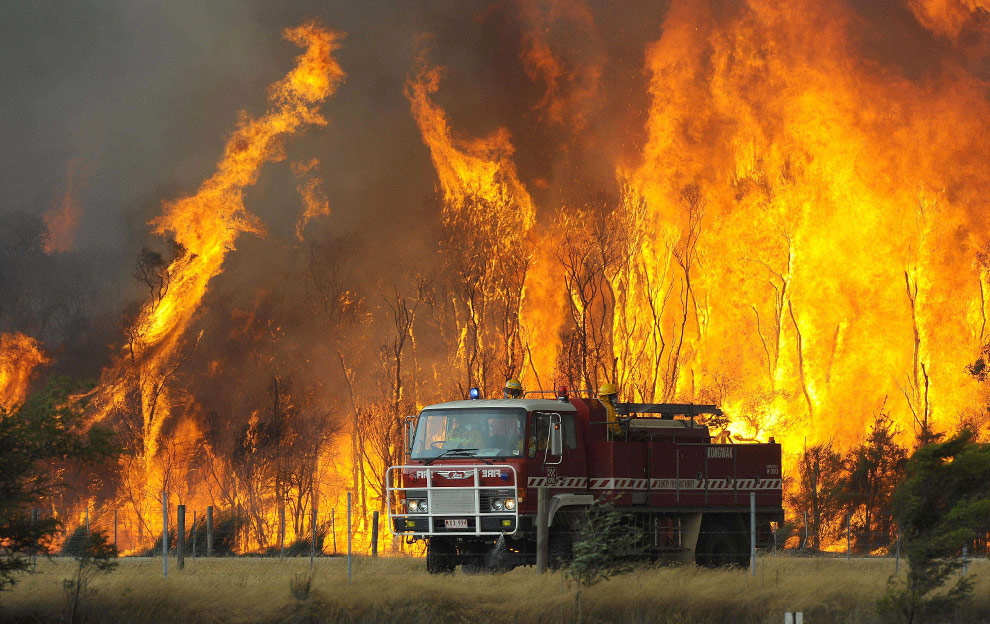
A firetruck retreat in face of raging flames

By Matt Siegel, The New York Times, January 9, 2013

SYDNEY, Australia — Bush fires raging across some of the most populous parts of Australia — feeding off widespread drought conditions and high winds — pushed firefighters to their limits and residents to their wits’ end on Wednesday as meteorologists tracked the country’s hottest spring and summer on record into uncharted territory.
Related
Firefighters battled a grass fire in Oura, near Wagga Wagga, Australia, on Tuesday. On Monday, Australia’s hottest day on record, the national average was 104.59 degrees.
Four months of record-breaking temperatures stretching back to September 2012 have produced what the government says are “catastrophic” fire conditions along the eastern and southeastern coasts of the country, where the majority of Australians live.
Data analyzed on Wednesday by the government Bureau of Meteorology indicated that national heat records had again been set. The average temperature across the country on Tuesday was the highest since statistics began being kept in 1911, at 40 degrees Celsius (104 degrees Fahrenheit), exceeding a mark set only the day before. Meteorologists have had to add two new color bands to their forecast maps, extending their range up to 129 degrees Fahrenheit.
“From this national perspective, one might say this is the largest heat event in the country’s recorded history,” said David Jones, manager of climate monitoring prediction at the Bureau of Meteorology. Firefighters were struggling to contain huge bushfires in Australia’s most populous state, New South Wales, which have scorched around 500 square miles of forest and farmland since Tuesday. Fires on the island state of Tasmania off the country’s southern coast have destroyed more than 300 square miles since Friday.
No confirmed deaths have been reported in connection with the fires, but about 100 people have been unaccounted for since a fire destroyed around 90 homes in Dunalley, Tasmania, last week. State agricultural officials say that tens of thousands of cattle and sheep are believed to have been killed in the fires, which have torn through some of the country’s most productive agricultural and farming regions.
Though the searing heat moderated a bit in some coastal areas on Wednesday, the government warned that the very hot air mass that blistered Sydney earlier in the week was moving up the eastern seaboard and would soon affect Brisbane, Australia’s third-largest city.
The fires have grown so large that they are plainly visible in photographs taken from the International Space Station on Tuesday and published by NASA. The intensity of the bushfires and the unrelenting heat prompted some climate scientists to decry what they see as public indifference to man-made climate change, which is widely seen as leading to more frequent extreme weather.
“Those of us who spend our days trawling — and contributing to — the scientific literature on climate change are becoming increasingly gloomy about the future of human civilization,” Elizabeth Hanna, a researcher at the Australian National University in Canberra, told The Sydney Morning Herald. “We are well past the time of niceties, of avoiding the dire nature of what is unfolding, and politely trying not to scare the public.”
Dr. Jones, the government climate scientist, echoed that opinion.
“This event is turning out to be hotter, more spatially expansive and the duration is quite remarkable,” he said in an interview. “And that suggests climate change.”
At least 141 separate fires were burning in New South Wales on Wednesday, 31 of them out of control. The deputy commissioner of the state’s Rural Fire Service, Rob Rogers, told reporters that it was a bad sign that the fires could not be contained during the brief drop in temperatures.
“We’ve got a huge swath of New South Wales that potentially is going to get new fires again this afternoon,” Mr. Rogers said. “It will be an absolute battle to get containment on most of those fires before the return of the hot weather on the weekend.”
Tuesday’s high added to a growing list of records set during this extended heat wave, including the first time the country has recorded seven consecutive days of temperatures above 39 degrees Celsius (102 degrees Fahrenheit) and eight straight days to start the year that were among the 20 hottest on record. And there is little prospect of imminent relief.
“We expect it to stay very hot across inland Australia for the next week,” Dr. Jones said. “Beyond that, it’s hard to say.”

Friday, January 4, 2013

981. Gerda Lerner, a Feminist and Historian, Dies at 92


Gerda Lener, a pioneer of
women's history

By William Grimes, The New York Times, January 3, 2013

Gerda Lerner, a scholar and author who helped make the study of women and their lives a legitimate subject for historians and spearheaded the creation of the first graduate program in women’s history in the United States, died on Wednesday in Madison, Wis. She was 92.

Her death was confirmed by Steve J. Stern, a history professor and friend at the University of Wisconsin-Madison, where Dr. Lerner had taught for many years.
In the mid-1960s, armed with a doctorate in history from Columbia University and a dissertation on two abolitionist sisters from South Carolina, Dr. Lerner entered an academic world in which women’s history scarcely existed. The number of historians interested in the subject, she told The New York Times in 1973, “could have fit into a telephone booth.”
“In my courses, the teachers told me about a world in which ostensibly one-half the human race is doing everything significant and the other half doesn’t exist,” Dr. Lerner told The Chicago Tribune in 1993. “I asked myself how this checked against my own life experience. ‘This is garbage; this is not the world in which I have lived,’ I said.”
That picture changed rapidly, in large part because of her efforts while teaching at Sarah Lawrence College in the early 1970s. In creating a graduate program there, Dr. Lerner set about trying to establish women’s history as a respected academic discipline and to raising the status of women in the historical profession. She also began gathering and publishing the primary source material — diaries, letters, speeches and so on — that would allow historians to reconstruct the lives of women.
“She made it happen,” said Alice Kessler-Harris, a history professor at Columbia. “She established women’s history as not just a valid but a central area of scholarship. If you look at any library today, you will see hundreds of books on the subject.”
Gerda Hedwig Kronstein was born on April 30, 1920, in Vienna, where her father, Robert, owned a large pharmacy. Her mother, the former Ilona Neumann, a free-spirited bohemian at heart, tried unsuccessfully to reconcile her budding career as an artist with her duties as a housewife and mother. This struggle made a marked impression on her daughter.
Immediately after Germany annexed Austria in 1938, Dr. Lerner’s father, a Jew, was tipped off that he was about to be arrested. As a hedge, he had started a pharmacy in Liechtenstein, and there he fled, whereupon the Gestapo arrested his wife and daughter to force his return. Five weeks later, after he sold his Austrian assets for a nominal sum, his wife and daughter were released and left for Liechtenstein as well.
“It was the most important experience of my life, because I didn’t think that I was going to come out alive,” Dr. Lerner told The Chicago Tribune in 1993.
A more thorough investigation by the Gestapo might have revealed that their young prisoner had been doing underground work for the Communists for several years.
Through a marriage of convenience, Gerda Kronstein made her way to New York, where she worked in menial jobs and trained at Sydenham Hospital in Harlem as an X-ray technician. As a saleswoman at a Fifth Avenue candy store, she was fired after she reported her employers to the Labor Department for paying their factory workers less than the minimum wage.
In 1941, she married Carl Lerner, a theater director and Communist who helped her polish her halting English by having her repeat tongue-twisters like “Mae West is wearing a vest.” The couple moved to Hollywood, where Mr. Lerner became an apprentice film editor.
Dr. Lerner placed a short story based on her jail experience, “Prisoners,” in The Clipper, a liberal literary journal, joined the Communist Party and began working with community groups to organize supermarket boycotts and neighborhood child care centers.
“I was unduly intense, super-serious, incapable of small talk or the kind of friendly gossip that hold acquaintances together,” she wrote in “Fireweed: A Political Autobiography” (2002). “My perfectionism, insistence on anti-fascist commitment in word and deed, and general ‘heaviness’ as a person set me apart from others.”

Because of his politics, Mr. Lerner found it increasingly hard to find work in Hollywood, so in 1949 the couple returned to New York, where he became a top film editor, working on “Twelve Angry Men,” “Requiem for a Heavyweight,” “Klute” and other films. In 1964, the two collaborated on the film “Black Like Me,” based on the 1961 book by the Southern white journalist John Howard Griffin that recounted his experiences disguised as a black man in the Deep South. Mr. Lerner directed, and together they helped adapt the book for film.

Mr. Lerner died in 1973 after a long illness that Dr. Lerner wrote about in “A Death of One’s Own” (1978). Her survivors include a sister, Nora Kronstein; a daughter, Stephanie Lerner; a son, Dan; and four grandchildren.
Dr. Lerner, with great difficulty, found a publisher for “No Farewell” (1955), a novel about the coming of fascism to Austria, but by the late 1950s she faced uncertain prospects as a writer. With thoughts of writing a historical novel, she began researching the lives of Sarah and Angelina GrimkĆ©, daughters of a wealthy plantation owner, who traveled throughout the United States proselytizing for the American Anti-Slavery Society.
The novel never materialized, but her research led to a new career. She began taking history courses at the New School for Social Research, where, while still an undergraduate, she taught “Great Women in American History.” It was one of the first courses ever given in the United States on women’s history.
After earning her bachelor’s degree from the New School in 1963, she enrolled at Columbia, her work on the GrimkĆ© sisters in hand, to study women’s history. Bending the rules, the university allowed her to complete her master’s and doctorate in three years. In 1967, she published “The GrimkĆ© Sisters from South Carolina: Rebels Against Slavery.”
At Sarah Lawrence, where Dr. Lerner began teaching history in 1968, she was the driving force behind what is widely credited as the first graduate program in women’s history in the United States, established in 1972.
At the same time, after writing the textbook “The Woman in American History” (1971), Dr. Lerner began gathering documentary material that would allow other scholars to write women’s history. Her material was published in two important sourcebooks, “Black Women in White America: A Documentary History” (1972) and “The Female Experience: Documents in American History” (1976).
In 1980, she joined the history department at Wisconsin-Madison, where she created the university’s doctoral program in women’s history. She retired from Wisconsin in 1991. In 1981, she became the first woman in 50 years to be elected president of the Organization of American Historians. The Lerner-Scott Prize, named in honor of her and Anne Firor Scott, another pioneer in women’s history, has been given annually since 1992 for the best doctoral dissertation on women’s history in the United States.
Dr. Lerner wrote two ambitious studies on women and society: “The Creation of Patriarchy” (1986) and “The Creation of Feminist Consciousness” (1997). Many of her essays were collected in “The Majority Finds Its Past: Placing Women in History” (1979) and “Why History Matters” (1997).
“I want women’s history to be legitimate, to be part of every curriculum on every level,” she wrote in “Living With History/Making Social Change” (2009), a collection of autobiographical essays. “I want people to be able to take Ph.D.’s in the subject and not have to say they are doing something else.”

Sunday, December 30, 2012

980. Birdsong Study Pecks Theory That Music Is Uniquely Human


By ScienceDaily, December 27, 2012 

A White-Throat Sparrow
A bird listening to birdsong may experience some of the same emotions as a human listening to music, suggests a new study on white-throated sparrows, published in Frontiers of Evolutionary Neuroscience.

"We found that the same neural reward system is activated in female birds in the breeding state that are listening to male birdsong, and in people listening to music that they like," says Sarah Earp, who led the research as an undergraduate at Emory University.

For male birds listening to another male's song, it was a different story: They had an amygdala response that looks similar to that of people when they hear discordant, unpleasant music.

The study, co-authored by Emory neuroscientist Donna Maney, is the first to compare neural responses of listeners in the long-standing debate over whether birdsong is music.

"Scientists since the time of Darwin have wondered whether birdsong and music may serve similar purposes, or have the same evolutionary precursors," Earp notes. "But most attempts to compare the two have focused on the qualities of the sound themselves, such as melody and rhythm."

Earp's curiosity was sparked while an honors student at Emory, majoring in both neuroscience and music. She took "The Musical Brain" course developed by Paul Lennard, director of Emory's Neuroscience and Behavioral Biology program, which brought in guest lecturers from the fields of neuroscience and music.
"During one class, the guest speaker was a composer and he said that he thought that birdsong is like music, but Dr. Lennard thought it was not," Earp recalls. "It turned into this huge debate, and each of them seemed to define music differently. I thought it was interesting that you could take one question and have two conflicting answers that are both right, in a way, depending on your perspective and how you approach the question."

As a senior last year, Earp received a grant from the Scholars Program for Interdisciplinary Neuroscience Research (SPINR), and a position in the lab of Maney, who uses songbirds as a model to study the neural basis of complex learned behavior.

When Earp proposed using the lab's data to investigate the birdsong-music debate, Maney thought it was a great idea. "Birdsong is a signal," Maney says. "And the definition of a signal is that it elicits a response in the receiver. Previous studies hadn't approached the question from that angle, and it's an important one."

Earp reviewed studies that mapped human neural responses to music through brain imaging.

She also analyzed data from the Maney lab on white-throated sparrows. The lab maps brain responses in the birds by measuring Egr-1, part of a major biochemical pathway activated in cells that are responding to a stimulus.
The study used Egr-1 as a marker to map and quantify neural responses in the mesolimbic reward system in male and female white-throated sparrows listening to a male bird's song. Some of the listening birds had been treated with hormones, to push them into the breeding state, while the control group had low levels of estradiol and testosterone.

During the non-breeding season, both sexes of sparrows use song to establish and maintain dominance in relationships. During the breeding season, however, a male singing to a female is almost certainly courting her, while a male singing to another male is challenging an interloper.

For the females in the breeding state every region of the mesolimbic reward pathway that has been reported to respond to music in humans, and that has a clear avian counterpart, responded to the male birdsong. Females in the non-breeding state, however, did not show a heightened response.

And the testosterone-treated males listening to another male sing showed an amygdala response, which may correlate to the amygdala response typical of humans listening to the kind of music used in the scary scenes of horror movies.
"The neural response to birdsong appears to depend on social context, which can be the case with humans as well," Earp says. "Both birdsong and music elicit responses not only in brain regions associated directly with reward, but also in interconnected regions that are thought to regulate emotion. That suggests that they both may activate evolutionarily ancient mechanisms that are necessary for reproduction and survival."

A major limitation of the study, Earp adds, is that many of the regions that respond to music in humans are cortical, and they do not have clear counterparts in birds. "Perhaps techniques will someday be developed to image neural responses in baleen whales, whose songs are both musical and learned, and whose brain anatomy is more easily compared with humans," she says.
Earp, who played the viola in the Emory orchestra and graduated last May, is now a medical student at the Cleveland Clinic.

So what music makes her brain light up? "Stravinsk's 'Firebird' suite," Earp says.

Story Source:
The above story is reprinted from materials provided by Emory University. The original article was written by Carol Clark.
Note: Materials may be edited for content and length. For further information, please contact the source cited above.

Journal Reference:
  1. Sarah E. Earp, Donna L. Maney. Birdsong: Is It Music to Their Ears? Frontiers in Evolutionary Neuroscience, 2012; 4 DOI: 10.3389/fnevo.2012.00014

Wednesday, December 26, 2012

979. Los Angeles Weighs Law Banning Elephant Shows

By Ivan Lovett, The New York Times, December 25, 2012
Ringling Brothers elephants in Los Angeles last year. Critics object to the animals’ treatment.
Photo: Stefano Paltera/Associated Press

LOS ANGELES — The Ringling Brothers and Barnum & Bailey Circus train has been bringing four-ton Asian elephants to this city since 1919.

Los Angeles is poised to ban elephants from performing in circuses within its city limits, after pressure from animal welfare advocates who have for decades condemned the methods used to train and transport elephants as abusive and cruel.

If the City Council adopts the ban early next year, Ringling Brothers, the oldest continuously operated circus in the country, will be barred from the nation’s second-largest city unless its owners agree to abandon one of the show’s signature acts.
“The treatment of elephants in traveling circuses is one of the crueler practices, and it’s time for us to stand up for them,” said Paul Koretz, the City Council member who sponsored the ban. He predicted that once Los Angeles outlawed circus elephants, other communities would follow. “At some point, this will be universally banned throughout the country,” he said.
The movement to ban elephant acts, which had until recently made little progress in this country, may now have found a foothold in Southern California, a region that has emerged as a hub of animal welfare legislation of all kinds. (It is illegal for pet owners to declaw their cats in this city, while in neighboring West Hollywood, the city government went so far as to officially deem pets “companion animals” and their owners “guardians.”)
Six Southern California cities already ban circus elephants, more than in any other state, according to animal welfare organizations. In addition, over the last year, the Santa Ana Zoo and the Orange County Fair both stopped offering elephant rides.
Ringling Brothers has fought back, arguing that its treatment of elephants, tigers and other animals is humane, and pointing to frequent inspections by the Department of Agriculture as proof that the animals are receiving exemplary care.
But the fight over whether elephants should be allowed to perform in traveling shows is only partly about how they are treated: an endangered species, Asian elephants are part of a broader debate over how, and whether, humans should interact with wild animals.
Trainers argue that letting people interact with elephants makes them more likely to support conservation efforts.
“Seeing animals up close is one of the main reasons people come to Ringling Brothers,” said Stephen Payne, a spokesman for Feld Entertainment, which bought Ringling Brothers in 1967. “Animal rights organizations want no human-animal interaction, period, regardless of how the animals are cared for.”
Elephants had been trained to work with humans for thousands of years before they became fixtures in circuses and roaming carnivals (just ask Hannibal). Intelligent and normally docile, they can learn tricks like headstands for wide-eyed children.
But pressure on circuses to drop wild animal acts has grown steadily, as activists have waged a campaign to convince the public that it is cruel to haul animals back and forth across the country to perform in front of crowds.
Animal rights organizations have criticized the conditions in which the animals are kept, offering what they say is evidence of mistreatment, including undercover videos of handlers hitting elephants over the head with bull hooks, rods with a curved, sharp end long used to train and control elephants.
Some organizations, like People for the Ethical Treatment of Animals, want to remove animals not only from circuses but also from zoos, even though those animals are not made to travel in boxcars or perform tricks.
“For the circuses, profit is always the priority,” said Lindsay Rajt, a spokeswoman for PETA. “Any time animals are used for profit, you’re going to see corners cut on their welfare, because it’s not the top priority.”
Even people who are not actively involved in animal rights have grown more receptive to this argument.
Rebecca Goldstein, a Los Angeles resident, said it would be a shame if she could not take children of her own to see a circus with live animals, like the one she went to when she was young.
“But if the way they’re treating animals is inhumane,” Ms. Goldstein, 29, said, “I’ll take them to see people instead.”
More than a dozen countries have banned at least some wild animals from performing in public. Several major American circuses have voluntarily eliminated animals from their shows, instead focusing on human acrobatics, while zoos, including the Los Angeles Zoo, have moved away from use of the bull hook.
But the pull to see elephants up close has proved a difficult force to overcome. Lawsuits designed to force Ringling Brothers to abandon elephant acts have been dismissed. Only a scattering of relatively small cities have adopted bans of their own.
About 10 million people nationwide came to see Ringling Brothers circuses in 2012, according to Feld Entertainment, including 100,000 in Los Angeles.
Despite the continued popularity of elephant acts, though, some elephant trainers fear that their work may soon be outlawed.
Kari Johnson, a co-owner of Have Trunk Will Travel, a company that trains and rents elephants for shows, including Hollywood movies, said the end of elephant rides in Orange County had hurt her business. A ban in Los Angeles could be ruinous.
“I believe if something drastic doesn’t happen, then we will be the last generation that trains elephants,” said Ms. Johnson, whose stepfather was also an elephant trainer. “People love elephants because they get to be around them a little.”