Thursday, March 22, 2012

723. Greenland Ice Sheet May Melt Completely With 1.6 Degrees of Global Warming


Greenland ice sheet melting
By ScienceDaily, March 12, 2012 

The Greenland ice sheet is likely to be more vulnerable to global warming than previously thought. The temperature threshold for melting the ice sheet completely is in the range of 0.8 to 3.2 degrees Celsius of global warming, with a best estimate of 1.6 degrees above pre-industrial levels, shows a new study by scientists from the Potsdam Institute for Climate Impact Research (PIK) and the Universidad Complutense de Madrid. Today, already 0.8 degrees of global warming has been observed. Substantial melting of land ice could contribute to long-term sea-level rise of several meters and therefore it potentially affects the lives of many millions of people.

The time it takes before most of the ice in Greenland is lost strongly depends on the level of warming. "The more we exceed the threshold, the faster it melts," says Alexander Robinson, lead-author of the study now published in Nature Climate Change. In a business-as-usual scenario of greenhouse-gas emissions, in the long run humanity might be aiming at 8 degrees Celsius of global warming. This would result in one fifth of the ice sheet melting within 500 years and a complete loss in 2000 years, according to the study. "This is not what one would call a rapid collapse," says Robinson. "However, compared to what has happened in our planet's history, it is fast. And we might already be approaching the critical threshold."

In contrast, if global warming would be limited to 2 degrees Celsius, complete melting would happen on a timescale of 50.000 years. Still, even within this temperature range often considered a global guardrail, the Greenland ice sheet is not secure. Previous research suggested a threshold in global temperature increase for melting the Greenland ice sheet of a best estimate of 3.1 degrees, with a range of 1.9 to 5.1 degrees. The new study's best estimate indicates about half as much.

"Our study shows that under certain conditions the melting of the Greenland ice sheet becomes irreversible. This supports the notion that the ice sheet is a tipping element in the Earth system," says team-leader Andrey Ganopolski of PIK. "If the global temperature significantly overshoots the threshold for a long time, the ice will continue melting and not regrow -- even if the climate would, after many thousand years, return to its preindustrial state." This is related to feedbacks between the climate and the ice sheet: The ice sheet is over 3000 meters thick and thus elevated into cooler altitudes. When it melts its surface comes down to lower altitudes with higher temperatures, which accelerates the melting. Also, the ice reflects a large part of solar radiation back into space. When the area covered by ice decreases, more radiation is absorbed and this adds to regional warming.

The scientists achieved their insights by using a novel computer simulation of the Greenland ice sheet and the regional climate. This model performs calculations of these physical systems including the most important processes, for instance climate feedbacks associated with changes in snowfall and melt under global warming. The simulation proved able to correctly calculate both the observed ice-sheet of today and its evolution over previous glacial cycles, thus increasing the confidence that it can properly assess the future. All this makes the new estimate of Greenland temperature threshold more reliable than previous ones.

Story Source:
The above story is reprinted from materials provided by Potsdam Institute for Climate Impact Research (PIK).
Note: Materials may be edited for content and length. For further information, please contact the source cited above.

Journal Reference:
  1. Alexander Robinson, Reinhard Calov, Andrey Ganopolski.Multistability and critical thresholds of the Greenland ice sheetNature Climate Change, 2012; DOI:10.1038/NCLIMATE1449

722. Insecticides Are Tied to Honeybee Colony Collapse Disorder


Corn insecticides are tied to honeybee
colony collapse disorder
By ScienceDaily,  March 14, 2012  

New research has linked springtime die-offs of honeybees critical for pollinating food crops -- part of the mysterious malady called colony collapse disorder -- with technology for planting corn coated with insecticides.

The study, published in ACS' journal Environmental Science & Technology, appears on the eve of spring planting seasons in some parts of Europe where farmers use the technology and widespread deaths of honeybees have occurred in the past.

In the study, Andrea Tapparo and colleagues explain that seeds coated with so-called neonicotinoid insecticides went into wide use in Europe in the late 1990s. The insecticides are among the most widely used in the world, popular because they kill insects by paralyzing nerves but have lower toxicity for other animals. Almost immediately, beekeepers observed large die-offs of bees that seemed to coincide with mid-March to May corn planting. Scientists thought this might be due to particles of insecticide made airborne by the pneumatic drilling machines used for planting. These machines forcefully suck seeds in and expel a burst of air containing high concentrations of particles of the insecticide coating. In an effort to make the pneumatic drilling method safer, the scientists tested different types of insecticide coatings and seeding methods.

They found, however, that all of the variations in seed coatings and planting methods killed honeybees that flew through the emission cloud of the seeding machine. One machine modified with a deflector to send the insecticide-laced air downwards still caused the death of more than 200 bees foraging in the field. The authors suggest that future work on this problem should focus on a way to prevent the seeds from fragmenting inside the pneumatic drilling machines.

The authors acknowledge funding from the University of Padova and the Ministero delle Politiche Agricole Alimentari e Forestali, Italy.

Story Source:
The above story is reprinted from materials provided byAmerican Chemical Society.
Note: Materials may be edited for content and length. For further information, please contact the source cited above.

Journal Reference:
  1. Andrea Tapparo, Daniele Marton, Chiara Giorio, Alessandro Zanella, Lidia Soldà, Matteo Marzaro, Linda Vivan, Vincenzo Girolami. Assessment of the Environmental Exposure of Honeybees to Particulate Matter Containing Neonicotinoid Insecticides Coming from Corn Coated SeedsEnvironmental Science & Technology, 2012; : 120217095058002 DOI: 10.1021/es2035152

721. Plants 'Remember' Drought, Change Responses to Survive


Nobbies are draught tolerant 
By ScienceDaily,  March 15, 2012 

Plants subjected to a previous period of drought learn to deal with the stress thanks to their memories of the experience, new research has found. The findings could lead to development of crops better able to withstand drought.

The research also confirms for the first time the scientific basis for what home gardeners and nursery professionals have often learned through hard experience: Transplants do better when water is withheld for a few days to drought harden them before the move.

"This phenomenon of drought hardening is in the common literature but not really in the academic literature," said Michael Fromm, a University of Nebraska-Lincoln plant scientist who was part of the research team. "The mechanisms involved in this process seem to be what we found."

Working with Arabidopsis, a member of the mustard family considered an excellent model for plant research, the team of Fromm, plant molecular biologist Zoya Avramova and post-doctoral fellow Yong Ding compared the reaction of plants that had been previously stressed by withholding water to those not previously stressed.

The pre-stressed plants bounced back more quickly the next time they were dehydrated. Specifically, the nontrained plants wilted faster than trained plants and their leaves lost water at a faster rate than trained plants.

"The plants 'remember' dehydration stress. It will condition them to survive future drought stress and transplanting," Fromm said.

The team found that the trained plants responded to subsequent dehydration by increasing transcription of a certain subset of genes. During recovery periods when water is available, transcription of these genes returns to normal levels, but following subsequent drought periods the plants remember their transcriptional response to stress and induce these genes to higher levels in this subsequent drought stress.

"All of this is driven by events at the molecular level," Avramova said. "We demonstrate that this transcriptional memory is associated with chromatin changes that seem to be involved in maintaining this memory."

Arabidopsis forgets this previous stress after five days of watering, though other plants may differ in that memory time.

This is the first instance of transcriptional memory found in any life form above yeasts. This discovery may lead to breeding or engineering of crops that would better withstand drought, although practical applications of these findings in agriculture are years away, Fromm said.

"We're a long way off. We're just starting to get a basic understanding," Fromm said. "It's possible plants overreact to a first drought stress. They panic, they slow down more than they need to."

Perhaps scientists can modify those instincts in plants to help maintain or improve productivity during times of drought, he added.
But home gardeners can make immediate use of these findings.

"If I was transplanting something, I would deprive it of water for a couple of days, then water overnight, then transplant," Fromm said.

The work is the subject of an article this week in the online journal Nature Communications and is funded by the National Science Foundation.

Story Source:
The above story is reprinted from materials provided byUniversity of Nebraska-Lincoln, via Newswise.
Note: Materials may be edited for content and length. For further information, please contact the source cited above.

Journal Reference:
  1. Yong Ding, Michael Fromm, Zoya Avramova. Multiple exposures to drought 'train' transcriptional responses in ArabidopsisNature Communications, 2012; 3: 740 DOI: 10.1038/ncomms1732

720. Early Spring Drives Butterfly Population Declines


Mormon Fritillary butterflies mating in the Rocky Mountains:
will this population survive? (Credit: National Park Service)
By ScienceDaily, March 16, 2012  

Early snowmelt caused by climate change in the Colorado Rocky Mountains snowballs into two chains of events: a decrease in the number of flowers, which, in turn, decreases available nectar. The result is decline in a population of the Mormon Fritillary butterfly, Speyeria mormonia.

Using long-term data on date of snowmelt, butterfly population sizes and flower numbers at the Rocky Mountain Biological Laboratory, Carol Boggs, a biologist at Stanford University, and colleagues uncovered multiple effects of early snowmelt on the growth rate of an insect population.

"Predicting effects of climate change on organisms' population sizes will be difficult in some cases due to lack of knowledge of the species' biology," said Boggs, lead author of a paper reporting the results online in this week's journal Ecology Letters.

Taking into account the butterfly's life cycle and the factors determining egg production was important to the research.

Butterflies lay eggs (then die) in their first summer; the caterpillars from those eggs over-winter without eating and develop into adults in the second summer.
In laboratory experiments, the amount of nectar a female butterfly ate determined the number of eggs she laid. This suggested that flower availability might be important to changes in population size.

Early snowmelt in the first year leads to lower availability of the butterfly's preferred flower species, a result of newly developing plants being exposed to early-season frosts that kill flower buds.

The ecologists showed that reduced flower--and therefore nectar--availability per butterfly adversely affected butterfly population growth rate.

Early snowmelt in the second year of the butterfly life cycle worsened the effect, probably through direct killing of caterpillars during early-season frosts.
The combined effects of snowmelt in the two consecutive years explained more than four-fifths of the variation in population growth rate.

"Because species in natural communities are interconnected, the effects of climate change on any single species can easily be underestimated," said Saran Twombly, program director in the National Science Foundation's Division of Environmental Biology, which funded the research.

"This study combines long-term, data models, and an understanding of species interactions to underscore the complex effects climate change has on natural populations."

"It's very unusual for research to uncover a simple mechanism that can explain almost all the variation in growth rate of an insect population," said David Inouye, a biologist at the University of Maryland and co-author of the paper.
Indeed, "one climate parameter can have multiple effects on an organism's population growth," Boggs said. "This was previously not recognized for species such as butterflies that live for only one year.

"We can already predict that this coming summer will be a difficult one for the butterflies," she said, "because the very low snowpack in the mountains this winter makes it likely that there will be significant frost damage."

"Long-term studies such as ours are important to understanding the 'ecology of place,' and the effects of weather and possible climate change on population numbers," said Inouye.

"This research is critical to assessing the broader effects of weather on an ever-changing Earth," he said. "By facilitating long-term studies, field stations such as the Rocky Mountain Biological Laboratory are an invaluable asset."


Story Source:
The above story is reprinted from materials provided by National Science Foundation.
Note: Materials may be edited for content and length. For further information, please contact the source cited above.

Journal Reference:
  1. Carol L. Boggs, David W. Inouye. A single climate driver has direct and indirect effects on insect population dynamicsEcology Letters, 2012; DOI: 10.1111/j.1461-0248.2012.01766.x

Monday, March 19, 2012

719. Fundamental Steps Needed Now in Global Redesign of Earth System Governance, Experts Say


ScienceDaily, March 16, 2012 

Some 32 social scientists and researchers from around
the world have concluded that fundamental reforms of global
environmental governance are needed to avoid dangerous
changes in the Earth system. (Credit: © Alx / Fotolia)
Some 32 social scientists and researchers from around the world, including a Senior Sustainability Scholar at Arizona State University, have concluded that fundamental reforms of global environmental governance are needed to avoid dangerous changes in the Earth system. The scientists argued in the March 16 edition of the journal Science that the time is now for a "constitutional moment" in world politics.

Research now indicates that the world is nearing critical tipping points in the Earth system, including on climate and biodiversity, which if not addressed through a new framework of governance could lead to rapid and irreversible change.

"Science assessments indicate that human activities are moving several of Earth's sub-systems outside the range of natural variability typical for the previous 500,000 years," wrote the authors in the opening of "Navigating the Anthropocene: Improving Earth System Governance."

Reducing the risk of potential global environmental disaster requires the development of "a clear and ambitious roadmap for institutional change and effective sustainability governance within the next decade," comparable in scale and importance to the reform of international governance that followed World War II, they wrote.

In particular, the group argued for the creation of a Sustainable Development Council that would better integrate sustainability concerns across the United Nations system. Giving a leading role to the 20 largest economies (G20) would help the council act effectively. The authors also suggested an upgrade of the UN Environment Program to a full-fledged international organization, a move that would give it greater authority and more secure funding.

To keep these institutions accountable to the public, the scientists called for stronger consultative rights for representatives of civil society, including representatives from developing countries, NGOs, consumers and indigenous peoples.

"We should seek input from people closest to the ground, not just from the elites, not just at the 30,000-feet level," noted Kenneth W. Abbott, a professor of international relations in ASU's Sandra Day O'Connor College of Law. "Consultations should not take place only at the global scale, where the broadest policies are created, but also at local scales, smaller scales, all scales," he said.

To improve the speed of decision-making in international negotiations, the authors called for stronger reliance on qualified majority voting. "There has to be a change in international negotiating procedures from the current situation, in which no action can be taken unless consensus is reached among all participating governments," Abbott said.

The authors also called for governments "to close remaining regulatory gaps at the global level," including the treatment of emerging technologies.

"A great deal of attention has been given to issues such as climate change, yet nanotechnology and other emerging technologies, which may bring significant benefits, also carry potential risks for sustainable development," Abbott said.
Relying on research by Abbott and his colleagues at ASU's College of Law, the authors wrote that emerging technologies "need an international institutional arrangement-such as one or several multilateral framework conventions" to support forecasting and transparency, and to ensure that environmental risks are taken into account.

"Working to make the world economy more green and to create an effective institutional framework for sustainable development will be the two main focal points at this summer's United Nations Conference on Sustainable Development in Rio de Janeiro," Abbott said. "This article was written to bring urgency to those discussions and to outline specific 'building blocks' for a more effective and sustainable Earth system governance system."

The authors also argued for increased financial support for poorer nations. "More substantial financial resources could be made available through novel financial mechanisms, such as global emissions markets or air transportation levies for sustainability purposes," they wrote.

Lead author Frank Biermann, of Free University Amsterdam and Lund University, Sweden, said, "Societies must change course to steer away from critical tipping points in the Earth system that could lead to rapid and irreversible change. Incremental change is no longer sufficient to bring about societal change at the level and with the speed needed to stop Earth system transformation.

"Structural change in global governance is needed, both inside and outside the UN system and involving both public and private actors," said Biermann, who also is chair of the scientific steering committee of the Earth System Governance Project.

All 32 authors of the Science article are affiliated with the Earth System Governance Project, a global alliance of researchers and leading research institutions, specializing in the scientific study of international and national environmental governance. ASU's Abbott is one of some 50 lead faculty of the Earth System Governance Project. Lead faculty are scientists of high international reputation who share responsibility for research on earth system governance.

Story Source:
The above story is reprinted from materials provided by Arizona State University, via Newswise.
Note: Materials may be edited for content and length. For further information, please contact the source cited above.

Journal Reference:
  1. F. Biermann, K. Abbott, S. Andresen, K. Backstrand, S. Bernstein, M. M. Betsill, H. Bulkeley, B. Cashore, J. Clapp, C. Folke, A. Gupta, J. Gupta, P. M. Haas, A. Jordan, N. Kanie, T. Kluvankova-Oravska, L. Lebel, D. Liverman, J. Meadowcroft, R. B. Mitchell, P. Newell, S. Oberthur, L. Olsson, P. Pattberg, R. Sanchez-Rodriguez, H. Schroeder, A. Underdal, S. C. Vieira, C. Vogel, O. R. Young, A. Brock, R. Zondervan. Navigating the Anthropocene: Improving Earth System GovernanceScience, 2012; 335 (6074): 1306 DOI: 10.1126/science.1217255

Friday, March 16, 2012

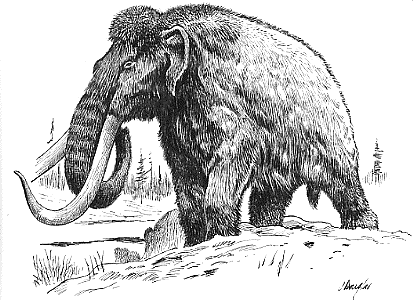
718. Climat Change and Humans Caused Mammoth Extinction


By Richard A. Kerr, Science Now, March 5, 2012
The past few tens of millennia were hard times for the "megafauna" of the world. Hundreds of big-bodied species—from the mammoths of North America to the 3-meter-tall kangaroos of Australia to the 200-kilogram-plus flightless birds of New Zealand—just disappeared from the fossil record. A new, broad analysis continues the century-long debate over the loss of the big animals, coming down on the middle ground between blaming migrating humans for wiping them all out and climate change alone for doing them in.
As in most contentious scientific debates, uncertainties in the data have fueled the dispute over what took out the megafauna. Typically, researchers would try to pin down exactly when, say, the mammoths of North America died out, when the climate changed the fastest as the world came out of the last ice age, and, most difficult, when humans from Asia first arrived on the scene. If the extinction in a particular area seemed to coincide with severe climate change or with the arrival of humans, one or the other could be blamed. If it seemed to have been the humans, researchers assumed the new arrivals must have hunted down too many mammoths, brought a lethal disease with them, or altered the environment somehow, perhaps by too much burning.
But the case-by-case tactic has not yet carried the day for either side. So zoologists Graham Prescott and David Williams and their colleagues at the University of Cambridge in the United Kingdom decided to take a broader approach. In a paper published today in the Proceedings of the National Academy of Sciences, they lay out their analysis of the extinction of 110 genera of megafauna on five landmasses in relation to the timing of four kinds of climate change and the arrival of humans.
The Cambridge group compiled dates from previous studies for the arrival of humans and the extinction of megafauna on each landmass: Australia, Eurasia, New Zealand, North America, and South America. And they took the temperature record locked in an Antarctic ice core as a guide to global climate change. Then they compared how well climate change and human arrivals, alone or in combination, could predict the timing and severity of extinctions on the five landmasses. To sort out the importance of timing uncertainties, they tested 320,000 different extinction scenarios. "We tested a lot of models across a huge range of human arrival times and extinction times," Prescott says. "It seems likely that both climate and human factors played a role" in most cases.
"What they found makes sense," says mammalian paleoecologist Anthony Barnosky of the University of California, Berkeley. "It makes a clear case for there being an interaction. It shows what happens when two bad things happen at once." Barnosky and environmental scientist Barry Brook of the University of Adelaide in Australia have found such a human-climate synergy operating in megafaunal extinctions when severe climate change coincided with human arrivals. A similar synergy is happening today, they say, as global warming intensifies and the human population continues to grow.
But others have concerns about the latest study—for example, the way it lumps together events occurring as much as 10,000 years apart to test for coincidence. "When you have such a challenging problem, what are you willing to ignore in the details to get the big picture?" asks ecological statistician Andrew Solow of Woods Hole Oceanographic Institution in Massachusetts. "I'm worried that too much of the detail was omitted. This is a first step."

717. A Little Gorilla in Us All


sn-gorillas.jpg
Kamila
By Elizabeth Pennisi, Science Now,  March 7, 2012
Ever since the human genome was sequenced a decade ago, researchers have dreamed about deciphering DNA from our three great ape cousins as well. Now the final remaining genome, that of the gorilla, is in hand, and it reveals interesting connections between us and them. Surprisingly, parts of our genome are more similar to the gorilla's than they are to the chimp's, and a few of the same genes previously thought key to our unique evolution are key to theirs, too.
Today there are four groups of great apes: chimps and bonobos, humans, gorillas, and orangutans. The genome of the chimp—our closest relative—was published in 2005; the orangutan sequence came out in early 2011. Now researchers have analyzed the DNA of a western lowland gorilla named Kamilah, who lives at the San Diego Zoo. In addition, they sequenced DNA from three other gorillas, including one eastern lowland gorilla, a rare species estimated at only 20,000 individuals. "It's essential to have all of the great ape genomes in order to understand the features of our own genome that make humans unique," says Gregory Wray, an evolutionary biologist at Duke University in Durham, North Carolina, who was not involved in the study. Adds paleoanthropologist David Begun of the University of Toronto in Canada: "It will allow us to begin to identify genetic changes specific to humans since our divergence from chimps."
Humans and apes are nearly identical in the vast majority of base pairs, or letters of the genetic code: The human genome is 1.37% different from the chimp's; 1.75% different from the gorilla's; and 3.4% different from the orangutan's, researchers from the Wellcome Trust Sanger Institute in Hinxton, U.K., and their colleagues report today in Nature. Although chimps and humans are indeed closest kin, 15% of the human genome more closely matches the gorilla's. Those genes' activity patterns are similar too, says Sanger evolutionary genomicist and lead author of the study Aylwyn Scally: "Some of our functional biology is more gorillalike than chimplike."
Moreover, with all the great ape genomes to compare, researchers are better able to assess when gorillas, chimps, and humans evolved—a matter of current debate. The molecular data indicate that humans and chimps went their separate ways only about 4.5 million years ago. But fossils that old and older look either ape or protohuman, so some paleontologists argue for a split as far back as 7 million years ago. Scally's group comes up with a date of about 6 million years ago, adjusting what would have been a more recent estimate by assuming that the mutation rate slowed over time in ape evolution. Another possible complication is that interbreeding may have occurred in the incipient species, slowing the actual separation of the DNA into distinct genomes, Scally points out. The authors suggest that ancestors of the gorilla separated from the human-chimp line about 10 million years ago, consistent with previous estimates.
"I am very happy to see the authors conclude [with] divergence dates that are consistent with both the fossil and genetic records," Begun says. "Usually one line of evidence is used to discredit the other."
The comparison with other sequenced genomes revealed that over the course of great ape evolution, about 90% of the genome has been influenced by natural selection. In each of the chimp, human, and gorilla, more than 500 genes have been evolving faster than expected, suggesting that they have changed in a way that confers some advantage. In the gorilla, one of the faster-evolving genes is involved in the hardening of skin, as happens in the knuckle pads for knuckle walking. Hearing genes that have evolved rapidly in humans also show accelerated evolution in gorillas. Some researchers had thought that those human genes might partly underlie language evolution, but that idea will need some rethinking now, Scally says. The researchers also saw parallel acceleration in the evolution of genes for brain development in gorillas and humans.
As part of the study, Scally and colleagues compared the genomes of eastern and western lowland gorillas and concluded that the species split up 0.5 million years ago but continued to interbreed a little after that. Moreover, many millennia ago, for some unknown reason, the eastern lowland gorilla population severely shrank, causing low genetic diversity and low numbers. Some researchers have suggested that the small population is due to recent human activity, but the new analysis suggests "it's a long-term thing," Scally says. "That's not to say that current human activity hasn't been a big threat."
Much more work remains to be done comparing the gorilla genome with other great apes. But already "it has provided a lot of important information regarding mechanisms and timing of speciation, gene evolution, [and] gene flow between [species and] subspecies," says gylcobiologist and great ape expert Ajit Varki of the University of California, San Diego, who was not involved in the study. "This information is, of course, of great interest to many investigators."