Tuesday, April 26, 2016

2293. What's Driving Deforestation?

By Union of Concerned Scientists, April 25, 216
Deforestation to feed beef cattle on pasture
What if you found out that just four commodities—commodities so pervasive in modern life that we encounter them daily—are responsible for more than half of the world’s tropical deforestation? What if you learned that many of the other commonly cited causes of deforestation, such as cocoa, sugar, and coffee, are now only marginal parts of the global problem?

Surprisingly, all of this is true. Just four commodities—beef, soy, palm oil, and wood products—drive the majority of tropical deforestation. 

Why does deforestation matter? Forests—especially tropical forests—store enormous amounts of carbon. When forests are destroyed, that carbon is released to the atmosphere, accelerating global warming. Deforestation accounts for around 10% of total heat-trapping emissions—roughly the same as the yearly emissions from 600 million cars.

In addition to storing carbon, forests provide important habitat for a long list of endangered species—and they offer many other benefits, such as clean water, forest products, and livelihoods for indigenous communities.

With large areas of cheap land, relatively low labor costs, and a year-round growing season, the tropics have become a favored location for large-scale industrial commodity production. Eliminating emissions from commodity-driven tropical deforestation can play a huge role in reducing climate change—and we can do it in the near future.

The four major drivers (and some minor ones)
The following four commodities are the largest drivers of deforestation. Together, they have an outsized impact on the health of our world’s forests and climate, annually contributing 3.83 million hectares of deforestation, an area about the size of Switzerland.


Beef cattle
Of the four major deforestation drivers, beef has by far the largest impact. Converting forest to pasture for beef cattle, largely in Latin America, is responsible for destroying 2.71 million hectares of tropical forest each year—an area about the size of the state of Massachusetts—in just four countries. This is more than half of tropical deforestation in South America, and more than five times as much as any other commodity in the region. 

Soybeans
Growing global demand for meat and dairy products has contributed to the doubling of soybean production in the last 20 years. Soy is primarily used to feed pork, poultry, and dairy cows, though significant amounts are also used to produce vegetable oil and biodiesel. Large soybean fields in the tropics, particularly in Latin America, are often planted on newly deforested land—or they may expand onto former pastureland, pushing cattle to the forest frontier. Every year around 480,000 hectares is deforested for soy in major soy-producing tropical countries.

Palm oil
Palm oil is used in countless processed foods and personal care products, as well as biofuels and vegetable oil. Produced largely in Southeast Asia, palm oil packs a powerful climate punch, not only because of the amount of land deforested annually (270,000 hectares in three leading countries), but also because much of this area includes the carbon-rich soils known as peatlands. Peatlands contain up to 28 times as much carbon as the forests above them—carbon that's released to the atmosphere when peatlands are drained for oil palm plantations. As a result, palm oil contributes the most global warming emissions of any commodity besides beef. 

Wood products
Perhaps the most iconic symbol of forest destruction, wood production has been shown to cause around 380,000 hectares of deforestation annually in key countries, though the actual number is likely higher. Wood products can be divided into two categories. Pulp is made from tree fibers and used to produce paper and related products. It drives deforestation primarily in Indonesia, where forests are cut down for plantations of fast-growing tree species. Timber, used for construction or high-end products like furniture, is most clearly linked to forest degradation, in which valuable tree species are harvested and the rest remain. Degraded forests are more likely to be targeted for conversion to other land uses. 

Other drivers
Besides the four mentioned above, many other commodities contribute on a smaller scale to tropical deforestation, including coffee, rubber, cocoa, and sugar. While these commodities may have caused significant deforestation in the past (and might again in the future), none of them currently has an impact approaching that of the four major drivers.

Solutions
Because these commodities are in so many widely used consumer products, changing the way they are produced could have huge benefits for the climate, forests, and people around the world. And this change is possible—there are strategies to produce beef, soy, palm oil, and wood products in ways that allow the world’s forests to thrive. 

Already innovative governments and companies have begun taking real steps toward protecting forests from destruction. Deforestation in the Brazilian Amazon fell by 70% from 2005 to 2014, largely thanks to temporary agreements by processors and exporters to stop buying cattle or soy linked to deforestation in the region. Some companies have made commitments to ensure that future sourcing of their commodities (most often palm oil) will be free from deforestation.


Yet these temporary and partial measures are not enough. As deforestation in the Brazilian Amazon has decreased, we must stem the tide of deforestation in other ecosystems and other countries. Major companies that operate in forested regions, or source products from them, must commit to ending deforestation for all their operations. When companies make these commitments—and follow through on them—they finally begin to show that destroying forests, reducing habitat, and contributing to global warming can no longer be business as usual. 

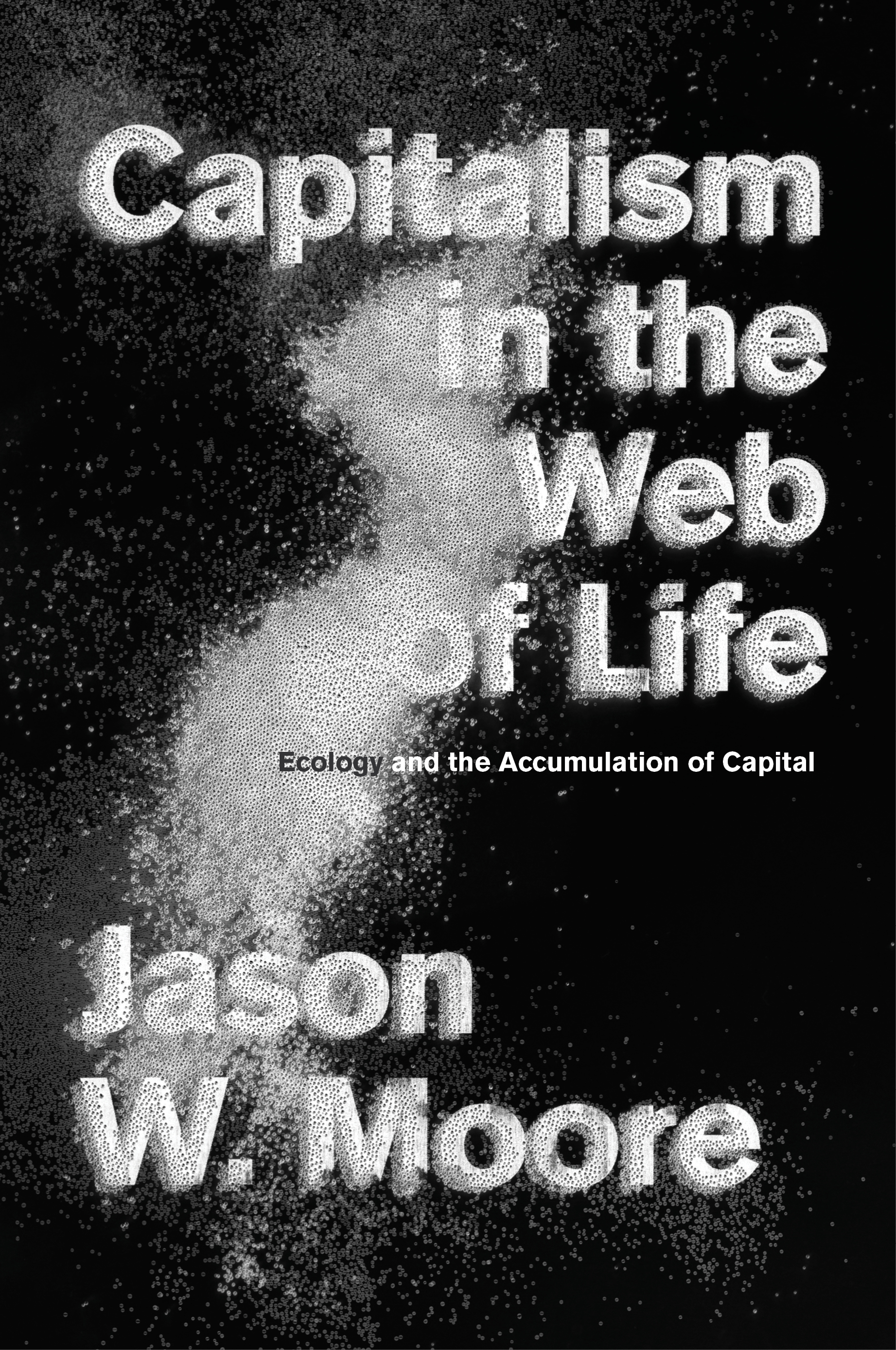
2292. Capitalism in the Web of Life: An Interview with Jason W. Moore

By Jason W. Moore and Kamil Ahsan, Viewpoint Magazine, Septermber 28, 2015

Partway through Capitalism in the Web of Life, Jason W. Moore provides the imperative for a complete theoretical reworking and synthesis of Marxist, environmental, and feminist thought by asserting: “I think many of us understand intuitively – even if our analytical frames lag behind – that capitalism is more than an “economic” system, and even more than a social system. Capitalism is a way of organizing nature.”
Kamil Ahsan spoke with Moore about his book Capitalism in the Web of Life(Verso), released last month, to grapple with his new challenges to old assumptions.
Kamil Ahsan: What was the impetus for Capitalism in the Web of Life?
Jason W. Moore: I wanted to come up with a framework that would allow us to understand the history of the last five centuries in a way that was adequate to the crisis we face today. For the past four decades, we’ve had a “Green Arithmetic” approach to crisis. When we’ve had an economic or social crisis or any other kind of crisis, they all go into one box. Then we have an ecological crises – water or energy or the climate – that go into another box.
So for roughly the past four decades, environmentalists and other radicals have been raising the alarm about these crises but never really figured out how to put them together. Environmental thinkers have been saying one thing and then doing another – they claimed that humans are a part of nature and that everything in the modern world is about our relationship with the biosphere, but then when they got around to organizing or analyzing, it came down to “Society plus Nature,” as if the relationship was not as intimate and direct and immediate as it is.
KA: The premise of this book is that we need to break down the “Nature/Society” dualism that has prevailed in so much of Red and Green thought. Where did this idea come from, and why is it so thoroughly artificial?
JWM: The idea that humans are outside of nature has a long history. It’s a creation of the modern world. Many civilizations before capitalism had a sense that humans were distinct. But in the 16th, 17th and 18th centuries, this very powerful idea emerged – that is embedded in imperialist violence and dispossession of peasants and a whole series of recompositions of what it meant to be a human, particularly divisions around race and gender—that there was something, in Adam Smith’s words, called “civilized society,” which included some humans.
But most humans were still put into this category of “Nature,” which was regarded as something to be controlled and dominated and put to work – and civilized. It sounds very abstract, but the modern world was really based on this idea that some group of humans were called “Society” but most humans go into this other box called “Nature” with a capital N. That’s very powerful. That didn’t come about just because there were scientists, cartographers or colonial rulers who decided it was a good idea, but because of a far-flung process that put together markets and industry, empire and new ways of seeing the world that go along with a broad conception of the Scientific Revolution.
This idea of Nature and Society is very deeply rooted in other dualisms of the modern world: the capitalist and the worker, the West and the rest, men and women, white and black, civilization and barbarism. All of these other dualisms really find their taproots in the Nature/Society dualism.
KA: What is the importance of breaking this dualism, especially in terms of how you reconceptualize capitalism as being “co-produced,” as you say, by human and extra-human natures?
JWM: It is important to understand that capitalism is co-produced by humans and the rest of nature, especially in order to understand the unfolding crisis today. The usual way of thinking about the problems of our world today is to put social, economic and cultural crises into the rubric of “social crises” – and then we have ecological crises and that’s climate and everything else. Today, we’re increasingly realizing that we can’t talk about one without the other, but that’s actually been the reality all along.
We need to overcome this dualism so we can build our knowledge of the present crisis, a singular crisis with many expressions. Some, like financialization, look to be purely social, and others, like the potential sixth extinction of life on this planet, appear to be purely ecological. But in fact those two moments are very closely linked in all sorts of interesting ways.
Once we understand that those relations are central, we begin to see how Wall Street is a way of organizing nature. We see the unfolding of problems today – like the recent turbulence in Chinese and American stock markets – as wrapped up with bigger problems of climate and life on this planet in a way that even radical economists are not willing to acknowledge. This has an impact on our politics. We are seeing today movements – such as food justice movements – that say we need to understand this transformation and it has to do with a right to food in an ecological sense, but also a cultural and democratic sense, and these cannot be separated out.
The problem with the “Green Arithmetic” of “Society + Nature” is this weird separation of environmental justice from social justice, environmental sustainability from social sustainability, ecological imperialism from regular imperialism – even though anyone who knows the history of imperialism knows that it is always about “who are we going to value” and “what groups of society are we going to value?” Once we stop this adjectival promiscuity, we see that imperialism was always about how humans and the rest of nature were wrapped up with each other.
I think then we can practically start to make new alliances with different parts of the world’s social movements that are disconnected – between peasant movements and workers’ movements, between women’s movements and the movement for racial justice. There is a common root. The reason why putting together what I call a “singular metabolism” of humans in the web of life is so crucial – it allows us to start making connections between social moments and ecological moments.
KA: In direct opposition to the Nature/Society binary, you pose a new synthesis, the “oikos.” What is that and how does that take us to a deeper analysis of capitalism?
JWM: At the core of radical thought is something that violates our emphasis on history and relations between humans and the web of life. What happened is this core idea of Nature as outside of human relations as pristine, as nature without a history. That leads to this sense of Nature is there and we need to protect it because if we don’t, the apocalypse is coming. It gets part of what’s going on correct, but it does what radicals have otherwise always been good at: naming the system wrong.
Radicals talk about the interaction between humans and the rest of the nature, but don’t name the relation of life-making that produces both environment and species. Humanity evolves through a series of environment-making activities that transforms not only landscapes but also human biology. For instance, the harnessing of fire allowed human ancestors to develop smaller digestive systems and treat fire as a sort of external stomach.
One of the big ideas in this book is that Nature in general has many patterns that are relatively constant—the Earth rotating in an orbital pattern around the Sun—but Nature is also historical.
With the oikos, we are talking about a relation of life-making, and we are naming this relation that gives rise to multiple ecosystems that include humans. Humans are always making their environments and in the process, making their relationships with each other and their own biology. The structures of power and production, and crucially of reproduction, are part of that story of how we go about making landscapes and environments, and how those environments are making us. However, our vocabulary and concepts are hard-wired in this dualism. We need to crack this dualism and offer some new concepts.
KA: Very early on in the book, you cite Marx’s observation that industrialization was turning “blood into capital.” You go on to talk about this terrifying transformation of the work of all forms of nature into value. What forms of Nature has capitalism historically appropriated and what is capitalism’s trend with previously unexploited natures?
JWM: Capitalism is a weird system, because it’s not really anthropocentric in the way that Greens usually talk about. It’s anthropocentric in a narrow way which is that humans work within the commodity system, which is based on exploitation: the worker works four hours to cover his or her own wages and then another 4-10 hours for the capitalist. That’s one dimension that Marx focused on. But he was aware of a wider set of dimensions.
Capitalism treats one part of humanity as social – the part of humanity that is within the cash nexus and is reproduced within the cash nexus. But –  and this is the counter-intuitive part – capitalism is also an island of commodity production and exchange within much larger oceans of appropriations of unpaid work/energy. Every work process of say, a worker in Shenzhen, China, or in Detroit 70 years ago in an auto plant, depends on appropriating the unpaid work/energy of the rest of nature. Capitalism is, above all, a magnificent and destructive system of  “the appropriation of women, nature and colonies,” to use Maria Mies’ great phrase.
The problem of capitalism today is that the opportunities of appropriating work for free – from forests, oceans, climate, soils and human beings – are dramatically contracting. Meanwhile, the mass of capital floating around the world looking for something to invest in is getting bigger and bigger. The view of capitalism in this book speaks to something that is dynamic about the present situation and will feed into an increasingly unstable situation in the next decade or two. We have this huge mass of capital looking to be invested and a massive contraction of opportunities to get work for free. This means that capitalism has to start paying its own costs of doing business, which means that opportunities for investing capital are shrinking. There’s all this money that nobody has any idea what to do with.
What happened in the radical critique is two parallel lines. One, the world is coming to an end, which is the planetary apocalypse view of John Bellamy Foster. Then there’s the other view of capitalism, that it has an underconsumption or an inequality problem. But each of these two arguments is incomplete without the other, and they need to be put together. And when you bring together the ecological into the theory of economic crisis or the analysis of social inequality, the terms of understanding economic boom and bust and inequality begin to change, and vice versa. Part of that is that the core issues of social inequality, along class, race, and gender lines, have everything to do with how capitalism works in the web of life.
KA: Let’s turn to the labor process, the cornerstone of capitalist exploitation in classical Marxist thought. You argue that Marx felt that it’s not just wage labor but the unpaid work and energies of both humans, especially women, and extra-human natures that has been central to capitalism. And you also note that we live in a world where increasingly, we seem to pit wages and jobs against the climate, which is a false dichotomy. How do we begin to move away from this binary you’re trying to break?
JWM: I went to the core of Marxist thinking to tease out a new interpretation that is consistent with how Marx thought about it. Value is one of the most boring things that any Marxist can talk about – to utter the words “the law of value” certainly makes my eyes glaze over. But all civilizations have a way of valuing life. That’s not unique to capitalism. What capitalism does is say that well, labor productivity within the cash nexus is what counts and then we’ll devalue the work of women, nature, and colonies. This turns inside-out the usual Marxist argument. There is a kind of law of value in capitalism that is a law of “cheap nature” or a law of devaluing the work of humans along with the rest of nature in order.
I grew up in the Pacific Northwest while this kind of politics was unfolding. On one side you had conservationists who, rightly so, wanted to protect old-growth forests. And on the other side, you had the bourgeoisie but also labor unions which said, well, we need jobs.
This is changing. It’s becoming clear, even for many big businesses, that climate change is going to fundamentally alter the conditions of making a profit. We can see this around food. The modern world is built on cheap food, which you can get if you have a very regular climate, lots of soil, cheap labor – then you can grow calories for relatively cheap. But we see the food sovereignty movement emerging which says there aren’t any jobs anyway, and there’s no way to get nature to work for free any more than it already is, because now we’re seeing all the bills coming due of treating the global atmosphere as a dumping ground for pollution.
We also see the situation in California, for instance, where the drought has become so severe—the worst in 1200 years, we’re told—that the center of North American cash crop agriculture might just disappear over the next few decades. So in a lot of ways, the acceleration of historical change is making that “jobs vs. environment” discourse obsolete.
KA: You talk a great deal about capitalism’s modus operandi being the appropriation of socially necessary unpaid work, and Green and Red thought has generally tended to ignore that. What are some examples?
JWM: The first thing we need to be aware of is that the most powerful organizing myth of Green thought and environmental activism over the past four decades has been the Industrial Revolution—this is the argument of the “Anthropocene” today, which says that everything bad about environmental change goes back to England around 1800 with the steam engine and coal. That’s not really true, but that idea is ingrained in how we learn about the modern world and especially how we think about environmental crisis.
In fact, the rise of capitalism can be seen most clearly in the 15th, 16th and 17th centuries in the ways that landscapes and humans on those landscapes were transformed. There was a revolution in environment-making that was unprecedented in scale, speed, and scope between 1450 and 1750.
The most dramatic expression of this was the conquest of the Americas, which was far more than merely military conquest and genocide, although that was a big part of it. The New World became a proving ground for industrial capitalism in every sense. The origins can be seen in sugar plantations. A close second was silver mining in Potosi, in Bolivia today, in Spain, Mexico today. There were very large production operations, lots of machinery, money flowing in, workers who were regimented by time and by task – and it was all premised on appropriating the work of nature for free or very low cost and turning it into something that could be bought and sold.
That destroyed soils and the mountainous zones of the Andes, for instance, which were completely denuded of trees, causing terrible soil erosion. But it was also devastating for the humans involved. In the viceroyalty of Peru in the 16th and 17th centuries, the Castilians, the Spaniards, for example, had a special word for indigenous people which was “naturales.” These workers and indigenous people were considered part of nature.
The same sort of dialogue went on around African slavery. The African slave trade was a conjoined reality with the sugar plantations, which tells us something important – not only were New World soils appropriated and exhausted and forests cleared, but also African slaves were treated not as humans or part of society, but as part of nature. The work of Africans was appropriated, and the work of soils and forests was appropriated. It was on this basis that a new relationship with nature started to emerge, and it had to do with the economy.
Every time new empires went out, the Portuguese to the New World and the Indian Ocean, the Dutch, the Spaniards, the first thing they did was start to collect all the natures they could find, including the humans, and to code them and rationalize them. Finally there were extraordinary processes of mobilizing unpaid work in service of commodity production and exchange. The first thing any capitalist wanted, or any colonial power wanted, was to put down a little bit of money, and get a lot of useful energy back, in the form of silver, sugar, and then later tobacco and then cotton with the advent of the Industrial Revolution. It was the same process that every act of technological breakthrough – the steam engine or before that, innovations in ship-building – was premised on: getting new ways of nature to work for free or a low cost on a mass scale. It’s the same thing in the past century with oil.
KA: What is your critique of the Anthropocene and how do you feel it glosses over real historical analysis of capitalism?
JWM: We need to distinguish between two uses of the term. One is the Anthropocene as a cultural conversation, the kind of conversation with friends over dinner or at the watercooler. In this sense the Anthropocene has the virtue of posing an important question: how do humans fit within the web of life? But the Anthropocene cannot answer that question, because the very terms of the concept are dualistic, as in the famous article “The Anthropocene: Are Humans Now Overwhelming the Great Forces of Nature?” That isn’t a great question if you believe humans are a part of nature.
The Anthropocene argument in its dominant form, on the other hand, is an absurd historical model. It says more or less that everything starts in England in 1800 with steam engines and coal. There are all sorts of historical problems with that, which we talked about. Long before the steam engine, there was an order of magnitude increase in capitalism’s ability to transform the environment, in terms of scale, speed and scope.
I’m very concerned that the Anthropocene plays this old bourgeois trick which says the problems created by capitalists are the responsibility of all of humanity. That is a deeply racist, Eurocentric, and patriarchal view that presents a series of very real problems as the responsibility of humanity as a whole. On a deep philosophical level, we are all the same in the eyes of the Anthropocene. In a historical sense, that is some of the worst conceptual violence you can impose. It would be like saying race doesn’t matter in America today – anybody who said that would be laughed off the stage. But part of getting away with the Anthropocene idea is the Nature/Society dualism.
KA: Is capitalism today, in the final analysis, in developmental crisis? What prognostication does this new historical analysis give us?
JWM: Everything depends on how you think of capitalism. If you have a standard definition of capitalism committed to endless economic growth and maximizing profitability, you can say a lot of things about capitalism’s ability to survive. But if you say capitalism is dependent upon appropriating the unpaid work of humans and the rest of nature… then you start to have a different view of limits.
The core question of political economy is: how do great booms of capitalist investment and accumulation occur in the modern world, and what are the limits to them?
Even if climate change weren’t happening, these limits would be profound. Capitalists have always found their way out of crisis, something radicals and conservatives agree on. Both say the same thing because they are both nature-blind. Capitalism is above all a system of cheap nature, consisting of the four cheaps: labor power, energy, food, raw materials. Capitalism restores the cheapness of those natures by finding new parts of nature that have not been commodified or brought into the cash nexus. In the 19thcentury, that was South Asia and East Asia. Over the past 30 years, neoliberalism brought in China, India, the Soviet Union, and Brazil.
Then we have climate change. That feeds back in a way that slows whatever “cheap natures” are left. Climate change is the largest single vector of rising costs of business as usual. It will undermine the basis of capitalism’s whole relationship with nature by radically undermining the cheap nature strategy that it was based on.
KA: You mention that environmental and social movements are slowly coming to the realization that the Nature/Society binary is false, possibly because of the real threats on both Nature and Society and capitalism, particularly with large-scale extractive drilling projects that are encroaching on a Nature of which humans are a part.
JWM: I think some movements are seeing Nature and Society as inextricably linked. I think the next step is to move into the heartland of questions of race, gender, and inequality to point out that these issues are intimately about how Nature and Society get imagined in the modern world. If you ask a simple question, like why do some human lives matter more than other – so we think about Black Lives Matter – or why do some genocides matter more than others, you start to see that there are very powerful presumptions of Nature and Society that go in there.
I think movements around the tar sands or the Keystone XL pipeline present the kind of social movement organizing that fits very well with the arguments of this book. Movements for justice cannot be placated anymore through a new distribution of reward, in part because capitalism doesn’t have the surplus that it used to have. You see these conversations especially around energy, fracking, oil, and extractive projects in Latin America. And of course, in Latin America, many indigenous groups never believed in this dualism to begin with. They were always ahead.
But there are still too many on the Left, especially in North America, who view Nature as out there, as a variable, or a context, which will be a complete political dead end. We need to bring Nature into capitalism, and understand capitalism in Nature.

2291. Culture and Socialism

By Terry Eagleton, International Socialism, March 31, 2009

All human beings are prematurely born, helpless and dependent, unable to look after themselves. This applies not just to Oxbridge dons but to the whole of the human species. Later on, if all goes well, we will achieve a degree of autonomy—but only on the basis of a continuing dependency, this time on culture rather than nature. Only through the form of dependence on others we call culture can we come to be self-sufficient, which is no doubt one reason why the word “monster” in classical antiquity meant among other things one who sees himself as self-dependent and to that extent is in conflict with his or her creaturely nature. Sophocles’s Oedipus is a case in point—that canny entrepreneur of himself whose suppressed parentage will return to destroy him. We all like to fantasise that we have a posher pedigree than we actually do or (even more deludedly) that we have no pedigree at all—that we sprang from our own heads or loins. Since that which was never born can never die, this yields us the comforting illusion of immortality.
This is certainly the case with what we might call bourgeois man, or Faustian Man, whose desire is infinite and whose will is unconfined. He must therefore secretly regard himself as wholly immaterial, since materiality is a constraint. This is a creature who recognises no end, origin, ground or goal but himself. When his phallic tower is demolished by terrorist aircraft he instantly resolves to build an even bigger one in its place. A case of slow learning if ever there was one…
Since we are all born prematurely, with a donnish inability to cope, we will all die very quickly unless culture moves in on us right away. I don’t mean by this that Stendhal or Shostakovich are essential for our survival. I mean culture in the sense of a system of nurture, “nurture” being a word which for Shakespeare mediates between nature and culture. The playwright Edward Bond speaks of the so-called “biological expectations” with which we are born—the expectation, he writes, that “the baby’s unpreparedness will be cared for, that it will be given not only food but emotional reassurance, that its vulnerability will be shielded, that it will be born into a world wanting to receive it, and that knows how to receive it”. Unless one of those faces around the cradle actually speaks to the infant it will never become a person at all. It will be human, of course, since this is a matter of the sort of body it has, but becoming a person is a project, not a given. Measuring contemporary capitalism by this single criterion, Bond refuses to grace it with the title of a culture.
Culture, one might note, is here a descriptive and a normative term at the same time. It describes in a neutral way what must actually happen for us to survive, but it also refers to a kind of loving and is thus a value term as well. Without some culture of caring geared up to greet us we simply won’t flourish. In this sense, the word “culture” leaps the gap between fact and value—between what is the case and what is desirably the case. Far from just rising shakily on our paws and licking ourselves down, we are born with an enormous hole in our natures, which culture must instantly plug if we are not to die. It is natural to us to be lacking. And since our premature birth results in an unusually long period of dependency on those human beings immediately to hand it gives rise to an unusually intense intimacy with them. This in turn results in a particularly traumatic severance from them at a later point, which is what gives rise to that curious human invention known as psychoanalysis. Psychoanalysis is a science concerned among other things with how the fact of our interaction with other bodies breeds certain conditions relevant to value: fantasy, neurosis, psychosis, denying that the grey-haired old codger who arrives at the school gates is your father rather than grandfather, pretending he’s just a wrinkled old family retainer and so on.
All of which is to say that culture is of our nature. A very different proposition, note, from the postmodern claim that culture is our nature. For the postmodern ideology we might dub culturalism, culture goes all the way down. It is, so to speak, wall to wall. You can’t ask what is being culturally constructed, since the answer to that must also be a cultural construction. This fashionable brand of culturalism, one which is rife all the way from Al Qaida to the Institute of Contemporary Arts, is among other things a disavowal of our fragility and mortality. Al Qaida is culturalist because it believes that values, religious ones in particular, are what matters, more so than material matters. For both Al Qaida and the American Dream, materiality is constraining rather than enabling, which is no doubt one reason why both parties have a somewhat casual way with human flesh and blood. Neither the ICA nor the American Dream (I haven’t consulted Al Qaida on this point) would agree that, whatever else we may be, we are in the first place natural material objects. Anything more glamorous, sexy and fascinating we can get up to has to be got up to on this basis. For the anti-culturalist view I’m proposing here culture is required by our peculiar kind of creatureliness, by the sort of species-being we share, by the kind of material bodies we have.
Only a linguistic animal—that is to say, one which moves within a world of meaning—can be said to have a culture. To live in a world of meaning is to share a sensory world with others of one’s kind in a way that transcends mere bodily contact. It isn’t just to add something extra to a sensory world but to transform it at a stroke. It is to extend the body outwards into a complex set of networks and institutions, and this in turn extends the body inwards, lending it its spiritual depth and interiority. The whole of civilisation is an extension of our bodies. Technology is a kind of prosthesis. And this is made possible by the kind of labouring, linguistic, conceptual, self-transformative, self-transcending bodies we have (or are). (Whether we “have” bodies or “are” bodies is a fascinating issue we must leave aside here.) As Ludwig Wittgenstein remarks, if you want an image of the soul, look at the human body.
Now this is both our delight and our disaster. The linguistic, culture building creature has the edge over its fellow animals in all sorts of ways. Indeed, it is hard to suppress a shudder of humanistic contempt when one thinks about all that we can do and they can’t. We can stockpile nuclear weapons, torture Muslims and blow the heads off small children, for example, none of which are within the capacity of moles or badgers (unless they’re being remarkably furtive about it). Language or conceptual thought allows us to sit loose to our own bodies, as well as to the bodies of others, unhinging us to some extent from our constraining sensuous responses. It is hard to strangle someone with your bare hands since the intra-specific inhibitions on killing a member of one’s own species would kick in and succeed in making us sick. And though it is unpleasant to have someone throw up over you, it is a great deal more agreeable than being strangled.
We can, however, override these sensuous inhibitions by killing each other at long range, an ingenious strategy which squirrels and earthworms have so far disastrously failed to come up with. (Why? Because a non-linguistic being can’t invent a rifle.) Language, and the cultural or conceptual world of which it is the medium, is the catastrophic triumph we have over our fellow animals. If this dangerously two-edged sword permits us to torture, it also allows us to perform major surgery without just throwing up over the patient’s body all the time. It does this because it helps to objectify the world, set it over against us, which is a source of alienation andachievement. Unlike aardvarks and alligators, we can be ironic and play the trombone, write Little Dorrit and care for the sick. Linguistic culture also means that we can enter into relations with others more intimate and intense than just bodily interaction, which is what we mean by spirit, soul or consciousness. 
Consciousness is more something between us than within us, more like dancing than a rumble of the gut. Because of this unique form of communication, we can dissolve the walls of our bodies and get closer to each other than touching. Sexual relationships, for example, are mostly a matter of talking (or am I missing out on something?). For sign-making animals like ourselves, physical action isn’t a way of getting closer to each other than words. In fact, actions like hugs or handshakes only make sense within a world of meaning. Sharing signs isn’t a substitute for sharing things; it is a way of sharing them more deeply.
Entering into language was certainly a fall. But like all the best falls it was one up and not down. It was a fall up from sheer innocent animality into the guilt laden domain of culture and history. It was, as the theologians say, felix culpa—a fortunate fall. To live in a world of meaning is both our glory and our terror. Language, or conceptuality, sets us free from the dull constraints of a biological routine into that form of collective self-determination we known as history. I don’t want to be odiously patronising here: I’m sure moles and badgers are splendid little chaps in their own way, and no doubt slugs and tapeworms make marvellous companions once you get to know them. It is just that their existence looks from the outside just a trifle boring, which is the last thing one can say of the flamboyant career of a species apparently set on destroying itself.
Because we live culturally and historically, our existence is at once enthralling and spectacularly precarious, whereas the lives of our fellow creatures are for the most part tedious but secure. Or rather they are insecure only because we are around. Being eaten by a tiger is not in the least tedious for us, but it is routine for the tiger. Having history means that we are never able to be fully identical with ourselves. Like language itself we are constitutively unfinished—and this means that death is always arbitrary and gratuitous even when we see it coming. As Lady Macbeth recognises but her husband does not, it belongs to our natures to transgress our natures. Living in a world of meaning also allows us to reflect on the grounds and validity of our meanings—in other words to do theory—which is another way in which we are not self-identical. In reflecting on ourselves, we divide ourselves into two, becoming both subject and object of our thought.
A creature doomed to meaning is one constantly at risk. It would seem, for example, to have no solid ground to its existence, since there is always more meaning where that came from, and meaning is in any case inherently unstable. There can be no such thing as a final interpretation, in the sense of an interpretation which does not itself need to be interpreted. There could be no final word because a word only has meaning in terms of other words. We are able to live historically because the kind of bodies we have are self-transcending, which is to say that they allow us within certain limits to determine the way in which we are determined. We are determined in such a way as to be able to make something creative and unpredictable of what makes us. Language offers a model of this, because it is a regular, fairly predictable system of conventions but one which all the time allows us to generate strikingly original speech acts which no one has ever heard before. A poem is the best example of such utterances.
Language allows us to make present what is absent. It punches a hole in the indicative mood and ushers in the subjunctive—the sphere of imagination and possibility. With language both futurity and negation are born. A dog may be vaguely expecting its master to return, but it can’t be expecting him to return at precisely 3.57pm next Tuesday. As for negation, it is language which allows us to do this as there is no negativity in reality. Speech introduces nothingness into the world.
The problem with this constant negating and transcending of the present (which is what we mean by history) is that linguistic creatures can develop too fast. Evolution, by contrast, is mind-blowingly slow and boring but safe.
Linguistic animals are perpetually in danger of overreaching themselves and bringing themselves to nothing. Their chronic condition is what the ancient Greeks knew as hubris or which modernity knows as the myth of Faust. We are always likely to be undone by our desire. In fact there is something perversely self-doing about it: a self-delighting, self-squandering, demonic recklessness which Freud called the death drive. When it comes to taking a gratuitous delight or obscene pleasure in the destruction of others simply for the hell of it, this recklessness is traditionally known as evil.
So what has all this got to do with Gordon Brown? Let me try to sidle my way from culture to politics by way of King Lear. Shakespeare, in Lear but also elsewhere, sees culture as a kind of surplus or excess, a superfluity over and above strict necessity. But he also sees that this superfluity is necessary to us as well. Superfluity belongs to our natures. Culture is a supplement—but it is one which is built into our being. Shakespeare sees that to overflow the measure, as he writes in Antony and Cleopatra, is somehow part of our measure, that transgressing the norm belongs to what we are. This is why Lear cries, “O reason not the need!” when he is asked by his brutally utilitarian daughters why he needs even one knight in his retinue.
At one point in the play Shakespeare seems to be arguing his way from the idea of surplus and the senses to the idea of socialism. Struck by the unfamiliar sight of the naked, defenceless poor, Lear exclaims, “O, I have ta’en Too little care of this! Take physic, pomp; Expose thyself to feel what wretches feel, That thou mayst shake the superflux to them, And show the heavens more just.” What Lear means is that power is without a body. Power is fleshless. If only it had a body, if it had senses, it would feel the misery it inflicts, and thus might stop doing so. What blunts the senses of power is a surplus of material property, which provides it with a kind of surrogate body, a fat-like swaddling of material possessions. And this is what insulates it against compassion. So the point is for power to shuck off its surplus fat to the poor (“shake the superflux to them”), which will then both improve the conditions of naked wretches and allow power itself (Lear himself) to feel, to re-appropriate its body, to be rehumanised. (The nearest thing to the play on this score, incidentally, is Marx’s Economic and Philosophical Manuscripts of 1844, a document which similarly seeks to argue its way up from the material body to communism, from the somatic to the socialistic. Marx, too, sees that socialism is essential if we are going to start feeling our bodies again.)
As Lear goes on: “Let the superfluous and lust-dieted man That slaves your ordinance, that does not see Because he does not feel, feel your power quickly, So distribution should undo excess, And each man have enough.” If the senses of the rich and powerful weren’t so swaddled and pampered, the rich might be moved by the deprivations of the poor to share with them the very goods which currently prevent them from feeling their misery. The rich are quarantined from compassion by an excess of property, whereas the poor are impoverished by too little of it. The renewal of the body and a radical redistribution of wealth are closely allied. Communism and corporeality, here as elsewhere in Shakespeare, are closely related ideas.
“O reason not the need!” Gift, gratuity, lavishness, non-necessity, superabundance: these things are constitutive of what we are, or rather, of what we could become in politically transformed conditions. This, surely, is one reason why artistic culture is so vital all the way from the romantics to Oscar Wilde. It represents a form of production which is radically for its own sake, done just for the hell of it. As such, it is an implicit critique of utility simply by the miracles of its existence, a living rebuke to the Benthamites and avatars of exchange-value. 
Art becomes that mysterious thing which, like the God from which it tries to take over, is its own ground, end and origin, which keeps conjuring itself spontaneously up from its own unfathomable depths for the sheer delight of it, which stoops to no external law and refuses to be judged by any grim faced tribunal of history, Geist, production, benevolence or utility, but which lives only by the law of its own autonomous being (auto-nomus)—and which in doing so resembles nothing quite so much as us, as men and women, or at least what men and women might be in a society in which we, too, would be treated as ends in ourselves, in which human existence might no longer be bent to the imperatives of a bloodlessly instrumental reason but could become, as Marx puts it in the Grundrisse, a matter of “the absolute working out of creative potentialities…with the development of all human powers as such as an end in itself”, which is to say, in his idiom, the realm of freedom rather than the domain of necessity. 
Astonishingly, then, from romanticism and aestheticism to modernism, art is most profoundly political when it’s least functional. It is most politically engaged and instructive when it broods over the miracle of its own being in a civilisation where, strictly speaking, it ought to be well-nigh impossible. Ours is a culture where the commodity, whose reason for being lies entirely outside its sensuous being, is the norm for what defines an object and where the work of art thereby becomes the very opposite of the commodity, even if it is now in fact for the first time part of general commodity production.
In the battle between nature and culture, nature always finally has the upper hand. It’s known as death. In the shorter term, however, the aim of socialism is for culture and self-delight to be where labour and necessity once were. There’s an important conflict within the socialist tradition over how this is to be best accomplished: do you try to make work creative in the manner of a William Morris, so that artistic culture becomes a paradigm of non-alienated labour, or do you try to abolish work altogether, in the style of Marx and Wilde? Is the best possible reason for being a socialist the fact that you object to having to work? For Wilde this is certainly the case. In his view, once the realm of necessity has been automated, we will simply lie around the place all day in loose crimson garments in various interesting postures of jouissance, reciting Homer, sipping absinthe and being our own communist society. Indolence is a sign of the coming socialist kingdom. It’s absolutely nothing to feel guilty about. The aristocrat is the forerunner of the communist, rather as the landowner has a sneaking affection for the poacher as opposed to the petty bourgeois gamekeeper. The culture which is at present the preserve of the privileged few is also a utopian image of a future beyond the commodity, on the other side of iron necessity.
This, however, involves a shift in the very meaning of culture, from the more restricted sense of the term, roughly, art, to the broader sense of a whole way of life. Art defines certain qualities of living which it’s the task of a radical politics to generalise to social existence as a whole: this, I take it, is a key insight of Raymond Williams, who died twenty years ago last year. Let me put these points in rather baldly propositional form:
(1) Culture in the broad sense—culture as language, symbol, kinship, community, tradition, roots, identity and so on—can be summarily defined as that which men and women are prepared to kill for, or die for. This isn’t true, as you may have noticed, of culture in the sense of Stendhal and Shostakovich, except perhaps for a few seriously weird types hiding out in caves somewhere too shamefaced to come out and confront the rest of us. As capitalist civilisation develops, this gemeinschaftlich idea of culture grows more and not less powerful, as an abstract globalism breeds a myopic particularism.
(2) This means that culture has on the whole ceased to be part of the solution, as it was in the heyday of liberal capitalism, and has instead in advanced capitalism become part of the problem. The generous, utterly well-meaning, hopelessly idealist view that culture could provide the common or universal ground on which we could all ultimately meet, regardless of our social, sexual, ethnic and other differences, and could thus offer a much needed form of spiritual cohesion in a fragmentary society, has ceased to be viable even for most liberal bourgeois critics. 
At the same time, however, culture as a radical utopian image of the kind I’ve discussed has ceased to be current too. Instead culture speaks the language of conflict and antagonism rather than consensus and universality. The three movements which have dominated the political agenda from the mid-20th century onwards—revolutionary nationalism, feminism and ethnic struggles—all see culture as the very idiom in which their demands are articulated, in a way that was not so true of the traditional industrial struggle.
(3) Finally, we are shifting from an opposition between civilisation and barbarism to one between civilisation and culture. The political left has always insisted that civilisation and barbarism are synchronous, not sequential—not just that civilisation was dredged laboriously from barbarism but that the two are secretly sides of the same coin. No cathedral without a pit of bones; no high culture without wretchedness and exploitation. Nowadays, however, civilisation means individuality, universality, autonomy, irony, reflection, modernity and prosperity, whereas culture signifies spontaneity, conviction, collectivity, specificity, tradition and (generally speaking) impoverishment. 
It isn’t hard to map this opposition on a geographical axis. Whereas there used to be parts of the globe which were civilised and others which were barbaric, there are now bits which have civilisation and other bits which have culture. Who said there was no progress in our thinking? The only problem for the left, before it rushes to dismantle this flagrantly ideological contrast, is that there are, of course, aspects of so-called civilisation which are precious and progressive, and aspects of so-called culture which are bigoted and benighted. And on that I impeccably even-handed note, I leave the question as one for you to ponder…

Monday, April 25, 2016

2290. Australian MP Sets River on Fire, Blames Nearby Fracking

Fire on the Condamine RiverAn Australian MP is blaming seeping methane from a nearby fracking site for making it possible for him to set Queensland's Condamine River on fire.
Jeremy Buckingham — a Greens party MP for New South Wales — posted a video of the incident to his Facebook page on Friday. As of Saturday afternoon, it had been shared more than 50,000 times.
"Unbelievable! A river on fire. Don't let it burn the boat," he says in the video. "The most incredible thing I've seen. A tragedy in the Murray-Darling Basin."
The Murray-Darling Basin is the largest river system in southeastern Australia and a significant source of fresh water for drinking and agriculture.
Buckingham said the river burned for more than an hour. He believes the nearby coal seam gas (CSG) operations were to blame.
"This area has been drilled with thousands of CSG wells and fracked. This river for kilometres is bubbling with gas and now it's on fire," he said.
"This is the future of Australia and the Murray-Darling Basin if we do not stop the frackers who wants to spread across all states and territories ... this is utterly unacceptable."
The Greens are campaigning to ban fracking in Australia.

Reports of gas seeps in river

There have been reports of methane seeps in the Condamine River— located near Chinchilla in southwest Queensland — since 2012, triggering a series of investigations.
A report by Norwest Corporation, a scientific analysis firm, outlined several scenarios that could be contributing to the bubbling in the river. These included natural events such as drought and the recharging of aquifers after floods.
Human activity such as CSG operations and water bore drilling were the other possible contributing factors.
Australian Greens MP Jeremy Buckingham posted a video of himself lighting Queensland's Condamine River on fire. He blames a nearby fracking site. (Photo courtesy of Max Phillips)
Professor Damian Barrett, the lead researcher into unconventional gas with Australia's Commonwealth Scientific and Industrial Research Organization, has been monitoring the river's gas seeps.
"The isotopic signature is telling us it's coming from coal at that point in the landscape but coal is quite close to the surface and there's a naturally existing small fault line, which cuts the river at that point," he said.
Barrett said research over the past 12 months showed the rate of the gas bubbling in the river was increasing.

Fracking company says 'no risk'

Origin Energy, which operates CSG wells in the district, has also been monitoring the bubbling.
"We're aware of concerns regarding bubbling of the Condamine River, in particular, recent videos demonstrating that this naturally occurring gas is flammable when ignited," a statement from the company said.
"We understand that this can be worrying, however the seeps pose no risk to the environment, or to public safety, providing people show common sense and act responsibly around them.
Origin Energy converts coal seam gas to LNG for export to Asia from Australia. 
"Ongoing research has identified several scenarios that could be contributing to the seeps including the natural geology and faults (formed tens-of-millions of years ago), natural events such as drought and flood cycles as well as some human activity, which includes water bores and coal seam gas operations."

Sunday, April 24, 2016

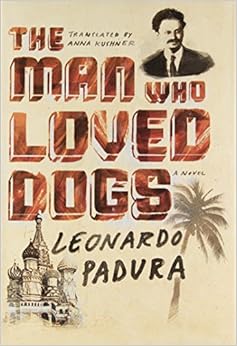
2289. Book Review: Leonardo Padura's "The Man Who Loved Dogs"

By Alan Woods, In Defence of Marxism, January 15, 2014

The publication in English of The Man Who Loved Dogs by the Cuban author, Leonardo Padura is a major literary and political event. I read this remarkable novel when it came out in Spanish and it made a profound impression on me. I had intended to write a review then, but was prevented from doing it by a combination of circumstances. With the greatest pleasure I will now rectify this omission.
Born in Havana, Cuba, in 1955, Leonardo Padura is a novelist of some stature as well as a journalist and critic. He is the author of several novels, two volumes of short stories, and several nonfiction collections. His novels featuring the detective Mario Conde have been translated into many languages and have won literary prizes around the world.
Padura is best known for his detective stories. But The Man Who Loved Dogs is of an entirely different order. In my opinion it can rightly be regarded as a modern classic, a combination of minute historical research with the creativity of a novelist of the highest order.
The intriguing title is the product of a literary device through which the author attempts to link the separate destinies of the three main characters: the Cuban writer Iván, the great Russian revolutionary Leon Trotsky and his assassin, Ramon Mercader. It is the last-named who is the man who loved dogs. Whether or not this close attachment to the canine species ever existed is naturally quite irrelevant to the central theme of the book. In the best tradition of the historical novel, Padura blends historical fact with creative artistic invention.

Crime and punishment
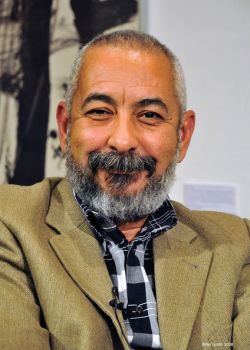
Leonardo Padura  Peter Groth
Leonardo Padura. Photo: Peter Groth.
The story revolves around a fictional character, Iván Cárdenas Maturell, who in his youth was a promising Cuban writer until one day he fell foul of the Stalinist censors who declared one of his stories to be counterrevolutionary. His career is blocked by a layer of bureaucrats, careerists and time-servers, and he is forced to eke out a poverty-stricken existence as a proof-reader at a veterinary magazine. At the start of the novel we meet him at his wife’s funeral, a disillusioned and broken man living in a ramshackle hut with a leaking roof whose only solace is in his pet dog.
While contemplating the death of his wife, he begins to look back on his past life and recalls the moment of an extraordinary coincidence. One afternoon in 1977 while strolling on a beach, he meets a mysterious foreigner walking his two Russian borzoi wolfhounds – a breed practically unknown on the island. The common interest in dogs is the starting point of a conversation in which the man who loved dogs introduces himself as Jaime López, an elderly Spaniard who is living in Havana.
The man eventually turns out to be Ramón Mercader, the Catalan Stalinist and GPU agent who, on Stalin’s personal orders, murdered Leon Trotsky, the man who, together with Lenin led the Bolshevik Revolution in Russia. After completing a twenty year sentence in a Mexican prison, Mercader was finally released in 1960, when he first travelled to Havana. A year later, in 1961, he transferred to Moscow, where his bosses in the Kremlin decorated him as a “Hero of the Soviet Union”.
However, Mercader was not destined to enjoy the fruits of his crime. Even the award had to be done in secret, since only a few years earlier Khrushchev had denounced Stalin as a criminal and a mass-murderer. Sworn to silence to the end of his days, Mercader lived a shadowy existence in Moscow, unable to emigrate abroad and under the watchful eyes of the KGB, until he was finally allowed to go to Havana, suffering from terminal cancer, where he died in1978, in complete obscurity.
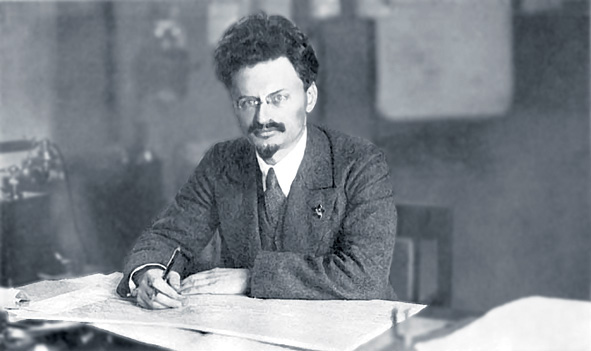
trotsky 1918 deskThese are the known facts. But around these few facts Padura spins a complex yet convincing web that mixes fact with fiction, passing seamlessly from the former to the latter in such a way that the reader soon forgets that he is using his imagination to fill in the missing gaps. At first the owner of the borzoi dogs claims to have been a friend of the man who assassinated Leon Trotsky. Could he himself be the infamous Mercader? All along Iván, and the reader, is kept in doubt.
At no point does the mysterious Jaime López ever admit in so many words that he and Ramón Mercader are one and the same person, but in the process of gradual revelation, an extraordinary story emerges. The doubts are finally resolved when, after the death of the man called Jaime López, a package is delivered to Iván containing Mercader’s life story. Driven by some internal urge, the assassin finds the need to speak from beyond the grave about his past to a complete stranger whose only thing in common is that he loves dogs.
At first glance such a scenario seems most unlikely. But the workings of the human psyche are complex and Padura shows considerable insight into these complexities. It is known that a guilty conscience can drive a criminal to recount his crimes to a police investigator, and that this fact can be used by a skilful interrogator to obtain the desired confession. The fact that Mercader knew he was dying adds weight to this psychological supposition.
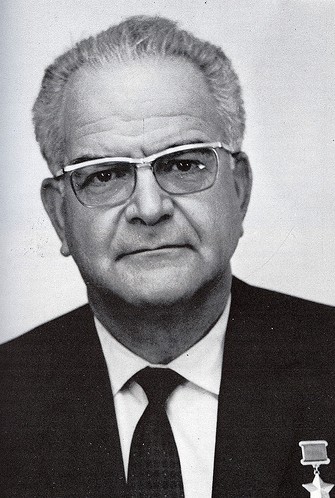
ramon-mercader
Ramón Mercader was decorated with the Hero's Golden Star
Perhaps it was the author’s experience as a crime writer that helped him gain this psychological insight. The great Russian writer Dostoevsky showed the same kind of insight when dealing with the psychology of the murderer Raskolnikov in his most famous novel, Crime and Punishment. Indeed, there are certain parallels between these two works. In the standard works of detective fiction, the identity of the murderer is only revealed at the end. The interest lies precisely in the gradual discovery of the murderer’s identity. But in Dostoevsky’s novel, the identity of the murderer is known from the beginning. The interest here is of a different kind: it lies in the gradual revelation of the psychology of crime and punishment.
Long ago the famous English poet Coleridge spoke of that “willing suspension of disbelief” as a precondition for the enjoyment of poetry, and Padura secures precisely that. It was doubtless the need to atone for his guilt that compels Mercader to describe his vile crime to a complete stranger. He succeeds in convincing the reader that this most unlikely of encounters did in fact take place, that the writer Iván did in fact exist and that the extraordinary events in the novel are fact, not fiction.

A many-layered work

From the point of view of literary technique, Padura shows great skill in linking together the events of Iván's life in Cuba, the early years of Mercader in Spain and France, and Trotsky's exile. Padura very conscientiously traces the life of Trotsky from the October Revolution, through the Civil War, when he led the Red Army to victory against 21 armies of foreign intervention, the struggle of the Left Opposition against the Stalinist bureaucracy, the long years in exile in Turkey, France, Norway and finally Mexico. The life of Trotsky is well documented and Padura’s version follows the facts very closely.
Padura tells the whole story of Trotsky’s battle with Stalin and Stalinism, his exile from the USSR and his eventual assassination. But it is a many-layered work, which knits together a number of related but separate strands. The first is the story of Iván Cárdenas Maturell. Secondly there is the life of Trotsky and that of Mercader, the Spanish Civil War, the sinister workings of Stalin’s GPU, and last but not least, the problem of bureaucracy and the reflections of Stalinism in Cuba itself.
It is also not hard to believe that the fictional character Iván is based on the real experiences that Padura has either had himself or observed in others. He is really the personification of a whole generation of young Cuban intellectuals who gave themselves body and soul to the Revolution, who fought, worked and made sacrifices to ensure its success, but who ended up disappointed and revolted by Stalinism, which twisted the ideals of the Revolution into a bureaucratic caricature.
Here, as in all truly great literature, the particular is firmly linked to the general: the lives of individuals interconnect with the destinies of the Revolution – and counterrevolution. These are not the cardboard characters that are customarily encountered in popular fiction but living, breathing men and women. However, their individual lives are inseparably linked to broad historical processes and cannot be understood outside them.

The problem of Mercader

Bit by bit, step by step, in the best tradition of a detective story, Iván manages to reconstruct the whole story of the murder of Lev Davídovich Trotsky, a reconstruction based on a vast amount of careful historical investigation and very close to the historical facts. The “man who loved dogs” initially appears reluctant to reveal anything about his past, but gradually, piece by piece, the puzzle falls into place. The skilful way in which Padura gradually builds up a picture of Mercader is one of the most impressive elements of the novel.
Through the personalities of Trotsky and his murderer, Ramon Mercader, Padura traces the history of some of the most important events of the 20th century. However, we must remember that we are dealing here not with a work of history but a novel. As we have seen, it is a novel with many different strands and layers. Padura goes to great lengths to reconstruct the life of Ramón Mercader. But here there is a problem.
In an interview in the Argentinean paper Clarin (7 May 2013) Padura said: “It took me five years to write it, with an intense and extensive documentary research. About Trotsky there was abundant information, about Mercader almost nothing.” Nevertheless, combining whatever facts were known, and making use of his “detective” skills and imagination, Padura succeeds brilliantly in putting together a very convincing portrait of the man who murdered Trotsky.
It is common knowledge that an author inevitably develops a certain sympathy for the character he or she depicts. The reason for such empathy is not difficult to understand. In order to portray men and women as real human beings, not merely empty abstractions, it is necessary to gain a deep insight into their hearts and minds, to understand their motivations, their passions, their most cherished beliefs, and to uncover the mainsprings of their actions.
Trotsky often quoted the words of the philosopher Spinoza: “Neither weep nor laugh but understand.” Of course, to understand a person’s actions is not necessarily to condone them. Nevertheless, in approaching the actions of men and women scientifically, with the same objectivity that an anatomist uncovers the different tissues of an organism, it is at least possible to avoid falling into hasty judgments based on petty spite, hatred or malice.
With a clinical detachment, Padura reconstructs the life of Mercader from his disturbed childhood in a bourgeois family in Catalonia. He describes the influence of his unstable mother, Caridad, who swings from anarchism to Stalinism and becomes fanatically devoted to the Party. Ramón joins the Communist Party and fights in the Spanish Civil War, when he is recruited by the GPU, Stalin’s secret police and murder machine, with the active encouragement of his mother.
At one point Caridad strongly hints that the famous anarchist revolutionary Durruti was murdered by the Stalinists, an act she considers completely justified:
“‘Did you believe the story about Buenaventura Durruti being killed by a stray bullet?’
“Ramón looked at his mother and felt that he couldn’t say a word.
“‘Do you think we can win a war with an anarchist commander who’s more prestigious than all of the communist leaders?’
“‘Durruti was fighting for the Republic,’ Ramón tried to reason.
“‘Durruti was an anarchist; he would have been one all his life.’”

Inside the murder machine

Later Ramón witnesses the crimes of the GPU in Spain: the persecution of the anarchists and supporters of the POUM, the kidnapping, torture and murder of the POUM leader Andres Nin. Finally he is sent to Moscow for training as a GPU assassin. The monstrous methods of the GPU are described in horrific detail, the way in which people like Mercader were systematically brutalised and turned into obedient machines, ready to carry out the most vicious and inhuman acts.
While in Moscow he is invited to attend a session of the notorious Purge Trials, “the most grotesque judicial farce of the century,” in which Stalin murdered all the leaders of Lenin’s party, after forcing them to confess to the most grotesque crimes against the Revolution. He also saw that Stalin was physically liquidating foreign communists:
“For example, in February 1937 Stalin told his peon Georgi Dimitrov, the Comintern general secretary, the foreign communists received in Moscow were ‘playing with the enemy’ and immediately tasked Yezhov with solving the problem. One year later, of the 394 members of the executive committee of the International who lived in the USSR, only 170 were still alive, the rest having been executed or sent to death camps. There were Germans, Austrians, Yugoslavs, Italians, Bulgarians, Finns, Balts, British, Frenchmen and Poles among them, while the proportion of sentenced Jews was once again noteworthy. In that witch hunt Stalin eliminated more leaders of the German Communist Party from before 1933 than Hitler himself had.”
Despite everything, Ramón remains blindly loyal to Stalin and his regime, which he identifies with the need to defend the Soviet Union. Like many others, he closed his eyes to all the crimes and barbarities, finding a thousand reasons, excuses and explanations. Overcoming all his human instincts he becomes a hired killer and accepts without question the mission entrusted to him by the Boss in the Kremlin – the liquidation of the “counterrevolutionary” Trotsky.

The assassination

At the heart of the book is a truthful historical account of the assassination of Leon Trotsky. In 1937 Stalin decided that his main opponent would have to be liquidated. The Moscow Trails were intended to establish a political and legal basis for this crime. The house in Coyoacan was surrounded by 20-foot garden walls and watchtowers with slits in them for machine-guns. But all this was no defence against Stalin’s murder machine.
Leon Trotsky’s grandson, my old friend Esteban Volkov still lives in Coyoacan. I met him not long ago in the house in Mexico City where his grandfather was murdered and asked him what he thought of Padura’s novel. “Of course, the events described in his book are very well known to me,” he replied. “I have read the book but rather quickly, and my impression was favourable. But I will have to read it again more in depth.”
The first attack occurred on 24 May 1940, when a group of 20 armed Stalinists, led by the artist David Siqueiros, stormed the house at night; the door having been left open by the young American Bob Sheldon, an agent who had been infiltrated into the guards. They threw grenades and sprayed the bedrooms with machine-gun bullets. By a miracle Trotsky and his wife Natalia survived by huddling under their bed. Their 14 year old grandson Esteban was slightly wounded in the foot by a stray bullet.
The only victim of that attack was Bob Sheldon who disappeared together with the assailants. His body was found later. Trotsky believed that he had been kidnapped, but in fact he had been part of the plan and was probably killed as a scapegoat for the failure. After the attack the guards began to strengthen the perimeter walls. But Trotsky was sceptical. “The next time it will be different”, he predicted. He was soon to be proved right.
The GPU had another team at work in Mexico, completely separate from the one that staged the bungled assault in May. Just as Trotsky had warned, they were working with entirely different methods. Their key man was Ramón Mercader who very skilfully infiltrated Trotsky’s Mexico circle, posing as a non-political businessman called Jacson.
Jacson-Mercader worked slowly and patiently to cultivate friendly relations with the guards and Trotsky’s closest friends. Esteban remembers that he was always performing little favours and offering to drive people around in his flashy car. “He even drove the Rosmers to Veracruz one time”. By such means he gradually wormed his way into the confidence of those surrounding Trotsky, while carefully refraining from seeking to approach his intended victim personally.
The book presents us with a very convincing reconstruction of Mercader’s relations with Sylvia Ageloff, the woman he seduced and who introduced him to the Trotsky household. Padura seems to penetrate the mind of the assassin and lay bare his psychological state in the days and weeks leading up to the murder, his intense inner agitation and violent mood swings. But gradually, imperceptibly, like a tiger silently stalking his prey, he moved ever closer to his target.
Pretending to develop an interest in Trotsky’s ideas, he unexpectedly produced an article on the War, which he asked Trotsky to read and correct. Already by this time Trotsky’s suspicions of this man were aroused. Yet astonishingly those who were supposed to be defending him displayed a complete lack of awareness of the danger. So careless were they of their duty that when Jacson appeared wearing a raincoat on a hot Mexican summer day, they did not even bother to “frisk” him. Had they taken this elementary precaution they would have discovered a knife, a pistol and an ice-axe and the plot would have been foiled.
So it was that on 20 August, Stalin’s agent was left alone in the company of his victim. Placing himself carefully behind Trotsky as he bent over the text of the article, he struck at the head of the revolutionary with all his strength. The blow was intended to have resulted in instant death, but, uttering a scream that raised the alarm, he fought, in a last supreme effort of the will, to fend off his assailant before collapsing.
His bodyguards hurried in – too late. The leader of the October Revolution and founder of the Red Army lay mortally wounded, blood streaming from his head. Too late the guards realised their mistake, their stupid carelessness and incredible negligence. Too late they tried to get some relief by battering the assassin. Even at this time the Old Man showed remarkable presence of mind when he called to the guards: “Do not kill him. He must talk!”
Returning from school that afternoon, Esteban witnessed a shocking scene. “I saw a man, his face covered in blood, crying like a baby, incoherent and beside himself. I did not recognise Jacson at first. He was more like an animal than a human being,” he told me. When the Old Man caught sight of his grandson, he ordered the guards to take him outside: “He must not see this,” he said. Trotsky was rushed to hospital, where the Mexican doctors struggled to save his life. He died the following day.

The revenge of history

Over twenty years later, Mercader meets with one of his fellow GPU agents, Leonid Eitingon, who, under the code name Kotov, was his immediate superior in the plot to assassinate Trotsky. But the wheel of history has now turned full circle. The clique in the Kremlin has been compelled, for its own self-preservation, to ditch Stalin and disassociate itself from his crimes.
The men who did the dirty work for Stalin now find themselves despised outcasts. The chief architect of Trotsky’s murder, Pavel Sudoplatov, spends fifteen years in a labour camp (though not for killing Trotsky). Eitingon was also sent to a camp. Old and embittered, he consoles himself by soaking himself in vodka as he commiserates with Mercader in a bar in Moscow.
That was in 1968, the year in which Brezhnev sent Russian tanks to crush the dissident Czech Party under Dubcek. Padura’s graphic description of Moscow at that time corresponds very closely with my own memories. Having dedicated their lives to a regime that betrayed every principle of socialism – a betrayal infinitely worse and more damaging than that perpetrated by the leaders of the Social Democracy in the summer of 1914, they now have only bitter memories.
Eitingon informs Mercader that they never expected him to survive the murder of Trotsky:
“You have to believe what I tell you: we were more cynical than you can imagine. You were not the only one who was going to die for an ideal that didn’t exist. Stalin perverted everything and forced people to fight for him’ for his needs, his hate, his megalomania. Forget that we were fighting for socialism. What socialism? What equality? They tell me that Brezhnev has a collection of antique cars.”
These lines suggest that the degeneration of the Russian Revolution was all the work of one evil man. Such an explanation explains nothing, of course. Padura has read Trotsky’s The Revolution Betrayed and is well aware that Stalin was only the representative of a privileged caste of officials, the bureaucracy that rose to power as the result of the isolation of the Revolution under conditions of extreme backwardness.
The death of Stalin did not signify the end of the rule of the bureaucracy, only a shift from one layer of the bureaucracy to another. Eitingon (or rather Padura) draws this conclusion: “I was convinced that without Stalin and his hate, the party would be just and the struggle would again regain its meaning... But forget it. I was wrong again. Everything was rotten. How long had it been rotten?” And Mercader asks him: “So what does a man like you do when he no longer believes in anything?”
This question goes right to the heart of the matter, and has a direct bearing on what is undoubtedly the weakest part of the book. In the last few pages entitled Requiem, the author muses briefly on what lessons can be drawn from all this. Being a novel and not a work of scientific political analysis, it would be asking too much to demand a Marxist perspective. Nor is it clear who is speaking here: Padura or one of his characters.
However, in the end the implication is that it was all utopian, an impossible dream, which Trotsky “with his obstinate fanaticism” pursued to the end. Such an ambiguous, and one might say, cowardly conclusion is unworthy of a great book. If socialism is utopia, the outlook for humanity would be grim indeed! One can only respond with the same question: “So what does a man do when he no longer believes in anything?”
The Russian Revolution of 1917 was not a utopia but the greatest single event in human history, and together with Lenin, Trotsky was the most important leader of the October Revolution. He alone maintained the spotless banner of proletarian democracy and socialist internationalism after the death of Lenin. From faraway exile in Mexico he carried on an implacable struggle against the bureaucratic and totalitarian Stalinist regime.  Finally, inevitably, he fell victim to one of Stalin’s assassins.
On 20 August 1940 Stalin imagines he had silenced Trotsky’s voice forever. It is so easy to destroy a man or woman. We are frail creatures and our lives can be ended by a bullet, a knife or an ice-pick as easily as snuffing out a candle. But one cannot extinguish an idea whose time has come. Today, 74 years after that fateful day, the ideas of Marxism are as relevant as ever, and the voice of Leon Trotsky rings out all over the world, while the memory of Stalin and his henchmen is spattered with blood and infamy.

The Revolution Betrayed

Slowly a new generation is taking shape that is struggling to find the truth. Nowhere is that truer than in Cuba, where so many great sacrifices were made in the cause of socialist revolution, and where so much harm was done by the influence of Stalinism. Padura’s book will without doubt help many people to understand the past and therefore prepare them to face the future. It is like a voyage of discovery where a bold intellect has managed to lift the thick veil that for so long obscured the views of so many people, and began to understand the truth.
In the Clarin interview Padura was asked why he chose to tell this story. He replied that while that there may be an element of nostalgia, he was also attempting to discover the real causes of the degeneration of the Russian Revolution. In studying the assassination of Trotsky, he began to understand the nature of Stalinism and its counterrevolutionary role: “Suddenly I understood some of the reasons why the utopia became perverted. The role of Stalinism, the inheritance of his figure, was a terrible thing,” he says.
The novel deals in outline with the struggle that ended in the rise to power of Stalin in Russia. But more than that, the author uses these events as a means of analysing the relationship between Cuba and Stalinism. The clear implication is that in Cuba there were many little Stalins – time-serving bureaucrats, selfish careerists and corrupt officials. By analysing in detail the personal experience of a handful of characters, Padura gradually unfolds before the reader a chain of epoch-making events: the Russian Revolution and the Civil War, during which Trotsky stood at the head of the Red Army that he created; the Spanish Civil War; and, last but not least, the fate of the Cuban Revolution itself.
In the 1970s, that black period in which Stalinism reigned and the burning revolutionary convictions of a generation of young Cubans were manipulated by the Stalinist bureaucracy for its own ends. This is graphically expressed in the book itself and the destiny of its central character. The fall of the Soviet Union plunged Cuba into a deep crisis, not just in the economic plane but in a political and psychological sense.
During the harsh and hungry years of what Cubans call “the Special Period”, “the years of the endless blackouts and the breakfasts composed of orange-leaf teas”, many people began to look more critically at life on the island. That clearly was the case of Leonardo Padura. Although Iván is a fictional character, through him Padura is clearly expressing his own personal experience and that of many other Cubans. This comes across strongly in the book:
“But it was clear that we had fallen to the bottom of an atrophied social scale where intelligence, decency, knowledge and capacity for work gave way before craftiness, proximity to the dollar, political placement, being the son, nephew or cousin of Someone, the art of making do, inventing, increasing, escaping, pretending, stealing everything that could be stolen. And cynicism, bastard cynicism.”
Forced to give up his career as a promising writer by the Stalinist censors, Iván has been obliged to earn a living as an editor of a veterinary magazine. He is thus a victim of a bureaucratic totalitarian system that is the negation of art and literature. In the end Iván commits suicide, shortly after finishing a novel entitled The Man Who Loved Dogs.
In an interview that Padura gave to our Danish comrades he says: “Ivan is not a man; Ivan is the synthesis of a generation, in which I put many of the illusions, disillusions, defeats and fears of my generation. It is a man that represents all the problems we have lived through in Cuba in my generation, that generation that grew up in the revolution, studied in the revolution, went to war in the revolution and that in the ‘90s found they had nothing in their hands.”
The fact that that Iván finally commits suicide seems to imply that an entire generation has lost all hope. Yet this pessimistic conclusion is contradicted by the content of the whole novel, and also by the words of Padura himself in the aforementioned interview:
“I believe the new utopia needs to rediscover the basis of the system with the real components that this kind of society needs: real democracy, real power to the people that work, not for the bureaucracy as was the case in the Soviet Union and in many socialist countries. For this reason I think that this book certainly is relevant to the moment we are living through.”
Although the worst features of Stalinist repression which existed in the 1970s have been eliminated and Cuba no longer suffers from the suffocating rule of the censorship, there are still some people in Cuba who hanker after a return to the past: to the, to a time when bureaucrats could dictate to the conscience of writers and tell them what to think, say and write. In fact, The man who loved dogs initially had to be published in Mexico and Spain, and was finally published in Cuba in a small edition of a few thousand because of the opposition of those who want to put the clock back.
In the Danish interview Padura explains how the book won a prize despite being subjected to a conspiracy of silence:
“Curiously on the day of the launch at the book fair no news appeared in the media about the presentation. Also afterwards the papers kept quiet even though the launch of the book was the most exciting meeting in the book fair, and the room was completely full with people outside trying to get in. A week ago the book won the national critics prize in Cuba, this highlights Cuba's contradictions: twenty years ago maybe I wouldn’t even have been able to think about writing this book; ten years ago I could write it but it wouldn’t have been published in Cuba; now it can be published and even though it is silenced in the media it can win prizes.”
The publication of Padura’s novel strikes a blow against Stalinism. It is a victory not just for artistic freedom but for the right of workers and artists to express themselves freely, which is the first condition for genuine socialism. However, today the Cuban Revolution faces a far more dangerous enemy than that posed by nostalgic Stalinists. The existence of the Revolution itself is being threatened by those who wish to push Cuba down the same capitalist road that has already been travelled by Russia and China. The pressures on the island are excruciating and are growing all the time.
But there are also internal dangers that are even greater than the external threats. The problems that arise from bureaucracy, inequality and corruption can undermine the very idea of socialism in the minds of the youth, breeding corrosive moods of scepticism and cynicism. In order to regenerate the Revolution, to revive the people’s faith in socialism, the first necessity is to re-examine the past, to rediscover the genuine ideas and programme of Lenin and the October Revolution. That cannot be done as long as the role and ideas of Trotsky are ignored.
In his book Padura has Mercader reading The Revolution Betrayed in prison. This, no doubt, is another example of the author’s creative imagination. But there can equally be no doubt that he has himself read Trotsky’s writings and is encouraging Cubans to do likewise. The Man Who Loved Dogs has played a most important role in introducing many people in Cuba to the ideas of Trotsky. My experience in recent years has proved to me that there is a growing interest in these ideas on the island. This was shown when we launched the Spanish language edition of The Revolution Betrayed in the Havana Book Fair.
The publication of this work has raised the profile and prestige of Padura as a writer of stature, not just in Cuba but internationally. It is well deserved. It is both a brilliantly executed novel and a most impressive work of historical investigation. It should be obligatory reading for all those who are interested in socialism and historical truth. I should add that the English translation is outstanding.
The Man Who Loved Dogs by Leonardo Padura, translated from the Spanish by Anna Kushner. Published by  Farrar, Straus and Giroux in the USA and by Bitter Lemon Press in Briatain.